Login
Login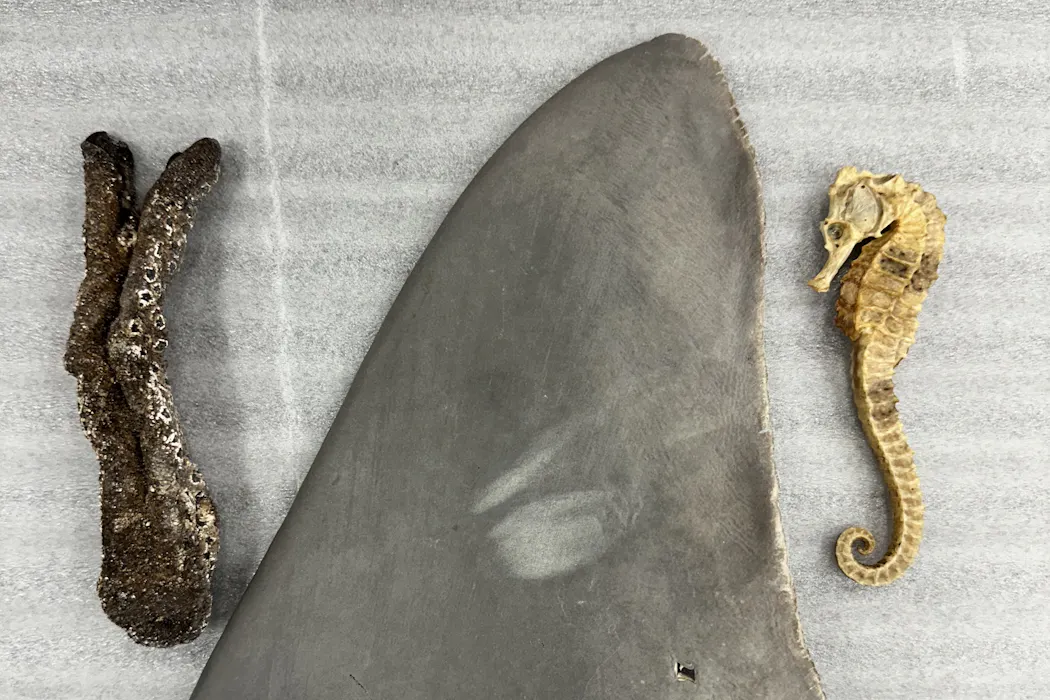


Seahorses and shark fins are illegally trafficked. An AI tool could help stop this crime

Shark fins on a plane, seahorses in your bag and sea cucumbers in the post – these are just a few examples of illegal marine wildlife trafficking.
This crime can be hard to detect. But in a new study, published in the journal Frontiers in Ocean Sustainability, we show how artificial intelligence (AI) can be harnessed as a complimentary detection tool to help stop marine wildlife trafficking at international airports and mail facilities.
A global crime
The cross-border trade in live animals, animal parts or products is a global crime, facilitating the flow of billions of illicit dollars each year. It’s known to converge with other criminal activity, including the trafficking in drugs, arms and humans.
The United Nations Office on Drugs and Crime identifies five sources of demand for wildlife trafficking: food, medicine, pets and ornamental plants, specialist collection and adornment.
In some cases, such as pet prestige, people are motivated both by the desire to have a pet and the perceived status it brings to own an exotic animal.
People traffic marine animals too
Wildlife trafficking affects around 4,000 species. Many of the more well-known examples involve land-based animals – ivory from elephant tusks, horns from rhinos and scales from pangolins – the world’s most trafficked mammal.
Closer to home, we also see native Australian reptiles and birds, sometimes shoved in tins, put in socks and packaged up live to be sent overseas.
Marine creatures, unfortunately, are targeted too. This can include live animals such as fish in people’s bags, or dried marine life such as the rise of the seahorse trade and demand for shark fin.
We have small pockets of knowledge of this activity. But the reality is we don’t fully understand how widespread it is.
AI to detect marine wildlife trade
Currently, the best means of detecting illegally trafficked wildlife is humans. And then there are our four-legged friends: biosecurity dogs.
Recently, Australia has also been working to develop the use of AI as a potential means of detecting land-based wildlife in illegal wildlife movements – building on existing detection pathways using 3D X-ray machines fitted with algorithms.
For our latest study, we built on these efforts by developing world-first marine wildlife algorithms. We taught computers to look for shark fins, seahorses and sea cucumbers.

We did this by collecting a total of 68 samples of dead marine animals, which we scanned in a 3D X-ray machine to create a library of images. We then used this image library to develop algorithms to enable computers to search for what we taught it to look for – in this case, shark fins, seahorses and sea cucumbers.
Samples were scanned alone and then in more complicated scenarios to reflect how people actually traffic marine life. This means if a bag or mail item is hiding a shark fin, seahorse or sea cucumber, the algorithm will be able to flag this to an operator, prompting them to inspect the item.
Out of a total of 298 scans and a training data set derived from these samples, our algorithm had success rates of 95%, 95% and 85% for shark fins, seahorses and sea cucumbers, respectively.
Humans and biosecurity dogs still needed alongside AI
While technology fitted with computer algorithms may help people inspecting luggage or mail, we still need people to verify what computers see. Sometimes the algorithms get it wrong and may miss items.
Despite this, the broader implications of having AI as a second set of eyes searching for trafficked marine life will aid in identifying key trade routes to potentially stop this activity. The next step is relying on implementation of these algorithms at the front lines.
Like computer algorithms and AI, the more we learn, the better we get at detecting and potentially stopping this harmful crime.
Vanessa Pirotta received funding from Rapiscan Systems for this research.
Justine O'Brien receives funding from the San Diego Zoo and Wildlife Alliance; NSW Department of Climate Change, Energy, the Environment and Water; the Australian Research Council; Institute of Museum and Library Services; Great Barrier Reef Foundation; and the Taronga Foundation.
Phoebe Meagher receives funding from San Diego Zoo and Wildlife Alliance and the Taronga Foundation.
Zara Bending serves as a Resident Expert for the Jane Goodall Institute Global and is a Distinguished Research Fellow at the Macquarie University Environmental Law Research Centre.