Normal view

The White House UFC event is a perfect storm of fight culture and US politics

The United States government is preparing a suite of events to celebrate “the most important milestone” in the country’s history: the 250th anniversary of the Declaration of Independence on July 4.

One of the festivities planned is set to take place on June 14 (which is president Donald Trump’s 80th birthday) on the South Lawn of the White House: “UFC Freedom 250” – a mixed-martial arts (MMA) competition organised by the Ultimate Fighting Championship (UFC).

It will be the first professional sporting event held at the White House.

So why is this happening and what does it say about the state of US politics?

Why is the White House hosting the UFC?

Trump has been a long-time supporter of the UFC and its CEO, Dana White.

He provided venues for the UFC in the early 2000s when MMA was struggling to go mainstream.

Trump even has a walkout song – Kid Rock’s “American Bad Ass” – played whenever he enters the UFC arena as a spectator.

In turn, White joined Trump on his presidential campaigns. In 2024, he also connected Trump with influencers and podcasters such as Joe Rogan, who cover MMA and other topics of interest to their audiences (mostly young men).

This increased Trump’s popularity among young male voters, contributing to his 2024 win.

However, more than one year into Trump’s second term, this popularity has deteriorated. Rogan and other podcasters have been critical of the president for starting the war with Iran.

Rogan, who will be commentating the June 14 event, has expressed concerns for the safety of the gathering and called it a “gimmick”.

However, Trump said the event is a “good gimmick” and “great for America”.

More than 4,000 people are expected to gather on the White House’s South Lawn to watch 14 professional male fighters punch, kick, and grapple each other, with the president’s official residence in the background.

Tickets cannot be purchased by the general public. Instead, Trump and the UFC leadership will distribute 1,400 invitations to attendees of their choosing, with the rest allocated to US military officers.

However, there are reports of invited celebrities snubbing the event and some tickets being sold as a part of US$1.5 million (A$2.14m) packages bundled with other UFC events.

Politics and sports converging

Trump closely associates himself with many sports, including American football, tennis, golf and MMA. This is part of his hypermasculine, populist image intended to attract his core supporters.

The ideological underpinnings of Trump’s “jock” image come out clearly in his sports-related policies, such as the controversial ban on transgender athletes in women’s sports.

This aligns well with many aspects of the UFC – whose CEO is comfortable with his association with the “manosphere”.

The UFC event at the White House reflects Trump leaning further into the polarising nature of his presidency.

It’s already obvious the event is not without politics: Sean Strickland, America’s only current men’s UFC champion, has alleged he has been prohibited from attending because of his stance on Israel’s war on Palestine.

Trump’s political opponents have also criticised UFC Freedom 250 for its costs, the impact on the White House as a culturally significant site and because it will distract from the Declaration of Independence anniversary.

This culminated in a lawsuit filed to stop the event due to alleged corrupt use of public land for private gain.

Even some fighters are against the event including the US’ Bryce Mitchell. He said:

It’s really outside of what the goal of the government was intended to be […] the government is supposed to protect us, not entertain us.

What about women?

With so much debate in the public domain about masculinity, fight sports and politics, the lack of women fighters at UFC Freedom 250 highlights the sport’s tumultuous relationship with women athletes.

Back in 2011, White infamously touted he would never sign a woman to a UFC contract.

But since then, several women athletes have become huge stars in the sport, including UFC Hall of Famers Ronda Rousey, Joanna Jędrzejczyk and Amanda Nunes.

Yet women are absent from the UFC 250 roster. When asked why, White failed to offer anything more than: “we did try to make a women’s fight. We couldn’t get it done.”

Even though women are missing from the UFC 250 roster, this does not negate the growing success of women fighters even within the UFC and the potential of fight sports to provide sources of strength, empowerment and belonging for all genders.

A costly, controversial spectacle

The UFC 250 event is groundbreaking in many ways and will entertain many fight fans across the world.

At a reported cost of more than US$60 million (A$86m), it will certainly be one expensive display of American pride and flamboyance.

There’s also no doubt the event has become a political spectacle and one which reflects the combative and hypermasculine image Trump presents to the world.

The Conversation

Adele Pavlidis receives funding from the Australian Research Council

Erin Nichols and Kateryna Kasianenko do not work for, consult, own shares in or receive funding from any company or organisation that would benefit from this article, and have disclosed no relevant affiliations beyond their academic appointment.
Where did language come from? Nobody really knows, but the theories are fascinating

Sriharu Kapu/Unsplash

Humans are the only species known to use fully symbolic language: a system capable of expressing abstract ideas, imaginary worlds and endless combinations of meaning. But how did we get there?

The origins of language have fascinated philosophers, scientists and storytellers for thousands of years. Despite all our advances in linguistics, archaeology and cognitive science, we still don’t know exactly how language began.

That uncertainty hasn’t stopped people from trying to solve the mystery. In fact, some of the earliest theories of language’s origins are among the strangest and most entertaining ideas in the history of science.

Bow wow, ding-dong

In the 19th century, scholars proposed a flurry of curious theories to explain how speech first emerged. Many of these theories were given playful nicknames by the German philologist Max Müller, who intended them partly as satire. Yet the theories were genuine attempts to tackle one of humanity’s biggest questions.

German philologist Max Müller gave playful nicknames to competing theories of language’s origins. Public domain, via Wikimedia Commons

The most famous is probably the Bow-Wow Theory. This suggested language began through imitation of natural sounds. Early humans, according to this theory, copied the noises around them: animal cries, splashing water, thunderclaps and birdsong. Words such as “buzz”, “hiss”, “bang” and “splash” seem to support the idea because they sound like what they describe.

But there is a problem. Different languages hear the same sounds differently. English dogs go “woof” or “bow-wow”, but in Turkish they go “hev-hev”, while Indonesian dogs go “guk-guk”. Even animal noises, it turns out, are filtered through culture and language.

And onomatopoeic words (words that imitate sounds) make up only a tiny fraction of our vocabularies. Most words sound nothing like their meanings. For instance, there is nothing inherently tree-like about the word “tree”.

That brings us to the Ding-Dong Theory, which argued that sounds and meanings are naturally connected in some deeper, almost mystical way.

Some words do seem to fit their meanings uncannily well. “Mini”, “teeny” and “itsy-bitsy” feel small and delicate. “Lump”, “rump” and “plump” sound heavier and rounder.

Modern linguists call this sound symbolism. One famous experiment asked participants to match two nonsense words, “bouba” and “kiki”, to two shapes: one rounded and one jagged. Most people matched “bouba” with the soft shape and “kiki” with the sharp one.

The effect is real, but it is limited. Most language still appears to be arbitrary, which means there is no natural reason why a particular sound should mean a particular thing.

Pooh-pooh, la-la, ye-he-ho

Other theories focused less on imitation and more on emotion and social interaction.

The Pooh-Pooh Theory proposed that speech began with instinctive emotional cries such as “ouch”, “oh” or perhaps less publishable exclamations uttered after stubbing a toe. According to this idea, language evolved from spontaneous vocal reactions to pain, surprise, fear or joy.

Again, though, there are complications. Interjections vary widely across languages. English speakers say “ouch”. Greeks say “aou”. Czechs might exclaim “ach”. Emotional sounds are not nearly as universal as they seem.

Then there is the wonderfully named Yo-He-Ho Theory, which suggested language emerged from rhythmic chants used during collective labour, like sailors chanting “yo-heave-ho” while hauling ropes, or workers singing together to coordinate physical effort.

The theory may sound quaint, but modern researchers do think rhythm, cooperation and social bonding played important roles in human evolution. Language is, after all, deeply social.

Charles Darwin speculated that speech evolved from musical expression. Herbert Rose Barraud, Public domain, via Wikimedia Commons

Another proposal, the La-La Theory, linked language to music. Charles Darwin entertained the possibility that speech evolved from musical calls used in courtship and emotional expression. Before humans spoke, perhaps we sang?

Some modern theories echo this idea. One hypothesis suggests that, as early humans began walking upright, parents increasingly needed to soothe babies from a distance. Sing-song vocalisations, cooing and proto “baby talk” may have helped strengthen emotional bonds and eventually paved the way for speech.

Gestures, symbols and brains

Today, most scientists think no single theory fully explains language origins. Instead, language probably emerged gradually through a combination of gestures, vocalisations, facial expressions, social cooperation and increasing cognitive complexity.

Some researchers argue that language began with gestures before shifting to speech. Others believe language evolved as a tool for social bonding, allowing larger groups of humans to cooperate and share information. Still others see language as tied to the evolution of symbolic thought itself: our ability to imagine, plan, remember and communicate abstract ideas.

Biology is also a factor. Humans have developed unusually precise control over the tongue, lips and vocal tract. We have evolved specialised brain regions linked to language processing.

But anatomy alone cannot explain language. Parrots can mimic speech sounds. Many animals communicate. None, however, appear to possess grammar and symbolism on the human scale. And, frustratingly, early language leaves no evidence behind. Spoken words don’t fossilise.

That lack of evidence is one reason the topic became so controversial that, in 1866, the Société de Linguistique de Paris banned discussions about language origins altogether, dismissing the field as hopelessly speculative.

Saraswati, Hindu goddess of knowledge and speech – Raja Ravi Varma (1894) Public domain, via Wikimedia Commons

Of course, theories about language origins also appear in religion and mythology. In Greek mythology, the messenger god Hermes was associated with language and communication. In the Hindu tradition, the goddess of knowledge and speech Saraswati bestowed Sanskrit upon humanity. In the Judeo-Christian tradition, language was a gift from God, who enabled Adam to name the animals in the Garden of Eden.

These stories reflect something deeply human: our urge to explain where language came from, because language itself feels almost magical. Every theory of language origins captures a small piece of the puzzle. Imitation, emotion, rhythm, music, gesture, cooperation and symbolic thought probably all played some role.

But none can provide a complete answer. The truth is that language evolved so long ago, and likely so gradually, that we will never pinpoint a single moment when it began, unless someone invents a time machine.

The birth of language will probably remain one of humanity’s greatest unsolved mysteries. Still, the theories themselves tell us something important. Humans are always trying to explain what makes us human. And language may be the most human thing of all.

The Conversation

Karen Stollznow does not work for, consult, own shares in or receive funding from any company or organisation that would benefit from this article, and has disclosed no relevant affiliations beyond their academic appointment.

Instead of a soft power coup, the World Cup could be an ‘own goal’ for Donald Trump

For football fans, the FIFA World Cup is so much more than sport. Every four years, it presents a unifying moment – bringing people together across the divides of language, culture and geography in a shared passion for the game.

For hosting nations, the World Cup is often a soft power supercharger. Watched by billions of people around the globe, it is a prime opportunity to showcase one’s country, culture and values.

This is all part of what’s known as sport diplomacy, or in this case “football diplomacy”. Beyond the trophies, governments invest in football to “win” off the pitch, too, in terms of fostering better relations, courting investment and earning global prestige.

There’s no question the United States could use a boost like this at the moment after 18 months of Donald Trump’s polarising leadership.

But, there’s a crucial difference between soft power and spectacle. Early signs suggest the 2026 World Cup will offer more of the latter for Trump’s America – an event that highlights power (not the soft kind), tribute, exclusion and vested interests.


Read more: For Iran’s diaspora, a tough World Cup call: To support the national team or protest – or both?


The soft power of sport

The term “soft power” was coined in the 1990s by Harvard political scientist Joseph Nye Jr. It means a country’s power isn’t just derived from military force or economic weight (otherwise known as “hard power”), but also in its ability to influence through attraction.

Think South Korea’s K-pop phenomenon, the United Kingdom’s prestigious universities and the Nordic countries’ embrace of sustainability, good governance and progressive values.

In essence, this is the intangible power nations have to get others to sit at your table and consider, perhaps even support, your view of the world.

The concept has since evolved significantly since Nye developed it, and received heavy criticism. Critics are quick to point to its subversive potential, particularly when deployed by authoritarian states with less benign motives.

Political scientists Christopher Walker and Jessica Ludwig have introduced another term, “sharp power”, to describe how states, like Russia and China use their influence not to attract others, but to manipulate them.

Revisiting the topic more recently, Nye himself acknowledged that soft power has become more complicated. He recognises it can be gamed, misread or turned inward in ways that undermine the very openness it depends on.

The distinction is an important one today, reflecting a broader shift in how nations now use culture and spectacle as instruments of self-interest and dominance over others in a zero-sum world.

Trump, Infantino and the 2026 World Cup

Enter Trump and the 2026 World Cup.

With an expanded format of 48 teams playing a record 104 matches in 16 cities across three countries, FIFA President Gianni Infantino has labelled this year’s tournament as the “greatest event that mankind has ever seen”.

Yet, as the tournament begins, it’s already been an opportunity lost from a sports diplomacy and soft power perspective.

For starters, the event should be a celebration of North American partnership among the three hosts, the US, Mexico and Canada. But tensions have been high since the Trump administration imposed 25% tariffs on goods from both Canada and Mexico.

Rather than seek to deescalate in the spirit of unity, Trump instead needled his counterparts in Mexico and Canada, saying the tariffs would make the World Cup “more exciting”, claiming “tension’s a good thing”.

Canadian Prime Minister Mark Carney’s statement on the opening of the World Cup makes only perfunctory reference to the United States.

Mexican President Claudia Sheinbaum, meanwhile, did not attend the opening match in Mexico City in solidarity with regular Mexicans who cannot afford the exorbitant ticket prices (set by FIFA).

The vision of football uniting the world – FIFA’s own stated mantra – has given way to a tournament defined by who gets to participate and who doesn’t.

Professor Jules Boykoff, the author of Red Card: The 2026 World Cup, Sportswashing and the FIFA Greed Machine, describes it as a “massive paradox”:

On one hand, it has more teams than ever participating. On the other hand, because of the policies of the Trump administration, it looks more like a World Cup of exclusion than inclusion.

This goes beyond the soaring ticket prices. Many supporters of nations that qualified from Africa and the Middle East had their visas rejected with no explanation. Visas were rejected for some of the Iranian team’s support staff, too.

And Somali referee Omar Artan was refused entry in Miami, dashing his dreams of being the first Somali official at a World Cup.

To make matters worse, the concerns over the exclusive nature of the tournament so far have been met with shrugs by Infantino, head of FIFA.

When asked about Artan’s situation, Infantino said it was “unfortunate” he was denied entry, but added, “sometimes it’s good to just to chill, relax”.

Infantino also had little to say about US treatment of the Iranian team, which was abruptly moved from its training base in the US across the border to Mexico and saw the tickets for its fans revoked by FIFA at the last minute.

Infantino’s response? He said he would drive the team on a bus himself from Iran to ensure they could play. Just not the team’s fans, apparently.

A stage for self-glorification

Soft power, at its best, works through genuine openness, two-way dialogue and collaboration – building understanding, trust and respect along the way.

During Australia’s hosting of the 2023 Women’s World Cup, for example, Foreign Minister Penny Wong was able to bring global leaders together to take a stand on gender equality and draw attention to the plight of women living under the oppressive Taliban regime in Afghanistan.

But the 2026 Men’s World Cup appears to be offering something else. The stage is set for self-glorification, managed by a political leader who frames division and tension as a basis for entertainment and a governing body too invested in commercial gain to be concerned about the social divisions it is creating.

This is not soft power. But there’s bound to be plenty of spectacle.

The Conversation

Caitlin Byrne has previously advised the Department of Foreign Affairs and Trade on the development of the 2030 Sports Diplomacy Strategy and sat as a member of the Australian government's Ministerial Council on Sports Diplomacy.

Pauline Hanson attracting women voters? It’s part of a global far-right trend

Pauline Hanson and her party One Nation have been dominating headlines after their recent electoral successes in South Australia and Farrer. A new national opinion poll has One Nation’s primary vote at 31% – up from 7% just two years ago.

Not only are growing numbers of Australian voters openly expressing their support for One Nation, but the party, and its leader, are doing particularly well among Australian women.

According to an April study by RedBridge and Accent Research, Pauline Hanson is now the most popular party leader among women voters – ahead of the prime minister. And One Nation is their leading first-preference party.

That this is happening to a far-right party might raise some eyebrows. Far-right parties have traditionally been considered “men’s parties”: first, because men tend to be predominant among their voters, grassroots and elected politicians; and second, because their image and political agendas are seen as very masculine.

Yet, in Australia, where women rarely lead parties of any kind, Pauline Hanson has led hers for decades, and One Nation is mobilising women voters. This might look like an anomaly, but it isn’t.

Women leading ‘men’s parties’

In fact, Hanson is part of a small but substantial group of women who have led or currently lead far-right parties, including Marine Le Pen in France, Giorgia Meloni in Italy and Frauke Petry and Alice Weidel in Germany.

What is particularly striking is that these women are at odds with the traditional gender roles and family values their parties promote – be that due to divorces (Hanson, Le Pen, Petry), having had a child when unmarried (Meloni), or being lesbian (Weidel).

So, how did they become leaders?

It helped that most of them did not have to climb a party hierarchy dominated by men. Hanson and Meloni founded their own parties. In the case of Le Pen, the National Front (now National Rally) was founded by her father, Jean-Marie Le Pen, whom she kicked out in 2015 to cleanse the party of its most toxic elements (read: antisemitic, monarchist, militarist).

As for Petry and Weidel, a mixed-gender dual leadership model is the norm across most German parties.

One might therefore think these women represent exceptions in the far-right party landscape. But women’s increasing participation in the far right is not only about party leadership, but voters and grassroots membership.

One Nation and women

Far-right parties are attracting more women voters than ever. Although their electorates in Europe remain those most dominated by men, the proportion of women voting for them, relative to men, has increased.

In Australia, poll data by RedBridge/Accent Research collected in April shows 28% of women voters have One Nation as their first choice for the House of Representatives, up from 9% in June 2025.

By contrast, the proportion of women with Coalition parties as their first preference fell from 30% to 22% in the same timeframe.


Read more: The Making of One Nation: podcast out now


To be clear, the rise in popularity of One Nation (and the decline of the Coalition) is not driven just by women. Men display very similar trends.

And there are few gender differences in terms of the reasons why people say they are planning to vote for One Nation. For both women and men, supporting One Nation is a way to express dissatisfaction with the major parties and their handling of the cost-of-living crisis.

Yet, as my recently published book finds, we can also see this playing out in other countries.

A global trend

My book is the first study on women’s involvement at the grassroots of far-right parties. I interviewed more than 100 members and officials from the Bharatiya Janata Party in India, the League in Italy, and the Sweden Democrats. I also collected survey responses from thousands of League and Sweden Democrats members.

In my surveys, women make up between one-quarter and one-third of party members. This sits somewhere in between other far-right parties, such as Reform UK (39%) and Chega in Portugal (15%).

Despite being a minority, I found women play a key role at the far-right party grassroots.

To begin with, women join the far right largely for the same reasons as men: because they hold grievances against racialised out-groups (immigrants, ethnic minorities, or refugees) and feel left behind by mainstream parties. Women’s motivations are therefore not a “softer” version, or more feminine, than men’s.

Second, the (few) women who join far-right parties are very active – even more so than men. They post political content online, stand as candidates and run local branches.

This is very surprising, given how in mainstream parties, it’s the opposite, with men being more active.

In bucking these long-standing trends, not only do women help far-right parties fulfil their key functions, they also mobilise other women to vote for the far right.

Finally, far-right parties actively try to recruit women members for electoral and reputational gains. They know that, by doing so, they can both improve their electoral support among women and appear as less extreme political actors.

So while far-right parties may still be numerically dominated by men, women are increasingly central to their success and legitimacy.

In that sense, Pauline Hanson and One Nation reflect a broader international trend in which women are helping make the far right appear more mainstream, respectable and electorally viable.

The Conversation

Sofia Ammassari receives funding from the Australian Research Council.

Politicians have long misunderstood the ‘working class’. The rise of the far right shows how mistaken they have been

Class has always mattered, and now social democratic parties that sprung from a working class — including the Australian Labor Party – are finding out why.

Over many years, and in many countries, a growing view among political actors and within political science was that class was losing its punch. The line was something like this. The working class once voted for labour parties. The middle class voted conservative. But over many years) that difference between how the classes voted got smaller and smaller. In some places it disappeared.

The “decline of class” narrative suited the leaders of labour and social democratic parties.

They could safely adopt market-based neoliberal policies, with a human touch added, in the knowledge their base wouldn’t desert them. But their base was changing. It was becoming more middle class, more individualistic, more awake to the benefits of market solutions to complex problems.

Now, those politicians are shocked by the rise of far-right political parties that now claim to represent the working class. In Australia, One Nation is close to matching Labor — in some polls, it is already ahead.

In the United Kingdom, Reform is leading in all the polls, while the governing Labour party is below 20%. In Germany, the neo-nazi AfD is presently leading in all opinion polls, while the Social Democrats are below 14%.

In the United States, the Republican Party has gone full Trump, on an agenda with aspects that look eerily reminiscent of prewar Germany. In France, the National Rally candidate is ahead in all opinion polls for the next presidential election.

‘Blue collar’ is not the same as ‘working class’

In many countries, the labour and social democratic parties are mere shadows of their former selves.

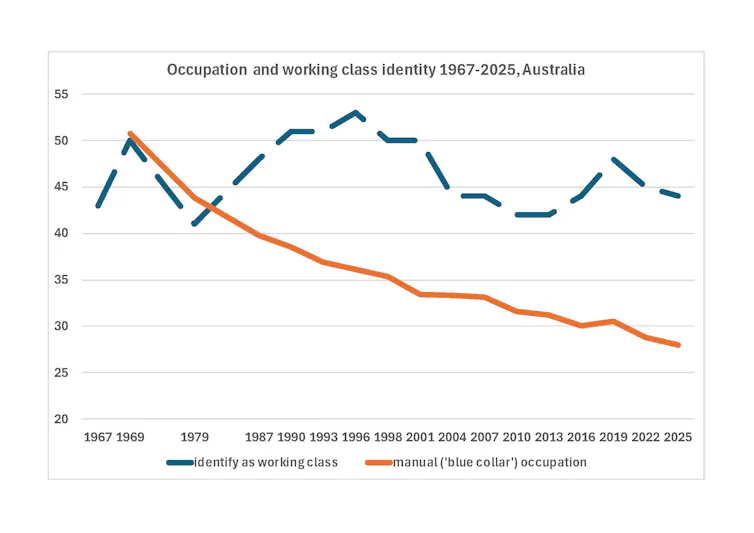
Perhaps the labour parties mistook the decline in “blue-collar” (manual) jobs for the decline of the working class. In Australia, the blue-collar share of jobs fell from 44% in 1979 to 28% in 2025. It’s fallen in the UK, the US and elsewhere.

Union membership, once a mostly “blue-collar” phenomenon, declined in most industrialised countries. It fell from an average of 30% of employees across the OECD in 1985 to 19% in 2005 and 15% in 2023. The fall was even greater in Australia.

But these changes did not reflect how likely people were to identify as working class.

In Australia, national attitude and election surveys give us a good idea of trends in people’s views. Between 1979 and 2007, the proportion of respondents in a standard national survey defining themselves as working class or lower class temporarily grew from 40%, to the low 50s in the 1980s and ‘90s, then back to 44% by 2007. In 2025, after a bit more movement, it was still 44% working class.

A chart with two lines, showing (in red) a gradual decline in blue collar occupations and *b) a variable but relatively flat proportion of peoploe identifying as working class.
Occupation x working class identity. Australian Election Study and Australian Bureau of Statistics, CC BY

A British survey in 1983 found 58% of people claimed to be working class. By 2005, those identifying as working class had barely fallen to 57%. In 2023, still 53% of people identified as working class.

In the US, where the phrase “working class” appeared absent from public discourse for decades until Trump, a differently worded question showed that in 1976, 51% of Americans thought of themselves as either working class or lower class. In 2006, the same survey showed 52% identifying as either working class or lower class. Within this period, numbers had fluctuated from year to year — but always between 48% and 55% expressed working or lower class identity.

A Gallup poll added “upper-middle class” to the options, and the proportion claiming working or lower class status was only 39% in 2006. In 2024, that number was 43%.

In Canada, the proportion identifying as working or lower class was 36% in 1980 and still 36% in 1995. In 2017, a different poll found 37% identified as working class.

In short, while “blue-collar” jobs have sharply declined almost everywhere, the experience of “working class” has been relatively stable, within some fluctuating bounds. Differences in class identity between countries seem more notable than differences over time, perhaps due to how questions are asked or how different cultures interpret them.

This is not to say that giving a “working class” response to a forced-choice survey question is the same as a deeply thought position on class. But if people no longer thought of themselves as working class, you would expect to see some pretty big changes over time in answers to these questions.

How the working class was left behind

Sure, jobs changed, a lot. But there has never been much middle-class glamour in the “white collar” jobs at the checkout counter, behind the hamburger hotplate or in the call-centre factory.

Class relations didn’t weaken. In fact, inequality worsened in many countries. Neoliberal policies, including those adopted by social democratic parties, made the rich much richer, but they slowed the growth in the wellbeing of the majority of people, and left the working class behind.

The proportion that thought big business had too much power, and income and wealth should be redistributed, became larger.

Unions lost ground not because their ideas became unpopular with workers. It simply became much harder for unions to recruit and retain members in the face of increasingly hostile employers, governments and laws.

Working class voters didn’t have solutions to hand. But nor were they offered any by social democratic parties that barely spoke their language. Now the door has been opened to far-right parties, presenting alternatives that appeal to some facing those class problems.

There’s life in class voting yet, just not in the way we thought of it.

The Conversation

Over the years David Peetz has received funding for research from the Australian Research Council, various unions and employers, the Fair Work Commission, state and national governments of both political flavours in Australia and overseas, the International Labour Organisation and the Organisation for Economic Cooperation and Development. He is presently employed by the Centre for Future Work.

❌
AU Conversation