Normal view

From Schuman's post-war declaration to the EU today, the Historical Archives unpack how Europe came together

The Historical Archives of the European Union (HAEU) in Florence is home to a wealth of public documents and records of decisions issued by EU institutions along with artefacts illustrating pro-European movements and initiatives led by prominent personalities that helped shape the EU as we know it today. May 9 is Europe Day which celebrates the European Union’s founding values of unity, solidarity, democracy, human rights and shared prosperity. This year marks the 76th anniversary of Robert Schuman’s historic declaration. In 1950, the birth of a union of coal and steel was at the centre of the vision of a united Europe backed by the governments of France, West Germany, Italy, the Netherlands, Belgium and Luxembourg.

Dieter Schlenker is the Director of the Historical Archives of the European Union at the European University Institute (EUI) in Florence which is now in its 50th year and has grown into a thriving community centred around interdisciplinary research and public engagement. We asked him to walk us through the archives that retrace the history of the European Union and its institutions, and the trajectory of the EUI from its conceptual beginnings in the post-war period to its consolidation as an international centre for research and intellectual exchange.


The Conversation: The historical archives provide the public with a written memory of the European integration process since the early 1940s. What is available to visitors, and which resources would be of particular interest to researchers?

Dieter Schlenker: The HAEU has received over the last 40 years more than 300 holdings that comprise almost 1 million paper files stored at Villa Salviati on 10 kilometres of dedicated roller shelving. During the Open day on May 9 visitors will have the unique opportunity to discover archival documents, artefacts and materials in various forms, in a high security, climate-controlled environment that is normally closed to the public. Almost 1.000 visitors will be invited to take a tour through the Villa and the Archives on the open day. They will be accompanied by a professional archivist who will explain the mission and holdings of the archives and show them a selection of documents including the authentic copy of the Maastricht Treaty, historical letters, notes, photos and even objects that belonged to European politicians and EU officials, plus a selection of media formats for audio-visual and digital archives that have become obsolete (magnetic tapes, floppy disks, CDs, etc), and which show the volatility of modern archives and the challenge of preserving and maintaining them so they remain accessible to the general public.

A behind the scenes presentation of The Historical Archives of The European Union (Florence, Italy) on the history of the European Union, which promotes public interest in European integration and enhances transparency in the functioning of EU Institutions.

Researchers can consult the archives in the reading room at Villa Salviati from Monday to Friday. Approximately 40% of the hard copies of the archives have been digitised, so they are available online in the archives database. The holdings comprise the archives of EU institutions, such as the European Commission, the Council and the European Parliament along with a unique collection of archives from other highly relevant European organisations, such as the European Space Agency, the European Free Trade Association, and the European Cultural Foundation. The HAEU is also home to the archives of various European movements and associations, and political groups in the European Parliament. Finally, more than 100 personal papers have been deposited by important European political figures, from pioneers, such as Alcide De Gasperi and Altiero Spinelli, through to Commission Presidents, such as Jacques Delors and Romano Prodi, and numerous Commissioners and Members of European Parliament.

How are the archives organised, and what are visitors most drawn to?

D.S.: Visitors can discover the physical infrastructure and how the numerous archives are stored in different rooms, in boxes and files, organised according to where they originate from and by the type of archive. They also get to see the complex coding and classification systems in place that facilitate the storage and retrieval of the documents. Guided tours also allow visitors to see documents on display and extended photo collections that are mounted on the walls, and can ask questions about their conservation and access conditions, the history and context of the creation of the documents and the people featured on the photos.

Monetary policy or EU expansion, what significant moments are captured in the archives?

D.S.: The Historical Archives of the European Union’s mission is to collect and provide the broadest possible archival legacy of European integration and European Union in a single location. This is why many different topics of European history since World War II can be studied on the basis of numerous original primary sources. These reach from the first pro-European federalist movements emerging during WWII, the important Congress of The Hague 1948 that led to the creation of the Council of Europe in Strasbourg, the whole negotiation process of the Schuman Plan and the European Coal and Steel Community, then all the policies and actions taken by the Commission created by the Rome Treaties in 1957, all plenary and committee sessions of the Parliament, the Council and European Council meetings, the various enlargments, all procedure files of the European Court of Justice, etc. All EU documents are opened to the public after a 30-year period and shipped here to Florence by the respective institution for public access, which is why the documentation currently available approximately goes up to the mid-1990s.

How are the archives used and which documents have proven to be the most thought-provoking for academic research?

D.S.: The archives provide such a large base for research that the points of view, research interests and findings change all the time. More than 120 researchers register every year at the archives reading room and conduct 1.000 research sessions. The output reaches from the first works on European integration, mostly biographic studies on the founders, such as the works of Raymond Poidevin on Robert Schuman and the Biography of Jean Monnet by François Duchêne, or institutional history, such as Dirk Spierenburg’s book on the High Authority of the European Coal and Steel Community. Today, historical research covers practically all different areas of European policies, and we may highlight the many diverse publications produced by the members of the European Union Liaison Committee of Historians that also edits the Journal of European Integration History (JEIH), or mention the current EUI Chair on European integration history, Emmanuel Mourlon-Druol, who works on European Monetary Union.

The HAEU also hosts the historical archives of the European Space Agency including the records of the continent’s earliest major efforts to develop a space programme, what are the highlights on display?

D.S.: The European Space Agency in Paris decided to entrust the HAEU with their historical archives in 1989 and revised the deposit contract in 2020 to deepen cooperation and set focus on digital access, data protection and information security. This included the archives of the forerunner organisations ELDO and ESRO and therefore provides researchers with thousands of paper files documenting all aspects of European ambition in space since the early 1960s. These archives provide unique insight into the various joint European satellite, earth observation and human space flight projects of the past 60 years.

Looking back at the archives, what insights do we gain about European identity today? What values still stand and how are they reflected in visitors’ feedback?

D.S.: Looking at the recently published catalogue commemorating the 40th anniversary of the archives, we can see how all the many facets of European cooperation and integration are covered and referred to in the archival holdings preserved in Florence. It offers a fascinating trip back in time. Certainly, the documents on a peaceful and democratic post-War Europe expressed by those resisting against the Nazi and Fascist regimes provide a highly visionary humanistic picture of a united Europe, while the later negotiations on European treaties, policies, enlargements and external relations become much more multi-faceted, detailed, technical and concern very concrete political, economic and social arguments.

Nonetheless, the fascination of how it all started in Hour Zero in 1945 as a vision of peace, democracy and solidarity remains very strong until today. Visitors often refer to the founders of the European Union and their foresight and long-term vision securing peace amongst European states since 80 years, which is particularly important as visitors are rather worried about the present and future of Europe in a multipolar globalised world.

Interview by Carly Lock, Journalist at The Conversation Europe & The Conversation France.


A weekly e-mail in English featuring expertise from scholars and researchers. It provides an introduction to the diversity of research coming out of the continent and considers some of the key issues facing European countries. Get the newsletter!


The Conversation

Dieter Schlenker ne travaille pas, ne conseille pas, ne possède pas de parts, ne reçoit pas de fonds d'une organisation qui pourrait tirer profit de cet article, et n'a déclaré aucune autre affiliation que son organisme de recherche.

Why was an Egyptian mummy stuffed with a fragment of Homer’s Iliad?

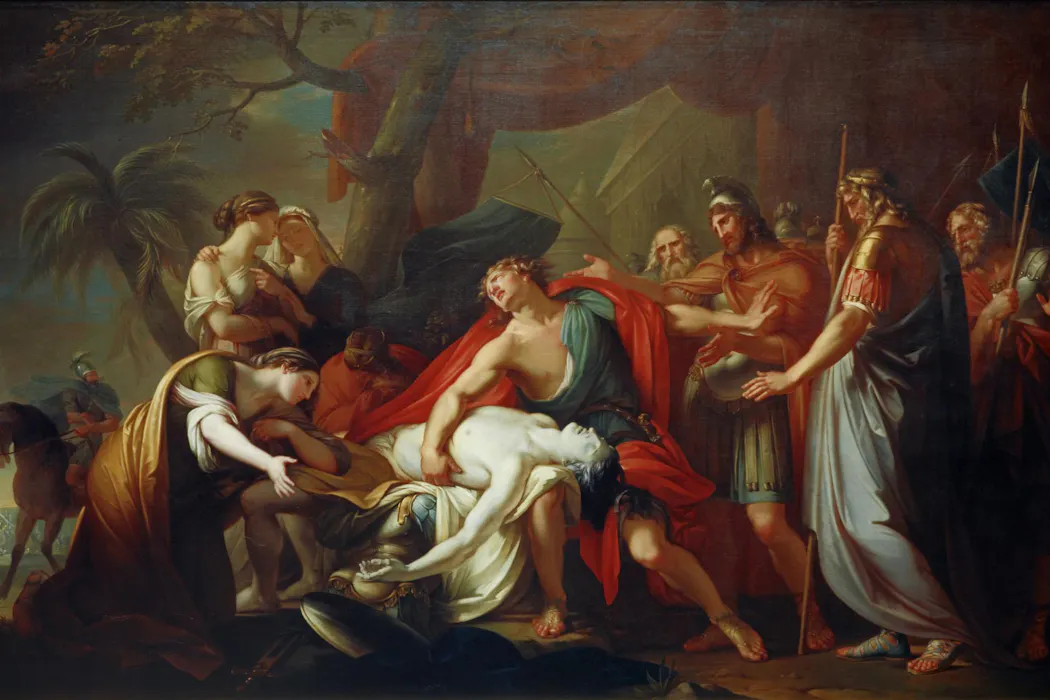
Achilles Lamenting the Death of Patroclus by Gavin Hamilton (1760-1763). National Galleries of Scotland Collection

Archaeologists have found something unexpected inside a 1,600-year-old Roman-era Egyptian mummy: a fragment of Homer’s Iliad. It wasn’t placed beside the body, but inside the mummy’s abdomen. But the real surprise isn’t just where the fragment was found. It’s how it got there. To understand, we must go back – to the Iliad itself, and to what it became in the Roman world.

In The Iliad, a poem shaped in the 8th century BC and attributed to Homer, the Trojan war does not end in triumph or renewal. It ends in devastation. The poem closes at the edge of collapse, with Troy reduced to a landscape of heroic ruin. And yet, this is not where the story ends.

According to later Roman tradition, one Trojan escaped. Aeneas – son of Anchises and the goddess Aphrodite – fled the burning city carrying his father on his shoulders and the household gods in his hands. He moved west, across the Mediterranean, towards Italy, where he became the ancestor of Rome.

This continuation did not come from the Iliad itself. It was shaped centuries later, most famously in Virgil’s Aeneid. But it changed the meaning of the Trojan war entirely. The past, in other words, was actively reorganised – through stories that could be reworked, extended and connected across time and space.

Painting by Pompeo Batoni (1753), depicting Aeneas fleeing the burning city of Troy with his father Anchises and the household gods, as the fall of Troy is recast as the beginning of a journey toward the foundation of Rome.
Painting by Pompeo Batoni (1753), depicting Aeneas fleeing the burning city of Troy with his father Anchises and the household gods, as the fall of Troy is recast as the beginning of a journey toward the foundation of Rome. Galleria Sabauda

Turning defeat into origin

For Roman audiences, the Trojan war was more than a distant Greek legend. It became a way of thinking about origins, identity and power.

Claiming descent from Troy was more than a matter of tracing a lineage. It required constant cultural work – through storytelling, education and shared knowledge. The Iliad provided the raw material: characters, events and genealogies that could be reshaped and redeployed across generations.

Across the Roman Empire, educated elites learned Homer as part of their schooling. They quoted him in speeches, analysed him in classrooms and used him to signal cultural authority. To know the Iliad was to speak a language that others across the empire understood.

A senator in Rome, a teacher in Asia Minor or a student in Egypt could all draw on the same stories. The poem created a shared frame of reference – one that allowed very different people to situate themselves within a common past.

Plan of the late bronze age citadel of Troy
Plan of the late bronze age citadel of Troy (c. 1300–1109BC) shown in red, with Roman-period structures in blue, integrated into the ancient fortification in such a way that the surviving walls functioned as a theatrical backdrop of ‘authentic antiquity’, transforming archaeological depth into a deliberately scenographic experience. University of Tübingen, CC BY-SA

In the Roman imperial period, the site of ancient Troy – located in modern-day Turkey – became a destination. Emperors invested in its development, tying it directly to Rome’s claimed Trojan origins. Under Emperor Augustus, Troy was folded into the political language of empire. And under Emperor Hadrian, it became part of a wider culture of travel, memory and heritage.

A visitor to Troy in the 2nd century AD would have arrived at a curated landscape. There were baths, places to stay and spaces for performance. A small theatre – the Odeion – was built directly into the ancient citadel, so that the remains of the bronze age city, understood as the setting of the legendary battles around Troy, formed a dramatic backdrop.

Visitors could walk through what was presented as the setting of Homeric epic, experiencing the Trojan war as something anchored in the ground beneath their feet.

From Troy to Egypt

Across the Roman Empire, the Iliad circulated as a living text: copied, taught and read. Egypt, one of Rome’s most important provinces, was no exception. Yet here, Homer circulated within a cultural landscape that differed in important ways from the Greek literary world in which the poem had first taken shape.

For Roman observers, Egypt often appeared as a place where antiquity was materially preserved as well as remembered – through temples, monuments and practices that emphasised continuity with the past. At the same time, it was a deeply hybrid society, where Egyptian, Greek and Roman traditions interacted in complex ways.

Homer was among the most widely copied authors in Roman Egypt – read and taught as a marker of education and cultural belonging and deeply embedded in everyday literary culture.

A small covered Roman theatre
The Odeion of Troy, a small covered theatre inserted into the fabric of the ancient citadel and constructed in the early 2nd century AD, exemplifies the Roman reconfiguration of the site’s urban and cultural landscape. University of Tübingen, CC BY-SA

The Homeric version of the Trojan War was particularly prominent among the Greek-speaking elite, especially in urban centres such as Oxyrhynchus, where the mummy was found. Other versions of the story – which placed greater emphasis on Paris and Helen’s stay in Egypt, as reported by Herodotus based on accounts from Egyptian priests – were probably more widespread among the broader Egyptian population.

The initial media coverage of the discovery of the fragment inside the Egyptian mummy suggested the text was deliberately chosen to accompany the deceased. As a personally meaningful object, perhaps reflecting their education or cultural identity.

The most telling explanation, however, may be the most straightforward. Discarded or damaged papyri could be reused as inexpensive material. The fragment may therefore have functioned as stuffing – bundled together and inserted into the body cavity without particular regard for its literary content.

The very fact that a scrap of the Iliad could end up as disposable filling, however, speaks to how deeply Homer had penetrated everyday life in Roman Egypt.

A text in motion

To make sense of the past in the Roman world meant moving between story and monument, between genealogy and deep time. Each perspective made the others more intelligible.

The Iliad helped create a world in which different pasts could be connected, compared and reshaped. By linking stories, places and traditions across the Mediterranean, the Roman world turned the past into a flexible resource – one that could generate identity, authority and belonging in shifting contexts.

This is why the Iliad mattered: it circulated across many different settings. It shaped elite education, but it was also part of everyday reading culture. At Troy, it helped transform the city into a place of cultural memory. The text itself also had a long material afterlife, surviving not only as an authoritative story, but through manuscripts and writing materials that were copied, passed on – or even reused for entirely different purposes.

Its most enduring insight is therefore this: the past is not something simply preserved, but something continuously made and remade – through the stories, practices and materials that carry it across time.

This article features references to books that have been included for editorial reasons, and may contain links to bookshop.org. If you click on one of the links and go on to buy something, The Conversation UK may earn a commission.

The Conversation

The authors do not work for, consult, own shares in or receive funding from any company or organisation that would benefit from this article, and have disclosed no relevant affiliations beyond their academic appointment.

Germany pulled the plug on flagship FCAS fighter jet – the implications for European defence are worrying

The effective collapse of the Future Combat Air System (FCAS) fighter jet programme is a major setback for European defence cooperation.

France, Germany and Spain have spent nearly a decade trying to develop what was intended to become Europe’s premier next-generation combat aircraft, only for the programme to succumb to disputes over leadership, the distribution of work and intellectual property.

Yet Europeans shouldn’t be surprised. The history of European combat aviation is littered with programmes that struggled under the weight of competing national ambitions. In this respect, FCAS looks less like an extraordinary failure than the latest chapter in a recurring story.

The more important question is not why FCAS has run into trouble, but rather what its collapse reveals about Europe’s ability to generate and sustain the military capabilities it will need in a more dangerous world.

Adversaries are now investing heavily in integrated and layered air defences encompassing long-range missiles, electronic warfare capabilities and increasingly sophisticated sensors. Maintaining the ability to penetrate defended airspace in future conflicts will require a step change in capability.

FCAS was conceived as a “sixth-generation” combat system – the latest leap in fighter jet technology – to overcome this contested air environment. At its centre would sit a new combat aircraft, supported by autonomous drones, advanced sensors, electronic warfare systems and a digital network linking everything together from the 2040s.

The challenge is that such programmes are becoming extraordinarily expensive to develop. By sharing costs, expertise and industrial capacity, European governments hope to achieve capabilities that would otherwise be beyond their reach.

The Eurofighter Typhoon was one of the most successful military collaborations of the cold war. R. Sanchez Aviation Photo / Shutterstock

Reality check

Despite the perceived commonalities, the FCAS nations – France and Germany in particular – had very different objectives.

For France, the project was never simply about replacing its Rafale fighter jet. Any successor aircraft would eventually have to support the airborne component of France’s nuclear deterrent, operate from its aircraft carrier, and preserve sovereign industrial capabilities – specifically the ability to independently design and build advanced combat aircraft. The insistence by France on design leadership for FCAS therefore reflected concerns about national autonomy, even if portrayed as industrial obstinacy.

Meanwhile Germany, represented by the aerospace giant Airbus, had little interest in financing a programme that was likely to concentrate Europe’s most valuable expertise, intellectual property and design authority in Dassault, the French aerospace company, for decades to come.

These tensions are hardly new. In the 1960s, Britain and France attempted to build the Anglo-French Variable Geometry aircraft. But France’s withdrawal in 1967, for similar reasons to FCAS, led to the project’s collapse.

Other joint European projects have succeeded. For instance, the Panavia Tornado. And in the 1980s, the Eurofighter consortium was developed. This time, despite France withdrawing (to produce the Rafale), the UK, Germany and Italy proceeded (with Spain later joining) with what would become the Eurofighter Typhoon.

Reliance on America

For decades, therefore, European collaborative programmes have been expected to do several things at once: deliver military capability and sustain national industries while strengthening diplomatic relationships or at least not upsetting them.

That may have been a manageable compromise when Europe’s security was underwritten by the United States and the threat from Russian appeared contained. It is far harder to justify when European governments are warning that the continent must rearm.

Emmanuel Macron and Friedrich Merz.
Emmanuel Macron and Friedrich Merz have several options in the wake of the project’s collapse. EUS-Nachrichten

The challenge is compounded by the changing relationship between governments and industry. Unlike Airbus, which remains partly state-owned, Dassault is controlled by the family that bears its name.

This reflects a broader trend of European governments often exercising less influence over major defence firms than they did during the cold war, when state ownership and greater industrial competition gave them more leverage. This is to say nothing of the tech firms increasingly fundamental to military capability.

That matters because armed forces are built over decades, not electoral cycles. If European governments struggle to mobilise industry to meet their defence requirements, they may find themselves confronting capability gaps at precisely the moment they are trying to deter aggression.

Germany’s defence minister, Boris Pistorious, has already outlined three alternatives to FCAS. The first and simplest is to buy more F-35s from the US. But this would fall short of Germany’s requirements while also deepening dependence on the US – something European nations are keen to avoid.

The second option is to join another collaboration, most likely the UK-Italian-Japanese effort to build a sixth-generation fighter, called the Global Combat Air Programme (GCAP). Germany’s growing defence budget could provide the project with additional funding and a larger order book. But it would also raise questions about influence.

If Berlin rejected a subordinate role within FCAS, it is unlikely to accept one within GCAP. Existing partners may therefore conclude that the benefits of expansion are outweighed by the risks of delay to a programme targeting entry into service by 2035.

The third option is a German-led effort, being discussed through the proposed Team Gen 6 industrial grouping – an Airbus-led alliance of eight defence firms. This would solve industry concerns, preserve German design ambitions and might allow Berlin to build a coalition with other partners, such as Spain and Sweden.

But it could be prohibitively expensive, risky, and by further fragmenting Europe’s already crowded combat aircraft landscape, reduce the viability of all the existing programmes. France faces similarly difficult choices. It can pursue a national successor to Rafale, preserving control over industrial, nuclear and carrier requirements but accepting substantial costs. Or it could seek a revised collaborative framework.

In the meantime, both French president Emmanuel Macron and Germany’s chancellor Friedrich Merz have made clear that other opportunities for collaboration exist, such as the drones intended to support the FCAS fighter jet, or the main aircraft’s engine.

The experience of FCAS is not that Europe cannot cooperate. History shows otherwise, and GCAP may yet again demonstrate that a pragmatic coalition can succeed where a more politically ambitious partnership failed.

What FCAS does reveal, however, is a growing mismatch between Europe’s security environment, the way it continues to procure defence equipment and the costs involved. The recent resignation of Britain’s defence secretary, John Healey, amid disputes over defence funding, points to the same problem.

European governments increasingly agree on the threats they face, but remain “unwilling” to make the financial and political compromises required to address them. That should concern us all.

The Conversation

Arun Dawson does not work for, consult, own shares in or receive funding from any company or organisation that would benefit from this article, and has disclosed no relevant affiliations beyond their academic appointment.

Land by Maggie O'Farrell is a haunting tale set in post-famine Ireland about history, map-making and memory

Maggie O’Farrell’s exquisite new novel, Land, is a haunting tale of loss, endurance and renewal. Spanning generations and continents, O’Farrell traces the fragile threads that connect people and place: stories half remembered, names erased, objects carried forward like talismans against oblivion, ghosts that haunt the edges of memory, music that conjures grazed fields and the wind-scratched surface of water. Moving between intimacy and sweeping historical change, the novel reveals the land itself as a living archive of rupture, survival, and belonging.

Land begins in 1860s Ireland, on an unnamed “windswept tongue of land” that branches out in the roiling, icy currents of the Atlantic. A gifted mapmaker, Tomás, and his eldest son, Liam, are busily adjusting their chains and surveying poles, taking measure of the land. Tomás is an employee of the Ordnance Survey, dispatched out west to revise barony maps that no longer conform to a landscape ravaged by hunger and emigration.

In the distance, Tomás glimpses a thicket of trees, not knowing that it is a sacred place whose origins reach back to the “beginning of time”. The mysterious woodland is not recorded on any existing map and when Tomás enters the copse to investigate he vanishes only to reappear the following morning, dishevelled but otherwise unharmed.

He does emerge changed, however. The certainty of the surveyor’s world – with its theodolites (a precision instrument used for measuring angles horizontally and vertically), gunter’s chains (a distance-measuring device) and Euclidean faith in point, line, measure, and angle – imploded in the copse. He sees now that mapping is “act of colonisation”, a way of making space legible so that it can be appropriated as property.

The simplified landscape of the usurper – a landscape of estates, courthouses, cathedrals and market squares – yields easily to the neat authority of line and symbol. But what of the rich, sensuous world preserved within the people’s oral traditions? What of the world in which rivers are alive, animals speak, gods and mortals mingle, and death is less an end than a transformation into another form of being? What of the mystical, awe-inspiring and spiritual, and the wisdom kept alive in the lore of the seanchaí (the traditional Irish storyteller)?

As a scholar of Ireland’s Great Famine, An Gorta Mór, I am aware of how devastating the 1840s were. One million lives were lost to starvation and disease and two million people emigrated in the immediate aftermath.

In a five-year period, between 1845 and 1851, the number of plots under or equal to 1 acre declined by almost 75% and farms between 15 and 30 acres increase by nearly 80%. By the end of the century, the acreage under potatoes and grain had halved as a tillage farming made way for an export-oriented pastoral economy. In 1800, half of Ireland’s population talked in the Irish language. By the end of the 19th century that figure was reduced to 14%. Emigration was the new normal, part and parcel of life-cycle of rural life in Ireland.

This is the context for O’Farrell’s novel: the land was changed utterly. A whole way of life was eroded, and Land imagines what it must have been like to walk among the ruins, to see a agrarian culture collapse, and, for those left behind, to forge a future from remnants.

Tomás vows that he will “never again cede to [the coloniser’s] version of geography, of history, of linguistic and toponym”. With his family’s savings, he purchases a plot of ground next to the copse and moves his family there. He is determined to make a different map of the land, one that will capture not only its physical features – “dolmen, stone cist, tumulus, evicted village, pre-colonial kingdom, and navel” –but the shifting webs of meaning attached to place.

“[It’s] not impossible,” our narrator at one point informs us, “that there are remnants of others here in this place, stray elements or traces of the people who walked this land before.” Ultimately, Land suggests that place is neither neutral nor empty, but always layered with what has been lived, lost and half-forgotten.

The novel resists any neat separation between past and present, “myth” and “fact”, showing instead how meaning endures in material and uncanny forms. Meaning can be found in stone and soil, in buried objects, and in memories that resist erasure. In O’Farrell’s hands, the land is both witness and participant, holding within it the imprint of human experience and the unsettling knowledge that nothing really goes away.

This article features references to books that have been included for editorial reasons, and may contain links to bookshop.org. If you click on one of the links and go on to buy something, The Conversation UK may earn a commission.

The Conversation

David Nally does not work for, consult, own shares in or receive funding from any company or organisation that would benefit from this article, and has disclosed no relevant affiliations beyond their academic appointment.

Europe’s dilemma – to use China’s turbines to meet its renewable targets or not

Europe’s wind turbines have become part of a wider struggle over energy security, industrial power and the west’s dependence on China.

European wind power capacity has surged dramatically in recent years. Wind energy now supplies 17% of EU electricity up from 13% in 2019. Offshore wind has expanded particularly rapidly, with installed capacity growing strongly over the past decade.

But Brussels wants renewables to provide at least 42.5% of the EU’s total energy mix by 2030. Wind is “pivotal” to this strategy, according to the European Commission’s wind power action plan. The challenge for Europe is to meet its 2030 target, it needs to build 33 gigawatts (GW) of new wind turbines annually.

So far, data from 2022, 2023 and 2024 indicates that Europe has averaged only around 16-19 GW of new installations per year. This leaves a significant gap between Europe’s target and its implementation.

Across the Atlantic, the picture is just as uncertain. The US Inflation Reduction Act introduced during Joe Biden’s presidency promised a surge in renewable energy investment, including wind. But growing political opposition to turbines, especially from Donald Trump and his political allies, has cast doubt over how far that momentum can go.

Cheap turbines and fast delivery

Europe’s installation shortfall and the US’s retreat from wind energy create a strategic opening for China. Chinese manufacturers dominate the global wind industry, with six of the top ten turbine makers and producing over 70% of the world’s new wind turbines in 2024. Companies like Goldwind, Envision and Mingyang offer turbines that are 30-40% cheaper than western equivalents and promise faster delivery.

This puts the west in a bind: accept Chinese help to meet climate targets quickly and cheaply, or reject it and risk falling further behind.

Europe could certainly rely on Chinese wind power to close its gap in renewable energy. The same could be said about the US, although its desire to push forward with wind power is not clear. US wind deployment fell to 5.2 GW in 2024, the lowest level in a decade, and turbine orders dropped 50% in the first half of 2025.

However, allowing Chinese firms greater market access creates a real policy dilemma. While purchases of Chinese turbines would speed up Europe’s energy transition and is cost effective, the EU sees China as an economic rival and security risk that potentially undermines the union’s industrial and strategic autonomy.

The US appetite for Chinese wind tech is much lower than Europe’s. Aside from permit delays, grid connection bottlenecks and rising costs, Trump’s return to office in 2025 is an important factor in the US’s renewable slowdown. The US president has publicly labelled wind power “a joke”, and has frozen federal permits for offshore and onshore wind projects, in addition to eliminating renewable energy tax credits.

But that’s not all. Washington views China’s dominance in wind turbine technology as a security threat requiring protectionist barriers, and has effectively blocked Chinese wind technology through various measures. This includes national security probes into wind turbine imports, 50% tariffs on wind turbines and parts, and tax credit restrictions that bar companies using Chinese-manufactured components from accessing federal clean energy incentives.

Western tariffs haven’t slowed China’s wind industry but have redirected it. Chinese wind turbine exports surged 50% in 2025. By the end of 2025, cumulative exports had exceeded 28 GW, a thirteenfold increase from 2015. Chinese manufacturers are now selling wind turbines to more than 60 countries, and have established production or research operations in more than 20.

The UK’s largest wind farm is off the east coast.

Targeting new markets

The pattern is clear: China is targeting developing markets where western competition is weak and renewable energy demand is surging. The biggest purchasers of turbines from China in 2024 were Saudi Arabia, Uzbekistan, Brazil, Egypt and Kazakhstan. All are participants in China’s economic development plan, the Belt and Road Initiative.

But China’s wind momentum shows no signs of slowing. Pakistan, Indonesia, Vietnam, Saudi Arabia and Malaysia are expected to add 120 GW of wind and solar capacity over the next decade, requiring US$73 billion (£53.5 billion) in investment. Chinese firms already captured over 60% of renewable energy capacity in these markets since 2024, and is set to expand further.

While China’s wind turbine sales to the US and Europe may be uncertain, Beijing has secured a different prize. Since 2013, Chinese companies have installed 156 GW of power capacity across Belt and Road Initiative countries, 70% in Asia and 15% in Africa.

The west may be protecting its own energy independence, but may also be handing the control of Africa and Latin America’s energy future and security to China, if things don’t change.

The Conversation

Chee Meng Tan does not work for, consult, own shares in or receive funding from any company or organisation that would benefit from this article, and has disclosed no relevant affiliations beyond their academic appointment.

Self-driving cars struggle to see at night or in fog – but imitating the human brain can make them safe

AI-powered autonomous vehicles still have major hurdles to clear. Samuele Errico Piccarini/Unsplash, CC BY-SA

Picture this: you’re driving on a mountain road, when you suddenly hit a thick patch of fog. You respond instinctively. Your vision sharpens, and you narrow your eyes to make out the shape of any oncoming cars.

Human beings handle these quick changes very well, but if it were a self-driving car – at least one with a current artificial intelligence (AI) system behind the wheel – things could easily end in disaster.

Today’s AI vision systems are extremely accurate when visibility is good. On a clear, sunny day a self-driving car can recognise pedestrians, road signs and other vehicles with precision. However, they are extremely vulnerable to environmental changes. If it rains, or gets dark or foggy, standard AI systems become blind, incapable of detecting obstacles that a human driver would spot with ease.

Our research at the University of Valencia proposes a possible solution: instead of exposing AI models to millions of images of every possible road condition, we decided to imitate biology. But biologically speaking, why can humans see so well under such a wide range of conditions?


Leer más: Human vision: what we actually see – and don’t see – tells us a lot about consciousness


The brain’s ‘volume control’

In our brains, neurons do not work alone. They use a truly fascinating form of adaptation that neuroscientists call divisive normalisation.

To understand this (without getting into mathematics) we can picture it as an automated “volume control” system, with neurons working in a team. Let’s say one neuron is looking at a very dark area of the field of vision, such as a black car at night. The neighbouring neurons turn up the “volume” of this weak signal, amplifying the small details to make them more visible.

If we look at a bright light, the same thing happens in reverse. The brain turns down the volume to prevent us from being dazzled.

This mechanism is what allows us to adapt and see clearly in a very wide range of conditions. But in the search for speed and accuracy, modern AI systems have neglected this biological inspiration.


Leer más: AI systems and humans ‘see’ the world differently – and that’s why AI images look so garish


AI in the driving simulator

In our study, we processed images using some of the most widely used AI models, adding layers to simulate the brain’s “volume control” mechanism. In basic terms, we forced their neurons to communicate with one another and adapt to their environment, just as our own brains do.

We wanted to see if imitating biology would make cars safer. To do this, we submitted both standard AI models and our brain-inspired modification to a series of tests. Using databases from real driving in European cities, night driving images from Switzerland, and several different virtual driving simulators, we were able to compare responses to difference levels of fog, darkness and light variation.

The results showed that imitating our own brains worked. After being trained, the two types of AI models could drive perfectly well, but once fog and darkness came into the equation, the unmodified one began to fail. It lost the ability to distinguish cars from buildings, and even from the road itself.

The AI system that was equipped with our brain-inspired mechanism, on the other hand, was robust. Even in fog or complete darkness, it performed more than 20% better than its unaltered counterpart.

We analysed, from the inside, how this new system perceived the world and found that it was doing exactly what we expected. It was capturing and enhancing the details of vehicles hidden in the fog that would otherwise be invisible. As a result, its performance became more stable in the face of changing weather conditions.


Leer más: The next generation of driverless cars will have to think about what’s on the road, not just see it


Learning from nature

Getting society as a whole to trust AI poses major challenges, and the safety of passengers and pedestrians in self-driving cars is a major aspect of this. It is not enough for smart systems to work under ideal conditions. We need them to be completely safe in the real world, and to safeguard the lives of all road users in all weather conditions.

Our research shows that the key to making artificial intelligence safer, more robust and more adaptable may be closer than it seems. There is no need for more powerful computers or vastly greater amounts of data. Sometimes, all we need is to look at the millions of years of evolution that have shaped our own brains.

In many cases, nature has already solved some of the problems that artificial intelligence faces today. We just need to learn from it.


A weekly e-mail in English featuring expertise from scholars and researchers. It provides an introduction to the diversity of research coming out of the continent and considers some of the key issues facing European countries. Get the newsletter!


The Conversation

Pablo Hernández Cámara receives funding from the Spanish Ministry of Science, Innovation and Universities.

Iran’s attacks on Israel were an attempt to shape the region on its own terms – and it might just do so

Iran fired barrages of missiles at Israel for the first time in two months on June 7. The initial trigger was an Israeli strike against a Hezbollah target in the Lebanese capital of Beirut earlier that day, an attack that Donald Trump had only recently asked the Israeli prime minister, Benjamin Netanyahu, to avoid carrying out.

Israel’s military soon launched retaliatory strikes on targets in western and central Iran, again defying calls by Trump for restraint. Iran subsequently launched fresh strikes of its own, before the Iranian military announced it was bringing its attacks to an end. In a statement, Iran warned it would carry out a “more severe” response if Israel’s attacks on Lebanon continue.

What caught my attention about this round of fighting is the geopolitical context in which it has occurred. Iran is trying to establish a new regional order, based on new rules. And it might just pull it off.

The first notable feature of this order is that Iran dictates to Israel and the US what they may and may not do. Iran started this latest round of fighting not because of an attack on Iranian territory, but as an attempt to dictate Israeli military actions in Lebanon.

Six months ago, Israel could do as it pleased in Lebanon without Iranian intervention. Now, thanks to Trump and Netanyahu’s war, Tehran feels empowered enough to try and place limits on Israeli action on Israel’s own borders.

We have seen, somewhat more obliquely, the same principle apply in the Strait of Hormuz over the past month or so. Iran established a chokehold over the vital waterway shortly after the start of the war in late February. And it has no intention of letting its control go.

This, too, is part of Iran’s new regional order. It is telling its opponents: do as we say or we tighten our stranglehold on the global economy. For now at least, US actions show that Washington would rather accept the continued existence of this reality than fight to change it.

A second aspect of the new regional order is Iran’s expanding ways of inflicting pain on its enemies in order to force acceptance of this new world. Iran has established that it can rain missiles on Israel, strike infrastructure across the Gulf states, kill American soldiers and choke the global economy of oil, all without facing a realistic attempt at regime change.

Iran also still has many cards in its pocket. These range from expanding the scope of energy and desalination targets it hits across the Gulf to activating the Houthis to block energy traffic in the Red Sea. The Houthis have announced a ban on Israeli shipping in the Red Sea following the latest escalation.

The US has threatened many times now to attack Iranian civilian infrastructure, invade its Kharg island export terminal or to escort ships through Hormuz. However, it has backed down from all of them out of fear of the consequences.

Strained US-Israeli ties

The third feature of the new regional order is that Israel and the US no longer march in lockstep. Trump responded to Iran’s attack on Israel by emphasising that his priority was to stop Israel from retaliating. “I am going to call Bibi right now and tell him not to retaliate,” he said following the initial Iranian strikes.

Netanyahu has managed to manoeuvre Israel into a position in which a Republican president is telling him not to respond to incoming Iranian missile barrages targeting Israeli civilians. This situation would scarcely have been believable six months ago.

Separating Israel from the US is a longstanding dream of Tehran. So far at least, there is no hint that Trump is threatening to withhold missile interceptor defences from Israel over the resumption in hostilities. But even while keeping American defensive aid, it would be very difficult for Israel to sustain further conflict with Iran.

Hunting missiles launchers would alone prove a challenge, because Israeli air power would be stretched much more thinly without American assistance in hitting targets. If the northern front against Hezbollah remains active as well, the Israeli military’s resources will be even more strained.

And for how long is the US going to accept running down its missile interceptor stocks in order to defend Israel from a bout of warfare that its famously mercurial president told the country not to start? In the short term, perhaps for a while. But over the longer term, it is not sustainable for the US to dedicate a substantial portion of its missile defences to protecting Israel.

The fourth and final feature of the new regional order is that peace seems impossible to imagine. Netanyahu cannot accept an Iranian veto over Israel’s actions in Lebanon, nor absorb the implications for Israeli deterrence if he lets attacks from Iran go unanswered.

Trump cannot get his peace deal with Iran while Israel is bombing Lebanon. And Iran has the incentive to keep pushing for more, inflicting more costs on its opponents, because in the new regional order it can do so without many consequences.

This is the result of a disastrous war of choice which will go down as one of the most ill-conceived in American history.

The Conversation

Andrew Gawthorpe is affiliated with the Foreign Policy Centre in London. He is the author of America Explained (https://amerex.substack.com/), a newsletter covering US politics, foreign policy and history, which features regular analysis of the Iran war.

NATO would survive a US withdrawal. But what kind of alliance would it become?

As NATO counts down to its annual summit in Turkey in July, the alliance is facing perhaps the biggest challenge in its history – what a potential future without the United States, or US security guarantees, would look like.

In recent weeks, the Trump administration has taken a series of steps widely interpreted in European capitals as retaliation for allies’ reluctance to more strongly support the US position in the Iran war. It has announced the withdrawal of 5,000 troops out of Germany, halted the deployment of 4,000 troops to Poland and even reportedly considered moves to suspend Spain from the alliance.

Europe was already uneasy about Washington’s broader strategic intentions. Increasingly, NATO allies are realising they can no longer depend on the United States for their security and will have to shoulder far greater responsibility themselves.

NATO 3.0

US President Donald Trump’s narrow understanding of the value of alliances has long been known. Now, his vision for a new NATO is coming into view.

At a NATO defence minister meeting in February, the US under secretary of defence for policy, Elbridge Colby, introduced the idea of “NATO 3.0”. This would entail Europeans assuming a much larger role in conventional deterrence. The US, meanwhile, would prioritise strategic competition with China and supporting European security more selectively and from greater distance.

NATO Secretary General Mark Rutte and Elbridge Colby speaking at NATO in February.

At the same time, the White House has reportedly been pushing to roll back decades of NATO’s mission expansion and keep Ukraine and NATO’s four Indo-Pacific partners (Japan, South Korea, Australia and New Zealand) out of the annual summit in July.

This reflects a broader transformation in US strategic thinking. NATO is no longer viewed as a political community and a pillar of the liberal international order. Increasingly, it is seen as a narrower military arrangement whose value depends on whether Europeans can shoulder more of the burden themselves and remain compliant with Trump’s agenda.

In this new paradigm, the United States is not simply asking European allies to spend more. It is telling Europe to do more with less American hardware, a looser political alignment, and fewer guarantees.

Plus, there’s a deeper problem: the erosion of trust within the alliance and the assumptions that have underpinned NATO’s deterrence posture for decades.

The result is a “Europeanised NATO” emerging by necessity rather than design. What such an alliance would actually look like remains unclear.

A focus on collective defence

One thing is certain: one single country won’t simply replace the United States as alliance leader. No European power possesses the capabilities, resources or political legitimacy to fill that role alone. Instead, leadership will likely come from the most capable states acting together.

That trend is already visible in “Europe’s minilateral moment”. The E3 group (Britain, France and Germany) and newer E5 coalition (with Italy and Poland), for example, have begun accelerating coordination among Europe’s leading military powers.

These arrangements are not alternatives to NATO. Rather, they may become the mechanisms through which a stronger European focus inside NATO is organised.

But this is where the uncertainties begin. A more Europeanised NATO is far from guaranteed to become a more cohesive NATO. The alliance has long struggled with the strategic cacophony of its 32 members, driven by divergent threat perceptions, regional priorities and strategic cultures. As American leadership recedes, those differences may become even sharper and harder to manage.

A more Europeanised alliance is, at least initially, likely to narrow its focus on collective defence and deterrence to counter Russia’s militarism and its ongoing war against Ukraine.

The broader agenda that expanded after the Cold War to include crisis management and cooperative security may increasingly become secondary. This included efforts to address global security challenges (such as supporting capacity building in countries affected by violent conflict), counter-terrorism operations, and enhancing energy and maritime security.

Yet, many NATO allies, particularly those on NATO’s southern flank, continue to argue that crisis management and cooperative security must remain core alliance functions. For countries facing instability across North Africa and the Middle East, migration pressures, terrorism and maritime insecurity, NATO cannot be concerned only with Russia.

NATO’s cooperative security partnerships in the Indo-Pacific are also increasingly important, even though they are no longer openly supported by the US administration.

Cooperation with Japan, South Korea, Australia and New Zealand (known as the IP4) has emerged as perhaps NATO’s most promising cooperative-security framework, precisely because it strengthens the alliance’s core deterrence mission.

Unlike many earlier partnership initiatives, this is tied directly to defence-industrial cooperation, technological resilience, security of supply chains for defence-critical materials, and strategic signalling.

The new reality

The “new NATO” is by no means a settled compact. It is an alliance caught between competing visions, profoundly uncertain political commitments from erstwhile supporters, and unresolved strategic questions.

Europe is moving towards greater responsibility for its security, but without a clear consensus on what greater strategic autonomy ultimately means.

The central question facing NATO today is not whether the alliance survives. It almost certainly will in some form, as one should never underestimate the binding power of bureaucracies.

The real question is what kind of alliance emerges and how credible it remains. Will it be a narrower military pact laser-focused on continental defence? Or a broader political-security community capable of managing the full spectrum of crises affecting Europe?

The Conversation

Gorana Grgić was previously a recipient of research and teaching funding from NATO.

European countries reach new agreement on human rights – here’s what it means for the UK’s immigration debate

The 46 countries bound by the European Convention on Human Rights (ECHR) have signed a new declaration on migration, setting out how they believe human rights law should apply to migration issues.

With the ECHR playing a contentious role in immigration discourse in the UK, the UK government trailed this declaration as a “more modern interpretation” of the ECHR that would help “restore order and control”. Yet the declaration may not change very much in practice.

The ECHR is a key human rights treaty signed by almost every European country, binding them to respect a list of fundamental rights. The European Court of Human Rights in Strasbourg has the final say in interpreting what these rights require in practice.

Two ECHR rights are particularly important when it comes to immigration: Article 8 (the right to respect for private and family life), and Article 3 (the right to freedom from torture or inhuman treatment). This new declaration, signed in the Moldovan capital of Chișinău, follows a campaign by some countries, including the UK, to change the interpretation of these rights to make removing migrants easier. It does not remove the authority of the Strasbourg court on these issues, but is likely to influence it.

The right to family life

Article 8, the right to family life, is known as a “qualified right”. This means that governments can make decisions that interfere with it (such as deporting someone with family in the UK) to pursue aims like immigration control – so long as their actions are “proportionate” to their aims.

The UK government wants a “rebalancing” of this right, giving more weight to the “public interest” and less to offenders’ family ties. The Chișinău declaration says that Strasbourg should respect national governments’ views, intervening only very exceptionally.

In reality, however, the Strasbourg court has already been doing this for years. In 2017, the court held that as long as ECHR countries carefully weighed up all relevant factors, such as the extent of the person’s family life and nature of their offending, then, “it is not for the court to substitute its own assessment”.

The perception that Strasbourg hinders the UK on family life matters is aided by misinformation – for example, the extensively reported case of a criminal migrant who was supposedly allowed to remain in the UK because his son disliked the chicken nuggets abroad. This was, however, never the basis of the decision. The declaration may fuel headlines about closing a “chicken nugget loophole”, but no such loophole really existed.

Inhuman treatment

The other right up for reinterpretation is Article 3, covering torture or inhuman treatment. This is an “absolute” right, meaning states are forbidden from such treatment under any circumstances.

Strasbourg’s interpretation of this right in migration has caused a genuine problem for governments. An example is the recent case of Nicolas de Brito, who was wanted on murder charges in Brazil. After fleeing to the UK, he successfully challenged extradition because prison conditions in Brazil fell below Strasbourg’s standards for inhuman treatment, due to overcrowding. He was released to live and work in the UK, and the murder case in Brazil had to be shelved.

In my forthcoming research, I argue that results like this arise from a crucial mistake made by Strasbourg. The problem began with a case in 1989, when the court first considered a new question: can a European state extradite someone if they might suffer inhuman treatment in the country receiving them?

The court’s judgment was ambiguously written. In my view, it is best read as saying that the ECHR does not normally govern what another state outside Europe does after extradition. However, removal should be blocked if there is a risk of exceptionally grave treatment.

In subsequent cases, though, Strasbourg arguably misinterpreted this. Instead of holding that only the most serious forms of mistreatment should prevent a person’s removal, it began holding that anything that would breach Article 3 should prohibit a person being extradited, if it might happen abroad.


Read more: Why is it so difficult for the UK to deport foreign criminals?


When “inhuman treatment” was later expanded to include overcrowded prisons, this created a difficult situation for governments trying to extradite people. If a European country’s own prison systems are found to fall below acceptable standards, they can respond by changing them. However, they cannot control prisons in countries like Brazil. This means that in a case like de Brito’s, they are forced to release him regardless of the murder charges, as this is the only way to ensure he does not enter these conditions.

The solution is to recognise that while the ECHR should still bar European governments from imposing inhuman prison conditions themselves, the position must be different when it comes to conditions in another country. Then, only the most serious matters should block extradition. This is not because someone in de Brito’s situation has inferior rights to a prisoner in Europe, but because it is Brazil, not the UK, that is responsible for fulfilling his rights.

While the new declaration made in Moldova expresses that states are “concerned” about the implications of this issue, it otherwise again simply restates the law as it already is. This is a missed opportunity to untangle the knot in which the court has tied itself.

Finally, in a section on “new approaches to migration”, the declaration says that European states are allowed to process asylum seekers’ claims in another country. This could include schemes like the UK’s now-abandoned Rwanda plan.

However, this is not a new position. The UK’s plan wasn’t blocked because countries could not process asylum claims abroad in principle. Instead, it was because the UK’s specific scheme failed to ensure these claims would be properly dealt with. This remains the case: the declaration says that states’ power to operate such schemes applies only “provided that they continue to fulfil their [ECHR] obligations”.

Overall, then, the declaration does very little to change how countries may legally approach immigration control. It spends much time restating existing law, while missing a chance to meaningfully engage with the hardest issue.

Rights groups worried that the declaration would weaken protections for migrants. Their concern should not be with the declaration itself, but the wider political context in which it originates – and that debate is set to rumble on.

The Conversation

Angus Harrison does not work for, consult, own shares in or receive funding from any company or organisation that would benefit from this article, and has disclosed no relevant affiliations beyond their academic appointment.

How switching to smarter lighting can cut energy bills and boost your health

A great shot of/Shutterstock

Lighting accounts for almost 8% of the world’s energy usage. It makes up around 10-20% of domestic energy bills, with an even higher proportion in commercial premises like offices.

But it still has huge potential for improvement. Technological changes and management of consumer behaviour can greatly reduce energy consumption without sacrificing comfort – and even improve health and wellbeing along the way.

LED lightbulbs marked a huge leap forward in energy efficiency. They can reduce energy consumption by 50-80% in comparison with older technology, but their impact goes beyond energy savings, as by emitting less heat than older bulbs, they also reduce the need to cool interiors.

Type of light also plays a role in our bodies, affecting sleep, attention and metabolism. But its impact mainly depends on intensity. Bluer light – typically emitted by screens and “cold” LED bulbs – can alter the brains’ production of melatonin, which impacts sleep and circadian rhythms. Warmer and properly adjusted LEDs, on the other hand, can minimise this effect. They are also more energy efficient than other systems.

Better lighting doesn’t mean more light

A typical mistake in interiors is total, uniform lighting. We flip the switch and illuminate an entire space without considering how each each area of it will actually be used. But lighting needs are far from uniform. For instance, European regulations state that a hallway needs around 100-200 lux, while a workstation needs around 500.

Dividing up spaces can reduce lighting energy consumption by anywhere from 20% to 40% without affecting visual comfort. And further savings – as much as 20-60% – can be achieved through smart lighting systems that use sensors to automatically adjust lighting depending on where people are within a space.

Excessive lighting is another common problem. Many lighting systems exceed recommended levels without producing noticeable benefits, causing unnecessary energy use.

In short, what we need is to use less energy, and adapt spaces to how people actually use them.


Leer más: If everyone in the world turned on the lights at the same time, what would happen?


Benefits of natural light

A building’s most efficient lighting resource is natural light. Outside it can exceed 10,000 lux, while inside it is rarely more than 500 lux. Even so, it is common to leave artificial lights switched on all day, which both increases energy costs and reduces our exposure to natural light.

But an office or residential building design that makes the most of natural light can reduce lighting energy use by 40-70%. It also improves productivity and mood, reduces visual fatigue, and helps to regulate our biological clocks.

At night, artificial light can affect sleep by reducing levels of melatonin, the hormone that helps us to fall asleep. Exposure to natural light during the day helps to improve night time rest and balance our circadian rhythms. Since each person responds differently, it is important to adapt lighting to individual needs.


Leer más: How scientists changed their view of insomnia


Colour temperature also affects the way we feel. Cold light makes us more alert, while warm light is better for rest and relaxation. Dynamic lighting systems allow us to adapt lighting over the course of the day, improving comfort and only using as much energy as necessary.

Sustainability and health certifications

In recent years, energy-efficient lighting has ceased to be an isolated objective, and now forms part of global certification systems that analyse buildings as a whole. The two most important certifications are LEED and WELL.

LEED: energy efficiency and sustainable design

LEED (Leadership in Energy and Environmental Design) has become one of the world’s most widely used standards for evaluating building sustainability.

In lighting, LEED does not just look at energy consumption. It also considers use of natural light, ways of reducing power consumption from lighting, automatic controls and sensors, and the quality of lighting in interior spaces.

Studies show that LEED-certified buildings can significantly reduce global energy consumption, with lighting and heating making a direct impact.

In practice, LEED pushes us towards more energy-efficient buildings, where lighting systems are an integral part of the design as opposed to an isolated, separate element.

WELL: lighting and health

While LEED certification is based on efficiency, the WELL Building Standard looks at human health. In its lighting section, WELL looks at exposure to natural light (including duration), control of excessive light, spectral qualities of artificial light, alterations to circadian rhythms and night-time light exposure, and flexibility of lighting at different times of day.

The WELL Standard illustrates how the paradigm is shifting when it comes to lighting. No longer just a technical parameter, it is now seen as a direct determiner of physical and mental wellbeing. A 2022 study found that following WELL criteria can reduce fatigue, and improve quality of sleep and cognitive performance.

WELL introduces the vital concept that improvements to lighting should not just aim to save money, but also protect our health.


Leer más: Sleepless cities: how urban noise and light keep us up at night


Interior design and energy efficiency

A space’s design is also decisive in energy consumption. For instance, lighter coloured surfaces reflect up to 80% of light, while darker colours increase the need for artificial light.

Research has shown that certain passive design choices can reduce energy use for lighting by 30-50%, all without any technological changes. These include a building orientation that makes the most of natural light, using materials that reflect light, control of excessive light or glare, and indirect lighting.

Carefully designing a space can save as much energy as renovating its entire lighting system.

The lighting of the future

Reducing energy consumption does not depend on one technological fix, but on a broader, integrated strategy that ranges from the layout of a space down to the type of lightbulbs used.

There is not one official statistic that encompasses the potential savings of all of these measures combined, as this figure also depends on the type of building, climate and use. But we do have estimates. For instance, modernising lighting in an office building can reduce lighting energy consumption by 60-90%, depending on how well it is optimised.

But lighting is not just a question of energy use. It is also a key component of health, productivity and wellbeing. The buildings of the future will therefore not just be more efficient, but also healthier, and certified under criteria that cover energy, use, health and design.


A weekly e-mail in English featuring expertise from scholars and researchers. It provides an introduction to the diversity of research coming out of the continent and considers some of the key issues facing European countries. Get the newsletter!


The Conversation

Roberto Alonso González-Lezcano no recibe salario, ni ejerce labores de consultoría, ni posee acciones, ni recibe financiación de ninguna compañía u organización que pueda obtener beneficio de este artículo, y ha declarado carecer de vínculos relevantes más allá del cargo académico citado.

Iodine deficiency is creeping back. Vegans, vegetarians and pregnant women are most at risk

9dream studio/Shutterstock

Iodine deficiency is often seen as a problem of the past, but this isn’t entirely true. During the 20th century, the iodisation of salt became one of the most effective public health interventions for preventing conditions caused by a lack of this mineral, including goiter (enlargement of the thyroid gland) and preventable damage to neurological development.

The World Health Organization (WHO) still views iodised salt as a safe and effective strategy, while UNICEF notes that it is the most widely used way of improving iodine intake worldwide.

However, the success of this simple measure means iodine has all but disappeared from public debate. And today, in several countries, signs of insufficient intake are once again being detected in certain groups, particularly in pregnant or breastfeeding women and people on restrictive or poorly planned diets.

What we are witnessing is not a dramatic resurgence of the most severe symptoms everywhere, but rather a silent risk of deficiency in contexts where vigilance has waned.

Iodine’s role in the body

Iodine is an essential micronutrient for the synthesis of thyroxine (T4) and triiodothyronine (T3), hormones that regulate metabolism, growth, and many physiological processes. Adequate intake during pregnancy and early childhood is particularly important for the normal development of the central nervous system and for the early stages of brain maturation.

In addition, the body’s needs increase during pregnancy and breastfeeding due to increased maternal production of thyroid hormones, greater renal excretion of iodine, and the transfer of this mineral to the fetus and the infant.

Why deficiency is on the rise again

The issue is not that people have stopped consuming salt, but rather that the type of salt they consume has changed, as have the sources of sodium in their diet. In recent years, iodised salt has been replaced in many households by “gourmet” or “natural” salts. These include sea salt, pink Himalayan salt, flaked salt and kosher salt, which are often perceived as more sophisticated or healthier, even though they are not always iodised.

In a way, iodised salt has an image problem. Compared to the culinary prestige of its trendy rivals, it has come to be viewed as something ordinary, outdated even.

Today, lot of our salt intake also comes from processed and ultraprocessed foods, meaning the use of iodised salt cannot be guaranteed. For this reason, the World Health Organization has called for coordination between policies that aim to reduce sodium intake and those that promote iodised salt.

The makeup of our diets has also changed a lot. Iodine is naturally present in all seafood, some dairy products and in eggs, though the quantity may vary from one region or food system to another. When a person reduces or cuts out several of these sources at once while not also consuming iodised salt or fortified foods, the risk of deficiency increases.

The result is that a basic, inexpensive, and effective micronutrient has fallen out of the spotlight just as certain groups are once again at risk of not getting enough iodine.

Plant-based diets

Vegetarian and vegan diets can be healthy, but they must take iodine into consideration. A 2023 review in the British Journal of Nutrition concluded that people following a plant-based diet, especially vegans, may find it hard to get the recommended amount of iodine from these foods alone.

This does not mean a plant-based diet is inherently lacking – and the solution is straightforward. Just as vitamin B12 is is commonly recommended for those who reduce their consumption of fish or dairy – or when people replace animal products with unfortified plant-based alternatives – so too should iodine.


Leer más: Vegan and vegetarian diets may lack certain nutrients – here’s how to get more of them


Pregnancy and breastfeeding

Iodine deserves special attention during pregnancy. There is strong evidence that a severe deficiency of this micronutrient can affect fetal development and thyroid function, which is why many organisations use specific thresholds to assess iodine status in pregnant women. The US National Institutes of Health states that a urinary concentration of 150–249 micrograms per liter (μg/L) in pregnant women is considered adequate for the general population.

But there is a caveat to this. Concerns about mild or moderate deficiency are legitimate, but there is no conclusive evidence as to the cognitive benefits of supplementing all pregnant women who show a mild deficiency. Reviews and trials have indicated that there is plausible biological concern, and some studies suggest an association with poorer outcomes, but controlled experiments have not unanimously shown clear improvements in infant neurodevelopment.

Nevertheless, several scientific societies have adopted a cautious stance. The American Thyroid Association, for instance, states that women who are planning to conceive, pregnant or breastfeeding should receive 150 μg of iodine daily in prenatal or multivitamin supplements, usually in the form of potassium iodide, to help meet increased requirements.

Why ‘more salt’ is not the answer

Another important clarification is needed here. Advocating for iodised salt does not mean recommending a higher salt intake. The WHO maintains its recommendation to reduce sodium intake due to its link with high blood pressure and cardiovascular disease. In terms of public health, the solution is not “more salt”, but less – though the salt we do eat should be iodised.

In fact, the WHO itself has emphasised that reducing salt intake and fortifying salt with iodine are compatible, provided the concentration of the mineral is properly adjusted and salt used by the food industry is also fortified.

This point is key because it avoids two common pitfalls: turning the issue into a nostalgic defence of table salt, or the other extreme of assuming that any reduction in sodium intake will automatically solve all health problems without any nutritional consequences. But it is possible to strike a balance between preventing cardiovascular disease and iodine deficiency.


A weekly e-mail in English featuring expertise from scholars and researchers. It provides an introduction to the diversity of research coming out of the continent and considers some of the key issues facing European countries. Get the newsletter!


The Conversation

José Miguel Soriano del Castillo no recibe salario, ni ejerce labores de consultoría, ni posee acciones, ni recibe financiación de ninguna compañía u organización que pueda obtener beneficio de este artículo, y ha declarado carecer de vínculos relevantes más allá del cargo académico citado.

From ‘French leave’ to ‘Irish goodbyes’: why you may be right to exit a party without saying goodbye

Rawpixel.com

Whether you call it an Irish goodbye, French leave or filer à l'anglaise (leave in the English style), as the French prefer, the act of quietly slipping out of a party without fanfare is a familiar social impulse. The Brazilians called it sair à francesa (French style) and the Germans a Polnischer Abgang (Polish departure). Whatever name it goes by, the concept is the same: one moment you’re there, the next you’ve vanished into the night without a drawn-out round of explanations, hugs and promises to catch up soon.

The pattern is telling: every culture has a term for it, and every culture blames someone else. That collective deflection suggests we already know, on some level, that slipping out unannounced is a social transgression.

But for those of us with anxiety, that silent exit isn’t rudeness. While etiquette traditionalists will probably insist that leaving without saying goodbye is a social no-no, some psychologists argue that it’s a coping strategy. Here’s why sneaking out without saying goodbye might be the healthiest decision you make all evening.

When you break it down – and let’s be honest, those of us who are anxious, introverted, neurodivergent or dealing with chronic illness have all broken this down into agonising detailed steps – saying goodbye is a loaded cultural ritual. It’s a performance that demands a high degree of social skill, accuracy and nuance.

Goodbyes are high-demand situations and, sadly, by the end of a social occasion, many of us are already depleted and don’t have the energy to handle all the steps involved.

For many of us, socialising can mean feeling overwhelmed, constantly monitoring how we come across, trying to fit into other people’s expectations, comparing ourselves to others and worrying about rejection. It can be exhausting to feel like you’re constantly trying to act like your best version of normal.

When socialising means constantly adapting yourself to other people’s expectations, the healthy choice becomes using your last bit of energy to recharge and take care of yourself. Don’t leave the party completely drained with nothing left to recover with.

Sometimes we want to leave quietly because leaving loudly feels like shouting out: “I matter! Look at me, I’m leaving!” The fact is, many of us sit with the belief that we don’t really matter that much, so we don’t say goodbye because we don’t feel we are worth the performance.

Sometimes a silent exit is about self-respect, minding your energy reserves, even if you really enjoyed the evening. At other times, though, it’s an act of self-erasure. You leave without saying goodbye because you think no one will care, that you don’t matter enough to make a fuss when leaving.

Leaving quietly can become a way to protect yourself from the discomfort of saying goodbye. But the quiet exit cuts both ways. Ask yourself whether leaving without a word made your life bigger – you conserved enough energy to recover and you’re glad to go back next time – or whether it shrank it, adding another reason to avoid socialising altogether.

If you are going to pick apart your goodbye and negatively assess it, the next goodbye will feel even harder. Be careful to reality-test your post-event ruminations. It’s usually not as bad as you think, especially if you are assessing your performance through the distorting lens of anxiety.

A woman lying in bed, hands over her face, suggesting remembering something bad.
It’s probably not as bad as you remember it. GBALLGIGGSPHOTO/Shutterstock.com

The healthiest choice of all

There is always a tension between wanting to belong and wanting to be yourself. If saying goodbye starts to feel so pressured and so performed that you lose any sense of being authentic, then the connection is starting to cost more than it’s worth.

If you feel like you need to be a chameleon to survive the complexities of socialising, the healthiest choice is to find a way to be who you really are. Find a way to tell your friends and family that leaving quietly is something you need because of how your nervous system and psychology are made, and not a reflection of the relationship. Research shows that being your truest self and having the best social connections go hand in hand.

And if you are neurodivergent, being open about what you need can feel like a risk, but it can also be a way to find acceptance, support and understanding when you let people know what you need and like.

If you’re anxious, it’s worth letting your host know in advance that you might need to slip away quietly. Otherwise, there’s a risk that people will read it the wrong way, as coldness or indifference, say.

Get ahead of it by letting people know you’ll leave without saying goodbye, and that you’re grateful to have been invited. Anxious people aren’t bad at relationships. Relationships just work better when everyone understands the other person’s needs.

Less is more

There’s a growing idea that being choosy about your social life isn’t antisocial – some psychologists call it “selective sociality”. Picking your moments carefully means you have more to give when it counts. The goal isn’t to retreat, but to invest in deeper relationships and in real presence, rather than the hollow churn of online contact – unless it supports meaningful connection.

In a world where being seen to do the right thing has begun to outweigh doing the right thing, selective sociality offers a way forward. Knowing our limits and being open about them, when possible, doesn’t weaken connection – it helps create relationships that feel real and sustainable.

If sneaking out without a fuss makes it more likely you will go to the next party, then it’s a choice for more social connection and therefore your health.

Correction: Our colleagues in Australia inform us that “ninja bombing” is not a common Australian term for exiting a party without saying goodbye. This line has now been removed from the first paragraph.

The Conversation

Trudy Meehan does not work for, consult, own shares in or receive funding from any company or organisation that would benefit from this article, and has disclosed no relevant affiliations beyond their academic appointment.

❌
Conversation EU