Global oil prices surged on Thursday after renewed clashes between the United States and Iran in the Strait of Hormuz heightened fears of further disruption to global energy supplies.Brent crude futures climbed by as much as 7.5 per cent during volatile trading before easing slightly in early Asian trade on Friday. The international benchmark was trading at around $101.12 per barrel at 03:00 GMT after earlier touching an intraday high of $103.70.The sharp movement in oil prices followed reports
Global oil prices surged on Thursday after renewed clashes between the United States and Iran in the Strait of Hormuz heightened fears of further disruption to global energy supplies.
Brent crude futures climbed by as much as 7.5 per cent during volatile trading before easing slightly in early Asian trade on Friday. The international benchmark was trading at around $101.12 per barrel at 03:00 GMT after earlier touching an intraday high of $103.70.
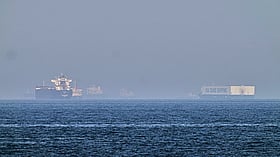
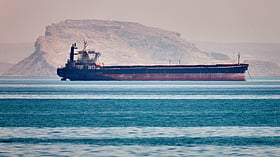
The Strait of Hormuz remains one of the world’s most critical shipping routes, carrying nearly one-fifth of global oil and natural gas supplies.
According to the United States Central Command (CENTCOM), American forces launched retaliatory strikes after three US Navy guided-missile destroyers were targeted by Iranian missiles, drones and small attack boats in the strait, the Al Jazeera reported.
Earlier, Iran’s Khatam al-Anbiya Central Headquarters accused the United States of breaching the ceasefire by attacking an Iranian oil tanker and another vessel near the strategic waterway.
Iranian officials also alleged that US strikes targeted civilian areas, including Qeshm Island.
BREAKING: US–Iran conflict escalates again
Iranian media says Tehran targeted US warships near the Strait of Hormuz after an alleged attempt to strike an Iranian oil tanker.
Despite the escalation, US President Donald Trump sought to minimise concerns, insisting that the ceasefire remained in place. Iranian state broadcaster Press TV similarly reported that conditions had “returned to normal”.
Shipping activity in the Strait of Hormuz has remained severely disrupted since late February amid growing fears of attacks on commercial oil tankers operating in the region.
Brent crude prices have now risen roughly 40 per cent since before the conflict began, with analysts estimating a global supply shortfall of approximately 14.5 million barrels per day.
The renewed tensions also weighed on global financial markets. Major Asian indices opened lower on Friday, with Japan’s Nikkei 225, South Korea’s KOSPI and Hong Kong’s Hang Seng Index each declining by more than 1 per cent.
On Wall Street, the benchmark S&P 500 ended the previous session down about 0.4 per cent after reaching a record high a day earlier.
At least five deaths have been reported from different parts of West Bengal since results of the assembly election were declared on Monday, 4 May. The latest casualty is BJP leader and a front runner for the chief minister’s post Suvendu Adhikari’s executive assistant, who was shot dead around 10.20 pm on Wednesday while returning home to Barasat in North 24-Parganas. TMC has claimed three of its workers were killed in the first 48 hours after the counting.On Wednesday, DGP Siddh Nath Gupta brie
On Wednesday, DGP Siddh Nath Gupta briefed the media and confirmed that a total of 200 FIRs had been registered regarding post-poll incidents, leading to the arrest of 433 individuals.
“Since 4 May, after the announcement of results, there have been incidents of violence, including threats, assaults, and intimidation. We have detained more than 1,100 people under preventive measures,” he said, adding that there have been reports of violence and assault since Wednesday morning.
Gupta confirmed two deaths related to post-poll violence – one at Nanoor and another at New Town, Rajarhat on the outskirts of Kolkata. “We are investigating both cases. We have been able to arrest those involved in these two murders,” he said.
Responding to allegations made by Trinamool Congress that BJP workers had unleashed the violence, BJP state president Samik Bhattacharya had said that internal squabbles within TMC were responsible for the violence. Trinamool workers were misusing BJP’s flags, he alleged, while engaging in violence. “TMC is attacking TMC…," he was quoted as saying.
There are indications that a section of TMC workers, out of fear or otherwise, have overnight changed colours and switched their loyalty. Visuals of policemen and state government employees dancing while shouting slogans of Jai Shri Ram have been circulating.
A state government employee, a Left Front supporter, confided that he had been advised by colleagues to lie low and shout JSR slogans in order to escape attention to his political affiliation. Doubts are also being expressed over the possibility of people settling personal scores and local business rivals using the turmoil after the election to vandalise property of competitors.
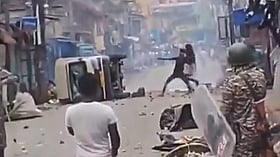
However, the role of the CAPF too has come under increasing scrutiny as visuals of the CAPF standing by while mobs resort to violence have also been circulating. The armed troops seem to be under instructions not to intervene.
Day 1 of regime change in Bengal:
Bulldozer razes TMC office near Kolkata's iconic New Market. Muslim-run Biriyani shop near a temple told to pack up. Muslim names of parks, roads erased. Eidgah vandalized. @Shinjineemjmdr reports. https://t.co/JjmdRmNEc6
Who says the @ECISVEEP SIR deletions didn’t have an impact on West Bengal polls 2026? Just look at how carefully targeted the exclusions were. Very revealing chart here . Thanks for sharing @AnantGuptaAGpic.twitter.com/xnEt6VoKcn
After watching this video, how can anyone still say that India’s Supreme Court and central forces are impartial? Look at how openly the CRPF is covering up for the rioters. All these rioters are so-called BJP workers.
With the Election Commission having sidelined local police in the run up to the elections, the authority of the police appears to have collapsed. This would explain the use of a bulldozer to demolish a TMC office outside the Hogg market known as the New Market in central Kolkata, a stone’s throw from the police headquarters.
Several incidents of violence and vandalism have been recorded in the state over the last three days. Some of them are the following:
Several youths scaled a decorative gateway arch of Masjid Bari Road in Barasat’s Nabapally area, broke off the letterings, and replaced them with a hoarding reading “Netaji Pally”
A park named Siraj Udyan in Champadali, Barasat, was also ‘renamed’ as Shibaji Udyan
Saffron-clad BJP workers approached a biryani shop located next to a temple in Bongaon, North 24 Parganas, and asked the staff to move the shop elsewhere
BJP workers stormed into and vandalised the Lalbagh Eidgah in Murshidabad. In a video circulating online, saffron-clad workers can be seen aggressively breaking a tin barricade and forcing their way into the field amid chants of “Jai Shi Ram”
Shops of Muslim fruit vendors in Uluberia were targeted Muslim-owned shops were vandalised.
In Dinhata, a ‘Bengal Taj Mahal selfie point’ was vandalised & burnt by a mob chanting “Tel lagake Babur ka, Naam mitado Babur ka”
At Jiaganj in north Bengal, a statue of Lenin was broken and dislodged
Several TMC leaders, workers and outgoing ministers were heckled, manhandled and thrashed in different parts of the state
In a free-for-all, party offices of the TMC across the state are being taken over by other parties, including non-BJP parties.
A panchayat of 10 villages in Assam's Barpeta district used to be represented by one MP in the Lok Sabha and one MLA in the state Assembly. The same panchayat will now be represented by two MPs and three MLAs. This bizarre outcome, said journalist Rokibuz Zaman in a video interview to Scroll, was achieved by the Election Commission’s delimitation of constituencies in Assam in 2023.In 2023, ignoring previous guidelines — which laid down that a block or a tehsil, the smallest administrative unit,
A panchayat of 10 villages in Assam's Barpeta district used to be represented by one MP in the Lok Sabha and one MLA in the state Assembly. The same panchayat will now be represented by two MPs and three MLAs. This bizarre outcome, said journalist Rokibuz Zaman in a video interview to Scroll, was achieved by the Election Commission’s delimitation of constituencies in Assam in 2023.
In 2023, ignoring previous guidelines — which laid down that a block or a tehsil, the smallest administrative unit, should not be broken up — the ECI commission made the village the smallest unit and decided to split up panchayats instead. Makes sense?
A look at the map of Assam will indicate a redrawing of political boundaries that disregards natural and geographical barriers. While the idea is to ‘balance’ the number of voters in each constituency to ensure that the value of each vote remains more or less equal, delimitation can also enhance the political advantage of one political party or group of people.
Gerrymandering, to use the American term, was carried out in both Assam and Jammu and Kashmir in 2023. Being opaque and non-justiciable, no legal challenge could be mounted against the process. Having tested it in Assam, the BJP would have foisted it on the rest of the country, had it not failed to get the Delimitation Bill through Parliament on 17 April.
Experts have described the 2023 delimitation of Assam’s parliamentary and Assembly constituencies as the most “consequential and contentious exercise in the state’s recent political history” which, they believe, worked “in favour of the BJP” in the recently-concluded Assembly elections on 9 April.
The devil in Assam’s delimitation exercise lies in its details. Prima facie, the state merely complied with a constitutional mandate to redraw its electoral boundaries to reflect demographic changes. Articles 82 and 170 of the Constitution provided for such readjustment following each census.
However, constitutional amendments in 2001 and 2003 froze the total number of seats in the assembly to 126, permitting only internal reconfiguration based on the 2001 Census. This meant that Assam’s delimitation — conducted nearly 50 years after the last exercise in 1976 — was carried out using outdated demographic data.
Instead of carrying it out under the Delimitation Act, though, the exercise was conducted under Section 8A of the Representation of the People Act, 1950. This provision, specifically crafted for certain northeastern states, empowered the ECI to carry out delimitation once a presidential order lifted the earlier deferments. In February 2020, the President rescinded this deferment, paving the way for the exercise.
For Assam, this meant there was no independent Delimitation Commission, usually headed by a retired Supreme Court judge. Instead, it was the Election Commission which carried out Assam’s delimitation. Without any judicial oversight, Assam’s delimitation exercise was open to manipulation.
****
The exercise classified Assam’s districts into three categories based on population density. It allowed for a 10 per cent deviation from the average state population per constituency. This ensured that sparsely-populated hill districts were not under-represented, while densely populated areas did not dominate.
There were extensive consultations, including deliberations over 1,200 public representations. It also ensured greater representation for Scheduled Tribes and addressed the demands from autonomous and tribal regions. The state government projected the increase in reserved seats for SC and ST as part of its commitment to social justice and inclusion.
According to a retired state government official, deviation from procedure was not the only unique feature of Assam’s delimitation. It also achieved the unstated — yet obvious — objective of diluting the political influence of Muslims and other key minority communities though ‘communal gerrymandering’. This was accomplished through ‘cracking’ (splitting concentrated minority populations), ‘packing’ (consolidating them into a few seats) and ‘stacking’ (merging them with larger majority populations to ensure electoral defeat).
Constituencies like Barpeta saw significant restructuring, including the removal of Muslim-dominated areas and the conversion of the seat into a reserved SC constituency. In Naoboicha, previously a competitive seat with notable minority representation, reservation effectively altered the electoral landscape. In Katigorah, demographic reconfiguration allegedly shifted the constituency’s balance in favour of Hindus.
The net outcome was a sharp reduction in the number of constituencies where Muslim voters enjoyed influence and representation. And when communities lost influence due to delimitation, so did leaders, especially those who were at the receiving end.
“Delimitation made my seat unwinnable,” said veteran Ahom leader and former BJP MP Rajen Gohain, who quit the BJP in late 2025 after serving the party for 30 years during which he represented Nagaon in the Lok Sabha four consecutive times.
Gohain has been vocal against chief minister Himanta Biswa Sarma, accusing him of running the state like a “commercial enterprise” and neglecting marginalised and indigenous communities. He is also confident of winning the 2026 Assembly elections as an Asom Jatiya Parishad (AJP) nominee from Barhampur.
“The Opposition alliance is coming to power in Assam. The undercurrent of dissatisfaction against Himanta Biswa Sarma is now boiling over,” Gohain told National Herald days before counting of votes on 4 May.
The new political equations thrown up by delimitation in Assam manifested in internal bickering within the Assam BJP where Biswa Sarma has inducted and given party nomination to a new set of leaders to fight a rejuvenated Opposition.
According to the Guwahati grapevine, Amit Shah’s observation during an internal meeting that Congress-turned-BJP leader and minister Pijush Hazarika had managed to secure nomination for 15 of his followers — out of the 90 seats the BJP contested — did not go down well with Biswa Sarma.
To diminish Hazarika’s growing stature, Biswa Sarma began promoting Jayanta Malla Barman, Hazarika’s bête noire since their NSUI days, making Barman the point of contact for alliance partners like the Bodoland People’s Front (BPF) and AGP (Asom Gana Parishad). Hazarika’s role was whittled down to fund and media management.
The BJP’s alliance with the BPF also meant the latter would have a greater say on the syndicates that controlled the flow of traffic through the Srirampur entry gate on the West Bengal-Assam border — a role Hazarika reportedly played with elan.
Assam’s old guard did not hide their dissatisfaction, with veteran BJP leaders like Gautam Das openly revolting against Biswa Sarma to contest as independent candidates.
While the BJP waxes euphoric over a clear-cut win in Assam, the buzz over a possible Opposition victory — captured in a number of exit polls — is getting stronger. Biswa Sarma is clearly fronting a political party that is divided, bruised and propped up by local interests, rather than steered by a grand vision for the state.
If tailored electoral rolls and redrawn constituency maps combined with shrill communal rhetoric do not yield the desired results for the BJP, the knives will soon be out for Assam’s beloved ‘mama’.
Sourabh Senis a Kolkata-based independent writer and commentator on politics, human rights and foreign affairs. More of his writing here
The Congress on Friday accused the BJP-led governments at the Centre and in Manipur of being responsible for the “total breakdown” of law and order in the state, a day after armed militants attacked and burnt several houses in Naga villages near the India-Myanmar border.State Congress president O. Ibobi Singh questioned the role of the Assam Rifles, which functions under the Union home ministry and is tasked with guarding the international border in Manipur, Mizoram and Nagaland.Pointing out tha
The Congress on Friday accused the BJP-led governments at the Centre and in Manipur of being responsible for the “total breakdown” of law and order in the state, a day after armed militants attacked and burnt several houses in Naga villages near the India-Myanmar border.
State Congress president O. Ibobi Singh questioned the role of the Assam Rifles, which functions under the Union home ministry and is tasked with guarding the international border in Manipur, Mizoram and Nagaland.
Pointing out that Assam Rifles personnel were stationed close to the site of Thursday’s attack, Singh asked why the force had “remained a mute spectator”.
“The Assam Rifles are stationed near yesterday's incident site. Who is in charge of the law-and-order situation in the state? Is it the state government or the Central government? They cannot turn away or escape their responsibility,” he said.
His remarks came a day after heavily armed militants, allegedly from Myanmar, attacked and torched several houses in the border Naga villages of Namlee, Wanglee and Choro in Kamjong district, located less than one kilometre from the International Border.
Ruling Naga Peoples’ Front MLA L. Keishing had claimed the attack was carried out from across the border by the Kuki National Army (Burma) and the Peoples’ Defence Force.
Singh said the nature of the attack pointed to a serious collapse in security irrespective of whether it was an external or internal threat. “Whether it is external aggression as alleged by a ruling party MLA or an internal aggression, it is a total failure of law and order. Recently, two children were killed in a bomb attack in Tronglaobi,” he said.
“We heard that a few unarmed Manipur police personnel were deployed at the site while the militants were heavily armed with sophisticated weapons. This shows the state government is not serious about the people of Kamjong district, whereas the Assam Rifles is just a mute spectator.”
The three-time former chief minister alleged that both the state and Union governments were equally accountable for the continuing violence in the state. “The state and Central governments are equally responsible for what is happening in Manipur,” Singh said.
Manipur has remained tense since ethnic clashes broke out between the Meitei and Kuki communities in May 2023, with the conflict spreading to other communities since then. The violence has so far claimed at least 260 lives and displaced thousands of people across the state.
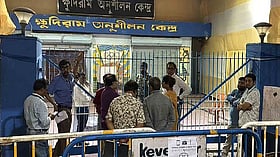
The All India Trinamool Congress (TMC) on Saturday alleged irregularities in the handling of postal ballots in West Bengal and lodged a complaint with the Election Commission of India (EC).The allegation is based on an incident at the Khudiram Anushilan Kendra in Kolkata, where electronic voting machines (EVMs) from several assembly constituencies are stored. TMC workers stationed outside the strongroom claimed that eight boxes containing postal ballots were brought in around 4 am and taken to a
The All India Trinamool Congress (TMC) on Saturday alleged irregularities in the handling of postal ballots in West Bengal and lodged a complaint with the Election Commission of India (EC).
The allegation is based on an incident at the Khudiram Anushilan Kendra in Kolkata, where electronic voting machines (EVMs) from several assembly constituencies are stored. TMC workers stationed outside the strongroom claimed that eight boxes containing postal ballots were brought in around 4 am and taken to a room without CCTV coverage.
Party leaders said they had consistently demanded comprehensive surveillance of all EVMs and postal ballots, and alleged that moving the boxes outside camera range raised serious concerns about transparency.
Tensions escalated at the site when Purnima Chakraborty, a candidate of the Bharatiya Janata Party (BJP) from Shyampukur, arrived with her supporters. Both sides exchanged slogans, prompting police intervention to maintain order. Chakraborty accused TMC workers of creating unrest out of fear of defeat.
A complaint has been filed with the Election Commission of India against the Returning Officer at Khudiram Anushilan Kendra. The party has sought urgent intervention over allegations of unauthorised sorting of postal ballot covers: TMC pic.twitter.com/12aLIlswJ1
TMC has filed a complaint against the Returning Officer of Khudiram Anushilan Kendra, seeking urgent intervention over allegations of unauthorised sorting of postal ballot covers. pic.twitter.com/SmeGLcgB6J
A similar protest unfolded at Barasat Government College in North 24 Parganas district, where TMC supporters alleged that CCTV cameras outside a strongroom had been switched off for 17 minutes. The party’s Ashoknagar candidate, Narayan Goswami, reached the spot and sought access to the premises.
Election officials, however, denied any lapse in surveillance, stating that the cameras were functioning properly and that only the external monitor wires had been damaged. They added that the recorded footage for the period in question would be made available to political parties upon request.
Meanwhile, the BJP circulated a video purportedly showing a man scaling the wall of a building in East Bardhaman district where EVMs were stored. The EC dismissed the clip as outdated, clarifying that the individual was part of a team installing CCTV cameras and air-conditioning units.
The allegations come just days before the counting of votes, heightening political tensions in the state as parties remain on edge over the integrity of the process.
The UAE’s decision to walk out of OPEC and OPEC+ is not just about oil. It represents a blunt geopolitical rupture. Abu Dhabi is no longer disguising its rivalry with Saudi Arabia nor walking a tightrope between regional camps. It is openly gravitating towards a new axis consisting of the US, Israel and increasingly India — and this high-risk strategy is deepening conflict lines across regions already on edge.OPEC, created in 1960, was designed to coordinate oil production and give oil-producing
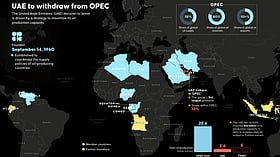
The UAE’s decision to walk out of OPEC and OPEC+ is not just about oil. It represents a blunt geopolitical rupture. Abu Dhabi is no longer disguising its rivalry with Saudi Arabia nor walking a tightrope between regional camps. It is openly gravitating towards a new axis consisting of the US, Israel and increasingly India — and this high-risk strategy is deepening conflict lines across regions already on edge.
OPEC, created in 1960, was designed to coordinate oil production and give oil-producing countries collective control over global prices. OPEC+ came into being in 2016 to fold in 10 other countries, including big producers like Russia. For decades, Saudi Arabia dominated both structures, using them as instruments of economic and geopolitical influence. The UAE’s exit strips away part of that leverage and signals that Abu Dhabi no longer accepts Riyadh’s leadership, not just in oil but in the broader regional order.
The economic argument for leaving is straightforward. The UAE wants to produce more oil than OPEC quotas allow because the Iran war has put its economy under great strain. It wants to monetise its reserves quickly, to hedge against a future where fossil fuel demand has declined. But this is only the surface. What lies underneath is a deeper strategic break with Saudi Arabia, stretching across energy policy, military alliances and global partnerships.
The Abraham Accords of 2020 marked a significant geopolitical shift, with the UAE normalising relations with Israel and building cooperation in trade, technology and security. In contrast, Saudi Arabia declined to join the Accord, with Crown Prince Mohammed bin Salman maintaining that normalisation of ties with Israel would be contingent on the establishment of a Palestinian state and broader regional considerations.
This divergence between the UAE and Saudi Arabia is growing, and it shows in their external alignments.
Deserted OPEC headquarters in Vienna
Where Saudi Arabia is strengthening ties with Pakistan through a formal defence partnership, the UAE is moving closer to India, expanding cooperation in defence, intelligence, energy and technology, while also embedding itself deeper into a shared strategic space with Israel.
The United States has quietly encouraged this shift. Washington has long viewed OPEC as an obstacle to lower oil prices and greater Western leverage over energy markets. By leaving OPEC, the UAE weakens the cartel’s collective ability to control supply and pricing, opening space for increased Emirati production and greater market volatility that could benefit American oil producers.
Abu Dhabi’s move aligns neatly with broader US strategic interests: weakening Saudi-dominated oil coordination, reducing OPEC’s influence and committing the UAE more deeply to a US-led geopolitical and economic order.
The UAE’s growing proximity to India is also not just economic. It is political and strategic as well and carries serious implications. Abu Dhabi has chosen to align itself with a government in New Delhi whose domestic and regional policies have caused deep concern in the Muslim world. At the same time, India has been moving closer to Israel, expanding defence cooperation, intelligence sharing and technological partnerships.
The convergence of interests — seen in evolving UAE–India ties and India–Israel relations—is not accidental but part of an opportunistic geopolitical realignment that prioritises security cooperation and economic gain without bothering with notions of accountability and justice or a rules-based order.
The UAE’s relations with Pakistan have deteriorated sharply. Abu Dhabi has scaled back financial support, cooled diplomatic engagement and withdrawn from investment commitments. Pakistan was asked to pay back the entire UAE debt of $3.5 billion in April.
So, the UAE–Saudi rivalry will extend beyond West Asia, and what was once a regional competition is now entangled with India–Pakistan dynamics, creating overlapping fault lines. Instead of trying to reduce tensions, the UAE is embedding itself firmly on one side of a deeply polarised geopolitical divide.
Crown Prince Mohammed bin Salman Al Saud of Saudi Arabia
The UAE’s broader foreign policy reinforces this pattern. From Yemen to Libya, from Ethiopia and Sudan to the Horn of Africa, Abu Dhabi has pursued influence through strategic investments, military interventions and even proxy actors.
In Yemen, it backed separatist groups that clashed with Saudi-supported forces. In Sudan, it supports paramilitary actors accused of terrible atrocities. In Libya, it armed and financed a rival strongman. It has forged ties with Somaliland. All these actions have entrenched division.
The UAE frames its activism as a fight against extremism and disorder. But the reality is more troubling. It has continued to expand economic, technological and military cooperation with Israel despite its horrific genocidal project in Gaza. Trade has grown and defence and intelligence ties have deepened. The Iran war has only hardened Abu Dhabi’s conviction that its security lies with Israel and the US, not with Arab institutions.
The addition of India to this axis intensifies the problem. By aligning with Netanyahu-led Israel and Modi-led India while distancing itself from traditional partners, the UAE risks deepening divisions across West and South Asia. It also risks undermining its own credibility. A state that claims to promote tolerance cannot indefinitely ignore the implications of its alliances.
Saudi Arabia is not without fault. Its own interventions and ambitions have contributed to regional instability. But the UAE’s challenge is not a progressive alternative. It is a competing model of authoritarian power projection. The rivalry between the two is less about ideology and more about who will dominate the next phase of regional politics.
The risk is that this competition, now intertwined with India-Pakistan dynamics and reinforced by external alliances, will deepen instability across multiple regions. Yemen, Sudan and Libya are already paying the price. South Asia could become another arena for Gulf rivalries to play out.
Ashok Swainis a professor of peace and conflict research at Uppsala University, Sweden. More by the author here
The Communist Party of India (Marxist) on Monday termed the latest round of Assembly election results a “serious setback” for the Left, especially in Kerala, while cautioning that the BJP’s expanding footprint across states presents a broader challenge to secular politics and the Opposition INDIA bloc.The CPI(M) said the outcomes in West Bengal, Assam and Puducherry signal the “ascendancy of right-wing communal forces led by the BJP,” calling it “a matter of deep concern for all secular, progres
The Communist Party of India (Marxist) on Monday termed the latest round of Assembly election results a “serious setback” for the Left, especially in Kerala, while cautioning that the BJP’s expanding footprint across states presents a broader challenge to secular politics and the Opposition INDIA bloc.
The CPI(M) said the outcomes in West Bengal, Assam and Puducherry signal the “ascendancy of right-wing communal forces led by the BJP,” calling it “a matter of deep concern for all secular, progressive and democratic forces.”
Addressing a press conference, CPI(M) general-secretary M.A. Baby said the results highlight “two major features”: the defeat of the Left Democratic Front (LDF) in Kerala after a decade in power, and the BJP’s growing strength in states such as West Bengal, Assam and Puducherry.
“The LDF was defeated in Kerala after ten years of continuous rule, during which it had done its best for the welfare of the people despite financial constraints imposed by the BJP-led Union government,” he said, adding that the party would undertake a “comprehensive introspection” to understand the reasons behind the reversal.
The party also flagged a shift in Tamil Nadu’s political landscape, where actor-politician Vijay’s outfit has emerged as a significant force, denting the DMK-led alliance. “A new political force is inching towards power, reducing other parties to a minority. This is a new development whose implications will have to be watched,” Baby said.
On West Bengal, he alleged that the BJP’s gains were driven by several factors, including “strong anti-incumbency against the corrupt” Trinamool Congress government, along with “communal polarisation, huge money power and misuse of Central agencies, including the Election Commission of India.”
“Even in such a polarised situation, the Left has marginally improved its performance. In over 30 constituencies, our position has improved, though we expected a far better outcome,” he said.
Despite the setbacks, Baby emphasised that the Left retains relevance in national politics, pointing to its organisational base and grassroots reach. “The Left continues to have a strong presence among workers, peasants and unorganised sectors. But we have to examine why this is not adequately translating into electoral gains,” he said.
— All India Trinamool Congress (@AITCofficial) May 4, 2026
He also defended the LDF government’s record in Kerala, citing achievements such as the elimination of extreme poverty. “Kerala is the only state where extreme poverty has been eliminated. These are tangible accomplishments, but we must still understand the people's verdict,” he added.
According to Baby, the results carry wider implications for opposition politics and the INDIA bloc, formed to counter the BJP. While acknowledging “problems” within the alliance, he maintained that its core framework remains intact.
“The INDIA bloc is a political-tactical line to isolate and defeat the BJP. There will be contradictions because different parties operate in different states and sometimes contest against each other. But that does not weaken the broader objective,” he said.
Referring to states like Delhi, Kerala and West Bengal — where alliance partners have contested separately — he said such situations reflect the “complex federal nature of Indian politics.”
“Even when we fight each other, it should be in a manner that does not benefit the BJP. That has to be the guiding principle,” he added.
Asked whether the lack of Opposition unity in states such as West Bengal aided the BJP, Baby said the issue would be reviewed internally. “These are questions the party will examine. There were arrangements earlier; this time, there were none. We will review all such decisions,” he said.
Looking ahead, the CPI(M) said its Politburo and Central Committee will carry out a detailed assessment of the results and devise a strategy to respond to the “new political situation.”
“The task remains to expose, isolate and defeat the BJP and its policies. For that, cooperation among secular democratic forces will continue, both inside and outside Parliament,” Baby added.
US forces overnight fired on and disabled two Iranian oil tankers after an exchange of fire with Iranian forces in the Strait of Hormuz, while the United Arab Emirates reported fresh Iranian missile and drone attacks.The developments on Friday, 8 May further deepened uncertainty over a fragile month-old ceasefire that Washington maintains remains in force. The United States is meanwhile awaiting Iran’s response to its latest proposal aimed at ending the conflict, reopening the strategic waterway
US forces overnight fired on and disabled two Iranian oil tankers after an exchange of fire with Iranian forces in the Strait of Hormuz, while the United Arab Emirates reported fresh Iranian missile and drone attacks.
The developments on Friday, 8 May further deepened uncertainty over a fragile month-old ceasefire that Washington maintains remains in force. The United States is meanwhile awaiting Iran’s response to its latest proposal aimed at ending the conflict, reopening the strategic waterway and curbing Tehran’s disputed nuclear programme.
US Secretary of State Marco Rubio said he hoped to receive “a serious offer” from Iran later on Friday.
The US military said its forces disabled two Iranian tankers that were attempting to breach an American blockade on Iranian ports. Hours earlier, it said US forces had thwarted attacks on three Navy ships in the strait and launched retaliatory strikes on Iranian military facilities.
Iran has largely blocked the crucial shipping route for global energy supplies since the US and Israel launched military operations on 28 February, triggering sharp increases in fuel prices and unsettling global financial markets. Washington has in turn imposed its own blockade on Iranian ports.
The UAE’s defence ministry said three people were wounded after air defences engaged two ballistic missiles and three drones launched by Iran. It was not immediately clear whether all the projectiles had been intercepted.
US-Iran Naval Clashes Escalate in Strait of Hormuz as Tehran Threatens Global Oil Flows
US and Iranian forces exchanged fire again in the Strait of Hormuz as tensions surged despite a fragile ceasefire. CENTCOM confirmed strikes on Iranian-flagged tankers, while Iran seized… pic.twitter.com/6g7EUl3M3G
The US military released footage showing American fighter jets striking the smokestacks of the two Iranian tankers on Friday. Earlier this week, a US military aircraft reportedly disabled the rudder of another tanker that Washington claimed had tried to violate the blockade.
Late on Thursday, the US military said it had prevented Iranian attacks on three Navy vessels in the Strait of Hormuz and carried out strikes on Iranian military targets in response. It said no American ships were hit. “They threaten Americans, they are going to be blown up,” Rubio told reporters on Friday.
Iran’s foreign ministry condemned what it described as “hostile” US military action, saying it violated the ceasefire agreement. “Every time a diplomatic solution is on the table, the US opts for a reckless military adventure,” Iranian foreign minister Abbas Araghchi wrote on X.
A US strike overnight killed at least one sailor and injured 10 others aboard a cargo vessel that caught fire, according to a news agency affiliated with Iran’s judiciary. It remained unclear whether the vessel was one of the two tankers acknowledged by the US military.
⚡️JUST IN
Iran struck Dubai International Airport overnight
A video filmed at 7 a.m. local time shows a cloud of smoke rising from Dubai International Airport
US President Donald Trump has continued to insist that the ceasefire remains intact, while also warning that Washington could resume large-scale bombing if Tehran refuses to accept terms to reopen the strait and scale back its nuclear programme.
Pakistani Prime Minister Shehbaz Sharif said Islamabad had been in constant contact with both Washington and Tehran “day and night” in an attempt to preserve the ceasefire and secure a broader peace agreement.
Satellite images reviewed by the Associated Press appeared to show a major oil slick spreading in the Persian Gulf from the western side of Kharg Island, Iran’s main crude export terminal.
Images captured on Friday showed the slick covering around 71 square kilometres and suggested oil was continuing to leak from the terminal, according to Ami Daniel, chief executive of maritime intelligence firm Windward AI.
Every time a diplomatic solution is on the table, the U.S. opts for a reckless military adventure. Is it a crude pressure tactic? Or the result of a spoiler once again duping POTUS into another quagmire?
Daniel estimated that the equivalent of roughly 80,000 barrels of oil had spilled from Kharg Island since the slick was first detected in satellite imagery on Tuesday. The cause of the spill remains unknown and could involve a malfunction, an airstrike or another factor.
“This is the risk of fighting in an oil-rich area,” Daniel said, adding that any clean-up operation was unlikely while Gulf waters remained an active conflict zone. He said the slick appeared to be drifting southwest and could potentially reach the coastlines of the UAE, Qatar or Saudi Arabia within two weeks.
Nina Noelle, an international crisis operations expert with Greenpeace Germany, said more recent imagery suggested the spill was beginning to disperse and might not ultimately make landfall, though sensitive marine ecosystems could still be affected. “More likely, it will dissipate offshore under prevailing conditions,” Noelle said.
The Pentagon declined to comment on whether the US military was monitoring the spill or whether recent strikes had targeted Kharg Island. Based on earlier satellite imagery, the spill appeared to have begun before the latest round of US attacks.
Rubio also criticised Iran’s reported creation of a government body to regulate and tax ships transiting the Strait of Hormuz.
JUST IN: Massive oil spill detected in Strait of Hormuz near Iran's Kharg Island, satellite image shows. pic.twitter.com/DuRX3nsUuO
Shipping data firm Lloyd's List Intelligence reported on Thursday that Tehran had established the Persian Gulf Strait Authority. The move has intensified concerns over international shipping, with hundreds of commercial vessels reportedly stranded in the Persian Gulf and unable to access open waters.
“Is the world going to accept that Iran now controls an international waterway?” Rubio said. “What is the world prepared to do about it?”
Iran has effectively shut the strategic waterway — vital for transporting oil, gas, fertiliser and petroleum products — while the US continues its blockade of Iranian ports.
A Chinese-crewed oil tanker was also reportedly attacked near the strait. China, despite the disruption, has continued importing Iranian oil. China’s foreign ministry expressed concern over the incident, noting that the tanker was registered in the Marshall Islands and carried a Chinese crew. No casualties were reported.
Meanwhile, an oil tanker that transited the Strait of Hormuz in mid-April arrived off the South Korean coast on Friday carrying one million barrels of crude oil. South Korea, which imported more than 60 per cent of its crude through the strait last year, has imposed caps on petrol and other petroleum product prices.
Three alleged sharpshooters arrested from Uttar Pradesh in connection with the assassination of Chandranath Rath — close aide and personal assistant to senior BJP leader Suvendu Adhikari — will be produced before a district court in Barasat on Monday as investigators intensify their probe into the sensational killing.The trio was arrested by the Special Investigation Team (SIT) of the West Bengal Police, which has been probing the murder that sent shockwaves through the state’s political landsca
Three alleged sharpshooters arrested from Uttar Pradesh in connection with the assassination of Chandranath Rath — close aide and personal assistant to senior BJP leader Suvendu Adhikari — will be produced before a district court in Barasat on Monday as investigators intensify their probe into the sensational killing.
The trio was arrested by the Special Investigation Team (SIT) of the West Bengal Police, which has been probing the murder that sent shockwaves through the state’s political landscape just days after the assembly election results.
Sources in the state police said the prosecution would seek police custody of the accused for detailed interrogation regarding the conspiracy, logistics and possible masterminds behind the assassination.
Investigators, however, have chosen to keep the identities of the arrested sharpshooters under wraps until they are formally presented in court and remanded to police custody. Officials have also declined to disclose the exact location in Uttar Pradesh from where the accused were picked up.
According to sources, the three men were quietly brought to Kolkata late Sunday night and taken directly to Bhabani Bhavan, the state police headquarters in south Kolkata, where they were interrogated through the night.
Rath was gunned down on the night of 6 May, barely two days after the results of the fiercely contested West Bengal Assembly elections were declared. The BJP secured victory in 207 constituencies, reducing the ruling All India Trinamool Congress to just 80 seats.
Police said Rath was returning home to Madhyamgram in North 24-Parganas district after attending a party programme when his vehicle was intercepted at a crossing by a four-wheeler.
Preliminary investigation revealed that two motorcycles had been tailing Rath’s car for a considerable distance before the attack.
As Rath’s vehicle slowed after being blocked by the four-wheeler, one of the motorcycles pulled up alongside. The pillion rider allegedly opened fire from point-blank range, pumping around 10 bullets into Rath.
Rath died on the spot, while his driver, Buddhadeb Bera, sustained critical injuries. Police sources said Bera’s condition has since improved significantly.
Investigators later discovered that the registration numbers used on the four-wheeler and the two motorcycles involved in the operation were fake, indicating meticulous planning behind the attack.
Adhikari has alleged that Rath was targeted because of his political association with him, claiming the killing would not have happened had Rath not been the aide of the leader who defeated chief minister Mamata Banerjee from the Bhabanipur constituency by a margin of over 15,000 votes.
The SIT is now probing whether the assassination was a contract killing linked to political rivalry and is trying to identify those who financed and orchestrated the operation.
Congress leader Pawan Khera on Sunday welcomed the Supreme Court’s decision granting him anticipatory bail, calling it a reaffirmation of constitutional protections for those “fighting against an oppressive government”.The relief came after the Supreme Court of India on 1 May allowed Khera’s plea in connection with an FIR over his alleged remarks against Riniki Bhuyan Sarma, wife of Assam chief minister Himanta Biswa Sarma.Speaking to IANS at the Delhi airport, where he received a warm welcome f
Congress leader Pawan Khera on Sunday welcomed the Supreme Court’s decision granting him anticipatory bail, calling it a reaffirmation of constitutional protections for those “fighting against an oppressive government”.
The relief came after the Supreme Court of India on 1 May allowed Khera’s plea in connection with an FIR over his alleged remarks against Riniki Bhuyan Sarma, wife of Assam chief minister Himanta Biswa Sarma.
Speaking to IANS at the Delhi airport, where he received a warm welcome from party workers, Khera credited the Constitution for safeguarding individual rights.
“The Constitution helps everyone. Whenever someone is in trouble or fighting against an oppressive government, B.R. Ambedkar’s Constitution ensures protection. The relief I received is also because of the same Constitution,” he said.
A Bench of justices J.K. Maheshwari and Atul S. Chandurkar set aside the Gauhati High Court’s earlier order denying pre-arrest protection, underscoring that individual liberty under Article 21 cannot be compromised lightly.
The court allowed anticipatory bail, directing that Khera be released in the event of arrest, subject to reasonable conditions set by the investigating officer.
He has been asked to cooperate with the probe, appear before authorities when required, refrain from influencing witnesses or tampering with evidence, and not leave the country without prior court permission.
The Congress termed the ruling a significant reaffirmation of civil liberties. Party leaders Jairam Ramesh and Abhishek Manu Singhvi said the judgment reinforces the principle that arrest should be a last resort, particularly in defamation-related cases.
“Personal liberty remains paramount, and arrest must not be routine but a last resort,” they said at a press conference.
Singhvi, who represented Khera, highlighted the “triple test” for arrest — risk of flight, tampering with evidence, or influencing witnesses.
“Without these, custodial action risks becoming a tool for humiliation, harassment and political point-scoring,” he said.
Ramesh added that the ruling strengthens faith in the judiciary.
“It shows that the flame of justice is very much alive in our country,” he remarked.
The case continues to draw political attention, with the Supreme Court’s order placing renewed focus on the balance between investigation and individual liberty.
Kolkata witnessed scenes of massive celebration, political theatre and severe disruption on Saturday as Suvendu Adhikari took oath as West Bengal’s first BJP Chief Minister at the historic Brigade Parade Ground.While BJP supporters described the day as “historic”, the grand ceremony also exposed significant organisational strain, strict restrictions and widespread inconvenience across large parts of the city.From early morning, lakhs of supporters flooded central Kolkata carrying saffron flags,
Kolkata witnessed scenes of massive celebration, political theatre and severe disruption on Saturday as Suvendu Adhikari took oath as West Bengal’s first BJP Chief Minister at the historic Brigade Parade Ground.
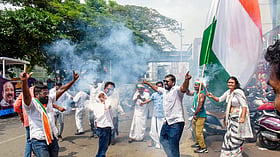
From early morning, lakhs of supporters flooded central Kolkata carrying saffron flags, beating drums and chanting “Jai Shri Ram”. Roads around the Maidan, Esplanade and Hastings areas became heavily congested long before Prime Minister Narendra Modi arrived at the venue.
Despite the swearing-in ceremony being projected as open to the public, many supporters were left angry after being denied entry to the Brigade grounds because they lacked official identity cards distributed by local BJP leaders and organisers.
Large queues formed outside multiple entry gates from morning onwards. Police and central forces conducted rigorous security checks, allowing entry only to those carrying approved passes or identification documents.
Several supporters who had travelled overnight from districts such as Bankura, Purulia and Cooch Behar alleged that they were unable to enter despite arriving hours in advance.
One frustrated BJP worker from East Midnapore said, “We came all the way to see Suvendu babu become Chief Minister, but without the party card they would not let us enter. We waited for hours outside.”
Police sources indicated that thousands of people remained outside the barricaded areas during the ceremony as security agencies refused to relax entry protocols because of the presence of high-profile VVIPs, including Modi, Amit Shah and several Chief Ministers.
The entire Brigade area resembled a fortified security zone. The ground was divided into around 35 sectors, with IPS officers supervising different blocks. Drones monitored crowds continuously while police personnel occupied rooftops of surrounding buildings.
Attendees were prohibited from carrying umbrellas, bags or even water bottles into the venue. In the intense afternoon heat, many supporters complained of discomfort after being forced to discard water bottles at entry points.
An elderly supporter standing outside one of the gates said, “We understand security is important, but people have been standing in the sun for hours without water.”
Central forces and the Special Protection Group maintained a tight cordon around VVIP enclosures, where nearly 40 high-profile guests were seated.
The scale of the celebration and the sweeping security restrictions threw Kolkata traffic badly out of gear for most of the day.
Major roads surrounding the Maidan, including stretches near Victoria Memorial, Cathedral Road, Kidderpore Road and AJC Bose Road, faced severe congestion from morning till evening.
Goods vehicles were barred from entering large parts of the city between 4 am and 8 pm. Although emergency vehicles were exempted, commuters reported unusually long delays across central Kolkata.
Officegoers, patients travelling to hospitals and ordinary commuters found themselves stranded for hours as roads were repeatedly stopped to facilitate VVIP movement.
A taxi driver near Esplanade remarked bitterly, “Today the whole city became a political stage. Ordinary people suffered the most.”
Public buses moved slowly through packed roads while many commuters chose to walk long distances after traffic diversions left several routes paralysed.
Inside Brigade, the atmosphere remained deeply political and heavily symbolic. BJP supporters danced to dhak beats, blew conch shells and shouted religious slogans while saffron flags covered large sections of the ground.
Food stalls selling jhalmuri, sitabhog and mihidana did brisk business throughout the day. However, several attendees noticed that non-vegetarian food was entirely absent from the venue and surrounding organised stalls despite Bengal’s strong culinary association with fish and meat dishes.
Party organisers appeared to consciously project a culturally controlled and devotional atmosphere around the event, especially as the ceremony coincided with the birth anniversary of Rabindranath Tagore.
One attendee commented quietly, “It felt more like a religious-political gathering than a typical Bengal public event. Everything was very carefully curated.”
While Brigade erupted in celebration, the atmosphere outside the residence of former Chief Minister Mamata Banerjee at Harish Chatterjee Street was subdued and tense.
The roads there appeared unusually empty except for police personnel, paramilitary troops and a small group of Trinamool supporters who had gathered outside her residence.
Prime Minister Modi’s arrival generated some of the loudest cheers of the day. Travelling in a flower-decorated open-top vehicle, he acknowledged supporters continuously as chants and drumbeats echoed through the grounds.
On stage, Modi first offered floral tributes to Rabindranath Tagore before performing a full sastanga pranam to the people of Bengal — a gesture many BJP workers described as deeply emotional and politically significant.
The Prime Minister later posted a video of the moment on social media, writing that he bowed before the “people’s power of West Bengal”.
For BJP supporters, the ceremony marked the fulfilment of a long political journey in Bengal. Yet beneath the celebration, the day also revealed the immense logistical pressure, security anxieties and public disruption that accompanied the transfer of power.
As crowds finally dispersed from Brigade Parade Ground, Kolkata was left exhausted after a day that combined triumph, tension, symbolism and chaos in almost equal measure.
Suvendu Adhikari being sworn in as the new chief minister
A two-year-old tiger was found dead in the buffer zone of Panna Tiger Reserve on 5 May, taking the number of tiger deaths in Madhya Pradesh to 28 since 7 January this year.Forest officials said the carcass was recovered from the Amanganj buffer area. The animal had recently been rescued from Tara village and was fitted with a radio collar for continuous monitoring.Brijendra Srivastava, field director of Panna Tiger Reserve said the carcass was intact and no signs of foul play were immediately de
A two-year-old tiger was found dead in the buffer zone of Panna Tiger Reserve on 5 May, taking the number of tiger deaths in Madhya Pradesh to 28 since 7 January this year.
Forest officials said the carcass was recovered from the Amanganj buffer area. The animal had recently been rescued from Tara village and was fitted with a radio collar for continuous monitoring.
Brijendra Srivastava, field director of Panna Tiger Reserve said the carcass was intact and no signs of foul play were immediately detected.
“The situation will become clear only after a detailed inspection of the site,” Srivastava said.
Activist alleges ‘systemic collapse’
Wildlife activist Ajay Dube termed the incident a failure of forest management, linking it to repeated tiger deaths in the state.
“This isn't just unfortunate — it's a systemic collapse. The lack of stern action against forest officials is the root cause of these repeated killings.
High-tech collars mean nothing if the boots on the ground aren't doing their jobs,” Dube said in a post on X.
Rising tiger deaths in Madhya Pradesh
According to the National Tiger Conservation Authority, a total of 28 tiger deaths have been recorded in Madhya Pradesh so far this year, beginning with the first fatality reported on 7 January at the Bandhavgarh reserve.
Madhya Pradesh, which has nine tiger reserves, recorded 785 tigers in the 2022 census — the highest in the country.
Authorities said further details on the cause of death would be known after post-mortem and site examination.
carcass was intact and no signs of foul play were immediately detected.

 Login
Login