• Gohar announces ‘black day’ on new govt’s swearing in• Seeks re-election in Astore; says party brought evidence of ‘167 bogus votes’ to presiding officer’s attention• Opposition alliance also rejects results, describes them ‘action replay’ of 2024 general polls
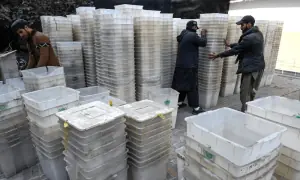
ISLAMABAD: Rejecting the results of the Gilgit-Baltistan elections, the PTI announced on Monday that it would issue a white paper detailing “electoral irregularities” and also observe a ‘black day’ when the newly elected lawmakers of th
• Gohar announces ‘black day’ on new govt’s swearing in • Seeks re-election in Astore; says party brought evidence of ‘167 bogus votes’ to presiding officer’s attention • Opposition alliance also rejects results, describes them ‘action replay’ of 2024 general polls
ISLAMABAD: Rejecting the results of the Gilgit-Baltistan elections, the PTI announced on Monday that it would issue a white paper detailing “electoral irregularities” and also observe a ‘black day’ when the newly elected lawmakers of the region take their oath of office.
Addressing a press conference, PTI Chairman Barrister Gohar Ali Khan said that the party’s primary agenda was to address “widespread irregularities” in the GB elections held on Sunday. He claimed that PTI was barred from campaigning in the days leading up to the election, alleging that it was part of a “planned arrangement aimed at eliminating the party from the polls”.
He said that out of the region’s 24 seats, PTI-backed candidates were leading in two constituencies — Naik Karim in Hunza and Sohail Abbas in Gilgit — while their ally Majlis Wahdat-i-Muslimeen’s Muhammad Kazim was ahead in Skardu.
However, he claimed that PTI-backed candidates were “winning 100 per cent” in a total of eight constituencies — one seat from Astore, one from Diamer, two from Nagar, and one from Ghizer. He alleged that due to “rigging, vote-stuffing, and the casting of bogus votes”, the PTI’s “victory” was overturned.
The PTI chairman said the party had demanded a re-election in Rehmanpur, Astore, stating that they had brought evidence of “167 bogus votes” to the presiding officer’s attention.
“The PTI rejects the process, results and vote count of this election,” the PTI chairman said, stressing that “once again, people who did not have the people’s mandate have been given a false mandate”, in an apparent reference to the 2024 general polls.
He also demanded that out of the six seats reserved for women and the three allocated for technocrats, the PTI should be given one from each category. Barrister Gohar also outlined plans to hold a protest in GB after consulting the PTI’s political allies.
Separately, the opposition alliance Tehreek-i-Tahafuz Ayeen-i-Pakistan (TTAP) held a consultative meeting under the chairmanship of Opposition Leader in the National Assembly Mehmood Khan Achakzai. During the huddle, the alliance condemned efforts aimed at “keeping the PTI out of the democratic process” in the GB elections.
In a statement, the TTAP called the GB elections an “action replay” of the 2024 general elections. “When the decisions are going to be made elsewhere, then what is the point of holding elections?” the statement said, adding that in the aftermath of the elections, “neither the election commission nor the electoral process had any credibility left”.
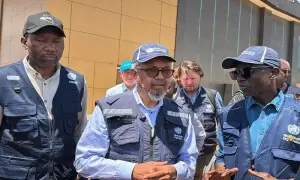
UN health chief Tedros Adhanom Ghebreyesus landed on Saturday in the eastern Democratic Republic of Congo (DRC) province worst-hit by a severe Ebola outbreak.
The World Health Organisation’s director general told reporters in Bunia, capital of Ituri province, that the international community was helping the DRC government cope with the outbreak, but “at the same time, community ownership is important”.
He said that was the reason for his trip: “We are here to discuss with the community, to see h
UN health chief Tedros Adhanom Ghebreyesus landed on Saturday in the eastern Democratic Republic of Congo (DRC) province worst-hit by a severe Ebola outbreak.
The World Health Organisation’s director general told reporters in Bunia, capital of Ituri province, that the international community was helping the DRC government cope with the outbreak, but “at the same time, community ownership is important”.
He said that was the reason for his trip: “We are here to discuss with the community, to see how the response is running and if there are challenges to help.”
The highly contagious haemorrhagic fever is already present in three eastern DRC provinces and in neighbouring Uganda, where nine confirmed infections, including one death, have been recorded.
There have been at least 1,077 suspected cases of Ebola in the DRC since the outbreak was declared on May 15, including 246 deaths, the Africa Centres for Disease Control and Prevention said on Thursday.
The true reach of the outbreak in the DRC, which is thought to have been circulating before it was detected, is likely to be much wider, the WHO has warned.
The vast, unstable central African country — whose impoverished east has been plagued by three decades of conflict — has limited capacity to conduct laboratory tests to confirm cases.
Conflict and Ebola
Uganda closed its border with the DRC this week and ordered a 21-day quarantine for anyone arriving from that country.
On Friday, the WHO announced that a patient had recovered on Wednesday, left hospital and was discharged into the community after two negative tests.
WHO’s Anais Legand told reporters in Geneva it marked the “first” among patients who had been confirmed Ebola carriers in the current outbreak.
Ebola, which is passed on through close contact and bodily fluids, has killed more than 15,000 people in Africa over the past 50 years.
The deadliest outbreak in the DRC claimed nearly 2,300 lives out of 3,500 cases between 2018 and 2020.
The medical charity Doctors Without Borders (MSF) said in a statement of the latest outbreak that “never has an Ebola epidemic recorded so many cases in the first days after it being declared”.
It said the numbers of medical experts being deployed to the region was still insufficient.
State services are largely lacking in Ituri province, where access is hindered by insecurity due to the presence of Islamic State-affiliated Allied Democratic Forces militants and other militias that regularly kill civilians.
The nearby North and South Kivu provinces, which have also seen Ebola cases in the outbreak, have been plagued by near-continuous violence for three decades.
Swathes of the region are controlled by the Rwanda-backed armed group M23 which has been battling government forces.
Millions of people have fled the fighting and are living in displacement camps with poor hygiene conditions.
Nearly a million of those displaced are in Ituri province, where the prospect of the epidemic spreading throughout the camps has sparked alarm.
“If Ebola comes, we’ll be wiped out as we’re packed like sardines,” Dorcas Mapenzi said at the Kingonze camp on the outskirts of Bunia.
No vaccine or specific treatment exists for the Bundibugyo strain of Ebola, which is behind the current outbreak.
KARACHI: Visiting Lyari around this time when the FIFA World Cup is just round the corner is an experience. Football fever is on the rise. Walking down each lane and alley tells you a story about the community’s love for football.
Ill-famed for turf wars and drug trafficking, Lyari is also known as ‘Mini Brazil’ because while the negatives divide the community, football unites it.
The narrow winding alleys of Lyari permit the children and youth playing football here to give short passes mostly a
KARACHI: Visiting Lyari around this time when the FIFA World Cup is just round the corner is an experience. Football fever is on the rise. Walking down each lane and alley tells you a story about the community’s love for football.
Ill-famed for turf wars and drug trafficking, Lyari is also known as ‘Mini Brazil’ because while the negatives divide the community, football unites it.
The narrow winding alleys of Lyari permit the children and youth playing football here to give short passes mostly and become great dribblers of the ball. Their playing style resembles that of Brazilian players. Their looks resemble too and to enhance that particular feature you’ll find most youngsters sporting the hairstyles of their favourite Brazilian players.
This reporter must have run into five or six Neymar look-alikes just because of the hair.
With giant screens being installed and walls painted with flags, youngsters sport their favourite footballers’ hairstyles
Still, over time, there has been some change in opinions.
Abdul Waheed, a popular football coach and entrepreneur, said that earlier the people of Lyari had a favourite team, Brazil, which they all associated with. “But now, you’ll find the lovers of football here associating with particular players rather than teams. The fan following for a player is what brings them closer to the teams,” he said.
“For example, the Neymar fans are drawn to Brazil, the Messi fans cheer for Argentina and the Ronaldo fans are all for Portugal,” he explained. “That’s how the craze for Brazil in Mini Brazil has dropped from 100 per cent to 80 per cent,” he added.
The kids playing football at the Al Usmani Sports Academy, which include girls, are mostly Brazil fans. Ali Mohammad, Tanya Faisal, Umme Safa Abdul Majeed, Safa Shakeel and Sonia are all loyal Brazil fans but there are also Abdul Aziz and Saima who are willing to bet that Portugal will do better than Brazil in this World Cup.
“What to say about Portugal, Brazil will lose its very first match against Morocco on the 14th, you’ll see,” said Abdul Aziz.
“Every four years, as the football World Cup approaches, Lyari’s entire mood changes. The place just comes alive like no other. With big screens installed in all the grounds, parks and even at intersections and crossroads, we forget all our troubles to just enjoy the game despite there being no scope in football in this country,” Abdul Waheed points out.
Abdul Rasheed is a local painter and decorator in Lyari’s Baghdadi area. But during this time he diverts all his energies to painting flags of the participating nations in the World Cup on neighbourhood walls. Of course, Brazilian flags take up entire building walls. “Brazil has its own charm but I do paint other flags too besides painting portraits of various star players of different teams,” he said.
World Cup fever has reached a high temperature in Ali Mohammad Mohallah in Lyari’s Kalri area where there is no wall left that does not have a flag or a popular footballer on it.
Tied to strings, different country flags, too, fluttered away. An Iranian flag on a tall pole on the roof of a building also flapped in the evening breeze. “This year it deserved the highest point,” smiled Yasir Ali, a neighbourhood youth.
He also said that he along with other kids went around collecting money for the flags, paint and decorations. “The shopkeepers in the area happily donated 50, 100 or 200 rupees for decorating our lanes and alleys. It is not every day that you have the World Cup,” he smiled.
Among the flags was a Pakistan flag, which raised a question. He said. “People don’t realise that Pakistan is also always participating in the FIFA World Cup as all the footballs used in the over-a-month-long competition are made in Pakistan,” he reminded.
THE insurgency in Balochistan has posed a different set of problems for the state, which is still struggling to fully understand its dynamics. Perhaps the biggest challenge is defining the unrest in the province and identifying the factors that are contributing to it.
Even as it tries to understand the insurgency, the state has become fixated on the youth, particularly the educated ones, whom it sees as leading the unrest. It sees them as the core of the problem, which it seeks to address throug
THE insurgency in Balochistan has posed a different set of problems for the state, which is still struggling to fully understand its dynamics. Perhaps the biggest challenge is defining the unrest in the province and identifying the factors that are contributing to it.
Even as it tries to understand the insurgency, the state has become fixated on the youth, particularly the educated ones, whom it sees as leading the unrest. It sees them as the core of the problem, which it seeks to address through narrative campaigns and a few incentives. In its search for quick fixes, it expects rapid results; when these don’t materialise, it stigmatises the very youth it seeks to influence.
A recent statement attributed to Balochistan Chief Minister Mir Sarfraz Bugti that Baloch youth pursuing PhDs at the state’s expense were conducting misleading research and supporting militancy reflected a hasty attitude. The statement drew sharp criticism from Balochistan’s political and civil society leadership and was perceived as an attempt by the state to silence critical voices that question poor governance, highlight flaws in the system, and expose the cost of electoral manipulation to political stability.
Since the beginning of the new phase of the insurgency in Balochistan, dozens of leading intellectuals, writers and journalists have been killed — from Prof Saba Dashtyari to Prof Ghamkhwar Hayat, who was recently killed in Noshki. On the one hand, the state claims that it has invested heavily in the education sector and set up dozens of universities across the province. On the other, it remains apprehensive about political and intellectual activities on university campuses.
The security institutions have a better understanding of religiously inspired militancy, having engaged with it since the Afghan-Soviet war and having developed a deeper knowledge of its character. It emerged from narratives once nurtured by the state for strategic purposes. It mainly relied on madressah students and youth educated in public-sector institutions affiliated with religious parties. Their worldview is different from that of Balochistan’s educated youth, who are more influenced by leftist and anti-colonial intellectual traditions of the Global South.
Dialogue remains part of the solution, particularly with those who are still willing to talk.
It took nearly two and a half decades for the state to develop an effective approach to address religiously motivated terrorism, which state institutions had, at times, themselves helped nurture. Even today, such militancy continues to pose several visible and hidden threats. Yet state institutions appear eager to crush an insurgency they don’t understand as well, and to do so in a much shorter period.
The state has a reasonably accurate diagnosis of Balochistan’s issues, but it errs in identifying the factors behind them. It is aware that the Balochistan problem has three dimensions: genuine political representation, the issue of missing persons, and a sense of deprivation. However, it continues to rely on the same remedies that have failed to produce results since the era of Gen Pervez Musharraf. It was during that period that a policy of zero tolerance towards dissent in the province took shape. The assassination of Nawab Akbar Bugti was a consequence of that approach.
For a brief period, the state softened its posture when the PPP government launched the Aghaz-i-Haqooq-i-Balochistan package. Over the following decade, however, the state pursued an ambiguous policy — involving neither carrot nor stick. Billions of rupees were spent on surrender schemes, many of which were viewed as dubious, while efforts to engage militant leaders in exile through dialogue were discouraged.
Ironically, that was perhaps the best time for negotiations, as the insurgency was still in the early stages of its transformation from a tribal-led movement into one increasingly driven by the educated middle class, particularly in the southern and western parts of the province.
Obviously, the time for talks with the exiled leadership has largely passed. The tribal leaders in exile no longer command the influence they once did, and those currently leading the insurgency appear unwilling to engage with the state. Yet dialogue remains part of the solution, particularly with those who are still willing to talk, whether they are nationalist groups, religiously inspired actors, rights-based pressure groups, or organisations such as the Baloch Yakjehti Committee.
However, the same confusion persists, and opinion within the state remains divided. Those who favour dialogue are in the minority, while proponents of a coercive approach continue to dominate policymaking. At the same time, the coercive strategy is not as muscular as many within the Balochistan government would like. The state continues to rely on familiar strategies and tactics that ordinary Baloch citizens understand all too well and are suspicious of — particularly regarding anti-terrorist squads.
At the narrative level, some institutions appear to be attempting to create divisions within Baloch society. This includes raising questions about a Baloch-Brahui divide. More recently, a Punjab-based activist associated with a banned religiously inspired terrorist organisation claimed that 40 per cent of insurgents belong to the Zikri faith. Many criticised this as another attempt to create rifts within Baloch society.
The question is whether such campaigns can achieve their intended purpose. Arguably, they strengthen the insurgents’ narrative by providing them with examples they can exploit to justify their position.
Another concern is that stigmatising Baloch youth fuels broader public resentment. A large number of young Baloch aspire to join public and private sector institutions across the country. In simple terms, they want to become part of the national mainstream. Narratives that portray them with suspicion can have a deeply negative impact on their aspirations and sense of belonging.
Running narrative campaigns is a delicate undertaking. If poorly conceived, they create more problems than they solve. This is particularly true when such campaigns emerge from an approach that itself lacks clarity and strategic coherence.
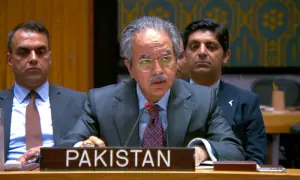
As the United States and Iran engage in a fresh round of hostilities, Pakistan has urged all sides to exercise restraint and give peace a little more chance.
“As we work earnestly and painstakingly, together with our friends and partners, to find a peaceful diplomatic solution to the conflict, and especially when the final objective is just about to be achieved, we sincerely urge all sides to exercise restraint and give peace a little more chance,” said Pakistan Permanent Representative to the U
As the United States and Iran engage in a fresh round of hostilities, Pakistan has urged all sides to exercise restraint and give peace a little more chance.
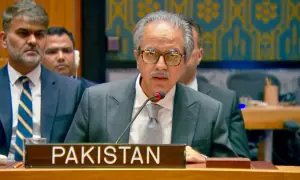
“As we work earnestly and painstakingly, together with our friends and partners, to find a peaceful diplomatic solution to the conflict, and especially when the final objective is just about to be achieved, we sincerely urge all sides to exercise restraint and give peace a little more chance,” said Pakistan Permanent Representative to the UN Asim Iftikhar Ahmad at a United Nations Security Council (UNSC) meeting on Tuesday.
The statement came against the backdrop of the US carrying out attacks in Iran in response to what US President Donald Trump said was the downing of a US Apache helicopter on Tuesday. In retaliation, Iran said it attacked bases and other targets in the Gulf.
The clashes mark one of the biggest exchanges in hostilities since the two countries agreed to a Pakistan-brokered ceasefire in April and deepens doubts about the prospects for a deal to end the war that started on February 28 with joint US-Israeli strikes on Iran.
During the UNSC session, Ambassador Ahmad said Pakistan was deeply concerned at the ongoing situation in the region marked by renewed conflict and heightened tensions.
“Events of the last few days have amply underscored the fragility of the situation, the risk of escalation and the need for diplomatic efforts to come to fruition – sooner than later,” he added.
The recent surge in violence in the Middle East is a “stark reminder of the dangers associated with a tenuous ceasefire and the unbearable consequences it may lead to,” he said.
“The cycle of violence and instability must end for the good of regional and international peace, security and prosperity,” Ahmad added.
The ambassador regretted that the “breakdown of diplomacy and outbreak of hostilities has also impacted the consideration of the Iran nuclear issue, pushing the parties further apart on this complex file. It also disrupted the IAEA’s crucial verification mandate,” he said.
“We reaffirm our support for the resolution of all outstanding issues, including Iran nuclear issue, through peaceful means, diplomatic engagement and sustained dialogue,” he said.
“We are of the view that diplomacy and dialogue should be the guiding principles for achieving negotiated settlement of all contentious issues in accordance with the rights, obligations and responsibilities of the parties concerned,” he further added.
Pakistan, he said, along with partners, initiated diplomatic efforts to stop the war and bring the parties to the table. He added that “Pakistan had been undertaking constructive diplomatic engagement in support of de-escalation, ceasefire, and the broader pursuit of stability in the region”.
He also referred to mediation efforts by Pakistan, saying that “We appreciate both parties for reposing their trust in Pakistan, and engaging in dialogue to achieve a ceasefire and participating in the ‘Islamabad Talks’ – the highest-level direct engagement between the United States and Iran for over four decades”.
In his remarks, he said that “through sustained interaction at the leadership level with both Washington and Tehran, as well as with other partners in the region and beyond, notably Saudi Arabia, Egypt, Turkiye, Qatar, China and others, Islamabad had sought to encourage dialogue, facilitate the exchange of messages, and help create space and conditions conducive to meaningful negotiations”.
“Pakistan’s sincere efforts are meant to break the momentum of hostilities, save lives and give diplomacy a chance,” he added.
The ambassador further said that “our approach underscores Pakistan’s consistent commitment to regional stability and international peace, reflecting our preference for principled, dialogue-oriented diplomacy in addressing geopolitical challenges and managing complex disputes”.
“As we work earnestly and painstakingly, together with our friends and partners, to find a peaceful diplomatic solution to the conflict, and especially when the final objective is just about to be achieved, we sincerely urge all sides to exercise restraint and give peace a little more chance,” he asserted.
Ambassador Ahmad concluded: “So let us continue to tread the path of peace and diplomacy, for it has bright prospects of success, something that the international community has pinned its hopes on.”
WASHINGTON: Pakistan’s envoy to the United Nations said on Monday that India’s key objectives in Afghanistan were “solely driven by the singular goal of destabilising Pakistan”.
He made these remarks during a UN Security Council meeting on Afghanistan while responding to remarks by Afghanistan’s Permanent Representative to UN Nasir Ahmad Faiq.
Earlier in the session, Pakistan’s Permanent Representative to UN Ambassador Asim Iftikhar Ahmad detailed the use of Afghan soil by terrorists and its imp
WASHINGTON: Pakistan’s envoy to the United Nations said on Monday that India’s key objectives in Afghanistan were “solely driven by the singular goal of destabilising Pakistan”.
He made these remarks during a UN Security Council meeting on Afghanistan while responding to remarks by Afghanistan’s Permanent Representative to UN Nasir Ahmad Faiq.
Earlier in the session, Pakistan’s Permanent Representative to UN Ambassador Asim Iftikhar Ahmad detailed the use of Afghan soil by terrorists and its impact on Pakistan, calling for the Afghan Taliban to take action against militants. He also spoke about Pakistan’s counter-terrorism measures.
Responding to Faiq’s comments on Pakistan’s counter-terrorism operations, Ambassador Ahmad said: “Pakistan’s actions, including those conducted in March, were directed solely against the terrorist and military support infrastructure that is operating from Afghanistan. And it is in no way directed against the brotherly people of Afghanistan.”
On March 16, the Afghan Taliban had accused Pakistan of striking a hospital in Kabul; however, Islamabad denied the accusations, maintaining that the strikes targeted terrorist infrastructure linked to hostile activity in Pakistan and no civilian facility was targeted.
In response to the Afghan diplomat, Ambassador Ahmad reiterated Islamabad’s position that strikes targeted “drone storage and technical support infrastructure and ammunition storage sites, which were being used by the Afghan Taliban regime to carry out attacks against innocent Pakistani civilians”.
“The strikes were precise, deliberate and professional. No hospital or drug rehabilitation centre or civilian facility was targeted by these strikes. And as part of established practice, video footage of all six strikes was released by the Ministry of Information shortly after the operation, clearly showing the nature of the targets.
“The secondary explosions visible in the footage further confirmed that ammunition storage facilities were indeed struck with precision. So all insinuations to the contrary are not based on facts and are in fact just propaganda,” he asserted.
The ambassador said three key expectations of the international community were at the core of the day’s discussion: “inclusive governance, good governance, human rights, women and girls’ rights, and counterterrorism”.
Noting that there were expressions of concern regarding all three points, Ahmad pointed out that there were “clear demands from the majority of those who took the floor for the Taliban regime to comply with those commitments … with the exception” of India.
The Pakistani envoy remarked: “It does not come as a surprise to us, hearing comments made by the Indian representative … And we listened to, in fact, a long list of so-called development and humanitarian activities and support that India is purportedly carrying out in Afghanistan.”
He said that the Indian representative’s remarks seemed a “long prologue to something he actually intended to say, and something that he actually wanted to utilise and abuse this forum. And that was to target Pakistan”.
“So to us, it is absolutely clear — India’s key aims and objectives, even though under the garb of, under the disguise of development or humanitarian assistance, its key aims and objectives in Afghanistan are solely driven by the singular goal of destabilising Pakistan, including by using terrorist groups operating from Afghan soil. And that includes the TTP, which so many of my colleagues around the table condemned, and the BLA, which acts as a proxy of India to perpetrate terrorism inside Pakistan,” he said.
Ambassador Ahmad added that the banned Baloch Liberation Army (BLA) — Fitna al Hindustan — was “supported and financed by India to destabilise and target Pakistan”.
‘India’s newfound love for Taliban’
In his remarks, Pakistan’s envoy pointed out that the Indian representative did not condemn the banned Tehreek-i-Taliban Pakistan (TTP) or the BLA even once.
“Yes, Fitna al Hindustan, who have been carrying out attacks targeting innocent Pakistanis who have tragically lost their lives at the hands of these terrorists,” he said.
He added: “I think for some time we are amused, perhaps, to listen to India’s newfound love for the Taliban. We know all the history, what’s there in the background. All those years, we knew what India’s position was. But for us, this is not a coincidence. This shift of policy comes at the heels of Pakistan’s successful counterterrorism operations against the terrorist hideouts and camps that are operating inside Afghanistan with the active support of India.”
Contending that New Delhi’s “hostile policies and complicity” were further validated by its envoy’s remarks during the session, Ahmad said, “I seriously believe that this behaviour should be a cause of concern for the Security Council and the international community.”
The ambassador went on to quip that India must find it “discomforting” to see its terrorist infrastructure being destroyed in Afghanistan by Pakistan’s security forces.
Referring to India’s calls on others to comply with international law, he said, “It would be laughable if we are not aware of India’s own record, and if the matter under consideration in the council was not that serious, for we know that India’s true face is truly exposed before the international community.
“It is a serial violator of international law,” he asserted.
Ambassador Ahmad further stated that India was not only a “state sponsor of terrorism” in India-occupied Kashmir and Pakistan, but also it was “openly aiding, abetting and financing terrorism elsewhere”, including extraterritorial assassinations in the US and Canada.
“It talks of international law. It is in serious breach of Security Council resolutions on Jammu and Kashmir. It has seriously violated the Indus Waters Treaty by declaring that it is holding it in abeyance, without any reason, justification, and in complete defiance of the treaty’s provisions and international law.
“It was talking about cricket and sportsman spirit, and we know the sportsman spirit when it refuses to play, or if it refuses to shake hands with the players. This is a country that is coming to the Council and telling us what cricket and sports could bring in terms of peace and harmony,” the envoy said.
He added, “I think we should seriously consider also how we allow countries to take the floor in this council, and under what rules and etiquette they should be speaking in this council.”
Concluding his remarks, Ambassador Ahmad advised India to “do a little bit of introspection”.
“It can do [so] by discontinuing its policies of aggression, subversion and sabotage against neighbouring countries, particularly Pakistan,” and calling on the country to “look inwards”.
“Pakistan is well aware of India’s motives and evil designs. But we will not allow them to nourish terrorists and threaten our national security,” he said.
Ambassador Ahmad concluded: “I would say that we have stopped them before and we will do it again, and we will do it always.”
‘Verifiable, non-reversible action’
Ambassador Ahmad earlier told the UNSC that Islamabad’s demand from the Afghan Taliban was simple and clear: “verifiable and non-reversible action“ against terrorist groups operating from Afghan territory.
“Regrettably, this demand remains unmet,” he said.
And while the window for course correction was narrowing, it remained open, he added.
“We hope the Taliban realise this in earnest and cooperate with the international community for the long-term peace and development of Afghanistan and, above all, in the best interest of all Afghans,” he said.
There has been a resurgence in terrorism in Pakistan since the Afghan Taliban returned to power in Kabul in 2021.
For its part, Islamabad has repeatedly urged the Taliban administration to dismantle terrorist sanctuaries on Afghan soil, particularly those linked to the banned TTP. But, officials say those appeals have gone unheeded, while the Afghan Taliban reject these allegations.
During the UNSC meeting, Ambassador Ahmad noted that it had been nearly half a decade since the Taliban takeover of Afghanistan in 2021.
“It was hoped that this would end the bloodshed and Afghanistan would be at peace with itself and its neighbours,” he said.
The envoy added that with the end of the civil war, it was “anticipated that the Taliban would take positive steps to transform into a responsible governing authority by adhering to their international obligations and commitments, and that they would lead Afghanistan into an era of stability and progress, provide the long-awaited relief to all Afghans and live in harmony with immediate neighbours”.
“For decades, terrorism has been a major problem in Afghanistan, with implications not just for Afghanistan, but the immediate neighbourhood and beyond. Afghanistan has a history of being a safe haven for terrorist groups, including those used as proxies by our adversaries to target Pakistan and other countries,” he highlighted.
It was “our expectation that the Taliban would take concrete and verifiable actions against terrorist groups such as the TTP, BLA and its Majeed Brigade, Islamic State-Khorasan, East Turkestan Islamic Movement and their affiliates that are operating with impunity on Afghan soil”.
“Regrettably, they have failed to undertake action, showing complete disregard for the legitimate security concerns of Pakistan and other countries,” the ambassador said.
He added that, besides “independent analysis and reports of the Analytical Support and Sanctions Monitoring Team, which clearly outline the terrorism situation in Afghanistan and the ground realities, along with the recent exponential rise in terrorist attacks in Pakistan, these developments serve as glaring reminders of the precarious situation and the continuing threats posed to international peace and security”.
“As a direct result of the freedom with which these terrorist groups operate in Afghanistan, Pakistan has borne the brunt of their attacks, as well as the Taliban’s growing nexus with these terrorist groups.
“And once again, a significant number of Afghans are found to be involved in terrorism inside Pakistan,” he added.
Ambassador Ahmad said these terrorist groups had access to advanced weapons and sophisticated equipment, including drones.
“Much of this can be traced back to the multi-billion dollar worth of arms and ammunition left behind by foreign forces — which was meant for use by the previous Afghan national government,” he said.
Moreover, during counter-terrorism operations by Pakistan, there have been more than 290 cases of seizures of such weapons, which are used for terrorism and suicide bombings in the western parts of Pakistan, and which have exacted a heavy toll of human life and material losses, he told the UNSC.
In 2025 alone, Pakistan reported more than 5,300 terrorist incidents and lost more than 1,200 lives to terrorism emanating from Afghanistan, he said.
In this connection, he recalled that a vehicle-borne IED attack by the TTP on a police post in Khyber Pakhtunkhwa on May 9 resulted in the martyrdom of 15 police officers.
“Our investigations revealed that the attack was planned by terrorists in Afghanistan.”
‘Pakistan will not sit idle while suffering from terrorist acts’
Ambassador Ahmad said: “It is deplorable that the Taliban have reverted back to their old tactics of providing safe havens to terrorist groups and chosen the perilous path of complicity, backed by an outside actor, the historic spoiler and instigator of chaos — that has moved fast as an opportunist to wage a proxy war against Pakistan.
“Let me make it clear: Pakistan will defend itself against whosoever attempts to harm our sovereignty, territorial integrity and national security.”
Ambassador Ahmad recalled that numerous diplomatic efforts were made to counsel the Taliban.
He said: “We thank friendly countries for their genuine mediation efforts, particularly Qatar, Turkiye, Saudi Arabia and most recently, China, to find amicable solutions.
Yet the Taliban’s continued intransigence and even refusal to publicly denounce and condemn terrorist groups such as the TTP and BLA is deeply disturbing — it is evidence enough of their complicity and active support for these groups. Pakistan will not sit idle while suffering from terrorist acts. We will respond in self-defence, as and when needed and always in conformity with international law and International Humanitarian Law,” he said.
Pakistan raises questions on UNAMA
Referring to a recent report by the UN secretary general, he said it “seems to largely externalise the responsibility for Afghanistan’s multifaceted challenges”.
“The fatalities of terrorists and their supporters as a result of counter-terrorism operations are mentioned within the ambit of ‘civilian casualties’, posing serious questions on the credibility of UNAMA’s reporting from Afghanistan and the nature of their engagement with the Taliban,” Ambassador Ahmad said.
He remarked that the United Nations Assistance Mission in Afghanistan (UNAMA) was “swift in reporting incidents of cross-border actions and casualties but fails to provide the overall context — which is the grave terrorist threat emanating from Afghanistan and its cross-border impact directed at Pakistan that is harming Pakistan and killing innocent Pakistanis”.
Ahmad further said that the report also did not provide information on the destabilising accumulation of small arms and light weapons inside Afghanistan.
“Nor does it adequately shed light on Afghanistan’s illicit economy, with its complex web of money laundering and terror financing networks, including hundi and hawala networks. Instead, the report resorts to shifting the blame on external dynamics, with little regard for the Taliban’s own policies that have brought Afghanistan to the brink of disaster,” he said.
The envoy stressed that “we must not lose sight of the fact that it is the Taliban’s reckless style of governance and flawed ideologies of extremism, suppression and radicalisation that have brought upon Afghanistan the calamities it faces today”.
“The Humanitarian Needs and Response Plan for 2026, we are told, is underfunded at 14 per cent — again a direct result of Taliban’s unwillingness to prioritise the welfare of Afghans over their own interest and authoritarian control,” he pointed out.
Noting that several references had been made to the Pak-Aghan border closure in the report, he said: “Let me clarify that the closure of border between Pakistan and Afghanistan does not, from Pakistan’s perspective, affect the movement of humanitarian supplies.
“Pakistan has been processing and facilitating the passage of humanitarian goods and material. However, the Afghan Taliban regime refuses to let them pass and keeps the border closed on its side, even to receive such life-saving cargoes, which obviously is to the detriment of the Afghan people.”
He went on to say that the worsening human rights situation in Afghanistan “aligned with Taliban’s failings and deceitful narrative to meet the demands of the international community”.
“Women and girls are denied their fundamental human rights and dignity, with discriminatory and abusive practices — a clear violation of their international obligations as well as of Islamic laws, traditions and tenets of the Muslim faith. The Afghan people are being held hostage to these inhumane restrictions, oppression and selfish behaviour,” he said.
He said that Pakistan took numerous steps to support Afghanistan, including humanitarian relief efforts, political engagement, providing incentives to boost bilateral trade, offering transit concessions, issuing student and medical visas, conducting high-level visits to Kabul and participating in various regional cooperation initiatives to help Afghanistan succeed in its quest to find its rightful place in the international community.
For over four decades, he continued, Pakistan welcomed millions of Afghan refugees “despite limitations and insufficient international support, dealing with huge caseloads of illegal Afghans, including those without documentation, posing a serious threat to our security”.
But these were never meant to stay indefinitely, he added.
The ambassador called on the UN secretary general to “clearly outline the status of third country resettlement cases of Afghans in a transparent manner — cases that are pending for years, despite being a tiny fraction of what Pakistan had to deal with, in the face of national security threats that no country would tolerate”.
“While we provide all possible facilitation, the international community must step up and shoulder its responsibility. Shifting the blame of Afghanistan’s woes to the inflow of Afghan returnees will not solve the problem,” he said.
Ambassador Ahmad further said, “We look forward to the next steps of the UN-led Doha Process and action plan for its Mosaic approach, to address Afghanistan’s multifaceted challenges comprehensively, with well-defined objectives and a realistic roadmap as the only viable pathway for normalisation”.
Pakistan and Afghanistan, he said, were bound by geography, deep-rooted ties, civilisational links dating back centuries, and fraternal bonds of faith, culture and ethnicity.
“No country has suffered more from the consequences of conflict and instability in Afghanistan than Pakistan. So we understand, and we also know, that no country stands to benefit more from peace, prosperity and stability in Afghanistan than Pakistan.
“Pakistan’s demand from the Taliban is simple and clear: verifiable and non-reversible action against terrorists. Regrettably, this demand remains unmet. The window for course correction is narrowing but is still open. We hope the Taliban realise this in earnest and cooperate with the international community for the long-term peace and development of Afghanistan and, above all, in the best interest of all Afghans,” he said, concluding his address.
• Steps up attacks against police headquarters and personnel
• Hamas says ending Israeli military operations is essential for progress in negotiations
CAIRO: Israeli strikes on a Hamas-run police station and a vehicle in the Gaza Strip killed at least nine people and wounded 20 others, health officials said, as mediators began new efforts to salvage a fragile US-brokered ceasefire deal.
One strike hit a police post adjacent to a large tent encampment of displaced families i
• Steps up attacks against police headquarters and personnel
• Hamas says ending Israeli military operations is essential for progress in negotiations
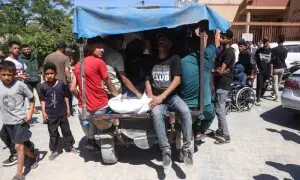
CAIRO: Israeli strikes on a Hamas-run police station and a vehicle in the Gaza Strip killed at least nine people and wounded 20 others, health officials said, as mediators began new efforts to salvage a fragile US-brokered ceasefire deal.
One strike hit a police post adjacent to a large tent encampment of displaced families in Khan Yunis in the south of the enclave, killing five people and wounding 16 others, medics said. They did not say how many of the casualties were police.
Israel has stepped up attacks against police headquarters and personnel
in the past several months, killing dozens of them, according to Hamas security officials.
Later on Sunday, another Israeli airstrike killed four people and wounded four others when it hit a vehicle driving through the middle of Gaza City, medics said.
The Israeli military did not immediately comment on the incidents.
Major fighting has been paused since October under a ceasefire after two years of war, but no agreement has been reached to implement a further US-backed plan for Israeli troops to withdraw, Hamas to disarm and Gaza to be rebuilt.
Israeli troops still control more than half of Gaza’s territory, where they have ordered residents out and destroyed remaining buildings. Nearly the entire population of 2 million now lives in a tiny strip of land along the coast, mainly in makeshift tents or damaged buildings, under Hamas control.
Hamas’ nearly 10,000 police officers have emerged as a sticking point in talks to advance Trump’s plan for Gaza. Hamas wants them included in a new police force; Israel rejects a role for any Hamas-affiliated personnel.
Egypt began hosting a new round of truce talks with leaders from Hamas and other Palestinian factions, sources from Hamas and other sources close to the negotiations said. The talks are expected to last for a few days.
Israel and Hamas have repeatedly accused each other of violating the truce. Israeli strikes in Gaza have killed more than 950 Palestinians since the start of the truce, while Palestinian attacks have killed four Israeli soldiers.
Last year’s deal established a Board of Peace led by Trump to oversee a phased ceasefire and was ratified by the United Nations Security Council.
Hamas told envoys from the Board and mediators Egypt, Qatar and Turkiye that ending Israeli attacks in Gaza was essential for any progress, sources from the group and officials close to the talks said.
Hazem Qassem, a Hamas spokesperson in Gaza, said on Sunday the group was open to ideas that would lead to ending Israeli attacks in Gaza and reaching common ground over issues of the second phase of the Trump plan. But he said the Board of Peace should stop being “biased” towards Israel.
ISLAMABAD: PTI leaders on Thursday arrived at Adiala jail hoping to meet party founder Imran Khan but were once again denied permission to meet the former prime minister.
The Islamabad High Court (IHC) has allowed the incarcerated ex-premier to have twice-a-week meetings — on Tuesdays and Thursdays — with his family, lawyers and other associates. Despite the order, Imran has been restricted from meeting visitors for several months.
A day earlier, the PTI sent a list of six leaders to Adiala jail
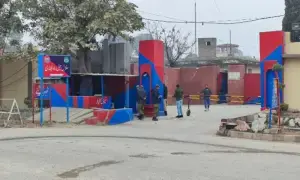
ISLAMABAD: PTI leaders on Thursday arrived at Adiala jail hoping to meet party founder Imran Khan but were once again denied permission to meet the former prime minister.
The Islamabad High Court (IHC) has allowed the incarcerated ex-premier to have twice-a-week meetings — on Tuesdays and Thursdays — with his family, lawyers and other associates. Despite the order, Imran has been restricted from meeting visitors for several months.
A day earlier, the PTI sent a list of six leaders to Adiala jail authorities, requesting that they arrange a meeting with the incarcerated former premier. The list included Seemabia Tahir, Usman Jora, Asad Abbas, Malik Yasir Patwali, Malik Azeem and Rohail Anjum.
Patwali, while speaking to Dawn, said that all the leaders arrived at the prison well before 2pm.
“We informed the prison administration that we had been nominated for the meeting, as per the directions of the IHC, but we were told that a message was being sent for approval,” he said.
“Officials also recorded our video footage and asked us to wait. We waited there until 4pm, which was the cutoff time for the meeting, but we were not allowed to meet Khan sahib,” he added.
Patwali said he would work with lawyers to file a contempt petition. Since his name was on the list, he said he was unable to file the petition himself.
Replying to a question, Patwali said the government should understand that the PTI would form the government in the future, adding: “So the government should be ready to face the brunt.”
Seemabia, while speaking to Dawn, said that police did not allow PTI leaders to approach Adiala jail and instead asked them to park their vehicles on the side of the road.
“We recorded our protest and then returned. We demand that Imran Khan be admitted to Shifa International Hospital for medical treatment,” she said.
Pre-Poll Rigging
Separately, PTI Information Secretary Sheikh Waqas Akram condemned the government for unleashing “fascism” ahead of the elections in Gilgit-Baltistan (GB) and Azad Jammu and Kashmir (AJK).
“Central PTI leaders are being subjected to name-based profiling, forced movement restrictions, and NOC (no-objection certificate) denials, while the Election Commission, administration and police are colluding to pressure candidates into abandoning the party,” he claimed.
He alleged that the “same discriminatory tactics” were being used in AJK to sideline PTI, warning that such provocative actions in sensitive areas risk creating lasting divisions and that the party was poised to win a majority.
“The abrupt and indefinite delay in presenting the federal budget is a humiliating confession of economic bankruptcy and the complete surrender of national sovereignty to the IMF, which now micro-manages every tax, revenue target and utility tariff,” Akram said.
“The so-called differences between PPP and PML-N over provincial funds and agricultural taxes are a staged drama to fool the people while both parties collude in economic destruction,” he alleged.
Imran — imprisoned since Aug 5, 2023, for concealing details of Toshakhana gifts — is serving a 14-year sentence at Rawalpindi’s Adiala jail in a £190 million corruption case, also known as the Al-Qadir Trust case.
Earlier this week, Imran’s sister Aleema Khan and Khyber Pakhtunkhwa Chief Minister Sohail Afridi went to the prison for a meeting with the PTI founder, but were once again denied a meeting with Imran.
Speaking to the media outside the prison, Aleema said it was their constitutional right to meet Imran. She vowed to continue visiting Adiala, saying it was the only way to exert pressure on the “powers that be”.
LAHORE: The Faisalabad City police are going to launch a major operation against drug cartels after the arrest of 80 women and 20 male traffickers who were supplying narcotics to university and college students.
Police reports have revealed that the women traffickers dominate the city as they are perceived as less suspicious than men. During interrogation, the suspects revealed that they were supplying drugs through several ‘supplier networks’ to education institutions. The drugs are being route
LAHORE: The Faisalabad City police are going to launch a major operation against drug cartels after the arrest of 80 women and 20 male traffickers who were supplying narcotics to university and college students.
Police reports have revealed that the women traffickers dominate the city as they are perceived as less suspicious than men. During interrogation, the suspects revealed that they were supplying drugs through several ‘supplier networks’ to education institutions. The drugs are being routed through district Jhang from Sindh and KP and some groups are working under political backing. The use of internet and social media has become popular for trafficking synthetic drugs.
An official said the anti-narcotics cells of the Faisalabad City police arrested 80 women smugglers during the last five months and a majority of them were operating in urban hubs, exclusively targeting students and children of the elite for supply of ice and cocaine. Women traffickers were used to supply drugs in education institutions and hostels.
During the last five months, police lodged 4,700 FIRs against the drug suppliers. Ninety percent cases were registered under section 9(c) (non-bailable offence) of the Control of Narcotic Substances Act (CNSA).
Faisalabad police arrested 80 women, 20 men for trafficking in last few months
“The supply of ice and cocaine by women smugglers to the education institutions had posed a potential challenge for police,” Faisalabad Regional Police Officer (RPO) Sohail Akhtar Sukhera told Dawn. He said the role of women drug cartels, especially their backing by the highly influential bigwigs, was a matter of concern.
Some leading lady drug traffickers were identified as Shehnaz alias Cheeno, Suraya, Rabia Dogar, Saira Pathani, etc, he said.
The female smugglers had created their respective drug empires across Faisalabad, the DIG said, adding that the arrest of women traffickers helped them secure a majority of the education institutions and students. The male big drug distributors marked by the police included Hamza alias Kamoka, Sunil Dogar, Riaz, Nadeem, Waseem, Shahzad etc.
The RPO said that a majority of the drugs was being smuggled through the goods transport. He added that the police had also engaged the prosecution department to ensure punishments to the criminals. He said police had obtained the details of the social media accounts and the phone numbers of the drug traffickers.
“The police teams are all set to launch fresh crackdowns,” the RPO said, adding that police would also seek cooperation of Nadra and other relevant institutions to reach the criminals.
WASHINGTON: Deputy Prime Minister and Foreign Minister Ishaq Dar said on Friday that Pakistan remained firmly committed to its longstanding position on Palestine and Gaza and that there could be no change in Islamabad’s stance towards Israel without the establishment of an independent Palestinian state.
He said this during a press conference at Pakistan’s embassy in Washington after a meeting with US Secretary of State Marco Rubio.
Dar was asked whether US President Donald Trump had dropped his
WASHINGTON: Deputy Prime Minister and Foreign Minister Ishaq Dar said on Friday that Pakistan remained firmly committed to its longstanding position on Palestine and Gaza and that there could be no change in Islamabad’s stance towards Israel without the establishment of an independent Palestinian state.
He said this during a press conference at Pakistan’s embassy in Washington after a meeting with US Secretary of State Marco Rubio.
Dar was asked whether US President Donald Trump had dropped his calls for Muslim countries to join the Abraham Accords as part of a potential deal with Iran. The question arose because Trump did not mention the issue in a statement issued earlier on Friday outlining potential key areas in the deal.
DPM Dar did not respond directly to the question. Instead, he said he had reiterated Pakistan’s position during his engagements at the United Nations earlier this week.
“Pakistan remains steadfast in its position on Palestine and Gaza,” Dar said, adding that Israel “must move towards the establishment of a Palestinian state” before there could be any change in Pakistan’s stance towards Israel.
The Abraham Accords are a set of agreements brokered under Trump in 2020 and govern the normalisation of diplomatic relations between Israel and countries that have historically been hostile to it.
In a lengthy social media post, Trump listed on Monday countries whose leaders he spoke with over last weekend about efforts to end the war with Iran.
“After all the work done by the United States to try and pull this very complex puzzle together, it should be mandatory that all of these countries, at a minimum, simultaneously sign onto the Abraham Accords,” he wrote.
“Those countries discussed are Saudi Arabia, the United Arab Emirates (already a Member!), Qatar, Pakistan, Turkiye, Egypt, Jordan, and Bahrain (already a Member!),” he added.
The nations named by Trump, including Pakistan, Saudi Arabia and Qatar, have traditionally advocated for a two-state solution between Palestine and Israel as a precursor to any discussions on the normalisation of relations with Israel.
Mediation efforts appreciated
During his press conference, Dar said Washington “deeply appreciates” Pakistan’s efforts aimed at easing tensions between Iran and the United States, noting that this recognition was conveyed during his meeting with the US secretary of state.
He referred to a statement issued by the US State Department after the meeting, which said that “the secretary thanked the minister for the constructive role Pakistan continues to play […] for peace in the Middle East and its mediation efforts with Iran.”
The statement added that the two sides agreed on the “importance of working together to further strengthen a meaningful partnership that fosters security and prosperity for both Americans and Pakistanis”.
Later, Rubio shared this in an X post as well.
In a separate statement attributed to State Department spokesperson Tommy Pigott, Washington said Rubio had met Dar in Washington and discussed bilateral cooperation as well as regional security issues.
It added that Rubio also expressed his condolences for the victims of the terrorist attack in Quetta on Sunday, in which a suicide bombing targeting a shuttle train claimed more than 10 lives and left several others injured.
“The secretary and the deputy prime Minister agreed on the importance of working together to further strengthen a meaningful partnership that fosters security and prosperity for both Americans and Pakistanis,” the statement said.
Meanwhile, a statement issued by the Foreign Office (FO) in Islamabad also said that Rubio acknowledged Pakistan’s “sincere diplomatic and mediatory efforts for peace and stability in the region and beyond”.
It further said the two leaders “expressed satisfaction over the positive momentum in the Pak-US bilateral relations and exchanged views on the evolving regional and global situation”.
“The two sides agreed to strengthen the bilateral cooperation in all areas of mutual interest including trade and investment, security, and counter-terrorism.
“They also agreed to advance Pak-US partnership, propelled by high-level exchanges and shared interests in regional peace, security and prosperity,” it added.
Dar also separately commented on the “very good” meeting with Rubio, saying, “Always a pleasure to engage with him on further strengthening Pak-US bilateral relations and advancing our shared goals of peace, stability, and prosperity for our two countries and the wider region.”
During his press conference, Dar maintained the cautious approach reflected in the two official statements, emphasising that he was not in a position to divulge further details of his talks with Rubio and other American and Iranian officials. He added, however, that he was very hopeful Pakistan’s efforts would help achieve comprehensive peace in the Middle East.
“Pakistan cannot compromise its role as a mediator by divulging details of the talks because we are deeply invested in the peace process,” he said.
The foreign minister said he and his team, which included Pakistan’s Ambassador to the United States Rizwan Saeed Sheikh, were “very satisfied” with their talks with Secretary Rubio.
“We are the mediators and, as such, we are required to maintain secrecy,” he said, adding that both the Americans and the Iranians appreciated Pakistan’s approach.
Dar said it was not only the United States and Iran but also countries across the globe that were appreciating Pakistan’s efforts.
“The mediation has brought global recognition for us, as did our victory against India [in May 2025],” he added.
Dar said Qatar, Oman and several other countries had also expressed interest in hosting the talks, but Pakistan was chosen because of its close and friendly relations with all parties involved in the conflict.
When reminded that the United States traditionally maintained a transactional relationship with Pakistan and asked whether the country’s current mediatory role could lead to a more substantive and strategic partnership, Dar said that during Friday’s meeting he proposed holding substantive discussions on building a strategic partnership, and that his proposal was accepted.
Rubio, he said, also agreed to visit Pakistan later this year. He did not say whether the next round of US-Pakistan talks would be held in Islamabad, but emphasised that Pakistan would continue to play a key role in the process.
Dar travelled to New York earlier this week to participate in a China-sponsored discussion at the UN Security Council on the role of the United Nations in resolving global disputes. Dar reached Washington for his meeting with Rubio earlier on Friday. Upon his arrival, he was received by Pakistan’s Ambassador to the US Rizwan Saeed Sheikh, along with senior officials of the Pakistani embassy.
The visit comes amid reports in American media that US and Iranian negotiators have edged toward a deal to extend their fragile ceasefire for 60 days.
But the potential breakthrough was still hanging on President Trump’s approval, who said on Friday he was making a “final determination” on the Iran deal.
He said he was holding a meeting in the White House Situation Room. The meeting was concluded hours later, a White House official confirmed without sharing any more details.
The US sources confirmed reporting by Axios that the two sides had agreed on a memorandum of understanding to prolong the ceasefire and launch negotiations on Iran’s nuclear ambitions.
However Trump also said Iran would have to end its chokehold on the Strait of Hormuz and dismantle its capacity to make a nuclear weapon — two conditions that Tehran has not agreed to.
“Iran must agree that they will never have a Nuclear Weapon or Bomb. The Hormuz Strait must be immediately open, no tolls, for unrestricted shipping traffic, in both directions,” Trump said in a Truth Social post, adding that nuclear material would be “unearthed” by the US.
Iran’s semi-official Fars news agency, citing sources, said Trump’s comments were an “attempt to portray a fabricated victory.”
The senior Iranian source, speaking on condition of anonymity, said the potential deal does not include any nuclear-related issues, while Iran’s Foreign Ministry spokesperson Esmaeil Baghaei said on state TV that the management of the strait must be decided by Iran and Oman.
The semi-official Fars news agency, citing sources, said the strait would be reopened under Tehran’s conditions after the US lifts its blockade on Iranian ships.
Fars said there was agreement to release $12 billion of Iran’s frozen assets.
Trump said no money would be exchanged “until further notice” — a possible reference to Iran’s demands for toll payments in the strait, war damage reparations or a release of frozen Iranian assets.
The war launched by the US and Israel on February 28 has killed thousands of people, mainly in Iran and Lebanon, and caused global economic pain by pushing up energy prices due to Iran’s effective closure of the Strait of Hormuz.
In his post on Truth Social, Trump said mines would be removed from the strait and ships trapped there may start to go home: “Say HELLO to your wives, husbands, parents, and families from me, your favorite President!”
SWABI: Journalist Yasir Ayaz, who went missing from Islamabad four days ago, was recovered here on Tuesday, police officials said.
Officials stated that Mr. Ayaz contacted his father from an unknown number, informing him that he was in the Baraqai area of Swabi district.
When contacted, the incharge of Mansoori police post, Waleed Khan, told Dawn that he was in the Charbagh area when he was informed that an unconscious man had been found near the police post.
He was brought to the police post in
SWABI: Journalist Yasir Ayaz, who went missing from Islamabad four days ago, was recovered here on Tuesday, police officials said.
Officials stated that Mr. Ayaz contacted his father from an unknown number, informing him that he was in the Baraqai area of Swabi district.
When contacted, the incharge of Mansoori police post, Waleed Khan, told Dawn that he was in the Charbagh area when he was informed that an unconscious man had been found near the police post.
He was brought to the police post in a critical condition. However, when his condition improved he told that he was a journalist. “He was extremely nervous and unable to speak. We immediately took him to a private hospital in the Gohati area for a medical check-up.
He was brought back to the police post as his condition improved,” the police official said.
Later, he contacted his family and as soon as the information was received, reporters from the private TV channel he works for reached Swabi, while his brother and other family members also arrived at the Mansoori police post.
He said it was not known who the assailants were who had abducted him from Islamabad and it was not immediately clear how Mr Ayaz was brought to the Baraqai area and for what purpose.
Journalist Yasir Ayaz went missing from the jurisdiction of Aabpara police station in Islamabad on June 5, after which his whereabouts remained unknown.
He belongs to the Mansehra district and works as a journalist in Islamabad.
The district police handed over the recovered journalist to Islamabad police, who then took him back to the capital.
ISLAMABAD: The capital’s administration has re-imposed restrictions on market timings, once again mandating their closure by 8pm throughout the week.
According to a late-night notification, issued by the Islamabad Capital Territory’s district magistrate, all shops, markets and shopping malls will close at 8pm, while restaurants, tandoors, grocery stores, bakeries, meat, fruit and vegetable vendors are to close shop at 10pm.
The notification said th
ISLAMABAD: The capital’s administration has re-imposed restrictions on market timings, once again mandating their closure by 8pm throughout the week.
According to a late-night notification, issued by the Islamabad Capital Territory’s district magistrate, all shops, markets and shopping malls will close at 8pm, while restaurants, tandoors, grocery stores, bakeries, meat, fruit and vegetable vendors are to close shop at 10pm.
The notification said that marriage halls, marquees and all other commercial places where festive events are held shall be closed at 10pm. This restriction also applies to events held on private premises.
The new timings will come into effect from today (Monday) and remain in force until further orders, the notification said.

 Login
Login