
Normal view

  • ✇Cartoon Research
  • Special Bull-etin! (Part 5) Charles Gardner
    A few more this week from Hanna-Barbera, then more bullfighting action from UPA, Terrytoons, the Disney Afternoon, and even from Japan. Smurf Me No Flowers (The Smurfs, 11/27/82). Lazy Smurf, true to his name, loves to spend the day performing no work, and snoozing away. Oddly, he’s experiencing a problem he’s never faced before – inability to doze off, no matter what position, and no matter where he tries to sleep. Experimenting with new sleeping locales in the underbrush of Smurfette’s gar
     

Special Bull-etin! (Part 5)

25 March 2026 at 07:01

A few more this week from Hanna-Barbera, then more bullfighting action from UPA, Terrytoons, the Disney Afternoon, and even from Japan.

Smurf Me No Flowers (The Smurfs, 11/27/82). Lazy Smurf, true to his name, loves to spend the day performing no work, and snoozing away. Oddly, he’s experiencing a problem he’s never faced before – inability to doze off, no matter what position, and no matter where he tries to sleep. Experimenting with new sleeping locales in the underbrush of Smurfette’s garden, inside Baker Smurf’s cupboards, and even down the village well, is driving the other Smurf’s crazy with fright at discovering his wide-awake eyes in the darkness. Brainy Smurf suggests Lazy see Papa Smurf for some sort of magical cure. But even Papa Smurf claims to have nothing for Lazy in his bag of tricks. The best cure he knows for sleeplessness is good old fashioned exercise. Exercise? Not a permissible word in Lazy’s vocabulary. Lazy leaves Papa Smurf’s home with a feeling of hopelessness, just as Vanity Smurf bursts in, panicking at the condition of a withering plant in a pot, and hoping that the wrinkles in the plant’s leaves aren’t catching. Papa tells him to leave the plant with him to see if there’s anything he can do. Meanwhile, Lazy breaks the news to Brainy outside that Papa had no magical solution. Brainy is unconvinced that these words could have come from Papa, and advances to Papa’s door to speak to their leader himself. But before entering the doorway, he overhears the voice of Papa Smurf, remarking “If only he’d come to me sooner. It looks like this is the end. I’d say two more days, at the most.” Of course, he is talking to himself about the plant. Brainy, however, assumes the worst – that Lazy is not long for this Smurf.

Brainy spreads news of the tragedy to everyone except Lazy and Papa Smurf. The Smurfs plan to make Lazy’s last days as happy as possible, starting by throwing him a going-away party – hopefully without letting him know he is going away. All hope for secrecy dies quickly, when a Smurf’s ode to Lazy causes him and others to break down in tears, and Clumsy Smurf blurts out the bad news, amplified by Brainy repeating similar phrases in trying to shut him up. Lazy gets it, and his first instinct is to retreat into solitude. His continuing inability to sleep results in a change of plans. He resolves to use his last two days wisely – by doing great things he was always too tired to do. Ride roaring rapids. Conquer the highest mountain. And tame a fierce wild beast. The other Smurfs tag along in hopes of dissuading him, or at least keeping his numbered days from dwindling in number prematurely. Lazy accomplishes the first two tasks, while his friends take the lumps in a wrecked canoe and caught in a rolling snowball. As for the beast, Lazy selects a menacing-looking bull in a cow pasture. The Smurfs get an idea to prevent another disaster, and divert Lazy for a few moments with the suggestion that he needs a few more slices of Baker’s cake to strengthen himself before taking on his foe. In the meanwhile, the Smurfs perform a switcheroo, doctoring and dolling up a cow to serve as the bull’s substitute. Lazy returns, carrying a large red autumn leaf to serve as a cape. He gets some slow responsive action by waving it at the cow, and the cow passes in plodding, non-threatening manner, while Smurfs seated on the cowpasture fence shout “Ole”. Lazy takes bows between passes to his public. The noise of the event is heard by Papa Smurf, who has remained for the day inside his home, tending to the sick plant, and achieving wonders that seem to ensure the plant’s survival. Carrying the plant along to deliver to Vanity, Papa finds the village deserted, and follows the sounds of the cheers to the cowpasture. Of course, the misunderstanding is quickly cleared up, to everyone’s surprise – particularly Lazy, who stammers, “Then what am I battling this fierce beast for?” Lazy turns to run, but the other Smurfs laugh and tell him of the substitution they made. However, a snort of hot breath above their heads tells them the danger isn’t over – the real bull has returned. The Smurfs scatter, every Smurf for themself, as the bull charges, but is stopped by a smack of his head on the pasture fence. By the time they reach the village, Lazy is found – fast asleep. Papa remarks that he told him some good exercise would cure his problem. However, exercise has also been a sure cure for everyone else’s ability to doze, too, and Papa finds the village’s entire population exhausted in the square and snoring everywhere. Papa smiles, and turns to Vanity’s plant, remarking, “Well, little friend, it looks like you and I eat alone tonight.”


Just Rambling Along (from “The Tom and Jerry Kids Show”, 10/31/92) – Mice have large families. (For example, witness, all those cousins of Herman the Mouse we knew for years at Famous.) We’ve been introduced to Jerry the Mouse’s cousins and uncles since 1951. His family further expanded in the Tom and Jerry Kids Show with the introduction of Slowpoke Antonio – a character who seemed to descend (or steal) in equal parts from Jerry’s Uncle Pecos (“Pecos Pest”), and Speedy Gonzales’s cousin Slowpoke Rodriguez (“Mexicali Shmoes”/“Mexican Boarders”). What, cross-pollination between the products of two rival studios? Next thing you know, some genealogist will find a direct bloodline link between Jerry and Pixie and Dixie!

Slowpoke differed primarily from his namesake at Warner Brothers by speaking in a Western twang, singing in off-key country yodeling style, and being an expert in fancy lariat work in the rodeo. His connection to Uncle Pecos became painfully evident in his first appearance in the series, where he completely lifts Pecos’s reach-out-of-the-TV ending to hogtie Tom. This time, Slowpoke is given a starring cartoon of his own, and for reasons unknown, has traveled to sunny Spain, believing there is a rodeo playing locally in which he wants to enter the bulldogging events. Of course, he erroneously enters the local bull ring through the matadors’ entrance. Just before reaching the ring, he encounters a Senorita and her Mamacita mouse in a box seat located within a flower pot. The Senorita asks if he is the matador who will fight the bull. Slowpoke claims he doesn’t know what this “matador” stuff is (a writing inconsistency, as, at a later point of the film, he utters verbal challenges of “Ole” and “Toro”, and adds “That’s matador talk”), but boasts that he can throw any bull in this here parts. The snorting breath of a bull’s muzzle suddenly blasts at him, as the bull has overheard the insulting claims of the little “turista”, and denies that he can be thrown. Slowpoke puts a stop to the “rude interruption”, by plugging the bull’s nostrils with two corks, and stating that he doesn’t like being in a draft. As Slowpoke enters the ring, the bull gallops toward him at full speed. Slowpoke grabs onto the bull’s nose ring, and attempts to stop him (though in fact being pushed several times across the arena), claiming this ain’t no way to start a rodeo. Slowpoke pulls out his lariat, and with a great time of only a couple of seconds, has the bull on his back and hogtied at the hooves. Slowpoke tells the cantankerous bovine to get back to his pen and not come out until it’s his turn.

The bull makes an ungraceful exit bound in rope, but somehow breaks loose and re-emerges, ready for another charge. Slowpoke is butted into the air, landing on the bull’s back. This suits Slowpoke fine, as he always loves the bucking bronco event. He performs a wild ride, staying upon the bull bareback. Then, gag material begins to get highly derivative of several past cartoons. One gag has Slowpoke opening the bull’s mouth, to play his teeth like a piano keyboard (Tex Avery’s “Bad Luck Blackie”). Slowpoke produces a branding iron, and, as the bull hides behind a wooden barrier, brands him right through the wood (derived from Pixie and Dixie’s “Cousin Tex”). A tug on a triple-looped lariat around the bull turns the bull into a link of sausages (“Popalong Popeye”). Slowpoke finally adapts to toreador cape, and plants an anvil behind it (“Bully For Bugs”, derivative of “The Grey-Hounded Hare”). And the bull can’t stand Slowpoke’s singing (“El Kabong Strikes Again”). Writers (or shall we call them “researchers”?) must have been really hoping the viewing kids had never seen other cartoons before to hope to get away with this many gag thefts unnoticed. Yet, in fairness, the animation is of reasonably high quality, commensurate with the obviously larger budgets H-B was able to obtain for this show, pacing is energetic and more in tune with the classic theatrical days, and, if you can ignore the fact that you’ve seen almost all of it before, it doesn’t play badly. Slowpoke ends the film serenading the Senorita, who acknowledges that she thinks he’s a great bullfighter – if only she could say the same for his singing.

• No online prints available of “Just Rambling Along”. If you find one, let us know.


A late entry nominally-billed as Hanna-Barbera product by Cartoon Network was Johnny Bravo’s Did You See a Bull Run By Here? (7/28/97). It’s a bit of a weak finish to the H-B bullfighting legacy, without much of a plotline. While at the Pamplona running of the bulls trying to pick up Senoritas, Johnny winds up in the way, has his shirt snagged by a charging bull, and is dragged into the bull ring. He still tries to put the make upon a shapely American girl in the stands, but someone hands him a cape, saying he is going to need it standing in the ring. Johnny doesn’t know what it’s for, and throws it over his shoulder, playing cavalier and spouting poetry to the lady in improvised Shakespeare fashion. He is tapped on the shoulder by the hoof of the bull, who says its nothing personal, and agrees that violence isn’t the answer, yet knows the rules. Johnny’s got the cape, so they gotta fight. Johnny gets butted into the air three different times (once as himself, once playing matador, and once attacking the bull with kung fu moves. All his flights into the air result in crashing into the dust below, leaving three identical craters stretched end to end at arms-length. Johnny says it’s getting personal. The bull meanwhile lounges between rounds on a lawn chair with a martini, gets a manicure, and flirts with the American girl, trying to tell her a funny joke. Someone passes the bull a phone in the middle of his flirtation. “Talk to me”, he grunts. A voice says, “Look behind you.” It is Johnny, wearing an oversize red boxing glove. With one punch, he K.O.’s the bull. The American girl leaps into the ring, checking on the bull’s condition, and tells Johnny, “Well, I hope you’re happy.” It seems losing bulls in these parts are eaten by the crowd, and their hooves turned into ash trays. As the folks in the stands raise their knives and forks, and the dazed bull sings a chorus of “Won’t You Come Home, Bill Bailey”, Johnny provides a distraction, by simply pointing to the sky and stating, “Look up there.” While the crowd looks, the girl drives into the arena with a convertible, and she, Johnny and the bull drive away, leaving the crowd asking whether they should order Chinese. The girl turns out to be a Hollywood producer, and signs up the bull for a movie contract, but only on the bull’s condition that Johnny also be signed as his comedy partner. Johnny ends the cartoon in a successful career as the bull’s stooge, remarking to the camera that a guy’s gotta make a living.

• A flipped version of “Did You See a Bull Run By Here?” is on a block of Johnny Bravo cartoons on Dailymotion, beginning at 1:14:23.


Turning back the clock again to the 1950’s, UPA’s The Boing Boing Show included a bullfighting episode entitled The Matador and the Troubadour (circa 1956?). Only a foreign-language print without subtitles is currently available online, so I can only give details beyond the visuals from memory of a prior screening recorded on VHS which I cannot readily lay hands upon. It tells a simple tale of a village where the local matador reigns supreme in the eyes of the villagers – and especially, the ladies – in popularity, while a small, lonely troubadour strums his guitar alone in the streets, virtually unnoticed (except by a rather plain and homely village girl, who is the only one charmed by his plaintiff ballads). The troubadour believes he has all the moves and grace to match the matador, and indeed is shown in a side-by-side performance behind the matador’s back, matching his every move in miniature. Thus, the troubadour begins training in secret to learn all the passes of the matador, with the local girl assisting by charging at him with a set of bull horns attached to the head of a wheelbarrow. The film attempts to be slightly educational, naming in Spanish several of the passes he perfects, but ending with something that sounds like “El Paseo Ridiculoso” – a move that gets the Troubadour completely wrapped up from head to toe within his own cape.

The day finally comes when the Troubadour presents himself for a tryout at the bull ring. The Matador, in attendance at one side of the arena, accompanied by a beautiful Senorita, scoffs at the amateur upstart, as does his girl. The bull they release is so mean, he wears a patch over one eye like a pirate. The Troubadour makes a gallant try, but repeatedly gets mowed down by the bull. Even the bull starts to take pity on him as he lays in the dust of the arena, propping him up with his muzzle so that the Troubadour can continue the fight. Finally, the Troubadour repeats his “Paseo Ridiculoso”, swishing his cape repeatedly from one side of the bull to the other, and winds the bull up in fabric, using the cape to hogtie him upside down as if in a rodeo. Cheers go up from the crowd. The matador in the stands utters a half-hearted “Ole”, but is surprised when his Senorita abandons him, and appears in the ring, offering her hand to the Troubadour for a kiss. The Troubadour is about to deliver the kiss, but then has second thoughts. If this girl will so easily dump the matador, would she not someday possibly do the same to him? Is she worth it? The Troubadour concludes, no – and so, without delivering the kiss, releases her hand, bows to her respectfully, and exits the arena. Where does he go? Back into the village, to sit next to the plain and homely girl, who smiles, offers him his old guitar which she has saved, and faithfully sits quietly with him, to listen entranced to his melodies. True beauty runs farther within than skin deep.

• A German-language print of “The Matador and the Troubadour”, at least showing-off the visuals and the music, can be found on Youtube titled “Zu Gast bei Paulchens Trickverwandten – Der kleine Troubadour” on the channel of Joey Bridgehouse at https://www.youtube.com/watch?v=Fu2wnezvjSM


A whole article has been devoted by the columns of Dr. Toon on this site to the story and history of Toei Animation’s feature-length Saiyuuki, or Alakazam the Great (8/14/60) (as known to American audiences), and its checkered editing and translation in attempt to make its material palatable to the U.S. market. I thus won’t go into its sometimes unfathomable plot about a magical monkey king, his fall from grace by challenging the gods, and his lengthy pilgrimage with a ragtag band of friends to achieve humility. However, it is odd that it has been forgotten by the readership here, as its climactic sequence develops into a full-blown bullfight with an evil bull-demon who resorts to his roots, transforming into a humongous and pure-animal version of the bovine beast for a savage showdown with Alakazam. Alakazam himself produces a red cape, and adds something no other animated depictions of the sport have included – the decorated banderillas, spear-like poles, used to puncture the bull’s shoulder muscles and weaken him. To make things a little more magical, the battle occurs in mid-air, both characters defying gravity (Alakazam doing so by taking up his matador positions while standing atop a floating cloud, while the bull needs no cloud to gallop airborne at will), with both of them hovering over a volcanic lava pit. The bull action is rather traditional to the moves of the ring, with graceful passes, and multiple spears placed into the bull’s back. (It’s hard to tell if the animation shows primarily red paper streamers upon the spears, or if there is some suggestion of bloodletting from the wounds.) It seems unclear what is the fatal blow or cause that finally sends the bull tumbling from the sky into the lava pit. Strangely, one of Alakazam’s companions, a large pig in a kimono who provides most of the comic relief, is in possession of a magic fan which can freeze things in its path. He chooses at this moment to wave the fan to stop the lava flow, freezing the lava and the mountain peak in ice. So we may never really know if the bull demon burned to a crisp in the volcanic molten rock, or merely was placed into a deep freeze.

The full feature of “Alakazam the Great” is on You Tube. Below is an 11-minute highlight reel including the bullfight:

NEXT WEEK: We’ll wrap a cape around this subject, with some more Disney, and contributions from WB, The Simpsons, Dreamworks, and a feature.

• A perfect print of “When Mice Were Men” is on You Tube.

Now Gadget can complete her project – a mechanical toreador! Mounted on a wheeled base, the device also features flip-down anchoring boards with metal spikes at the ends, to allow the machine to hold its ground when needed. Its waist consists of a large coiled spring, giving it flexibility during the passes, and a broom handle out of the torso serves to hold out a red tablecloth as a torero’s cape. Everything is operated from several stations within the machine, by pulleys, ropes, and levers. The first charge brought on by waving the cape repeats the old standby gag of positioning the cape in front of a large boulder. The bull is dazed, but not down. Pass number two relies upon the spring-waist, tossing the bull backwards on the rebound, but having almost an equally-jarring effect upon the Rangers within. Plans A and B having not worked quite as Gadget hoped, she asks the others to stall for time, while she works out the coordinates for a plan C with a slide rule. The robot toreador and the rangers take a bit of a beating in the meanwhile, but manage to regain a standing position, while the bull rubs his horns together to sharpen them, ready to finish the job. Planting one anchor of the toreador in the ground, and leaning just so to one side, Gadget induces a side pass that spins the toreador device around at the waist by its mainspring, catching the bull with it into a spiral, then reversing the force of the wound-up spring, to launch the bull upwards into the bell tower of the mission, where he becomes solidly wedged inside to tower’s huge bell. The rangers leave him there, getting the bull wagon rolling downhill toward the village, to arrive just in time to crash, breaking open the wagon pen lock to release the other bulls in time to save the fiesta. El Emenopio (whom Dale, who never can get the name right, refers to as “El Lemonpie-o”) stumbles back into town after having somehow gotten free of the tower, but is so groggy, Monty is able to knock him to the ground with just a flick of one finger upon his nose. The mice clamor around Monty, and carry El Monte Grande in a victory parade upon their shoulders. Dale grumbles at Monty taking all the credit, noting that the rest of them did as much as he did. But a small child in her mother’s arms extends Dale a kiss on the cheek, thanking “El Dale Grande” for saving the day, bringing a quick end to Dale’s complaining, as he blushes and responds bashfully, “Gosh, it was nothin’.”

Chip, Gadget, and Zipper console Monty, and assure him that, with their unified help, they can better the odds against the villain. But there’s still the matter of Dale. Dale is still outside, thinking the bull is paying possum and just trying to mess up his show of heroism. Dale tries to lasso the bull and drag him off with a rope, but still can’t budge him. Chip emerges, trying to get Dale to follow them inside, and insisting that Dale can’t do the job all by himself. The two chipmunks get into one of their usual verbal debates, while the bull comes to. It is not long before they are both cornered against a wall. Gadget meanwhile has been engaging in her own specialty – trying to construct a mechanical contraption out of the debris in the storage shed, with Monty’s help. They discover upon looking outside that their help may be too little and too late to save their chipmunk friends. But one team member is neither too little nor too late. Little Zipper the fly hits upon an idea, and zips straight into one of the bull’s ears. The bull becomes entirely distracted, pawing at his ear and trying to hit his head on the side with the opposite hoof to get the proverbial bee out of his bonnet. The diversion does the trick, and Chip and Dale join the others inside the shed as Zipper also flies through the crack in the door, leaving the gang in temporary safety.

The mice’s present plight has resulted from the unexpected return of El Emenopio, days before the festival, making no attempt to attack of interfere with the humans, but singling out the mice for destruction and punishment. A phase two of the bull’s plans is quickly revealed, as the time arrives for the bulls to run – only to leave the populace gazing upon an empty street. The bulls have disappeared! The Rescue Rangers rise to the occasion to conduct investigation, Monterey Jack hesitantly bringing up the rear, as if none-too-anxious to get involved in the situation. The trail of inquiry leads to the corrals of a hacienda where the bulls would usually be maintained – but none to be found. Only fresh wagon tracks, leading several miles away to the gates of an empty mission – and hoofprints pulling it, of humongous size. Monty can tell in an instant that only one animal could have made those prints – El Emenopio. Sure enough, when they enter the mission yard, the missing bulls are immediately spotted in plain sight, locked in a wagon bed, and who should be awaiting their arrival but Monty’s old adversary. El Emenopio snorts his challenge, stating that he knew destroying the mice’s homes and stealing the bulls would bring Monty back – so he can now take sweet revenge. Instead of answering the challenge with bravado, Monty, knowing well that Dale has been itching to get into the action, relinquishes responsibility to Dale and offers him the chance to be the hero. Dale advances on the bull, who gives him virtually no notice, his eyes still glued on Monty. Dale tries to grab the bull’s tail to throw him like in the flashback, then grabs upon his horn in attempt to bulldog him – all with no effect nor recognition from the bull. Seeing that the bull remains unhampered, Monty directs a full-speed retreat of the remaining rangers through a crack in the door of an old building storing a small pile of long-neglected tools and debris, including an old broom, splintered wood, springs, and other bric-a-brac. The bull crashes his head into the wooden door, temporarily knocking himself cold. Explanations are in order from Monty, who finally fills in all but Dale on the details of the past. What the villagers thought they saw several years ago was at a distance. In reality, Monty had just been wandering along the road next to the wall overlooking the bay, after having scouted up one of his favorite pieces of smelly cheese. Upon catching sight of El Emenopio trashing the town, Monty had turned to run – smacking right into the wagon of a mouse clothing vendor. In rolling through the merchandise, Monty had accidentally come up with the toreador cap and suit, and with the red cape dangling on his tail. The bull charged the red cape, and crashed into the wall as in the legend. But instead of throwing the bull into the fishing trawler, El Emenopio’s downfall came from standing up upon reviving, and slipping by placing one hoof upon the squishy wad of cheese Monty had dropped on the pavement during his own tumble. So the legend had been born – from mis-reporting of what had occurred – and Monty was the only one who knew he was in fact no match for the bull’s ferocity.

Upon arrival at the village in the Ranger Plane, the rangers are surprised to see nothing out of the ordinary among the town’s human population, who are busy gathering and decorating the place for the village’s biggest annual festival – the running of the bulls. Upon turning into a smaller back alley, a different sight awaits them. The small pottery, crates, and other objects that the local mice use as their homes have been well trampled everywhere. The rodent residents come out of hiding among the rubble, and shout praise that “El Monte Grande” has returned to answer their call. The other rangers are genuinely surprised and impressed at the renown of Monty – but the usual braggadocio of the largest ranger seems to have disappeared from him, and only the locals will reveal the story of how Monty became so “Grande”. In a flashback sequence told by them, we learn that several years back, during a prior running of the bulls, the fiercest bull in all Spain, El Emenopio, went without an invitation. The slighted bovine stormed into town despite the lack of welcome, and began tearing up the place, frightening away both the others bulls and the humans in his determined effort to bring a halt to the festival. According to the legend, only one stood his ground against the invader. None other than Monty, wearing mouse-sized toreador hat, yellow suit, and flashing red cape. A wave of the cape, and the bull is lured into smashing face-first into a rock wall bordering the bay. Monty is then shown grabbing the bull by the tail, swinging him around in the air in the manner of Mighty Mouse in “Throwing the Bull”, and tossing the bull into the fish-filled tank of a trawler heading out to sea. As the scene returns to the present, and Dale expresses hero-worship of Monty’s feats, Monte remains tight-lipped and exhibiting a visible degree of embarrassment, and remarks that there’s a good deal of luck involved in any heroic endeavor.

When Mice Were Men (Disney, Chip ‘n’ Dale’s Rescue Rangers, 11/17/89), presents a typical high-quality script for its extended half-hour length. Monterey Jack is usually the first one to tell (many times over) of his tales of past exploits as a daring world-wide adventurer – and Dale the first one to provide an audience as an avid listener. But there’s one episode from Monterey’s past as to which he’s been entirely hush-hush – even though it earned him the reputation of a local hero. The incident cones to light when Monterey receives a letter from Trampleonia, Spain, desperately seeking his help. Though they are told nothing of the details by the letter (or by Monterey), the other rangers volunteer to accompany Monty as a team to the colorful Spanish village to investigate. Dale in particular is eager to team up with Monty, hoping for a chance to share in the glory of participating in a fearless rescue.


Deputy remains clinging to the matador’s waist, informing him that bullfighting is un-legal in this country, and that he is under arrest. The matador jabs Deputy in the gut with his elbow, causing Deputy to lose his grip and fall. Deputy lands hard on the diving board, and is sprung back up again, passing the matador, and snagging away his cape in the process. Now with no parachute, the matador falls into the drink. He utters what seem to be curse words at Deputy in Spanish, while Deputy, now floating down himself with the cape, retorts back, “Well, the same to you, fella!” Deputy lands on the ground under the cape, and the matador leaps upon him, pounding viciously upon the cape to deliver Deputy a hidden beating. The bull reacts with shock at the sight of seeing someone beating up on his friend, and begins to snort and paw the ground. Muskie remarks, “I thought you were afraid to fight, Mr. Bull.” The bovine remarks, “Oh, no. I am not cheeken. I simply did not wish to fight – – until NOW!” The bull charges, knocking the matador into a tree so hard, the trunk is nearly snapped in half, and the matador sports a black eye. But the matador is pleased. “So, you have decided to fight”, and holds out his cape in traditional manner, shouting “Toro, Toro.” The bull charges again, and the matador makes a sweeping move and reversal of direction to let the bull pass. “Surprise”, says the bull, who, instead of passing, has put on the brakes, and is standing directly behind the matador’s rear end. POW! Deputy covers his eyes – almost, stating “I can’t bear to look – Well, maybe a little.” The bull returns, carrying the battered bullfighter on one horn, speared through his trousers seat. “You want a news flash? I have just discovered I like this bullfighting, Senor Deputy.” “No, no!”, shouts the matador, darting away in retreat, leaving a patch of his pants on the bull’s horn. “Come back, you cheeken bullfighter”, shouts the bull, as they both disappear in the direction of Mexico. Vincent asks whether Deputy thinks they’ll make it back to their own country. “Si si, Vince. They’ll make it, I theeeenk. That’s foreign talk.”

Muskie and Vincent usher the bull into the watermelon patch for hiding. The matador soon joins them, telling the “chicken” to come out, wherever he is. Deputy follows, but is knocked back by the matador tossing a watermelon at him from his sword tip. The bull sees merit in this strategy, and launches two watermelons at the matador from his horns. Muskie and Vincent lead the bull off in search of a better hiding place, with the bull thanking them, “Muchas gracias”. Vincent doesn’t have the hang of the language yet, and responds, “Oh, yeah, we’ll get ya’ much grass, too.” They hide together in the waters of the creek, in close proximity to a diving board. The matador steps out on the board to look in the water, just as Deputy catches him by the waist. Both Deputy and the matador bounce off of the board, with the matador landing seat first – on the bull’s submerged horns. Springing high into the air, Deputy and the matador begin to sail slowly back to earth, with the matador’s cape billowing out like a parachute to suspend them. (Is this where Tennessee Tuxedo later got the idea in his opening credits?) The bull comments “Ees fun for everyone here, si?” Muskie responds, “Yeah, I see.”

Chicken Bull (3/30/63) is a fairly-short late season episode of The Deputy Dawg Show from Terrytoons, but packs plenty of action and gags into its running time of only 4:06. Muskie awakens from slumber with Deputy and Van Gopher at their creek fishing hole, to observe a sight the likes of which the South has never seen – a bull in a small sombrero, floating to shore while rowing with the aid of an inner tube. The bull claims to have been paddling for nineteen days, and states he is seeking political asylum. “Nobody by that name around here”, responds Deputy. Clarifying that he merely wishes to stay in this country, the bull is told by Deputy he can stay as long as he wants to. But it seems the bull will stay hidden in a tree stump, as a matador appears in pursuit of the bull, addressing Deputy at sword-point with inquiry as to the bull’s whereabouts. Deputy demands that he remove that pig-sticker from his chest – please – and finds out that the charge against the bull is running away from the bull ring. The matador refers to him as a “chicken bull”, causing the bull to give away his position with the response, “I am not chicken. I just do not weesh to fight.” The matador sticks his sword point into a hole in the stump, forcing the bull into the open, while Deputy hops onto the end of the matador’s cape to prevent his pursuit. “He doesn’t have to fight unless he wants to”, says Deputy. “That’s what you theenk, gringo”, says the matador, pulling the cape out from under Deputy’s feet for a backwards flip of the lawman.

  • ✇Cartoon Research
  • Special Bull-etin! (Part 4) Charles Gardner
    As usual, Hanna-Barbera was always a major contributor to standard cartoon scenarios and settings, tried and true by studios for years, which would find regular reuse in their seemingly-endless stream of production of films for TV. Of course, bullfighting thus became a common fall-back for situation comedy. Previous comments and posts have already addressed Bullfighter Huck, and Yogi Bear’s Big Bad Bully. We thus pick up with the sadly-neglected third member of H-B’s original triumvirate of
     

Special Bull-etin! (Part 4)

18 March 2026 at 07:01

As usual, Hanna-Barbera was always a major contributor to standard cartoon scenarios and settings, tried and true by studios for years, which would find regular reuse in their seemingly-endless stream of production of films for TV. Of course, bullfighting thus became a common fall-back for situation comedy. Previous comments and posts have already addressed Bullfighter Huck, and Yogi Bear’s Big Bad Bully. We thus pick up with the sadly-neglected third member of H-B’s original triumvirate of animal icons, Quick Draw McGraw, who provides two episodes of interest, then proceed ahead into other series with bullfight action overlooked by our readership.

El Kabong Strikes Again (Quick Draw McGraw, 12/21/59, Carlo Vinci, anim.) – Michael Maltese’s follow-up to his sub-franchise-creating classic that gave Quick Draw an alter ego which may have had longer longevity in viewers’ memories than his “real” persona. The continuing legend of the bumbling horse Western cowpoke who vanquishes evil by slipping into a mask and cape, swinging from a rope, and using his trusty “gee-tar” instead of a gun as his weapon of choice, smacking it over the heads of villains with the mighty shout of “KABONG!” (all in a clever lampoon of the long-popular Zorro franchise and then-current television series under production by Disney).

A narrator recites background for the story in rhyming couplets, setting the tale in the Mexican border town of El Pueblo. (There are two recordings of the narration – one for the cartoon track, and one re-recorded by Daws Butler as Quick Draw (with assistance from Baba Looey, his mock Spanish-accented anthropomorphic burro sidekick) for a storyteller Colpix LP otherwise using original dialog and sound-effects tracks from the film (but not the Capitol records needle-drops which provided the music). Some key differences in the record script will be noted below). The town’s hero is El Kabong, who is shown driving out the latest bandit to hold-up the town. But no sooner does one bad guy leave, then another arrives. Both narrations recite, “Then fickle fate inflicted a fiendish fiasco, in the form of the tyrant – the terrible Tabasco!” (The LP version adds a comment between Baba Looey and Quick Draw. Baba: “Was his last name, ‘Sauce’?” Quick Draw: “Who told ya’?” The LP continues with Quick Draw adding a couplet not in the film: “He was so mean, and he was so cruel, he threatened a beautiful Senorita O’Toole.” Baba sound incredulous about this remark. “Was that her name?” Quick Draw responds, “Search me. It rhymes with ‘cruel’, that’s all I know.”) Tabasco threatens the Senorita, “If tomorrow you do not have ten thousand pestardos, you will have to marry me.” Senorita: “You fiend. Haven’t you done enough harm to this town?” Tabasco: “Nooo…There must be something else I can steal.” The girl screams for El Kabong, and Quick Draw, off on the plains with Baba while singing a number in incredibly off-key fashion, hears the call. He shouts, “El Kabong strikes again! – Notice how neatly that works into the title of the picture?”

A quick costume change plays on an old gag from Bugs Bunny’s “Super Rabbit”, as Quick Draw appears mistakenly in a clown outfit instead of the proper cape and mask. Once wardrobe problems are resolved, Tabasco receives his first introduction to Kabong’s “Kabonger” – over the head. “He is dangerous”, Tabasco admits. Even making an escape in a stagecoach provides little protection, as the Kabonger is extended to the moving stagecoach’s window on a telephone extender to strike another blow. But the matter remains that the debt of ten thousand pestardos still needs to be paid, and all Kabong has in his pockets is $1.35 and half a Green Stamp (far insufficient, even with favorable Mexican exchange rates).

By a strange coincidence, Tabasco is also active in promoting bullfights, and a poster on the wall of the plaza offers Tabasco’s prize of ten thousand pestardos to anyone who fight El Gorito, the ferocious bull. “You are going to fight the bull for me?” asks the Senorita. “I am?”, responds Kabong in a tremulous question. “Ah, I knew you would”, sighs the Senorita. Before he knows it, Kabong is being pushed out into the bull ring by Baba before a cheering crowd, protesting that he’s not fighting any bull. “But the bull is bullfighting you”, says Baba, as the bull pen gate bursts open to reveal Kabong’s competitor. Baba wishes Kabong luck, and scatters. Kabong wishes the bull luck, and starts running too. The bull and Kabong perform about three laps around the arena, while Tabasco calls out from the stands, “What kind of bull fighting you call that?” “I’m gonna tire him out first – that’s what kind!” shouts Kabong. The bull pauses to remove one horn from his head, and insert its point in a “Sure Sharp” pencil sharpener mounted on the arena wall. Kabong continues his next lap around the ring, skidding to a stop as he realizes he’s caught up with the bull, who scores a “bull’s eye” on Kabong’s rear-end with the newly-sharpened horn. “Oooh – that’s pointy!” From the sidelines, Baba offers and suggests that “Queek Straw” use his trusty Kabonger. “Why didn’t I think of that”, says Kabong. But instead of smacking the bull over the head with it, Kabong has a different plan. He plays the guitar, singing a repeat performance of his awful song from earlier in the film: “I have not slept in twenty days. I should look an awful sight. But it doesn’t bother me at all – ‘cause I always sleep at night.” This is too much for any bull to handle. Holding his ears, the bull moans, “Oh, no, no, NO!!”, and runs away. But Tabasco makes a quick getaway with the chest full of pestardos. Finally, Kabong makes use of his guitar for its proper purpose, and bashes Tabasco over the head again. Tabasco scoots, leaving the chest behind. The Senorita thanks Kabong, but asks for him to unmask so that she can reward him with a kiss. Quick Draw obliges. One look at that “rugged” face, and the Senorita screams in panic. She runs from the ring, but not before grabbing the money chest and taking it with her, calling out, “Wait, Tabasco! Wait for me!” Baba has the final observation for the curtain line: “I thinn, maybe El Kabong strikes out again, yes, no?”


Bull-Leave Me (3/7/60) finds Quick Draw in a new setting – on the pampas in the Argentine. A prize bull, named El Screwballito, has escaped, and a gaucho is in pursuit to re-capture him. The bull features a delightful resonating basso chortle of a laugh, that is reminiscent of the laugh of Tex Avery in such films as “Hamateur Night” and “The Penguin Parade” – a bit of a surprise it doesn’t show up in more H-B films, in place of Don Messick’s ever-present snicker for dogs such as Muttley and Mumbly. A narrator asks the bull why he ran away, and, after a laugh, he responds, “Ees fun!” The gaucho throws a set of bolas at the bull, but the bull acquires from nowhere a baseball bat, and bats the bolas back to the gaucho, tying him firmly up. The gaucho points out how well the name “El Screwballito” thus fits the bull.

Ranchero Don Town (or as Baba puts it, maybe Uptown – what’s the difference?) can’t get any further volunteers from his gauchos to pursue the bull. Enter Quick Draw, anxious to fill the role of hero. In another instant costume change, Quick Draw assumes the garb of a gaucho, but Don Town does not believe his horse-face fills the bill. He gives Quick Draw a pop quiz on the basic terminology of the job. Q: “What’s a gaucho?” A: “One of the Marx Brothers.” Q: “What are the Andes?” A: “The other half of ‘Amos and’.” Q: “What are bolas?” A: “Where you keep a goldfish.” Don Town leans against Quick Draw, weeping, “Oh, no!” Quick Draw consoles him with the un-encouraging words, “Let’s face it. You’re stuck with me.”

A lengthy chase ensues between Quick Draw and El Screwballito over the pampas, most of which makes little direct reference to the sport of bullfighting. One notable gag has the bull appearing to patiently wait for Quick Draw, leaning against a rock and laughing. Quick Draw charges him at full speed toward the camera – then slams his face into what appears to be an invisible barrier, and collapses. The camera pulls back, to reveal a huge pane of invisible glass which the bull has put up between himself and Quick Draw. But ultimately, Quick Draw resorts to the red cape and calls of “Toro” in the traditional matador manner. His plot is a variation of Bugs Bunny’s “The Grey-Hounded Hare” and “Bully For Bugs” gag and similar gags which followed at other studios – having the bull charge, while the cape is held before a solid object, to cause the bull to conk himself on the head. Quick Draw chooses to hold the cape before a mammoth boulder. Unfortunately for him, he underestimates Screwballito’s strength – as the bull charges with such power, he knocks the boulder upwards high into the air – then down upon Quick Draw’s head. What else is there to say, but “Ouch Ouch, Ooch Ouch Ouch!!” The final sequence plays upon an old gag setup first seen in the context of bullfighting in the famous Three Stooges live-action short, “What’s the Matador?” (though the Stooges’ writers likely modified it from the ending of the Donald Duck cartoon, “Sea Scouts”, in which the head-to-head battle was performed between Donald and a shark). Quick Draw equips the hood of a jeep with a huge set of bull horns taken from a longhorn steer, planning to “fight horns with horns”. El Screwballito is caught by surprise, and mutters, “Uh oh”, as he finds himself on the retreat, ahead of the hood of the speeding jeep. The bull comes upon the gates of a pampas corral, which just happen to have a matching set of longhorn horns hanging over the gate. “Ah ha!”, snorts the bull, grabbing the larger horns and tying them onto his own head. Now evenly matched, the bull charges the jeep. The camera quickly swaps between alternating views of the speeding jeep and the speeding bull. – then finally shows us the dust clouds of the ultimate head-on collision. (One will recall similar staging for the ending of Woody Woodpecker’s “The Hollywood Matador”). When the dust clears, Quick Draw and jeep look visibly shaken, but temporarily whole. It doesn’t last long, and crack lines appear throughout the bodies of both Quick Draw and the jeep, as both crumble into powder. The bull engages in his laugh again at this outcome, but suddenly goes rigid, with a cry of “Huh?” Within a few seconds, he too has developed crack marks, and crumbled into powder. Baba as usual delivers the afterthought. “That’s Queek Straw for you. When the chips are down, he goes all to pieces – – but I like him.”


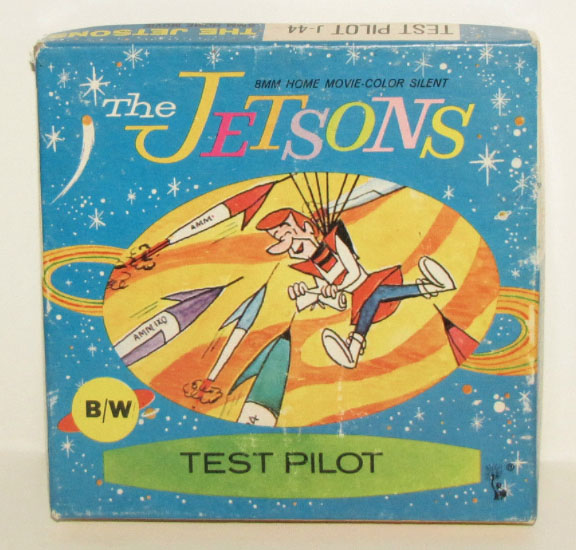
George Jetson in a bullfight? Well, of sorts, in Test Pilot (The Jetsons, 12/30/62). Spacely’s research division (consisting of one old timer who’s been at it for 58 years) has developed the indestructible suit, guaranteed to be impervious to all destructive forces, and to protect the wearer as well. Unfortunately, as Spacely stares out the window at the Cogswell Cogs building, relishing the thought that his competitor’s days are numbered with all the sales Spacely will make, an explosion matching the one in which Spacely’s inventor put the final touches on the suit is witnessed inside the Cogswell building. A peek through binoculars reveals that Cogswell’s researchers have produced a matching suit! The only way for Spacely to get the jump on sales is to call out the press, and stage a public demonstration of the suit’s wonders. But one problem quickly presents itself. No one is stupid enough to agree to test-hop the suit – not even the suit’s inventor. Cogswell finds himself in the same boat, and for the moment, the two moguls are stymied and stalemated in their race for success.

Meanwhile, George is reporting for a company physical, at the office of a doctor who just happens to collect ancient human artifacts, including a genuine Egyptian mummy. Via a space-age slingshot gun, George is made to swallow a computerized mini-probe shot down his throat. The probe (in the voice of Mel Blanc, not far removed from his voice for Marvin the Martian) communicates with the doctor on a monitor screen, as it travels through George’s body examining him from the inside. On the way to the brain, the probe overshoots a curve, pops out of George’s ear unnoticed (wouldn’t this at least leave a punctured ear drum?), and winds up inside the ear of the mummy resting on the opposite side of the room. As the probe gives an image of the brain, it displays a darkened maze of cobwebs. The probe states that this is the first time he’s ever been inside a haunted head, and when asked by the doctor for an opinion of the patient’s condition, the probe reveals a small bugle, upon which it blows “Taps”. George is told the end is imminent, and if he has anything he needs to do, do it in a hurry. Assuming his life is ending, George finds the gumption to do something he could never do if he had anything left to live for – tell Spacely off, and quit. After blowing smoke in Spacely’s face and dousing him with water, George seizes him by the collar, stopping him cold before he can utter, “You’re fired”, and making clear Spacely’s threats mean nothing to him anymore. The suit’s inventor sees this display of courage as the answer to their prayer – here is the man brave enough to test the suit. A bidding war for George’s services takes place between Spacely and Cogswell, with Spacely going all out and offering money from his private safe that hasn’t seen the light of day for so long, the picture of George Washington on the bills has to don a pair of sunglasses. With nothing to lose, George accepts Spaceley’s proposition.

The tests begin, with Spacely sparing no expense on publicity. George runs the gamut of hazards – spun underwater tied to a ship’s propeller blade, lying under a ten-ton boulder while it is smashed to pebbles in a compressor, placed in a room with closing walls on all sides, electrically fried with a mammoth dose of voltage, and defying a buzzsaw which is unable to saw him in two. George somehow survives all with no lasting damage. The final test finds George set to be raised to a height of three miles and dropped by parachute, with two anti-missile-missiles targeted to hit him simultaneously during his descent. Just before the lift-off, who should break through the crowd to speak to George but the doctor, with news that it was all a mistake, and that George should live to the ripe old age of 150. But it’s too late to stop the stunt. The missiles launch, and George finds himself in their crosshairs. Grabbing the parachute fabric (though no explanation is offered why George continues to fall slowly with no billowing silk), George waves the fabric with timid cries of “Ole”, to lure the missiles to charge him. The missiles pause in mid-air, and, accompanied by the music of a majestic trumpet as if from the bull ring, paw with their stabilizer fins as if a four-legged bull pawing the dirt before a charge. The first missile advances, and George performs a perfect matador’s pass. The other missile takes up the challenge. George continues his beckoning calls: “Ole – Ole – Oy, Vey!” as the second missile passes. Both missiles loop and turn around, returning simultaneously from both directions. George hastily writes a will, drops it to the ground, and closes with the words, “George Jeston, signing off.” BOOM!! But George descends to the ground, still all in one piece. The suit worked, and Spacely tells George his bonuses and vice-presidency are assured. George would have settled just for finding himself alive. But of course, all is not the bed of roses they planned. Before a banquet to announce George’s promotion, well-intentioned Jane puts the suit in the washer. It falls apart from not being dry-cleaned! Spacely announces he’ll be bankrupted, and George submits a quick resignation, racing to Cogswell Cogs to see if he can find a job. Even Spacely is forced to eat his pride, shouting after George, “Wait! I’ll go with you!”


Bully For Atom Ant (1/22/66) – Atom Ant takes a needed vacation South of the border, traveling incognito under a sombrero of human size. While sampling the local cuisine at a taco stand, he hears weeping at the shoreline. A skinny young man is about to toss a large boulder off a pier – with himself tied to it. “Adios, cruel world. I don’t theenk I stay on you anymore.” He and the rock plunge into the briny – but Atom Ant zooms in to pull the spluttering man back onto the shore. He wails that nothing goes right, unaware he has been saved, and thinking the ocean is as dry as the dry land. Atom explains that he has been rescued, but the man sees little point in it, as there is nothing to live for. His senorita has given him the air and will not marry him, because he will not fight El Tornado in the bull ring. Atom asks the man’s name, and he responds, “C. Enchilada” – the “C” standing for “Chicken”. (Perhaps if he’d had a brave brother, his first initial would have been B. for Beef.) But Atom has a plan. The man himself can hardly see Atom – even when he is standing on the man’s nose – so no one in the bull ring will see Atom either. Atom will thus do the real fighting, and all Enchilada has to do is wave a cape around for a sure victory.

Enchilada’s appearance in the ring fails of itself to provide any instant impression on the senorita, who remains haughty and unconvinced that anything has changed with Enchilada. El Tornado makes an impressive entrance, and revs up for his first charge. Atom hides behind the folds of Enchilada’s cape, and when the bull hits, he is knocked back so far by Atom’s fist, he has to creep up on the cape and look underneath it, to resolve his worries that Enchilada placed a solid rock behind it. Tornado charges again, after using the old pencil sharpener gag to sharpen his horns. Enchilada is bent over taking bows to the crowd, and seems an easy target – but Atom lifts Enchilada up by the seat of his pants into mid-air, in the nick of time, leaving Tornado to crash through a wooden barrier. Enchilada remains suspended in air, still waving his cape to entice Toro. Tornado resets his sights, placing a stepladder in the center of the ring, and charging up its steps to reach Enchilada. Atom pulls Enchilada away to one side, leaving the bull racing upwards into thin air past the last ladder rung, then falling to create a crater in the arena dirt. Enchilada, back on the ground, waves his cape to entice the bull again. But the bull dives deeper into the crater he has created, tunnels underground, and pops up with full force under Enchilada’s feet, driving him and Atom as passenger into the air and down, to create a matching crater in the dust of their own. Now the bull takes bows to the crowd. Enchilada asks Atom what they should do now? Atom asks Enchilada to wait just a minute. With speed in excess of the sound barrier, Atom takes a ten-second time out to fly through the air all the way back to his headquarters hole in the ground, do about six lifts of his barbell to build up his strength, and zip back again to Mexico, where he returns the bull’s trick, by tunneling underneath him, then delivering through the dirt the might of his “atomic punch”. The bull rises high in the sky, then his descending shadow looms over Atom. “And here comes the fallout”, remarks out hero, zipping out of the bull’s trajectory. The bull again winds up buried in the dirt, and raises from the dust a white flag hoisted upon his tail, as a sign of surrender. The film closes with Enchilada and the senorita as newlyweds, riding off into the sunset atop the now tame El Tornado, dragging clanking tin cans and a “Just Married” sign upon his tail. Atom closes to the audience with, “And so, they lived happily ever after, I theenk!”

• “Bully For Atom Ant” is on Dailymotion.


Unaccounted for are two possible (one likely) episodes from The Abbott and Costello Cartoon Show, with no plot synopsis available, but promising titles. The longshot is Bully Billy, which might as easily refer to some human bully. But Bully For Lou sounds like a sure bet. Anyone know what old retreaded gags they dredged up for either of these?


What a difference a decade and mother’s anti-violence groups can make. H-B’s new “The Tom and Jerry Show” was never something I heard Bill or Joe discuss in interviews, but, even if they spoke of it to the press at some point, one has to believe that deep within, there had to be some shame as to the visible shoddiness of production, poor timing, and entirely lackluster plots of virtually the entire show. It was certainly something they kept their own names off of as far as direction credits (though by this time, this was true of all their shows), and some of the TV shorts they would direct themselves in their final years (such as “Wind-Up Wolf” and others) certainly show they personally still had within them a sense of better timing and a glimmer of their old creative spark. Perhaps the biggest sin of this project was its managing to render two characters who had exuded so much personality on screen without need to utter a word entirely persona-less – cardboard cutouts with no more visible character traits than Buster Bear or Marty the Monk (if you don’t know ‘em, look ’em up). And gone was any semblance of the signature scenario of the series – the chase. Now, the two would fit better as members of the Get Along Gang. H-B’s re-licensing of their own creations, just to allow the entire reputation of the series to be dragged down to an all-time low (even Filmation’s later encounter with the characters, though miserably animated, could sometimes generate a small laugh, restored the characters to adversaries, and resumed the chasing), seemed clearly a simple “taking a dive” for the almighty dollar, and an absolute sell-out of the franchise which never should have seen the light of day. I still (I’m sure along with most fans of the characters) cringe whenever one of these items gets replayed, although I seem to be able to at least sit through everyone else’s attempts.

The Bull Fighters (12/6/75) finds Tom and Jerry, for no apparent reason, walking along a road in the Mexican countryside, apparently on their way to Tiajuana. A bull in a pasture works out with barbells for his morning exercise, then plants a sign near the road reading “Shortcut to Tiajuana” to lure Tom and Jerry into his pasture – thus providing the bull with a target for his morning “road work”. The bull charges, but T&J make a quick reversal of directions, and the bull keeps on sliding forward in his attempt to stop, sliding into the water of a pond. The bull flounders in the water, calling for help because he can’t swim. Tom notices a well with an attached wooden bucket, and tosses the bucket at the bull’s horns, spearing one horn into the bucket’s wood. Tom then reels in the line with the well handle, towing the bull to safety. Despite the good deed, Tom and Jerry aren’t going to stick around to see what mood the bull is in, and start running again. The bull hollers for them to come back, and tosses the well bucket so as to land atop them, stopping their retreat. The bull explains that they saved his life, and from now on, they’ll be friends forever. He introduces himself as Toro the Terrible, a fighter in the bull ring, and as a reward for saving his life, gives T&J two free tickets to see him perform at the arena this afternoon.

T&J needn’t have worried about the free passes to the ring, as circumstances have them destined to view the event from a different perspective. As they enter the town, several people, including the owner of the bull ring, flee in terror, as another bull, El Rotteno, has broken loose. T&J find themselves running away once again, as the hooves of El Rotteno come closer and closer. Tom gets tangled up in the clothing rack outside a dressmaker’s shop, and emerges carrying a frilly red dress. As he holds the garment out in front of him to observe it, the bull passes through, reacting to it as if a cape. Tom is unscratched, but the bull is unable to put on the brakes after the pass, slides up the ramp of a truck with a wooden stake bed, and gets his horns jammed in the wood of one of the cross-beams, holding him captive. The arena owner is amazed at Tom’s cape-work, and offers to make him a famous and wealthy matador. Tom shakes his head no at the offer, until he hears that the owner intends to match him in the ring with someone he knows – Toro the Terrible. Remembering the bull’s promise of eternal friendship, Tom accepts the owner’s offer with a friendly handshake. The owner takes T&J to a holding corral outside the arena, giving Tom a chance to study his bovine opponent. This allows Toro, after briefly putting on an act of ferocity for the boss, to reaffirm that the match will be “duck soup”, and giving Tom a set of signals – a twirl of his left horn means Toro will pass on the left, and the opposite if he twirls his right.

Jerry becomes practically a non-participant in this cartoon, appearing in the ring only as an assistant to carry Tom’s capes (we never see a sword, so one can only wonder how any match is supposed to end). Toro is released from the opposite door of the arena, and begins giving his horn-turning signals. Tom pulls a few of the standard cape maneuvers, including the old windowshade roll-up as Toro passes. Tom uses one new move, hanging the cape upon his tail for another pass. Toro looks back to observe that the crowd is loving it – but overshoots the parameters of the arena, sliding through the archway of the matadors’ entrance, and crashing into a wall inside. He is not only temporarily dazed, but comes up with a twisted ankle. The show must go on, declares the arena owner, making a call for a substitute – El Rotteno. The angry substitute quickly recognizes Tom as the wise guy with the red dress, and seeks to even the score. Tom, however, is none the wiser about the substitution, and calmly walks up to the bull, clasping the metal ring hooked in his nose, and raising and lowering it a couple of times as if using a door-knocker. El Rotteno charges, and two old Warner gags are quickly swiped by the writers. First, a pass transforms Tom’s cape into a string of paper dolls (straight out of Daffy Duck’s “Mexican Joyride”). Then, a second cape handed to Tom by Jerry is punctured with a bull-shaped silhouette (from “Bully for Bugs”). Tom smiles through it all, still thinking it’s part of the act (though no explanation is provided as to why Tom is not looking for the twirling horn signals expected from Toro). As for Toro himself, he suddenly appears above Jerry on the sidelines, watching the match from the spectator’s side of the fence. Toro thinks Tom is doing all right for himself – but explains to Jerry about his twisted ankle, and that Tom is really fighting El Rotteno. Jerry, maintaining his inability to speak, quickly scribbles a note of explanation to Tom, runs up Tom’s back, and displays the note before Tom’s eyes. El Rotteno makes another pass, catching the note on his horns, then slashing one horn against another to cut the paper into confetti. Tom runs for one of the picador barriers, climbing it. El Rotteno again slams his horns into wood, but this time exerts his strength, lifting the barrier out of the ground, and carrying Tom along on top of it with him. He then spots Jerry, and starts to chase him too. Atop the bull, Tom grabs the points of the bull’s horns protruding through the barrier, and steers them to the right to change the bull’s direction. El Rotteno is steered through the archway back to the bull enclosure, and the wooden barrier falls into place at the archway, very unconvincingly providing a supposed barrier to the bull’s re-entrance. (It’s not mounted to the wall by anything, so couldn’t El Rotteno merely knock it down?) The film abruptly ends without further development, in a traditional scene of T&J taking bows as sombreros are tossed into the ring. Ho Hum – and this was one of the better installments of the series!


How do you turn bullfighting into a competitive team sport, without an awful lot of bloodletting? That’s what “Scooby’s All-Star Laff-a-Lympics” attempted to do in the installment, Spain and the Himalayas (11/5/77), taking a leaf – as well as petals and stem – from Lotte Reiniger’s 1934 shadow-animation version of “Carmen” (discussed in chapter I of this article series), and reversing it. Instead of the bull taking a rose from the lips of Carmen, the objective is to retrieve a rose from the lips of the bull! I don’t particularly know of any professional toreadors who have tried this stunt, nor of any bull who was cooperative enough to keep his teeth clenched throughout the event. So let’s just chalk this up to animators’ poetic license – anything for a gag situation.

Mumbly open the competition for the Really Rottens – as usual, with a plan to cheat. He has with him a sleeping gas bomb, intending to make the bull go nighty-night while he grabs the rose. But the device doesn’t work as intended when tossed, merely bouncing off the bull’s nose without emitting its contents, and rebounds back to Mumbly’s feet where it finally bursts open. Mumbly yawns, falls into a sleepwalk, and walks himself out of the arena in a complete doze. Dynomutt steps out as the representative of the Scooby-Doobies. Hos gimmick: use his bionic leg extensions to obtain an overhead position on the bull, sneaking up from behind to pluck the rose from a position right between the bull’s eyes. The bull, however, spots him on the first attempt, and dodges forward into a run across the arena before Dynomutt can make the grab. With his feet still planted where they started from, Dynomutt attempts to keep up with the bull not by running, but by continuing to extend his telescoping lower limbs. He runs out of extension room, reaching his maximum limit, and is sprung backwards by his mechanical limbs, which land hard upon his feet, compressing him into a short squat stance back where he started. Dynomutt apologizes that he must have strained a transistor, and waddles slowly away. This leaves the surprise contestant chosen to represent the Yogi Yahooeys – Cindy Bear! Commentators Snagglepuss and Mildew Wolf can’t figure how she ever expects to get near enough to the bull to do anything – especially when, instead of a cape, Cindy produces a music stand and sheet music. But Cindy promises that music has charms to soothe the savage beast, and the tune she intends to perform will have the bull dropping the rose right at her feet. The bull begins a charge, and Mildew observes that he doesn’t look like he’s got any ear for music. But Cindy stands her ground, and must have been taking lessons from Quick Draw McGraw (making one wonder why Quick Draw wasn’t chosen as team representative to repeat his performance discussed above, since Quick Draw is also a regular member of the Yogi Yahooeys team), performing a run of high-piercing, off-key contraltos. Her singing has the same effect upon the bull as Quick Draw’s, with the bull stopping just short of impact to plug his ears with his hooves, his jaw dropping open in a “no” position, and the rose landing right at Cindy’s feet as promised. (Odd in retrospect, since Cindy sang quite competently in “Hey, There, It’s Yogi Bear”, and “Yogi’s First Christmas”.) Mildew loses a bet to Snagglepuss that Cindy couldn’t do it, and is required to eat his straw hat, complaining that it’ll spoil his din-din – but please, pass the ketchup.

• “Spain and the Himalayas” is on Dailymotion.


There’s plenty of bull in the double-length “All-New Popeye” installment, King of the Rodeo (circa 1979, air date unknown). While the setting is a Western event, traditional bullfighting capework shows up twice in this story, once in each reel. Unusual to a rodeo, the first event is expressly referred to by announcer/judge Wimpy as “bullfighting”. Popeye steps into the arena, producing a cape from under his Stetson hat, and expertly handling the bull’s first pass. As the bull shifts direction to advance upon Popeye again, Popeye wise-cracks, “Reversing the charges, eh?” Of course, Bluto is Popeye’s competition, sitting on the sidelines atop a corral gate. He decides to improve his odds for the competition, by getting at Popeye’s “threads” with the suction of a vacuum cleaner, which steals his cape away. Popeye avoids impact by jumping over the top of the approaching bull, leap-frogging over his oncoming horns. The bull’s momentum carries him forward, and he smashes horns-first into the corral gate Bluto is sitting on. Rearing back, the bull picks up both the gate and Bluto, carrying them back into the arena to pursue Popeye. The ride’s a little rocky, but as long as Bluto is in the event, he chooses to steer the bull by the horns toward Popeye. Popeye remarks, “A bull-cycle built for two”, and runs. But, as the three approach an arena exit with a low overhanging archway, Popeye yells out to Bluto that his mount has no power steering. The bull follows Popeye through the exit, but Bluto and the gate smash into the upper archway, pressing Bluto momentarily flat and dazed, while Popeye, somehow safe, peeps in to laugh with delight at his downfall.

One of the events in the second half of the film is bulldogging. Bluto fouls up Popeye’s attempt to grab the bull by the horns, by placing stretchy rubber tips at the top of each of the bull’s horns while in the corral. Popeye gets a false grip, and is dragged behind by the stretchy rubber. When he finally lands in front of the bull, the bull hogties him, takes his own bows to the crowd, then pulls on the rope to release Popeye like a spinning top. A quick head-butt, and Popeye is driven head-first through a wooden barrier, stuck. Bluto uses a pencil to draw circles upon the seat of Popeye’s pants, providing the bull with a perfect bull’s-eye. Olive tries to intervene, running out into the ring with a red cape of her own, and shouting “Andalay, Andalay.” The bull changes target, sending Olive for a spin of her own as he passes, and spearing her cape upon one of his horns. As the bull reverses direction, Olive and Popeye find themselves cornered on one side of the arena. Popeye meets the challenge, pawing the dirt with one foot and charging the bull, but suddenly transforms the confrontation into a social affair, with the inquiry to the bull, “May I have this dance?” He and the bull break into a round of square dancing, Olive joins in, and the bull even drags in Bluto from the sidelines. Bluto complains that dancing is for sissies, so the bull casually tosses him aside into a watering trough. Finally, however, Popeye decides to have the last laugh, grabbing one of the bull’s front hooves, spinning him around, and landing the bull upside-down on his back, allowing Popeye to rope his feet and win the event.

Brahma Bull riding is the last event. Bluto’s taking no chances on losing this one, having supplied his own mount, in the form of two dumb assistants who wear an old cowhide in impersonation of a bull. Bluto saunters out of the corral atop the two of them, in almost slow motion, but certainly having no trouble staying astride the beast. Wimpy awards him 10 points for a perfect, if somewhat boring, ride. Popeye, however, draws El Diablo, the toughest Brahma in the event. He holds firmly to the rope around the bull’s waist, failing to notice Bluto as he cuts it. Popeye thus finds himself in the ride of his life, fighting desperately to keep his seat. Olive uses a lariat to lasso the bull’s hump, but is merely towed along, her spurs digging a deep trench into the ground, within which Olive becomes stuck. The bull circles around, and now charges at the trapped Olive. Time for Popeye’s “pick-me-up”, this time opening the can by using one of the bull’s horn tips as a can opener. The spinach turns him into a human bulldozer, allowing him to dig Olive out of the ground and deposit her back in the stands to safety, then meet the bull’s charge head on, stopping him cold. The bull turns to an easier target, approaching the fake steed of Bluto, and the two flunkies within ditch their bull costume and run for the exit, revealing Bluto’s fraud. Bluto is disqualified, and Popeye receives the Rodeo crown and trophy. But Bluto never loses gracefully, and seeks revenge by releasing all the remaining bulls in the rodeo at once for a stampede. Popeye grabs up a tall pile of spare boards used for building the bleacher grandstands, and tosses them into the air, forming a corral pen around the cattle. Bluto tosses huge bales of hay at Popeye, but Popeye as quickly tosses them back, stating that once again he as to “bale” Bluto out. Bluto is buried under the hay bales – and who should come charging through them but Popeye’s Brahma bull. Bluto is chased out of the arena and down the road, only one step ahead of the beast’s horns. The final scenes of the film have Popeye and Olive parading before the crowd in victory. Olive observes that Bluto is back in the stands. “Even Bluto’s standing to watch us ride by”, she remarks. “That’s because he can’t sit down”, correctly guesses Popeye, as two large band-aids are observed upon Bluto’s soft and tender pants-seat.


Scooby’s Bull Fright (The Scooby and Scrappy Doo Show, 12/6/80) is a short one-reeler, with neither mystery to solve, nor the human players of the Scooby Gang in attendance besides Shaggy – although the Mystery Machine makes an appearance for transportation. Dawn breaks upon two familiar figures sleeping on blankets under large sombreros, with the Mystery Machine seen parked in the background. They are, of course, Scooby and Shaggy, who are awakened by a rooster, who crows, but adds the words, “Hey, Senor”. Shaggy thinks it’s still night – because his hat is pulled down far over his eyes. But a call for breakfast from Scrappy Doo opens both of their eyes, as he tosses them the local idea of breakfast fare – hot tamales. As steam pours out of Scooby’s and Shaggy’s ears, Shaggy manages to gasp an inquiry to Scrappy as to where he got this stuff. “Right up there”, says Scrappy, pointing upwards to a grandstand where a vendor sells them to the seated crowd. Scooby and Shaggy suddenly realize that, in the darkness, they mistakenly camped out in the middle of the bull arena.

Of course, the bull makes an appearance right on cue. Scrappy is in his usual fighting mood, and grabs up a small cape, yelling “Toro, Toro. Right this way, ya big bully.” Scooby runs interference, wearing a Keystone Kop hat, and holding up a traffic sign reading “Stop” in the bull’s face. (Never mind that the sign is red, which should make the bull even madder.) Scooby races off with Scrappy, depositing him in the Mystery Machine, as Shaggy tries to start the ignition. Of course, the engine won’t turn instantly over, providing Scrappy with enough time to emerge from the van’s rear, wearing boxing gloves and challenging the bull to put up his dukes. The bull answers the challenge, abandoning his traditional charge, and also appearing in fighter’s gloves. Before the two can mix it up, Shaggy rings a bell, and Scooby places a stool at one side of the arena, as the two convince the bull that round 1 has just ended, and take the bull over to one corner, pep-talking him with phrases such as “He never laid a glove on ya”. Scooby throws a pail of water in the bull’s face, as our heroes drag Scrappy back behind a picador’s barrier. But Scrappy emerges again, this time decked out in the mask of a hockey goalie, and with his own stick, puck, and net. He challenges the bull to try to score a goal on him. Once again, the bull answers the challenge, appearing with a hockey stick larger than Scrappy himself. But Shaggy and Scoob run interference again, blowing a penalty whistle, accusing the bull of crossing the blue line too soon, and giving him four minutes in a penalty box. The diversion again gives them time to drag Scrappy away.

With the Mystery Machine’s ignition still not cooperating, our heroes attempt to make a getaway, disguised in an old cow hide. As in any bullfight cartoon, the bull is smitten by the fake female, but a kiss from him is more than Scooby in the fake cow head can stand, who reveals himself to spit away the flavor and say “Yuck”. Scrappy somehow winds up inside the head, and still utters verbal challenges to the bull, charging him, and dragging Shaggy and Scooby along in the rear of the costume. Roles become reversed, as the bull picks up a cape, and plays toreador for a pass of the charging Scrappy. Scooby and Shaggy crash into a wall, while Scrappy breaks free of the head, and leaps on the bull’s back, seeking to ride him as if in a rodeo. The bull begins to buck, but Scrappy remains astride him. Shaggy and Scooby duck out of the galloping bull’s way, as Scrappy leans over the top of the bull’s head. “You still wanna play games, eh? Well try this one.” He leans over the bull’s brow, using both front paws to shut the bull’s eyes. “Guess who?”, he says. Unable to see, the bull charges through an arena archway, and a loud crash is heard within. Scooby and Shaggy presume the worst, but Scrappy emerges from the archway unharmed, leading the bull, who is bandaged and in traction. The boys find themselves strewn with roses tossed from the stands, and Scrappy still wants more. “We can’t quit while we’re ahead”, he declares. “That’s what you think”, answers Shaggy, as the Mystery Machine’s engine finally turns over, and the three speed off into the Mexican sunset.

• “Scooby’s Bull Fright” is on Dailymotion

NEXT WEEK: If you can stand it – A few more H-B items, and miscellany from other studios.

❌