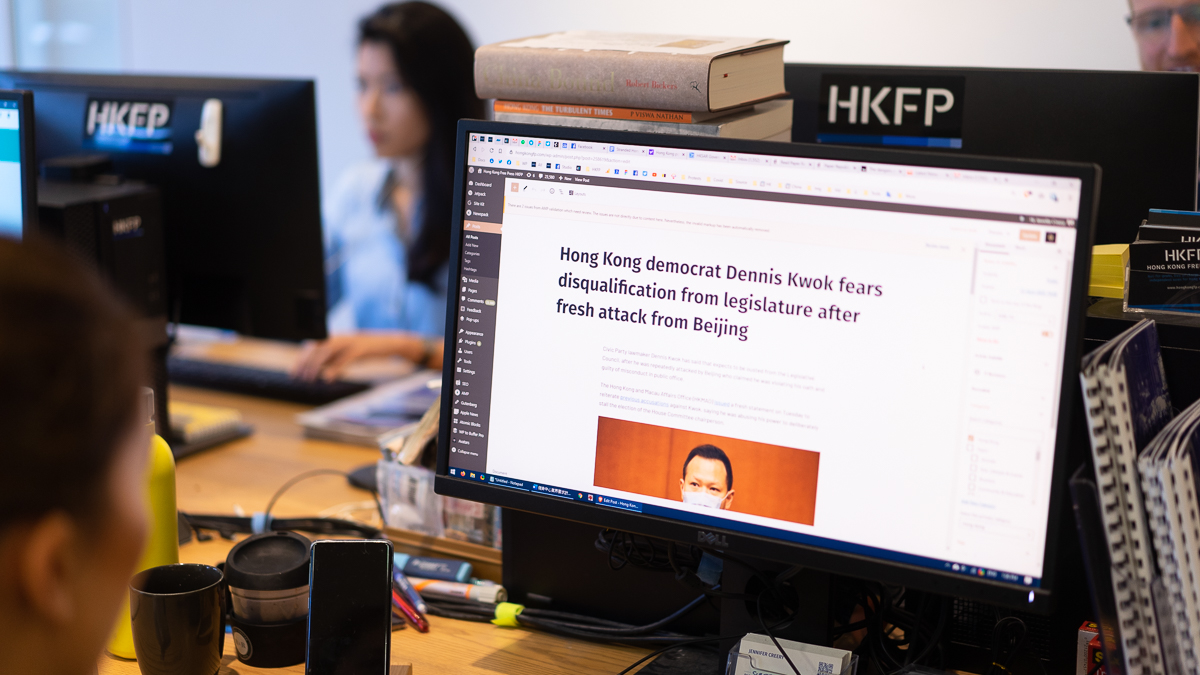
Reading view

Explainer: What to know about Hong Kong’s past Tiananmen commemorations and nat. security trial of vigil leaders

Hong Kong's Tiananmen crackdown vigil. File photo: Etan Liam, via Flickr.

“This prosecution is, in fact, a trial of the law itself,” Hong Kong pro-democracy activist Chow Hang-tung told a court last month.

june 4 tiananmen vigil victoria park
Hong Kong’s Tiananmen crackdown vigil. File photo: Etan Liam, via Flickr.

Chow, 41, made the remark during a defiant closing argument in her trial.

The barrister-turned-activist sought to challenge the legitimacy of the national security allegations against herself, former colleague Lee Cheuk-yan, and the organisation they led, which held Hong Kong’s candlelight vigils commemorating China’s 1989 crackdown on pro-democracy demonstrators in Beijing’s Tiananmen Square.

From 1990 to 2019, the Hong Kong Alliance in Support of Patriotic Democratic Movements of China organised the commemorative event every year on June 4 at Victoria Park, demanding accountability for the bloody crackdown and the democratisation of China, both taboos in the country.

Beijing imposed a national security law in Hong Kong in 2020, following the 2019 protests and unrest. In 2021, police arrested the Alliance’s leadership, including Chow, Lee, and Albert Ho. The Alliance voted to disband that year, ending its decades-long vigils and advocacy.

Chow, Lee, and the Alliance are standing trial for “inciting subversion” under the national security law, an offence that carries a maximum penalty of 10 years behind bars. Ho pleaded guilty when the trial opened in January.

HKFP looked at the events surrounding the establishment of the Alliance, the Tiananmen vigils it organised, and the ongoing trial of its leaders.

Chow Hang-tung, barrister and a leader of the Hong Kong Alliance in Support of Patriotic Democratic Movements of China, poses during a photo session in Hong Kong on March 21, 2021.
Chow Hang-tung, barrister and a leader of the Hong Kong Alliance in Support of Patriotic Democratic Movements of China, on March 21, 2021. Photo: Peter Parks/AFP.

Hong Kong prosecutors have argued that the case against the Alliance is not political and does not concern its activism, the vigils, or the 1989 crackdown. They allege that, however, the group had been calling for the overthrow of China’s ruling Communist Party (CCP) through its “end one-party rule” slogan – a key tenet of the Alliance since its founding.

For Chow, who represents herself in the trial, the prosecution has upended Hong Kong’s value of being a free-wheeling city that tolerates the kind of political dissent not permitted in mainland China.

The trial has in effect “cornered” the court, forcing it to choose its side between the rule of law and an authoritarian regime, she argued.

Alliance and 1989 Tiananmen crackdown

Massive pro-democracy demonstrations broke out in China in the spring of 1989, triggered by the death of Hu Yaobang, a former CCP leader seen as a reformist. Students and protesters gathered in Beijing’s Tiananmen Square for weeks, demanding political reforms and democracy, as the rest of the country rallied to support those in the capital city.

In May that year, the Alliance was founded in Hong Kong, and huge demonstrations were staged in support of protesters in mainland China.

Around 1.5 million people joined a mass rally on May 28, a day after celebrities like Anita Mui, Teresa Teng, Eric Tsang, and Jackie Chan took part in the Alliance’s benefit concert in support of the students’ movement.

Around 1.5 million people take part in a mass rally in Hong Kong in support of students protesting at Tiananmen Square in Beijing. Photo: 1989年的傳真 , via Facebook.

Lee personally went to Beijing to deliver donations raised during the concert. However, he was detained and made to sign a letter of remorse, around the time the tanks rolled in to crush the burgeoning movement. 

The protests in Beijing ended in a bloody crackdown as Chinese troops dispersed protesters on June 3 and 4. Estimates of death tolls during the crackdown range from hundreds to thousands.

In the years that followed, the Alliance organised candlelight vigils at Victoria Park every June 4 to commemorate the dead and to keep the spirit of the 1989 pro-democracy movement alive.

The Alliance’s five tenets – release pro-democracy activists, vindicate the 1989 democracy movement, hold those responsible for the crackdown accountable, end one-party rule, and build a democratic China – were an integral part of the candlelight vigils.

Tens of thousands of people attended the commemorations every year. They lit candles, sang songs, observed a moment of silence, and chanted the Alliance’s five slogans, led by the group’s leaders.
tiananmen massacre hong kong
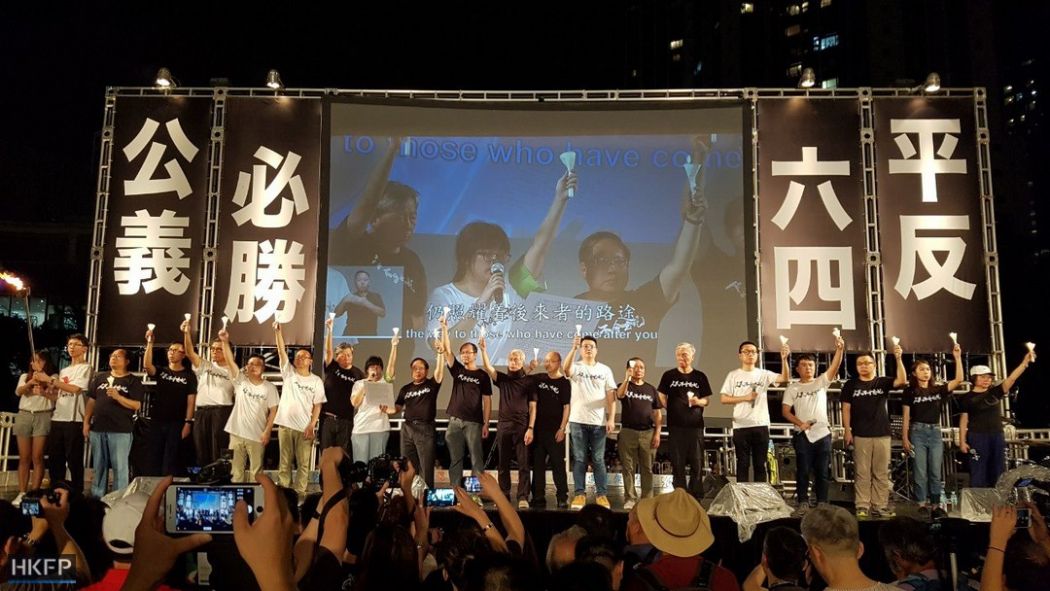
Alliance leaders (from left) Lee Cheuk-yan, Chow Hang-tung, and Albert Ho appear on the giant screen at Hong Kong’s annual Tiananmen crackdown vigil on June 4, 2019. File photo: Todd R. Darling/HKFP.

In 2020, authorities banned the vigil for the first time, citing Covid-19 restrictions. They prohibited the gathering again the following year, also citing the pandemic. The Alliance was disbanded in September 2021, following the arrests of its leaders.

No official vigils have been held since 2019, but there is a heavy police presence at Victoria Park and nearby streets on June 4.

For four consecutive years, Victoria Park has been occupied by a pro-China food festival in early June, including the anniversary day of the bloody crackdown.

‘Weird’ prosecution

In her closing argument last month, Chow said the prosecution was “weird,” as the defendants had not disputed the alleged acts and instead, they embraced what they did.

“Ending one-party rule means putting an end to the status quo, in which those in power are not bound by the law,” she told the court in Cantonese. “What is really in dispute is what the law suppresses and what it protects.”

According to the prosecution, the Alliance’s calls to “end one-party rule” had exceeded the legitimate boundary of freedom of expression as the defendants intended to stoke hatred against Beijing. “Freedom is not absolute,” lead prosecutor Ned Lai told the court in Cantonese.

The last official Tiananmen crackdown candlelight vigil on June 4, 2019.
The last official Tiananmen crackdown candlelight vigil on June 4, 2019. File photo: Todd R. Darling/HKFP.

Chow said the prosecution’s argument had undermined the values long championed in Hong Kong, such as freedom of expression and the rule of law.

“Speaking out the truth has become stoking hatred. Seeking justice has become taking advantage of suffering,” she said. “Asking for accountability has become breaching the constitution. Demanding democracy has become inciting subversion.”

She maintained that the court must protect human rights when reaching a verdict in the case.

“What the court has been asked to ban, to punish in this case are, in fact, what society and the law should encourage… They are the core values of Hong Kong, the norms and ideals accumulated through generations,” she said.

“I hope the court will make a correct decision to safeguard the dignity and bottom line of the law, at a time when values are being reshaped,” she added.

Prosecutors have argued that there are no “lawful means” to end CCP rule after a 2018 constitutional amendment stipulated that the party’s leadership is the “defining feature” of China’s socialist system.

TIananmen crackdown anniversary
A pro-Beijing food carnival at Victoria Park on June 4, 2025, the anniversary of the Tiananmen crackdown. File photo: Kyle Lam/HKFP.

During his closing submission last month, Lee’s lawyer, Erik Shum, argued that prosecutors had presented a “tautological theory.”

“We ask: How exactly did the Alliance incite others to overthrow the CCP? And my submission is that the prosecution has always reverted to the claim that ending CCP rule is illegal,” Shum said in Cantonese.

Shum urged the court to draw a boundary for what is considered an acceptable political expression and what is not.

“The court must not pay lip service to human rights protections,” he said.

The three-judge panel – Alex Lee, Johnny Chang, and Anna Lai – has adjourned the proceedings, saying they hope to deliver a verdict in “mid or late July.”

In a letter from prison this week, Chow, who has been behind bars since September 2021, said she would go on a 37-hour hunger strike in commemoration of the 37th anniversary of the 1989 crackdown.

  •  

Contribute to national development by telling ‘good stories’ of China and Hong Kong, John Lee tells journalists

Hong Kong's press. File photo: Kyle Lam/HKFP.

Hong Kong media outlets should “make contributions” to national development by telling “good stories” of the city and China amid geopolitical uncertainties, Chief Executive John Lee has said.

Press freedom media outlets news press freedom
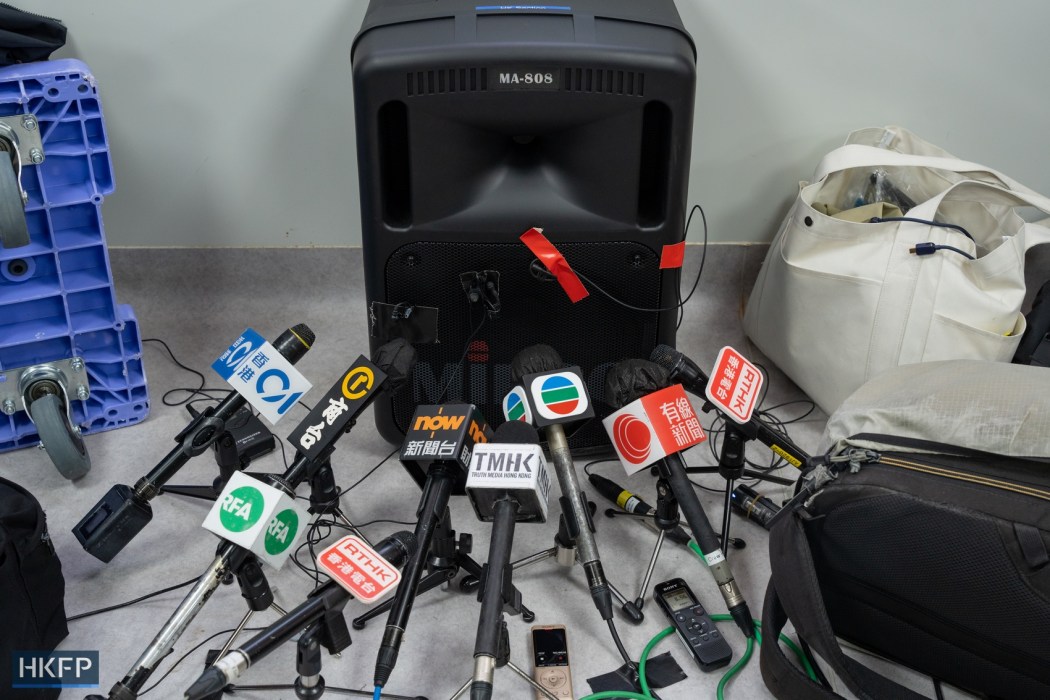
Microphones from media outlets at a press conference. File photo: Kyle Lam/HKFP.

Speaking at the annual Hong Kong News Awards ceremony on Friday, Lee said media practitioners in Hong Kong should aspire to contribute not just to the city’s progress, but also to China’s national development.

He made reference to the “Three Deeds to Immortality,” an ancient Chinese philosophy, and urged media workers to establish “virtue,” “contribution,” and “teaching.”

He said promoting national and city interests should be the core values of those in the media industry, especially amid uncertainties in global politics.

See also: Explainer: Hong Kong’s press freedom under the national security law

“Journalism has great influence and therefore comes with great responsibilities,” Lee said in Cantonese. “Such responsibilities include being impartial, not using news for personal gain, and reporting on accurate and high-quality information for residents.”

Lee said the government is working on Hong Kong’s first five-year blueprint in tandem with China’s 15th Five-Year Plan, a set of policy initiatives outlined by the Chinese Communist Party that has set the stage for the country’s social and economic development since the 1950s.

Hong Kong Chief Executive John Lee speaks at the 2025 Hong Kong News Awards ceremony on May 15, 2026. Photo: GovHK.

The 15th Five-Year Plan, announced in March, proposes expediting the development of a “Chinese narrative system,” and enhancing the country’s image on the global stage, Lee said.

“Excellent media workers… should assist Hong Kong in serving the country, connecting to the world, and contributing the power of the news to society and people’s wellbeing,” he said.

Lee has called on Hong Kong’s media sector to tell good stories of the city since he became Chief Executive in 2022. He has made similar remarks during past speeches at the Hong Kong News Awards ceremony, thought this was the first time he directly urged media workers to contribute to China’s development.

Hong Kong has plummeted in international press freedom indices since the onset of the 2020 and 2024 security laws. Watchdogs cite the arrest and jailing of journalistsraids on newsrooms and the closure of around 10 media outlets including Apple DailyStand News and Citizen News.

  •  

Police surround performance artist in Causeway Bay on eve of Tiananmen crackdown anniversary

Sanmu Chan

A Hong Kong performance artist has been stopped and searched by plainclothes police after showing up in Causeway Bay holding a red string ahead of the Tiananmen crackdown anniversary.

Performance artist Sanmu Chan holds a red string of 6.4 metres' long in Causeway Bay on June 3, 2026. Photo: Kyle Lam/HKFP.
Performance artist Sanmu Chan holds a piece of red string measuring 6.4 metres in Causeway Bay on June 3, 2026. Photo: Kyle Lam/HKFP.

Sanmu Chan appeared at the intersection of Lockhart Road and East Point Road in Causeway Bay at 4.25pm on Wednesday, one day before the 37th anniversary of the 1989 Tiananmen crackdown.

HKFP saw Chan holding a red string for around three minutes before he was surrounded by a group of plainclothes police.

Police searched him and checked his identity. He was then released and went to buy a can of beer in a convenience store.

Performance artist Sanmu Chan in Causeway Bay on June 3, 2026. Photo: Kyle Lam/HKFP.

Chan later told reporters at the scene that the red string was 6.4 metres long.

The Tiananmen crackdown occurred on June 4, 1989, ending months of student-led demonstrations in China. It is estimated that hundreds, perhaps thousands, died when the People’s Liberation Army cracked down on protesters in Beijing.

“It’s abnormal that, whenever we are saying or doing something, we are being monitored,” Chan said in Cantonese.

He did not comment further on his performance, saying that he left it for others to interpret.

Later in the evening, another artist – Chan Mei-tung – was stopped by police nearby. Holding a balloon shaped like a question mark, she was searched and ID’d by officers.

In response to HKFP’s enquiries about the two artists, police said that officers patrolling East Point Road and Lockhart Road spotted a man and a woman loitering in the area. Officers approached them to understand the situation, and both individuals subsequently left on their own accord.

They did not respond as to whether paying tribute to the 1989 dead was legal, but said that any enforcement action is handled lawfully, based on actual circumstances. Operational deployments are made appropriately in response to potential threats to national security, public safety, and public order, they added.

Vigil site

Chan was one of the artists who took part in commemorating the Tiananmen crackdown with performance art in Causeway Bay, when the candlelight vigils took place in Victoria Park.

The last vigil was held in 2019. In 2020, Hong Kong authorities denied permission for the annual event, which attracted hundreds of thousands, citing Covid-19 pandemic restrictions.

Police deployed in Causeway Bay on June 3, 2026. Photo: Kyle Lam/HKFP.

After Beijing imposed the national security law on June 30, 2020, the Hong Kong Alliance in Support of Patriotic Democratic Movements of China, which organised the annual event, was disbanded. The group’s key leaders are now facing a national security trial.

Since then, police have routinely searched and detained members of the public, activists, and artists on the crackdown’s anniversary or before.

Hong Kong artist Sanmu Chan was stopped and searched by police in Causeway Bay on June 3, 2026.
Hong Kong artist Sanmu Chan was stopped and searched by police in Causeway Bay on June 3, 2026. Photo: Kyle Lam/HKFP.

This week, from Wednesday to Sunday, pro-Beijing groups are hosting the fourth edition of an annual patriotic food carnival in Victoria Park.

Hong Kong artist Sanmu Chan is stopped and searched in Causeway Bay on June 3, 2026. Photo: Kyle Lam/HKFP.

Chan has appeared in previous years on the eve of the crackdown anniversary.

On the evening of June 3, 2024, the artist was stopped, questioned and taken away by police in Causeway Bay, as he sought to take part in performance art.

On the evening of June 3, 2023, Chan was apprehended by police on East Point Road. He repeatedly shouted, “Don’t forget June 4,” and “Hongkongers don’t be afraid,” as officers escorted him to a police vehicle.

  •  

Security law update to formalise power of Hong Kong leader to certify any criminal act as a national security case

national security

The Hong Kong government has proposed allowing the chief executive to certify any criminal act as a national security case, in a legal update that would be binding on the courts.

The National Security Exhibition Gallery in the Museum of History in Hong Kong, on August 8, 2024. Photo: Hans Tse/HKFP.
The National Security Exhibition Gallery in the Museum of History in Hong Kong, on August 8, 2024. File photo: Hans Tse/HKFP.

New subsidiary legislation under Article 23 – Hong Kong’s homegrown national security ordinance – will empower the city’s leader to certify “other offences endangering national security under the law of the HKSAR,” according to a proposal submitted to the Legislative Council (LegCo) on Monday by the Security Bureau and the Department of Justice.

The government proposed that the subsidiary legislation would be enacted through a “negative vetting” procedure, allowing it to be gazetted before being tabled at LegCo for scrutiny. It cited a “complicated geopolitical landscape” for the update.

The “legislative intent” of the Beijing-imposed national security law, which came into effect on June 30, 2020, is that offences endangering national security include not only the four types of offences under the Beijing-imposed national security law but also “other offences endangering national security under the law of the HKSAR,” the government’s proposal said.

The chief executive is already empowered to issue certificates to decide whether an act involves national security, but the new subsidiary legislation aims to “bring greater certainty” to the courts. There will no longer be room to debate whether an ordinary crime could face national security procedures when a certificate is issued.

Plus, later offences connected to an act classified as a national security offence would also face national security procedures, under the new plan.

Hong Kong's Legislative Council. File photo: Kyle Lam/HKFP.
Hong Kong’s Legislative Council. File photo: Kyle Lam/HKFP.

“The subsidiary legislation does not involve the creation of any new criminal offence, penalty or enforcement power,” the document said.

‘Any act’ can be reclassified

Under the proposal, the chief executive will be granted the power to declare that any act involved in a criminal offence case concerns national security. The leader may then issue a certificate: “[T]hen the case is a case concerning [an] offence endangering national security” under the Beijing-imposed national security law or Article 23,” the proposal says.

“If a person is charged with any offence endangering national security, and is charged with or convicted of any alternative offence in respect of the same act in the same case, such alternative offence is also an offence endangering national security.”

Once a case, or an offence, is certified as endangering national security, the procedures stipulated in Article 23 or the national security law for handling such cases will be applicable.

The national security law allows handpicked judges and closed-door hearings for national security cases, trials without juries, and a higher bar for bail.

The Panel on Security and the Panel on Administration of Justice and Legal Services will hold a joint meeting later on Monday to discuss the proposed subsidiary legislation.

Ming Pao reported on Sunday that some lawmakers were notified that such a meeting would be held the following day.

  •  

‘There must be reasons’: Cantopop star Hins Cheung’s apology for past political comments sparks fan theories

Hins feature

An engineer by day, Thomas spends most of his time inspecting building projects on construction sites. At night, he unwinds by performing in bars and restaurants across Hong Kong.

Cantopop singer Hins Cheung. Photo: Hins Cheung, via Facebook.

The 35-year-old has always had a passion for singing – in particular, he loves performing songs by Hins Cheung, his favourite Cantopop artist.

“When I have a gig, one-third or even half of my songs are Hins’ songs,” Thomas told HKFP. “I love how he expresses himself through singing. He’s very creative, and he’s humorous too.”

Last year, he even signed up for Hins Academy music seminars, personally taught by Cheung. They were not cheap, Thomas said, costing around HK$800 or $900 per seminar.

Cheung, 45, whose music career in Hong Kong has spanned more than two decades, was born and raised in the southern Chinese city of Guangzhou. He moved to Hong Kong in 2002 to pursue music.

His hits, from old-time favourites like “Tremor” to newer songs like “Imaginary Fairground,” are karaoke staples. He has also won multiple high-profile awards, and his concert tickets sell out notoriously quickly.

Hins Cheung's interview in Wen Wei Po's newspaper on April 11, 2026. Photo: Wen Wei Po.
Hins Cheung’s interview in Wen Wei Po’s newspaper on April 11, 2026. Photo: Wen Wei Po.

Last month, Cheung made headlines after he apologised for his past criticism of the government. His comments were published in a full-page interview with state-backed newspaper Wen Wei Po, in which he said he had been “impulsive” and “ignorant” in his younger years.

A pass for a Hins Academy music seminar attended by Thomas. Photo: Supplied.

The out-of-the-blue repentance contrasted with the pro-democracy stance that Cheung had been associated with. While he – like most public figures in the city’s post-security law environment – has not commented on politics in recent years, his fans remember his support for social movements dating back to the anti-national education protests in 2012.

Cheung also said in the interview that he would serve as a mentor for a Security Bureau programme targeting young people arrested for their involvement in the 2019 protests and unrest. He would lead them on trips to mainland China so they could learn more about the country, he said.

Thomas – who requested to use a pseudonym due to the sensitivity of the topic – said the recent news did not change his perception of Cheung, as he did not think the statements were made of his own free will.

“This is a 180-degree difference” from what Cheung used to be, Thomas said in Cantonese. “I think there must be reasons behind the scenes.”

Hins Cheung giving a music seminar to fans in 2025. Photo: Supplied.
Hins Cheung gives a music seminar to fans in 2025. Photo: Supplied.

His reaction echoed many comments left on Cheung’s social media posts, some of which said the Wen Wei Po interview felt “bizarre” and suggested that something “had happened.”

Political pressure

A political scientist at a university in Hong Kong, who declined to be named, said he believed there was some merit in fans’ theories. Cheung’s dramatic turn showed the increasing political pressure that artists had to cave in to in order to succeed in their field, he said.

He speculated that the government wanted a popular public figure to step forward and “admit their mistakes” to encourage others to rethink their political views. Cheung was a “suitable candidate,” the academic said.

He opined that while Cheung was believed to have a pro-democracy stance, he was not as anti-establishment as other singers who have engaged in political activism.

Screenshot: Hins Cheung/Weibo.
A Weibo post made by Hins Cheung marking China’s National Day on October 1, 2019. Screenshot: Hins Cheung, via Weibo.

In fact, while the Cantopop star has expressed support for the city’s social movements, he has also made posts on Weibo celebrating China’s National Day.

“He has the brand of being anti-government in some sense, but he’s not that extreme,” the scholar said. “He’s the ideal type for the government to work with.”

The apology and collaboration with the government are also beneficial for Cheung from a business perspective, the academic added. 

In the past, artists worried that anti-establishment political statements could limit their opportunities across the border. Mainland China has been known to bar singers perceived as pro-democracy, making it difficult for them to hold concerts there.

But now that fear could be felt right at home, too, the academic said. In recent years, singers who are outspoken about their pro-democracy stance have faced difficulties securing concert venues in the city. 

Ex-district councillor Lester Shum, who was jailed in the 47 democrats case but has completed his jail term, outside West Kowloon Law Courts Building on February 23, 2026. Photo: Kyle Lam/HKFP.

Outside of Cheung’s fan circle, however, criticism is not hard to come by. Lester Shum, a pro-democracy activist who was released from jail in January after serving a four-and-a-half-year sentence for a landmark national security case, said on Threads that Cheung was doing it “for the money.”

He appeared to downplay concerns that Cheung was under any pressure.

“Don’t say he’d get arrested if he didn’t do this lmao,” Shum wrote in Chinese. “I think the chances of that happening are close to zero.” 

Another Threads user accused Cheung of “playing the victim” and trying to fish for sympathy.

‘For his music’

Comments like that do not faze long-time fan Brian, who said he has been listening to Cheung since his late primary school days.

Brian's Hins Cheung concert ticket from 2018. Photo: Supplied.
Brian’s Hins Cheung concert ticket from 2018. Photo: Supplied.

The 29-year-old said he had been to Cheung’s concerts eight or nine times, a feat made possible by the fact that he could buy internal tickets through a friend’s relative who worked at Emperor Entertainment Group, Hong Kong’s talent management behemoth that manages the artist.

Tickets are too difficult to purchase during public sales, said Brian, who declined to disclose his full name.

“I have liked him for so many years for his music, not because of things he has said about politics in the past,” Brian told HKFP. “So I won’t stop liking him because of what he’s said about politics now.”

He told HKFP he himself is not a political person and that he does not support “either side.”

“But in Hong Kong, if you say you support the government, you will have more opportunities,” he said. “If [Cheung] still wants to develop in Hong Kong, to hold shows and appear in films, his stance must be supportive of the government.”

Cantopop singer Hins Cheung. Photo: Hins Cheung, via Facebook.

According to local media, Cheung appeared at a Security Bureau event at the Hong Kong Museum of History at the end of April, where he and other speakers gave talks to about 300 people. The event was aimed at young people who were arrested during the protests and unrest in 2019.

The singer shared the ups and downs of his career, including being scammed by a record company in mainland China when he was 17. In his talk, he did not mention national security.

Afterwards, participants were brought to the national security exhibition in the museum. Then, there was a lucky draw, with tickets to a star-studded concert featuring Emperor Entertainment Group’s singers among the prizes, an attendee told local media.

Thomas said he did not think that Cheung wanted to collaborate with the government on its event, but perhaps he had to as a favour to his music company, which is reportedly experiencing financial difficulties. Last year, Emperor Group actress Michelle Wai also gave a talk at a similar Security Bureau event targeting former 2019 protesters.

A Hins Cheung concert in May 2019. Photo: Hins Cheung, via Facebook.

He also said it was “abnormal” that Cheung unfollowed many accounts on Instagram around the time the Wen Wei Po interview came out, including some of his closest artist friends like Terence Lam and Tyson Yoshi.

Thomas said he believed Cheung would not do that on his own.

He added that while Cheung had not spoken about politics in recent years, his music video for “Imaginary Fairground” – filmed in London in 2023 and depicting Hongkongers’ struggle to adapt to a new life in the UK – was interpreted by fans as a message of encouragement for those who had emigrated because of the city’s political developments.

Thomas’ friends who are also Cheung fans share his continued support for the artist, the hobbyist singer said, but some members of his own audience seem less forgiving.

Thomas had come across restaurant customers at his gigs who, upon hearing him perform Cheung’s songs, said they no longer listened to the Cantopop star.

“I think those are not his real fans,” Thomas said. “All they’ve seen are the news reports.”

  •  

Hong Kong minister defends hospital decision to send girl home after mother’s death

Bouquets of flowers were laid at Taikoo Shing on June 11, 2026, where a mother and a girl fell to their deaths hours apart on June 10, 2026. Photo: Supplied.

Hong Kong’s welfare minister has defended what he called the “professional judgement” of medical and social workers following the death of a girl shortly after her mother’s.

Bouquets were laid at Taikoo Shing on June 11, 2026, where a mother and a girl fell to their deaths hours apart one day earlier.
Bouquets were laid at Taikoo Shing on June 11, 2026, where a mother and a girl fell to their deaths hours apart one day earlier. Photo: Supplied.

Secretary for Labour and Welfare Chris Sun spoke to reporters on Thursday following a double tragedy involving a 12-year-old girl and her 48-year-old mother, who both fell to their deaths within hours of each other on Wednesday in Taikoo Shing.

“The daughter went to the hospital accompanied by her family” after her mother’s death, Sun said in Cantonese.

“At the hospital, doctors, nurses and social workers met with her, and they had to make a judgement. I understand that they decided [the girl] could go home.”

💡If you are in need of support, please call: The Samaritans 2896 0000 (24-hour, multilingual), Suicide Prevention Centre 2382 0000 or the gov’t mental health hotline on 18111. The Hong Kong Society of Counselling and Psychology provides a WhatsApp hotline in English and Chinese: 6218 1084. See also: HKFP’s mental health services guide.

Sun said it was understandable that there were concerns about whether it was suitable to allow the girl to return home.

The daughter was accompanied by family members when she was assessed at the hospital and returned home, Sun added.

“I believe the doctors, nurses and social workers had made the decision [to let her go home] at that time based on their professional judgement.”

He said he refrained from commenting further as the police were investigating the double tragedy.

The mother, a social worker with the Social Welfare Department, was found dead on the podium of their residential block around 9.24am after she reportedly had an argument with her daughter about “educational issues,” according to local media.

At 7.21pm, roughly 10 hours later, police were notified of the fall of the daughter at the same address. The girl was certified dead at the scene.

Bouquets were laid at Taikoo Shing on June 11, 2026, where a mother and a girl fell to their deaths hours apart one day earlier.
Bouquets were laid at Taikoo Shing on June 11, 2026, where a mother and a girl fell to their deaths hours apart one day earlier. Photo: Supplied.

Sun urged people to give the family space and respect their privacy at the moment of tragedy, saying that authorities sought to provide immediate support to the father and other family members.

Edward To, director of social welfare, said at the same press conference that government social workers had visited the father following the incident.

Bouquets were seen at the scene at Taikoo Shing following the tragedy, as residents paid tribute to the mother and daughter.

  •  

Vandals break into Tiananmen crackdown museum in US, founder says

june 4 museum

The Tiananmen crackdown museum in Los Angeles was broken into and vandalised over the weekend, according to its co-founder Wang Dan.

The June Fourth Memorial Museum in Los Angeles was vandalised, its co-founder Wang Dan says on May 31, 2026. Photo: Wang Dan, via Twitter.

“This morning, volunteers at the June Fourth Memorial Museum discovered upon arriving at work that the museum’s main gate had been vandalized and graffitied. We have already reported it to the police,” said Wang on Twitter on Sunday.

Wang was among the student leaders during the 1989 movement.

The Tiananmen crackdown occurred on June 4, 1989, ending months of student-led demonstrations in China. It is estimated that hundreds, perhaps thousands, died when the People’s Liberation Army cracked down on protesters in Beijing.

The June Fourth Memorial Museum in Los Angeles was vandalised, its co-founder Wang Dan says on May 31, 2026. Photo: Wang Dan, via Twitter.

“The perpetrator infiltrated the memorial hall and destroyed the surveillance cameras before beginning the acts of vandalism,” Wang said, adding that commemorative events would go ahead this week regardless.

Footage posted by the museum’s Twitter account appears to show historic items and information boards damaged with spray paint.

在六四纪念前夕,六四纪念馆却遭到了人为的破坏。一直宣扬“伟光正”形象的组织,最擅长干卑鄙龌龊的勾当! pic.twitter.com/XpAJXIPbDC

— 中國議會(臨時)籌備委員會 (@ChinaCongress) May 31, 2026

In a later tweet, Wang said that the CCTV system had been repaired, with footage handed over to the authorities. “The June Fourth Memorial Hall will never cease operations due to such acts of destruction and threats,” he said.

Museums attacked, shuttered

The June Fourth Memorial Museum in Los Angeles was opened last June by Chinese dissidents and survivors.

In April 2019, vandals struck Hong Kong’s June 4 museum.

A year after the 2020 security law was imposed in Hong Kong, a revamped museum shut down just three days after opening, with the Food and Environmental Hygiene Department saying it lacked an entertainment licence.

An online museum remains largely inaccessible in Hong Kong.

Police outside Causeway Bay's Victoria Park, in Hong Kong, on June 4, 2024, the 35th anniversary of the 1989 Tiananmen crackdown. Photo: Kyle Lam/HKFP.
Police outside Causeway Bay’s Victoria Park, in Hong Kong, on June 4, 2024, the 35th anniversary of the 1989 Tiananmen crackdown. Photo: Kyle Lam/HKFP.

For the fourth year in a row, Hong Kong’s Victoria Park – historically the site of annual candlelight vigils to remember the victims of the crackdown – will host a patriotic food carnival on June 4.

  •  

Patriotic carnival to return to site of Hong Kong’s Tiananmen crackdown memorial vigil

Tiananmen site

For the fourth year in a row, Hong Kong’s Victoria Park – historically the site of annual candlelight vigils to remember the victims of the 1989 Tiananmen crackdown – will host a patriotic food carnival on June 4.

Hong Kong's Victoria Park on May 29, 2025. Photo: Kyle Lam/HKFP.
Hong Kong’s Victoria Park on May 29, 2025. Photo: Kyle Lam/HKFP.

The fourth edition of “Hometown Market” will be held from June 3 to 7 at Victoria Park, organisers said during a press conference on Tuesday. The event will feature more than 370 booths selling local Chinese delicacies and showcasing performances by robots, organisers said.

Hong Kong's Victoria Park. Photo: Kyle Lam/HKFP.
Hong Kong’s Victoria Park. Photo: Kyle Lam/HKFP.

Kung Chun-lung, chairperson of the Hong Kong Guangdong Federation, said the carnival will introduce products of “rural rejuvenation,” such as sweet potato, corn, and peanut. The five-day event will also see performances by local celebrities, such as Maria Cordero, as well as a traditional Chinese war dance and a “robotic band,” local media reported.

The five-day Hometown Market in Victoria Park
The five-day Hometown Market in Victoria Park in Causeway Bay, Hong Kong poster for the 2026 edition.

A section of the event will be dedicated to showcasing the technological innovations of Guangdong province, such as artificial intelligence-powered Chinese medicine consultations, according to organisers’ promotional videos on social media.

Decades of vigils

Prior to the Covid-19 pandemic and the Beijing-imposed national security law, tens of thousands of Hongkongers gathered for an annual candlelight vigil on June 4 to mourn the bloody crackdown on student-led protests around Tiananmen Square in Beijing.

Police officers outside Victoria Park, in Causeway Bay, Hong Kong, on June 4, 20204, the 35th anniversary of the 1989 Tiananmen crackdown. Photo: Kyle Lam/HKFP.
Police officers outside Victoria Park, in Causeway Bay, Hong Kong, on June 4, 2024, the 35th anniversary of the 1989 Tiananmen crackdown. Photo: Kyle Lam/HKFP.

The number of deaths is not known, but it is believed hundreds, if not thousands, perished during the People’s Liberation Army’s dispersal of protesters, which ended on June 4, 1989.

Police banned the Tiananmen vigil gathering at Victoria Park for the first time in 2020, citing Covid-19 restrictions, and imposed the same ban in 2021, nearly a year after the national security law came into effect.

The Hong Kong Alliance in Support of Patriotic Democratic Movements of China, which organised the vigils, disbanded in September 2021 after several of its members were arrested.

Photo: Todd Darling/HKFP.
The candlelight vigil held on June 4, 2019, to commemorate the 1989 Tiananmen Square crackdown. Photo: Todd R. Darling/HKFP.

No official commemoration has been held since then.

Over more recent years, the Hometown Market has taken place with police patrolling the vicinity, stopping and searching passersby.

Since the onset of the security law, the Hong Kong government has referred to the Tiananmen anniversary as a “sensitive date,” while statues and artworks paying tribute to the 1989 crackdown have been removed from the city’s university campuses.

The Pillar of Shame monument disappeared from the University of Hong Kong in a covert overnight operation on December 23, 2021. The next day, the Goddess of Democracy statue was taken away from the Chinese University of Hong Kong, while the Tiananmen Massacre wall relief was removed from Lingnan University.

Chow Hang-tung
Chow Hang-tung (right). File Photo: Candice Chau/HKFP.

A three-judge panel will deliver a verdict in “mid or late July” following the national security trial of the Tiananmen vigil organisers.

Its former leader Chow Hang-tung – along with activists Lee Cheuk-yan and Albert Ho – is charged with inciting subversion. She and Lee pleaded not guilty, while Ho pleaded guilty. They face up to 10 years in prison if convicted.

Prosecutors accuse the Alliance of inciting others to topple the ruling Chinese Communist Party through its calls to “end one-party rule” in China, a key tenet of the group since its founding in 1989 after the Tiananmen crackdown in Beijing.

  •  

In Pictures: For 4th year, patriotic carnival held on former site of Hong Kong’s Tiananmen crackdown vigils

tiananmen park

For the fourth consecutive year, a patriotic carnival is being held in Hong Kong’s Victoria Park on the anniversary of the Tiananmen crackdown, the former site of a traditional commemorative candlelit vigil.

A week-long patriotic food carnival is held in Victoria Park on June 3, 2026. The park was once the site of vigils to remember those killed in the Tiananmen crackdown. Photo: Kyle Lam/HKFP.Photo: Todd Darling/HKFP.
A five-day patriotic food carnival is held in Victoria Park on June 3, 2026. The park was once the site of vigils to remember those killed in the Tiananmen crackdown. Photo: Kyle Lam/HKFP & Todd Darling/HKFP.

The fourth Hometown Market Carnival – jointly organised by Hong Kong’s 30 provincial hometown associations – opened on Wednesday for a five-day run at Victoria Park in Causeway Bay, state-controlled Wen Wei Po reported.

The carnival features 370 booths showcasing Chinese specialities and performances, though it requires visitors to undergo security checks before entering the venue.

A five-day patriotic food carnival is held in Victoria Park on June 3, 2026.
A five-day patriotic food carnival is held in Victoria Park on June 3, 2026. The park was once the site of vigils to remember those killed in the Tiananmen crackdown. Photo: Kyle Lam/HKFP.

Thursday marks the 37th anniversary of the 1989 Tiananmen crackdown.

A five-day patriotic food carnival is held in Victoria Park on June 3, 2026.
A five-day patriotic food carnival is held in Victoria Park on June 3, 2026. The park was once the site of vigils to remember those killed in the Tiananmen crackdown. Photo: Kyle Lam/HKFP.

The Tiananmen crackdown occurred on June 4, 1989, ending months of student-led demonstrations in China. It is estimated that hundreds, perhaps thousands, died when the People’s Liberation Army cracked down on protesters in Beijing.

A five-day patriotic food carnival is held in Victoria Park on June 3, 2026.
A five-day patriotic food carnival is held in Victoria Park on June 3, 2026. The park was once the site of vigils to remember those killed in the Tiananmen crackdown. Photo: Kyle Lam/HKFP.

Before the enactment of the Beijing-imposed national security law, a large-scale candlelit vigil was hosted at Victoria Park every year on the evening of June 4. Members of Hong Kong’s pro-democracy movement would remember the dead, as well as call for the democratisation of China and justice for the victims.

A five-day patriotic food carnival is held in Victoria Park on June 3, 2026.
A five-day patriotic food carnival is held in Victoria Park on June 3, 2026. The park was once the site of vigils to remember those killed in the Tiananmen crackdown. Photo: Kyle Lam/HKFP.

On Wednesday, the eve of the 37th anniversary, HKFP saw police surround two performance artists, who attempted to stage subtle performances in Causeway Bay near to the park.

Hong Kong artist Sanmu Chan was stopped and searched by police in Causeway Bay on June 3, 2026.
Hong Kong artist Sanmu Chan was stopped and searched by police in Causeway Bay on June 3, 2026. Photo: Kyle Lam/HKFP.
Artist Chan Mei-tung was stopped and searched by police after appearing in Causeway Bay with a question mark-shaped balloon on June 3, 2026 - the eve of the Tiananmen crackdown anniversary.
Artist Chan Mei-tung was stopped and searched by police after appearing in Causeway Bay with a question mark-shaped balloon on June 3, 2026 – the eve of the Tiananmen crackdown anniversary. Photo: Kyle Lam/HKFP.

Meanwhile, on the same day, Hong Kong’s officials and lawmakers visited Victoria Park to endorse the patriotic event.

A five-day patriotic food carnival is held in Victoria Park on June 3, 2026.
A five-day patriotic food carnival is held in Victoria Park on June 3, 2026. The park was once the site of vigils to remember those killed in the Tiananmen crackdown. Photo: Kyle Lam/HKFP.

Chief Secretary for Administration Eric Chan appeared at the opening ceremony of the carnival. The No. 2 official said that the event boosted “love for hometowns,” as well as local consumption, Orange News reported.

Hong Kong lawmakers visit the patriotic carnival at Victoria Park on June 3, 2026.
Hong Kong lawmakers visited the patriotic carnival at Victoria Park on June 3, 2026. Photo: Starry Lee, via Facebook page.

Starry Lee, president of the Legislative Council (LegCo), led over 50 lawmakers to the carnival on Wednesday afternoon. On her Facebook page, Lee praised the event for not only showcasing Chinese specialities, but also boosting the local economy and enhancing exchanges between Hong Kong and mainland China.

However, some exhibitors cited hot weather when complaining that foot traffic at the carnival was down by 30 per cent compared to last year, HK01 reported.

A five-day patriotic food carnival is held in Victoria Park on June 3, 2026.
A five-day patriotic food carnival is held in Victoria Park on June 3, 2026. The park was once the site of vigils to remember those killed in the Tiananmen crackdown. Photo: Kyle Lam/HKFP.

In June 2020, Hong Kong police banned the Tiananmen vigil gathering at Victoria Park for the first time in 30 years, citing Covid-19 restrictions.

A five-day patriotic food carnival is held in Victoria Park on June 3, 2026.
A five-day patriotic food carnival is held in Victoria Park on June 3, 2026. The park was once the site of vigils to remember those killed in the Tiananmen crackdown. Photo: Kyle Lam/HKFP.

The force imposed the same ban in 2021, nearly a year after the national security law came into effect.

In 2023, a group of 26 hometown associations booked Victoria Park to host the patriotic carnival on the anniversary of the Tiananmen crackdown for the first time.

A five-day patriotic food carnival is held in Victoria Park on June 3, 2026.
A five-day patriotic food carnival is held in Victoria Park on June 3, 2026. The park was once the site of vigils to remember those killed in the Tiananmen crackdown. Photo: Kyle Lam/HKFP.

The Hong Kong Alliance in Support of Patriotic Democratic Movements of China, which organised the vigils, disbanded in September 2021 after several of its members were arrested.

A Hong Kong court is now hearing a landmark trial of the Alliance and two vigil leaders, Chow Hang-tung and  Lee Cheuk-yan. They are accused of “inciting subversion” under the national security law, an offence that carries a maximum penalty of 10 years behind bars. Another vigil leader – Albert Ho – pleaded guilty when the trial opened in January.

  •  

Explainer: Hong Kong’s national security crackdown – month 71

The landmark trial of Tiananmen vigil activists neared its conclusion in May, with both defendants and prosecutors delivering their closing submissions.

Photo: Todd Darling/HKFP.
Tiananmen crackdown vigil on June 4, 2019. Photo: Todd R. Darling/HKFP.

The government allocated more money to the national security fund and lashed out at Reporters Without Borders (RSF) after the NGO once again placed Hong Kong low on its annual press freedom index.

Trial of Tiananmen vigil activists

The national security trial of Tiananmen vigil activists Chow Hang-tung and Lee Cheuk-yan heard closing arguments from the defendants and the prosecution. Lee and Chow were leaders of the now-defunct Hong Kong Alliance in Support of Patriotic Democratic Movements of China.

Lee’s defence lawyer, Erik Shum, spoke before a three-judge panel on May 18, urging the court not to merely “pay lip service” to human rights protections.

He argued that calls to “end one-party rule” in China should be considered legitimate political expression.

Lee, Chow, and the Alliance are facing a charge of “inciting subversion,” an offence under the Beijing-imposed national security law, over the group’s calls to end one-party rule in China during decades of candlelight vigils commemorating the 1989 Tiananmen crackdown. The offence carries a maximum penalty of 10 years behind bars.

Tiananmen Massacre vigil Victoria Park 2018
The 2018 candlelight vigil commemorating the 1989 Tiananmen crackdown in Beijing. File photo: Kris Cheng/HKFP.

The Alliance had never proposed an “action plan” to mobilise supporters to topple the CCP, the lawyer said. “In the past 30 years, there has been no evidence showing that any person acted under the Alliance’s specific instruction,” Shum said in Cantonese.

In his closing submission, prosecutor Ned Lai argued the Alliance’s calls had exceeded the legitimate boundary of freedom of expression as the defendants intended to stoke hatred against Beijing.

“We say that their behaviour had crossed the line,” he said in Cantonese. “Freedom is not absolute.”

Chow, a barrister who represents herself in the trial, delivered her closing arguments on May 19.

She urged the court to safeguard the “dignity and bottom line of the law” and warned the judges not to become “accomplices” in an alleged government crackdown on free speech.

Chow said the crux of the case was whether the law protects the “perpetual rule” of the CCP or the rights of people to advocate democracy.

“Ending one-party rule means putting an end to the status quo, in which those in power are not bound by the law,” she said in Cantonese.

Barrister Erik Shum.
Barrister Erik Shum. Photo: Erik Shum’s Chambers.
Barrister Priscilia Lam.
Barrister Priscilia Lam. Photo: Plowman Chambers.

Senior counsel Priscilia Lam, representing the Alliance, argued the prosecution had not been able to present evidence of the group’s alleged incitement to subversion.

“What did the Alliance do to incite people to subvert state power?” Lam said in Cantonese. “I have heard nothing on this after sitting here for so long.”

The Alliance disbanded in 2021 after authorities banned the vigil for two years, citing Covid-19 restrictions, and arrested its leadership on national security allegations. Chow and Lee have been behind bars since September 2021.

Another defendant, former lawmaker Albert Ho, pleaded guilty when the trial opened in January.

The three-judge panel said they hope to deliver a verdict in “mid or late July.”

Gov’t reacts to UK trial conviction

The Hong Kong government denied any link to a high-profile UK court case after its trade officer was convicted of spying on overseas activists.

From left: Hong Kong Economic Trade Office (HKETO) official Bill Yuen and former UK Border Force official Peter Wai. Photos: Metropolitan Police.
From left: Hong Kong Economic Trade Office (HKETO) official Bill Yuen and former UK Border Force officer Peter Wai. Photos: Metropolitan Police.

“From the outset, the Hong Kong Special Administrative Region (HKSAR) Government has been clearly stating that the allegations in this case are absolutely not related to the HKSAR Government and the Hong Kong Economic and Trade Office in London (London ETO), nor are we party to the case,” a government statement sent to the media on May 8.

The statement was issued a day after Bill Yuen, an office manager at the Hong Kong Economic and Trade Office in London, and former UK Border Force official Peter Wai were found guilty under Britain’s national security laws of assisting a foreign intelligence service.

Yuen and Wai – both British-Chinese dual nationals – were accused of spying on Hong Kong pro-democracy activists living in Britain.

Among those the pair were said to have surveilled was Nathan Law, who is wanted by Hong Kong’s national security police with a bounty of HK$1,000,000.

Wanted activist arrested in Thailand

Hong Kong authorities declined to comment on reports that an activist wanted by the city’s national security police could face deportation to China after being arrested in Thailand for allegedly overstaying her visa.

Zhang Xinyan. Screenshot: Hong Kong Parliament, via YouTube.

Responding to media queries about concerns that wanted activist Zhang Xinyan could be transferred to China, the Security Bureau said on May 11 that it would not comment on news reports about law enforcement actions in other jurisdictions.

“Endangering national security is an extremely serious crime… no fugitive should harbour the illusion that they can evade criminal liability by fleeing Hong Kong,” the bureau said in a statement.

Zhang, 54, is wanted by Hong Kong’s national security police for allegedly committing subversion, a crime under Article 23 – also known as the city’s homegrown national security law.

She is among a group of 19 activists named in a round of arrest warrants issued in July 2025, with bounties between HK$200,000 and HK$1 million.

From February to June 2025, they were allegedly involved in the “Hong Kong Parliament,” a group of overseas activists who held unofficial polls outside the city to form a shadow legislature to “pursue the ideal of Hong Kong people ruling Hong Kong.”

According to Human Rights Watch, Zhang holds refugee status issued by the United Nations High Commissioner for Refugees (UNHCR).

New allocation for national security fund

The Hong Kong government allocated an additional HK$5 billion to a national security special fund.

Hong Kong's Security Bureau organises a flag-raising ceremony on June 22, 2025, to mark the fifth anniversary of the national security law. Photo: GovHK.
Hong Kong’s flag-raising ceremony on June 22, 2025, to mark the fifth anniversary of the national security law. Photo: GovHK.

The government unveiled the funding on May 15, when it gazetted the government accounts for the fiscal year 2025-26.

It was the third allocation for national security since Beijing imposed the national security law in Hong Kong in June 2020.

The special fund was established the same year. It received an initial allocation of HK$8 billion in December 2020 and an additional HK$5 billion in the financial year ending March 31, 2023.

The latest allocation thus brought the total amount to HK$18 billion.

In response to Ming Pao’s enquiry, the Financial Secretary’s Office said authorities will not disclose details of the funding, citing Article 14 of the national security law. It did not respond to whether the previous HK$13 billion funding had been depleted.

Worsening press freedom, FCC survey finds

Two out of three journalists say the working environment in Hong Kong has changed “for the worse” in the past year, according to the latest survey by the Foreign Correspondents’ Club, released on May 11.

FCC
The Foreign Correspondents’ Club, Hong Kong. Photo: Kelly Ho/HKFP.

The 2026 FCC Press Freedom Survey, which received 78 responses from members, found that “67 per cent of respondents said the working environment for them as a journalist had changed for the worse in the last 12 months.”

The FCC pointed out that the survey “happened to take place” after Apple Daily founder Jimmy Lai was convicted and sentenced to jail, as well as Beijing’s national security office in Hong Kong, the Office for Safeguarding National Security (OSNS), summoned representatives of several major foreign media outlets, shortly following the deadly Wang Fuk Court fire.

One respondent said that the warning by the OSNS to foreign journalists “should be seen as a watershed moment here in Hong Kong. It has created an increased chilling effect.”

Another respondent said that the 20-year sentence handed down to Lai “only further chills the local reporting environment.”

Gov’t reacts to RSF press freedom index

The Hong Kong government and the Legislative Council (LegCo) condemned Reporters Without Borders (RSF) in early May after the city was ranked low in the NGO’s annual press freedom index.

They also hit out after German public broadcaster Deutsche Welle (DW) awarded Lai, the jailed media tycoon, a press freedom prize on April 30.

Jimmy Lai
Jimmy Lai in 2020. Photo: HKFP.

In RSF’s 2026 global press freedom index, released on April 30, Hong Kong was ranked 140th out of 180 countries and territories – the same position as last year. The press freedom NGO highlighted the 20-year sentence handed down to Lai, who was convicted last year under the security law.

In response, the Hong Kong government issued a press release on May 1. It said that it “strongly condemned the attempts by an anti-China organisation and foreign media to sugarcoat the criminal acts of national security offender [Jimmy] Lai Chee-ying and to slander, smear, as well as attack the HKSAR by releasing a so-called press freedom index and presenting a so-called ‘award’. Such despicable behaviours totally disregarded the rule of law and twisted the facts, which must be strongly condemned.”

In a separate statement on the same day, the LegCo Secretariat said it “strongly condemned the release of a so-called press freedom index by a foreign media organisation and presentation of a so-called award to the national security offender Lai Chee-ying to sugarcoat his criminal acts, and smear the press freedom and rule of law” in Hong Kong.

RSF’s Aleksandra Bielakowska – who was denied entry to the city in 2024 – responded to the Hong Kong authorities.

“To make it clear once again: defending journalism is not ‘anti-China’; it is pro–press freedom,” she said on May 2. “At RSF, we stand arm in arm with Hong Kong journalists. We will not be intimidated and we continue supporting all media in Hong Kong, with the hope that one day we will see positive change and that the city will return to its golden years as an exemplar and beacon of press freedom.”

3 charged over alleged weapons training

Three people were charged with conspiracy to commit subversion after they were arrested by national security police over alleged illegal weapons training last year.

Students Wong Kit-lun, 20, and Tang Ngai-pok, 23, as well as waiter Chan Hiu-chun, 23, appeared at West Kowloon Magistrates’ Courts on May 15.

West Kowloon Law Courts Building. File photo: Kyle Lam/HKFP.

The trio stood in the dock beside Gallian Pang and Lee Chun-sum, who were also charged with conspiring to subvert state power – an offence under the Beijing-imposed national security law – on December 15.

The five men are among a group of 10 people – nine men and one woman – arrested on December 11 and 12 for alleged “unlawful drilling” – an offence under the Safeguarding National Security Ordinance, the homegrown national security law, also known as Article 23. The arrests marked the first time authorities had invoked the unlawful drilling offence.

Last month, the prosecution accused Wong, Tang and Chan of conspiring with Pang, Lee and “other persons unknown between November 1, 2024, and December 11, 2025, to organise, plan, commit or participate in acts to subvert the state power.”

Wong faced an additional charge of possession of child pornography, an offence under the Prevention of Child Pornography Ordinance.

The prosecution also charged Lee with allegedly possessing explosives and radio communications apparatus without a licence.

Prosecution and arrests figures

As of May 1, a total of 399 people have been arrested for “cases involving suspected acts or activities that endanger national security” since Beijing’s national security law came into effect, according to the Security Bureau. That figure includes those arrested under Article 23 and for other offences.

Of the 208 people and five companies that have so far been charged, 181 people and four companies have been convicted or are awaiting sentencing.

In total, 100 people and four companies have been charged under Beijing’s national security law, with 79 persons and three companies convicted. Thirteen people have been charged under Article 23, 11 of whom have been convicted.

  •  

2026 HKFP Reader Survey: Help shape our coverage… and win HKFP merch

HKFP Reader Survey

HKFP’s 2026 Reader Survey will help us to shape and prioritise our news coverage over the coming two years, and guide how we invest donor money.

Take part before June 5 for a chance to win an HKFP goodie bag including a tote, t-shirt, keyring, mug, stickers and an HKFP deer. A winner will be randomly selected.

Merch 2025
Win a goodie bag containing one of each item.

Your answers are confidential. We never pass on, or sell, reader data. You may skip any question.

HKFP Team
HKFP Team
  •  

HKFP Job Vacancy: Executive Editor

HKFP Careers

Whether it’s questioning top officials, gathering breaking news from court, or live-streaming from the ground, HKFP’s tight-knit team is on the frontlines of Hong Kong’s political twists and turns every day. At the city’s only independent English-language outlet, our journalists are in a privileged position to help write the first draft of history.

Team HKFP 2026
(L-R) Senior Reporter Hillary Leung, Photojournalist Kyle Lam, Senior Reporter Hans Tse, Features Editor Irene Chan, and Reporter James Lee. Seated are Director & Editor-in-Chief Tom Grundy and outgoing Executive Editor Yenni Kwok.

All of Team HKFP have a high level of responsibility, independence and freedom to chase their own stories. We have no junior staff – everyone is a multimedia journalist, and there is no such thing as a slow news day. 


HKFP staffers have gone on to work for outlets such as the New York Times, Agence France-Presse, the Wall Street Journal, Bloomberg, CNN, the BBC and the Financial Times. If you want to fast-track your career, if you thrive in a fast-paced environment, or wish to help shape the future of the city’s most independent and transparent English-language newsroom, consider applying to join our team.

Our mission: HKFP’s mission is to be the most credible, impartial and independent news outlet on Hong Kong affairs, and to help safeguard press freedom in the city. We seek to amplify the voices of the voiceless whilst bridging the gap between the Chinese and English languages. Read our Annual Report.


Executive Editor

HKFP is seeking an Executive Editor to oversee our daily output and manage the newsroom, beginning in late June.

  • Our Executive Editor will edit, polish and fact-check four to five hard news stories per day, and will schedule and promote them across our platforms. They will also edit newsletters, manage the newsroom, and support our Features Editor in overseeing weekend features and our Monitor newsletter.
  • Our newsroom leader will help the team plan future coverage, enforce deadlines, monitor local developments, and assist with story ideas.
  • They will be tasked with navigating legal risks and political sensitivities alongside the director, and may occasionally be required to write short leads.
  • This dynamic role involves a pathway to rapid, performance-based pay rises within the first year, and a promotion to Editor-in-Chief within three years.
  • Other than guiding our dedicated team, there are also opportunities for professional development, room to launch side projects (e.g. a podcast) and a chance to have a meaningful impact at a critical time for the city’s media landscape.

Requirements:

  • Candidates must have at least two years of experience in a daily news editorial role at a – preferably local – news outlet.
  • We are seeking applicants familiar with the Hong Kong political beat, with knowledge of who’s-who and a good understanding of how the government, legislative and judicial systems work. They will have an eye for news, and a comprehension of current political/legal risks.
  • Native-level English-language fluency is essential, with no tolerance for errors. Candidates must be self-directed, full of ideas and have the ability to edit news with accuracy and speed. Cantonese language skills would be an advantage, but not essential.
  • The ideal candidate would have excellent initiative, time management, and must be a team player.
  • Digital skills, knowledge of local law, SEO and analytics would be a bonus.
  • Candidates must already have the right to work in, and live in, Hong Kong – we cannot arrange visas.

Remuneration and benefits:

  • HKFP sets standards on pay, conditions, benefits and work-life balance – all of which are comparable to international news outlets.
  • We offer a competitive starting salary depending upon experience, skills and qualifications.
  • 14 days of leave per annum in the first year, rising yearly to 24 days in the fourth year, in addition to all Hong Kong public and statutory holidays.
  • International healthcare, dental and physio coverage.
  • Mental health support options.
  • A secure work laptop, work phone and VPN.
  • HKFP staff enjoy the many benefits of working at the Hive co-working spaces.
  • Staff receive occasional bonuses, and enjoy weekly opportunities to work remotely from home, or abroad.
  • HKFP’s Executive Editor may have the opportunity to represent the company at events and conferences, at home and abroad.

How to apply


Read more about us here. Read about our impact in our Annual Report.

hkfp stock broll b-roll
  •  
❌