The Hong Kong government has allocated an additional HK$5 billion to a national security special fund, bringing the total amount to HK$18 billion.
The funding is the third allocation for national security since Beijing imposed the national security law in Hong Kong in June 2020.
Hong Kong’s Security Bureau organises a flag-raising ceremony on June 22, 2025, to mark the fifth anniversary of the national security law. Photo: GovHK.
The government unveiled the funding on Friday, when it gazetted the government accounts for the fiscal year 2025-26.
It showed a HK$5 billion allocation for non-recurrent expenditure as special funding for safeguarding national security.
Hong Kong established the special fund in 2020 to finance expenses related to safeguarding national security after the national security law took effect in June that year.
The latest allocation thus brought the total amount to HK$18 billion.
In response to Ming Pao’s enquiry, the Financial Secretary’s Office said authorities will not disclose details of the funding, citing Article 14 of the national security law. It did not respond to whether the previous HK$13 billion funding had been depleted.
According to Article 14 of the national security law, no institution, organisation, nor individual in Hong Kong shall interfere with the work of the Committee for Safeguarding National Security, and information relating to its work shall not be subject to disclosure.
The Hong Kong government’s 2025-26 accounts show HK$5 billion is allocated to a special fund for safeguarding national security. Photo: HKFP screenshot.
The government said in July that it would not disclose any details of the special fund in a report to the legislature on the control and management of the special fund, citing the same article of the national security law.
It said authorities had established “a dedicated accounting and financial unit” in the secretariat of the Committee for Safeguarding National Security.
“The unit, which reports directly to the [financial secretary], is responsible for the revenue and expenditure arrangements and financial matters relating to such work,” the government said.
Hong Kong police took away seven people in Causeway Bay, where past public commemorations for China’s 1989 Tiananmen crackdown were once held, on Thursday, the 37th anniversary of the event.
A young man in a black T-shirt is intercepted by police on June 4, 2026. Photo: Kyle Lam/HKFP.
Police said late on Thursday that five men and two women, aged 17 to 79, were stopped by officers on suspicion of “disrupting order” near Great George Street and East Point Road in Causeway Bay.
They were taken away from the scene for further investigation and were released later, according to police.
“The police force will act according to threats to national security, public safety, and public order,” they added.
Activists and members of the public defied a heavy police deployment at and around Victoria Park, the former site of the city’s annual Tiananmen vigils, as they showed up in Causeway Bay on Thursday to mark the 1989 crackdown.
Chan Po-ying, chairperson of the now-defunct League of Social Democrats, a pro-democracy party, arrived in Causeway Bay holding a yellow paper flower. She was quickly told by police at the scene to put away the flower and was later taken away in a police vehicle.
Activist Chan Po-ying appears in Causeway Bay with a yellow paper flower on June 4, 2026. Photo: Kyle Lam/HKFP.
A young man in a black T-shirt was intercepted by police after he put on a blindfold and used a red marker pen to write on his arm outside the Sogo department store at around 7.15pm.
The man was driven away in a police van. He was also taken away from Victoria Park by law enforcement during the Tiananmen crackdown anniversaries over the past two years.
HKFP saw two other men taken away in a police van: a man holding a candle and another man sitting cross-legged on the ground outside the Sogo department store.
Police also took away a woman gesturing “six” and “four” with her hands, local media reported.
For the fourth consecutive year, on the day of the crackdown anniversary, a patriotic food carnival was being held in Victoria Park, at the same spot where hundreds of thousands of people attended the Tiananmen vigils. The carnival will run until Sunday.
Some people walked around the park to remember the crackdown and the past vigils. A 70-year-old man surnamed Tin told HKFP it was a “pity” that Hong Kong has lost its tolerance for public commemoration on June 4 – the date of the 1989 crackdown.
Police officers patrol Victoria Park on June 4, 2026. Photo: Kyle Lam/HKFP.
Compared with previous years, police officers appeared more relaxed on Thursday, patrolling the park and its vicinity in smaller groups and conducting fewer searches than before.
The Tiananmen crackdown occurred on June 4, 1989, ending months of student-led demonstrations in China. It is estimated that hundreds, perhaps thousands, died when the People’s Liberation Army cracked down on protesters in Beijing.
Two Hong Kong officials have condemned “groundless accusations” against a recent update to the city’s homegrown national security law, which empowers the chief executive to certify any criminal case as a national security offence.
Secretary for Security Chris Tang speaks at LegCo. File photo: Kyle Lam/HKFP.
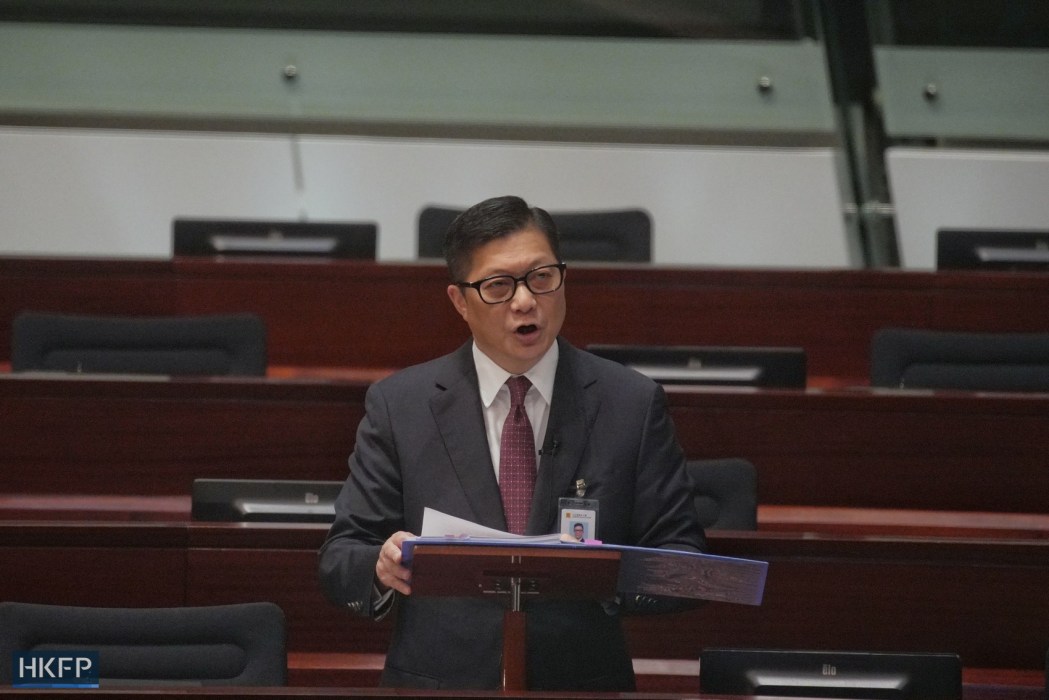
Secretary for Security Chris Tang told the Legislative Council (LegCo) on Thursday afternoon that he noticed some people had misunderstood or “deliberately misinterpreted” the subsidiary legislation.
They tried to intimidate the public by claiming that the subsidiary law would widen the scope of national security offences, turning minor offences into national security crimes, he said.
The security chief called the accusations “false, misleading, deceptive, and scaremongering” and said some people were attempting to incite hatred towards the government.
“Some people delivered alarmist remarks, saying that the government can randomly certify any acts of the public as national security offences. Those people may have ulterior motives or are cruel-hearted, hoping to incite others’ hatred of the HKSAR,” Tang said in Cantonese.
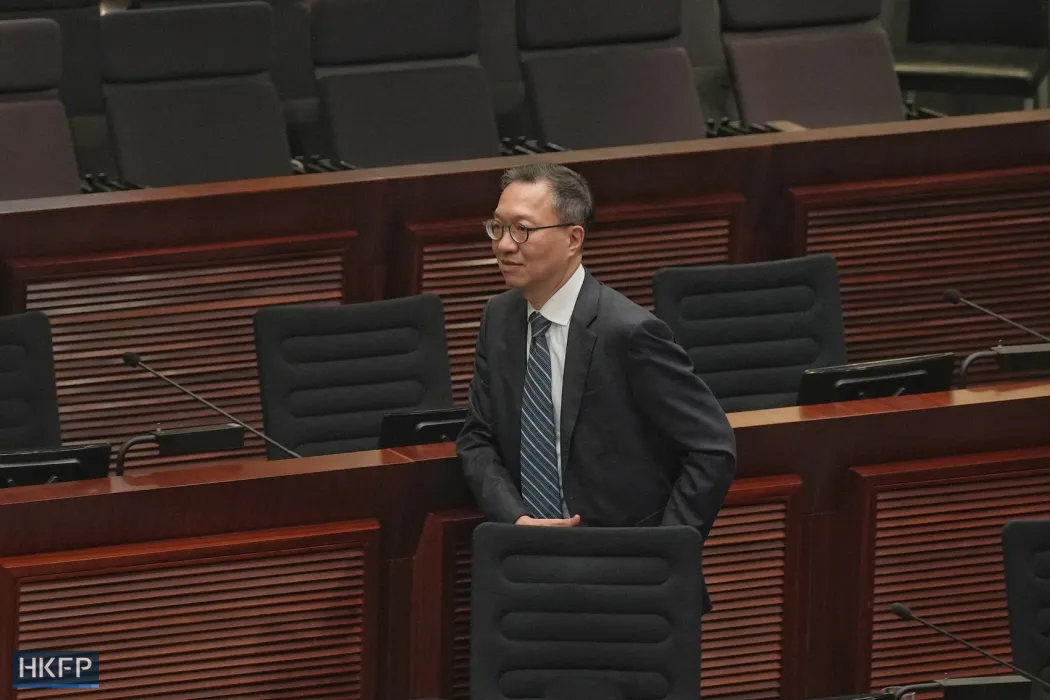
Also speaking at LegCo, Secretary for Justice Paul Lam said he noticed “some media outlets with ulterior motives, foreign forces, and fugitives” had made “groundless accusations” against the national security law.
The two ministers delivered their remarks during LegCo’s first meeting to review the Safeguarding National Security (Procedural Matters) Regulation, a subsidiary legislation of the homegrown national security law, commonly known as Article 23.
Authorities enacted the subsidiary law through the “negative vetting” mechanism, which allows the law to be gazetted and to take effect before legislative scrutiny.
Secretary for Justice Paul Lam at LegCo. File photo: Kyle Lam/HKFP.
Lam, the justice chief, said that the subsidiary legislation was necessary to further explain articles in the Beijing-imposed national security law and Article 23, which stipulate that the chief executive should have the power to determine whether a criminal case involves national security.
In its proposal, the government cited the “legislative intent” of the Beijing-imposed national security law, saying that offences endangering national security include not only the four types of offences under the national security law, but also “other offences endangering national security under the law of the HKSAR.”
Lam said the recent legislative update was intended to further define “other offences endangering national security under the law of the HKSAR,” and it did not introduce any new power or new offences.
Earlier on Tuesday, Chief Executive John Lee said the new subsidiary legislation “is purely to make the law even clearer.”
President Trump said Thursday that his choice to serve as director of national intelligence, Bill Pulte, would only be a temporary selection amid bipartisan controversy over the pick. Trump said Pulte, who’s currently the head of the Federal Housing Finance Agency, is “very smart” and has “high integrity,” when asked by reporters in the Oval...
Speaker Mike Johnson (R-La.) announced that the House will vote Thursday morning on extending the nation's foreign spy powers through July 2, a move that comes amid a partisan clash over President Trump naming Bill Pulte to be the acting director of national intelligence (DNI). The expected vote comes after Democrats in the Senate largely...
Podcaster Joe Rogan said the deployment of Immigration and Customs Enforcement (ICE) officers across the country by the Trump administration sets a “dangerous precedent.” “A different ruler could use this precedent in a very damaging way for our free society. That's my perspective on it,” Rogan said during the Wednesday episode of his podcast. “It's...
President Trump’s bid to install a controversial ally to head the intelligence community without the blessing of Congress is giving lawmakers pause about renewing the nation’s warrantless spy powers. Trump on Tuesday announced he had tapped Bill Pulte, the current head of the Federal Housing Finance Agency (FHFA), to additionally serve as the acting director...
China accused the United States on Thursday of distorting facts and smearing its political system, after Secretary of State Marco Rubio said censorship could not “erase” the memory of Beijing’s 1989 Tiananmen crackdown.
US Secretary of State Marco Rubio delivers remarks to members of the media at the White House on May 5, 2026. Photo: The White House, via Flickr.
On June 4 that year, the Chinese government sent troops and tanks to crush protests calling for political reform in and around Beijing’s Tiananmen Square.
The death toll remains unknown, and discussion of what happened is censored in mainland China.
Rubio told a news conference on Wednesday that “no amount of censorship can erase the past”.
“Those who sacrificed to uphold their unalienable rights of free expression and peaceful assembly will be vindicated someday,” he said.
China’s foreign ministry said Thursday it firmly opposed Rubio’s comments.
“The Chinese government has long since reached a clear conclusion regarding that political turmoil that occurred in the late 1980s,” ministry spokeswoman Mao Ning told a regular news briefing.
“The relevant erroneous remarks by the US side distort historical facts, smear China’s political system and development path, and interfere in China’s internal affairs,” she said.
This year, authorities reportedly prevented the families of those who died in 1989 from visiting their graves at Beijing’s Wan’an Cemetery, with Amnesty International calling the move “a heartless act”.
Beijing has also moved in recent years to snuff out all public commemorations in Hong Kong, where an annual candlelight vigil had been held for decades before the imposition of a national security law in 2020.
Tang Ngok-kwan, a former member of the Hong Kong Alliance in Support of Patriotic Democratic Movements of China, outside West Kowloon Law Courts Building on January 22, 2026. Photo: Kyle Lam/HKFP.
AFP reporters saw a heavy police presence on Wednesday near Hong Kong’s Victoria Park, the former site of the event.
Late that night, activist Tang Ngok-kwan stood alone in the park, reading the names of hundreds of victims in a low voice under the watchful eyes of several plainclothes police officers.
A defence lawyer for a Tiananmen vigil activist has urged a Hong Kong court not to “pay lip service” to human rights protections, arguing that calls to “end one-party rule” in China should be considered legitimate political expressions.
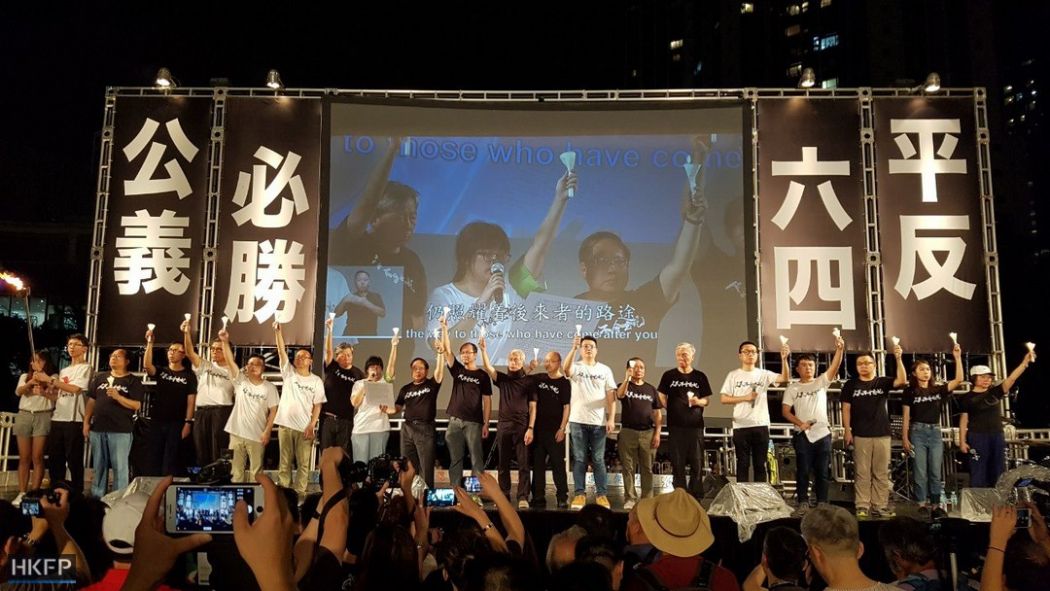
Alliance leaders (from left) Lee Cheuk-yan, Chow Hang-tung, and Albert Ho appear on the giant screen at Hong Kong’s annual Tiananmen crackdown vigil on June 4, 2019. File photo: Todd R. Darling/HKFP.
Barrister Erik Shum, representing Lee Cheuk-yan, spoke before a three-judge panel on Monday as closing arguments began in the national security trial of Lee and Chow Hang-tung. Both are former leaders of the now-defunct Hong Kong Alliance in Support of Patriotic Democratic Movements of China.
The pair and the Alliance are facing a charge of “inciting subversion,” an offence under the Beijing-imposed national security law, over the group’s calls to end one-party rule in China during decades of candlelight vigils commemorating the 1989 Tiananmen crackdown. The offence carries a maximum penalty of 10 years behind bars.
The calls to end one-party rule – one of the group’s five tenets that also included the democratisation of China since its founding in 1989 – were demanding a change in the country’s political system rather than targeting any specific political party, Shum said.
Shum told the court on Monday that prosecutors had failed to present evidence that the Alliance sought to incite the public to revolt against the ruling Chinese Communist Party (CCP).
The Alliance had never proposed an “action plan” to mobilise supporters to topple the CCP, he added.
“In the past 30 years, there has been no evidence showing that any person acted under the Alliance’s specific instruction,” Shum said in Cantonese.
Civilian political criticism
Prosecutors have argued that there are no “lawful means” to end CCP rule after a 2018 constitutional amendment stipulates that the party’s leadership is the “defining feature” of China’s socialist system.
Shum argued on Monday that prosecutors presented a “tautological theory.”
“We ask: How exactly did the Alliance incite others to overthrow the CCP? And my submission is that the prosecution has always reverted to the claim that ending CCP rule is illegal,” Shum said.
From left: Lee Cheuk-yan, Albert Ho, Chow Hang-tung. Photos: HKFP.
Shum urged the court to draw a boundary for what is considered an acceptable political expression and what is not.
“The court must not pay lip service to human rights protections,” he said.
Judge Alex Lee, one of the three national security judges presiding over the trial, asked Shum to elaborate on how higher courts interpreted illegal means in the landmark “Hong Kong 47” case, in which 45 pro-democracy campaigners were found guilty of subversion.
Shum argued that the case revolved around the group’s plan to indiscriminately veto the government budget once they were elected as lawmakers, which was ruled a breach of duty and an abuse of power.
The Alliance, however, was not exercising any power, and its calls should be considered civilian political criticism, Shum said.
“On this side of the spectrum is dissatisfaction with the status quo. Is that not allowed to be said?” he said.
‘Freedom is not absolute’
Also delivering closing arguments on Monday, lead prosecutor Ned Lai said the Alliance’s calls should be interpreted as toppling China’s “fundamental system” and the country’s central political bodies.
Lai argued the Alliance’s calls had exceeded the legitimate boundary of freedom of expression as the defendants intended to stoke hatred against Beijing.
“We say that their behaviour had crossed the line,” he said in Cantonese. “Freedom is not absolute.”
A Correctional Service Department vehicle arrives at the West Kowloon Law Courts Building on January 22, 2026. Photo: Kyle Lam/HKFP.
The prosecutor also said the defendants’ advocacy for democratisation was irrelevant to the case as their calls amounted to a breach of the law.
Judge Lee appeared skeptical of Lai’s submission, saying that the court may have to consider whether the defendants “genuinely believed” that their behaviour was lawful.
Chow, a barrister representing herself in the trial, is set to deliver her closing arguments on Tuesday.
For decades, the Alliance organised vigils at Victoria Park to commemorate the 1989 Tiananmen crackdown in Beijing, when hundreds, perhaps thousands, were killed as troops dispersed pro-democracy demonstrators in and around Tiananmen Square.
The Alliance disbanded in 2021 after authorities banned the vigil for two years, citing Covid-19 restrictions, and arrested its leadership on national security allegations. Chow and Lee have been behind bars since September 2021.
A third defendant, former lawmaker Albert Ho, was excused from attending the rest of the proceedings after pleading guilty when the trial opened in January.
President Trump has appointed Bill Pulte, with no known experience in national security, as acting director of National Intelligence, replacing Tulsi Gabbard, raising concerns about the state of the agency and the potential for increased threats to national security.
Senate Democrats on Thursday blocked Republicans' attempt to pass a short-term extension of the nation's spy powers by unanimous consent. Sen. Tom Cotton (R-Ark.) asked the chamber for unanimous consent to extend Section 702 of the Foreign Intelligence Surveillance Act (FISA) until July 2, but Sen. Ron Wyden (D-Ore.) objected. Wyden also objected to a...
A retired Hong Kong policeman and a former UK Border Force official were convicted by a London jury Thursday of conducting “shadow policing” on British soil on behalf of China.
Ex-police superintendent Bill Yuen, 65, and Peter Wai, 38 — both dual Chinese-British nationals — were found guilty of assisting a foreign intelligence service under Britain’s national security laws following a weeks-long trial.
From left: Hong Kong Economic Trade Office (HKETO) official Bill Yuen and former UK Border Force officer Peter Wai. Photos: Metropolitan Police.
Wai, who worked for the UK’s Border Force immigration and customs enforcement agency after previously serving in the British police and the Royal Navy, was also convicted of misconduct in a public office.
He had searched the interior ministry’s computer system for people of interest to Hong Kong authorities.
The jury at London’s Old Bailey court, which deliberated for nearly 24 hours, was discharged after failing to reach verdicts on a further foreign interference charge against each defendant.
Prosecutors promptly announced they would not seek a retrial and the duo were remanded into custody ahead of sentencing on a date to be set on May 15.
The court had heard how Wai had gathered intelligence on the orders of Yuen, who was a senior manager at the Hong Kong Economic Trade Office (HKETO), which represents Hong Kong’s government in London.
Politicians, campaigners
The pair targeted Hong Kong dissidents and pro-democracy protesters living in Britain, with “special attention” also paid to politicians, including senior Conservative Iain Duncan Smith.
They undertook information gathering, surveillance and acts of deception, with one operation capturing photographs of prominent campaigner Nathan Law.
Pro-democracy activist Nathan Law. Photo: Nathan Law, via Facebook.
Their activities coincided with Hong Kong authorities publishing bounties of around £100,000 (US$136,000) for information helping to identify several UK-based activists, including Law, jurors heard.
Another protester told the jury of how Wai had threatened him with arrest for confronting a Hong Kong diplomat in London.
Messages on Yuen’s phone showed surveillance of Law began as early as 2021, the prosecution said as it gave evidence.
The defendants’ activities were exposed in May 2024 when police foiled an alleged bid to snatch a former Hong Kong resident from her flat in the northern county of Yorkshire, the court heard.
Wai, of Staines-upon-Thames, southwest of the capital — who was known to associates as Fatboy — and Yuen, of Hackney in east London, had both denied wrongdoing.
The case comes in the wake of tens of thousands of people, including democracy activists wanted by Chinese authorities, moving to Britain since Hong Kong enacted a draconian National Security Law in mid-2020.

 Login
Login