Reading view

Jeremy Hunt may have just written the growth manual Britain has been waiting for

In Can We Be Rich Again? the former chancellor delivers a refreshingly self-aware diagnosis of what has gone wrong with the British economy, and a costed prescription that SMEs, in particular, ought to read with interest.

In Can We Be Rich Again? the former chancellor delivers a refreshingly self-aware diagnosis of what has gone wrong with the British economy, and a costed prescription that SMEs, in particular, ought to read with interest.

He could so easily have phoned it in. A bulky political memoir, a couple of nicely judged knives slipped between the shoulder blades of former Cabinet colleagues, an amusing yarn or two from Davos and the IMF spring meetings, and a discreet bit of humble-bragging about steadying the ship after the Truss-Kwarteng mini-Budget. Sir Jeremy Hunt, now liberated from the red box and with rather more time on his hands, could have produced precisely the sort of worthy but unreadable volume that gathers dust on the shelves of every Westminster bookshop.

To his very considerable credit, he has not. In Can We Be Rich Again?, the former chancellor has instead set himself the rather harder task of working out, with disarming honesty about his own role in the muddle, what has gone so badly wrong with the British economy, and how it might still be put right.

A question that should not feel provocative

That the title itself reads as slightly cheeky is, in truth, a damning indictment of where we have arrived. Rich? In an economy where output per person has barely shifted since the eve of the pandemic, the Office for Budget Responsibility’s March 2026 outlook puts real GDP per head growth at an average of just 1.1 per cent a year between now and 2030, against the 2 per cent enjoyed before the financial crisis, the average voter has long since lowered the bar to “not visibly poorer than last year.”

Sir Jeremy will have none of it. “We still have a lot going for us,” he writes, with the breezy confidence of a man who has just remembered he is no longer responsible. Britain, he reminds the reader, retains the integrity of its institutions, robust property rights and a serious legal system. It is the most open of the major economies and houses the third-largest technology ecosystem on the planet, behind only the United States and China. Harness those advantages, he argues, and the British economy can grow again. The diagnosis chimes neatly with the IMF’s own 2026 Article IV concluding statement, which praised the broad direction of the government’s investment-and-reform agenda while warning that “credibility will ultimately hinge on sustained implementation.”

The eight-point plan, costed

What lifts the book above the standard centrist-Tory lament is that Sir Jeremy has done his homework. Each of his prescriptions is tested against an estimated effect on GDP, lending the manifesto a refreshing absence of magical thinking.

The two opening shots are familiar enough: bring taxes down, and adopt a new fiscal rule that compels debt to grow more slowly than output. Then come the supply-side reforms, eight of them, that form the spine of the book. Fix a welfare system that has parked too many working-age adults on long-term sickness benefit. Relax planning rules so that Britain can build something, anything, again. Drive public-sector productivity higher. Hand local mayors the powers and budgets to rebuild their regions. Embrace artificial intelligence rather than regulating it into irrelevance. Restart oil and gas production in the North Sea. Repair an education system that has spent decades failing the 50 per cent of school-leavers who do not go to university. And, perhaps closest to the heart of this magazine’s readership, properly encourage entrepreneurship.

Put the whole package to work, Sir Jeremy reckons, and Britain could add three percentage points a year to its growth rate, a compounded gain of around 20 per cent over a decade. That is not loose change. It is the difference between managed decline and a recognisably advanced economy. For founders and owner-managers, it is the difference between scaling and surviving, a tension Business Matters has chronicled at length in its coverage of SME expansion plans.

Quibbles, mostly minor

It is not difficult to pick at the detail. AI may, in time, prove less revolutionary than its loudest evangelists promise, although the early productivity numbers, Business Matters recently reported research suggesting SMEs deploying AI can unlock productivity gains of between 27 and 133 per cent, argue otherwise. Politicians have been promising to fix vocational training for the best part of a century, generally without troubling the outcomes.

More seriously, Sir Jeremy remains, in temperament, a pragmatic centrist. He instinctively underplays the ferocity of the resistance any reforming chancellor will encounter from what Liz Truss memorably christened “the anti-growth coalition”, that diffuse weave of judges, quangos, NGOs and Whitehall lifers known to its critics as “the Blob”. After five years of a Labour administration that has fed and watered that ecosystem with some enthusiasm, it will be denser, better funded and considerably more confident than it was when he occupied 11 Downing Street.

The book Hunt wishes he had been handed

These, though, are quibbles. Sir Jeremy is unlikely to return to office, and the book never pretends to be a Treasury-ready blueprint. Its real virtue is in marshalling, in one place and with proper analytical rigour, every credible lever available to revive British growth, and in making the unfashionable case that none of this is especially difficult. Read in the context of the optimism filtering back through Britain’s small business community, the message lands harder still: the country wants to grow; it just needs a government that lets it.

By the close of this decade, he warns, Britain will look less like an advanced economy than a developing one. The flipside, he points out with a wry smile audible in the prose, is that emerging economies have spent decades demonstrating that catch-up growth is largely a matter of copying what works elsewhere. “My analysis shows that delivering it may not be easy, but it is not impossible either,” he writes. “All the solutions have been tried in other countries with similar democratic constraints to ourselves.”

The most uncomfortable passage in the book is also the most revealing. “If that’s the answer, why on earth didn’t you do it when you had the chance?” Sir Jeremy asks himself, with the directness of a man who knows the question is coming. “The truth is that no one starting a job can ever know all the answers. In some ways, I wish I had been given this book on the day I became chancellor.”

Whoever inherits the Treasury in 2028 or 2029, and the polling suggests it will not be a Conservative, would do well to take him at his word. Can We Be Rich Again? is, despite itself, the most useful piece of economic writing produced by a former British chancellor in a generation. It deserves to be read, argued with, and, on most counts, acted upon.

Can We Be Rich Again? by Sir Jeremy Hunt is published by Swift at £25.

Read more:
Jeremy Hunt may have just written the growth manual Britain has been waiting for

  •  

Nine in ten companies still waiting for AI to pay off, warns Accenture chief

Roughly nine in ten companies are yet to see a penny of financial benefit from artificial intelligence, despite a threefold rise in workplace usage over the past two years, according to the head of the world’s largest consulting firm in Britain and Ireland.

Roughly nine in ten companies are yet to see a penny of financial benefit from artificial intelligence, despite a threefold rise in workplace usage over the past two years, according to the head of the world’s largest consulting firm in Britain and Ireland.

Matt Prebble, chief executive of Accenture UK and Ireland, said the disconnect between enthusiastic adoption and measurable returns now ranks as one of the most pressing strategic questions facing boardrooms on both sides of the Atlantic.

“Over the last two years, we’ve seen three times as many people using AI within the workplace, but that individual productivity … that’s not actually yet translating to real company performance,” he said. His verdict echoes fresh Accenture research showing that only one in ten UK organisations has successfully scaled the technology into core operations.

According to Prebble, the failure to extract value has its roots in companies treating AI as a bolt-on rather than reshaping the way they work “across people, process and technology”.

“We found that one in ten companies are really starting to get the productivity flow through to the bottom line, but on the other hand, 90 per cent of companies aren’t,” he said. He remained confident, however, that AI would yet have a “material impact” on businesses prepared to display the “confidence and the willingness to reinvent” how they operate, with the technology at the centre of the redesign.

His warning lands at a moment when chief executives and chief financial officers are sharpening their pencils over AI budgets. Businesses are increasingly questioning whether the sums they are pouring into AI tokens, the basic units used by large language models to read, remember and generate content, are delivering a defensible return. The growing scepticism mirrors a wider pattern of stalling adoption at large enterprises as doubts mount over AI returns.

Andrew Macdonald, chief operating officer at Uber, conceded last week that the ride-hailing and delivery group had yet to observe any direct productivity uplift tied to its rising AI token consumption. “That link is not there yet, right?” he said. By March, Uber had burned through its annual budget for “agentic”, or autonomous, AI, with the link between greater token spend and useful consumer features still unconvincing.

Microsoft has reportedly told some of its staff to switch to its own in-house model rather than third-party alternatives, in an effort to rein in costs. According to Axios, one unnamed company spent $500 million in a single month on Anthropic’s Claude platform after leaving employee usage uncapped.

The mounting cost pressure has emboldened critics of the sector’s hyper-investment cycle. A widely cited MIT study reported by Fortune found that 95 per cent of corporate generative AI pilots were failing to produce measurable returns, prompting renewed warnings of a possible correction in the valuations and business models of the industry’s leading players.

Cultural headwinds are building too. Pope Leo has criticised the AI industry and called for tighter regulation, while graduates at several US college campuses have booed speakers championing the technology. Prebble acknowledged that AI was suffering from “a bit of a brand issue” in the West, “very different to Asia”, with anxiety over job losses and the pace of change clouding the picture.

“You have seen leaders in the market talking around the job dislocation and giving headlines around the impact on early graduate or next graduate jobs, which I think has created some of the fear out there,” he said.

He insisted, however, that equating greater AI adoption with fewer overall jobs reflected a “narrow view” of productivity. “The further we go in this cycle … things will be done differently. And therefore there’ll be different skills and different capabilities required,” he added. “There’s always been those waves of technological change that have come and it is true that it’s always created new job opportunities and over time, those job opportunities have outpaced the previous job.”

For all the gloom over returns, Prebble argued that Britain still has time to turn AI into a national growth story. The UK may have largely missed out on the spoils of building AI infrastructure, but he believes there is a credible path to capitalise on the application layer by playing to British strengths in life sciences and professional services. That view aligns with separate HSBC research suggesting AI adoption could unlock a £105bn revenue boost for UK mid-sized firms by 2030.

“If we can get our innovation swagger back to be able to then scale that across the country and globally, we’ve got some good opportunities,” Prebble said.

Accenture has begun rebranding its 800,000-strong workforce as “reinventors”, a label Prebble said reflects the group’s growing remit advising clients on how to overhaul their operating models for the AI era. Last year the consulting giant restructured its own business, folding strategy, consulting, creative, technology and operations into a single division dubbed “reinvention services”. Earlier this year, reports emerged that the Dublin-based firm had been monitoring how its own staff used AI tools as a factor in promotion decisions.

For now, though, the message from the boss of Britain’s largest professional services consulting brand is blunt: the productivity revolution promised by AI is still, for the vast majority of UK plc, a promise rather than a payslip.

Read more:
Nine in ten companies still waiting for AI to pay off, warns Accenture chief

  •  

Withdrawing a job offer can cost you more than you think

Many employers assume that withdrawing a job offer before someone starts work is a low-risk decision.

Many employers assume that withdrawing a job offer before someone starts work is a low-risk decision.

A recent Employment Appeal Tribunal ruling suggests otherwise. It held that the withdrawal of a conditional job offer amounted to a breach of contract, even though the employee had not actually started work, and that the financial consequences can be significant.

The case of Kankanalapalli v Loesche Energy Systems Ltd is a timely reminder that a job offer, even one labelled “conditional”, can amount to a binding contract the moment a candidate accepts it.

What happened?

A candidate was offered a role as a project manager, subject to satisfactory references, a right to work check, and successful completion of a six-month probationary period. The offer letter referred to key terms such as salary and a start date, but it did not mention a notice period. The employer also agreed to contribute towards relocation costs.

The candidate accepted the offer by email and completed the new-starter paperwork, including providing referee details and the required right to work documents.

A few weeks later, the employer withdrew the job offer because of delays in the project. The candidate brought a claim for breach of contract, citing the withdrawal of the offer and failure to pay any notice pay.

What did the Employment Tribunal and EAT decide?

The Employment Tribunal dismissed the claim. It held that the job offer was conditional and that the employer had not yet received references or completed the right to work checks (which required original documents). The contract had therefore not been formed.

The EAT disagreed. The key question was the nature of the conditions attached to the offer and whether they were:

  • “Conditions precedent”, that is, conditions that must be satisfied before any contract is formed) or
  • “Conditions subsequent”: whereby acceptance of an offer gives rise to a binding contract, but if the conditions are not satisfied, the contract terminates.

The conditions were grouped together in the offer letter, and one (passing the probationary period) could only be satisfied after employment began. As there had been no attempt to differentiate between the different conditions, this prevented the EAT from finding that they could be conditions precedent.

The offer letter included the key terms, both parties had treated the contract as binding, and the employer had started the onboarding process. Consequently, the employer did not have an unrestricted right to withdraw the offer for reasons unrelated to the conditions subsequent.

Finally, as the offer letter was silent on notice, the EAT had to imply a reasonable notice period. Taking into account the role’s seniority, the relocation requirement, and the lengthy interview process, it was concluded that three months’ notice would be a reasonable period, which the employer was required to pay.

What does this mean for your business?

The case highlights several practical steps employers should take when making job offers:

  1. Labelling an offer “conditional” is not enough on its own and will not prevent a binding contract from forming or a breach of contract if the job offer is withdrawn. If you intend certain conditions to be met before a contract exists, those conditions need to be clearly spelled out, with pre-contract conditions listed separately from post-start conditions, such as probation.
  2. Always include a notice period in the offer letter, covering both the probationary period and the post-probation standard notice period after probation has been successfully completed. If you don’t, the Employment Tribunal will imply one, and it may be longer than you’d expect.
  3. Before withdrawing any offer, take legal advice to ascertain whether the job offer was conditional or unconditional. Depending on the seniority of the role and the implied or stated notice period, a successful breach of contract claim can mean significant compensation as well as considerable management time.
  4. Finally, it’s worth reviewing your current offer letter templates to ensure key terms are included and that the conditional nature of any offer is clearly and correctly expressed.

A little extra care at the offer stage is far less costly than defending a claim if a job offer is withdrawn.

Read more:
Withdrawing a job offer can cost you more than you think

  •  

King’s Speech leaves small firms wanting more on rates, energy and red tape

Britain's small and medium-sized businesses have given the King's Speech a decidedly lukewarm reception, with industry leaders accusing ministers of squandering a "critical opportunity" to ease the mounting cost pressures threatening to choke off growth across the economy.

Britain’s small and medium-sized businesses have given the King’s Speech a decidedly lukewarm reception, with industry leaders accusing ministers of squandering a “critical opportunity” to ease the mounting cost pressures threatening to choke off growth across the economy.

While the legislative programme offered some genuine wins, most notably a long-awaited crackdown on late payments and a meaningful overhaul of City regulation, there was a conspicuous silence on the three issues that dominate the in-tray of every SME owner in the country: business rates, soaring energy bills and the rising cost of employing staff.

Coming as the deepening conflict in the Middle East drives up energy and shipping costs, the omissions felt particularly raw to firms already navigating what the CBI’s chief executive, Rain Newton-Smith, described as “strong global headwinds”.

A missed moment on rates and energy

Shevaun Haviland, director-general of the British Chambers of Commerce, did not mince her words. “With the Middle East conflict ratcheting up cost pressures, this was a critical opportunity to deliver meaningful change and give companies the certainty they urgently need,” she said. “Businesses will be disappointed to see no clear progress on reforming business rates, which remain a major cost burden for firms across the UK.”

Haviland was equally pointed on what she called the speech’s failure to grapple with supply-chain resilience, urging ministers to accelerate work on infrastructure, planning reform and the chronic backlog of grid connections that has become a binding constraint on industrial investment. Businesses, she said, wanted “a relentless focus on reducing costs, boosting investment and improving competitiveness”.

Newton-Smith struck a similar note. Firms, she argued, “want to go for growth, but they need strong leadership from government to reform an unfair business rates system, lower business energy bills and find appropriate landing zones on the Employment Rights Act”.

The British Retail Consortium went further, warning that ministers risked allowing an “inflationary storm” to take hold. Helen Dickinson, its chief executive, said: “Government cannot raise living standards without reducing the costs of doing business. Every moment of indecision will deepen the damage done to the British economy and extend the pain felt by households everywhere.”

Late payments: a long-overdue win for SMEs

For all the grumbling, one measure was greeted with something close to euphoria in the SME community. The Small Business Protections (Late Payments) Bill will impose maximum payment terms of 60 days, mandate interest on overdue invoices and arm the Small Business Commissioner with powers to investigate serial offenders and issue fines.

The economic case is stark. Late payments drain an estimated £11 billion from the UK economy every year and, according to government figures, contribute to the closure of 38 businesses every day.

Tina McKenzie, policy chair at the Federation of Small Businesses, called the bill “an historic moment for small firms”, adding: “Late payment destroys thousands of viable small firms a year. For too long, large businesses have used small suppliers as a free overdraft.”

Emma Jones, the Small Business Commissioner, described the package as “excellent news for UK businesses”. Steve Thomas, insolvency partner at Excello Law, said the measures could finally arrest the “domino effect” of large companies pushing smaller suppliers towards insolvency, though he argued the 60-day deadline should ultimately be tightened to 28.

The City cheers a regulatory reset

In the Square Mile, the mood was markedly brighter. The Enhancing Financial Services Bill promises a significant pruning of the post-crisis regulatory thicket, including an overhaul of the Financial Ombudsman Service, the absorption of the Payment Systems Regulator into the Financial Conduct Authority, and a streamlining of the Senior Managers and Certification Regime.

Miles Celic, chief executive of TheCityUK, said the package “signals a clear commitment to strengthening the UK’s position as a leading international financial centre”. Hannah Gurga, director-general of the Association of British Insurers, hailed it as “a significant step towards strengthening the UK’s competitiveness and long-term economic stability”.

Chris Hayward, policy chairman at the City of London Corporation, struck a note of cautious optimism. “Delivery will be key,” he said. “We must now maintain momentum and ensure reforms translate into tangible improvements in how regulation operates in practice.”

The accompanying Competition Reform Bill, which aims to speed up merger investigations and bake a growth duty into regulators’ decision-making, was similarly well received. Michael Moore, chief executive of UK Private Capital, said quicker, more focused investigations would provide “increased clarity” for private capital firms weighing UK investments.

Hospitality braced for a holiday tax

If the City had cause to smile, the hospitality sector did not. Proposals for local tourist levies have alarmed an industry already grappling with the highest employment and energy costs in its recent history.

Allen Simpson, chief executive of UK Hospitality, was blunt: a holiday tax, he said, would be “wildly unpopular, as well as economically destructive. A holiday tax will increase the cost of a staycation for Brits, it will hit lower income families hardest, it will lose the Treasury money and it will cost 33,000 jobs.”

Matthew Price, chief executive of Awaze, the holiday rentals group behind cottages.com and Hoseasons, warned that any levy on overnight stays “risks placing further pressure on consumers with already tight budgets, and by extension the communities and businesses that rely on holidaymakers for their living”. If a levy is unavoidable, he urged, it must be applied through “a standardised national framework that minimises the impact on guests, owners and the wider visitor economy in Britain”.

Steel, Europe and a leasehold flashpoint

Elsewhere, the Steel Industry (Nationalisation) Bill gives ministers the powers to take British Steel into full public ownership, subject to a public interest test. The CBI cautiously described nationalisation as “an expensive option of last resort”, while conceding that preserving sovereign steelmaking capability mattered for economic security.

The European Partnership Bill, which would fast-track future UK-EU agreements, was warmly welcomed by exporters and retailers. The BRC called it a “golden opportunity” to cut red tape for food businesses, manufacturers and suppliers trading across the Channel, though it pressed for clear guidance on the sanitary and phytosanitary arrangements that will follow.

The Commonhold and Leasehold Reform Bill, which will ban leasehold for new flats in England and Wales and cap ground rents at £250 a year, drew predictable battle lines. Matthew Pennycook, the housing minister, said the legislation “marks the beginning of the end for the leasehold system that has tainted the dream of home ownership for so many”. The Residential Freehold Association countered that the proposals were “a wholly unjustified interference with existing property rights” that risked damaging investor confidence in the housing market.

Regulatory sandboxes for the innovators

Finally, the Regulating for Growth Bill empowers regulators to establish “sandbox” schemes allowing firms to trial emerging technologies — from defence innovations to AI-controlled ships — under lighter-touch oversight. It was warmly received by investors, with Moore suggesting the powers would help founders and backers “grow, innovate and support jobs” in sectors often dependent on private capital.

 The verdict

Across 37 bills, the King’s Speech offered something for almost every business constituency, and, in the eyes of many SMEs, not nearly enough. The late payments crackdown will rightly be celebrated as a structural reform a generation overdue. The City has its long-promised regulatory reset. Exporters have a route to a closer European relationship.

But for the corner-shop retailer staring at a quadrupled rates bill, the manufacturer absorbing yet another energy price spike, or the publican counting the cost of the Employment Rights Act, the speech will feel like a missed opportunity. The political theatre may have moved on; the economic anxiety on Britain’s high streets has not.

Read more:
King’s Speech leaves small firms wanting more on rates, energy and red tape

  •  

Tesco loses court of appeal fight over equal pay job assessment in landmark ruling for SME and retail employers

Tesco has suffered a significant setback in the long-running equal pay battle being waged by tens of thousands of its shop floor staff, after the Court of Appeal threw out the supermarket’s challenge to the way an Employment Tribunal had been assessing the value of jobs carried out by its customer assistants.

Tesco has suffered a significant setback in the long-running equal pay battle being waged by tens of thousands of its shop floor staff, after the Court of Appeal threw out the supermarket’s challenge to the way an Employment Tribunal had been assessing the value of jobs carried out by its customer assistants.

In a judgment handed down on 12 May 2026, the Court of Appeal dismissed Britain’s biggest grocer’s appeal against the Tribunal’s approach to determining the job facts of customer assistants and warehouse operatives, a critical step in the so-called “equal value” process that underpins the entire dispute.

The ruling comes mid-way through a separate Employment Tribunal hearing in which Tesco is attempting to justify paying its predominantly female store workforce less than its largely male distribution centre staff. The supermarket has leant heavily on the argument that the differential reflects “market rates”, a defence lawyers at Leigh Day, who act for more than 16,000 claimants, insist cannot lawfully stand.

At the heart of the appeal was Tesco’s attempt to stop the Tribunal from relying on the company’s own training manuals and operational documents to establish what customer assistants and warehouse operatives are required to do day-to-day. For Britain’s SME employers and retail bosses watching closely, the Court of Appeal’s response will make uncomfortable reading.

The judges upheld the Tribunal’s approach, accepting that Tesco operates in a highly regulated environment, deploys sophisticated digital stock systems and maintains exhaustive training materials precisely to ensure work is carried out consistently across every one of its stores. The Court found Tesco had a “strong business need” for these roles to be performed in the same way throughout its operations, and that, absent clear evidence to the contrary, its own training documents could properly be treated as determinative of what staff were required to do.

The implications stretch well beyond Welwyn Garden City. The judgment effectively rejects attempts to force thousands of workers in mass equal pay claims to individually prove every nut and bolt of their roles when the employer has itself standardised the work. For any business with a structured operating model, supermarkets, hospitality chains, logistics operators and the wider SME retail community, the precedent is plain: your own training materials and operating manuals may be used as evidence against you.

The Court of Appeal also repeated earlier criticisms of Tesco’s evidential approach, raising concerns about both the nature and presentation of witness testimony deployed during the litigation. In a further blow to large employers, the judgment offered fresh guidance that tribunals in mass equal pay claims may, where appropriate, assess jobs more generically rather than insisting every single claim be picked apart on an overly individualised basis, a clarification that could substantially reduce the runway of delay and procedural complexity that often accompanies these disputes.

Kiran Daurka, employment partner at Leigh Day, said the ruling was a significant moment for access to justice. “The Court of Appeal has recognised the importance of removing unnecessary hurdles that prevent everyday people from accessing justice in complex equal pay litigation,” she said. “This judgment is a welcome clarification that, in large-scale cases involving sophisticated respondents like Tesco and other large retailers, tribunals can take a practical and proportionate approach to assessing jobs, which then mitigates against unnecessary complexity to delay or obstruct claims.

“Our clients have always maintained that these cases should focus on the reality of the work being done, not on creating artificial barriers that make equal pay claims impossible to pursue. This ruling will help future claims progress in a more streamlined and accessible way.”

For Tesco, and for every employer with a workforce split between front-of-house and back-of-house operations, the message from the Court of Appeal is unambiguous. The defence of “that’s just what the market pays” is wearing thin, and the documents sitting on a company’s own intranet may yet prove to be the most powerful evidence claimants ever need.

Read more:
Tesco loses court of appeal fight over equal pay job assessment in landmark ruling for SME and retail employers

  •  

Off-plan new home sales slump to 12-year low as landlords retreat and rates bite

The share of new-build homes snapped up "off plan" before a single brick is laid has tumbled to its lowest level in more than a decade, in a fresh blow to the government's ambition of delivering 1.5 million homes by the end of this parliament.

The share of new-build homes snapped up “off plan” before a single brick is laid has tumbled to its lowest level in more than a decade, in a fresh blow to the government’s ambition of delivering 1.5 million homes by the end of this parliament.

Research published by estate agency Hamptons reveals that just 33 per cent of new properties across England and Wales were sold prior to completion in 2025, down sharply from a peak of 49 per cent in 2016. The slide reflects a perfect storm battering the housebuilding sector, with buy-to-let landlords beating a retreat from the market, stubbornly high interest rates dampening buyer appetite, and construction costs continuing to spiral.

Off-plan sales have long served as the lifeblood of housebuilders’ cash flow, allowing developers to bank deposits and secure financing well before a project reaches completion. Their decline now threatens to push up the cost of capital across the industry at precisely the moment ministers are pressing for an acceleration in delivery.

The contraction has been driven, in large part, by the steady withdrawal of buy-to-let investors who have historically been voracious purchasers of off-plan stock, particularly flats in regeneration areas. The introduction of the 3 per cent second-home stamp duty surcharge in 2016 began the rot. That surcharge was hiked to 5 per cent at the end of 2024, and the Renters’ Rights Act, which came into force this month, has prompted a further wave of landlords to head for the exits rather than wrestle with rising costs and ever-tightening regulation.

First-time buyers, the other traditional mainstay of the off-plan market, are similarly hamstrung. Chain-free and typically flexible on timing, they have historically been natural candidates for purchases months ahead of completion. But higher borrowing costs, coupled with the closure of the government’s Help to Buy equity loan scheme in 2023, have squeezed many of them out of the picture entirely.

The pain is most acute in the flats sector, where investor and first-time buyer demand traditionally overlap. Just 22 per cent of new flats were sold off plan last year, a startling drop from 54 per cent in 2007.

Investors who remain in the game are increasingly looking north, where rental yields comfortably outstrip those available in the southern counties. In Oldham, Greater Manchester, an extraordinary 94 per cent of new flats were sold off plan last year, the highest share of any local authority in the country. London, by contrast, managed 65 per cent.

David Fell, lead analyst at Hamptons, warned that the structural shift away from high-density flats was creating fresh obstacles for ministers. “This move towards lower-density, house-led development is likely to make it harder for the government to significantly ramp up housing delivery,” he said.

Housebuilders, increasingly wary of carrying large blocks of flats on their balance sheets while they wait for buyers, are instead pivoting towards suburban housing schemes that sell more rapidly and limit exposure to rising financing costs. A Ministry of Housing assessment published at the end of March predicted the government would fall short of its 1.5 million target by some 400,000 homes.

The financial mathematics is becoming increasingly punishing for developers. Interest rates on construction loans are typically far higher than those attached to standard residential mortgages, meaning that every week a property sits unsold during the build phase adds materially to the cost base. Hamptons calculates that additional finance costs added £3,125 to the build cost per home last year, up from £2,934 in 2024. Roughly half of that increase, it says, is directly attributable to higher interest rates.

Material costs have piled further pressure on the sector. “Many of the materials needed to build new homes are highly energy-intensive, meaning their costs have risen far faster than wider inflation,” Fell added.

Separate research from the Home Builders Federation underlines the scale of the squeeze. The trade body calculates that the cost of building a new home has risen by an average of £76,000 since 2020, equivalent to 20 per cent of the total cost of constructing the average UK home. Some 40 per cent of that increase, it says, is attributable to government regulations and taxes, with the balance accounted for by material inflation and labour costs.

The financial consultancy RSM UK is among those calling for ministers to act decisively to revive momentum, with a particular focus on planning reform, lighter regulation and lower taxes on new construction.

Stacy Eden, partner and national head of real estate at RSM UK, said the picture was set to deteriorate further without intervention. “With costs set to escalate further due to the economic impact of the Iran conflict, the real estate industry urgently needs further support from government to make housebuilding more viable,” she warned.

For SME housebuilders in particular, who lack the deep balance sheets of the volume players, the squeeze on off-plan sales risks tipping marginal sites from viable to uneconomic, threatening both jobs and the government’s headline housing ambitions.

Read more:
Off-plan new home sales slump to 12-year low as landlords retreat and rates bite

  •  

JCB succession: Lord Bamford anoints younger son George as heir to £6.5bn digger empire

Lord Bamford

After years of boardroom whispers, palace-intrigue rumours and one alleged attempted coup, the question of who will inherit Britain’s most famous yellow-painted family business has finally been settled, and it is not the son the City had been quietly pencilling in.

Lord Bamford, the 80-year-old chairman of JCB, has confirmed that his younger son George, not his elder son Joseph (known as Jo), will eventually take the wheel of the Staffordshire-headquartered digger maker. The disclosure, made in an interview with the Daily Telegraph, brings to an end one of the longest-running succession sagas in British family enterprise and reshapes the future of a group that turns over £6.5bn, operates 22 factories across four continents and employs 19,000 people worldwide.

“In terms of us remaining a family business, that is very important, and we do have plans,” Lord Bamford said. “I’m very lucky and highly privileged to be in charge of this business at the moment. I don’t intend to be forever. I am 80, for heaven’s sake.” Asked directly who would step into his shoes, he replied: “It will be George.”

From heir apparent to outsider

For the best part of two decades, Westminster watchers and the wider engineering community had assumed Jo Bamford was being groomed to take over. He joined the family firm in 2004, was appointed to the board in 2006 and rose through a succession of senior roles, including head of major contracts, a brief widely read in the industry as a finishing-school posting for a future chairman.

What changed, according to people familiar with the boardroom, was an episode in which Jo is said to have pressed his father to step aside. Lord Bamford, by all accounts, viewed the approach as an attempted coup rather than a constructive nudge. The fallout has been swift and unambiguous: George, the family’s third child, has since been installed as deputy chairman, a clear public signal that the line of succession had quietly been redrawn.

The succession is yet to be formally rubber-stamped at board level, but few in the sector now doubt the trajectory. For a privately held company of JCB’s scale, the choice of chairman is not merely a question of family harmony; it shapes capital allocation, factory footprints, R&D priorities and the firm’s political voice for a generation.

Who is George Bamford?

If Jo was the obvious candidate, George has been the unconventional one. Best known outside engineering circles for the Bamford watch brand, which he founded and which built a cult following customising Rolex, TAG Heuer and other luxury timepieces, he has spent the past two decades building his own commercial reputation in the lifestyle and luxury goods market.

He will retain ownership of the Bamford watch business, but JCB is now becoming his full-time job. Those who have worked with him describe a brand-builder with an instinctive grasp of design and marketing, attributes that may prove useful as the digger maker leans further into electrification, hydrogen power and the premiumisation of construction equipment.

The inheritance-tax backdrop

The Bamford succession is playing out against a tax backdrop that has rattled family businesses across the United Kingdom. From 6 April 2026, the Treasury’s reforms to agricultural and business property reliefs have introduced a £2.5m 100 per cent relief allowance, with qualifying assets above that threshold attracting an effective 20 per cent inheritance tax charge rather than full exemption.

For the United Kingdom’s 5.3 million family firms, the change has been seismic. As the House of Commons Library has set out, the reforms close what ministers regard as a loophole exploited by the ultra-wealthy, but critics argue that they catch ordinary trading businesses in the same net as estate-planning vehicles.

Speaking at a business conference in April, Jo Bamford warned that the new regime could push the family’s empire abroad. “The family tax… is a real problem,” he said. “It could quite easily become an American business. I love being in Britain. But I would say to a political party of any stripe, look, there’s only so much you can ultimately do.” Lord Bamford, a long-time Conservative donor who has also written cheques to Reform UK, has been similarly vocal about Whitehall’s direction of travel, concerns explored in our recent piece on Lord Bamford’s £300m family windfall and the wealth-tax debate.

A sector-wide reckoning

JCB is far from alone. From Dyson to Global Brands, blue-chip family-controlled firms have warned that the new regime could force restructurings, share sales or outright relocations to safeguard jobs and intergenerational ownership. Business Matters has tracked the broader fallout in its analysis of how the £2.5m cap is reshaping family-business planning, with more than half of surveyed firms already pausing investment.

For Lord Bamford, the calculation has long been about more than tax. JCB’s ownership structure, headquartered in Rocester since 1945, is the bedrock on which the company’s long-term capital expenditure programme rests — including the recent decision to double its Texas plant in response to United States tariffs. A clean succession line gives lenders, customers and 19,000 employees a clearer view of the next chapter.

The lessons for other founders

The Bamford story is unusual in scale but not in shape. Even the most polished succession plans can be derailed by sibling rivalry, mismatched ambitions and an incumbent who is reluctant to let go. As Business Matters has previously explored in our five steps to successful business succession planning, early, candid conversations with successors, ideally years before any handover, remain the single biggest predictor of whether a family firm survives the generational baton change.

For Jo Bamford, life outside the JCB chair is unlikely to be quiet. He has built a substantial second career in clean energy, founding the hydrogen fuel firm Ryze Power and stepping in to rescue Northern Ireland’s Wrightbus from collapse. Few City observers expect him to disappear from the FTSE conversation.

For George, the in-tray is daunting but enviable: a globally respected brand, a balance sheet that has weathered tariffs, war in Ukraine and a cooling construction market, and a workforce that has known only one family at the helm. The yellow JCB livery has carried the Bamford name for three generations. On the strength of his father’s words this week, it is on course to do so for a fourth.

Read more:
JCB succession: Lord Bamford anoints younger son George as heir to £6.5bn digger empire

  •  

The Knowledge versus the algorithm: inside London’s £42bn robotaxi reckoning

The black cab is the most reliable piece of street furniture in London. It has outlasted hansom carriages, two world wars and the rise of Uber. But the trade now faces an opponent it cannot intimidate with a beep of the horn, an artificial intelligence that drives two million miles a week and never has to learn a single street name.

The black cab is the most reliable piece of street furniture in London. It has outlasted hansom carriages, two world wars and the rise of Uber. But the trade now faces an opponent it cannot intimidate with a beep of the horn, an artificial intelligence that drives two million miles a week and never has to learn a single street name.

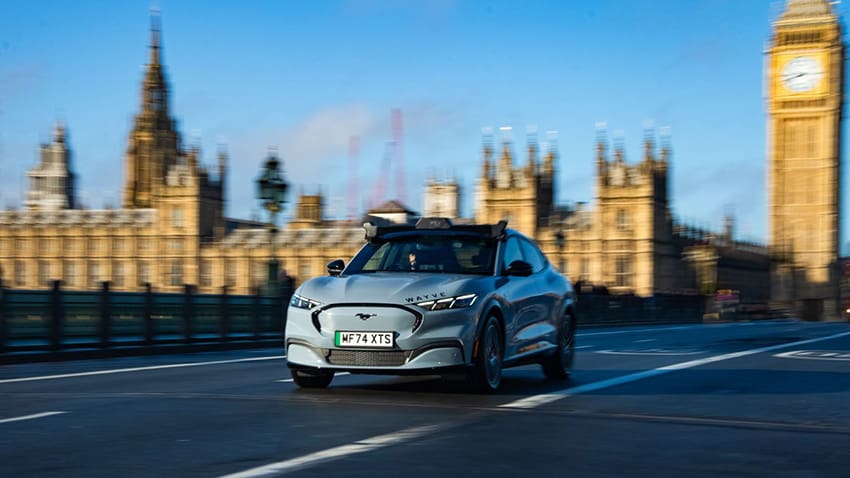
In a quiet corner of Westminster, just behind Parliament Square, a Jaguar I-Pace is nosing its way around a roundabout choked with tourists. The wheel is turning, the indicators are flicking on and off, the speed is precisely judged. The man in the driver’s seat is not driving. Alex Kendall, chief executive of the British self-driving start-up Wayve, has his hands in his lap.

A few miles east, in a hushed examination room at Transport for London, Steven Fairbrass is sitting his twentieth attempt at the Knowledge of London. He has been studying for eight years. He stumbles on a street name in Portland Place and the examiner, kindly, tells him to come back another day.

These two scenes, highlight the future of London transport and frame the most consequential business story the capital’s streets have seen in a generation. The world’s most heavily regulated taxi trade is colliding with one of the world’s most heavily capitalised pieces of artificial intelligence, and the collision is going to shape everything from urban property values to the United Kingdom’s industrial strategy.

A trade already in retreat

The numbers tell their own grim story. Licensed black cab drivers in London peaked at 25,538 in 2014. By November 2024 the figure had fallen to 16,965, a contraction of more than a third in a decade. Over the same period the number of licensed private hire drivers, Uber, Bolt, Addison Lee and the rest, has grown by 82 per cent, to 107,884. As Business Matters has previously detailed, the lost fare income runs into hundreds of millions of pounds a year, and the trade’s underlying cost base, electric-vehicle financing, congestion charging, insurance, keeps rising.

The pipeline of new cabbies is drying up faster than the existing workforce is retiring. The pass rate for the Knowledge, the test that for 161 years has separated the “knowledge boys” from the rest, has slumped from 59 per cent in 2020 to 38 per cent in 2025. Steve McNamara, head of the Licensed Taxi Driver’s Association, has warned that without intervention the trade could be functionally extinct by 2045.

Into this softening market arrive two competitors with very different business models but identical ambitions.

Waymo, the autonomous-driving arm of Alphabet, has been quietly mapping a 100-square-mile patch of London since the autumn

Silicon Valley meets the South Circular

Waymo, the autonomous-driving arm of Alphabet, has been quietly mapping a 100-square-mile patch of London since the autumn. A fleet of around 100 Jaguar I-Paces, fitted with the company’s proprietary stack of 29 cameras, six radars and five lidar units, has been recording the city’s curious right-hand-drive choreography. The company, as Business Matters reported earlier this year, is targeting a fully driverless commercial launch in the fourth quarter of 2026, in partnership with the fleet operator Moove.

Waymo’s co-chief executive, Tekedra Mawakana, points to a fleet that has now driven more than 170 million paying-passenger miles in the United States and a safety record that, the company says, shows 92 per cent fewer serious-injury crashes than the human benchmark. “We travel over two million miles a week,” she recently told Anderson Cooper for a CBS Minutes piece. “Humans drive about 700,000 miles in a lifetime, so this is almost three lifetimes per week that our fleet is driving.”

Wayve, the Cambridge-founded scale-up backed by Microsoft, Nvidia and now Uber, takes a deliberately different approach. Its AI Driver is a foundation model trained end-to-end on millions of hours of footage, designed to generalise to any city rather than relying on the pre-built high-definition maps that Waymo favours. The bet is leaner, faster and, in theory, exportable. It has been enough to attract a $1bn funding round last year and a valuation of $8.6bn, the richest yet awarded to a British AI company. In May, Wayve signed a Memorandum of Understanding with the Department for Business and Trade to fast-track the path from test fleet to commercial deployment.

The prize is not just London fares. Ministers estimate that the autonomous vehicle sector could add £42bn to the UK economy and create close to 40,000 jobs by 2035. Whoever wins London, the most complex, most regulated and most observed urban driving environment in the western world, wins a benchmark that can be sold to every other capital.

The regulatory starting gun

For years, the British self-driving question was theoretical. The Automated Vehicles Act 2024 settled the legal architecture, creating a new category of “authorised self-driving entity” that takes on legal liability when the car is in charge. In a significant acceleration, the Department for Transport has brought forward the Automated Passenger Services permitting regime to spring 2026, allowing pilots of driverless taxi and bus services with no safety driver onboard. The Vehicle Certification Agency has been confirmed as the single national gatekeeper deciding which vehicles can carry paying passengers.

This matters commercially because permits, not technology, were the real bottleneck. Now the path is clear. Uber, which is partnering with Wayve, plans to fold autonomous vehicles into its existing London app. Bolt has indicated it will follow. Waymo’s pilot may carry no driver at all from day one. Within twelve months, a Londoner could be hailing a robotaxi on the same screen they currently use to summon a human one.

The human moat

The cabbies’ counter-argument is not that the technology will fail. It is that a London journey is not a navigation problem.

The Knowledge requires aspiring drivers to memorise some 25,000 streets and 20,000 points of interest within a six-mile radius of Charing Cross. Tom Scullion, who has been driving for 34 years, says he is regularly asked to ferry unaccompanied children to school and a regular client’s Irish wolfhound to the vet. The trust is a function of the licence, and the licence is a function of the years of study.

It is also a function of biology. Research by the late Professor Eleanor Maguire at University College London famously demonstrated that the posterior hippocampus, the brain’s spatial filing cabinet, grows measurably larger in qualified cabbies. New work from UCL’s Spatial Cognition Group suggests, intriguingly, that taxi drivers’ route-planning strategies could in turn inform the next generation of AI navigation systems, an irony not lost on the trade.

Whether that biological moat translates into commercial defensibility is the question that matters in the boardroom. Wayve and Waymo are not pitching themselves as better navigators. They are pitching themselves as cheaper, always available and, they argue, safer. In a city where average black cab fares have risen sharply with electric-vehicle financing costs, price competition is the threat the trade has the least answer to.

What it means for UK plc

The substantive question is not whether the cabbie survives, it is what the disruption tells us about Britain’s appetite for tolerating one. The Treasury has banked on AV adoption to lift productivity and rejuvenate UK automotive manufacturing. The National Wealth Fund is reportedly close to backing the Oxford-founded driverless start-up Oxa. Sherbet London has just raised £40m to electrify its black cab fleet, an explicit defensive play. Insurance underwriters, fleet operators, mapping companies and local councils are all being asked to model a scenario that did not exist eighteen months ago.

Three commercial implications stand out. The first is that London is being treated by the world’s largest AV companies as a global proving ground; success here unlocks a regulatory passport to Paris, Berlin and Tokyo. The second is that the United Kingdom, almost uniquely among large economies, has both a credible domestic champion in Wayve and a willing regulator, which is rare leverage in a sector dominated by American capital. The third is that the long-feared “Uberisation” of the taxi industry was, in retrospect, a soft landing. The next disruption removes the driver altogether, and with it the principal cost line, the principal customer-service complaint and, less comfortably, the principal employer of working-class Londoners who never went to university.

The black cab will not vanish overnight. The same regulatory frame that admits Waymo also affirms the taxi trade’s protected status to ply for hire on the street, and the iconography remains commercially valuable: every tourism board on earth would pay to keep a TX5 in the establishing shot. Sherbet’s investors, evidently, agree.

But the economics are unforgiving. The number of “appearances” booked at TfL each year is falling. The capital cost of a new electric London-style cab now exceeds £70,000. And the next generation of would-be cabbies, including 41-attempt Knowledge graduate Anshu Moorjani, are entering a market in which their newly enlarged hippocampi will be competing with neural networks that learn faster every week.

A century after the last horse-drawn hansom left the streets of London, the same city is preparing to host the first commercial robotaxi service in Europe. The Knowledge made the London cab the gold standard of urban transport. Whether it survives the algorithm is now, finally, a question with a deadline.

Read more:
The Knowledge versus the algorithm: inside London’s £42bn robotaxi reckoning

  •  

Publishers take Meta to court in landmark AI copyright showdown

Mark Zuckerberg

Five of the world’s largest publishing houses have launched a class-action lawsuit against Meta Platforms in a Manhattan federal court, accusing the Mark Zuckerberg-led tech giant of pirating millions of copyrighted works to train its Llama artificial intelligence models, a development that throws fresh fuel on one of the defining commercial disputes of the AI era.

Elsevier, Cengage, Hachette, Macmillan and McGraw Hill, joined by the bestselling American author Scott Turow, filed proceedings on Tuesday alleging that Meta knowingly used pirated copies of textbooks, peer-reviewed scientific journals and novels, among them N.K. Jemisin’s The Fifth Season and Peter Brown’s The Wild Robot, to train the systems that now underpin the Silicon Valley group’s generative AI products.

The complaint, which seeks unspecified damages and class-action status on behalf of a far wider pool of rights holders, marks the first time that academic and trade publishers have moved against Meta as a unified front. It also signals a deliberate escalation by an industry that, until now, has largely watched from the sidelines as authors, newspapers and visual artists fought their own corner.

Maria Pallante, president of the Association of American Publishers, did not mince her words. “Meta’s mass-scale infringement isn’t public progress, and AI will never be properly realised if tech companies prioritise pirate sites over scholarship and imagination,” she said.

Meta has signalled it will mount a robust defence. “AI is powering transformative innovations, productivity and creativity for individuals and companies, and courts have rightly found that training AI on copyrighted material can qualify as fair use,” a spokesperson said. “We will fight this lawsuit aggressively.”

The case opens yet another front in a war that is rapidly redrawing the commercial map for content owners on both sides of the Atlantic. Dozens of plaintiffs, from The New York Times, which is pursuing OpenAI and Microsoft, to a coalition of authors, news outlets and visual artists, have already filed suit against the leading AI developers. The legal questions hinge on whether ingesting copyrighted material to produce new, “transformative” output qualifies as fair use under American law, and the early rulings have been anything but uniform. Two of the first judges to grapple with the issue reached opposing conclusions last year.

The first major scalp came when Anthropic, the AI company backed by Amazon and Google, agreed in 2025 to pay $1.5 billion (£1.18 billion) to settle a class action brought by a group of authors, a sum that could have ballooned into multiples of that figure had the matter gone to trial.

For UK small and medium-sized enterprises operating in publishing, marketing, education and the creative industries, the implications are far from academic. The absence of a coherent licensing regime has left British rights holders exposed to the same alleged practices, while AI-dependent businesses face mounting uncertainty over which models can be deployed without inheriting legal liability.

Benjamin Woollams, chief executive of TrueRights, argues the sector urgently needs commercial infrastructure capable of matching the speed at which AI models are being built. “Every one of these lawsuits points to the same underlying problem: there’s no standardised way to license creative work and likeness for AI,” he said. “Tech companies aren’t villains for wanting training data, and creators aren’t luddites for wanting to be paid, but the infrastructure to connect them simply hasn’t existed until now. This represents a huge opportunity for those in the industry to build a transparent and trusted licensing framework that allows innovation and creator rights to coexist commercially.”

He points to the influencer marketing economy, worth tens of billions of pounds globally and constructed almost entirely on rights licensing, as evidence that the commercial template already exists. “Brands and talent collaborate every day on an enormous scale. The commercial appetite for licensed content is there, the economic model is proven, and creators are increasingly aware of how their likeness and IP are used. What’s been missing in AI is a transparent, trusted way to license at the speed and scale these models require.”

Without such guardrails, Woollams warns, the drumbeat of litigation will only grow louder. “This sort of friction and litigation will continue to plague the industry, which will have negative knock-on effects on the kind of collaboration that should be powering the next generation of creative work, where AI platforms, advertisers and talent can actually build together.”

For Meta, the stakes extend well beyond the immediate price tag. A successful class certification could expose the group to claims from thousands of rights holders, while an adverse ruling would reverberate across an industry that has built its competitive edge on the unrestricted ingestion of vast corpora of human-authored work. For Britain’s SME publishers and creators, the case is a reminder that the rules of engagement with generative AI remain very much under construction, and that the courts, for now, are doing the drafting.

Read more:
Publishers take Meta to court in landmark AI copyright showdown

  •  

Hauliers, hotels and farms warn they are ‘in survival mode’ as fuel costs spiral

Britain’s rural economy is buckling. Hauliers, hoteliers and farmers up and down the country are warning that the cost shock unleashed by the Iran war has tipped thousands of small businesses into what one Somerset operator describes as “total survival mode”, and that, without urgent intervention from the Treasury, the pain will inevitably be passed on at the till.

Britain’s rural economy is buckling. Hauliers, hoteliers and farmers up and down the country are warning that the cost shock unleashed by the Iran war has tipped thousands of small businesses into what one Somerset operator describes as “total survival mode”, and that, without urgent intervention from the Treasury, the pain will inevitably be passed on at the till.

Even as diplomats in Washington and Tehran inch towards what officials describe as a “largely negotiated” peace deal, the damage on the ground is already done. Hauliers report fuel bills running tens of thousands of pounds a week higher than at the start of the year. Farmers say the economics have become so distorted that some are quietly selling stockpiled fertiliser rather than planting crops with it. And in Britain’s off-grid hotels, the cost of a litre of heating oil has very nearly doubled inside a fortnight.

It is, by almost any measure, a textbook cost-of-doing-business crisis, and one falling disproportionately on the small operators who keep rural Britain ticking.

A 76 per cent jump in heating oil, overnight

Shaun Whitehouse, co-owner of Lanes Hotel, a 35-strong boutique spa in Somerset, has worked in hospitality for almost half a century. He has never, he says, seen anything quite like this.

“We’re struggling to keep our heads above water,” he told Business Matters. The price of heating oil at the hotel, which sits off the national gas grid, has rocketed from 81p to 143p a litre in a fortnight — a rise of more than 76 per cent at exactly the moment his payroll has been inflated by the national living wage uplift and his business rates bill has risen again.

“There’s not a lot we can do. We have got to heat the place, and water, so we just have to absorb it,” he said. “Today I am covering three jobs; seven days a week of this and not being able to pay yourself enough money at the end of the month is just grim.”

His frustration with Whitehall is undisguised. “It seems that rural communities are just swept under the carpet by the government … that’s the feeling post-pandemic when this happened then.”

It is a story playing out across the off-grid hospitality sector, where operators have been navigating energy procurement as a strategic boardroom issue for some time, but where the speed and scale of the latest move has left even experienced buyers exposed.

‘Colossal’ costs on the farm

In the Hodder Valley, on the Lancashire–Yorkshire border, Rod Spence farms 1,000 acres and runs a butchery. The arithmetic, he says, has gone from tight to “colossal”.

“We’ve just come out of the lambing season. Even the petrol prices cost us an extra £10 to £15 a day just to check the sheep,” he said. “Contractors’ fees are all going up because of the price of the fuel, and fertiliser has absolutely rocketed. Food prices for the cattle have risen simply because it’s costing more to deliver it. When you live somewhere quite rural, it’s ten miles to the nearest garage, so those extra costs to get fuel for quad bikes all mount up.”

The distortion at the field gate is starkest of all. “I’ve listened to some of these cereal guys and they say, ‘Well, we’re going to sell the fertiliser rather than plant the crop because there’s more guaranteed profit.’”

Like many family operators, Spence is leaning on diversification, the butcher’s shop, a simulated clay pigeon shoot, a fencing arm — to keep retail prices stable and shield customers from the worst of the input shock. How long that can hold is another question.

A short drive away in Clitheroe, Charles Bowman, who runs the Inn at Whitewell, said heating oil and gas had risen by almost 30 per cent on top of fixed-price contracts agreed six months ago. “We are facing the living wage increase, we are now at a bottleneck,” he said. “It feels like the chancellor has strangled us.”

£40,000 a week, and rising

The picture in road transport is no less stark. The Road Haulage Association says fuel costs are running roughly 40 per cent higher than before the conflict, with the cost of brimming a 600-litre lorry tank up by £300, and a 300-litre coach tank by £150.

“For operators in our space, this can be the difference between viability and closure,” the trade body said, citing one member now absorbing an extra £40,000 a week in fuel expenditure alone. Coach operators are typically swallowing between £15,000 and £20,000 more.

It is a familiar refrain in an industry where margins have been wafer-thin for years; Business Matters has previously reported on haulage bosses contending with a £20,000-a-year fuel bill simply to keep a single lorry on the road. This time, that figure is being eclipsed inside a week.

Tina McKenzie of the Federation of Small Businesses warned that the impact ripples well beyond firms with their own fleets. “Higher fuel costs affect pretty much every business, even if they don’t have their own vehicles to run,” she said. “Spikes in fuel costs suppress economic activity and raise the risk of a downturn, something we as a country cannot afford.”

The FSB is calling for an emergency temporary cut in fuel duty of 5p per litre, a move the organisation has long argued would deliver fast, broad-based relief to the country’s 5.5 million small businesses.

The wider squeeze: contracts, rates and wages

The fuel shock is landing on a sector already weakened by overlapping cost pressures. Ofgem estimates that up to 10 per cent of UK businesses were forced to renegotiate fixed-price energy contracts in March and April, with a further 10 per cent up for renewal in May and June — locking thousands of SMEs into materially higher rates just as oil prices spiked. By industry estimates, some 180,000 firms have already signed more expensive energy deals since the war began.

Many of those same operators were already absorbing the national living wage uprating and another business rates increase. The compounding effect, as Business Matters reported earlier this year, has already prompted hospitality firms to cut shift hours by close to a third as they trim back to survive.

Kate Nicholls, chair of UK Hospitality, said several of her members were “already seeing prices spike, particularly those that are coming to the end of fixed contracts.” She added: “Rural hospitality and tourism businesses that are off grid will be particularly impacted by hikes to heating oil prices. Ultimately, it will result in price rises at the till, further driving inflation.”

The macro warning

Ms Nicholls’ point goes to the heart of the macro story. The International Monetary Fund has warned that Britain will be the worst-hit advanced economy from the Iran war, and is on track for the joint-highest inflation in the G7 this year alongside the United States. The Bank of England, which held the base rate at 3.75 per cent last month, has signalled that further tightening cannot be ruled out if the inflationary fallout persists; one well-known think tank is now pencilling in headline inflation above 4 per cent.

British households have already started to brace, cutting pension contributions and lifting precautionary savings in anticipation of higher prices to come. The cost of filling a typical 55-litre petrol car has gone up by £14 since the conflict began; a diesel tank now costs £27 more.

For now, the country’s rural SMEs, the hauliers moving the freight, the farmers producing the food and the off-grid hotels housing the visitors, are the shock absorbers. Whether they can keep absorbing is the question that should be exercising ministers this week.

As Whitehouse puts it from his Somerset reception desk: “We just live day to day and keep putting out fires.”

Read more:
Hauliers, hotels and farms warn they are ‘in survival mode’ as fuel costs spiral

  •  

Nightlife chief brands Chancellor’s summer VAT cut a ‘superficial fix’ that abandons clubs and festivals

The Government's headline-grabbing summer VAT giveaway has been dismissed as politically convenient window-dressing by the head of the UK's night-time economy trade body, who argues that the country's clubs, festivals and live music venues have once again been left to fend for themselves.

The Government’s headline-grabbing summer VAT giveaway has been dismissed as politically convenient window-dressing by the head of the UK’s night-time economy trade body, who argues that the country’s clubs, festivals and live music venues have once again been left to fend for themselves.

Michael Kill, chief executive of the Night Time Industries Association (NTIA), launched a withering critique of the Great British Summer Savings scheme unveiled by Chancellor Rachel Reeves, which slashes VAT from 20 per cent to 5 per cent on a narrow band of family attractions, including theme parks, zoos, museums, children’s cinema tickets and kids’ meals, between 25 June and 1 September. The cut, ministers say, is designed to help households afford summer days out and bolster the hospitality sector through its peak trading window.

For an industry that has watched roughly a third of the country’s nightclubs disappear since 2017, however, the measure looks less like a lifeline and more like a snub. The full details of the chancellor’s family-focused VAT package made no mention of the late-night venues, festivals or grassroots music spaces that have been pleading for sector-wide tax relief for the better part of a decade.

“The Government’s latest VAT announcement is not just a missed opportunity, it is a glaring example of short-term thinking and a fundamental misunderstanding of the UK’s leisure and cultural economy,” Kill said. “While positioning this as support for families, the policy completely overlooks and effectively sidelines the night-time economy, including festivals, clubs, live music venues and late-night cultural spaces that have been fighting to survive under relentless financial pressure.”

A backbone, not a footnote

Kill’s frustration is rooted in hard numbers. NTIA data shows the UK lost roughly 1,940 licensed clubs between 2015 and 2025, a 26 per cent decline, while 26 per cent of British towns that previously had at least one nightclub now have none at all. Industry research published earlier this year warned that, without urgent intervention, Britain risks losing 10,000 late-night venues and 150,000 jobs by 2028.

The festival circuit is faring little better. More than 40 UK festivals were scrapped in 2024, with a similar tally lost in 2025 and a fresh wave of 2026 cancellations, including Red Rooster, Stone Valley South and WestworldFest, already announced as operators buckle under soaring production costs, post-pandemic debt and softer ticket sales.

“These businesses are not peripheral, they are the backbone of the UK’s global cultural reputation and a critical driver of jobs, tourism and economic activity,” Kill argued. “For years, we have consistently lobbied for a fair and meaningful reduction in VAT across hospitality, live events and cultural experiences. Instead, what we have been given is a narrow, temporary measure that cherry-picks certain activities while leaving the rest of the sector to absorb rising costs, punitive tax burdens and ongoing instability.”

The trade body has repeatedly pressed Treasury ministers for a permanent VAT cut from 20 to 10 per cent across hospitality and the cultural sector, a campaign that has gathered momentum after a string of nightclub closures prompted renewed calls for action.

Squeezed at every turn

Operators say the picture on the ground is bleak. April’s business rates reforms removed the 40 per cent Hospitality, Leisure and Night-Time Relief, pushing the typical rates bill for a £100,000 rateable-value venue from £28,800 to roughly £43,000. Combined with higher employer National Insurance contributions, a steeper National Living Wage and double-digit increases in utilities, the cumulative cost burden has tipped many otherwise viable businesses into the red.

A recent New Statesman investigation into the policies killing Britain’s nightlife painted a similarly grim picture, charting how successive Westminster decisions, from licensing reform to tax tinkering, have hollowed out the cultural infrastructure of British towns and cities.

“Festivals are being squeezed to breaking point. Grassroots venues are closing at an alarming rate. Clubs and late-night operators are facing unsustainable operating conditions,” Kill said. “And yet, once again, they have been completely sideswiped by policy that claims to support leisure and participation.”

A test of credibility

The political calculation behind the Great British Summer Savings scheme is straightforward. A targeted, family-friendly cut delivers a punchy headline, plays well with voters facing another stretched school holiday and concentrates the Treasury’s fiscal firepower on a tightly bounded window. The trouble, as Kill sees it, is that such tactical interventions cannot substitute for a coherent strategy.

“This is not just short-sighted, it is economically reckless,” he warned. “You cannot claim to support the visitor economy, regional growth and cultural output while actively ignoring the sectors that deliver it at scale. If the Government is serious about growth, it must stop delivering piecemeal, headline-driven interventions and start engaging with the full reality of the industries it relies on. That means meaningful VAT reform, long-term policy stability and a commitment to supporting the entire ecosystem, not just the parts that are politically convenient.”

Until then, Kill concluded, the summer VAT cut “will be seen for what it is: a superficial fix that fails the very industries it should be backing.”

For SME operators across hospitality and the cultural economy, the message from Whitehall is becoming uncomfortably familiar. The headline is generous; the small print is not.

Read more:
Nightlife chief brands Chancellor’s summer VAT cut a ‘superficial fix’ that abandons clubs and festivals

  •  

Alvotech founder Robert Wessman threatens to quit Britain over ‘anti-wealth’ tax regime

The Icelandic-born billionaire behind Nasdaq-listed biosimilars group Alvotech has become the latest international entrepreneur to warn that Britain’s tax direction is making the country uninvestable for mobile capital.

The Icelandic-born billionaire behind Nasdaq-listed biosimilars group Alvotech has become the latest international entrepreneur to warn that Britain’s tax direction is making the country uninvestable for mobile capital.

Róbert Wessman, the 56-year-old founder and chief executive of Alvotech and the owner of fast-growing French wine venture Maison Wessman, has told Business Matters in an interview at his Pall Mall club that the “whole package” of inheritance tax, capital gains tax and political instability is steadily pushing him towards the exit.

“It’s just the whole scheme has changed so much, which makes it very difficult, not only for foreigners to come here, but for wealthy people, who live here, are born here, and have always been here, to basically stay here,” Wessman said.

His warning lands as Britain digests the most striking edition of the Sunday Times Rich List in living memory, with one in six members of the 2026 list dropping out and the UK billionaire population falling to 157, twenty fewer than four years ago. Almost a third of the 350 British nationals on the main list no longer live on the British mainland.

‘Not a pro-business country anymore’

Wessman, who moved his family from Reykjavík to London in 2019 and opened a Hammersmith head office for his Aztiq investment vehicle two years later, said he no longer regarded the UK as a pro-business destination.

“At the same time, the stability is not really there. You had Brexit, it was a big issue for the industry, for the country, for the business, and then all the tax legislation now,” he said.

He spoke before the former health secretary Wes Streeting, who has launched a Labour leadership bid against Sir Keir Starmer, pledged what he called a “wealth tax that works”, centred on aligning capital gains rates with income tax. The proposal has been costed by allies at around £12 billion a year.

Asked about politicians’ appetite for taxing the wealthy, Wessman was unsparing: “We see this in many countries, that this can be the flavour of the day for politicians. But in the end, countries are built on employment, on jobs, high-paying jobs preferably, value creation. And hopefully you can then benefit from having the business in the country.”

His comments echo a growing chorus of warnings from international business owners. Henley & Partners has forecast that Britain will lose more millionaires than any country bar China this year, and a BDO survey recently found that two-thirds of the UK’s ultra-wealthy have considered relocating, citing policy inconsistency as a bigger problem than the headline tax rate itself.

From Icelandic generics to Nasdaq biosimilars

Wessman has built, and lost, fortunes before. He turned Delta, an obscure Reykjavík generics business, into Actavis, one of the world’s largest generic drugmakers, before losing an estimated €250 million in the 2008 Icelandic banking crash. That episode triggered a long and bitter legal battle with fellow Icelandic financier Björgólfur Thor Björgólfsson over a highly leveraged pre-crisis buyout.

Undeterred, he has founded seven companies over three decades and is now ploughing capital into Alvotech, the Nasdaq, Icelandic and Swedish-listed group he is positioning as a global challenger in biosimilars.

The group has invested $2 billion since 2013, employs 1,500 staff, most of them in Reykjavík, and is being built deliberately as the “fourth leg” of the Icelandic economy alongside fishing, tourism and manufacturing. Alvotech has five approved biosimilars on the market, generated revenues of $593 million last year and is guiding to $650 million to $700 million in 2026. It is currently valued at around $1 billion in New York.

Wessman holds a 35 per cent stake through Luxembourg-domiciled Aztiq, plus a further 30 per cent through a partnership with Temasek, the Singapore sovereign wealth fund, and private equity house CVC Capital Partners.

Biosimilars, close copies of complex biological drugs whose patents have expired, are notoriously expensive to develop and frequently trigger patent litigation, as Alvotech experienced in its dispute with AbbVie over the autoimmune blockbuster Humira. Wessman argues they are essential if state-funded healthcare systems are to avoid being “sunk” by the cost of modern biologics.

A château, two million bottles and Norah Jones

His diversification into wine began as a hobby with the 2004 acquisition of the 12th-century Château de Saint-Cernin, near Bergerac, and the release of an inaugural vintage in 2016. Maison Wessman is now on track to produce around two million bottles this year, supplying French retailer Intermarché and backed by the American jazz singer Norah Jones, whom Wessman met through a mutual contact after Enrique Iglesias played at his wedding.

‘We are leaving with a lot of capital, a lot of jobs’

Wessman, who is not a non-dom, said he moved to London “against the stream when Brexit was happening” because of the capital’s practical access to his businesses across Asia, the United States and central and eastern Europe. His Russian-born wife and six children are settled in “world-class” London schools.

“London is the most amazing city to live in. It has amazing education. It has everything to offer. It has amazing history,” he said.

But he believes Brexit was a strategic error for what he called “a very proud nation”, leaving Britain less integrated into European supply chains and badly diminished as a listing venue.

“Since Brexit, many of the big banks don’t ever bring up the UK as an alternative, as a listing venue anymore,” he said.

That listings problem now compounds with sweeping fiscal reform. The chancellor, Rachel Reeves, has scrapped the centuries-old non-dom regime and replaced it with a new four-year residence-based test for foreign income and gains, plus a residence-based inheritance tax that captures worldwide assets for those resident in the UK for ten of the previous twenty years. Capital gains tax rates were also lifted in the October 2024 Budget to 18 per cent and 24 per cent.

The early evidence is unflattering: around 1,800 non-doms have already quit the UK in the wake of the reforms, raising serious questions about whether the package will deliver the £34 billion Treasury revenue target.

Wessman said he had recently looked at properties in Milan and made clear he was reluctantly being pushed in that direction.

“I don’t regret paying high taxes in the UK,” he said, “but it has to be within certain certainties and scope. I’m sitting with my tax adviser getting an update two to three times a year of what might be coming next, and it’s all over the place. This is not encouraging anyone to live here.”

“I really love to live here. But overall, I think where you have mobile capital, which can be based anywhere, it will push more people out.

“We are leaving with a lot of capital. We are leaving with a lot of jobs. We are leaving without even thinking that the UK would be a good idea to build any manufacturing or R&D or anything. That’s the sad part of it.”

For a government banking on wealthy non-doms to part-fund public services, that is a warning shot from precisely the sort of internationally mobile, job-creating, IP-rich founder the Treasury insists it still wants to attract.

Read more:
Alvotech founder Robert Wessman threatens to quit Britain over ‘anti-wealth’ tax regime

  •  
❌