Construction crews have erected scaffolding outside the Kennedy Center on Friday, the day of the court-ordered deadline to remove President Donald Trump’s name from the building.
The barrister-turned-activist sought to challenge the legitimacy of the national security allegations against herself, former colleague Lee Cheuk-yan, and the organisation they led, which held Hong Kong’s candlelight vigils commemorating China’s 1989 crackdown on pro-democracy demonstrators in Beijing’s Tiananmen Square.
From 1990 to 2019, the Hong Kong Alliance in Support of Patriotic Democratic Movements of China organised the commemorative event every year on June 4 at Victoria Park, demanding accountability for the bloody crackdown and the democratisation of China, both taboos in the country.
Beijing imposed a national security law in Hong Kong in 2020, following the 2019 protests and unrest. In 2021, police arrested the Alliance’s leadership, including Chow, Lee, and Albert Ho. The Alliance voted to disband that year, ending its decades-long vigils and advocacy.
Chow, Lee, and the Alliance are standing trial for “inciting subversion” under the national security law, an offence that carries a maximum penalty of 10 years behind bars. Ho pleaded guilty when the trial opened in January.
HKFP looked at the events surrounding the establishment of the Alliance, the Tiananmen vigils it organised, and the ongoing trial of its leaders.
Chow Hang-tung, barrister and a leader of the Hong Kong Alliance in Support of Patriotic Democratic Movements of China, on March 21, 2021. Photo: Peter Parks/AFP.
Hong Kong prosecutors have argued that the case against the Alliance is not political and does not concern its activism, the vigils, or the 1989 crackdown. They allege that, however, the group had been calling for the overthrow of China’s ruling Communist Party (CCP) through its “end one-party rule” slogan – a key tenet of the Alliance since its founding.
For Chow, who represents herself in the trial, the prosecution has upended Hong Kong’s value of being a free-wheeling city that tolerates the kind of political dissent not permitted in mainland China.
The trial has in effect “cornered” the court, forcing it to choose its side between the rule of law and an authoritarian regime, she argued.
Alliance and 1989 Tiananmen crackdown
Massive pro-democracy demonstrations broke out in China in the spring of 1989, triggered by the death of Hu Yaobang, a former CCP leader seen as a reformist. Students and protesters gathered in Beijing’s Tiananmen Square for weeks, demanding political reforms and democracy, as the rest of the country rallied to support those in the capital city.
In May that year, the Alliance was founded in Hong Kong, and huge demonstrations were staged in support of protesters in mainland China.
Around 1.5 million people joined a mass rally on May 28, a day after celebrities like Anita Mui, Teresa Teng, Eric Tsang, and Jackie Chan took part in the Alliance’s benefit concert in support of the students’ movement.
Around 1.5 million people take part in a mass rally in Hong Kong in support of students protesting at Tiananmen Square in Beijing. Photo: 1989年的傳真 , via Facebook.
Lee personally went to Beijing to deliver donations raised during the concert. However, he was detained and made to sign a letter of remorse, around the time the tanks rolled in to crush the burgeoning movement.
The protests in Beijing ended in a bloody crackdown as Chinese troops dispersed protesters on June 3 and 4. Estimates of death tolls during the crackdown range from hundreds to thousands.
In the years that followed, the Alliance organised candlelight vigils at Victoria Park every June 4 to commemorate the dead and to keep the spirit of the 1989 pro-democracy movement alive.
The Alliance’s five tenets – release pro-democracy activists, vindicate the 1989 democracy movement, hold those responsible for the crackdown accountable, end one-party rule, and build a democratic China – were an integral part of the candlelight vigils.
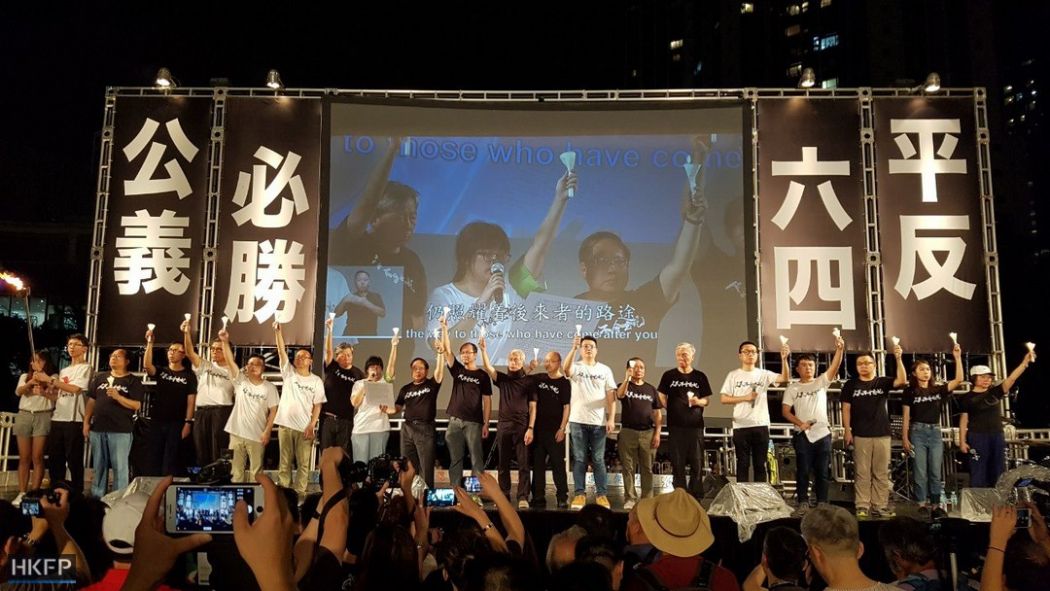
Tens of thousands of people attended the commemorations every year. They lit candles, sang songs, observed a moment of silence, and chanted the Alliance’s five slogans, led by the group’s leaders.
Alliance leaders (from left) Lee Cheuk-yan, Chow Hang-tung, and Albert Ho appear on the giant screen at Hong Kong’s annual Tiananmen crackdown vigil on June 4, 2019. File photo: Todd R. Darling/HKFP.
In 2020, authorities banned the vigil for the first time, citing Covid-19 restrictions. They prohibited the gathering again the following year, also citing the pandemic. The Alliance was disbanded in September 2021, following the arrests of its leaders.
No official vigils have been held since 2019, but there is a heavy police presence at Victoria Park and nearby streets on June 4.
For four consecutive years, Victoria Park has been occupied by a pro-China food festival in early June, including the anniversary day of the bloody crackdown.
‘Weird’ prosecution
In her closing argument last month, Chow said the prosecution was “weird,” as the defendants had not disputed the alleged acts and instead, they embraced what they did.
“Ending one-party rule means putting an end to the status quo, in which those in power are not bound by the law,” she told the court in Cantonese. “What is really in dispute is what the law suppresses and what it protects.”
According to the prosecution, the Alliance’s calls to “end one-party rule” had exceeded the legitimate boundary of freedom of expression as the defendants intended to stoke hatred against Beijing. “Freedom is not absolute,” lead prosecutor Ned Lai told the court in Cantonese.
The last official Tiananmen crackdown candlelight vigil on June 4, 2019. File photo: Todd R. Darling/HKFP.
Chow said the prosecution’s argument had undermined the values long championed in Hong Kong, such as freedom of expression and the rule of law.
“Speaking out the truth has become stoking hatred. Seeking justice has become taking advantage of suffering,” she said. “Asking for accountability has become breaching the constitution. Demanding democracy has become inciting subversion.”
She maintained that the court must protect human rights when reaching a verdict in the case.
“What the court has been asked to ban, to punish in this case are, in fact, what society and the law should encourage… They are the core values of Hong Kong, the norms and ideals accumulated through generations,” she said.
“I hope the court will make a correct decision to safeguard the dignity and bottom line of the law, at a time when values are being reshaped,” she added.
Prosecutors have argued that there are no “lawful means” to end CCP rule after a 2018 constitutional amendment stipulated that the party’s leadership is the “defining feature” of China’s socialist system.
A pro-Beijing food carnival at Victoria Park on June 4, 2025, the anniversary of the Tiananmen crackdown. File photo: Kyle Lam/HKFP.
During his closing submission last month, Lee’s lawyer, Erik Shum, argued that prosecutors had presented a “tautological theory.”
“We ask: How exactly did the Alliance incite others to overthrow the CCP? And my submission is that the prosecution has always reverted to the claim that ending CCP rule is illegal,” Shum said in Cantonese.
Shum urged the court to draw a boundary for what is considered an acceptable political expression and what is not.
“The court must not pay lip service to human rights protections,” he said.
The three-judge panel – Alex Lee, Johnny Chang, and Anna Lai – has adjourned the proceedings, saying they hope to deliver a verdict in “mid or late July.”
In a letter from prison this week, Chow, who has been behind bars since September 2021, said she would go on a 37-hour hunger strike in commemoration of the 37th anniversary of the 1989 crackdown.
In April, the 70th month since Beijing imposed the national security law, the Hong Kong government applied to the court to seize assets belonging to Apple Daily founder Jimmy Lai, who is serving a 20-year prison sentence.
St Paul’s Co-educational College Choir performs at the opening ceremony of National Security Education Day on April 15, 2026, at the Hong Kong Convention and Exhibition Centre. Photo: GovHK.
On National Education Day, a top Chinese official delivered a warning about those who “politicised” the deadly Tai Po fire and tried to “stir up chaos” in the city.
Gov’t seeks to seize Jimmy Lai’s assets
The Hong Kong government filed an application with the High Court on April 2 to seize “offence-related” properties owned by jailed pro-democracy media tycoon Jimmy Lai on national security grounds.
In a statement issued the same day, the government mentioned Lai’s earlier convictions under the Beijing-imposed national security law. It said the High Court had found that he was the “mastermind and driving force behind the case, consciously using Apple Daily and his personal influence” to undermine local and Beijing authorities.
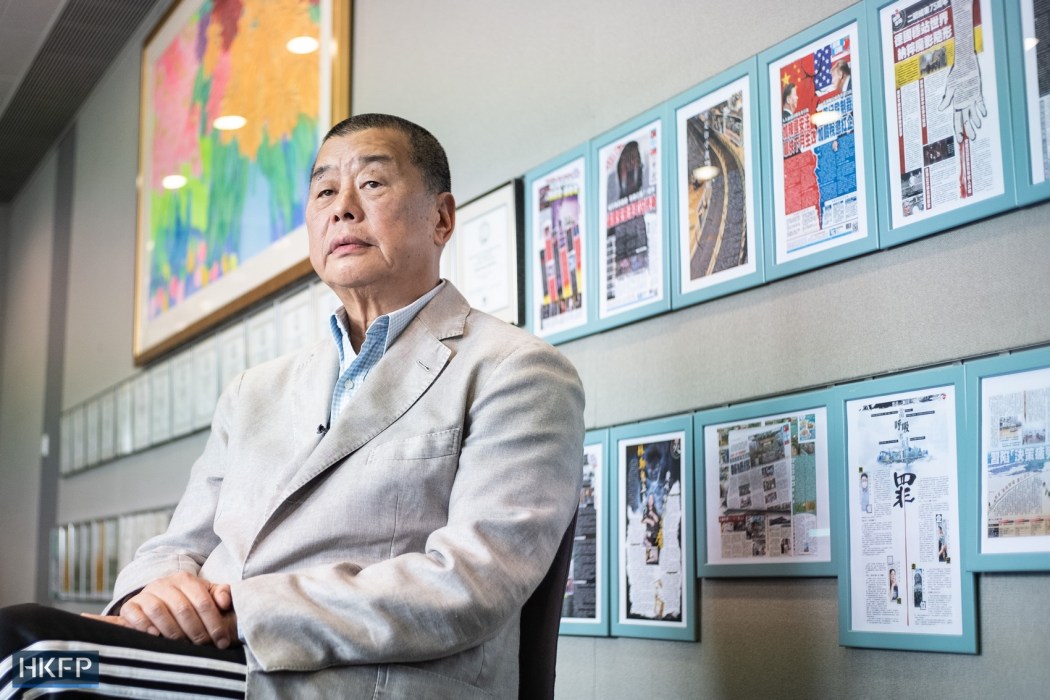
Hong Kong pro-democracy media mogul Jimmy Lai. File photo: Kelly Ho/HKFP.
The assets include credit balances in bank accounts belonging to or linked to the Apple Daily founder.
Fifteen bank accounts under Lai’s name – 10 with HSBC, two with Hang Seng Bank and three with Shanghai Commercial and Savings Bank – have over HK$32 million.
The government is also seeking to seize bank accounts belonging to 17 companies linked to Lai. It is also demanding that Lai give up shares in 17 companies, some of which overlap with the 17 firms whose assets the government is seeking to seize.
Among the companies whose assets and shares the government wants to seize are Dico Consultants Ltd, which has over HK$404,302 in its HSBC account, and Lai’s Hotel Properties Ltd, which has over HK$3.1 million in its four HSBC accounts.
Lai has been summoned to the High Court on July 8 to hear the government’s application. The case will be presided over by Esther Toh, one of the three judges who heard his national security trial.
Apple Daily headquarters. Photo: Candice Chau/HKFP.
The move to seize Lai’s assets came after the government designated three companies linked to Lai’s now-defunct Apple Daily tabloid “prohibited organisations” in late March and removed them from the corporate registry. Police cordoned off the Apple Daily building in Tseung Kwan O a day later.
The three firms were tried and convicted alongside the Apple Daily founder in his high-profile national security case. Lai was sentenced to 20 years behind bars in early February, while the companies were each fined over HK$3 million.
Wong Kwok-ngon, known by his pen name Wong On-yin, has been detained since his arrest in December for allegedly divulging in a YouTube video details of enquiries made by police during a national security investigation.
Judge Stanley Chan said the pre-trial review would take place behind closed doors on August 11, and the trial would begin on October 9.
Wong Kwok-ngon in a YouTube video posted on December 2, 2026. Screenshot: On8 Channel – 王岸然頻道, via YouTube.
Wong’s offence falls under the Safeguarding National Security Ordinance, a homegrown security law known as Article 23. It was added to the ordinance in May as part of subsidiary legislation, and Wong is the first to be charged under the new law.
He is also charged with sedition over videos posted on YouTube between January 3 and December 6 last year. He plans to plead not guilty to both charges.
The defendant, who continues to represent himself, told the court he had dropped his legal aid application.
Asked by the judge whether he had legal knowledge for self-defence, Wong said he had “three law degrees” and was confident of handling the case.
Nat. security clauses for restaurant licences
Secretary for Environment and Ecology Tse Chin-wan said in early April that all Hong Kong restaurant licences would include national security clauses from September.
Shops awaiting for lease on a Hong Kong street in October 2024. File photo: Kyle Lam/HKFP.
Tse made the remarks on April 7, nearly a year after the Food and Environmental Hygiene Department (FEHD) introduced the provisions for restaurant licence renewals in May.
“With restaurants renewing their licences gradually, we expect that by September this year, all restaurant licences will contain the clauses,” Tse told reporters, according to RTHK.
Retiree jailed over seditious Facebook posts
A Hong Kong man was jailed for a year under the city’s homegrown national security law after pleading guilty to making seditious remarks on Facebook, including comments supporting Hong Kong’s and Taiwan’s independence.
The magistrate handed Chong, a retiree in his early 60s, an 18-month sentence but discounted it by six months after considering his guilty plea.
A Facebook log-in screen. Photo: Pixabay, via Pexels.
Chong was accused of making 53 seditious social media posts between March 2024 and November 2025, local media reported.
The posts had wording such as “dissolving the Chinese Communist Party is the most important thing” and “Hong Kong independence is within sight.”
The defendant posted on a public Facebook page called “Holy Raymond,” which features the Chinese phrase “Heaven will destroy the Chinese Communist Party, God bless Hong Kong” as its profile picture.
During mitigation ahead of sentencing, his lawyer argued that Chong was a Falun Gong believer who had come to hate the Chinese Communist Party because of false information that the CCP engaged in live organ harvesting.
Beijing official warned of ‘politicising’ Tai Po fire
China’s top official in charge of Hong Kong affairs warned of some people who “politicised” the deadly Tai Po fire and tried to use the disaster to “stir up chaos” in Hong Kong.
Xia Baolong, director of the Hong Kong and Macao Affairs Office, delivered his remarks on April 15 via a recorded video shown at a National Security Education Day ceremony.
In his speech, Xia mentioned the massive fire that broke out at Wang Fuk Court, a government-subsidised housing estate in Tai Po, on November 26, killing 168 people.
Xia Baolong, the director of the Hong Kong and Macau Affairs Office, gives a speech via a video on National Security Day on April 15, 2026. Photo: GovHK.
“After the Tai Po fire, some malicious people politicised the tragedy, attempting to use the disaster as a means to disrupt Hong Kong,” Xia said in Mandarin, without giving further details.
“Once again, it reminds us that along Hong Kong’s path toward prosperity under good governance, there will be various risks and challenges.”
Speaking at the same event, Hong Kong Chief Executive John Lee also warned that some people were “using the disaster to stir up chaos” and “to incite hatred” in Hong Kong.
“Only through the government’s swift action and decisive law enforcement has the situation been able to return to normal,” Lee said in Mandarin.
French journalist denied entry to city
A French journalist was denied entry to Hong Kong in November, Reporters Without Borders (RSF) said in late April, accusing the city’s authorities of “weaponising visas” against foreign media workers.
French journalist Antoine Vedeilhe. Photo: Reporters Without Borders.
Antoine Vedeilhe, who was shooting a documentary for French public broadcaster France Télévisions, was questioned upon arrival at Hong Kong International Airport on November 2 last year, RSF said in a statement on April 24.
He was detained for three hours before being deported without being given a reason, it added.
The press freedom NGO said Vedeilhe was the 13th foreign media worker who had been denied entry or a visa by the city’s authorities following Beijing’s imposition of the national security law in 2020.
“In the journalist’s view, his detention was a reprisal for his work on a documentary examining Beijing’s grip on Hong Kong,” RSF said.
Another cameraman for the documentary was able to enter the city, RSF said, but he was followed by “unidentified individuals that he suspects were Hong Kong’s national security police.”
“In the following days, there was a hacking attempt on Vedeilhe’s private email account and his sources in the documentary were harassed by the national security police,” the NGO said.
In an emailed reply to HKFP’s enquiries, the Hong Kong government said it “strongly condemns the smearing remarks and distorted narratives by” RSF.
Prosecution and arrests figures
As of April 1, a total of 394 people have been arrested for “cases involving suspected acts or activities that endanger national security” since Beijing’s national security law came into effect, according to the Security Bureau. That figure includes those arrested under Article 23 and for other offences.
Of the 208 people and five companies that have so far been charged, 180 people and four companies have been convicted or are awaiting sentencing.
In total, 100 people and four companies have been charged under Beijing’s national security law, with 79 persons and three companies convicted. Thirteen people have been charged under Article 23, 10 of whom have been convicted.
The landmark trial of Tiananmen vigil activists neared its conclusion in May, with both defendants and prosecutors delivering their closing submissions.
Tiananmen crackdown vigil on June 4, 2019. Photo: Todd R. Darling/HKFP.
The government allocated more money to the national security fund and lashed out at Reporters Without Borders (RSF) after the NGO once again placed Hong Kong low on its annual press freedom index.
Trial of Tiananmen vigil activists
The national security trial of Tiananmen vigil activists Chow Hang-tung and Lee Cheuk-yan heard closing arguments from the defendants and the prosecution. Lee and Chow were leaders of the now-defunct Hong Kong Alliance in Support of Patriotic Democratic Movements of China.
Lee’s defence lawyer, Erik Shum, spoke before a three-judge panel on May 18, urging the court not to merely “pay lip service” to human rights protections.
He argued that calls to “end one-party rule” in China should be considered legitimate political expression.
Lee, Chow, and the Alliance are facing a charge of “inciting subversion,” an offence under the Beijing-imposed national security law, over the group’s calls to end one-party rule in China during decades of candlelight vigils commemorating the 1989 Tiananmen crackdown. The offence carries a maximum penalty of 10 years behind bars.
The 2018 candlelight vigil commemorating the 1989 Tiananmen crackdown in Beijing. File photo: Kris Cheng/HKFP.
The Alliance had never proposed an “action plan” to mobilise supporters to topple the CCP, the lawyer said. “In the past 30 years, there has been no evidence showing that any person acted under the Alliance’s specific instruction,” Shum said in Cantonese.
In his closing submission, prosecutor Ned Lai argued the Alliance’s calls had exceeded the legitimate boundary of freedom of expression as the defendants intended to stoke hatred against Beijing.
“We say that their behaviour had crossed the line,” he said in Cantonese. “Freedom is not absolute.”
She urged the court to safeguard the “dignity and bottom line of the law” and warned the judges not to become “accomplices” in an alleged government crackdown on free speech.
Chow said the crux of the case was whether the law protects the “perpetual rule” of the CCP or the rights of people to advocate democracy.
“Ending one-party rule means putting an end to the status quo, in which those in power are not bound by the law,” she said in Cantonese.
Barrister Erik Shum. Photo: Erik Shum’s Chambers.
Barrister Priscilia Lam. Photo: Plowman Chambers.
Senior counsel Priscilia Lam, representing the Alliance, argued the prosecution had not been able to present evidence of the group’s alleged incitement to subversion.
“What did the Alliance do to incite people to subvert state power?” Lam said in Cantonese. “I have heard nothing on this after sitting here for so long.”
The Alliance disbanded in 2021 after authorities banned the vigil for two years, citing Covid-19 restrictions, and arrested its leadership on national security allegations. Chow and Lee have been behind bars since September 2021.
Another defendant, former lawmaker Albert Ho, pleaded guilty when the trial opened in January.
The three-judge panel said they hope to deliver a verdict in “mid or late July.”
Gov’t reacts to UK trial conviction
The Hong Kong government denied any link to a high-profile UK court case after its trade officer was convicted of spying on overseas activists.
From left: Hong Kong Economic Trade Office (HKETO) official Bill Yuen and former UK Border Force officer Peter Wai. Photos: Metropolitan Police.
“From the outset, the Hong Kong Special Administrative Region (HKSAR) Government has been clearly stating that the allegations in this case are absolutely not related to the HKSAR Government and the Hong Kong Economic and Trade Office in London (London ETO), nor are we party to the case,” a government statement sent to the media on May 8.
The statement was issued a day after Bill Yuen, an office manager at the Hong Kong Economic and Trade Office in London, and former UK Border Force official Peter Wai were found guilty under Britain’s national security laws of assisting a foreign intelligence service.
Yuen and Wai – both British-Chinese dual nationals – were accused of spying on Hong Kong pro-democracy activists living in Britain.
Among those the pair were said to have surveilled was Nathan Law, who is wanted by Hong Kong’s national security police with a bounty of HK$1,000,000.
Wanted activist arrested in Thailand
Hong Kong authorities declined to comment on reports that an activist wanted by the city’s national security police could face deportation to China after being arrested in Thailand for allegedly overstaying her visa.
Zhang Xinyan. Screenshot: Hong Kong Parliament, via YouTube.
Responding to media queries about concerns that wanted activist Zhang Xinyan could be transferred to China, the Security Bureau said on May 11 that it would not comment on news reports about law enforcement actions in other jurisdictions.
“Endangering national security is an extremely serious crime… no fugitive should harbour the illusion that they can evade criminal liability by fleeing Hong Kong,” the bureau said in a statement.
Zhang, 54, is wanted by Hong Kong’s national security police for allegedly committing subversion, a crime under Article 23 – also known as the city’s homegrown national security law.
She is among a group of 19 activists named in a round of arrest warrants issued in July 2025, with bounties between HK$200,000 and HK$1 million.
From February to June 2025, they were allegedly involved in the “Hong Kong Parliament,” a group of overseas activists who held unofficial polls outside the city to form a shadow legislature to “pursue the ideal of Hong Kong people ruling Hong Kong.”
According to Human Rights Watch, Zhang holds refugee status issued by the United Nations High Commissioner for Refugees (UNHCR).
The latest allocation thus brought the total amount to HK$18 billion.
In response to Ming Pao’s enquiry, the Financial Secretary’s Office said authorities will not disclose details of the funding, citing Article 14 of the national security law. It did not respond to whether the previous HK$13 billion funding had been depleted.
Worsening press freedom, FCC survey finds
Two out of three journalists say the working environment in Hong Kong has changed “for the worse” in the past year, according to the latest survey by the Foreign Correspondents’ Club, released on May 11.
The Foreign Correspondents’ Club, Hong Kong. Photo: Kelly Ho/HKFP.
The 2026 FCC Press Freedom Survey, which received 78 responses from members, found that “67 per cent of respondents said the working environment for them as a journalist had changed for the worse in the last 12 months.”
The FCC pointed out that the survey “happened to take place” after Apple Daily founder Jimmy Lai was convicted and sentenced to jail, as well as Beijing’s national security office in Hong Kong, the Office for Safeguarding National Security (OSNS), summoned representatives of several major foreign media outlets, shortly following the deadly Wang Fuk Court fire.
One respondent said that the warning by the OSNS to foreign journalists “should be seen as a watershed moment here in Hong Kong. It has created an increased chilling effect.”
Another respondent said that the 20-year sentence handed down to Lai “only further chills the local reporting environment.”
They also hit out after German public broadcaster Deutsche Welle (DW) awarded Lai, the jailed media tycoon, a press freedom prize on April 30.
Jimmy Lai in 2020. Photo: HKFP.
In RSF’s 2026 global press freedom index, released on April 30, Hong Kong was ranked 140th out of 180 countries and territories – the same position as last year. The press freedom NGO highlighted the 20-year sentence handed down to Lai, who was convicted last year under the security law.
In response, the Hong Kong government issued a press release on May 1. It said that it “strongly condemned the attempts by an anti-China organisation and foreign media to sugarcoat the criminal acts of national security offender [Jimmy] Lai Chee-ying and to slander, smear, as well as attack the HKSAR by releasing a so-called press freedom index and presenting a so-called ‘award’. Such despicable behaviours totally disregarded the rule of law and twisted the facts, which must be strongly condemned.”
In a separate statement on the same day, the LegCo Secretariat said it “strongly condemned the release of a so-called press freedom index by a foreign media organisation and presentation of a so-called award to the national security offender Lai Chee-ying to sugarcoat his criminal acts, and smear the press freedom and rule of law” in Hong Kong.
“To make it clear once again: defending journalism is not ‘anti-China’; it is pro–press freedom,” she said on May 2. “At RSF, we stand arm in arm with Hong Kong journalists. We will not be intimidated and we continue supporting all media in Hong Kong, with the hope that one day we will see positive change and that the city will return to its golden years as an exemplar and beacon of press freedom.”
Students Wong Kit-lun, 20, and Tang Ngai-pok, 23, as well as waiter Chan Hiu-chun, 23, appeared at West Kowloon Magistrates’ Courts on May 15.
West Kowloon Law Courts Building. File photo: Kyle Lam/HKFP.
The trio stood in the dock beside Gallian Pang and Lee Chun-sum, who were also charged with conspiring to subvert state power – an offence under the Beijing-imposed national security law – on December 15.
The five men are among a group of 10 people – nine men and one woman – arrested on December 11 and 12 for alleged “unlawful drilling” – an offence under the Safeguarding National Security Ordinance, the homegrown national security law, also known as Article 23. The arrests marked the first time authorities had invoked the unlawful drilling offence.
Last month, the prosecution accused Wong, Tang and Chan of conspiring with Pang, Lee and “other persons unknown between November 1, 2024, and December 11, 2025, to organise, plan, commit or participate in acts to subvert the state power.”
Wong faced an additional charge of possession of child pornography, an offence under the Prevention of Child Pornography Ordinance.
The prosecution also charged Lee with allegedly possessing explosives and radio communications apparatus without a licence.
Prosecution and arrests figures
As of May 1, a total of 399 people have been arrested for “cases involving suspected acts or activities that endanger national security” since Beijing’s national security law came into effect, according to the Security Bureau. That figure includes those arrested under Article 23 and for other offences.
Of the 208 people and five companies that have so far been charged, 181 people and four companies have been convicted or are awaiting sentencing.
In total, 100 people and four companies have been charged under Beijing’s national security law, with 79 persons and three companies convicted. Thirteen people have been charged under Article 23, 11 of whom have been convicted.

 Login
Login