Login
Login
Frankly, I Don’t Give a Dam (Part 4)


Walter Lantz, Terrytoons, Famous, and Warner Brothers all contribute entries today to the saga of the beaver’s development in the animated cartoon, today sticking to theatrical short subjects. Let’s “cut” right to the chase, sink our teeth into the subject, and see what the audiences of the ‘40’s, ‘50’s, and early ‘60’s “saw”.
 Scrappy Birthday (Lantz/UA, Andy Panda, 2/11/49 – Dick Lundy, dir.) – The final of only two theatrical appearances for Buck Beaver, and also the swan song for Andy Panda as a star as well. A pity, as by this time, Andy had never looked so good. His flexibility of movement and character posing were at this point in his career sterling and flawless, and, when given the right plot material, such as here and in “The Playful Pelican”, Andy could be said to have finally achieved the ability to rival Mickey Mouse. Indeed, the concept of rivaling such icon seems to be prime in the minds of the studio in this production, as it also introduces to the screen a spirited girlfriend for Andy, Miranda Panda, who can easily be paralleled as the Minnie to Mickey or the Daisy to Donald. Given the right push by the creators, this duo might have gone places. But, alas, it was not in the cards. The United Artists’ distribution deal was about to run out, Lantz would lose the services of Dick Lundy, and himself wind up without contractual commitments save for commercial films for almost a year and a half. When the studio regrouped in 1951, no one seemed to feel comfortable about picking up the reins for the Panda’s productions. Paul J. Smith was handed a storyboard for “The Dog Who Cried Wolf” in 1953, boarded as a comeback script for Andy and his dog Dizzy. But Smith, while retaining Dizzy, crossed Andy out of the production, replacing his part with that of a generic farmer, and releasing the film as a one-shot instead of as part of any regular series. Andy would thus have only three more chances to appear on the screen for Lantz, as a bit player. He shared the screen with a redesigned Oswald Rabbit in an odd pairing for an early 1950’s theatrical automotive commercial (voice I believe provided by Dick Beals). He and Miranda Panda (in her only other screen appearance) walk into a barn dance (actually, about three Andys and three Mirandas, in a repeated cycle of animation) in “The Woody Woodpecker Polka”. And he makes a brief speaking appearance (voiced in Daws Butler’s Augie Doggie/Elroy Jetson voice) in the special television all-star episode, “Spook-a-Nanny” for the Woody Woodpecker show. He has since appeared on TV as one of several passengers in Woody’s car in a new opening credits sequence for a syndicated package of the Lantz cartoons in the late ‘90’s or early 2000’s, and in 2018 made some sporadic appearances in new Woody episodes, though his personality has become so un-Andy-like and his animation so poor that they really don’t count.
 It’s Miranda’s birthday. Andy arrives at her door, graciously presenting her with candy and flowers. But this is what he does for her on every birthday, and Miranda is bored with it. Why can’t he get her something different – something that all girls (at least of that era) want – a fur coat? Andy nearly keels over at the thought, proclaiming that he can’t afford a fur coat. Well, as far as Miranda is concerned, this means “You can’t afford a girlfriend, either.” She leaves Andy at the doorstep, stuffing the floral bouquet in his mouth, and smashing the candy box over his head. Enter the enterprising Buck Beaver, who can’t help just having overhead the squabble, and as usual has an instant solution – if the price is right. He jumps to the self-serving conclusion that Miranda will adore a fox fur – and just happens to have a run-down foxhound (Dizzy) for sale, at not one, not two, but a cost of five dollars. Andy becomes a dog owner without ever being able to utter a peep in protest.
If you’re going to hunt fox, you might as well look the part. Andy thus joins the local fox hunting club, and appears in red coat and hat and with hunting horn. Dizzy caddies his rifles in a golf bag, as Andy tries to sound a blast on the horn to commence the hunt. The horn seems to be plugged up with something, and it takes several blows before Andy is able to dislodge what’s inside – the fox himself, curled up for a siesta. The fox ducks into the trunk of a hollow and leafless tree. Andy inserts the end of his horn into the hole at the trunk base and attempts to blow the fox out with one prolonged blow. The force of his lung power propels out of the tree’s limbs a full covering of leafy green foliage, and this year’s entire crop of apples – all of which fall upon Andy. When Andy pops his head out of the apple pile, one fruit remains upon his head – causing the fox to perform a William Tell shot upon it with bow and arrow.
 The fox eventually resorts to subterfuge, entering another tree trunk as a fox, but emerging with the appearance of – a skunk! Andy investigates the tree hole, and finds inside a paintbrush, and a can of Special Skunk Paint manufactured by the Stinko Paint Company. Andy thus continues the chase, and after some gags in which the fox uses Dizzy as a living vacuum cleaner, the fox disappears into another stump, a sign outside declaring it to be the home of J. Primrose Skunk. When what appears to be the same “skunk” emerges again, Andy presumes it to be the still-painted fox, and charges after the creature, engaging in a battle with him in a whirlwind of action. Unseen by Andy, now emerging from the doorway of the stump comes the fox, with all paint removed, and wearing a clothespin on his nose! Back at the whirlwind, and without viewing the violence it takes to create it, Andy calls for a fur box from Dizzy, and packages up a ready-made fur coat, complete with black and white stripes. He presents the box to Miranda, surprising her completely. Without looking, she has Andy slip the garment on her – then wrinkles her nose several times at the odd smell. A scream of realization has her dart back into the house, tossing away the fur, and tossing every available object in her kitchen at Andy to give him the clear message that his presence isn’t wanted. The last object to his Andy is a frying pan – then J. Primrose Skunk appears, wearing a barrel and suspenders to cover his person. Primrose recovers his fur, zippers himself into it, then concludes the cartoon by smacking Andy another blow on the head with the frying pan, leaving a head-lump from Andy’s brow bulging from the metal bottom of the skillet.
 Woodman, Spare That Tree (Terrytoons/Fox, 12/28/50 – Eddie Donnelly, dir.) – A fairly weak outing with little in the way of plot material, that seems to exist only for the sole purpose of meeting annual production commitments. It is the kind of early-Silly Symphony knock-off that might have passed muster at some studios in the 1930’s – but in 1950? Spring is dawning, taking the form of a whirlwind sprite descending from the heavens, to thaw out the forest trees from the ice and snow, melt the river, and wake up the various creatures of the forest with their new offspring. One of the first families to be awakened is the beavers, where the tail of one adult serves as the blanket for three baby beavers. The sprite thaws out the river around their den, allowing all to dive in for a swim. All others in the forest are awakened, and a pageant and concert in honor of the season begins, including a mama and papa tree and a small new baby tree swaying to the music. Enter a burly lumberjack, looking for an easy mark for his axe. He singles out the baby tree, and prepares for a backswing to land the first chop. The animals, and even the elements, come to the rescue, in another of those “give him the works” scenarios. Daddy beaver is among the first to run interference to keep the axe blow from landing, spanking on the lumberjack’s rear end with his tail. A bird lands upon the axe handle, and pecks away at the wood, until the axe head falls off. Lack of a basic tool won’t stop the woodsman, who plants a lit stick of dynamite at the base of the little tree’s roots, despite the drill-shaped stinging formation of a swarm of mosquitoes. A centipede divides in sections, each segment separately ringing a string of bluebells as an alarm call to the Spring sprite. Hearing the ringing, the sprite zooms into the sky, getting behind a small cloud and giving it a strong push into another cloud, creating a rainfall and lightning storm. The rain puts out the dynamite fuse in the nick of time, while the lightning blasts reduce the lumberjack to his red flannel underwear, and chase him out of the forest. In a shot obviously intended to mimic the finale scenes of Disney’s “Flowers and Trees”, a ring of flowers dance around the little tree, for the fade out.
 Beaver Trouble (Terrytoons/Fox, 9/2/51 – Connie Rasinski, dir.) – The opening art card and design for the dog in this picture make the film look like it will star Dimwit. But in fact, the dog must be his distant relation, as he does not talk – only howl and bark. Two beavers are busy constructing a den, with no particular standout gag in their opening action. Much as the beavers in Andy Panda’s “Nutty Pine Cabin”, they spot a log cabin under construction, and decide its wood is just what they need for their project. The site, however, is being guarded by a watchdog, whose doghouse is itself a miniature of the larger cabin in progress. The two beavers take hold of a large log, and begin casually skipping back toward their den with it, each supporting one end of the log as they skip side by side. The dog catches sight of them, but, not wanting to be a total bully, tries to scare them rather than chomp them, following at close range behind the beavers and barking angrily. When they fail to take the hint, the dog chomps upon the open-stretch of log between their shoulders, attempting to yank the wood away. Instead, the dog’s false teeth remain embedded in the wood, and are pulled out of the dog’s jaws as the beavers continue skipping forward without missing a beat. Now the dog makes himself even more visible, jumping ahead of the beavers, and running back and forth in front of them while barking. The beavers still ignore his woofs, and back him up with the log until the dog reaches the riverbank. Then SPLASH, as the dog falls in the river, while the beavers merrily toss the log over his head and onto their den in the center of the river.
 Somehow, the dog will get the beavers’ attention – or perhaps die trying. Scrambling back to the construction site ahead of the beavers, the dog seats himself on the top log of a pyramid-shaped pile of cut logs, positioned as guardian of the woodpile and holding a small uncarved stick as a weapon to threaten intruders. The beavers still could care less about his presence, and reach directly into the center of the lumber pile, pulling out the central log upon which the pile is supported. The whole pile falls apart, and the remaining logs roll down a hill, taking the dog with them, who crashes with the lumber into an uncut tree. By the time the dog turns around, he views his doghouse – with its structure two-thirds dismantled, as one of the beavers walks off with a piece of its lumber. He stops the beaver’s progress by stepping on its tail. The second beaver comes to his friend’s rescue, calling the dog a bully and advising him to pick on someone his own size, then whacks the dog’s foot with his tail. The tricky twosome dash inside a hollow tree, but the dog lights and inserts a stick of dynamite in after them. From a hole in the tree above, one beaver spots the dog’s booby-trap, and turns the tables by sawing off the top half of the tree from within, with his teeth. The upper section of tree falls, knocking the dog inside the hollow lower half. As the dog gets jammed within the trunk, the beavers pop out the top of the lower tree half and escape, followed by the dog’s head emerging, with the lit stick of dynamite atop it. BOOM!! The hollow stump is blasted free of its roots, but remains an imprisonment for the dog’s arms, causing him to stumble about while wearing the trunk, in a mock-Charlie Chaplin walk. In a rare instance of political incorrectness, the two beavers join forces, entwining their tails to create the makeshift rotor blade of a helicopter, then spin them together to lift the dog out of the stump, and drop him down the chimney of the log cabin. The dog falls through a soot-filled fireplace, and upsets a dog dish with bone in the living room before it. When the dust clears, the bone is tied in the dog’s hair, and the dog appears in blackface as a canine African warrior.
 The beavers return to the doghouse, pulling out its structural support corner-logs one by one. The dog rushes in to replace each post with the bracing of his own paws – but when post number four is removed, the dog is literally left without a leg to stand on, and the roof collapses upon him. At this point, this film (which has already been a bit pokey in its timing) more or less runs out of plot ideas. The dog throws a lasso around the beavers, then marches them to a place to do them in with a shotgun. But, as often happens to many an animated character (such as Donald Duck in “Donald’s Penguin”, or Fox in “A-Hunting We Won’t Go”), one look at those sympathetic eyes and fuzzy faces, and the dog doesn’t have the nerve to pull the trigger. Dropping the gun and shedding a few tears, the dog slowly trods back to the site of his doghouse – now nothing more than a pile of loose roof logs – and settles down to shiver as the first winter snow begins to fall. The beavers realize that the dog has no home, so do the charitable thing – invite the dog to their own cozy den to spend the winter. To make him one of the family, the beavers tie a tennis racquet to the dog’s tail, and insert a pair of wood chips to protrude from the dog’s upper lip, providing him with the dentures and tail of a beaver. They all end the film hopping off together into the distance toward the comfortable den, for the fade out.
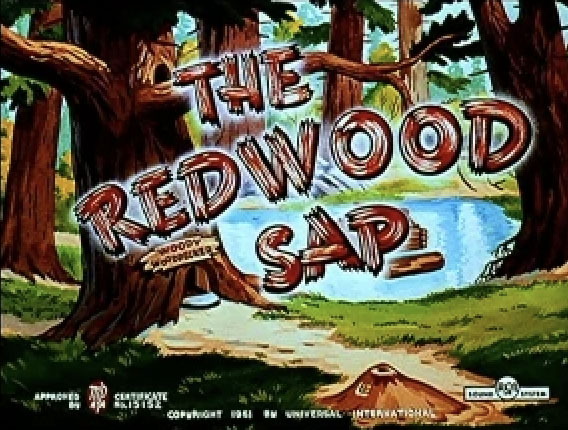 The Redwood Sap (Lantz/Universal, Woody Woodpecker, 10/1/51 – Walter Lantz, dir.) – Woody lives in an apartment in the hollow trunk of a tree, amidst a bustling community of ants, squirrels, and beavers. While all the other critters work busily in preparation for the oncoming winter season, Woody reclines in bed, enjoying some reading material suitably appropriate to his character – a volume entitled, “Work, and How to Avoid It”, by Hans Doolittle. The only thing that will interrupt Woody from his R&R is the chiming of his patented meal wristwatch, so frequently seen through his early 1950’s episode, ringing an alarm bell when its hands (shaped like a knife and fork) point to pictures of breakfast, lunch, dinner, and tea. Where does Woody get his meals? From his neighbors, of course. Zipping out his front door, he raids the contents of Dagwood-style sandwiches from the beavers, swallowing all the sliced goodies in one gulp. As the ants carry a full cob of corn, Woody sprinkles salt on the kernels, then pops them all of the cob into his own mouth by heating them with a blow torch. As the squirrel struggles to roll a towering stack of walnuts into a hole in the tree above Woody’s apartment, Woody appears on the branch above him, devouring each nut as it reaches the level of the hole. In fact, he keeps on chewing when the squirrel’s head also reaches branch level, and almost swallows the angry squirrel’s head. Woody then sails back into his apartment, floating into a reclining position on the bed with stomach bloated from his heavy meal. Woody looks up at a sampler-style sign on the wall, bearing his motto: “Why worry about tomorrow? It will be gone the day after.”
 This routine continues until the first light sprinkling of snow begins to hit the woods. The beavers disappear underwater into their den, where they sit in a parlor full of food watching TV. The ants clamber into their underground burrow, enjoying card games amidst tunnels lined with walls of corn kernels. The squirrel admires his storeroom, lined with alternating columns of walnuts and tin cans, with signs reading, “soup to nuts to soup to nuts to soup to…” All other birds in the woods pack their bags for fall migration, and one takes the time to knock on Woody’s door to suggest that he join them. But Woody is as usual too lazy to fly, envisioning only the negative sides of any suggested destination (hurricanes in Florida, and smog in sunny Hollywood). Settling down to sleep again, Woody awakens next morning, when the snow has grown to a depth of three or four feet everywhere. As his watch chimes, Woody prepares to zoom out the door – only to be buried in an avalanche of snow from the doorway. He clambers out of the ice, which has formed into the shape of an igloo inside his door, and seeks another way out through a window. Another column of ice slides in through the opening, extends over Woody’s head, then clunks him. The mercury in a wall thermometer drops to bottom, turns blue, and icicles form around the bottom of the glass barrel of the instrument, while a miniature snowstorm occurs within the glass. Woody looks down at himself, and discovers his torso is encased in an ice block – which he quickly pecks away with his beak. He opens his empty cupboard, and meets his old pal Starvation squarely in the face.
Woody’s had enough of his indoor confinement, and bores his way through the snow in his doorway, popping up outside. But where are his food sources? All holed up in their snuggly dens. All Woody can do is swallow his pride (if he ever had any), and show up at their doorsteps to beg for food. But his “pals” have been mooched from many times too often, and are out for revenge. The ants present Woody with a corn cob – cob only, devoid of corn, smacked over his head. The squirrel provides Woody with nuts – of the metal variety that fit a screw. The beavers are the most merciless, presenting Woody with a yummy-looking cake, complete with candle. However, its insides consist of ice cubes from the refrigerator, with a layer of frosting consisting of snow scooped up from outside the beaver den. Woody swallows the “cake” whole – then turns blue all over, as a cutaway view inside his stomach reveals it is so cold, even the fire on the candle goes out. Woody spends the entire winter frozen inside an ice block outside his home.
 When spring thaw comes, the local animals emerge from their homes and exchange greetings, and the migrating birds return. The bird seen earlier is the first to notice Woody, whose ice block has not yet melted. The animals put their heads together to finally rescue the trapped nuisance, by tilting the block over so that Woody’s rear is facing one side, then attacking the ice with the heat of Woody’s own blow torch. The bird revives, and zooms out of the ice through a hole he bursts through from the side opposite the torch, pausing to look at his now-sizzled tail feathers. Before Woody can even think about any lesson to be learned, his alarm watch goes off again. Reflexively, Woody returns to all the mooching activities he had utilized in the previous year, filling himself with the last stored food from each of his neighbors – and it is obvious as the cartoon ends that Woody, as usual, hasn’t learned anything, and will go on being – Woody.
• “The Redwood Sap” is viewable on Archive.org.
 Dick Lundy moved on to greener pastures – and possibly greener dollar bills – at MGM, producing in the Barney Bear series Busybody Bear (12/20/52). Good neighbor week has been declared in the morning papers, and Barney is determined to get into the spirit of helping his neighbor, who just happens to be Buck Beaver (no, not the Lantz character Lundy had left behind), just erecting signs announcing a beaver dam under construction. Another sign warns of falling trees, with the added note, “Watch your konk, neighbor”. Barney pays no heed of it as he approaches the site, and gets beaned by three different trees of varying sizes as they are felled by Buck. As Buck goes for the next one, Barney pushes him aside, pulling out his own axe to show the beaver just how it’s done. The beaver tries to yank the axe handle away, but Barney insistently gets in his chop – felling the tree upon himself before he can finish yelling “Timber”.
The beaver is next seen flinging mud upon logs with his tail to secure them into the dam. Barney tries doing the same thing with a shovel, them gets clever, inserting the shovel handle under the belt of his trousers, to operate it like a giant beaver tail. The beaver begins to get frustrated with Barney’s intrusions, and bends the shovel handle to whack Barney in the rear and up a sandy bank, where the entire front side of Barney becomes smoothly sandblasted. Next, the beaver begins cutting a log into segments with his teeth, but can’t make progress upon a stubborn outgrowth in the middle. Barney borrows an idea from Chuck Jones’s “The Eager Beaver”, placing Buck atop a block of ice until his teeth chatter, then uses him as a power saw to cut the tree, leaving Buck’s buck teeth loosely swaying from his upper lip.
 Buck moves on to using a two-handled saw on another section of a log, though he is operating it single-handedly from one side. Barney climbs atop the log and grabs the other handle. He makes cutting progress, but bashes Buck repeatedly into a tree stump on Buck’s end of the saw. Buck retaliates, by sliding the whole log until one end overhangs the drop-off of a cliff. As Barney saws through, he and his end of the log fall into the canyon. Barney wisely lets the log end fall away, and removes his trousers, allowing them to billow out in the wind and float him down as a parachute, suspended from the suspender straps. Buck isn’t going to let him have a graceful landing, and pushes the other end of the log over the cliff. Barney lands lightly on one toe – then is crushed into a pancake by the falling log.
 Buck finally gets the final log in place atop the project, then changes his signage from “under construction” to “completed”. However, as he turns around, he finds to his dismay the sight of Barney, adding a new log to the pile. Buck pushes the log away, and clears off the mud base with his tail, then finally speaks up to Barney. He tells the bear in no uncertain terms to mind his own business, and that the project is completed and just right the way it is. “I only want a little one”, he protests. Barney stubbornly insists that what he really needs is a great big one, which the bear intends to supply. To keep the complaining beaver from interfering, Barney ties him to a tree stump, then sets about his own appointed task. Scaling a hilly slope on one side of the valley, Barney chops two thirds of the way through the trunk of every tree. At the top of the hill, he yells, “Timber”, and pushes at the topmost trunk. Like a line of dominoes, one tree’s fall fells another, and another, until all the trees on the hillside are keeling over. Barney zooms back to the dam, and flings layer upon layer of mud with his shovel atop each log as it lands on the dam. Within seconds, he has constructed a dam rising nearly to the top of the valley walls. He releases the beaver, pats him on the head, and returns to his own cabin. Within moments, the beaver’s feet are being immersed in water – as the new dam is holding back all the water in the river, flooding the entire valley. Barney receives a knock on his front door. When he opens it, the beaver enters, emerging out of a wall of water, which blasts into Barney’s home in delayed reaction, thrusting the bear out the chimney top and into the flooded valley. Underwater in the bedroom, the beaver takes occupancy of Barney’s bed, pulling the covers over himself to rest up from the exhausting day, while Barney looks in from the submerged bedroom window, drumming his fingers on the windowsill in frustration, for the iris out.
You will note in the course of the cartoon that Scott Bradley was not one to miss appropriate opportunity for re-use of his own musical compositions. The main theme from Barney’s The Bear and the Beavers score receives healthy repetition here, underscoring many of the beaver’s activities.
 By the Old Mill Scream (Famous/Paramount, Casper, 7/3/53 – Seymour Kneitel, dir.) – A by-the numbers Casper script. Casper flops out at a ghost town amateur night performance in an abandoned Opry House, the spooks not appreciating his vocal rendition of his own theme song. Casper goes out into the world to make friends again. His travels take him to a beaver dam, where the smallest beaver, Little Shorttail, makes a similar flop trying to help with dam construction. Reason why? His tail is only a fraction of the size of those of the others, and only big enough to carry a tiny wad of mud for packing the logs together – in fact, just enough mud to accidentally flip into the foreman’s eyes. While the beaver cries by himself off in a corner, Casper shows up to offer any assistance in the construction. The other beavers depart in totem-pole formation. Casper finds Shorttail, the only one not afraid of him, and learns of his problem. He attempts to build confidence in Shorttail, telling him his tail is probably strong enough to carry a log – but invisibly lifting the log himself as Shorttail walks along. The dam springs a small leak, the water running right through the palms of Casper’s ghostly hands. Shorttail again can’t carry enough mud to plug the hole, leaving Casper to do it himself, piling the mud onto the beaver’s tail just as he returns to the dam, so as to allow Shorttail to claim the credit for the repair. As Shorttail goes for more wood, we get a late cameo appearance by Wolfie, who is hunting beavers with the aid of a plumber’s helper tied to a rope. He corners Shorttail in a hollow tree, and uses his plunger’s suction to pull Shorttail out of the tree’s hole. Casper shows up, scaring Wolfie out of his clothing, his outfit running away faster than himself. Shorttail shows up again at the dam along with Casper, the beaver clan now accepting Casper as their hero. Now Shorttail can carry and fling all the mud he wants for the dam – because Casper has installed a large frying pan tied to his own tail, as a prosthetic substitute.
 Unnatural History (Warner, 11/14/59 – Abe Levitow, dir.) is one of a few late returns to the Tex Avery spot gag cartoon style of the 1940’s, featuring random gag sequences involving various species of wild and domesticated animals or insects. Some of its most memorable highlights include the act of Cal the Chameleon, who can instantly match any color background inserted behind him – but draws the line at plaid, bawling in a tantrum, “I can’t do it!”. And a talking dog act, which strikes out at the booking agency when everything he says sounds like a dog bark, including his naming of “Ruth” as the greatest baseball player. As he and his owner are thrown out, the dog confides to his owner, “Maybe I shoulda said, Di Maggio”?” One of its last gags includes a beaver, repeating Chuck Jones’ gag from “The Eager Beaver” of actually “damming” a river, when the center of his dam construction falls apart from the water flow. He of course angrily shouts audible but unintelligible swear words at the water.
• “Unnatural History” is in a good print at DailyMotion.
 Beavers again get a mention – but no appearance onscreen, in Bugs Bunny’s Wet Hare (Warner, 1/20/62 – Robert McKimson, dir.). Bugs is taking his morning shower under a river waterfall, doing his best vocal impression of Al Jolson singing “April Showers”. Suddenly, the flow of water runs dry. Bugs knows he paid his water bill – then remembers what happens every year. Those pesky beavers upstream must be building a dam again. Bugs is about to investigate, then goes through a series of over-dramatic speculations, as to what might happen if it’s not the beavers, and the water has just dried up. He envisions his carrots shriveling, himself dying of thirst, and begins to gasp for water. Then just as suddenly, he changes mood entirely to his usual casual cool, remarking, “Nah, it’s gotta be them pesky beavers”.
Both of Bugs’s theories are wrong. At the top of the waterfall stands Blaque Jacque Shellaque (McKmson’s answer to Yosemite Sam, in a return appearance following his debut in “Bonanza Bunny”), who has just completed constructing a dam out of stray stones. He chuckles to himself that he fees just like a “pesky little beaver”. Bugs arrives at the top, learning from Jacque of his intention to keep the river water for himself, based on riparian rights consisting of a loaded pistol for anyone who defies him. Bugs claims to have no protest, but speculates as to how secure the dam is. What if one stone here or there were to fall out of place. He gets Jacque to remove a central stone, as a demonstration of “What could happen?” POW!! The whole thing falls apart, the water sweeping Jacque away.
 Bugs returns to his bathing, but the water dries up again (a shot we will see several times too often in this film, instead of varying things up by reanimating the angle or the flow of water differently each time the event recurs). Shellaque has built a stronger dam. A shark fin appears in the water, which Jacque thinks to be a trick, as there are no sharks in a trout stream. Apparently, however, Bugs has farmed this one in specially, leaving Jacque atop the dam, trying to bat off the shark and calling for help. Bugs comes charging to the rescue, floating on a log, but deliberately slams it right through the dam stones. “This is being saved?” shouts Jacque, once again falling into the water.
Another shower, another dam. Much larger, with neat squared-off stone wedges. Jacque wonders if the rabbit will try to blow up the dam. A small raft carrying a single stick of dynamite floats up to the dam wall. Jacque scoops it up in a net, then attempts to run with it off the dam. It blows up in his face, leaving him staggering, while a much larger raft holding crates full of dynamite floats in. BLAM!!
 Jacque is through fooling around. He climbs down into the valley, and blasts with a shotgun at the location behind the waterfall from which he hears singing, until the voice is silenced. Of course, Bugs is really off to one side of the river, tending his carrot patch, and the voice heard was nothing but a gramophone and record he placed behind the falls. Back at the top of the waterfall, Jacque has now constructed his masterpiece – a dam of solid metal and rivets (hopefully rust-proof). But instead of attacking the dam, Bugs changes tactics – rendering Jacque’s dam useless, by building another dam of rocks further upstream. “Sacre bleu”, utters Jacque at the insane determination of this rabbit. With a cannon, Jacque approaches Bugs’s dam, and blasts it away. But yet another dam stands behind it. Another cannon shot – and another dam upstream is revealed. Bugs continues to lure Jacque further and further upstream, blasting away dam after dam, until Jacque comes face to face with the towering edifice of the all-concrete Grand Cooler Dam. Reflexively, he loads his cannon, and blasts once again. The cannon ball merely bounces off the concrete structure, ricocheting back to catch Jacque in the belly, and knocks him into the waiting entrance doors of a police paddy wagon, which rolls him away to make the arrest for an assault upon public property. From the top of the dam, Bugs mutters that Jacque is not fooling him. “He’ll be back – like, in about 20 years.” Though a late entry in the series that could have had better animation and tighter timing in places, this one did have some clever ideas, and remains reasonably memorable.
• “Wet Hare” is on Facebook or on Toontales.
NEXT WEEK: Some feature work, and some television outings, next time.






 That night, Barney returns to what will be the scene of – the crime, armed with boxes galore. Displayed as still illustrations within the book pages, Barney “borrows” some wood. The next page displays him loaded – for bear, so to speak, adding the words, “Quite a bit.” The next page shows the beavers’ warehouse, empty, with the additional words, “In fact, all of it.” The theft of the century. However, Barney is as inept in covering his traces as he is as a woodsman. An elderly beaver with a walking cane, who acts as night watchman for the community, passes the warehouse on his rounds – and does a delayed double-take upon discovering the place laid “bear”. He races to a square in the center of the village, and rings a triangle to sound a community alarm, rousing all the other beavers from their dens, in a scene likely inspired by the “Giant on the beach” alarm sounded by Gabby in Fleischer’s “Gulliver’s Travels.” It’s not hard to find the path of the culprit, as the watchman points the community’s eyes to a long trail of huge bear pawprints left in the fallen snow. The trail ends obviously at the doorstep of Barney’s cabin. Inside Barney now basks in the heat of a monster blaze in the fireplace, stoked by a lumber pile at his sides reaching all the way to the ceiling. What’s more, embers and plumes of smoke pour out the chimney top, almost as visible as a rocket’s exhaust, making it elementary to determine from outside where the community woodpile is currently located.

 Nutty Pine Cabin (Lantz/Universal, Andy Panda, 6/1/42 – Alex Lovy, dir.) – Another fun romp, that I remember fondly from early screenings on the Kelloggs’ Woody show as a child. Rustic woodland cabins must have been a part of the American dream in 1942, because Andy Panda has the same home-building fever as Barney Bear. Andy’s chosen material, however, is plywood instead of logs. Though his carpentry supplies include a tape measure, he could use some practice in measuring board length, as the first act of the cartoon displays his battle to hammer in place one board in the cabin’s side wall that is too long. It either pops out at the top, bends upwards at the bottom, or springs outward as a bulge in the middle. When Andy finally manages to hold it in place, its top edge raises the roof just slightly, allowing all the other wall boards to fall out of place, then the roof to collapse upon him for lack of structural support.