Sophie Corcoran challenging 10,000 Interns Foundation, which works with people from under-represented groups
An influencer is taking a charity that organises internships for black and minority ethnic people to court because they do not organise schemes for white people.
Sophie Corcoran, a GB News commentator, applied to a programme the 10,000 Interns Foundation was running with the Bar Council. She said she was “shocked to discover that the scheme is restricted to applicants of a particular racial background”.
Meta was charged by European Union (EU) regulators with breaching landmark tech rules after failing to prevent children under 13 from accessing Instagram and Facebook.
Campaigners saying public spaces protection orders also being used to criminalise wide range of everyday activities
One in five local councils have banned swearing under new “busybody” orders, up from one in 20 councils in 2022.
A new report by the Campaign for Freedom in Everyday Life has found that public spaces protection orders (PSPOs) – originally intended to tackle serious anti-social behaviour – are being used by councils in England and Wales to criminalise a wide range of everyday activities, including standing in groups, shouting and picking up stones.
Google moved Location History to users' phones in 2024, ending the geofence pipeline. The Supreme Court heard arguments Monday on a case from before the cutover.
The European parliament has called on the EU to draw up a standardised consent-based definition of rape, in what legislators described as a crucial step towards addressing the patchwork of laws, some of them insufficient, that now exist across the bloc.
On Tuesday, 447 of the parliament’s 720 MEPs voted to approve a report calling for a common definition of rape, centred on “only yes means yes”, prompting a loud round of applause in the chamber in Strasbourg.
Global superstar Taylor Swift has filed trademark applications for her image in what is believed to be an attempt to protect her likeness from AI deepfakes.
The Victorian government will strengthen laws regarding the use of victim-survivors’ confidential communications after a push by advocates including Brittany Higgins, who described her experience of having counselling records subpoenaed as a “violation”.
In an interview with Guardian Australia, Higgins was also critical of the federal government’s lack of action following a sweeping review into the justice system’s responses to sexual violence, saying it had “completely fallen off the agenda”.
A convincing AI-generated image of a runaway wolf in South Korea led to the arrest of a man after it derailed the rescue team searching for the canine.
In today’s newsletter: As campaigners and critics reckon with the bill’s failure, the debate reveals a country struggling to support vulnerable people and those living with terminal illness
Good morning. Last week the terminally ill adults (end of life) bill in England and Wales fell at the final hurdle – just weeks after Scotland’s parliament voted down similar proposals to legalise assisted dying.
For those opposed to a change in the law, it was a victory. For supporters, it has prompted anger – not just at the outcome, but at the process, with campaigners arguing that the unelected House of Lords had thwarted democracy by blocking legislation that had already passed the Commons.
Monarchy | King Charles and Queen Camilla arrived at the White House on Monday for a state visit in Washington with the transatlantic alliance showing fresh signs of strain.
US news | The suspected gunman at the White House correspondents’ dinner had, according to the FBI, written that “I am no longer willing to permit a paedophile, rapist, and traitor to coat my hands with his crimes”. Cole Tomas Allen, 31, from Torrance in southern California has appeared in court charged with three federal crimes including attempting to assassinate the president.
UK politics | Keir Starmer will face a vote on whether to launch a standards investigation into his appointing Peter Mandelson as ambassador to Washington. The speaker, Lindsay Hoyle, has granted a debate today on potentially referring the prime minister to the privileges committee.
Conservatives | Police are assessing evidence about donations to Robert Jenrick’s campaign to become Conservative leader in 2024 after a referral from the elections watchdog, the Guardian can reveal.
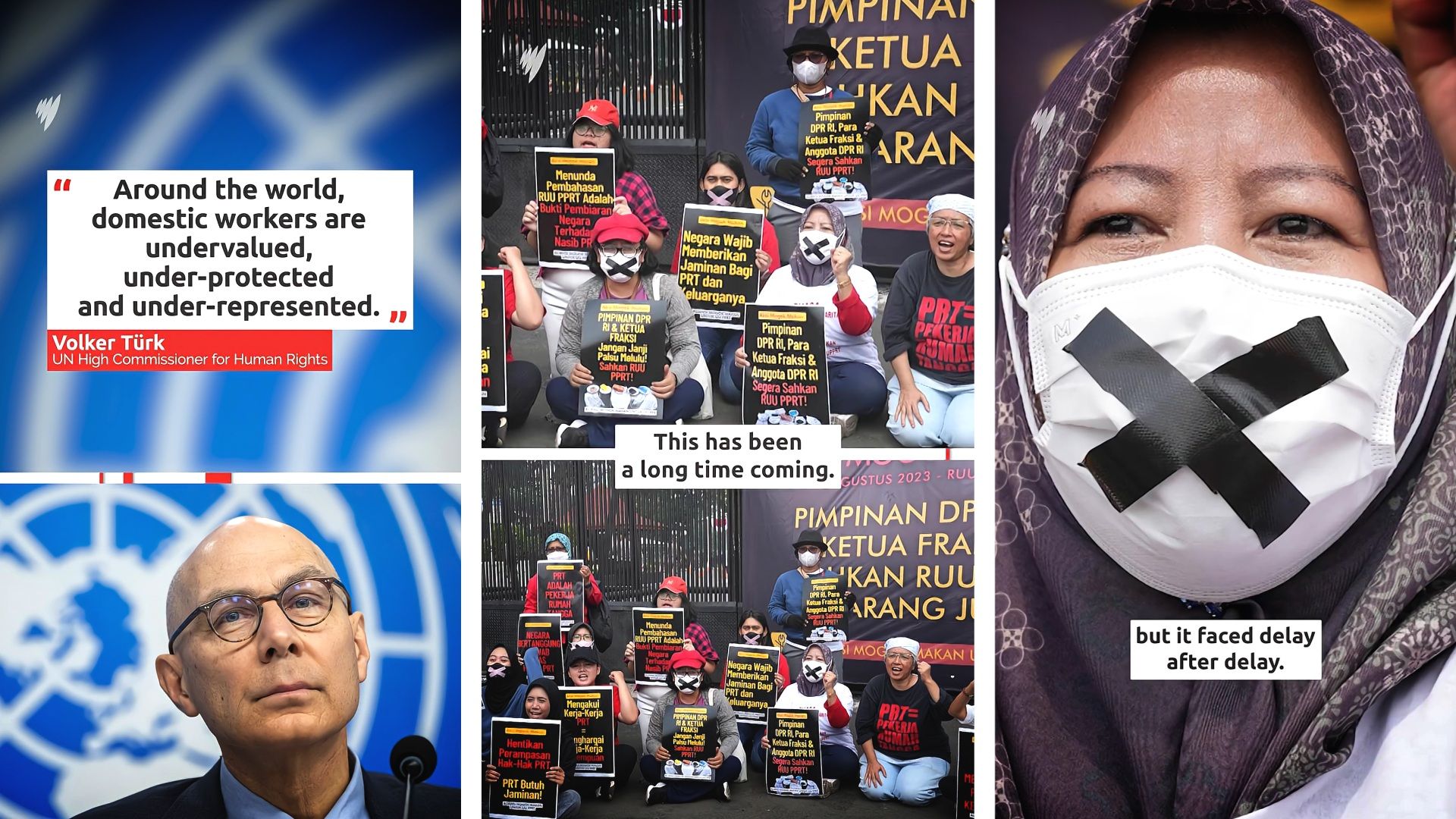
JAKARTA: Indonesia has passed a long-delayed law to protect domestic workers, marking a change after more than two decades of debate. The shift gives legal recognition to a workforce that has long operated without formal safeguards.
According to SBS News (April 24), the new move now affects more than 4 million domestic workers, 90% of whom are women, yet for years, they were not legally recognised as workers or covered by formal labour protections. This left them outside labour laws, exposed to abuse, and with little recourse when things went wrong.
That is now set to change. Under the new law, domestic workers will be entitled to rest days, health insurance, pensions and vocational training. It will also be illegal to hire children or allow employment agencies to deduct wages, practices activists say have been common.
Parliament’s approval drew applause in Jakarta. Law and Human Rights Minister Supratman Andi Agtas presented it as a step towards fairness, saying the new law sets out clearer protections while giving employers legal certainty. He also noted that President Prabowo Subianto had pushed for the bill to be completed, Channel NewsAsia (CNA) reports (April 21).
Regulators have now been given 12 months to finalise how the law will be enforced, including setting penalties for employers who breach the rules.
United Nations: “Around the world, domestic workers are undervalued, underprotected and underrepresented…”
UN High Commissioner for Human Rights Volker Türk praised Indonesia’s decision, describing it as a major step forward with historic significance. He said, “Around the world, domestic workers are undervalued, underprotected and underrepresented. This is an historic opportunity to turn the tables on this neglect and to protect, respect and honour their invaluable contribution to the welfare of so many people.”
The new law introduces several baseline protections for domestic workers
Domestic workers will now have access to training, as well as health and unemployment benefits. It also bans the hiring of anyone under 18, a notable change in a country where many leave school early.
There is still a wage gap as the law doesn’t set a minimum salary. Instead, the government has given itself 12 months to work out detailed rules, including penalties for violations, as without proper enforcement, laws can sit on paper while daily practices stay the same.
For many domestic workers, the law feels overdue
The bill first appeared in 2004. Since then, it has faced repeated delays. Advocacy groups kept pushing, arguing that domestic workers were invisible in the legal system despite their role in keeping households running.
One domestic worker described the moment as something that had taken over two decades to achieve, especially for women who had long been sidelined.
Jala PRT, a domestic workers’ rights group, called the law historic. Its coordinator, Lita Anggraini, said the law finally brings recognition to workers who had been ignored for years.
Abuse cases kept pressure on lawmakers to act
The urgency of the law is tied to real cases of abuse. Jala PRT recorded more than 3,300 abuse cases between 2021 and 2024. These ranged from physical harm to economic exploitation and even human trafficking.
One widely reported case in 2023 involved a young domestic worker in South Jakarta who suffered severe abuse. Several individuals were later jailed, with sentences of up to four years.
Cases like this kept the issue in public view and added pressure on lawmakers to act.
Stronger protections for domestic workers could shape expectations
For Singapore, Indonesia is also one of the main source countries of domestic helpers for the nation and across Southeast Asia.
Similar, stronger protections, like those enforced in Indonesia now, could shape expectations abroad as well. It may also influence future policy discussions on worker welfare, contracts, and employer responsibility.
At the same time, the law shows how long it can take to formalise protections for work that happens behind closed doors.
Rules on paper mean little without education and inspection
Currently, even supporters say passing the law is only the first step. Advocates stress that employers also need to understand their responsibilities. Public education will be crucial, as without it, the law risks becoming another rule that few follow.
There is also the question of enforcement because rules on paper mean little without inspections, reporting channels, and consequences. A law can change status overnight, but changing behaviours takes longer.
Nevertheless, this is a necessary reset, toward the finish line. The coming years will matter more than the last 22.
If the follow-up rules are strong and enforced, this could reshape how domestic work is treated across the region beyond Indonesia. Otherwise, it risks becoming just another symbolic win with limited impact.
Bangkok Thai authorities are exploring the reintroduction of a 1000 Baht exit fee on Thai nationals traveling abroad, wanting to generate billions of baht annually to subsidize domestic tourism and keep more spending within the country. Tourism and Sports Minister Surasak Phancharoenworakul announced that his ministry is in discussions with the Finance Ministry about reviving […]
In a viral video posted recently, a Kazakhstani influencer walked into a Thai 7-Eleven, grabbed snacks from the shelves, poured them over her head, and then emptied two bottles of fresh milk over herself while joking about a “delicious cocktail.” Milk and crumbs spilled across the floor and splashed onto nearby products, leaving store staff […]

 Login
Login