Login
Login
Assam delimitation: One panchayat, two MPs and three MLAs
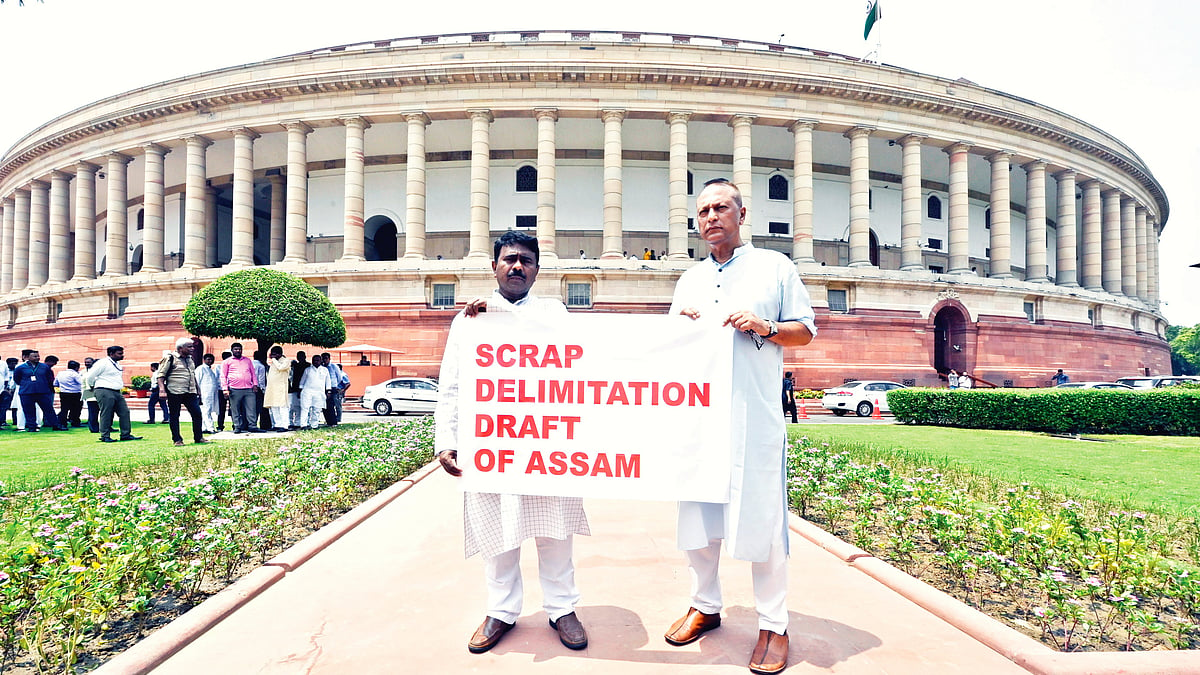
A panchayat of 10 villages in Assam's Barpeta district used to be represented by one MP in the Lok Sabha and one MLA in the state Assembly. The same panchayat will now be represented by two MPs and three MLAs. This bizarre outcome, said journalist Rokibuz Zaman in a video interview to Scroll, was achieved by the Election Commission’s delimitation of constituencies in Assam in 2023.
In 2023, ignoring previous guidelines — which laid down that a block or a tehsil, the smallest administrative unit, should not be broken up — the ECI commission made the village the smallest unit and decided to split up panchayats instead. Makes sense?
A look at the map of Assam will indicate a redrawing of political boundaries that disregards natural and geographical barriers. While the idea is to ‘balance’ the number of voters in each constituency to ensure that the value of each vote remains more or less equal, delimitation can also enhance the political advantage of one political party or group of people.
Gerrymandering, to use the American term, was carried out in both Assam and Jammu and Kashmir in 2023. Being opaque and non-justiciable, no legal challenge could be mounted against the process. Having tested it in Assam, the BJP would have foisted it on the rest of the country, had it not failed to get the Delimitation Bill through Parliament on 17 April.
Experts have described the 2023 delimitation of Assam’s parliamentary and Assembly constituencies as the most “consequential and contentious exercise in the state’s recent political history” which, they believe, worked “in favour of the BJP” in the recently-concluded Assembly elections on 9 April.
The devil in Assam’s delimitation exercise lies in its details. Prima facie, the state merely complied with a constitutional mandate to redraw its electoral boundaries to reflect demographic changes. Articles 82 and 170 of the Constitution provided for such readjustment following each census.
However, constitutional amendments in 2001 and 2003 froze the total number of seats in the assembly to 126, permitting only internal reconfiguration based on the 2001 Census. This meant that Assam’s delimitation — conducted nearly 50 years after the last exercise in 1976 — was carried out using outdated demographic data.
Instead of carrying it out under the Delimitation Act, though, the exercise was conducted under Section 8A of the Representation of the People Act, 1950. This provision, specifically crafted for certain northeastern states, empowered the ECI to carry out delimitation once a presidential order lifted the earlier deferments. In February 2020, the President rescinded this deferment, paving the way for the exercise.
For Assam, this meant there was no independent Delimitation Commission, usually headed by a retired Supreme Court judge. Instead, it was the Election Commission which carried out Assam’s delimitation. Without any judicial oversight, Assam’s delimitation exercise was open to manipulation.
****
The exercise classified Assam’s districts into three categories based on population density. It allowed for a 10 per cent deviation from the average state population per constituency. This ensured that sparsely-populated hill districts were not under-represented, while densely populated areas did not dominate.
There were extensive consultations, including deliberations over 1,200 public representations. It also ensured greater representation for Scheduled Tribes and addressed the demands from autonomous and tribal regions. The state government projected the increase in reserved seats for SC and ST as part of its commitment to social justice and inclusion.
According to a retired state government official, deviation from procedure was not the only unique feature of Assam’s delimitation. It also achieved the unstated — yet obvious — objective of diluting the political influence of Muslims and other key minority communities though ‘communal gerrymandering’. This was accomplished through ‘cracking’ (splitting concentrated minority populations), ‘packing’ (consolidating them into a few seats) and ‘stacking’ (merging them with larger majority populations to ensure electoral defeat).
Constituencies like Barpeta saw significant restructuring, including the removal of Muslim-dominated areas and the conversion of the seat into a reserved SC constituency. In Naoboicha, previously a competitive seat with notable minority representation, reservation effectively altered the electoral landscape. In Katigorah, demographic reconfiguration allegedly shifted the constituency’s balance in favour of Hindus.
The net outcome was a sharp reduction in the number of constituencies where Muslim voters enjoyed influence and representation. And when communities lost influence due to delimitation, so did leaders, especially those who were at the receiving end.
“Delimitation made my seat unwinnable,” said veteran Ahom leader and former BJP MP Rajen Gohain, who quit the BJP in late 2025 after serving the party for 30 years during which he represented Nagaon in the Lok Sabha four consecutive times.
Gohain has been vocal against chief minister Himanta Biswa Sarma, accusing him of running the state like a “commercial enterprise” and neglecting marginalised and indigenous communities. He is also confident of winning the 2026 Assembly elections as an Asom Jatiya Parishad (AJP) nominee from Barhampur.
“The Opposition alliance is coming to power in Assam. The undercurrent of dissatisfaction against Himanta Biswa Sarma is now boiling over,” Gohain told National Herald days before counting of votes on 4 May.
The new political equations thrown up by delimitation in Assam manifested in internal bickering within the Assam BJP where Biswa Sarma has inducted and given party nomination to a new set of leaders to fight a rejuvenated Opposition.
According to the Guwahati grapevine, Amit Shah’s observation during an internal meeting that Congress-turned-BJP leader and minister Pijush Hazarika had managed to secure nomination for 15 of his followers — out of the 90 seats the BJP contested — did not go down well with Biswa Sarma.
To diminish Hazarika’s growing stature, Biswa Sarma began promoting Jayanta Malla Barman, Hazarika’s bête noire since their NSUI days, making Barman the point of contact for alliance partners like the Bodoland People’s Front (BPF) and AGP (Asom Gana Parishad). Hazarika’s role was whittled down to fund and media management.
The BJP’s alliance with the BPF also meant the latter would have a greater say on the syndicates that controlled the flow of traffic through the Srirampur entry gate on the West Bengal-Assam border — a role Hazarika reportedly played with elan.
Assam’s old guard did not hide their dissatisfaction, with veteran BJP leaders like Gautam Das openly revolting against Biswa Sarma to contest as independent candidates.
While the BJP waxes euphoric over a clear-cut win in Assam, the buzz over a possible Opposition victory — captured in a number of exit polls — is getting stronger. Biswa Sarma is clearly fronting a political party that is divided, bruised and propped up by local interests, rather than steered by a grand vision for the state.
If tailored electoral rolls and redrawn constituency maps combined with shrill communal rhetoric do not yield the desired results for the BJP, the knives will soon be out for Assam’s beloved ‘mama’.
Sourabh Sen is a Kolkata-based independent writer and commentator on politics, human rights and foreign affairs. More of his writing here