Login
Login
West Bengal: Has the ECI done enough?
No adult living in India today, with a constitutionally guaranteed right to vote, will ever forget the SIR. Not even the legions of India’s unlettered, who won’t even know what those dreaded letters stand for.
The state of West Bengal had its tryst with the process over the past six months, after Bihar had seen it first. In Phase 2 of the SIR that got under way on 4 November 2025, the Election Commission of India (ECI) lavished special attention on Bengal, though it was only one of 12 states and Union Territories covered in this round.
The people of Bengal had seen it coming even before the process started here, when lakhs of deleted voters in Bihar were scrambling desperately to get back onto the electoral rolls. And now, a full six months after the grind started here, they are finally awaiting the results on 4 May.
Irrespective of which way they lean, neither the voters nor the pundits nor even pollsters of any integrity are sure how thoroughly gamed this supposedly ‘free and fair’ process is. Has the ECI done enough to swing it for its political masters?
“If the BJP finally wins West Bengal,” a state this Hindi heartland party has long coveted, “it’ll be because of the SIR,” reflected a veteran of many earlier poll battles, preferring not to be named. “But if it loses again, even after all it has done, it’ll be because of the SIR.”
This apparent paradox isn’t really. If you discount the SIR for just a moment and think only of the palpable mood of the electorate of this state, its people and the BJP are not really ready for each other.
Not even after 15 years of Mamata Banerjee and all the talk about the need for poriborton (change). Poriborton may yet come — if not organically through a popular mandate, then via the BJP’s joint venture with the ECI. But if it doesn’t, the seething anger of voters with the ECI will have played a big hand.
****
For a while it looked like the ECI was still trying to keep the real agenda under wraps, its attempt to re-engineer the electorate to the BJP’s advantage. The BJP has made no secret of its support for the exercise, and a fair-minded outsider might wonder why it’s only the Opposition that worries about largescale exclusions.
Union minister Shantanu Thakur, a prominent Matua leader of the BJP, representing the party from the state’s Bongaon Lok Sabha constituency, said it was preferable to sacrifice 20,000 Hindus to weed out 200,000 Rohingyas. But of the 58.2 lakh ASDD (Absent/Shifted/Dead/Duplicate) deletions in the draft list of December 2025, not one was Rohingya or Bangladeshi.
Soon after, the ECI deployed a mysterious software that flagged 1.3 crore voters for ‘logical discrepancy’ — a newly minted category of provisional deletions — and asked them to produce documents at in-person hearings.
Migrant workers, men, women, the elderly and the ailing queued up to produce the documents they could muster. No receipts were given, no evidence provided that they had been ‘heard’, pointed out Sahidul Munshi, retired justice of the Calcutta High Court, who found his name had been dropped. Following an interview published in Bar & Bench, his name was quickly restored but others were not so lucky.
From the pre-SIR baseline of 7.66 crore voters, the number was down to 7.08 crore (after ~58 lakh deletions) in the draft list of December 2025. The ‘final list’ of 28 February had 7.04 crore names, with ~60 lakh now placed ‘under adjudication’.
Post-adjudication by judicial officers, engaged to do the ECI’s job at the direction of the Supreme Court, 32 lakh names were cleared, which still left 27 lakh voters disenfranchised, who were now advised to approach 19 single-member appellate tribunals, made up of retired chief justices and judges of the Calcutta High Court.
By 23 April (Phase 1 voting day for 152 Assembly constituencies), a total of 138 appeals had been heard and 136 cleared for inclusion; by Phase 2 (on 29 April for 142 constituencies), another 1,474 appeals had been processed and 1,468 names revalidated. At this rate of disposal, the tribunals would have taken 10-12 years to hear the rest of the appeals!
At the end of Bengal’s SIR nightmare, the state’s count of eligible voters for this election was ~90 lakh short of its pre-SIR baseline of 7.66 crore!
No wonder the senior BJP leader who spoke on condition of anonymity felt the anger of the people might singe the party, but he also admitted he didn’t have the courage to warn the party’s big guns from Delhi of the potential backlash.
In West Bengal, he explained, the SIR had completely overshadowed anti-incumbency. All the pre-SIR talking points — corruption, jobs, lack of industries, recruitment scams — had disappeared from the electoral discourse.
Muslims rallied behind the ruling Trinamool Congress, convinced that the SIR was a diabolical plot to strip them of citizenship. Even the Matuas — Scheduled Caste Hindus from Bangladesh, many of whom found their names deleted — felt betrayed by the BJP. Migrant workers were incensed by the harassment and financial loss in travelling back and forth.
****
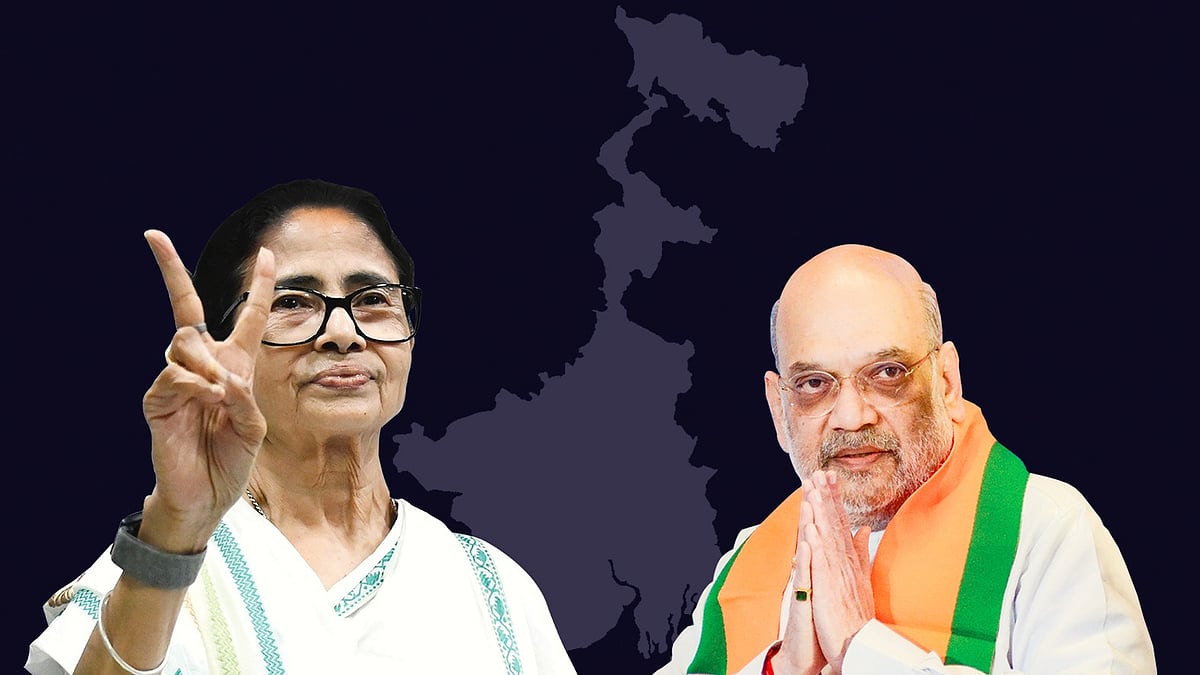
The voter turnout was a record 92.4 per cent and both the TMC and BJP were outwardly confident this was a sign of a mandate in their favour. The BJP would have us believe the political wind is blowing towards ‘poriborton’, the TMC insists the same wind is blowing for ‘pratyaborton’ — the return of 71-year-old Mamata Banerjee as chief minister for a fourth term.
Before returning to Delhi, Union home minister Amit Shah exuded confidence that the BJP would get an absolute majority, even quoting a number — 177 — that sounded suspiciously omniscient. But, then, he had also predicted a 200+ majority for the BJP in 2021!
If indeed the BJP’s brag about the popular mood is right, what was the unprecedented security bandobast in the run-up to elections about? The deployment of 2.8 lakh CAPF troops looked like an invasion rather than an election. (For context, Manipur had 29,000 CAPF troops on ground at the peak of the 2023 ethnic violence.)
Why was the NIA (National Investigating Agency), normally tasked with counter-terrorism duties, strutting around polling booths? Why were Central troops threatening Kolkata mayor Firhad Hakim in Bhabanipur (Mamata Banerjee’s constituency) at 1 a.m. on polling day? “Aap mayor saab ho na? Agar kuchh hua, toh aap ke liye achha nahi hoga (you’re the mayor, right? If anything [untoward] happens, you’ll be in trouble.)"
****
A post-election wisecrack summed up the mood thus: “This is an election the BJP will lose even if it wins. It won’t savour confronting Mamata Banerjee even in Opposition.” Wisecracks aside, if she loses, Mamata Banerjee will certainly be seen as a martyr, defeated unfairly by an unscrupulous rival with the help of the official machinery and a compromised Election Commission.
Most exit polls have predicted a close race, some have forecast a BJP majority, some others a clear return mandate for TMC. Historically, the verdict in West Bengal has been one-sided, with the winning party securing over 200 of the 294 seats in the assembly. In the past three elections (2011, 2016, 2021) , the TMC won 226, 211 and 215 seats, respectively. The Left Front fell four short of the 200-mark in 1996 but made up in the next election by taking its tally to 235. We’ll see if this trend persists.
Five years ago, pollsters People’s Pulse and Axis-My India had predicted the BJP would win 173-192 seats, comfortably ahead of the majority mark of 148. (The BJP won 77.) This time, Axis-My India refrained from projecting a number, claiming that 70 per cent of voters preferred not to divulge who they had voted for. People’s Pulse has predicted 95-110 seats for the BJP, and sees the TMC coasting to victory with 177-187 seats.
We wouldn’t wager any money on these predictions, though exit polls do create a flutter in the stock market and the satta bazaar, and those with an appetite for risk do make a quick crore or few. For other people who have a taste for political theatre but are less invested in the outcome, exit polls are excellent entertainment, certainly worth the price of a PVR movie ticket!
With inputs from Kunal Chatterjee