
Reading view

Gen Z spends 85 cents on daily breakfast, saves up to 70% of income to reach FIRE by 40

Like many young Millennials and Gen Z who want to achieve FIRE (Financial Independence, Retire Early), Mia McGrath is doing the best she can to achieve it by 40—and somehow she decided to do it by starting her day with her “humble eggs” breakfast, which costs just 50 pence (S$0.85).

The London-based 25-year-old model, influencer, and now brand founder, who shares finance tips with her over 500,000 TikTok followers, also said she saves up to 70% of her income to reach her goal.

While she didn’t grow up financially literate, she said she became obsessed with becoming rich—in time, choice, and autonomy—and began learning what she could from YouTube and books on how to achieve financial freedom.

Before quitting her 9-to-5 job in the fashion industry in October last year, she told Fortune last April, that unlike other white-collar workers who spend money on daily sandwiches or salads, she cuts back on daily coffees and sticks to leftovers.

Ms McGrath, who aims for a FIRE number—the amount of savings and investments that allows someone to stop working while covering living expenses—of £1.25 million, said she already saved £70,000 at that time.

Commenters, however, questioned her lifestyle, with one saying, “Would she be alive by 40 if she keeps eating like that?” Another asked, “Does that make her happy and satisfied?” Others also said they practised similar habits of saving but had reached their 40s and 50s without retirement in sight.

Pushback against those pursuing the FIRE movement is not new. In fact, a man in Singapore who was after the same financial freedom was called “calculative” by his friends when he started cutting back on spending when they went out together. Others earning below S$10,000, however, questioned whether it was even possible. Meanwhile, some who have achieved it were prompted to question what to do next. /TISG

Read also: Young worker quits Singapore job at 27, leaves ‘predictable and unreachable’ life behind for Penang

This article (Gen Z spends 85 cents on daily breakfast, saves up to 70% of income to reach FIRE by 40) first appeared on The Independent Singapore News.

  •  

‘Better to hang on ’til you find another job’: Netizens advise man who wants to quit his first job after just 2 weeks

SINGAPORE: Would you quit if you had no job lined up? A 27-year-old man was considering doing so after working for just two weeks, as he found his job “very dry.” He also said he dreaded going to work every day and felt “very unmotivated,” adding that he plans to switch to a career in project management, which he had experience in, having had two internships managing projects.

Netizens commenting on The Independent Singapore’s Facebook page, however, advised him against doing so, with one saying, “Better to hang on till you find another job – not easy to get jobs these days.”

Another called pushing through quitting without backup as “foolish.” While a third advised, “You should always secure a job first before quitting, especially when the current job market is much tougher.”

Before starting his current role, the man said he had been eyeing a job with a hybrid arrangement but faced multiple rejections and eventually settled for his current role, which pays less than S$4,000 a month. He noted then that after applying for two weeks, he received little to no callbacks.

While you’re often told never to jump without a safety net, there are five situations where it may make sense to do so, career change coach Caroline Ceniza-Levine wrote on Forbes.

  1. When your health is compromised by burnout because the work environment is too toxic.

  2. When the opportunity cost of staying in your job is too high and means missing out on what matters most to you.

  3. When you have the savings to handle the financial impact of a career gap, or clear ideas on what to do next.

  4. When you’re sure your next move would be more lucrative, more fulfilling or more suitable to you.

  5. When you’re at peace with quitting and ready for a change.

Meanwhile, in the little red dot, the job market just recorded the largest decline in job postings since March 2021, according to online job portal Indeed. Although it is worth considering that, at the same time, Singapore workers have been found to be more resilient but disengaged, with some quiet cracking from pressure, job uncertainty, and stalled professional growth. /TISG

Read also: ‘I’m job hugging even harder’: Some Singaporeans share how they’re navigating rising costs amid the Middle East war

This article (‘Better to hang on ’til you find another job’: Netizens advise man who wants to quit his first job after just 2 weeks) first appeared on The Independent Singapore News.

  •  

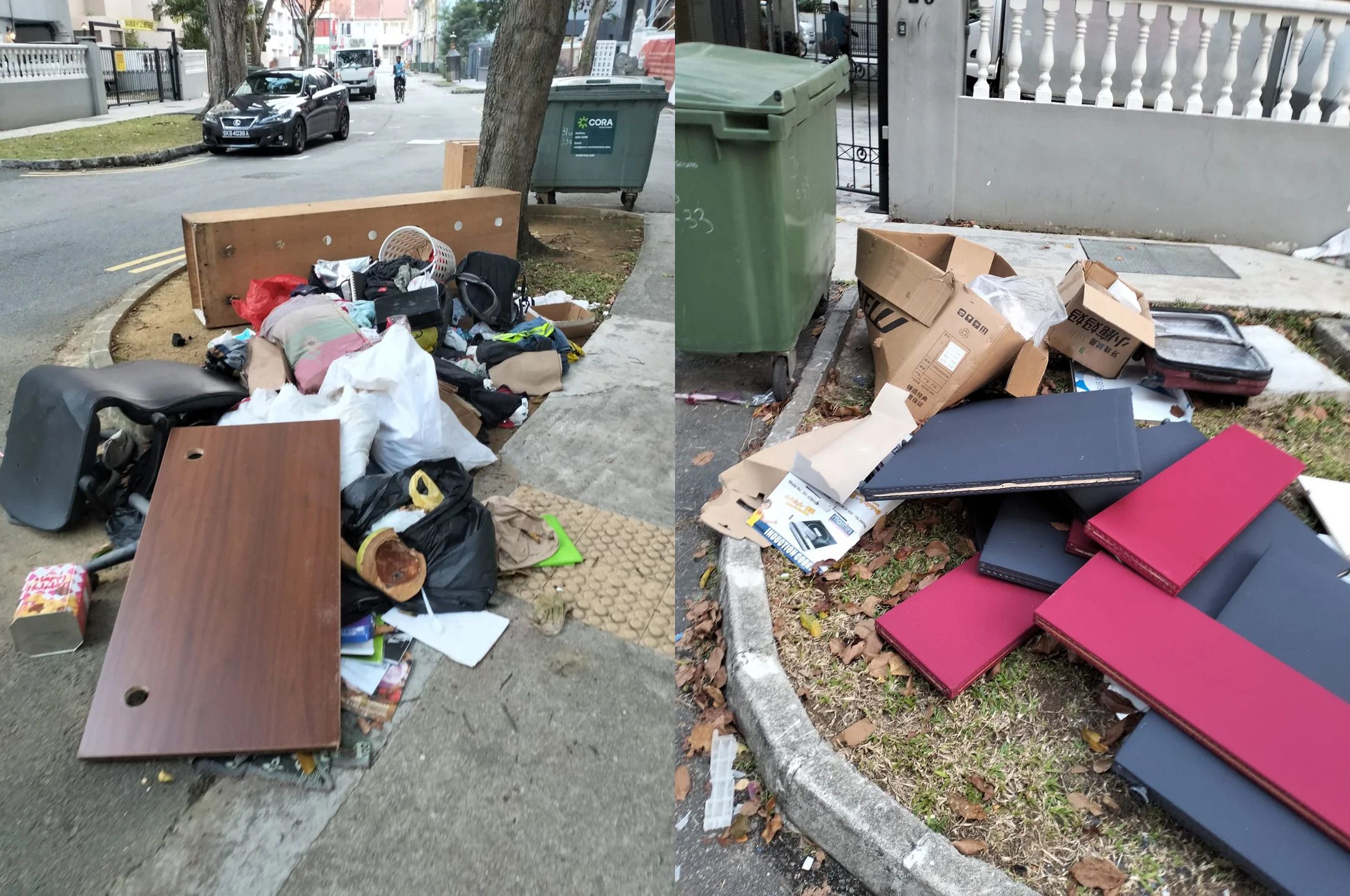
‘Clean Singapore no more’: Uncle shares concern of irresponsible rubbish dumping in Geylang not because of property prices dropping but of dengue and rats

SINGAPORE: “Clean Singapore? No more,” an uncle in his late 40s living in Geylang shared photos of rubbish dumping in his neighbourhood, saying he has grown tired of repeatedly reporting the issue, which he felt had worsened in recent years, especially after Covid.

“Every week, I need to report to the National Environment Agency (NEA) via the LifeSG app. I have reported so much that I am getting tired,” he lamented on r/SingaporeRaw.

He also pointed out that there are only two cleaners covering the neighbourhood, calling the workload too taxing as they have other areas to clean as well. He added that there are a few CCTVs there, which he assumed were mainly for traffic matters, and said he had tried reaching out to the authorities for help in identifying the culprits, but it did not lead to much.

In the comments, when asked whether his concern was linked to property prices dropping, he replied, “Uncle here more concerned with dengue and rats.”

Saying he is not so good with social media, he hoped others could help share his post, adding, “We need a clean home and not a rubbish dump.”

One commenter noted the same issue is happening “almost everywhere,” while another said, “The cleaners can’t keep up with the litterers.” A third added, “Singapore isn’t clean, it’s cleaned. And at the rate we take our cleaners for granted, we’d be drowning in our own trash and filth.”

Just last month, the same littering concern was raised by Housing and Development Board (HDB) block residents, after food scraps and diapers with excrement were thrown from high-rise buildings.

Still, another commenter shared that residents in their HDB block had been recycling more, but said the recycling bins were too small to fit a week’s worth of recycling, causing overflow.

Illegal dumping of waste is a serious offence. Residents who witness rubbish dumping can contact the NEA Call Centre at 1800-2255-632 to make a report by providing the date, time and location of dumping, vehicle registration number, and their name and contact information. /TISG

Read also: HDB resale prices dip after 7 years, netizens divided over what it means

This article (‘Clean Singapore no more’: Uncle shares concern of irresponsible rubbish dumping in Geylang not because of property prices dropping but of dengue and rats) first appeared on The Independent Singapore News.

  •  

SIA Group’s March passenger traffic rises amid Middle East disruptions

SINGAPORE: Singapore Airlines (SIA) Group’s passenger traffic rose 14.7% year-on-year (YoY) in March, outpacing its passenger capacity increase of 7.2%. The increase helped lift total passenger numbers to a record 42.4 million for the financial year 2025/26 (FY2025/26) ended March 31, 7.7% higher than the record 39.4 million in FY2024/25.

In a bourse filing on Wednesday (April 15), the group said that “The robust passenger traffic growth was supported by the increase in demand for air travel ahead of the Easter holiday in early April, as well as spillover Europe-bound traffic as capacity through Middle East air hubs was affected by the ongoing Middle East conflict.”

The group’s passenger load factor (PLF), the percentage of available seating capacity filled with passengers, was 90.6%. SIA posted a new monthly PLF record of 90.3%, while Scoot recorded a PLF of 91.7%.

Cargo loads also rose 2.4% YoY in March, against a 1.3% capacity decrease. The group said this was partly supported by “spillover volumes amid disruptions to Middle East airspace.”

Amid continued uncertainty in the Middle East conflict, the International Monetary Fund (IMF) has warned that the global economy faces a “close call” recession due to escalating energy and geopolitical risks.

Separately, with the current oil and ‌gas crisis, International Energy Agency (IEA) executive director Fatih Birol said he expects countries to turn to renewables very soon. /TISG

Read also: ‘I’m job hugging even harder’: Some Singaporeans share how they’re navigating rising costs amid the Middle East war

This article (SIA Group’s March passenger traffic rises amid Middle East disruptions) first appeared on The Independent Singapore News.

  •  

Young worker quits Singapore job at 27, leaves ‘predictable and unreachable’ life behind for Penang

SINGAPORE: Bunny Mook, a 27-year-old worker who just quit her job in Singapore last week, left the city-state not because she hated life here, but because it had become “very predictable and unreachable.”

On her Instagram @thesumobunny, she described her life in Singapore as a routine on repeat: revolving around working, eating, and hitting the gym.

“I could see exactly where my life was going… It scared me more than uncertainty ever could. Because I realised my life was on loop. And maybe in 30 years’ time, when I look back, I might really regret not doing more things when I was younger. So I’ve decided to leave,” she said.

In a separate video on her Instagram page, she shared that she returned home after quitting, describing her life in Penang as “messier with less structure but at the same time, so calm and comforting.”

Only then, she said, did she realise “how fast of a pace I was living in Singapore, till I actually slowed down to notice the little things.”

Some commenters online, including those who are also planning to leave the little red dot for a life elsewhere, wished her well. One said, “Best of luck, I understand how you are feeling & don’t want to not be in a life I dislike.”

However, others were not as supportive of her decision, with one saying, “To be honest, life in SG can be chaotic, unstable and risky as well. You really don’t have to leave SG to experience that.”

Another, who did the same when she was at her age, said, “I quit my job at 27 and realised I needed the job to make it to 28.”

Others, however, pointed to the financial realities behind such a choice, with one asking, “What will you do for money though? Hope it works out well”.

Another warned, “Wait till you don’t have enough money and can’t find a job, then you will appreciate the time when you have a stable job.”

Ms Mook’s experience comes at a time when workplace sentiment in Singapore is showing signs of strain.

Intellect’s latest Workplace Wellbeing 360 report found that workers in the city-state have become more resilient but disengaged, with a drop in their sense of purpose and optimism, which could be contributing to why some are reassessing their work and lifestyle choices. A separate survey found Singapore workers ‘quiet cracking’ from pressure, job uncertainty, and stalled professional growth.

Still, while some locals have seriously contemplated relocating overseas or splitting their time between Singapore and another neighbouring country for a slower pace of life outside the rat race, others refuse to leave the city-state because of its safe environment, higher salaries, family ties, or simply because they cannot afford to.

Meanwhile, some of those who have left end up thinking of coming back, not because they realised life here is better, but due to necessary reasons such as caring for ageing parents. /TISG

Read also: Singapore PR family moves to JB for 3x more space while saving 80% on rent

This article (Young worker quits Singapore job at 27, leaves ‘predictable and unreachable’ life behind for Penang) first appeared on The Independent Singapore News.

  •  

Netizens share why Singaporeans are not cut out for entrepreneurship despite Singapore universities producing top students

SINGAPORE: One would expect that a global business hub like Singapore would be sprouting entrepreneurs from top students of its globally-ranked universities. However, netizens are convinced that Singaporeans are just not cut out for entrepreneurship.

Discussion about why top students in Singapore rarely pursue entrepreneurship sparked online after Dr Tan Sian Wee, senior vice-president of Innovation and Enterprise at the National University of Singapore (NUS), told The Straits Times that while entrepreneurship is forged in uncertainty, risk-taking isn’t really practised in local universities.

Proposed new ventures are often met with a “we need to study this further” reflex, which delays momentum and dampens Singaporeans’ bold ideas.

“This wariness ties back to our ‘culture’ that favours certainty over experimentation, and caution over ambition,” he said.

Netizens echoed similar views, with one saying Singapore’s education system is not centred around taking risks, unlike entrepreneurship, which is a high-risk, high-reward career path.

One commenter wrote, “Singapore is good at producing technocrats. Excellent executors. But very little in the entrepreneurship mindset.”

Others pointed out that entrepreneurship often involves losing money first, given how expensive it is to do business in Singapore.

“Most are not privileged enough to have the funds to start a business or take risks. 99% of startup founders I have seen have the connections or financial means to start their startup and take risks,” another wrote 

However, a third added that most Singaporeans really just prefer stability, saying those who can or are willing to take risks have already left the little red dot.

Still, with many struggling to find jobs, some Singaporeans have recently been fuelled to start businesses, as it has seemed less risky than waiting for employment. /TISG

Read also: Warren Buffett says you can still be a great CEO even without attending college because he never looks at where a job candidate went to school

This article (Netizens share why Singaporeans are not cut out for entrepreneurship despite Singapore universities producing top students) first appeared on The Independent Singapore News.

  •  

‘I’m job hugging even harder’: Some Singaporeans share how they’re navigating rising costs amid the Middle East war

SINGAPORE: Singaporeans’ worries over job stability and rising costs have surfaced online amid the Middle East war, as countries scramble for oil and gas supply and contend with higher petrol prices.

On r/singaporefi, one Singaporean said, “I’m job hugging even harder”, with the majority sharing similar concerns over job stability.

One commenter said he was having a hard time sleeping, fearing for his job amid concerns over the economy.

“Would I get enough to pay for [our] mortgage? Would we still have electricity, given that SG imports everything? Food prices… will inflation hit and even cai png be out of reach to me?” he wrote.

Another said, “I cook for myself all the time. I can feel the food cost rising rapidly.”

Meanwhile, investors have become more cautious with global stocks wobbling amid the war. While the majority expect higher prices for almost everything in the short term, others were more positive.

One said, “I feel most of us in Singapore don’t have to lose sleep over this war but I have to admit that I do feel that my dollar has been smaller and I am hoarding more cash during this season for emotional and investment security. Other than that, we are very privileged to still go about our day-to-day life with little to no impact.”

“We’re actually more energy secure than Australia. Thailand and the Philippines are already rationing energy usage. We also have access to Malaysia if all else fails. I would say we’re good for 3-4 months from the point of total collapse of other nations,” another added.

Earlier this month, Prime Minister Lawrence Wong gave an update on the situation in the Middle East, saying, “The situation is highly uncertain, and we cannot predict how exactly events will unfold. But the risks are significant, and the worst may not yet be behind us.”

While he provided assurance that the city-state has plans, capabilities, and resilience to navigate economic pressures from the Middle East conflict, he also warned that the little red dot “cannot be insulated from such global upheavals – no country can, least of all a small island-nation like ours.”

Still, there is some relief from recent developments as the United States and Iran are on a two-week ceasefire, although uncertainty remains over whether it will hold. /TISG

Read also: Singapore braces for ‘hard times ahead’ as PM Wong warns of fallout from Iran war

This article (‘I’m job hugging even harder’: Some Singaporeans share how they’re navigating rising costs amid the Middle East war) first appeared on The Independent Singapore News.
  •  

Childcare job postings in Singapore see steepest decline in February as fertility rate hits record low

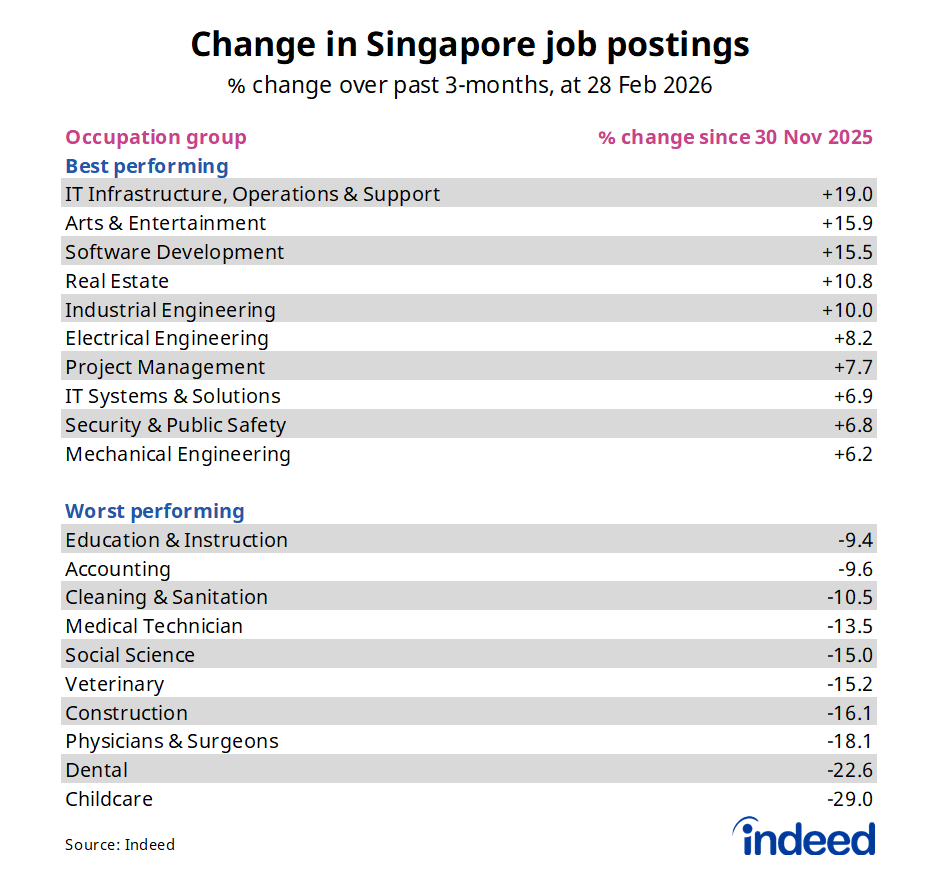
SINGAPORE: Job postings in Singapore fell 4.5% in February to their lowest level since March 2021, with childcare roles seeing the steepest decline at 29% among occupation groups, according to Indeed’s latest Singapore hiring lab report, which tracked percentage changes in job postings over the three months to Feb 28, 2026.

This comes as Singapore’s total fertility rate fell to a record low of 0.87 in 2025.

In an early March report by The Independent Singapore, a Singaporean mom shared four reasons why fewer Singaporeans may want more kids or choose not to have any at all.

She noted that it could be due to Singapore’s shrinking affordable home sizes, demanding work culture, rising education-related costs, and limited support for mothers who want to stay home to care for their children full-time, although the government recently announced that paid shared parental leave will be extended from six to 10 weeks starting this month, separate from the existing maternity and paternity leave.

In January, the global HR technology company expected job postings in the city-state to remain on a downward trend in the near term.

Aside from childcare roles, job postings also declined in dental (-23%) and civil physicians and surgeons (-18%), with education and healthcare among occupations where posting volumes have eased in recent months.

However, roles with high exposure to AI transformation, such as IT infrastructure and software development (+15%), recorded some of the strongest gains in job postings. Other occupations, including operations and support (+19%) and arts and entertainment (+16%), also saw notable increases.

Change in Singapore job postings on Indeed
Photo: Indeed

According to Indeed’s report, job postings in 92% of occupations are above their pre-pandemic baseline, and the job market remains “incredibly tight”, with the unemployment rate just 2% at the end of last year.

With the conflict in the Middle East triggering higher inflation and increased cautiousness from households and businesses, job opportunities are expected to “continue to moderate over the course of 2026.

“With the job market still tight and the economy growing strongly last year, Singapore is relatively well placed to absorb the impact of geopolitical uncertainty and a weaker global economy. Nevertheless, the economic outlook has certainly weakened in recent weeks,” the report added. /TISG

Read also: Singapore pulls in more investments but fewer jobs follow

This article (Childcare job postings in Singapore see steepest decline in February as fertility rate hits record low) first appeared on The Independent Singapore News.

  •  
❌