SINGAPORE: The perennial hot-button topic of Singapore’s high ministerial salaries returned to the fore this week, after Senior Minister Lee Hsien Loong said that the Government must work harder to keep Singapore exceptional.
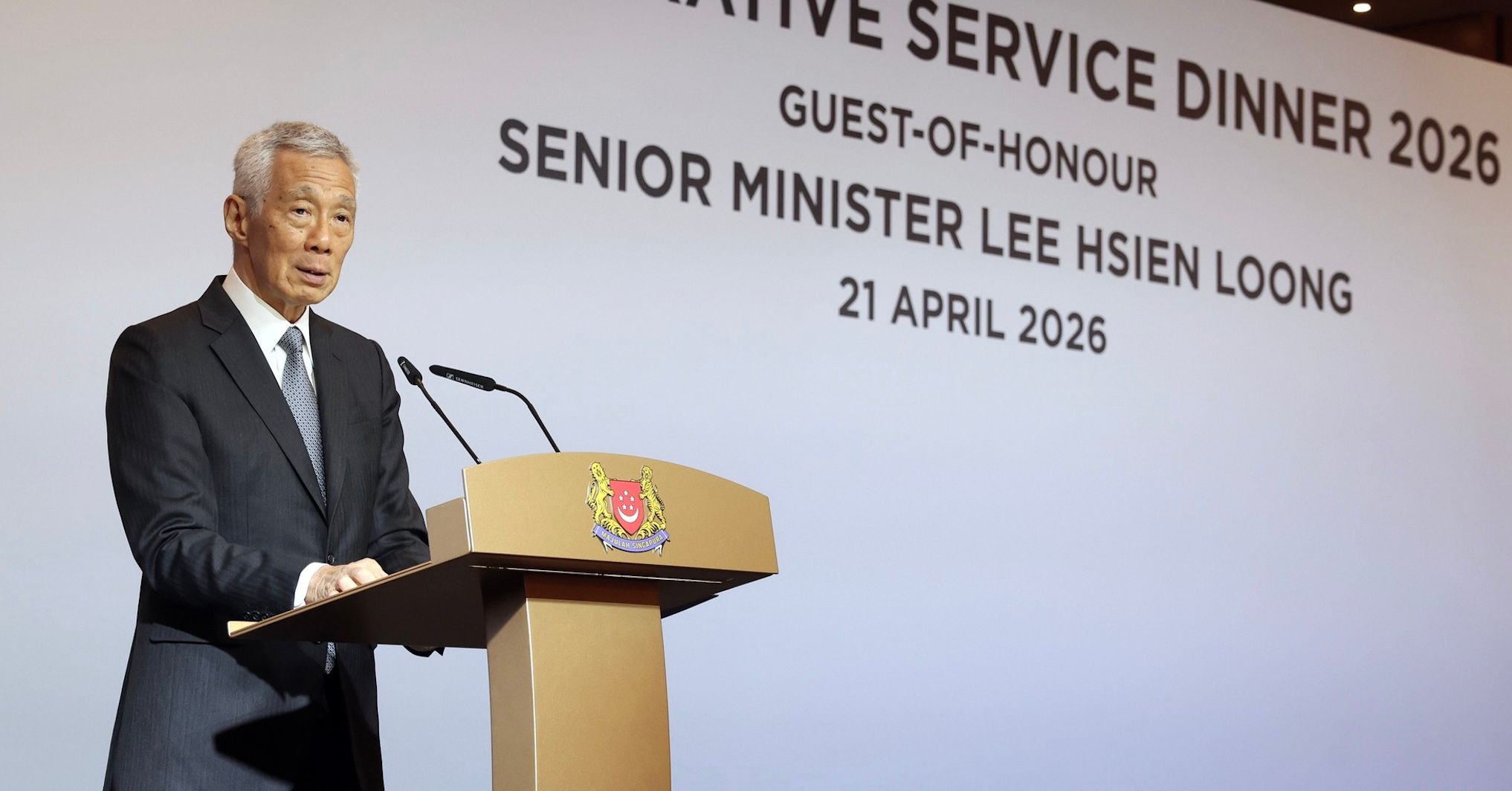
Speaking at the annual Administrative Service dinner on April 21 at the Marina Bay Sands Expo and Convention Centre, SM Lee told senior civil servants that the risk of Singapore’s “virtuous cycle” of effective governance and sound policymaking weakening has grown. This, he said, could make it more challenging to deliver continued prosperity and progress for the country.
He stressed that maintaining Singapore’s exceptional standing would require sustained effort from both political leaders and the public service. “We need to work much harder to keep it going,” he asserted.
Addressing top administrative officers, SM Lee emphasised that civil servants must go beyond simply carrying out decisions. He urged them to take ownership of the policymaking process by forming clear views, offering considered advice, and standing by their recommendations. Effective governance, he said, depends on a close partnership between ministers and officials, built on shared conviction and mutual trust.
His remarks come against the backdrop of a shifting global landscape. SM Lee noted that Singapore’s success over the past six decades was supported by a relatively stable, rules-based international order, with strong economic cooperation and expanding global markets, particularly with China’s rise. However, he cautioned that such conditions are unlikely to persist.
“I do not believe the next 60 years will be anything like the last 60,” he said, pointing to increasing geopolitical tensions and reduced collaboration between major powers. These changes, he added, could result in slower economic growth and reduced global prosperity, posing greater risks for small nations like Singapore.
SM Lee highlighted the importance of maintaining a high-quality public service, alongside capable political leadership, to navigate these challenges. While civil servants are expected to remain apolitical, he clarified that this does not mean being indifferent to policy outcomes. Instead, they should be deeply committed to ensuring the best possible decisions are made for the country.
He also cautioned against complacency, noting that even countries once regarded as models of good governance have seen public trust erode, with voters turning to populist leaders. Singapore, he said, must avoid such a trajectory by continuing to deliver competent governance and maintaining public confidence.
At the same time, SM Lee stressed the role of politics in enabling good policy. Sound ideas alone are insufficient if they lack public support. Governments must be able to persuade citizens, and voters must be willing to back leaders who pursue difficult but necessary policies.
Describing administrative officers as “generalists”, he said they must balance deep knowledge of their respective domains with a broader understanding of national priorities and trade-offs. While they should be well-versed in the rationale behind existing policies, he stressed that these should not be treated as unchangeable. Instead, policies must be regularly reviewed, updated, and, when necessary, reimagined.
Looking ahead, SM Lee called for Singapore to harness not just the capabilities of its leaders and civil service, but also the ideas and energy of its people. Strengthening social cohesion and trust among citizens, in leadership, and in national institutions will be critical in facing future challenges, he indicated.
Only by remaining united and adaptable, he said, can Singapore continue to make sound decisions and preserve its stability, security, and success in the years to come.
While the former PM’s speech was directed at officials, Singaporeans responding to his remarks have reignited the debate on ministerial salaries, asking what some of the world’s highest aid ministers are doing as Singapore navigates the tenuous geopolitical climate.
One netizen quipped on social media, “Big salary must work hard, that is normal,” while another commented, “Salary so high = work for it.”
Another commenter said, “Well, the nation pays you an above-market salary, and with a high salary comes great responsibility. Nothing is free. so of course you need to work harder during difficult times to prove your worth.”
Some felt the high ministerial pay packages have made some ministers “out of touch” with the concerns of ordinary Singaporeans, leading them to “talk down” to citizens. One commenter said, “Our government is polarised to talk down to citizens. And not wanting to listen to feedback from Singaporeans on jobs, [and] high cost of living. But when it comes to their salary, they can try to give all the reasons why they should be paid [more].”
Another commenter pointed out, “Small country of 6m and highest remunerations in the world!”
Ministerial pay has grown significantly since Singapore gained independence in 1965. In 1965, Singapore’s founding Prime Minister, the late Lee Kuan Yew, who was then known as the Chief Minister, reportedly earned a monthly fixed salary of $3,500. This means that he was paid $42,000 annually.
In 1973, the Prime Minister’s salary was bumped up to a monthly sum of $9,500 while other ministers started to earn $7,000, nearly double the $4,500 they used to earn, following a ministerial salary review.
$9,500 and $7,000 in 1973 roughly translate to $27,742 and $20,441, respectively, in 2016 when adjusted for inflation.
Justifying the salary increase in 1973, the elder Mr Lee said: “Too great a disparity between Ministerial rewards and what Ministers, with business experience and professional qualifications, could earn outside will make it increasingly difficult to assemble a successor government.”
Then, 20 years later, in 1994, the first framework for ministerial salaries came into play. The policy, which saw ministers being paid two-thirds of what the top four earners from six professions in the private sector earn, caused ministerial salaries to balloon. Mr Lee Kuan Yew explained then:
“Sir, my generation of political leaders has become dinosaurs, an extinct breed of men who went into politics because of the passion of their convictions.
“The problem now is a simple one: How to select younger leaders when the conditions that had motivated the Old Guards to sacrifice promising prospects of a good life for a political cause are no longer obtainable in a completely different social climate?
“This change in climate is inevitable with economic progress and a change in social values.Let me explain very simply, Mr Speaker, that MPs are real men and women, just like you and me, with real families who have real aspirations in life. So when we talk of all these high-falutin, noble, lofty causes, remember at the end of the day, very few people become priests.”
In 1996, two years after the White Paper on “Competitive Salaries for Competent and Honest Government” was released, Lee added: “People accept the principle of pegging Ministers’ salaries to the top men in the private sector, but to many people the top salaries are too large.”
Ten years after the ministerial salary framework was released, Lee Hsien Loong took over the reins of the nation from his father’s successor, now-Emeritus Senior Minister Goh Chok Tong. In 2007, Lee Hsien Loong’s annual salary climbed to a whopping $3,090,000 under this framework.
And then, the unthinkable happened. In 2011, the ruling party lost a Group Representation Constituency (GRC) to the opposition and public support for the People’s Action Party (PAP) slipped.
In 2012, for possibly the first time ever, Singapore’s ministers took a pay cut. An independent committee reviewed the ministerial salary scheme and recommended the following salary cuts:
-
President’s annual salary to be slashed by 51 per cent to $1.54 million;
-
Prime Minister’s annual salary to be cut by 36 per cent to $2.2 million, along with the removal of pension;
-
Full minister’s (MR4 level) annual salary to be reduced by 37 per cent to $1.1 million, along with the removal of pension;
-
Prime Minister’s salary to be pegged to double the MR4 salary;
-
MP’s annual allowance to be cut by 3 per cent to $192,500; and
-
The entry MR4 minister’s salary to be benchmarked to the median income of the top 1,000 earners who are Singapore citizens, with a 40 per cent discount.
The Government accepted the committee’s proposal. Prime Minister Lee Hsien Loong’s annual salary was slashed to $2.2 million, where it has remained for the last six years.
In 2017, a committee formed by PM Lee to review ministerial salaries recommended that political salaries be adjusted to reflect “annual benchmark movements,” given a 9 per cent rise in benchmark salaries.
Ministerial salaries have not gone up since then
Deputy Prime Minister Teo Chee Hean said then that ministerial pay will remain the same and will be reviewed again in five years: “… since the scheme remains valid and the economy is still in transition, we will not change anything now and will maintain the current salary structure and level. We will review the matter again after five years or when it becomes necessary.”
This year, the Government convened an independent committee to review the salary framework and recommend appropriate salaries and refinements.
Coordinating Minister for Public Services and Minister-in-charge of the Public Service Chan Chun Sing said in February that the norm annual salary for an entry-level minister has remained at S$1.1 million, from 2012 to now.
Ministerial pay is structured with fixed components — comprising monthly salary and a 13th-month non-pensionable annual allowance — accounting for 65 per cent of total annual pay. The remaining 35 per cent is variable and linked to both national economic performance and individual performance.
The national bonus component is tied to four indicators: real median income growth, income growth at the 20th percentile, the unemployment rate and real gross domestic product growth. No bonus is paid if targets are not met, while meeting targets results in up to three months’ bonus, rising to as much as six months if targets are significantly exceeded.
Political officeholders also receive an annual variable component in line with civil servants, which ranged from zero to one-and-a-half months between 2018 and 2024. In addition, individual performance bonuses, determined by the prime minister, can range from zero to six months each year.
It is unclear when the ongoing salary review will conclude.
This article (Debate on high ministerial salaries resurfaces as SM Lee says Govt must work harder to keep Singapore exceptional) first appeared on The Independent Singapore News.

 Login
Login