
Reading view

OMG: Singapore now offers Malaysian doctors S$110K salary, even before their graduation

SINGAPORE/MALAYSIA: A healthcare Instagram post is drawing attention to how early Singapore is now moving to secure Malaysian medical talent.

In a post published on April 18, the healthcare media platform One Milligram (OMG) Digital Health @omg_digital_health claimed that recruiters linked to Singapore hospitals are already approaching Malaysian medical students even before their final MBBS exams, offering salaries of around S$110,000 a year, along with permanent employment and pension benefits.

The claims were based on an earlier New Straits Times report published on March 29, headlined, “Brain drain worsens as trainee doctors turn to Singapore.”

Recruitment starts even before medical student graduation

According to the Facebook page, recruitment agents have reportedly been targeting students from Universiti Malaya, Universiti Kebangsaan Malaysia, and Universiti Sains Malaysia (USM), with graduates signing Singapore employment contracts almost immediately after finishing medical school.

The page also pointed to Singapore’s recent recognition of USM graduates through the Singapore Medical Council, saying the move expanded the eligible Malaysian talent pool by an estimated 30% to 40%.

Malaysia’s healthcare brain drain worsens as trainee doctors turn to Singapore

The New Straits Times reported that only 529 out of 5,000 housemanship placements offered by Malaysia’s Health Ministry in January 2026 were filled. The newspaper cited a research note by MBSB Research, which described the situation as a worsening brain drain within Malaysia’s healthcare sector.

Salary differences appear to be a major factor, as the report said Singapore’s starting pay for doctors can reach about S$110,000 (RM385,000) annually, roughly five to six times higher than Malaysia’s entry-level public healthcare offers.

Singapore also offers permanent employment pathways and pension benefits, while many Malaysian junior doctors still face contract-based appointments and uncertainty over long-term career progression.

Healthcare workers want stability, not just salary

Online reactions to the Facebook post expressed a mix of frustration and resignation. Some commenters argued that it’s no longer so straightforward for Malaysia to retain healthcare workers, especially when neighbouring countries are offering more attractive pay packages and career structures.

Others said the matter involved burnout, long working hours and uncertainty over permanent placements, alongside concerns about salary.

For Singaporeans, the news also shows how regional healthcare competition is intensifying as countries race to secure doctors, nurses and specialists amid ageing populations and rising healthcare demand.

Retention issue vs pipeline issue

Malaysia’s Health Ministry is reportedly working on reforms expected by the end of 2026, including plans to end the contract doctor system and restore permanent appointments for new graduates, according to the New Straits Times report.

Still, the deeper concern remains difficult to ignore. Once medical graduates begin planning their careers overseas before even entering the local healthcare system, the problem ceases to be a retention issue and becomes a pipeline issue, an early loss of future talent.

This article (OMG: Singapore now offers Malaysian doctors S$110K salary, even before their graduation) first appeared on The Independent Singapore News.


  •  

Know Singapore’s senior-friendly zones, with significant upgrades to facilities

SINGAPORE: The Housing and Development Board (HDB) has recently named Bedok, Bukit Panjang, and Tiong Bahru as ‘senior citizen zones’, in which the government will invest in upgrading public facilities to better suit the needs of over 110,000 elderly residents. 

The government’s choice of sites is very clear—these locations are already established towns with great convenience, and further investments to these areas will make things even better. 

Bedok is known to be a town in the east with a major transport hub and commercial center. Significantly, it is next to Changi General Hospital, making healthcare easy to reach and readily available for senior citizens. 

Tiong Bahru is a traditional and cultural area with high land prices. In this location, the government wants to establish top-notch facilities to create a model for aging at home. 

Furthermore, Bukit Panjang is a location in western Singapore near Jurong East, with great green spaces and easy access to major hospitals as well. 

What are the upgrades? 

As reported by Yan.sg, the HDB’s “Neighbourhood Renewal Scheme” allots S$6,600 renovation budget for each beneficiary household. More so, key changes included in this program will have health gardens and rehab centres right in the neighbourhood, so seniors can manage long-term illnesses and therapy without hospital queues, covered walkways with benches from HDB blocks to bus stops and shops, keeping elders dry and safe from slipping, and fun fitness and social events just for seniors to fight loneliness when living alone.

Overall, this initiative claims that senior zones will feel like having a full community with hospital and care systems within reach. 

This is a game-changer for families living with elders because as time passes by, responsibilities change. With these senior citizen zones, it allows seniors to handle most needs alone, easing family stress, all within a familiar environment and community. 

Indeed, these senior citizen zones hope to provide a brighter future for Singapore’s ageing population and their families. These locations aim to bring convenience, care, and community in one place. These upgrades can set a new standard of living, easing family burdens while also boosting property sales in the long run.

This article (Know Singapore’s senior-friendly zones, with significant upgrades to facilities) first appeared on The Independent Singapore News.

  •  

Opposition politician slams system that forces elderly Singaporeans to ‘work till they drop’

SINGAPORE: Concerns over the treatment of low-income seniors in Singapore have resurfaced after an elderly amputee was killed while he was out collecting recyclables.

Red Dot United (RDU) member Harish Mohanadas shone a spotlight on the case as he criticised what he described as a system that forces vulnerable elderly Singaporeans to continue working despite serious health issues and financial hardship.

In a Facebook post, Mr Mohanadas said he, Emily Woo, and the RDU West team had spent time speaking to residents living in rental units in Holland–Bukit Timah GRC. He said many of the residents they met were elderly Singaporeans coping with health problems and limited income.

Among the stories shared during the visit, Mr Mohanadas said one in particular left a deep impression on him, that of a 68-year-old taxi driver who is bankrupt and still struggling to work despite chronic pain following spine surgery.

According to Mr Mohanadas, the man underwent surgery about a year ago but was unable to rest long enough to recover properly because he needed to return to work. He said the resident continues to drive part-time despite ongoing pain from sitting for extended periods, and wears a bandage on his lower back that offers little relief.

Mr Mohanadas added that the man told him he needed to continue working in order to pay taxi rental fees as well as rent for his HDB flat. He said the resident’s HDB rent had recently increased from $59 to $99, and the man feared it could rise further to $165 if his income increased slightly.

“I did not understand this. Really, I don’t,” Mr Mohanadas wrote, “What kind of a system expects a 68-year-old man to work till he drops?”

The opposition politician linked the taxi driver’s situation to the recent death of a 69-year-old amputee near Blk 647B Senja Close. The elderly man had reportedly died after being struck by a garbage truck while collecting recyclables near a rubbish collection point.

Referring to reports that the man was often seen collecting cans and bottles in the area while moving around in a wheelchair after losing his right leg, Mr Mohanadas questioned whether poverty was the deeper cause behind the tragedy.

“When I read that news, I remember thinking: was it the garbage truck that killed him, or was it poverty?” he wrote.

“Poverty that meant he had to work, and work collecting rubbish, at the age of almost 70. Don’t tell me he was collecting recyclables ‘just to exercise’.”

He was referring to a controversial comment former ruling party politician Tan Chuan-Jin had made in 2015, when he implied that some senior citizens who collect cardboard do it as a form of exercise.

Mr Mohanadas argued that many elderly Singaporeans from older generations had spent their lives working during periods when wages were lower and social support schemes were less extensive than they are today.

“These are not people who coasted,” he wrote, They are the generation that worked when wages were low, CPF was thin, and there was no Workfare or Progressive Wage to top up their incomes.”

He added that while Singapore today has the cost structure of a wealthy country, support systems for low-income seniors remain inadequate.

“Food, utilities, medical bills, and basic necessities are priced like a rich country,” he said, “Their protection is still designed like we are a poorer one.”

Mr Mohanadas also used the post to highlight proposals from Red Dot United’s Shadow Budget 2026. He said the party had proposed monthly payouts of at least $500 for the poorest 30 per cent of seniors, and $700 for seniors above the age of 80 living in small flats with little CPF savings remaining.

He argued that stronger support would allow elderly Singaporeans to continue working only if they genuinely wished to do so, rather than out of necessity.

“That way, they could work if they wanted to – really to exercise, or to pass time – but not because the system requires them to break their bodies as a sacrifice to keep the wheels churning,” he wrote.

Netizens responding to his post agreed with the need for greater support for struggling seniors. One commenter said, “Yeah its a sad state of affairs when so many of such cases fly under the radar or rather off the radar of our government. The policies and plans we have in place definitely lack the compassion and humanity required to serve those truly in need.”

He also suggested that the Government consider lifting up those in dire straits with more payouts instead of launching schemes like the CDC voucher scheme to ensure that no Singaporean is left behind.

Another commenter quipped, “Those who have not experienced poverty can never imagine the plight of the poor.”

This article (Opposition politician slams system that forces elderly Singaporeans to ‘work till they drop’) first appeared on The Independent Singapore News.

  •  

Garbage bin caught fire at Punggol HDB Block caused by people smoking, sparking residents’ safety

SINGAPORE: A disturbing incident happened at a HDB block in Punggol when a recycling bin caught fire, prompting the Singapore Civil Defence Force to take action. 

As reported by Shin Min Daily News, a 37-year-old resident claimed that when he passed by the area at 8:20 in the morning last May 8, he saw several fire trucks and firefighters extinguishing the blaze. According to investigations, the fire started at approximately 7:55 in the morning. 

Fortunately, there were no other items near the recycling bin that might have caused the blaze to spread. 

What caused the accident? 

The resident revealed that the accident was allegedly caused by the people who were smoking nearby, or those who decided to throw their cigarette butts into the recycling bins. As seen in the photos shared by the resident, the blue recycling bin truly melted, and the contents of the bin were burned black. 

The authorities admitted that they had received the report and that members of the public were brave enough to assist in extinguishing the fire. Thankfully, no one was injured in the accident, and the true cause of the blaze is still under investigation. 

Other related news 

In similar news related to fire accidents in Singapore, there was a recent report where a 32-year-old Malaysian man pleaded guilty to arson after setting fire to a debtor’s home for a promised payment of S$2,500.

This incident had put a family of seven at risk, in an HDB unit occupied by a 41-year-old man, his wife, their two children aged nine and three, his parents, and his sister.

Read more about the news story here

This article (Garbage bin caught fire at Punggol HDB Block caused by people smoking, sparking residents’ safety) first appeared on The Independent Singapore News.
  •  

‘What are we teaching our children?’: Prominent wildlife activist decries death of Sentosa crocodile

SINGAPORE: Prominent wildlife photographer and conservation activist Michael Aw has condemned the National Parks Board’s (NParks) decision to euthanise the crocodile spotted in the waters off Sentosa, joining a growing wave of criticism directed at the statutory board over the handling of the case.

The reptile, estimated to be about two metres long, was captured and euthanised on May 6. NParks said the move was made due to public safety concerns and the lack of suitable relocation options.

The decision sparked widespread backlash online, with many social media users arguing that the crocodile had not harmed anyone and should not have been put down. Mr Aw echoed those sentiments in a strongly worded Facebook post, where he described the animal as having been “wrongly killed.”

“Just because it entered the waters off Sentosa Cove, Singapore, it was captured, then killed. Not because it attacked anyone. Not because it hunted a child. Not because there was no alternative. It was euthanised so humans could return to the beach,” he wrote.

Mr Aw questioned humanity’s treatment of wildlife, adding, “And we call ourselves the most intelligent species on Earth. What gives humanity the right to decide which life deserves to exist and which does not? Why do we constantly insist we are superior to every other species that shares this planet with us?”

“This crocodile was not a criminal. IT WAS LOST. Where is our compassion? Shall we go around killing lost species of our own?” he added.

The veteran wildlife photographer argued that more should have been done to explore alternatives before the crocodile was euthanised.

“Surely in a nation as advanced as Singapore, relocation possibilities should have been exhausted before execution became the solution. Why were sanctuaries not explored more transparently?” he wrote.

Mr Aw is a well-known figure in wildlife and underwater photography circles, with a career spanning decades. His work has received more than 60 international awards and has been featured in publications including BBC Wildlife, National Geographic, Smithsonian, GEO, Ocean GEOGRAPHIC, Asian Geographic, Action Asia, and Nature Focus.

In 2010, he received the WYLAND ICON award for Conservation, while his documentary “Philippines – Heart of the Ocean” won the Palme d’Or at the World Underwater Pictures Festival in France in 2009. He is also the founder of Ocean Geographic.

Drawing on his own experiences interacting with crocodiles overseas, Mr Aw said coexistence with apex predators is possible when they are handled responsibly.

“As the founder of Ocean Geographic, I, together with many members of our community, have in recent years travelled to Cuba and Mexico to responsibly interact with Saltwater crocodiles in their natural habitat. With due diligence, experienced guides and respect for wildlife, we have never experienced life-threatening encounters,” he said.

He added, “Around the world, people are learning how to coexist with apex predators. Yet here, a lost crocodile was sentenced to death simply because its existence disrupted human comfort.”

“WHAT MESSAGE ARE WE TEACHING OUR CHILDREN? That’s when wildlife becomes inconvenient; we kill it? Do apex species only deserve protection when they stay invisible and far away from us?” he asked.

Mr Aw said the incident reflected a troubling attitude towards wildlife and conservation.

“As someone who has spent a lifetime documenting endangered species and witnessing humanity’s relentless expansion into the last wild places, I find this deeply disturbing. Not only for the crocodile — but for what it says about us,” he wrote.

He also called for greater accountability over the decision-making process, saying, “A public inquiry should be conducted into how this decision was reached and whether every possible non-lethal option was genuinely explored. Accountability matters. Compassion matters. Ethics matter.”

In a statement issued on May 7, NParks group director of wildlife management, How Choon Beng, explained why relocation was not pursued.

Mr How said Sungei Buloh Wetland Reserve, which currently has a crocodile population of around 20 animals, was not considered a suitable release site for the reptile. He noted that NParks had previously relocated a smaller crocodile there in 2021.

He added that relocating saltwater crocodiles carries the risk of the animal returning to the area where it was first captured, potentially creating further danger to the public.

NParks also said it had approached Mandai Wildlife Group about taking the crocodile into its care, but the organisation was unable to accommodate the animal.

In a separate statement on May 7, Mandai Wildlife Group said decisions on whether to accept animals are made based on whether it can provide suitable welfare standards and quality of life.

The organisation said it also has to consider the impact on its existing animal population and conservation commitments.

“After careful assessment, we determined that we were not in a position to provide a placement that would meet these standards for this animal,” a spokesperson said.

“This is a difficult situation, and this was not a decision we made lightly,” the spokesperson added.

This article (‘What are we teaching our children?’: Prominent wildlife activist decries death of Sentosa crocodile) first appeared on The Independent Singapore News.

  •  

Indian company Nybula says CECA deal has ‘become a slur’ in Singapore as it decries ‘racism against Indians’

SINGAPORE: An Indian company has publicised what it calls “racism against Indians,” accusing a number of countries, including Singapore, of harbouring xenophobic sentiments against Indians.

The company, Nybula (pronounced “nebula”), positions itself as an “Indian technology company” and as a digital marketplace connecting individuals with work and study opportunities abroad. Nbyula says it aims to “enable and empower ‘Skillizens without Borders’“ and offers packages to prospective clients who wish to be mentored on the process of applying to jobs and academic programs around the globe.

Last month, Nybula published a controversial post on Instagram, decrying a petition that was signed by 40,000 Taiwanese people who want to keep Indians out of their country.

As Nybula characterised it, “Taiwan has a labour crisis. Their population is ageing fast, and birth rates have collapsed, leaving factories without enough workers to function. So in February 2024, Taiwan signed a deal with India to bring in just 1,000 Indian workers. A pilot programme to test the deal before scaling.

“Then, in April 2026, 40,000+ Taiwanese signed a petition demanding the government cancel the deal. The petition cited fears of sexual violence by Indian men, using selected Indian crime statistics to fearmonger.”

The company said, “Taiwan literally needs us. Their citizens still don’t want us.”

Claiming that Taiwan is not alone in harbouring this sentiment, the company added, “And this is not just Taiwan. In Singapore, BBC found over 140 rental listings that explicitly said ‘no Indians.’ The CECA trade deal turned into a slur.”

It also spoke about discrimination against Indians in Japan and South Korea, as well as hate crimes against Indians in the UK, US, and Canada. The company said, “The West has loud racism. When mobs riot, the PM goes on TV calling it ‘thuggery.’ The press covers every attack, and charges get filed against the rioters.

“The East has quiet racism. No riots, no headlines. Just a bouncer telling you ‘no Indians’ at a club in Busan or a landlord in Tokyo rejecting your application without giving a reason. There’s no anti-discrimination law to invoke and no press to escalate to.”

Positioning the West as a “safer” place to migrate to, Nybula asserted, “The loud version of racism gives you something to fight. The quiet version just wears you down.

“What you should actually ask about a country (is) not “is it safe?” Every country has crime stats, and they all look fine on paper. Ask, if I get rejected, can I do something about it?’ In the West, you usually can. There are laws that protect you and media that covers you when something goes wrong. In Asia, you mostly can’t.”

The company then promoted its services to help Indians get matched to destinations that are “safe.” It claimed, “…we’ll help you figure out which country fits your career goals and your budget, and which ones are safe enough that you won’t spend the next 10 years feeling like you don’t belong.

“A bad country choice will cost you 5 years of your life and a loan you can’t pay off. The right one will pay you back for the rest of your life.”

While some netizens agreed with the characterisations the company made of Eastern nations, others had mixed opinions. One commenter said, “If more than one culture is doing it, maybe you need to address the behaviour instead of saying it’s racism.”

Another commenter, referring to the point about Singapore, asked, “How many non-vegetarians, Dalits, Muslims have been denied a house for rent? The reasons are similar. First, have we been able to fix these issues in India?”

A number of individuals also questioned whether more can be done to stop these negative impressions from taking root in the first place. One commenter opined, “It’s actually shameful for us as Indians. In the past decades, if we look, several Indians visited countries but misbehaved and did not show any civic sense…as Indians, why not we behave properly when we visit any other country?

“When we visit our relatives’ home, we don’t misbehave or spread mess, so why we forget when we visit a foreign country? More importantly, we need to make our country better, cleaner & systematic,” they added.

This article (Indian company Nybula says CECA deal has ‘become a slur’ in Singapore as it decries ‘racism against Indians’) first appeared on The Independent Singapore News.

  •  

7 in 10 Southeast Asia unaware of how much energy AI uses

SINGAPORE: A recent survey conducted by Milieu Insight has shown that most Southeast Asians don’t know how much energy is used up by Artificial Intelligence (AI).

An April 2026 study from Milieu of respondents across Singapore, Malaysia, and Thailand showed that 7 in 10 are unaware of the amount of energy AI really uses. The study also showed that less than a third (29%) correctly know that an AI chatbot uses 10 times more energy than a Google search, with 35% thinking they use about the same.

While a hyperscale data centre uses more than five Olympic swimming pools of water every single day, more than half of the respondents (51%) underestimated this. In Singapore, which had the highest number of participants who knew how much water data centres need, only 51% were aware of this.

Singapore also had the highest trust in government (19%) to act on sustainability, while in Malaysia and Thailand, 12% and 7% respectively say they are “very confident” on the issue.

A majority across the three countries (68%) say that individuals and companies must act to tackle environmental issues, and two in five say they want more accessible green choices for everyday choices, such as affordable eco-friendly products, better public transport, recycling and waste infrastructure that’s easy to use, sustainable food options that are widely available, and energy-efficient products and solutions.

Why is AI so energy-intensive?

A lot of energy goes into operating AI systems as it requires massive computational power to run, train, and maintain. Many systems demand thousands of specialised processors that run continuously in data centres, and generative AI tasks are particularly heavy.

In addition, carbon emissions from power generation, water use for cooling servers, hardware manufacturing and e-waste, and the rapid growth in demand should also be taken into account.

According to one Penn State study, 4.4% of US electricity was consumed by data centres in 2023. By 2028, this figure could triple. This should be a cause for concern, especially since the data centres primarily operate on fossil fuels. 

Many scientists have become increasingly concerned, especially climate scientists, sustainability researchers, and energy experts, and there have been calls for monitoring, regulation, transparency, and efficiency improvements.

What individuals can do

While most of the monitoring of AI usage will be done at the government level, individuals who are concerned about the toll AI takes on the planet could practice intentional usage, in the sense of not generating unnecessarily large images or long videos.

People can also urge companies and governments to disclose information about energy and water use, emissions, and the sourcing of electricity, which helps with transparency and accountability. /TISG

Read also: Concerns over Artificial Intelligence in recruitment grow among HR professionals in Singapore

This article (7 in 10 Southeast Asia unaware of how much energy AI uses) first appeared on The Independent Singapore News.

  •  

4 Southeast Asian countries are friendliest to expats, but Singapore isn’t one of them

SINGAPORE: While Singapore is in the top expat destinations when it comes to quality of life, it is not in the overall top 15, ranking 32nd out of the 46 countries on InterNations’ Expat Insider 2025 report.

Moreover, while four Southeast Asian countries are on the top 10 friendliest list, Singapore is not. Indonesia took pole position for ease of finding friends, while the Philippines ranked fourth, Thailand, eighth, and Vietnam, 10th. Singapore was 34th on the list.

Singapore, however, ranked well in other categories, placing fourth in travel and transit, and 10th in security. It also ranked 14th in terms of salary and job security, seventh in language, and ninth in digital life. 

The city-state was low on the list for work and leisure (44th), personal finance (41st), and work culture and satisfaction (36th).

As can be guessed, the cost of living is the biggest reason why expats in Singapore are unhappy. The study’s participants rated countries based on three factors: general cost of living, satisfaction with their financial situation, and whether their disposable household income is enough to lead a comfortable life.

Vietnam has emerged as number one in this category for five years in a row. In 2025, 89% of the respondents expressed satisfaction with the general cost of living, and 87% said their disposable household income was enough or more than enough to live a comfortable life. In contrast, the global average is at 40% and 69%, respectively.

Singapore, meanwhile, has been in the bottom 10 for personal finance for the past three years and has also been in last place (46th) for cost of living for three years in a row.

Affordable housing, in particular, is a recurrent issue for expats in Singapore. 

Additionally, the report says that the share of expats in the city-state who have said it’s easy to get a visa for Singapore has decreased by 10 points over the past year, dropping from 59% in 2024 to 49% in 2025.

A quarter of expats in Singapore said they were sent by their employer to the city-state, while 22% said they had found a job there, and 17% said they had been recruited internationally.

When asked if they are planning on leaving, 38% said they did not know yet, while 21% said they would within the next five years, and 14% said they wanted to stay in Singapore forever. As for a breakdown by industry, 15% said they work in finance, 12% say they work in information technology, and 8% work in manufacturing and engineering. /TISG

Read also: ‘Great opportunities, but…’: French expat flags rent as biggest hurdle in Singapore

This article (4 Southeast Asian countries are friendliest to expats, but Singapore isn’t one of them) first appeared on The Independent Singapore News.
  •  

He Ting Ru: Open economies like Singapore, Hong Kong, Switzerland easily exploitable by criminals

SINGAPORE: Workers’ Party Member of Parliament (WP MP) He Ting Ru (Sengkang) shared in a recent Facebook post that she had attended the International Monetary Fund (IMF) and World Bank 2026 Spring Meetings in Washington DC, which took place from April 13 to 18.

Ms He spoke at a Global Parliamentary Forum, discussing the issues surrounding anti-corruption, good governance, and cross-border financial crime.

“Our panel covered the importance of strong laws and stringent enforcement in combating corruption and cross-border financial crimes in this rapidly moving issue area. Transnational scams are a key part of this landscape,” wrote Ms He, who is a lawyer by profession.

Also on the panel were Rody Senderowitsch, Practice Manager for Public Administration at the World Bank Group’s Governance Global Department, and Chady Adel El Khoury, Assistant General Counsel of the IMF’s Financial Integrity Group. It was moderated by Javier Maroto, the First Vice-President of the Spanish Senate.

Ms He wrote that she had shared her views on the challenges of fighting cross-border crime, especially with the speed with which technologies such as AI evolve, as well as how the authorities in different countries have to work together to expand information-sharing, as cross-border crime has gone beyond tracing funds. Today, authorities need to understand how criminals use such assets as cryptocurrency, real estate, precious metals, and luxury items. 

She added that Intermediaries, including lawyers, accountants, and realtors, should also be held accountable and given support in crime-fighting.

“For highly open economies with large financial and wealth management sectors, such as the UAE, Singapore, Hong Kong, and Switzerland, the very structure of our economies makes us easily exploitable by criminals. Failure to address these issues effectively harms our people and can eventually lead to serious reputational damage,” wrote the MP.

Ms He also wrote that she had posed a question to IMF Managing Director Kristalina Georgieva about AI adoption and her views on the longer-term potential and risks associated with AI during a Town Hall session.

She specifically wanted to know how the technology can be used to boost productivity without diminishing entry-level jobs and widening inequality, specifically for vulnerable groups and women, as well as Dr Georgieva’s perspective on whether reskilling workers, updating labour regulations, or regulating AI deployment mattered more.

“Dr Georgieva pointed out that Singapore was ranked top in our holistic approach to AI and that we were a case study with much to offer. She, however, noted that the world has now reached the stage where it is ‘AI or die’; that the speed of transformation is unparalleled. Current projections understand the overall trajectory of AI on GDP and job growth as positive, but we must continue to look to ways in which AI can be harnessed safely and meaningfully,” wrote Ms He. /TISG

Read also: WP MP He Ting Ru shares what Sengkang is doing to cope with Singapore’s heat

This article (He Ting Ru: Open economies like Singapore, Hong Kong, Switzerland easily exploitable by criminals) first appeared on The Independent Singapore News.

  •  

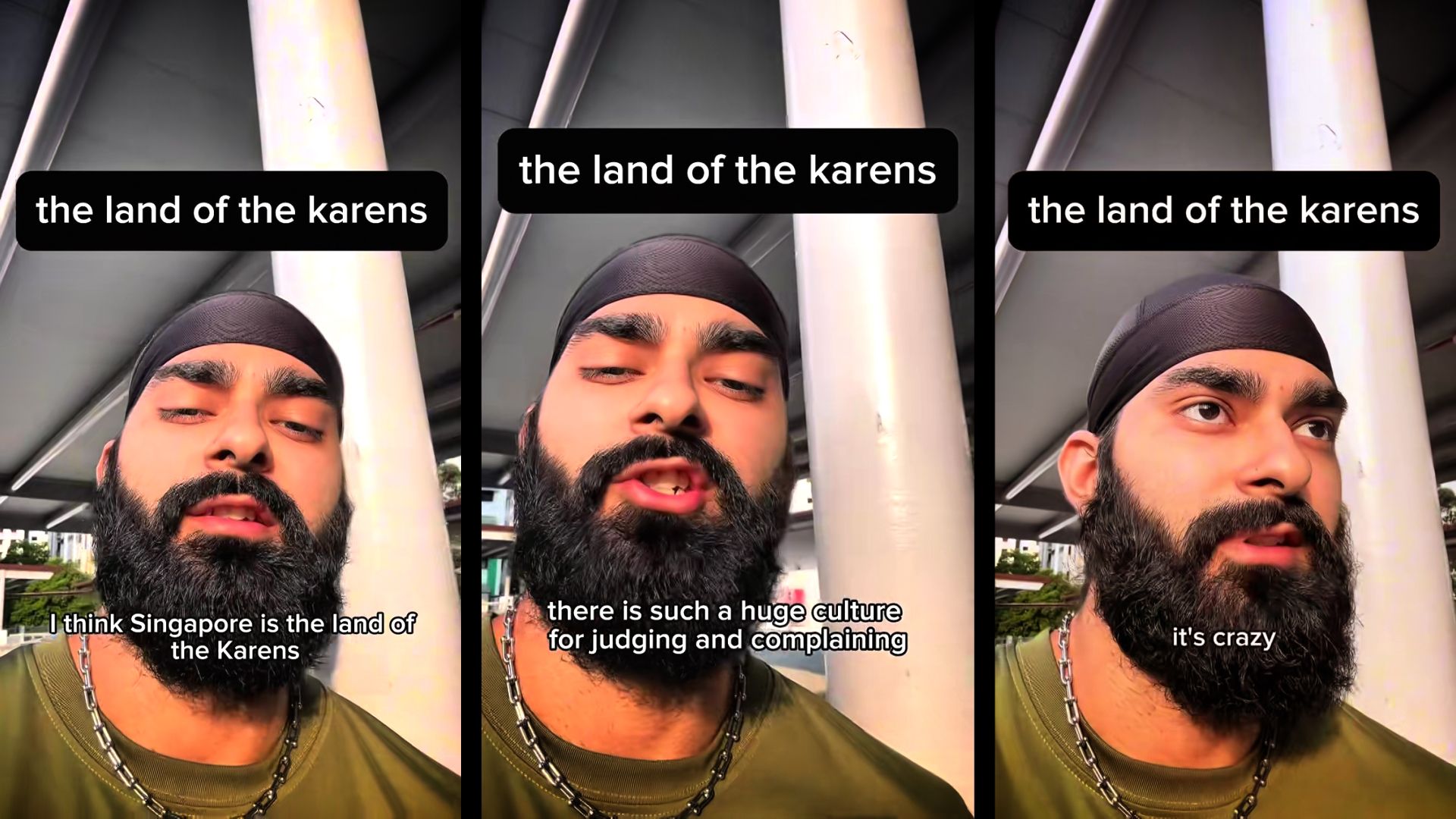
‘I think Singapore is the land of the Karens’ — Man says, ‘There’s such a huge culture of judging and complaining’

SINGAPORE: A TikTok video rant by a man about Singaporeans complaining and conforming to local social norms without much thought ignited hundreds of reactions, with many also arguing that resorting to criticism is partly why the country functions well.

The TikTok video calling Singapore “The land of the Karens” has fired up an online debate after the man claimed there is “such a huge culture of judging and complaining” in the country. The clip, posted on April 1 by TikTok creator @gavs.rana, has drawn nearly 25,000 views and over 200 comments on Reddit and TikTok combined, with discussions about whether Singaporeans are indeed overly critical, overly conformist, or simply practical.

In his own words, the man said, “I think Singapore is the land of the Karens. There is such a huge culture for judging and complaining, and you’re incentivised to be a bot, to be an NPC.” He then added that while saying this about Singaporeans, “It’s been so much more rewarding because I feel like an outlier just by doing this. It’s simple, just putting myself out there, and I feel rare. It’s crazy.”

The man’s remarks spread on the video platform and the Reddit forum, where commenters debated whether Singapore’s culture truly rewards conformity more than individuality.

What does “NPC” even mean?

The term “NPC” comes from video games; it stands for “non-playable character,” usually referring to background characters controlled by a game’s programming rather than independent decision-making. The term has evolved into slang for people seen as overly predictable, passive, or simply following social scripts without questioning them.

So when the TikTok video creator said Singaporeans are “incentivised to be a bot, to be an NPC,” he appeared to be referring to the way local society rewards people who closely follow accepted paths. This could mean studying hard, avoiding risk, staying within social norms, and prioritising stability over standing out.

The man’s comment also mirrors a common criticism usually aimed at high-pressure Asian cities: that efficiency and order can sometimes come at the cost of individuality. Still, some commenters pushed back against the idea that being “normal” or being conventional is somehow negative.

One commenter on Reddit argued that conformity exists partly because it works. “We complain because it works in Singapore. By complaining, things get fixed. It works. The government works, compared to other countries,” the commenter opined.

Another pointed out the irony of the original video itself. “So, this guy is complaining about other people complaining. Everything has come full circle,” while another added, “Everyone thinks they’re special.”

“It’s OK to be normal…”

One of the longer Reddit responses gained attention for defending what many online call “NPC behaviour,” or mindset.

The commenter wrote that there was “absolutely nothing wrong with being an NPC,” arguing that ordinary lifestyles provide the safest and most stable route for most people. Therefore, “It’s OK to be normal.”

The person added that middle-class stability, worker protections, work-life balance, and the five-day work week were built by large groups of ordinary people, not rebellious outliers.

The same commenter also argued that Singaporeans have gradually become more open-minded over the years despite the country’s reputation for conformity.

Seeking balance: People just want stability and a manageable life

Debates like this appear in Singapore from time to time because the country sits in a middle ground between structure and self-expression.

As Singapore rewards order, efficiency, and predictability, this system has helped create public safety, reliable infrastructure, and economic stability. At the same time, younger Singaporeans are increasingly exposed to global internet culture that celebrates individuality, personal branding, and unconventional lifestyles.

Complaining may be common among Singaporeans, even if not among all. Grumbling about transport, prices, queues, or policies may also be typical among locals, but they also believe public complaints help improve services and accountability when all else fails.

In that sense, the TikTok creator’s remarks may have resonated with many because they touched on something people, including Singaporeans, already recognise, even if others disagree with his conclusion: one side may want freedom from social expectations, while the other may see those expectations as part of why Singapore functions as smoothly as it does.

Being different may attract attention in tightly organised societies, but being ordinary is also not the insult the internet sometimes makes it out to be. Most people simply want stability, decent work, and a manageable life, as the earlier “It’s OK to be normal” commenter wrote, “I am an outlier [as well], and if there is one thing I would tell people, it is that you have to be comfortable being an outlier, otherwise conform,” and perhaps seeking that balance is the way to go without resorting to any form of absolutes.

This article (‘I think Singapore is the land of the Karens’ — Man says, ‘There’s such a huge culture of judging and complaining’) first appeared on The Independent Singapore News.

  •  

Fuel prices soar, but Singapore’s cruise sector stays afloat with steady travel demand

SINGAPORE: Singapore’s cruise sector is holding up better than expected despite rising fuel prices linked to the Middle East conflict, with operators adjusting routes and cutting costs while travel demand stays firm.

According to the Singapore Tourism Board (STB), international cruise arrivals into Singapore rose 10 per cent year-on-year in March 2026. The top source markets were Indonesia, China, and Malaysia, with passenger numbers from those countries also climbing.

While airlines are dealing with flight disruptions, higher fuel costs and route changes, cruise operators appear to have more room to adapt without heavily affecting travellers. Some companies are slowing sailing speeds to save fuel. Others are changing routes or scaling back promotions instead of sharply increasing prices.

For many Singapore-based travellers, cruises are also starting to look more predictable than overseas flights. Education consultant Kristabel Quek, 40, told Channel NewsAsia (CNA) she booked two cruises after the Middle East conflict began and didn’t notice major price jumps compared to earlier trips. She said flying now feels less certain due to fare increases and possible disruptions, while cruises remain easier for multi-generation family holidays.

That convenience matters in Singapore, where cruises have long appealed to retirees, families with children, and travellers looking for short regional getaways without the stress of airport transfers and packed itineraries.

Fuel costs are rising, but operators are absorbing part of the pressure

Cruise companies are still feeling the impact behind the scenes. Very low sulphur fuel oil, commonly used by cruise ships, reportedly jumped from around US$550 (S$697.84) per tonne in February to more than US$1,000 in March, according to fuel tracking platform Ship & Bunker. Prices remained elevated in May.

StarDream Cruises president Michael Goh said the company has introduced measures such as route optimisation, speed management and energy-saving efforts across its fleet. The company also imposed a S$15 fuel surcharge per passenger in March following the spike in fuel prices. Still, Mr Goh said the operator continues to offer promotions, including buy-one-get-one-free deals, to keep cruises attractive amid the current uncertainty.

Industry observers said cruise firms are handling the situation more quietly than airlines. Christopher Khoo, managing director of MasterConsult Services, said that fuel usually makes up 10% to 20% of cruise operating costs, lower than airlines, where fuel can account for up to 35%. That gives cruise operators more breathing room to manage volatility.

He added that operators often pass on costs indirectly through smaller promotions, fuel surcharges or pricier excursions instead of steep headline fare hikes.

Some cruise routes are changing

The conflict overseas has also forced some itinerary changes. Oceania Cruises said its Oceania Vista sailing from Singapore to Southampton will now avoid the Suez Canal and travel via Cape Town instead due to security concerns in the Gulf region.

Regent Seven Seas Cruises also changed one of its routes earlier this month, ending a sailing in Mumbai instead of Doha. For Singapore travellers, though, many Asia-focused cruises remain largely unaffected.

Mr Goh said StarDream Cruises continues to concentrate on Southeast Asia and East Asia routes, helping to reduce exposure to conflict-affected areas.

Asia could benefit from the disruption

Some tourism analysts believe the crisis may even shift more cruise business into Asia. Kevin Phun, director at the Centre for Responsible Tourism Singapore, said travellers may increasingly choose Asian cruise routes, seen as safer and more stable.

A Seatrade Cruise News industry poll found that 39% of travel agencies identified North and Southeast Asia as alternative cruise regions amid the ongoing conflict. The Singapore Tourism Board also said cruise lines are exploring more “Asia for Asia” deployments, in which ships remain stationed within the region rather than rotating globally.

That shift could benefit Singapore in the long run as the country already acts as a major regional cruise hub, backed by strong flight connections and steady demand from nearby markets. Cruise passenger numbers globally are projected to reach 42.1 million by 2029, up from 37.2 million in 2025, according to STB figures cited.

Frequent cruise passenger Mr Zheng, who booked a 2028 sailing earlier this year, said prices still felt reasonable despite the broader fuel situation. He described cruises as a simpler and more manageable option compared to traditional overseas holidays.

The bigger picture is that travellers are increasingly paying for certainty and convenience. When flights feel unpredictable and overseas costs keep shifting, many travellers appear willing to pay for something that feels organised, contained and easier to plan around.

Singapore’s cruise industry seems to understand that well, so instead of making dramatic changes, operators are making small adjustments while keeping the holiday experience mostly intact.

This article (Fuel prices soar, but Singapore’s cruise sector stays afloat with steady travel demand) first appeared on The Independent Singapore News.

  •  

Teen who allegedly attacked Amos Yee at Suntec City anime event faces public nuisance and causing hurt charges

SINGAPORE: An 18-year-old teenager was charged on Monday after allegedly assaulting Amos Yee during an anime convention at Suntec City over the weekend. The incident happened at about 2.10 pm on May 9 at the Suntec City Convention Centre.

Bosco Chun Ho Wang, a Chinese national and Singapore permanent resident, faces one charge of voluntarily causing hurt and another for public nuisance. Prosecutors alleged that he shouted, punched and kicked Yee during the confrontation, causing annoyance to members of the public nearby.

Videos of the incident spread online over the weekend, drawing strong reactions across social media. Some Singaporeans criticised the violence, while others pointed out that public anger toward Yee has remained intense for years due to his past controversies. Yee later uploaded a photo showing a bloodied lip after the incident.


The 27-year-old Yee returned to Singapore earlier this year after being deported from the United States. In March, he was charged over offences linked to National Service obligations. He is due back in court on May 22 for a pretrial conference regarding those charges.

The latest case also revived memories of a similar incident in 2015, when Yee was slapped outside the State Courts by another man. The attacker in that case, Neo Gim Huah, was jailed for three weeks after the court said vigilante-style behaviour couldn’t be accepted.

The Suntec City incident has once again drawn attention to how public confrontations can spiral out of control in crowded spaces, especially when polarising figures are involved. Anime and pop culture conventions are usually associated with cosplay, merchandise collection and fan meetups, not physical altercations.

Singapore courts have consistently taken a hard line against public violence, even when emotions run high. The legal signal has remained the same over the years: Personal anger doesn’t override the law.


Read related: Amos Yee gets attacked by teen at Suntec City anime convention

This article (Teen who allegedly attacked Amos Yee at Suntec City anime event faces public nuisance and causing hurt charges) first appeared on The Independent Singapore News.

  •  
❌