The last time a museum tried to capture the fantastical world of Icelandic artist Björk, it fell flat. Art critic Roberta Smith called MoMa’s 2015 retrospective “scant, cramped,” and “reek[ing] of ambivalence” all while “jammed into a tacky little two-story pavilion.” Frieze’s critic wrote that the show was impressive in just how “vapid [it made] a genuinely interesting artist.” The prevailing sentiment was that art institutions may lack the formal language to meaningfully explore and engage with pop music.
Now, over a decade later, Björk has released two new challenging, deeply intimate albums; toured the ambitious concert series Cornucopia; invited fans into an immersive VR album exhibition at Somerset House, London; and collaborated with Rosalía on Lux’s operatic ode to all-consuming love, “Berghain.” Her oeuvre has only gotten richer and more high-concept with time, expanding the boundaries of pop as she experiments with technology and sound. This week, a major museum has, at last, found the courage to take on the artist’s magical, delicately layered imaginings once again.
From May 31 to September 20, the National Gallery of Iceland in Reykjavik presents “Echolalia” and “Metamorphlings,” two interwoven shows exploring Björk’s work and that of her friend, longtime collaborator, and co-creative director James Merry. The exhibitions take over the entire museum and feature a new, monumental piece speaking to Björk’s next creative chapter; immersive, theatrical representations of the songs Ancestress and Sorrowful Soil; and over 80 incredible masks by Merry, many of which he made with and for Björk.
“Both Björk and James are interested in nature and are profoundly inspired by the natural world, in particular Iceland,” says chief curator Pari Stave. “But they’re also interested in technology. They’re interested in new forms of making things, whether it’s recording sound or creating images or sculpting masks. They’re interested in material and method. These works are resonant with meaning.”
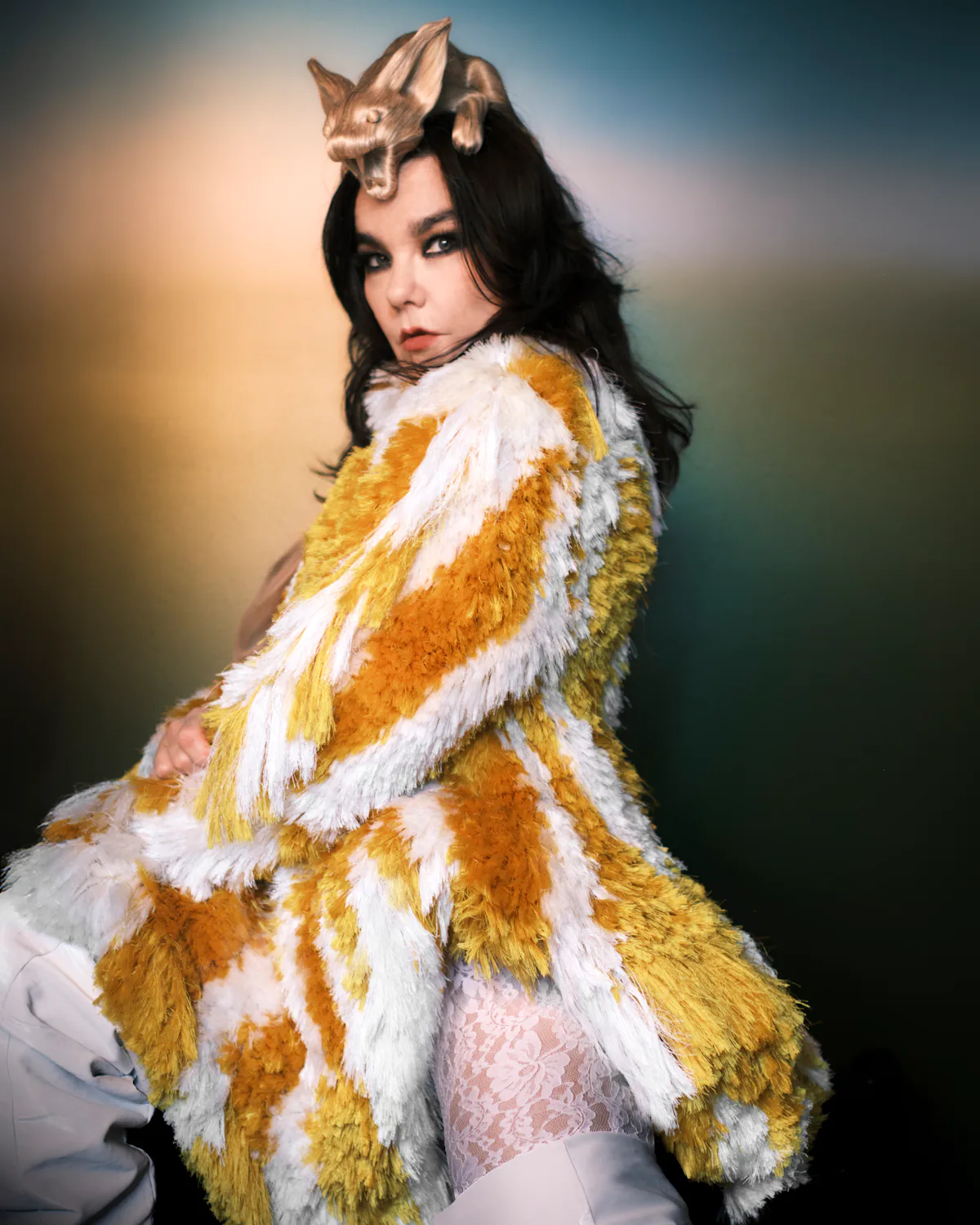
Björk and Merry began working together in 2009 when Björk brought him into her team to help with research for Biophilia. “She will have quite specific references, color palettes, textures, etc. for each song,” Merry says. “So I will usually try and tap into those and mix them with the forms I am experimenting with at the time, until it grows into a new physical headpiece.” He’s created masks like the curving red latex piece looking almost like a stingray that Björk wears on her Vulnicura album cover and the metallic, organic gems models wore for friend Iris van Herpen’s “Earthrise” couture collection. The latter were inspired by “three of my visual obsessions at the time: the structure of baleen (whale teeth), the delicate forms of the Icelandic tungljurt plant, and the anatomical lines of the zygoma or cheekbone,” Merry adds.
Björk in Bottega Veneta with James Merry | Courtesy
Both Merry and Björk draw deeply from nature, and this love comes out in the show. For instance, the installation for “Sorrowful Soil”—a song off Björk’s 2022 album Fossora that eulogizes her mother—brings the visitor into a room showing the singer performing on blackened lava fields as the Icelandic volcano Fagradalsfjall erupts around her. Thirty speakers surround the visitor, each transmitting a single voice from the Hamrahlíð choir. “When you’re in the center of the space, you hear the full score, and as you walk around the room, you can hear the individual voices,” Stave says.
Björk’s new piece is called “Nerve Bloom.” “I did it with Natalia Kleszczewska and Natalie Liu,” Björk writes. “My role in it was a creative director, bringing in the singer-songwriter tradition, where emotionally precise things happen inside the structure of a song. I guided color palettes, textures, and the environments the music happens in.... Everything I do comes from a sonic point of view.”
Merry also made new works for the shows. “I’ve always fixated on the mercurial, changing aspects of nature... like mutation, transformation, and the ‘in-between’ stages of metamorphosis,” he says. “Recently, that has led me back to archaeology, specifically the Iron Age in Europe and a period called ‘La Tene,’ where the hybrid forms and concentration on the face (rather than the body) really resonates with me. I already have a few new masks in the pipeline for this group.”
James Merry, Greenman, 2017 | Courtesy of the artist. Photo by Tim Walker
The museum hopes the shows will highlight a new side of Iceland to visitors—and give locals something worth returning to. A highlight will be on August 12, when Björk will host Echolalia, a one-day solar eclipse rave that will culminate as the moon covers the sun to bring Iceland into total darkness. Björk will DJ, and she has invited Arca, Ronja, and others to perform. “On the face of it—if you didn’t know more about the origins of these works—you might think this is about costume and theatricality,” says Stave. “In fact, in both cases, the works are so much deeper.”
Images courtesy of the brands. Collage by Kimberly Duck
Just outside of Reykjavik, you’ll find Iceland’s Blue Lagoon—those mythical, electric-blue hot springs in the center of desolate lava fields. Blue Lagoon is one of the Nordic island’s most sought-out destinations. It’s known for beauty and ethereal strangeness, and perhaps most of all, powerful skin-rejuvenating benefits. Juergen Teller famously shot Björk and her son there in the early ’90s, and more recently, everyone from Jay Z and Beyoncé to Justin Bieber, Kim Kardashian, and icons of the beauty world like Isamaya French have traveled to the mineral-rich, milky-blue pools to bathe in their therapeutic, geothermal waters.
But the benefits go beyond an Instagram photo. Decades of research shows this one-of-a-kind, extreme environment—high in silica, salinity, and heat that makes its way from tectonic plates 2,000 meters below the earth’s surface—contains two unique, restorative forces that exist only there: the microcosm’s silica, and a single microalgae that can survive these conditions. “It’s like the perfect antiaging potion, because the microalgae induces synthesis of new collagen and also seems to be pushing to keep the skin barrier strong,” says Dr. Asa Bryndis Gudmundsdottir, lead research and development scientist at Blue Lagoon Iceland. Using this research, Dr. Gudmundsdottir and his team developed BL+ Complex, a patented bioactive that uses biomimicry to penetrate deep into the skin. BL+ Complex is the core ingredient in Blue Lagoon Skincare, the luxe beauty line known for lava, mud, and algae-enhanced masks; the incredibly moisturizing BL+ The Cream; and a serum combining BL+ Complex, hyaluronic acid, and vitamin C.
Courtesy of Blue Lagoon Iceland
It turns out, Blue Lagoon Skincare isn’t the only beauty brand grounded in extraordinary bioactive ingredients. At the bottom of Lake Héviz in southwest Hungary, the Budapest-founded line Omorovicza sources mineral-rich water and glistening black mud, a biounique ingredient with a pH close to neutral that’s densely concentrated with magnesium and calcium. Biotech line Clark’s Botanicals recently launched the DNA-42 Clinicalift Serum, merging plant cell-derived exosomes with goji berry exosomes and Jasmine Catalyst Complex derived from the Amalfi coast (the serum promises to improve skin elasticity and firmness). Dior, meanwhile, uses golden grapes from the brand’s long-held vineyard Chateau d’Yquem for its L’Or de Vie line; the house explains that the Yquem vine combats oxidative stress. In the rainforest of the Azores, biotech company Ignae—a favorite of celebrity facialist Joanna Czech—works with camellia extracts from the Furnas Valley and other volcanic soil-grown plants in its nanotechnology. Sienna Miller used label’s Volcanic Clay mask before last year’s Met Gala—a product rich in collagen-boosting, local extracts.
Lake Hevis in western Hungary | Courtesy of Omorovicza
“Environmental stressors often force organisms to produce more potent secondary metabolites, such as antioxidants,” explains Ignae’s founder, Miguel Pombo. “Because the flora here is exposed year-round to oceanic winds and thrives in volcanic soil (the result of 17th-century eruptions that blanketed the islands in ash), we knew this ‘biological enhancement’ would be present in our locally sourced ingredients.”
Still, the seductive visuals beg the question: what is the link between an ecologically niche ingredient and a product’s efficacy? Is a hyper-local botanical just another alluring marketing ploy? Or are there measurable impacts that translate to topical products, backed by the kind of research Dr. Gudmundsdottir does?
Lia Chavez—the Brookhaven, New York-based multimedia artist and visionary behind the botanical-derived line Hildegaard Haute Botanical Oils—works on the regenerative Mama Farm with her friend and neighbor, Isabella Rossellini. She tends 80 percent of the 70 different oil extracts that make up her facial oils herself, rewilding two acres of woodland behind her atelier with endangered medicinal plants to grow beautyberry, elderflower, and more. Chavez points to botanical intelligence as an answer to why incredibly local ingredients have an effect on product efficacy. Her facial oils feature herbs like the antioxidant-rich American ginseng, the antibacterial lemon balm, and damask rose “cultivated by a fourth-generation farmer in the high-altitude Isparta-Burdur region of Turkey,” says Chavez. “Centuries of fungal networks have co-evolved with rose species in that soil, delivering phosphorus, zinc, and iron in precise bioavailable ratios no synthetic substrate can replicat. This matters enormously for the skin, because a rose grown in living, mineral-complete soil carries the full spectrum of its therapeutic compounds rather than a nutritionally compromised approximation of them.”
Irene Forte, the English-Italian heiress of the Rocco Forte hotels and the mind behind her eponymous skincare line, has been working with hyper-local ingredients in her science-backed products for years. “I started with the olive oil that we produce from three different types of olives on the farm,” says Forte of her family’s regenerative farmland in Sicily, which provides olive oil to the historic properties’ Italian-led kitchens. “I was like, wouldn’t it be amazing if we could put it in a skincare product?” Her company blossomed with products “rich in omegas, vitamin E, and polyphenol: all the benefits that you get from the concept of the Mediterranean diet, too.”
“We make a neuropeptide from hibiscus seeds, which has been shown to relax muscles in the face,” Forte adds. “We call it nature’s Botox. But nature alone is absolutely not enough. I do think you need science to get the best out of nature.”
Although experts agree that a scientific approach benefits all parties involved, “the skincare business is sort of the wild, wild west,” Dr. Gudmundsdottir admits. Clinical studies measure whether people feel that a product impacted their skin, not actual impact in a measurable sense. More robust research like the type Dr. Gudmundsdottir’s doing at Blue Lagoon Skincare is often separate from the beauty industry’s day-to-day endeavors.
Nonetheless, Blue Lagoon is not alone in diving deeper into the mystery of its super ingredients. “We are preparing a peer-reviewed paper on a novel microalgae extract capable of neutralizing 100 percent of IL-1, one of the most influential proteins in the aging process,” Pombo says.
“A lot of people are always like, do the products really work? And I’m like, yes, we really see results in trials where there’s an actual, not only visible, but measurable instrument, measurable difference,” Forte notes. “Using science to unlock the best out of nature has always been our philosophy.”
Last night, Demna took his vision for the next chapter of Gucci straight to the white-hot center of American consumerism: Times Square. The fashion house shut down the Midtown plaza on May 16, splashing advertisements for real and imagined Gucci products across 50-some skyscraper-climbing screens before sending an assortment of very New York character models down the runway. If we needed any reminder of just how major and how culture-interwoven the house of Gucci is, the move left few unanswered questions.
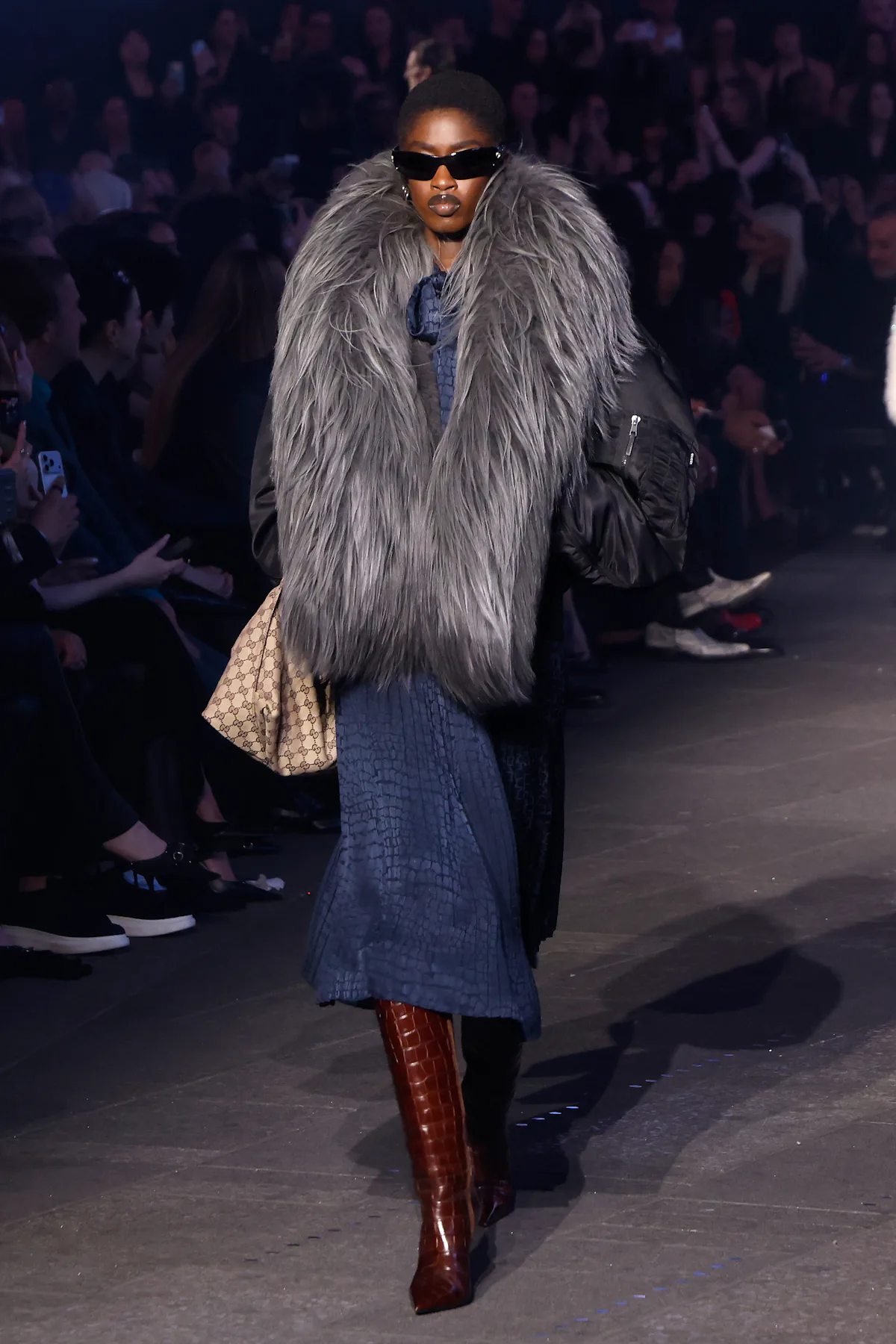
Rather than give us clothes for a seaside holiday or for cocktails in Capri, Demna zeroed in on everyday staples, presenting archetypal pieces like the classic peacoat and the pencil skirt in his own Gucci language. “I wanted to show this collection on the kind of people you might pass on the street, individuals with their own way of wearing clothes, a plurality of styles that intersect like the streets of the city,” said the designer. “Most of what you’ll see in this show is part of GucciCore, a permanent collection that will evolve over time, shaping my vision by building the foundation of a Gucci wardrobe grounded in pragmatic, wearable pieces that are unmistakably Gucci.”
Photo by Taylor Hill/Getty ImagesPhoto by Taylor Hill/Getty ImagesPhoto by Taylor Hill/Getty Images
The collection was his (self-admitted) most commercial, flush with highly wearable city-life garments aimed largely at the both the overworked and the ladies who lunch among us. Athena Calderone walked in faded dark denim, croc-embossed boots, and a navy blazer; Salon 94’s Jeanne Greenberg sauntered in a floral, handpainted white leather coat; and indie film legend Sophia Lamar stomped in a high-slit black dress and the type of (faux) fur coat our grandmothers pass down. Tom Brady was practically beaming as he made his way through the square in a very ’80s-cut, double leather ensemble. Ladylike frocks—in printed yellow on a brunette Paris Hilton and a shimmering leopard print number with a bow at the neckline—felt like new incarnations of the Gucci we know from an earlier era. The Web stripe became a bandeau top styled on men; ultra-baggy jeans and some very desirable oversize faux-fur coats dominated, along with tailored officewear. Mariacarla Boscono walked down the street in a feathered, asymmetric evening dress, cut all the way up the thigh for dramatic effect. Cindy Crawford closed the show in a feather plume gown.
It wouldn’t be a Demna collection without a layer of irony or some rather dystopian metacommentary. Imaginary products sold on the many towering screens included “Gucci Time” and “Gucci Life.” So are we living Gucci lives? Many will certainly be inhabiting Demna’s GucciCore garments the second his pieces drop.
Photo by Taylor Hill/Getty ImagesPhoto by Taylor Hill/Getty ImagesPhoto by Taylor Hill/Getty ImagesPhoto by Taylor Hill/Getty ImagesPhoto by Taylor Hill/Getty ImagesPhoto by Taylor Hill/Getty ImagesPhoto by Taylor Hill/Getty ImagesPhoto by Taylor Hill/Getty ImagesPhoto by Taylor Hill/Getty ImagesPhoto by Taylor Hill/Getty ImagesPhoto by Taylor Hill/Getty ImagesPhoto by Taylor Hill/Getty ImagesPhoto by Taylor Hill/Getty ImagesPhoto by Taylor Hill/Getty ImagesPhoto by Taylor Hill/Getty ImagesPhoto by Taylor Hill/Getty ImagesPhoto by Taylor Hill/Getty ImagesPhoto by Taylor Hill/Getty ImagesPhoto by Taylor Hill/Getty ImagesPhoto by Taylor Hill/Getty ImagesPhoto by Taylor Hill/Getty Images
In 1986, a group of unknown designers drove from Belgium to Great Britain to show their work during London Fashion Week. They weren’t given a stage, and few locals could pronounce their names. Along with Martin Margiela (the unofficial seventh), Ann Demeulemeester, Dirk Bikkembergs, Dirk Van Saene, Dries Van Noten, Marina Yee, and Walter Van Beirendonck were labeled the Antwerp Six. They were the first Flemish designers to break through globally; while their aesthetics are distinct, their ethos brought them together. The group was markedly antiglamour, underwritten by a sharp independence and an openness to breaking norms.
This sensibility changed the industry at its core. Today, Belgian designers and designers educated in Belgium still dominate the fashion system. Just look at Matthieu Blazy at Chanel, Pieter Mulier at Versace, Raf Simons at Prada, Julien Dossena (who graduated from La Cambre Mode[s] in Brussels) at Rabanne, Meryll Rogge at Marni, Glenn Martens at Margiela and Diesel, and Anthony Vaccarello at Saint Laurent; then there’s Demna, who famously studied in Belgium and learned under Margiela. Meanwhile, many of the original Six+1 have left fashion altogether, moving onto sculpture, furniture design, and other art forms.
This past week and weekend, the city celebrated the first Antwerp Fashion Festival, inviting the world to get to know the new, rich talent coming out of the unlikely fashion capital. Both new and established Belgian designers were in attendance; Walter Van Beirendonck showed his emotional 40th anniversary collection, 40 Years of Dreaming the World Awake, on the 7th floor of a construction site in an abandoned bank. (The structure was the first skyscraper in Europe—showing in its ruin felt particularly on-brand for the radical pop-conceptual designer.) Dries Van Noten creative director Julian Klausner opened up about how he feels taking the helm from Noten, and how excited he was to meet a designer he loves at the event (Rick Owens). This year’s LVMH Prize finalist, Julie Kegels, put on a group art and design show at the gallery Cour, while the Royal Academy of Fine Arts, Antwerp showcased graduating student collections and invited guests to meet the young designers one-on-one. Designer Tom Van der Borght showed sculptures of real bodies at the Botanic Sanctuary Antwerp and concept shop DONUM, works that broke against the idea that only one form is desirable in the industry.
Walter Van Beirendonck 40th anniversary collection | Courtesy of Walter Van Beirendonck
The Antwerp Fashion Festival events make a strong case for the fact that the city is still a hotbed for avant-garde and independent design. W spoke with 10 of the participating creatives to ask: what makes Antwerp fashion so compelling? And what does the future of fashion look like?
Julian Klausner
Creative director of Dries Van Noten
What do you think about the current state of the industry and its future?
I’m grateful to be part of this big wave of new creative directors. In the season before my start and after, 20 or 30 new creative directors [began]. The future seasons are looking really exciting. It’s humbling, as well, because I had my debut show on the same day Haider Ackermann debuted at Tom Ford. I think the morning after was Sarah Burton at Givenchy.
Does Antwerp have a distinct voice in fashion?
This is a very fertile place to be creative. We are quite a particular country: We’re very small and we have three official languages and a messy government and [we’re surrounded] by these great, big histories. As a Belgian, you don’t take yourself too seriously. You are pushed to look at things in a slightly different way.
The state has very little fashion history. So for the first wave of designers, the Antwerp Six, there was everything to be done. There was no weight of heritage or something to be compared to. And that gives a certain creative freedom.
How do you decide between taking creative risks and the demands of the business of fashion? Where do you draw the line?
I’m very instinctive in the way I work. This is what I saw from Dries—I was also aware when I took on the role that I had to find my way. It’s still a work in progress to make the work personal to me. Every season, Dries wanted to push things forward. He was keen on looking to the future. The combination pushes me, still, to be daring. Between being a little bit too daring or being a little bit too bland or commercial, I’d rather lean toward creativity. It is the spirit of the house.
Brandon Wen
Designer and creative director of the fashion department of the Royal Academy of Fine Arts, Antwerp
Describe your brand in three words.
Abstract tropical elegance.
You said the latest collection is about abstraction specifically.
The collection started from the idea of nothing. How does nothing become something? The other note of inspiration is I am originally from Los Angeles. My mother is Spanish, my father is Chinese. So there’s a surfer boy-slash-old Spanish woman inside of me that comes out in the raffia, in the taffeta, in the embroideries.
Courtesy of Brandon Wen
Who do you picture in the clothes?
I only have a basic answer: Björk, obviously. But I like this collection on boys. I make this clothing for myself. People are like, who’s your client? It’s kind of a Harold and Maude situation.
What are your thoughts on the future of fashion?
We have a lot of students who want to continue creating. But as a fashion designer, it’s hard. You can’t just do that. A painter can make 12 paintings and it’s fine. In fashion, you have to have a collection. For me, the future is in small resources, and finding the people and the communities that will help make that happen. Because right now, I don’t know if a space like that really exists.
How would you define Antwerp fashion?
Antwerp is garment-obsessed. London is more [defined by] abstraction, experimentation. Antwerp is still experimental, but it’s really about garment details. It’s how we teach, it’s what the Six were all about. And historically, it’s always been eclectic.
Walter Van Beirendonck
Member of the Antwerp Six showing his 40th anniversary collection
Tell us about your new collection.
For me, it was a new step, a little more spiritual. The clothes are probably more relaxed, less complicated. I’ve become a little more relaxed, a little less complicated. Also, the world is changing. I’m changing.
Courtesy of Walter Van Beirendonck
How would you describe these 40 years?
As a rollercoaster. I never skipped a season. One way or another, I always put a collection together. I had periods that I really had to survive. Other periods were extremely successful, like the ’90s, with a lot of selling points all over the world. But then again—down and then up, and up and down.
What’s your best memory of these years?
The beginning years were fantastic. You can see it in the exhibition of the Antwerp Six: it was a very naive start because we didn’t know what to do, we didn’t know how to move forward. But at the same time, we were so desperate and ambitious to make it. And it was such an incredible energy, which we all experienced together. That was a nice start to our careers.
What do you see as the future of fashion?
It’s all about creativity—that’s hopefully what can survive and what is so necessary in this fashion world, which has been ruined in the last few years by the big houses, by a lot of money, by mainly concentrating on marketing, by changing designers all the time. We are losing so much of the soul of fashion.
Courtesy of Walter Van Beirendonck
How did you keep going over the years, and what keeps you going today?
In my life, there has always been hope. I’m still fascinated by fashion. It’s still a strong tool to express myself. This last collection is called “I know.” I know that it’s a terrible time. I know that the world is going [through darkness], I know all these things—but still I want to go on and make fashion.
Bernadette de Geyter and Charlotte de Geyter
The mother-daughter designers of women’s ready-to-wear line Bernadette
How would you describe your aesthetic?
Charlotte: We value authenticity, timelessness, optimism, and color.
Courtesy of Bernadette
Do you think Antwerp has a specific sensibility?
Charlotte: Antwerp designers are very down-to-earth. There’s a stubbornness of doing exactly what we want and not being too influenced by what is already happening.
What are your thoughts on the future of the industry?
Charlotte: It changes quickly. With social media, it has already changed so much. So for us, what’s important is that we have slow growth.
Do you have a favorite garment or signature piece?
Bernadette: I always love to wear our robes. It’s a comfort-first garment. You can wear it with a slipper, you can wear it with a heel.
Pommie Dierick
2024 Royal Academy of Fine Arts graduate preparing to launch her own label
Tell us about your work.
I like to work around strong women. My masters collection was about Grace Jones and Bette Davis. I like that energy in a woman, and also in clothing.
Do you work for a designer? Do you have your own line?
I just came back from Paris, actually. I was doing internships, first for Louis Vuitton doing bags, and then I went to Loewe and I did leather there. Now, I work for my own brand.
Is there something that characterizes Antwerp fashion?
There is a certain something you cannot really put in words—we’ve been trying to define it. Antwerp designers are creative, and they put a lot of imagination in their work. You can feel it.
What do you see as the future of fashion?
I’m actually optimistic, because for young designers, it’s more about creativity. The art is coming back, the craft is coming back.
Florentina Leitner
Antwerp-based designer showing her namesake label at Paris Fashion Week
Describe your brand in three words.
Feminine, floral, fantasy.
What are your thoughts on the future of the industry?
I hope the industry will survive what’s going down with wholesale. It’s crazy. It’s important for younger designers to build more B2C and discover their crowd and their direct clients. We’re in very risky times. But I hope it’s settling, and I hope retail is becoming a big thing again. I was in South Korea and Japan last December, and especially in South Korea, I saw amazing stores that were so immersive; it was really an experience.
Carla Lázaro Bonet
2026 Royal Academy of Fine Arts, Antwerp MA graduate, winner of the Jury Prize
Tell us about the concept of your collection.
It was based on my grandmother. I saw her not giving a fuck about social norms. She was doing whatever she wanted, and that was inspiring to me. It’s a balance between contemporary and traditional.
Describe your work in three words.
Craftsmanship, bold, and colorful.
What are your thoughts on the future of the industry?
For me, it’s slowly coming back to craftsmanship. I know this [work] is so time-consuming and exhausting, but at the same time, there is beauty in it. And it’s not about perfection. We need to slow down and work with our hands.
Tom Van der Borght
Designer and artist, winner of the Grand Jury and Public Prize at Hyères 2020
Do you think Antwerp has a specific sensibility?
Antwerp culture is very connected to Belgian culture at large. We are a quite young country; we’re like a collage of people from very different directions. We are dealing less with a strong national identity. And that in itself gives more space for freedom, different approaches, different point of views.
Photo by Robin Joris Dullers
What are your thoughts on the future of the industry?
I always try to approach things in a positive way, but also in a radical way. So I hope for a radical future where we switch our ideas, our ways of producing, our ways of thinking about the body, and also how we deal with each other.
Anna Lackner
2026 Royal Academy of Fine Arts, Antwerp, MA graduate
Tell us about the concept for the collection.
This is so funny, because my collection was inspired by a W magazine shoot—it’s a Juergen Teller shoot from the ’90s with Kate Moss and Claudia Schiffer at the Cannes Film Festival. I love those images so much. I love that there’s still some beauty in this messiness. From this photo shoot, I developed an idea: this diva has a mental breakdown.
When you picture the collection, who do you see wearing it?
Lady Gaga. I think it fits.
What are your hopes or wishes for the future of the industry?
I would love it if people were not too stressed and could be daring and a bit crazy. A lot of people from my class are thinking the same way. There’s a movement—everybody just wants to be free and do what they want without pressure.
Julie Kegels
2026 LVMH Prize finalist who launched her womenswear line in 2024
Describe your brand in a few words.
Stable, fresh, and realistic.
Photo by Elias Asselbergh
Do you think there is one thing that characterizes Antwerp fashion?
There is something very raw about Antwerp and Belgium in general, and that breeds something ordinary out of daily life. But still, there is a lot of grace. There is also room to dream and have fantasies.
What do you think about the future of fashion?
This is a big industry, and there is a lot of corporate flattening. But on the other hand, there’s something very positive happening because of AI, and things that are too perfect. It actually gives us an opportunity to go more toward craft. You need humans, and the imperfections and the mistakes that humans make. I’m positive, of course, because I just started, I have to be positive. Maybe I’m still a bit naive, and maybe it’s also good to dream.

 Login
Login