Reading view

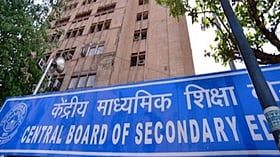
Why is CBSE silent on vendor behind ‘On-Screen Marking’ system?

Under the newly introduced OSM system, answer books are digitally scanned and evaluated online — which the board had claimed would eliminate totalling errors and reduce manual intervention. The system, the CBSE had stated, would enable faster evaluation, wider teacher participation including overseas schools, reduce logistics costs, and enable environmentally sustainable processes.

Post-result verification of marks would no longer be required, was another claim made by the CBSE. Instead of checking physical answer sheets, examiners were expected to log into an online portal where scanned copies of answer scripts were assigned to them for evaluation.

The results of class 12 Board examination, 2026 were announced on 13 May. A large number of complaints have surfaced since then of students who demanded to see the scanned copies of their answer sheets with marking.

At least two of the examinees complained that the answer sheets emailed to them were not theirs. In both the cases, the first page of the Physics and Chemistry answer sheets bore the handwritten details filled by the examinees themselves. But the rest of the answer sheets did not match their handwriting, complained Vedant and Sanjana.

The Central Board of Secondary Education (CBSE) is one of the largest national education boards in India. It operates under the Government of India and runs major examinations like the Class 10 and Class 12 board exams for millions of students every year.

CBSE is affiliated with over 28,000 schools in India and several hundred more abroad, which makes it one of the most influential educational bodies in the country. Every year, millions of answer sheets are evaluated by thousands of teachers and examiners as part of the board exam process.

The On-Screen Marking (OSM) system however failed due to technical glitches, mismatched answer sheets, missing scans, and a grievance portal crash — causing widespread panic among Class 12 students.

The CBSE acknowledged the errors due to alleged technical glitches and sent the correct answer sheets to both the students. However, other errors cropped up and it was noticed that some questions had not been marked at all.

The mother of Sanjana was quoted in The Hindustan Times as saying, “My daughter finally received the scanned copies of four answer sheets and to our shock, page number 22 is missing from one of the documents. On top of that, marks have not been awarded for several answers that exactly match the official answer key. And this isn’t limited to just one paper; the same issue appears across multiple subjects”.

Kudos to you Vedant, for speaking up for yourself & thousands of many other students.

It takes courage to come out & face the heat when you know the fight is not gonna be fair, but still chose to fight.

You are the future of this country ⭐️ pic.twitter.com/qkUnL1rces

— Arpit Sharma (@iArpitSpeaks) May 25, 2026

Rajma chawal after such a hectic day a big thanks to all who supported us from Vedant and Siddhant and we are not Pakistani pic.twitter.com/JNdf2szqvN

— Siddhant Srivastava (@iamsidddhant) May 25, 2026

One of the examinees took to X and aired his public complaint, “Your OSM system gave us blurry, unreadable answer sheets. The revaluation portal has been crashing since day one, payments failing repeatedly, students overcharged up to Rs 2,07,000 and 1 lakh due to glitches, hackers attacking the site, endless delays and useless extensions.

Lakhs of us failed in multiple subjects despite our hard work. I just lost my close friend to this pain. He couldn't survive the heartbreak. Many more students are having severe breakdowns and attempting suicide. Families are shattered. Our dreams of JEE, NEET and college admissions are finished”.

The brother of Vedant Srivastava, Siddhant explained to a news agency, “The problem was that his answer sheet was exchanged with someone else's, and the marks we received were based on someone else's answer sheet. We emailed the complaint to CBSE. We also made a video, gave an interview to a news channel, and tweeted it. When this matter received a lot of public attention, CBSE reached out to us and sent us the correct answer key… After Vedant's case was revealed, more students came forward… We want a formal portal established for other students as well, where they can report such problems directly to CBSE and not face [harassment] and trolling as we did—to report their genuine issues.”

CBSE has not officially named the private firm that designed the On-Screen Marking (OSM) system.

Procurement records show tenders were floated for scanning, stapling, and technical support services, but the vendor responsible for the OSM platform itself has not been publicly disclosed.

CBSE floated multiple tenders in 2025–26 related to Cutting, scanning, and stapling of answer books for regional offices and also for selection of an agency as Technical Support Unit (TSU) for development and launch of CBSE’s Global Curriculum. While these tenders confirm CBSE was outsourcing technical and operational services, there is no mention of a specific OSM platform vendor.

The non-disclosure of a OSM vendor may mean that the system was developed in-house with outsourced scanning support, or a private vendor was contracted but not named publicly in press releases or tender summaries.

The chairman of the parliamentary standing committee on Education, Congress Rajya Sabha MP Digvijaya Singh, is learnt to have convened a meeting of the committee next week to ascertain the identity of the vendor from the CBSE, if any, and the vendor’s past experience, technical expertise etc. Unverified reports circulating on social media claim the vendor is a company with a record of failures in other states.

While teams from IIT, Madras and IIT, Kanpur are carrying out third-party audits of the system, a 19-year-old ‘hacker’ has claimed that he had detected the vulnerabilities of the system way back in February, 2026 and had alerted CERT-In (Computer Emergency Response Team-India) about them immediately.

Describing himself as a “hobbyist cybersecurity researcher” who has just finished his Class 12 exams this year, the 19-year-old with the handle “@nisarga” posted on X, “I've done bug bounty and security work for fun before, so when CBSE rolled out OSM and I noticed the portal link was completely public, my curiosity got the better of me.”

He flagged five vulnerabilities and summarised what these flaws allowed:

  • Log in as any examiner using a master password leaked in the frontend.

  • Bypass OTP entirely, because validation happens in the browser.

  • Reach any internal page without authenticating at all.

  • Reset any examiner's password without knowing their current one.

  • Act as any user across the API thanks to systemic IDOR, and in doing so edit marks, change examiner details, and tamper with the evaluation process.

“None of this required sophisticated exploitation. The hardest part was reading a JavaScript file and editing a couple of values in DevTools,” he said before adding, “I reported all of this to CERT-In (the Indian Computer Emergency Response Team) before writing anything publicly”.

His full blogpost can be accessed here: ni5arga.com/blog/posts/hacking-cbse/
Why is CBSE silent on vendor behind ‘On-Screen Marking’ system?
  •  

Bengal braces for more post-poll violence as CAPF experiment fails

At least five deaths have been reported from different parts of West Bengal since results of the assembly election were declared on Monday, 4 May. The latest casualty is BJP leader and a front runner for the chief minister’s post Suvendu Adhikari’s executive assistant, who was shot dead around 10.20 pm on Wednesday while returning home to Barasat in North 24-Parganas. TMC has claimed three of its workers were killed in the first 48 hours after the counting.

On Wednesday, DGP Siddh Nath Gupta briefed the media and confirmed that a total of 200 FIRs had been registered regarding post-poll incidents, leading to the arrest of 433 individuals.

“Since 4 May, after the announcement of results, there have been incidents of violence, including threats, assaults, and intimidation. We have detained more than 1,100 people under preventive measures,” he said, adding that there have been reports of violence and assault since Wednesday morning.

Gupta confirmed two deaths related to post-poll violence – one at Nanoor and another at New Town, Rajarhat on the outskirts of Kolkata. “We are investigating both cases. We have been able to arrest those involved in these two murders,” he said.

Responding to allegations made by Trinamool Congress that BJP workers had unleashed the violence, BJP state president Samik Bhattacharya had said that internal squabbles within TMC were responsible for the violence. Trinamool workers were misusing BJP’s flags, he alleged, while engaging in violence. “TMC is attacking TMC…," he was quoted as saying.

There are indications that a section of TMC workers, out of fear or otherwise, have overnight changed colours and switched their loyalty. Visuals of policemen and state government employees dancing while shouting slogans of Jai Shri Ram have been circulating.

A state government employee, a Left Front supporter, confided that he had been advised by colleagues to lie low and shout JSR slogans in order to escape attention to his political affiliation. Doubts are also being expressed over the possibility of people settling personal scores and local business rivals using the turmoil after the election to vandalise property of competitors.

However, the role of the CAPF too has come under increasing scrutiny as visuals of the CAPF standing by while mobs resort to violence have also been circulating. The armed troops seem to be under instructions not to intervene.

Day 1 of regime change in Bengal:

Bulldozer razes TMC office near Kolkata's iconic New Market. Muslim-run Biriyani shop near a temple told to pack up. Muslim names of parks, roads erased. Eidgah vandalized. @Shinjineemjmdr reports. https://t.co/JjmdRmNEc6

— Mohammed Zubair (@zoo_bear) May 6, 2026

Where are central forces ? Where are @AmitShah’s massive security forces ? Brutal open attacks on @AITCofficial on the streets. Whats happening ?? pic.twitter.com/DC3cv2dBsV

— Sagarika Ghose (@sagarikaghose) May 6, 2026

Who says the @ECISVEEP SIR deletions didn’t have an impact on West Bengal polls 2026? Just look at how carefully targeted the exclusions were. Very revealing chart here . Thanks for sharing @AnantGuptaAG pic.twitter.com/xnEt6VoKcn

— Sagarika Ghose (@sagarikaghose) May 6, 2026

After watching this video, how can anyone still say that India’s Supreme Court and central forces are impartial? Look at how openly the CRPF is covering up for the rioters.
All these rioters are so-called BJP workers.

What a shame.

India is no longer a secular & constitutional… pic.twitter.com/javECNyi6o

— Nasreen Khan (@MuslimHuman77) May 6, 2026

With the Election Commission having sidelined local police in the run up to the elections, the authority of the police appears to have collapsed. This would explain the use of a bulldozer to demolish a TMC office outside the Hogg market known as the New Market in central Kolkata, a stone’s throw from the police headquarters.

Several incidents of violence and vandalism have been recorded in the state over the last three days. Some of them are the following:

  • Several youths scaled a decorative gateway arch of Masjid Bari Road in Barasat’s Nabapally area, broke off the letterings, and replaced them with a hoarding reading “Netaji Pally”

  • A park named Siraj Udyan in Champadali, Barasat, was also ‘renamed’ as Shibaji Udyan

  • Saffron-clad BJP workers approached a biryani shop located next to a temple in Bongaon, North 24 Parganas, and asked the staff to move the shop elsewhere

  • BJP workers stormed into and vandalised the Lalbagh Eidgah in Murshidabad. In a video circulating online, saffron-clad workers can be seen aggressively breaking a tin barricade and forcing their way into the field amid chants of “Jai Shi Ram”

  • Shops of Muslim fruit vendors in Uluberia were targeted Muslim-owned shops were vandalised.

  • In Dinhata, a ‘Bengal Taj Mahal selfie point’ was vandalised & burnt by a mob chanting “Tel lagake Babur ka, Naam mitado Babur ka

  • At Jiaganj in north Bengal, a statue of Lenin was broken and dislodged

  • Several TMC leaders, workers and outgoing ministers were heckled, manhandled and thrashed in different parts of the state

  • In a free-for-all, party offices of the TMC across the state are being taken over by other parties, including non-BJP parties.

  •  

Parents Flying Alone to Visit Children Abroad: Travel Insurance Scenarios Families Often Miss

Parents who travel abroad alone to visit their children often focus on tickets, gifts, hotel reservations, and visa paperwork. Yet the journey may involve medical, baggage, documentation and disruption risks that feel manageable only until they happen away from home. For Indian families, choosing suitable travel insurance can make overseas visits more organised, especially when parents are travelling without a younger companion.

Here is what this article will help you understand before your parents travel overseas alone.

Pre-Existing Medical Limitations

Parents may already be managing diabetes, blood pressure, heart concerns or age-related conditions. Before buying travel insurance, families should review how the policy treats pre-existing conditions and emergency care linked to them.

Key points to check include:

●       Whether stable pre-existing conditions need declaration

●       Whether emergency stabilisation is considered

●       What medical documents may be required during a claim

Overseas Medical Emergencies

Medical treatment abroad can be stressful because parents may not know local hospitals, appointment systems or payment processes. A suitable policy can offer support for sudden illness or injury, depending on the chosen plan.

Families should review:

●       Emergency hospitalisation benefits

●       Outpatient treatment terms, where available

●       Cashless or reimbursement claim process

●       Required bills, reports and prescriptions

Trip Cancellation Risks

A parent may need to cancel the trip due to illness, family emergencies, visa delays or other covered reasons mentioned in the policy. Families often miss this point while booking flights early.

Before finalising plans, check:

●       Covered cancellation reasons

●       Documents needed to support the claim

●       Whether airline, hotel or tour losses are considered

●       Timelines for informing the insurer

Baggage and Document Loss

Lost baggage can be inconvenient for any traveller, but it can be harder for a parent travelling alone. Delayed bags, misplaced passports or lost travel documents can affect the entire visit.

Useful policy features may include:

●       Support for checked-in baggage delay

●       Compensation for baggage loss, as per terms

●       Assistance for passport loss

●       Guidance on reporting to local authorities

Senior Traveller Restrictions

Senior parents may face specific policy conditions based on age, trip duration, destination and health declarations. Families should avoid buying a plan only at the final stage of visa filing.

Review these areas carefully:

●       Eligible traveller age band

●       Medical screening requirements, where applicable

●       Maximum trip duration allowed

●       Claim documentation expected for senior travellers

Emergency Evacuation Requirements

A serious medical event may require movement to another hospital or, in rare cases, return to India for continued care. Such situations need quick coordination and proper approval channels.

Families should check whether the policy mentions:

●       Medical evacuation support

●       Repatriation assistance

●       Doctor-certified need for transfer

●       Prior approval process from the assistance team

Extended Stay Coverage

Parents visiting children abroad may extend their stay due to family needs, childbirth support, recovery, weather disruption or changed return plans. Standard travel insurance may be valid only for the original travel dates.

Before departure, families should ask:

●       Whether policy extension is allowed

●       How early must the extension request be made

●       Whether claims during extended stay are considered

●       What happens after policy expiry

Routine Treatment Exclusions

Travel cover is primarily designed to cover unexpected events during the trip. Families sometimes assume it can replace regular health cover abroad, which may not be the case.

Parents should understand that policies may not include:

●       Planned medical check-ups

●       Routine medicine refills

●       Preventive tests

●       Ongoing treatment already scheduled before travel

Travel Disruption Expenses

Flights may be delayed, connections may be missed, or local transport may be affected due to weather, operational issues or other covered reasons. Such disruptions can be difficult for parents managing travel alone.

Check whether the policy supports:

●       Trip delay benefits

●       Missed connection cover, where available

●       Additional stay-related expenses

●       Required proof from the airline or transport provider

Emergency Assistance Services

Emergency assistance can be valuable when parents are in a different time zone, and children may not be immediately reachable. This service can guide the traveller during medical, document or travel-related difficulties.

Families should look for:

●       Round-the-clock assistance access

●       Hospital referral support

●       Claim guidance during emergencies

●       Help with local coordination where available

Travel Insurance for Schengen Visa

Many Indian parents visit children in European countries, where visa rules may require valid travel insurance for Schengen visa applications. The policy should align with visa requirements, travel dates, and the parents’ personal needs.

Before applying, families should verify:

●       Destination coverage

●       Policy validity dates

●       Medical emergency coverage

●       Required certificate or policy document format

Conclusion

Parents travelling alone to visit children abroad deserve more than a rushed policy purchase. A careful review of medical needs, trip risks, baggage support, stay duration and emergency assistance can make the journey more secure and easier to manage. The right travel insurance choice should match the destination, age, health profile, visa needs and travel plans mentioned in the policy wording.

This is an advertorial. The article is published as received.

Parents Flying Alone to Visit Children Abroad: Travel Insurance Scenarios Families Often Miss
  •  

President neglecting kitchen at Rashtrapati Bhavan, complain foodies

During the then US President Barack Obama’s state visit to India, a lunch hosted at Hyderabad House with PM Modi in attendance did serve non-vegetarian dishes. For starters, the ‘perfectly cooked ‘Shrimp Karavalli’, a delicacy from coastal Karnataka and ‘Murg Neeza Kebab’, part of the Mughlai cuisine were showcased. Non-vegetarians also had the Bengali mustard fish preparation described as ‘Mahi Sarson’ and ‘Bhuna Gosht Boti’ — tender pieces of lamb cooked in tomato and onion masala.

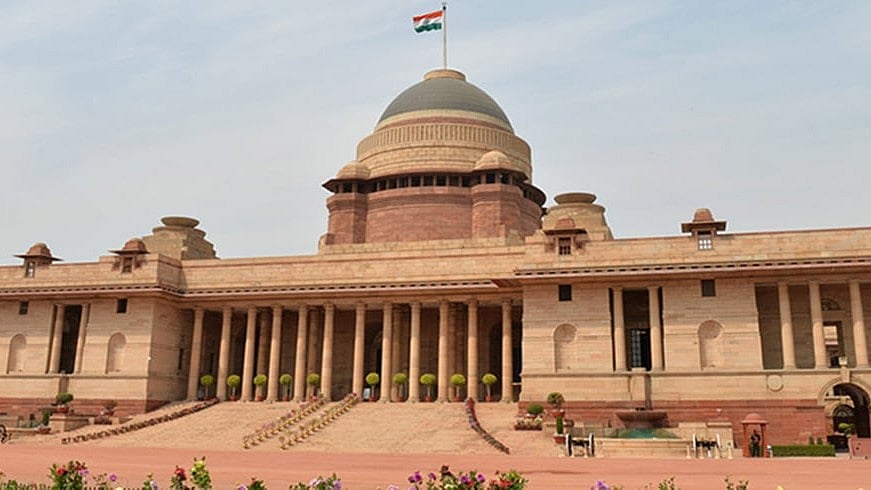
At the banquet hosted by Rashtrapati Bhavan this week for the visiting Vietnamese President To Lam the menu was entirely vegetarian. The spread included Bharwan Vilayti Gobi (stuffed broccoli in green tomato sauce), Gajar Matar Naal Wadiyan (carrots and peas stir-fried with urad dal dumplings), Bhatinde Waale Aloo (baby potatoes with freshly pounded herbs and mango powder), Hisar Bajra Khichdi (porridge of millets, lentils and vegetables), Basmati rice with peas and Dal Amritsari. Was there no South Indian dish that could be served, wondered a few.

President Droupadi Murmu received President To Lam of Viet Nam at Rashtrapati Bhavan and hosted a banquet in his honour. The President said the elevation of India-Viet Nam ties to an Enhanced Comprehensive Strategic Partnership will not only provide momentum to our bilateral… pic.twitter.com/gOsT5lBgka

— President of India (@rashtrapatibhvn) May 6, 2026

Menu of the banquet hosted by President Murmu in honour of Vietnam president To Lam pic.twitter.com/ljZmOA81A9

— Sidhant Sibal (@sidhant) May 6, 2026

“What an utterly unimaginative menu - the worst of Indian vegetarian food. And to serve this to the President of a country which is incapable of serving even one tasteless meal, even in the simplest home. Shame,” exclaimed chef, food writer and columnist Rajyasree Sen based in New Delhi. Former diplomat Ambassador K.C. Singh endorsed her sentiment. “Absolutely agree. It’s not even refined Punjabi food. This is reducing Rashtrapati Bhawan to a Dhaba. And how can vegetarianism be inflicted on foreign dignitaries when even India eats meat. Sure, have visitors taste Indian food. But be selective & adaptive,” he tweeted.

There were others who defended the menu. President Droupadi Murmu is a member of Brahma Kumaris, who have several dietary restrictions, they reasoned. If she chooses to have stuffed broccoli and baby potatoes served to a foreign dignitary, it is her prerogative. People were quick to question such reasoning though. When President Murmu or PM Modi go abroad, the hosts are certainly alerted about their food preferences and which are possibly honoured. So, why shouldn’t the Rashtrapati Bhavan serve non-vegetarian delicacies as was done for President Obama?

French President Macron was presented a similar vegetarian slop menu. He was later found to have ordered bread and cheese through room service.

When India was run by educated elites with refined tastes, who would serve foreign dignitaries exquisite Indo-Muslim cuisine,… https://t.co/5H2u63dCKy pic.twitter.com/Wec2pviUPR

— Indian Muslim Archives (@Rustum_0) May 7, 2026

In case you have always wondered why the BJP/sangh types are always so angry & hateful and thats all they spread, imagine if this was your idea of - best food... would you be a happy person? pic.twitter.com/uSu3sESzuW

— Abhinandan Sekhri (@AbhinandanSekhr) May 7, 2026

While poultry and pork are the staple in Vietnam, the Vietnamese President, argued some, may be a vegetarian; after all he is a Buddhist and began the state visit from Bodh Gaya. However, Vietnamese cuisine being based headily on meat and seafood, there is little evidence that the visiting President is a vegetarian. Serving vegetarian food was India’s diplomatic choice.

It was explained by sources that President Murmu does not partake onions and garlic; that being a devotee of the Brahma Kumaris she eats only ‘satvic’ (pure, light and vegetarian) food since 2006. At least one hawk eye however spotted ‘mushrooms’ in the menu and flagged it as ‘tamasic’ (heavy, impure, living beings) food, which PM Modi is said to have regularly. The third kind of food, Rajasic (meat, fish) was of course missing.

Launch as many ‘veg-only’ culinary maps as you want but the reality is unchanged: 77% of Indians are non-veg pic.twitter.com/S5uANi48NC

— SamSays (@samjawed65) May 6, 2026

They have memories of Nehru and in revenge we fed them this menu. https://t.co/5dGSzgccHa pic.twitter.com/kLjHM22ohx

— Venkat Reddy (@Venkat_R_) May 7, 2026

The menu triggered both humour and sarcasm. “Campaign days: Non-veg meal is not only fine but also to be flaunted. Even beef is fine. Normal days: Strictly veg while hosting heads of state in Rashtrapati Bhavan. Don't really get how people fall for such brazen frauds,” tweeted Urvish Kothari, author and commentator from Gujarat. Journalist and founder of Newslaundry Abhinandan Sekhri exclaimed, “In case you have always wondered why the BJP/Sangh types are always so angry & hateful and that is all that they spread, imagine if this was your idea of - best food... would you be a happy person?”

Non-vegetarians were upset and pointed out that nearly 80 per cent of the population consume meat and fish. India, they pointed out, possesses one of the richest seafood and meat traditions on the planet. Bengali fish culture, Kashmiri Wazwan, Kerala beef fry, Nagaland smoked pork, Mughlai cuisine, Goan seafood, Lucknowi kebabs, the choice was endless, they pointed out.

The consensus was that the menu was pedestrian and unimaginative. Why couldn’t food from every corner of India, appetisers from the North-East, a dish from the South and another from the West and so on could be served? President Murmu needs to pay more attention to the kitchen, seemed the prevailing sentiment.

This is what the dinner menu for foreign dignitaries visiting India should actually look like. pic.twitter.com/yVUmzYfFgV

— Frontier Indica (@frontierindica) May 7, 2026

  •  

SIR is exclusionary, but states must act before more citizens lose voting rights

The Special Intensive Revision (SIR) of electoral rolls, launched in June 2025, has reportedly deleted almost 10 per cent of the voters in every state where it has been conducted. That totals to nearly six crore voters. At this rate, four crore more will be dropped by the end of the third phase of the SIR.

Not all of those deleted are foreigners or deceased. Many of them are also mapped and have voted in the past. Yet, they have been disenfranchised with not much rhyme or reason or clarity on the grounds for deletion.

It is now evident and acknowledged that the SIR is exclusionary by design. The Election Commission of India (ECI) is yet to explain what made it change the process of revision being followed since 1951; and why it launched an exercise from scratch without doing even a basic homework. The SIR remains opaque and instructions have changed repeatedly over time and across states since it was first launched in Bihar in June last year, ahead of assembly elections there.

There is no handbook or manual to serve as a guideline. In many cases, directions seem to be arbitrary, informal verbal instructions or conveyed through WhatsApp messages to the Booth Level Officers (BLOs) and Returning Officers.

While the primary reason for the exercise was said to be the need to remove foreigners from the electoral rolls, the ECI yet to disclose the number of foreigners, if any, detected in each state.

The process also relies heavily on digital access to enumeration forms, electoral rolls and booth-wise deletion lists, making it difficult for the poor, the illiterate and the marginalised communities to navigate the exercise.  

SIR is also systematically rewriting the Constitution, taking away the universal adult franchise guaranteed to every citizen. People are being denied their voting rights on grounds of discrepancies in name, age or address across different official documents or because a computer software flags age discrepancies. Does the ECI have the right to take away a constitutionally guaranteed right, especially when government records in India have long been riddled with clerical and data-entry errors—errors created not by citizens, but by state agencies themselves?

The exercise begins by dividing citizens into two categories—‘mapped’ and ‘unmapped’. Mapping simply means to trace your own name or that of your ancestors to the electoral roll of 2002-03, when SIR was first conducted under very different rules. However, there is a third category—of citizens born before 1987—who are exempt from mapping. What SIR has demonstrated, however, is that being mapped too is no guarantee for retaining the right to vote.

In West Bengal, for example, the 27 lakh citizens whose names were deleted from the electoral rolls were all mapped. All had filled enumeration forms, were presumably visited and verified by BLOs, produced documents and attended hearings. Most of them had also voted in earlier elections. Yet, their names were removed.

Remarkably, the specially constituted appellate tribunals, upheld nearly 96 per cent of the 1,600 plus appeals before polling in West Bengal. Their deletions were wrong, said the tribunals and ordered their restoration.

Neither the ECI nor the Supreme Court has publicly clarified who was responsible for these errors, or whether any corrective action has been taken.

Meanwhile, the third phase of SIR is all set to begin from 30 May in 16 states and three Union territories. The governments in these states appear to be passive onlookers. States ruled by opposition parties have made brave statements they will not allow any bona fide citizen to be disenfranchised, but at the same time maintaining they would not interfere with the ECI’s constitutional role. They all have stopped short of any meaningful intervention.

So what can the state governments still do?

1.    Launch a drive to correct the discrepancies— caused by state government employees at different stages and by data entry operator—in documents. Citizens who have different documents showing discrepancies should get a chance to correct them before SIR

2.    Conduct a survey of the homeless and the destitute with no fixed address and document them to facilitate their inclusion

3.    Collect a polling booth-wise list of women and ensure that documents clearly mention their maiden name and current marital status, changed name and addresses or change in religion, if any.

4.     A similar list of people from the minority communities could be drawn up because of the widely held suspicion that the SIR is designed to target them

5.    Approach the President of India, the ECI and the judiciary to point out why SIR requires more time and care

6.    Demand the provision of an audit of the SIR in the state and also create a special cell to address grievances

7.    Conduct a survey of migrant workers, coordinate and work out a verification mechanism with their home states, including a work permit with photographs and family details.

The onus is on opposition-ruled states to take the lead before any large-scale irreversible disenfranchisement. 

  •  

EV Protection Plans: What Sets Them Apart from Regular Insurance

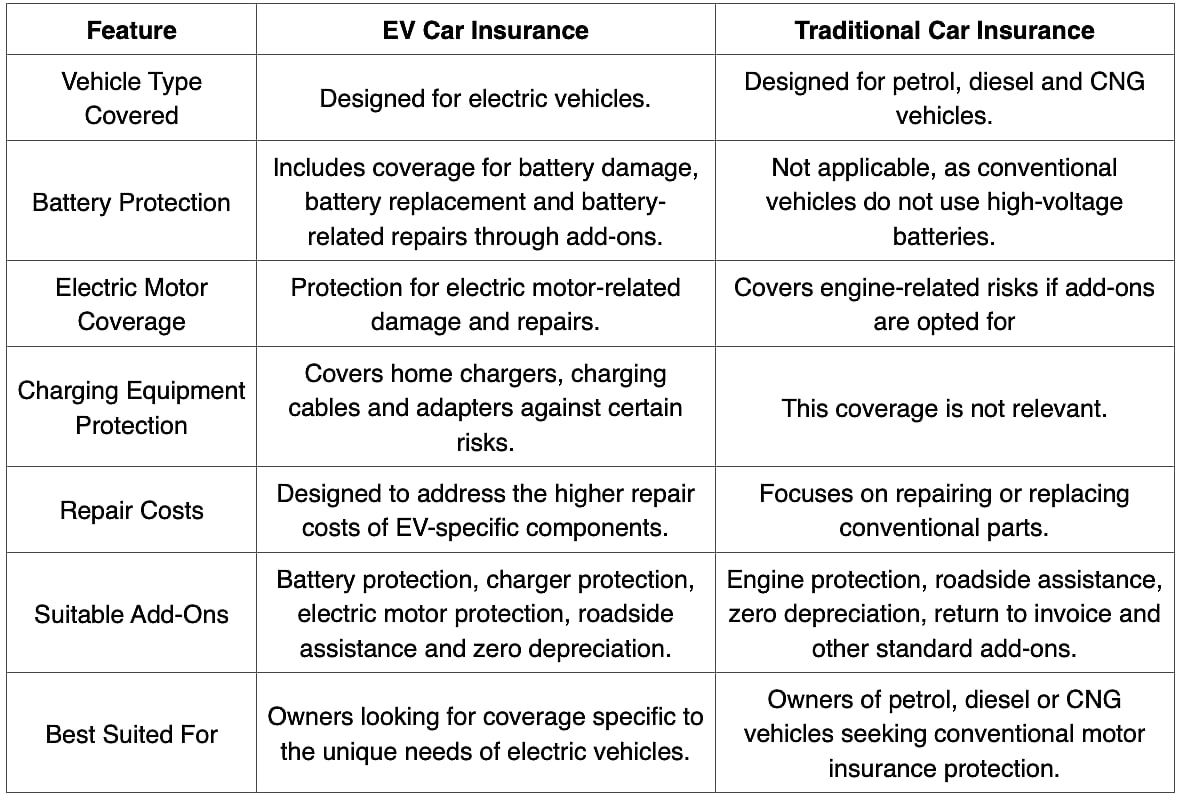
Electric car insurance is a motor insurance policy designed for electric vehicles (EVs). Like a standard car insurance plan for petrol, diesel or CNG cars, it covers risks such as accidents, theft and third-party liabilities. However, EVs have unique components like batteries, electric motors and charging equipment that may need specialised protection. 

This often raises a common confusion: is EV insurance different from regular car insurance? Today, we'll compare electric car insurance and standard car insurance to help you understand the differences.

Electric Car Insurance vs Traditional Car Insurance

Is Electric Car Insurance Priced Differently from a Conventional Plan? 

Yes, EV car insurance may have slightly different costs than the car insurance price for a petrol car. This is mainly because of the specialised technology and higher value of its components. However, the difference in the price is not significant compared to the specialised coverage you get. Similar to every car insurance plan, the price depends on several factors such as:

  • Battery value – Batteries are expensive to repair or replace.

  • Electric motor and electronics – Advanced systems can increase repair costs.

  • Charging equipment cover – Protection for chargers may affect premiums.

  • Vehicle value – Higher-priced EVs generally attract higher premiums.

  • EV-specific add-ons – Covers like battery protection can increase costs.

Is the Claim Process for EV Car Insurance Different?

The claim process for EV car insurance is largely similar to that of conventional car insurance. You need to report the incident, submit the required documents and get the vehicle inspected. The main difference is that the assessment may include EV-specific components such as the battery, charging system and electric motor to determine the extent of damage and repair costs.

Secure Your Smart EVs with IndusInd General Insurance’s Smart EV Plans

Your EV deserves protection that protects the unique technology and expensive components. With IndusInd General Insurance's EV car insurance plans, you can protect your smart EV against everyday risks and also get specialised add-on options for your EV components. Explore our plans today and choose protection designed for the way you drive.

Frequently Asked Questions

Is it cheaper to get insurance for an electric car?

No. As compared to conventional cars or fuel cars, EV car insurance could be pricier since there are more advanced components in an EV car. However, since EV cars help save money in the long run and attract discounts, it does not burn a hole in your wallet.

What is the cover of electric car insurance?

EV car insurance extends above standard risks such as accidental damage, fire, theft, natural disasters, etc., to more specialised EV parts including battery, charging unit and EV motor.

This is an advertorial. The article is published as received.

  •  

Why the SIR is Narendra Modi’s chosen weapon to crush democracy

At a press conference she held at her Kalighat residence immediately after the West Bengal assembly election results were announced on May 4, former West Bengal chief minister, Mamata Banerjee, whose Trinamool Congress had suffered its first defeat in 15 years, had adamantly declared, “There is no question of me resigning; we were defeated not by public mandate but by conspiracy.” She accused the Election Commission and the central security forces of colluding with the Bharatiya Janata Party (BJP) to “loot” the election. “I have not lost, so I will not go to Raj Bhavan. I will not tender my resignation,” she said. 

In closed-door meetings she held later with her newly elected MLAs, she reportedly added, “Let them impose President’s Rule if they want. Let them dismiss me if they want. Let this day go down on the record as a black day for democracy.”

Her reason for taking that step was perhaps her realisation that she and her political party, the Trinamool Congress, were not going to be the only, but the first, victims of Prime Minister Narendra Modi’s determination to crush the last remnant of India’s democracy – its so far irreproachable election system – and turn India into a fascist ‘Hindu state’. 

The weapon Modi has chosen is a Special Intensive Review of the electoral rolls. The word ‘special’ suggests that the normal annual updating of electoral rolls has been a lackadaisical affair, and needs backstopping every few years with an intensive review of the voters’ lists. Two of these were held in Bihar and West Bengal last year, because of the imminence of the state assembly elections, and were followed by decisive victories of the BJP in West Bengal and the BJP and allied political parties in Bihar. The SIRs have now been completed in the 11 most populous of India’s 28 states, that account for two-thirds of its population and three of its eight Union territories that are ruled directly by the Union government. A pattern is emerging that fully vindicates the Bengal former chief minister’s warning that these so-called SIRs are designed only to allow the Modi government to steal election after election until its grip on the country is complete. 

Why is Modi doing this only now, when he has already been the prime minister of India for the past 11 years? The answer is that he needs to – after the jolt he got from the 2024 Lok Sabha election results – because he knows he can get away with it thanks to the Election Commission whose pliant nature he has reinforced. 

An attempt was made by transparency activists to ensure the government did not fully control the selection of election commissioners and a five-judge bench of the court ruled in March 2023 that the Modi government needed to enact a law that would create a proper, independent, and transparent process for the appointment of the chief election commissioner and other election commissioners. But it held that until that law was passed it should appoint the commissioners through a committee consisting of the prime minister, the leader of opposition in the Lok Sabha and the Chief Justice of India.

This was the loophole that Modi was looking for. So he lost no time in passing that law, but with a single change that reversed its entire intent: This was to replace ‘the Chief Justice of India’ in the election committee with ‘a Cabinet Minister nominated by the Prime Minister’. Since the BJP and its allies were in power, and none of the latter saw the trap he was dragging them into, they gave their assent. That law has given the ruling party a permanent majority in the choice of election commissioners and the BJP has sought to use this ‘court-approved’ power to steal the vote election after election in order to stay in power for the foreseeable future. 

Modi began to use his complete control over the ECI within months to the enactment. The law he passed in response to the Supreme Court’s directive shows such utter contempt that it has been challenged by many civil rights organisations in the country and numerous individuals ranging from members of former and current members of Parliament to eminent citizens who fear that India’s democracy is at its last gasp. Chief among the appellants are the four most respected civil rights organisations in the country, The Association for Democratic Rights, the Peoples’ Union for Civil Liberties, Common Cause and the Centre for Public Interest Litigation. 

The Supreme Court has bunched all of these petitions together and as is its wont, took its time in getting to hear them. The matter is being considered only now – three years after it should have been. Admittedly, justice hastened can lead to justice denied, but on this issue, justice delayed is giving the Modi government all the time it needs to complete the dismantling of India’s democracy and its conversion into a one-party quasi-fascist state. 

Modi unveiled the principal weapon that he wished to deploy to achieve his goal on June 24, 2025. This was to hold an SIR of the electoral rolls. In its various submissions and FAQs, the Election Commission explained the need for the SIR by saying that  as follows the last full Special Intensive Revision was conducted in 2002–2004 and that there had been a massive demographic change in the country since then, and that it was likely that a large number of deceased persons, permanently shifted voters, and duplicate entries remain on the rolls. And that since only summary revisions (i.e. annual routine updates) had been carried out over the past two decades, these were not sufficient to remove accumulated errors. 

The ECI’s explanations were intended to fool a gullible electorate into believing that the Modi government is belatedly making up for the laxity and irresponsibility of the work by earlier commissioners appointed by its predecessors. But even a superficial examination of the changes in the lists of registered voters over the past 70 years shows that this is nothing more than a pretext for tearing up the present voters’ lists and creating new ones that will increase its chance of staying in power for the foreseeable future. For there have been 18 elections to the Lok Sabha and 345 elections to state assemblies in the past 75 years, and in not one has the performance and independence of the Election Commission even been questioned, let alone impugned. 

After Independence, the ECI engaged in the ground-breaking task from 1948 till 1952 of generating an electoral roll that could give effect to the principle of universal adult franchise. The task took four years because there was no way then for identifying and enumerating the largest electorate in the world, other than through a house-to-house, hut-to-hut count of every living soul in India’s half a million cities, towns and villages. 

This basic survey was updated, once every five years till 1967, and then twice every five years from 1971 onwards, after Prime Minister Indira Gandhi separated the Central from state assembly elections. This doubled the ECI’s workload, but made it even more necessary for it to maintain accurate data on the electorate. It was only able to cope with this doubling of its workload because of India’s decennial censuses. The introduction of digital data storage progressively eased its workload as well. 

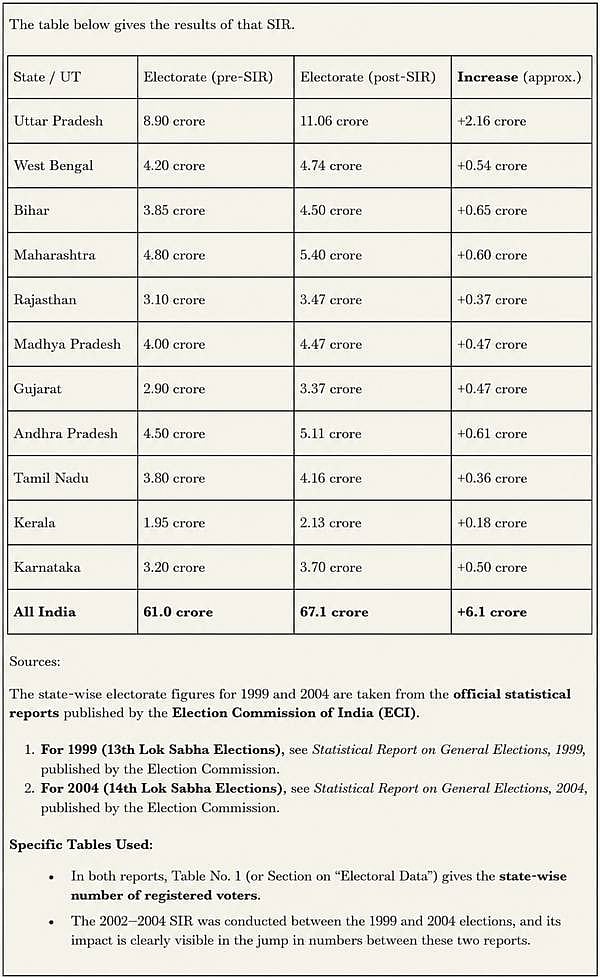
Twenty years later its task became even easier when Electronic Voting Machines and record keeping were introduced, first in selected states in 1998, and then nationwide in 2004. That finalisation of the switch to electronic voting and record-keeping enabled the ECI to conduct its first Special Intensive Review from 2002-2004, generating a basic electoral roll which has become the reference point for all elections held in the country since then, including the one launched by the Modi government in 2025. The table below gives its results:

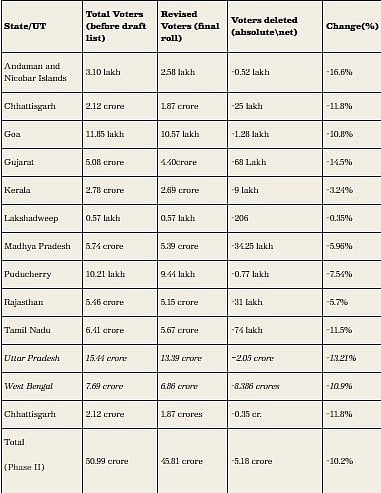
In sum, between 1951 and 2004 the Election Commission’s growing experience, and progressively better methods of registration and record- keeping, increased the size of the electorate. But, in the sharpest possible contrast, as the table issued by the Election Commission itself, which is reproduced below, shows, the 2025-26 SIR has done the exact opposite, and reduced the size of the electorate by almost the same proportion. 

Which of these two diametrically opposite trends – where the 2002-2004 SIR led to an increase in the size of the electorate while the 2025 one led to a sharp decrease – should the Indian public trust? The answer can be found by comparing both sets of data with a third: That is the change in the size of the population of India between 2004 and 2024. This grew from 113.6 crores in 2004, to 144.2 crores in 2024. 

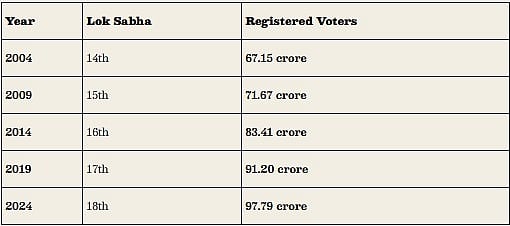
Moreover, as the table below shows, this increase was fully reflected in the increase in the number of registered voters in the Lok Sabha elections of this period: 

This is an increase of 30.64 crores in 20 years, an annual increase of almost 1.5 crores a year. These voters’ rolls were prepared during the tenure of Manmohan Singh and Narendra Modi both. All of this data, compiled by AI from EC reports, reflect the same rate of growth of the electorate, of about 1.56% a year, which is identical to the growth of the +18 population of the country during this periodSo the possibility of double-counting of voters because of mass migration, non-registration of change of residence, or death – all the plausible reasons that CEC Gyanesh Kumar has given – at the scale suggested seems improbable. 

There are only two possible answers: the first is that the Election Commission has deliberately made it so difficult, and so expensive, for those who are not on the so-called “legacy electoral rolls” of 2004, created a full 20 years agoto return to their original homes now to collect, or get re-issued, the documents of domicile that will enable them to qualify as voters, that huge numbers have simply given up trying. The second, which is Modi’s favourite, is the need to prove that they are truly Indian citizens and not illegal immigrants from Bangladesh, Myanmar, or any other place. Although the Supreme Court has asked the Election Commission to consider the Aadhaar card, every other proof of identity that a migrant worker needs has to be obtained from home. 

The 10% drop in the electorate shows how vast is the number that have given up even trying to vote. That, of course is what Modi and the BJP want, for these are the poorest people in the country who are most prone to voting as a bloc, and have tended to vote, as the Aam Aadmi Party’s repeated victories in Delhi and more recently in Punjab show, for those who can give them a smidgen of hope for the future. 

As many surveys have shown, a disproportionate proportion of the poorest in the country are also Muslims. So, Modi has all but succeeded in ensuring that only the relatively privileged will find it easy to cast their votes. 

Mamata Banerjee is therefore right. The election in Bengal was, in all probability, ‘stolen’ through a conjunction of these factors. But what happened in Bengal will now happen in the rest of India.

Prem Shankar Jha is a veteran journalist, writer and economist. Read more from him here

  •  

Best International Travel Insurance Plans for Stress-Free Overseas Trips

But travel has its own problems you never added to the itinerary. A medical emergency in a country where one hospital visit costs more than your flight tickets. A cancelled connection that disrupts an entire trip. Luggage that lands in a different city while you land in another.

These are not rare travel horror stories. They are the everyday situations travel insurance plans are built for, especially when you are travelling abroad.

The right international travel insurance does more than cover unexpected expenses. It gives you a way to handle delays, medical emergencies, or travel disruptions without suddenly depending entirely on your savings.

The Part Nobody Tells You About Travelling Abroad

Your regular health insurance, the one you dutifully pay premiums for every year, almost certainly does not work outside India. Most domestic policies stop at the border.

So, the moment you land in another country, you are essentially uninsured for medical expenses unless you have a travel insurance plan specifically built for international travel. And medical costs abroad are not comparable to what you would pay at home. A single night in a US hospital can run into several lakh rupees. In Europe, even a GP consultation can cost more than a decent hotel room.

This is the gap that international travel insurance fills, especially when standing in a foreign emergency room.

What You are Actually Paying for When You Buy a Plan

Beyond medical cover, a solid travel insurance plan usually takes care of:

  • Non-refundable flight and hotel costs if your trip gets cancelled for a covered reason

  • Baggage that gets lost, stolen, or delayed long enough to ruin the first few days

  • A missed connecting flight that leaves you stranded between cities

  • Emergency cash assistance if your wallet gets stolen abroad

  • Legal and repatriation costs in worst-case scenarios

Some plans also allow you to add extra coverage for adventure sports, cruise travel, or higher personal liability limits. The base plan handles the common situations. The add-ons handle the specific ones.

How to Actually Pick the Right Plan for Your Travel Abroad

Honestly, start simple. Where are you going?

Medical costs vary wildly by country, and that single factor shapes everything else. A trip to Thailand or Bali needs a very different sum insured than a trip to New York or London. Southeast Asia is generally more forgiving of medical bills. The US is not. If America is on the itinerary, do not lowball the coverage and hope for the best.

How often you travel matters too. If this is a once-a-year holiday, a single-trip plan does the job fine. But if you are someone who catches flights the way most people catch the metro, an annual multi-trip plan will save you both money and the recurring headache of buying a new policy every time.

What If You are Travelling to a European Country?

If a Schengen country is on your list, international travel insurance is not a nice-to-have. It is a visa requirement. Your plan needs to show a minimum medical cover of EUR 30,000, valid across all Schengen member states, for every single day of your stay.

Conclusion

Good international travel insurance is bought before the trip, sits quietly in your inbox, and hopefully never needs your attention.

That is usually the ideal outcome.

But if a flight gets cancelled, your baggage disappears, or a hospital visit suddenly becomes part of the itinerary, having the right travel insurance plan can make the situation far easier to handle financially.

And that is usually when you realise why buying it early was worth it.

This is an advertorial. The article is published as received.

Best International Travel Insurance Plans for Stress-Free Overseas Trips
  •  

Benefits of Using Hero FinCorp EMI Calculator for Financial Planning

Financial planning involves managing income, expenses, and future commitments in a balanced way. When considering a loan, it is important to understand how repayment will affect monthly finances. A Personal Loan monthly EMI calculator helps estimate this obligation in advance, allowing borrowers to plan with greater clarity. By using such a tool early, individuals can avoid uncertainty and make informed decisions. To better understand its role, it is useful to first look at how EMIs fit into overall financial planning.

Understanding EMI in Financial Planning

Equated Monthly Instalment, or EMI, is the fixed amount paid every month towards repaying a loan. It includes both the principal and the interest components. Since EMI is a recurring expense, it directly affects how a person manages their monthly budget. Knowing this amount in advance helps individuals assess whether the repayment fits within their income.

Without this clarity, it becomes difficult to balance loan commitments with other financial priorities such as savings, essential expenses, and emergency funds. A well-planned EMI ensures that borrowing remains manageable over the entire loan tenure and supports long-term financial stability.

How the EMI Calculator Supports Financial Planning

An EMI calculator supports financial planning by providing clear, practical insights before a loan is taken.

Clarity on Monthly Financial Commitment

The calculator provides an instant estimate of the EMI based on inputs such as loan amount, tenure, and interest rate. This helps users understand how much they need to allocate each month, making it easier to assess affordability and avoid unexpected financial pressure later.

Better Alignment with Monthly Budget

With a clear EMI figure, individuals can compare the repayment amount with their income and existing expenses. This allows them to maintain a balanced budget and avoid disruptions to essential spending. It also supports disciplined financial management over time.

Flexibility to Plan Loan Structure

Users can adjust variables such as loan amount and tenure to see how the EMI changes. A longer tenure may reduce the monthly EMI, while a shorter tenure may increase it but lower the total interest paid. This flexibility helps borrowers choose an option that fits both short-term affordability and long-term financial planning.

Helps Avoid Over-Borrowing

By testing different loan amounts, users can identify a borrowing level that fits their repayment capacity. A Personal Loan monthly EMI calculator encourages responsible borrowing by showing realistic repayment expectations and helping users stay within their financial limits.

Supports Informed Decision-Making

Instead of relying on assumptions, users can make decisions based on calculated values. This reduces uncertainty and helps them evaluate whether the loan aligns with their financial goals. Once comfortable with the estimate, they can proceed to apply for an instant Personal Loan with better confidence and preparedness.

Smooth Transition to Application Stage

After identifying a suitable EMI and loan structure, the next step becomes more straightforward. The calculator bridges the gap between planning and action, allowing users to move forward when they feel prepared to apply for an instant Personal Loan without hesitation.

These benefits make the EMI calculator a practical tool for planning and evaluating borrowing decisions.

How to Use the Hero FinCorp EMI Calculator

Using the Hero FinCorp EMI calculator is a simple and structured process that helps estimate the monthly repayment based on key loan details.

●       Enter Loan Amount: Input the amount you plan to borrow, as this forms the basis of the EMI calculation.

●       Enter Interest Rate: Add the applicable rate of interest, which influences the overall repayment amount.

●       Select Loan Tenure: Choose the repayment period in months or years based on your financial capacity.

●       View EMI Instantly: The calculator displays the estimated monthly instalment along with the total interest payable.

●       Adjust Inputs: Modify the loan amount, interest rate, or tenure to compare different repayment scenarios.

By following these steps, users can evaluate multiple loan options and select a repayment plan that aligns with their financial goals and monthly budget.

Key Considerations While Using EMI Calculators

While EMI calculators are useful for planning, it is important to interpret the results carefully.

●       Indicative Estimates: The EMI shown is an estimate and may differ from the final approved amount.

●       Variable Interest Rates: The applicable interest rate can vary based on individual eligibility and other factors.

●       Overall Financial Position: Monthly repayment should be evaluated along with existing expenses and obligations.

Keeping these factors in mind ensures that the calculator is used as a planning tool rather than a final loan commitment, helping users stay realistic about their financial decisions.

Conclusion

Planning finances before taking a loan helps in managing future commitments with greater confidence. An EMI calculator provides a simple way to estimate monthly repayments and assess affordability in advance. By offering clarity on repayment structure, it supports better budgeting, disciplined financial planning, and informed decision-making. When used effectively, it allows individuals to approach borrowing with a clear understanding of their financial position, making the overall process more predictable, balanced, and easier to manage over time.

This is an advertorial. The article is published as received.

Benefits of Using Hero FinCorp EMI Calculator for Financial Planning
  •  

Savings account statement explained: How to read and understand it

You do a lot with your savings account over the course of a month. From bill payments, fund transfers, investments, to building your account balance, you explore various functions with regular transactions. It helps to get an overview of all the debits and credits to help you keep track of your finances. This is where a bank statement becomes relevant. It is a detailed record of your financial activity. Learn how to read it for proper financial planning in this blog.

What is a savings account statement? 

A savings account statement is a periodic summary of your banking activity over a specific time frame. It includes details of every deposit, withdrawal, transfer, and payment made in a single place. This gives you a clear view of the cash flow and the actions leading up to your current account balance.

You see your opening and closing account balances, giving you a snapshot of how you started and where you currently stand. You also get details on the interest credits made to your account. You can estimate the same using a savings account calculator.

Key components of a bank statement 

The main aspects covered in a bank statement can be broadly broken down into these components:

  • Account information

This section is typically the first thing you’ll see. It highlights your name, address, account number, bank name, branch details, etc.

  • Statement period

The timeframe covered appears at the top. It shows the start and end dates for each of the listed financial activities.

  • Balance summary

This is an overview of how money moves in and out of your account. You see the opening balance, deposits (credits) or withdrawals/deductions (debits), and the closing balance.  

  • Transaction details

Each entry includes the date of the transaction, a short description to identify the activity, debit/credit amounts, fees, interest, and the balance after each transaction.

  • Fees and interest

Interest earned and fees applied are also listed. You can cross-check the earnings as estimated against the interest rate with a savings account interest calculator.

How to read your bank statement 

Having understood the main aspects covered in a bank statement, you can put it all together easily. Here’s how you can proceed to decode the essentials:

  • Check your account details and statement period to review transactions within the specific timeline you prefer.

  • Scan the account balance to get a sense of where you stand with your finances.

  • Go through each entry carefully to match it to your spending pattern and receipt record.

  • Review any fees levied and interest credited.

  • If something looks unfamiliar, double-check against your activity and report it immediately.

Steps to get a bank statement 

Many banks send periodic statements to your registered email if you’ve opted in, or you can update your physical passbook. Another convenient option to get your bank statement is online.

  1. Log in to your bank account: Use your bank’s net banking portal or mobile app to access your account.

  2. Navigate the statement section: Look for the ‘Account Statement’ or ‘Download Statement’ option under the menu.

  3. Select the account and time period: Choose the savings account you need the statement for and specify the date range you need.

  4. Generate and download: Confirm your request to view, download, or get the bank statement in your email inbox.

You can do this as many times as you like for different periods. You can get a mini-overview or a detailed statement for a thorough evaluation of your banking activity.

Final words 

It’s easy to understand your bank statement once you understand the main components. Look at how it is structured and review all the details to get a complete overview of your transactions. Developing this habit of reading your bank statement is good for planning your finances effectively. It is also a safety measure to spot suspicious account activity in time. Also, the various ways to get your bank statement add to the flexibility.

This is an advertorial. The article is published as received.

  •  

Deleted voters must not be forgotten

The Opposition parties in India are either naive or we must conclude that they may not be really sincere when they shout about ‘vote chori’. If they indeed believe in what they say about ‘vote chori’ and massive targeted deletions, why are they participating in these fake elections and sitting in legislatures which are elected on the basis of ‘vote chori’ and voters list deletions?

I’ve been arguing for a long time that in the light of serious questions on the fairness of due process in the elections, the entire opposition should boycott elections and resign their seats from all the legislatures: Lok Sabha and State Assemblies. This will deny the BJP legitimacy in the eyes of the people.

Let me say this about Mamata Banerjee’s stand. If she’s really serious about rejecting the declared mandate and refuses to resign, it means that she doesn’t recognise the to-be constituted Assembly – which only means she is considering the outgoing legislature still valid.

In that case, she should say all her party people who got elected in this illegitimate election would quit the house, and she should make them quit. Then her stance carries conviction. If you say, ‘my party’s winners are ok but your party’s winners are illegally elected’, what does that say about her conviction?

An argument with conviction would be to reject the results, indeed even if she won, since the deletion of 93 lakh votes and denial of voting rights to 27 lakh people vitiates the process, irrespective of who won or who lost. If this was her position, then it would be considered genuine and her stance accepted as taken with conviction.

Now, sadly, she is open to be accused of playing a sore loser. With the large-scale deletions and a humongous number of ‘under adjudication category’ voters not allowed to vote, it is time that all opposition parties sit together and do some serious thinking.  

Consider Bihar and the ‘Vote Adhikar’ yatra led by Rahul Gandhi, described as “a united fight to protect the most sacred right in our democracy – the right to vote”.

It covered over 1,300 Km and 20 plus districts to “expose voter list manipulation and demand clean voter lists from the Election Commission”. Looking at the surging crowds, the Congress fancied that they’d somehow win. So, victory mattered more than disenfranchised people. If they won, should it be the case that deletions and disenfranchisement did not matter?

Any one eligible person who is struck off the electoral rolls should worry everyone who is in the electoral rolls. Recollect that during the hearings regarding the Special Intensive Revision (SIR) of voter lists in West Bengal in April 2026, Justice Joymalya Bagchi of the Supreme Court raised concerns about scenarios where the deletions might turn out to be more than the margins of victory, which would invite serious scrutiny from the Supreme Court.

One implication of this is that a deletion becomes an issue only on the basis of the preferences of those who are not deleted! If those on the voters list choose a party/candidate and the margin of that party’s/candidate’s victory is less than the number of deleted citizens, do the deleted matter? Not that after the results, nobody talks about the those who were deleted from the electoral rolls in Bihar.

A similar story is repeated in States that went to the elections but about which there is not as much controversy – Tamil Nadu, Kerala, Puducherry – and the States that did not go for elections but had SIR, like UP, where 2.8 crore deletions happened: What about them?

No political party, no media, not even the so-called independent digital platforms talk about them. In other words, 2.8 crore people don’t matter to us when there’s no election?

Boycotting elections and resigning from legislatures until this institutional capture is broken might sound and look like an ideal but an impractical solution. But very rarely do the ideal and the practical converge in real life. In our nation’s life, this is the moment that calls precisely for that convergence.

The practical is ideal and the ideal is practical at this juncture of our Republic, when we face a deep crisis.

If we are to believe that Mamata Banerjee is a real crusader, let her decide that all her newly elected MLAs resign or refuse to take oath in the new legislature that she questions the legitimacy of. Then she will carry conviction in my reckoning.

Otherwise, she will be vulnerable to the charge that she is just a sore loser. But can the opposition bite the bullet? It is not a business-as-usual situation anymore. Extraordinary times call for extraordinary measures. Afterall, it is the Republic that is at stake. It’s our Republic. We gave the constitution unto ourselves.

Only a peaceful, Gandhian ‘feet on the ground’ movement can save our 1950 compact. The values embedded in that 1950 compact: Liberty, Equality, Fraternity, Justice, Secularism, can be defended only by that. Each one of us must decide and work for rescuing the republic and the Idea of India. Keep in mind that everyone who lives in this land owns this country. It’s not owned by any one denomination, religion, caste, creed, region, colour, eating and dressing habits and traditions.

It’s owned by everyone. Forces that are in disagreement with this idea of India, assaulted it and worked for a hundred years to undermine it. Today, there is no alternative to defending the essential character of India, a country, a territory, a space that is and must be available for everybody.

(Dr. Parakala Prabhakar is a noted economist, political commentator and a former communications advisor to the Government of Andhra Pradesh) (Syndicate: The Billion Press) (E-mail: editor@thebillionpress.org)

Deleted voters must not be forgotten
  •  

What is a GIFT City bank account, and who can open one?

GIFT (Gujarat International Finance Tec-City) is India’s first International Financial Services Centre (IFSC) that competes with global hubs like Singapore and Dubai. Among its various services, it also offers banking services for NRIs. This opens a new avenue to manage your foreign income in India. If you’ve been curious about it, this blog explores everything you need to know about a GIFT City account for upgrading your banking experience in India.

What is a GIFT City bank account? 

GIFT City account is essentially a foreign-current bank account that IFSC Banking Units (IBUs) offer. You can hold and make transactions directly in foreign currencies like USD, GBP, EUR, etc., with this global bank account.

It is ideal for cross-border transactions. A GIFT City combines global access with a familiar banking setup in India. You are eligible to open the GIFT City account as an NRI, OCI, or PIO. You can use the account to save, make seamless transfers, and explore international markets.

Key features and benefits of the GIFT City account 

GIFT City account includes a host of features that enhance your banking journey as per the international standards within India. Some of them include:

  • Transact in foreign currency

With banking in GIFT City, you can hold and use your funds directly in currencies like USD, EUR, AUD, GBP, etc. This reduces the need for constant conversions and saves cost.

  • Access to global investment avenues

A GIFT City bank account opens up opportunities to explore international investments easily. Since your finances are already aligned with the global markets, you get easy access.

  • Tax-efficient structure

Under the IFSC framework, certain investments incur zero capital gains tax, no GST on offshore services, no STT on certain investments. This helps you earn efficiently from overseas markets.

  • Globally competitive interest rates

As the interest rates are linked to international benchmarks, your deposits get to grow in line with the global trends.

  • Simplified banking experience

Much like a regular NRI account, a GIFT City account also comes with seamless digital operations. You can perform day-to-day transactions through the convenient banking app.

  • Strong regulatory framework

The IFSCA, a government body, authorises banking activities within the GIFT City. Hence, you are assured of a transparent and globally compliant system.

  • Ease of remitting money

As the GIFT City global account is connected to the international markets, moving funds across borders is a breeze. There are no unnecessary delays or hefty charges.

  • Cheaper borrowing cost

You can access cheaper dollar loans or External Commercial Borrowing (ECBs) with your GIFT City bank account. This is possible thanks to IFSC entities that reduce borrowing costs and enhance capital access.

How to open a GIFT City bank account 

The process of opening a GIFT City account is straightforward with a fully digitised system. Follow these simple steps:

  1. Choose an IBU

Select a bank registered as an IBU. Compare the specialised bank-specific offers, the reputation, and service experience of each bank to finalise the GIFT City account.

2.       Fill out the application

Provide your basic identity-specific details and contact information. If you need assistance, you can seek the help of a relationship manager.

3.       Complete documentation

Provide basic documents like your passport, visa, residence proof, and PAN (if applicable). If you are an existing customer, you only need to fill out the application.

4.       Activate your account

Once approved, you can activate the account by remitting funds in foreign currency directly from your overseas account.

Final words 

As global financial services evolve, financial hubs like IFSC highlight growing potential. You can participate in this revolution as an NRI with a GIFT City bank account. It is easy to open through any of your preferred IBUs, and you can set it up in minutes. Once done, explore seamlessness of global transactions with India, investing in capital markets, and advanced investment avenues. The possibilities are endless for your foreign income to grow. This is yet another way to connect to your homeland besides NRI savings accounts.

This is an advertorial. The article is published as received.

What is a GIFT City bank account, and who can open one?
  •  
❌