
Normal view

When a president is unfit for office, here’s what the Constitution says can happen

President Donald Trump mimics an Iranian protester being shot while holding a news conference in the White House on April 6, 2026. Tom Williams/CQ-Roll Call, Inc via Getty Images

Bipartisan calls for President Donald Trump’s removal from office increased on April 7, 2026, after he issued threats to destroy “a whole civilization” if Iran refuses to reopen the Strait of Hormuz.

These calls have come from across the political spectrum, from Democratic Reps. Alexandria Ocasio-Cortez of New York and Melanie Stansbury of New Mexico to former Rep. Marjorie Taylor Greene and right-wing pundit Alex Jones. Unlikely allies seem to agree that the president has gone too far and needs to be reined in.

Their concerns have emerged as Iran has walked away from talks to end the war and Trump’s language suggests that he plans to escalate it by destroying the country’s power plants and bridges.

Concerns over Trump’s fitness for office have grown in recent weeks as his commentary has become more erratic.

If lawmakers do attempt to remove Trump from office, here’s what would happen:
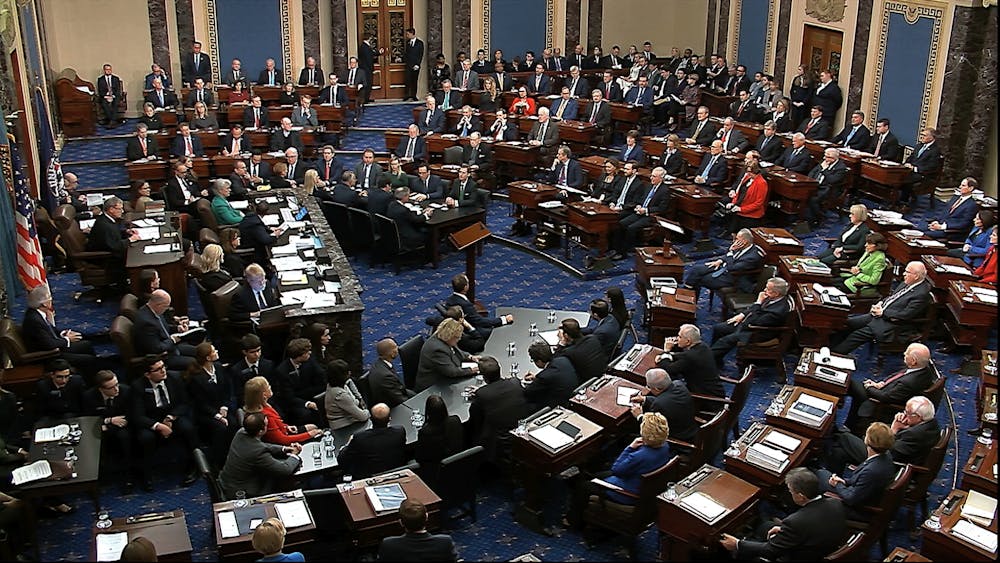
A scene of the Senate voting in Trump's impeachment trial in 2020
Donald Trump has been impeached twice, but has not convicted. Senate Television via AP

25th Amendment

The Constitution’s 25th Amendment provides a way for high-level officials to remove a president from office. It was ratified in 1967 in the wake of the 1963 assassination of John F. Kennedy – who was succeeded by Lyndon Johnson, who had already had one heart attack – as well as delayed disclosure of health problems experienced by Kennedy’s predecessor, Dwight Eisenhower.

The 25th Amendment provides detailed procedures on what happens if a president resigns, dies in office, has a temporary disability or is no longer fit for office.

It has never been invoked against a president’s will, and has been used only to temporarily transfer power, such as when a president is undergoing a medical procedure requiring anesthesia.

Section 4 of the 25th Amendment authorizes high-level officials – either the vice president and a majority of the Cabinet or another body designated by Congress – to remove a president from office without his consent when he is “unable to discharge the powers and duties of his office.” Congress has yet to designate an alternative body, and scholars disagree over the role, if any, of acting Cabinet officials.

The high-level officials simply send a written declaration to the president pro tempore of the Senate – the longest-serving senator from the majority party – and the speaker of the House of Representatives, stating that the president is unable to discharge the powers and duties of his office. The vice president immediately assumes the powers and duties of the president.

The president, however, can fight back. He or she can seek to resume their powers by informing congressional leadership in writing that they are fit for office and no disability exists. But the president doesn’t get the presidency back just by saying this.

The high-level officials originally questioning the president’s fitness then have four days to decide whether they disagree with the president. If they notify congressional leadership that they disagree, the vice president retains control and Congress has 48 hours to convene to discuss the issue. Congress has 21 days to debate and vote on whether the president is unfit or unable to resume his powers.

The vice president remains the acting president until Congress votes or the 21-day period lapses. A two-thirds majority vote by members of both houses of Congress is required to remove the president from office. If that vote fails or does not happen within the 21-day period, the president resumes his powers immediately.

The 25th Amendment
The 25th Amendment to the U.S. Constitution. National Archives via AP

The case for impeachment

Article II of the Constitution authorizes Congress to impeach and remove the president – and other federal officials – from office for “Treason, Bribery, or other high Crimes and Misdemeanors.” The founders included this provision as a tool to punish a president for misconduct and abuses of power. It’s one of the many ways that Congress could keep the president in check, if it chose to.

Impeachment proceedings begin in the House of Representatives. A member of the House files a resolution for impeachment. The resolution goes to the House Judiciary Committee, which usually holds a hearing to evaluate the resolution. If the House Judiciary Committee thinks impeachment is proper, its members draft and vote on articles of impeachment. Once the House Judiciary Committee approves articles of impeachment, they go to the full House for a vote.

If the House of Representatives impeaches a president or another official, the action then moves to the Senate. Under the Constitution’s Article I, the Senate has the responsibility for determining whether to remove the person from office. Normally, the Senate holds a trial, but it controls its procedures and can limit the process if it wants.

Ultimately, the Senate votes on whether to remove the president – which requires a two-thirds majority, or 67 senators. To date, the Senate has never voted to remove a president from office, although it almost did in 1868, when President Andrew Johnson escaped removal from office by one vote.

The Senate also has the power to disqualify a public official from holding public office in the future. If the person is convicted and removed from office, only then can senators vote on whether to permanently disqualify that person from ever again holding federal office. Members of Congress proposing the impeachment of Trump have promised to include a provision to do so. A simple majority vote is all that’s required then.

This is an updated version of an article originally published on Jan. 9, 2021.

The Conversation

Kirsten Matoy Carlson does not work for, consult, own shares in or receive funding from any company or organization that would benefit from this article, and has disclosed no relevant affiliations beyond their academic appointment.

What a US attorney general actually does – a law professor spells it out

U.S. Attorney General Pam Bondi answers questions from the media at the U.S. Capitol on March 18, 2026. Matt McClain/Getty Images

President Donald Trump fired Attorney General Pam Bondi on April 2, 2026, only 14 months after she was sworn into office, making her time in the role the shortest in 60 years.

While much recent attention has focused on Trump’s decision to fire Bondi, there has been less attention on what the attorney general actually does, or what happens when the attorney general gets fired.

The attorney general is the lawyer appointed by the president and confirmed by the Senate to lead the Department of Justice, known as the DOJ. Because the attorney general’s expansive responsibilities place the office at the forefront of both politics and the law, the position is one of the most important in the federal executive branch.

Two men in suits walking through a crowd outside.
NAACP leader Roy Wilkins walks in front of U.S. Attorney General Robert Kennedy during an NAACP march on June 24, 1964, in Washington, protesting the disappearance of three civil rights workers in Mississippi. Washington Bureau/Getty Images

File lawsuits, give advice

Congress created the position of attorney general in 1789 so the national government had a designated lawyer to conduct federal lawsuits for crimes against the United States such as counterfeiting, piracy or treason, and to give legal advice to the president and cabinet officials, such as the secretary of the Treasury.

Initially, the attorney general served part time. Indeed, for the first few decades of U.S. history, most attorneys general maintained private law practices and even lived away from the capital. But as the federal government began to do more, the role of the attorney general grew and became a full-time job.

The attorney general represents the United States in all legal matters. In doing so, the attorney general supervises federal prosecutions by the 93 U.S. attorneys who live and work across the United States to enforce federal laws. The attorney general also supervises almost all legal actions involving federal agencies – from the Department of Homeland Security and the Environmental Protection Agency to the Social Security Administration.

For example, in the past few months, DOJ lawyers supervised by the attorney general have charged people with conspiring to smuggle artificial intelligence technology to China and negotiated an agreement requiring Ford Motor Company to clean contaminated groundwater in New Jersey. They have also worked with Wisconsin to successfully prosecute deceptive timeshare exit services targeting elderly customers.

Additionally, the attorney general gives legal advice to the president and heads of the cabinet departments. This includes providing recommendations to the president on whom he should appoint as federal judges and prosecutors.

In combination, these two aspects of the job, representing the U.S. and advising the cabinet departments, mean that the attorney general plays a key role in helping the president perform his constitutional duty to take care that the laws of the United States are faithfully executed.

115,000 employees

Since 1870, attorneys general have had an entire executive department – the Department of Justice – to help them execute their duties.

Today’s department contains over 70 distinct offices, initiatives and task forces, all of which the attorney general supervises. There are currently over 115,000 employees in the department.

The DOJ contains litigation units divided by subject matter like antitrust, civil rights, tax and national security. Each of these units conducts investigations and participates in federal lawsuits related to its expertise.

The Justice Department also has several law enforcement agencies that help ensure the safety and health of people who live in the United States. The most well-known of these agencies include the FBI, the Drug Enforcement Administration and the U.S. branch of the International Criminal Police Organization, known as Interpol.

Additionally, the DOJ contains corrections agencies like the Federal Bureau of Prisons and the U.S. Parole Commission. These agencies work to ensure consistent and centralized coordination of federal prisons and offenders.

Finally, the department manages several grant administration agencies. These agencies, such as Community Oriented Policing Services, the Office of Justice Programs and the Office of Sex Offender Sentencing, Monitoring, Apprehending, Registering and Tracking, or SMART, provide financial assistance, training and advice to state, local, tribal and territorial governments as they work to enforce the law in their own communities.

A formal portrait of a man with dark hair and colonial dress.
Edmund Jennings Randolph, appointed by President George Washington as the nation’s first attorney general in 1789 and then, in 1794, secretary of state. The Diplomatic Reception Rooms, U.S. Department of State, Washington, D.C.

Separating politics from law

Given all the attorney general’s responsibilities, the role is both political and legal. As such, attorneys general historically have a difficult task in separating their jobs as policy adviser from their duties as chief legal officer of the United States.

For example, President George W. Bush’s attorney general, Roberto Gonzales, resigned from office amid accusations of the DOJ’s politicized firing of U.S. attorneys and misuse of terrorist surveillance programs. And Loretta Lynch, President Barack Obama’s attorney general, was criticized for meeting privately with former President Bill Clinton while former Secretary of State Hillary Clinton was under investigation by the DOJ.

The attorney general’s job is complicated by the fact that the president has the constitutional power to fire them for political reasons.

During his first term, Trump replaced Attorney General Jeff Sessions after Sessions angered Trump by recusing himself – removing himself – from overseeing the Mueller investigation into Russian interference in the 2016 election.

Given the attorney general’s connection to the president and the attorney general’s position as the head of the DOJ, when Bondi originally got the job critics saw her as a key part of Trump’s plan to control the department’s agenda, including through the use of the FBI to pursue his perceived enemies.

And now Trump has reportedly fired Bondi for failure to execute his vision.

What next?

Under current law, the president can designate a Senate-confirmed official in the administration or another high-ranking person who has worked within the DOJ for 90 days to serve as acting attorney general. Presidents across both parties historically have relied on these temporary appointments to steer the department as they decide whom to nominate officially for the position.

President Trump has named Todd Blanche as acting attorney general. Blanche, who served as deputy attorney general under Bondi, represented Trump in three of the four major criminal lawsuits he faced before the 2024 presidential election.

Trump is rumored to have discussed Lee Zeldin, the current head of the Environmental Protection Agency, to be Bondi’s permanent replacement. Zeldin worked as part of Trump’s legal defense team during his first impeachment trial.

Blanche’s temporary appointment and Zeldin’s potential nomination have spurred more questions about the politicization of the DOJ.

A recent Associated Press study found that only two in 10 Americans have a great deal of confidence in the department. In part, this is a result of the longstanding political connections between the presidents and their attorneys general.

Ultimately, the fate of the nation’s top law enforcement official is in the hands of politicians.

This is an updated version of an article originally published on Dec. 19, 2024. It is part of a series of profiles explaining Cabinet and high-level administration positions.

The Conversation

Jennifer Selin does not work for, consult, own shares in or receive funding from any company or organization that would benefit from this article, and has disclosed no relevant affiliations beyond their academic appointment.

Supreme Court ruling on Colorado conversion therapy case is not a clear win for conservatives

3 April 2026 at 12:44
The U.S. Supreme Court found a Colorado law banning conversion therapy for gay and transgender minors likely violates free speech. Roberto Schmidt/Getty Images

In an 8-1 decision authored by Justice Neil Gorsuch, the Supreme Court held on March 31, 2026, that a Colorado law prohibiting licensed counselors from performing “conversion therapy” on minors was likely unconstitutional as applied to talk therapy. Justice Elena Kagan filed a separate concurrence, joined by Justice Sonia Sotomayor. Justice Ketanji Brown Jackson dissented.

I am a law professor and political scientist who teaches and writes on free expression and discrimination. I see this holding as a potentially important decision at the intersection of free speech and health care.

Colorado’s law defines conversion therapy broadly. It bans practices that attempt not only to “change an individual’s sexual orientation or gender identity” but also to reduce same-sex attraction. The law allows therapists to provide “acceptance, support, and understanding” of gay or transgender identity. However, they may not help a client suppress those identities. Penalties include fines, probation and loss of license.

People hold signs outside a tall building under construction protesting conversion therapy.
Demonstrators with the Human Rights Campaign stand outside the United States Supreme Court during oral arguments in October 2025. The court released its decision on a free speech challenge to a ban on conversion therapy on March 31, 2026. Jabin Botsford/The Washington Post via Getty Images

Kaley Chiles challenged the law as a violation of her First Amendment free speech rights. As a therapist who only offers talk therapy, Chiles’s objection was limited to her talk therapy. She didn’t contest the ban on what she called “long-abandoned, aversive” conversion practices. And – notably, considering she is an evangelical Christian – Chiles said she never set out to convert her clients. She says she respects her clients’ “fundamental right of self-determination” and determines her therapy approach only after a client identifies his or her own objectives. But she argued that some of her clients wish to “reduce or eliminate unwanted sexual attractions (or) change sexual behaviors,” and the law prevents her from expressing support for any of those goals.

Colorado’s failed ‘professional speech’ argument

Colorado faced a major obstacle in defending the Colorado conversion therapy law. The law was transparently driven by the government’s views about the well-documented inefficacy and harmful effects of conversion therapy. And outside of certain contexts, such as government grants, public employees, advertising and threats, courts have treated such viewpoint-based laws as constitutionally dead on arrival.

Colorado’s best hope in defending the law, then, was to argue that it wasn’t principally a restriction on speech at all. Rather, the state framed the law as a restriction on professional conduct — an area where states have broad regulatory latitude. That framing would mean the law burdened Chiles’ speech only incidentally.

A CBS News Colorado report on Coloradans’ conflicted feelings about the Supreme Court ruling.

In NIFLA v. Becerra, decided in 2018, the court rejected the argument that professional speech was a less-protected category. But it acknowledged that laws “regulating conduct in ways that incidentally sweep in speech” – particularly where they “fall within the traditional purview of state regulation of professional conduct” – might survive under a lower standard of scrutiny.

Colorado attempted to demonstrate such a tradition here, citing medical licensing laws, informed-consent requirements and malpractice liability.

A divided 10th U.S. Circuit Court of Appeals had agreed with Colorado’s argument, as did Jackson in her dissent. But the Supreme Court majority rejected it. Gorsuch wrote that a government cannot evade First Amendment scrutiny by relabeling restricted speech as “conduct,” “treatment” or a “therapeutic modality.” Quoting the dissent of U.S. Circuit Judge Harris Hartz, he called Colorado’s argument a “labeling game.”

For Gorsuch, the key question is whether the law restricts speech in practice. And in Chiles’ case the answer was yes. Colorado was plainly restricting what she wished to tell her clients about their sex and gender issues.

Not just content but viewpoint discrimination

More than that, the majority noted, Colorado’s law doesn’t regulate therapists’ speech based on its content. The law discriminates based on viewpoint, permitting expressions of acceptance and support for a client’s self-identity while forbidding expressions that attempt to change it.

Under 1995’s Rosenberger v. University of Virginia, viewpoint discrimination is an “egregious form” of content regulation. Governments must “nearly always abstain” from it. The court remanded the Colorado case back to the 10th Circuit to resolve the case under this standard.

Jackson’s dissent: Medical treatment, not speech

Jackson’s solo dissent emphasizes that states have long enjoyed broad power to regulate how licensed medical professionals treat patients. To Jackson, the First Amendment should not interfere simply because a treatment is applied through words rather than instruments.

The court’s 2018 NIFLA decision, she argues, distinguished between speech restricted “as speech” and speech restricted “incidentally” as part of a medical treatment the state is otherwise entitled to regulate. According to Jackson, the majority arbitrarily collapses that distinction simply because the treatment is delivered orally. A talk therapy session and a drug infusion are both medical treatments, she argues, and the analysis should not turn on whether the provider uses a syringe or a sentence.

Jackson’s dissent also raises difficult line-drawing problems, such as the validity of less controversial potential prohibitions, such as those on encouraging a patient to smoke or to take their own life.

Implications are broader, narrower than most believe

First, only talk therapy is implicated.

The holding is narrow in this sense. It leaves room for policymakers still hoping to limit the practice of conversion therapy. Because Chiles challenged the statute only as applied to her, the majority’s analysis does not invalidate conversion therapy bans wholesale – neither Colorado’s nor those of more than 20 other states – but applies only to the extent they ban conversion talk therapy.

State legislatures can define conversion therapy a bit more narrowly, for example, by prohibiting the physical and more coercive techniques that initially gave rise to these bans. States can then leave the regulation of talk therapy to other legal and professional mechanisms, such as malpractice or enforcement of professional ethics.

Second, the standard of scrutiny that the lower court must now apply is not strict scrutiny; it is more demanding. Strict scrutiny is a legal test that validates a law if it is “narrowly tailored to achieve a compelling government interest.” Contrary to what some legal commentators have implied, Gorsuch never directs the lower court to use strict scrutiny.

The opinion emphasizes that the law doesn’t just discriminate against certain types of content – a trigger for strict scrutiny; it discriminates based on viewpoint. The strict scrutiny standard is demanding, but laws sometimes survive it. Viewpoint discrimination, on the other hand, is subject to a near-absolute prohibition: Governments must “nearly always abstain” from it. This language is stronger and more categorical than that for strict scrutiny. The implication is that the law should certainly be invalidated as applied to talk therapy.

Not a clear win for conservatives

Finally, the holding is a double-edged sword for conservatives with traditional views of gender identity. And for those discouraged by the outcome, seeing it only as a victory for religious conservatives, the holding’s logic offers a silver lining.

Kagan’s concurrence makes explicit that a “mirror image” law – one barring talk therapy that affirms gender identity – would raise the same constitutional problems.

Dr. John Fryer revolutionized mental health care by speaking publicly about being gay at a 1972 conference of psychiatrists. This NBC News report covers Fryer’s legacy.

The majority makes a similar point. As late as the 1970s, the American Psychiatric Association still classified homosexuality as a mental disorder. Under Colorado’s position, a law from that era prohibiting counselors from affirming gay clients’ identities would have been constitutionally sound.

Today, more than 20 states have moved to restrict gender-affirming care, and the federal government is pressuring state medical boards to adopt skeptical positions on gender transition. It’s not implausible that a legislature would attempt to ban gender-affirming, talk-based therapies. If and when conservative policymakers attempt that move, Chiles will be a formidable obstacle.

Read more of our stories about Colorado.

The Conversation

Kevin Cope does not work for, consult, own shares in or receive funding from any company or organization that would benefit from this article, and has disclosed no relevant affiliations beyond their academic appointment.

❌