Normal view

How America’s independence from England revolutionized US philanthropy

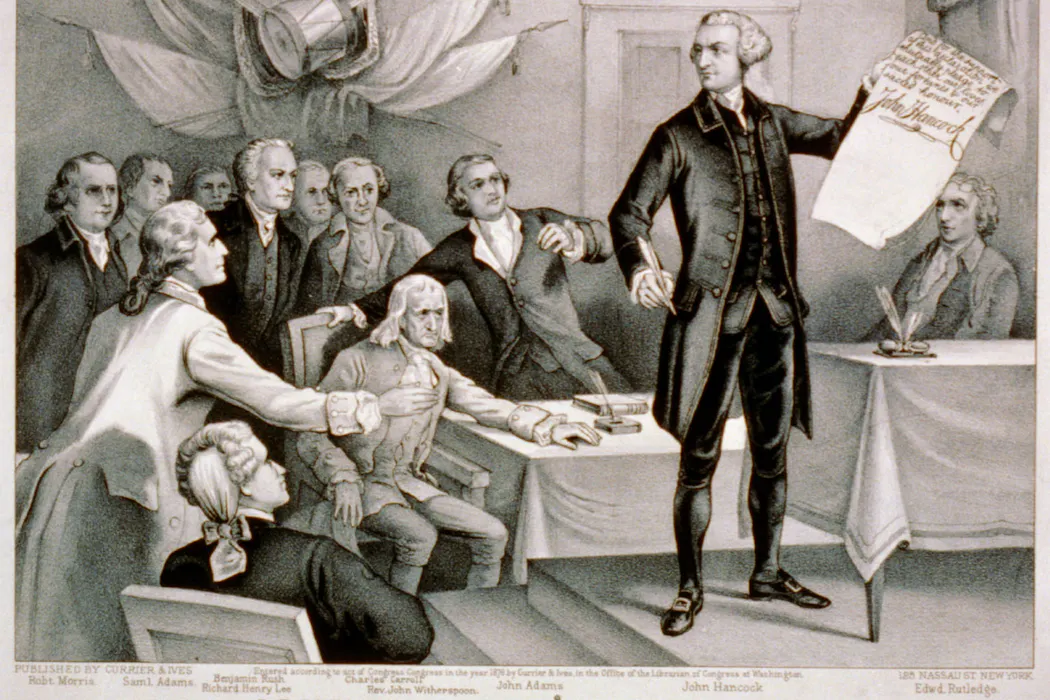
John Hancock, like many American men and women of his generation, transformed the new nation's charitable activities. Universal History Archive/UIG via Getty images

John Hancock did something revolutionary 250 years ago when the Massachusetts merchant signed the Declaration of Independence, announcing to the world that 13 English colonies were freeing themselves from Great Britain and from monarchy.

About a decade later, he signed up as a member of a charity aiding drowning strangers.

That endeavor was revolutionary, too.

As I explain in my 2016 book, “From Empire to Humanity,” the American Revolution transformed how Americans, and also Britons, engaged in giving. Many Americans turned to philanthropy after gaining independence to pursue their ideals of life, liberty and happiness for the new nation.

And while curating the Smithsonian’s National Museum of American History’s “Giving in America” exhibition, for which I collect objects telling stories about Americans’ volunteering, donating and working to aid others, I’m often reminded that Americans still pursue these ideals through their everyday philanthropy.

Charity in North American colonies

Hancock, who was born in Braintree, Massachusetts, on Jan. 23, 1737, grew up in a world where men like his uncle Thomas Hancock dominated charitable activity. Thomas Hancock had made a fortune in business ventures, including the slave trade and military contracting. When he died, he left an array of charitable bequests, including one used for Communion silver for his church.

An engraved silver plate is displayed.
This Thomas Hancock silver communion plate was made around 1764 in Boston. Bequest of Arthur Michael/National Museum of American History

By having Thomas Hancock’s name engraved on the silver plates, the church leaders highlighted what colonial Americans knew: Leadership in philanthropy, as in society at large, was in the hands of elite white men.

That uncle raised John after his father’s death, educating him so he would be prepared for business and civic leadership.

When colonists fell on hard times, they might be eligible for an early form of governmental benefits, known as “poor relief.” They could also turn to their churches, to one another or to a small number of ethnic aid societies, such as Boston’s Scots Society, for support.

In the mid-1700s, Americans founded a number of new welfare and educational institutions, including colleges and charity schools. Benjamin Franklin, a leading philanthropic innovator, helped establish the Pennsylvania Hospital with mixed public and private funding. That funding model would later become common for charitable institutions.

The Revolutionary War interrupted these developments. After independence was won in 1783, the number of charitable organizations and institutions would soon soar.

Humane societies to protect people

U.S. charitable institutions began to rapidly change in the 1780s, as Americans sought to reform society by establishing organizations to support people in need.

An old medal is shown.
This Humane Society of the Commonwealth of Massachusetts Medal was made in 1852. National Numismatic Collection/National Museum of American History

One of those groups was the charity dedicated to rescuing drowning victims and aiding shipwrecked sailors that John Hancock joined, along with Paul Revere. It was known as the Humane Society of the Commonwealth of Massachusetts and, like other similar groups, offered rewards or honors to motivate people to undertake the risky work of saving people from watery graves.

Americans in several cities, along with their peers in the British Isles, the Caribbean and Europe, worked together by publicizing resuscitation techniques, sharing information on effective methods and offering each other moral support.

“Humane” was a popular word in the names of charities dedicated to an array of causes in this era, long before it became associated with the protection of animal welfare.

Philanthropy’s meaning at the time

Throughout the 1700s and much of the 1800s, the word “philanthropy” referred to a sentiment – the love of humanity. That reflected the word’s origins: It’s derived from the Greek words for “love” – “philos” – and “anthropos” – “man.”

For Americans of the founding generation, philanthropy meant, above all else, aiding strangers – people outside their local, religious or ethnic community. Spurred by African Americans’ advocacy, some prominent white Americans, such as Alexander Hamilton, joined antislavery societies, while Northern states gradually began passing antislavery laws.

Making maritime travel safer for people of all backgrounds and nationalities was another way to uphold this value of universal benevolence. Humane societies’ rescuers and rescued people alike included African Americans and foreign mariners, including some from Asia and the Spanish empire. African Americans received awards from anti-drowning groups using the same criteria applied to white people.

In 1794, one of the highest honors went to Dolphin Garler, a Black man in Plymouth, Massachusetts, who had risked his life to rescue a young boy from drowning. Many Americans at this time saw benevolence as a criteria for citizenship. By lauding Garler, the leaders of the Massachusetts Humane Society were challenging other white Americans to recognize Black Americans’ humanity.

Like humane societies, other charities innovated by giving aid across ethnic or denominational lines as Americans built bonds in the new nation. Among them was New York Hospital, which had “charity to all” as its motto and had a diverse patient population. Many were British, Irish and German, with small numbers of people, probably mariners, from places like Portugal and South Asia. The hospital also treated African Americans in segregated wards.

Another new charity embracing this new more universal approach was the Society for the Relief of Poor Widows with Small Children, established in New York City in 1797. It supported poor widows with small children and helped the widows find jobs. While the organization excluded African American women, it innovated by aiding white women without regard to their ethnic or religious background.

New leaders with new causes

The Widows Society, as it was known, was notable for another reason. It was one of the first charities founded and led by women in the new United States.

Before the late 1780s, women made charitable donations to institutions run by men and gave personal alms, but women didn’t lead organizations.

Engraving of a woman writing in a book, wearing a bonnet.
Isabella Graham was a 19th-century diarist and charitable pioneer. Wikimedia

In New York, Scottish immigrant Isabella Graham and other women challenged traditional roles by founding the Widows Society in 1797. That they came together from various Protestant backgrounds was notable at the time.

Within a few years, Eliza Hamilton, Alexander Hamilton’s wife, would join and help lead the Orphan Asylum Society of the City of New York, which grew out of the Widows Society.

Engraving of a well-dressed man.
Richard Allen, an African American bishop, established the first church for Black people in Philadelphia in the late 1700s. Hulton Archive/Getty Images

And yes, that’s the orphanage Eliza Hamilton sings about in “Hamilton,” Lin-Manuel Miranda’s award-winning musical.

Black Americans likewise broke ground by creating charities and independent churches in the founding era. Black men like Richard Allen and Absalom Jones, for example, created the Free African Society, a mutual aid organization, in 1787 in Philadelphia.

In addition to supporting members of the Black community at times of need, the Free African Society led to the creation of independent Black churches as African Americans struggled for inclusion.

Revolutionizing charity management

Founding charities was one thing. Running them was another.

Americans applied managerial skills acquired from operating business, churches and households to caring for people in distress. They also became pros at the business of fundraising: cultivating donors, hosting fundraising events and publishing annual reports, including names of donors.

In short, Americans developed the critical skills to make philanthropy work.

Philadelphia doctor and signer of the Declaration of Independence Benjamin Rush was one of the most skilled philanthropic communicators. As he undertook one humanitarian endeavor after another, Rush collaborated with philanthropic leaders like Isabella Graham and Richard Allen.

Like others of his generation, Rush devoted himself to reforming the country and world. Medical philanthropy, education, antislavery, prison reform – he was engaged in all of them.

He routinely placed excerpts of his letters with other humanitarian leaders in newspapers. Publicity documents, he knew, helped build momentum for humanitarian causes.

Many others shared his belief in the power of philanthropy to help make the world anew.

The Humane Society of the Commonwealth of Massachusetts’ “provision made for Ship-wrecked Marriners is also highly estimable in the view of every philanthropic mind,” George Washington said in 1788. “These works of charity & goodwill towards men … presage an æra of still farther improvements.”

This goodwill could go global. Cooperating across the Atlantic in this cause and others helped Americans and Britons reaffirm and reimagine their bonds.

Bedrock of the American experiment

It was only when rich Americans like steel magnate Andrew Carnegie and oil baron John D. Rockefeller began to make massive donations and set up their own foundations in the late 1800s and early 1900s that the word philanthropy would come to be associated with giving on a massive scale.

As Americans celebrate the 250th anniversary of the Declaration of Independence, I believe it’s worth remembering that the founding generation embraced civic engagement, organizational innovation and generosity as essential pillars in the pursuit of life, liberty and happiness.

For that generation, philanthropy – love of humanity – was the bedrock of the American experiment in republican government.

The Conversation

Amanda Moniz has received funding from the William L. Clements Library in Ann Arbor, Michigan, for research on Isabella Graham.
Solar activity follows an 11-year cycle – here’s how it controls eruptions and solar flares

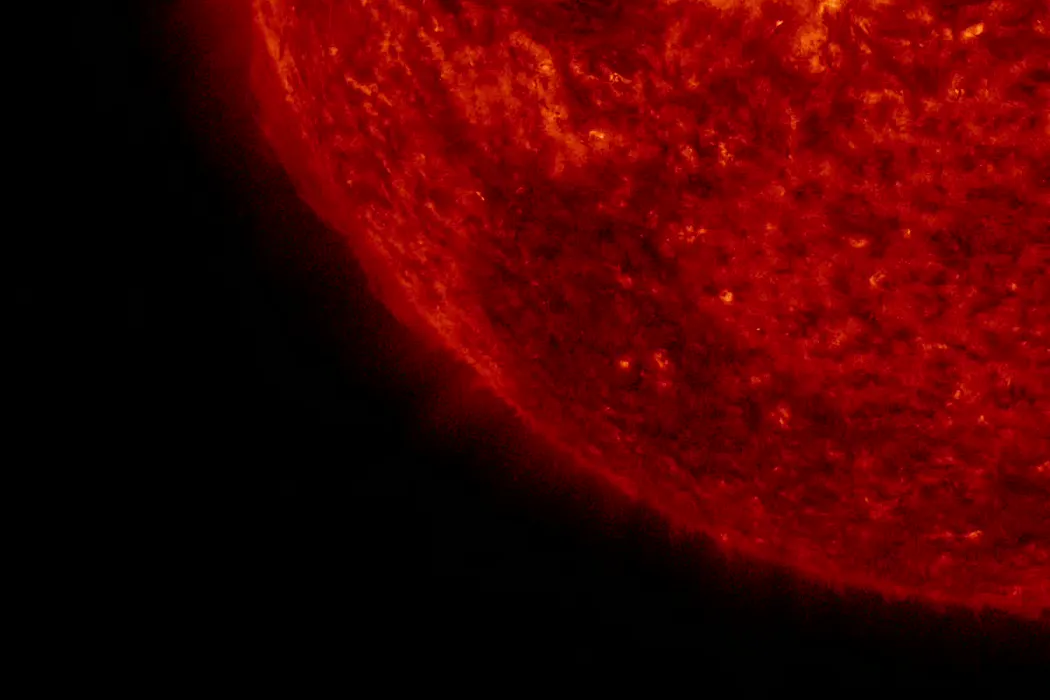
The Sun's surface is dynamic, affected by convection in its interior. NASA/Solar Dynamics Observatory

When you look up at the sky on a sunny day, the Sun might seem like a bright spot, unchanging in the sky. But the Sun is a complex, dynamic celestial body, wrapped in electrical currents and magnetic fields that constantly move and tangle as it rotates. At times the Sun’s surface is very active, casting out powerful bursts of plasma called coronal mass ejections, while at other times it is calmer.

I’m a solar physicist who has spent over a decade researching the Sun. Its movement and activity is directly linked to conditions on Earth: Solar flares and ejections can cause space weather that produces beautiful Northern lights but threatens satellites. This activity follows a roughly 11-year-long cycle, and learning about this cycle helps researchers predict future space weather.

Inside the Sun

The Sun is a star composed of plasma: a hot, ionized gas. The plasma acts as an electrically conductive fluid, and generates large-scale magnetic fields that encircle the Sun.

The Sun is composed of several layers, all made up of a plasma that’s about 70% hydrogen and 28% helium by mass.

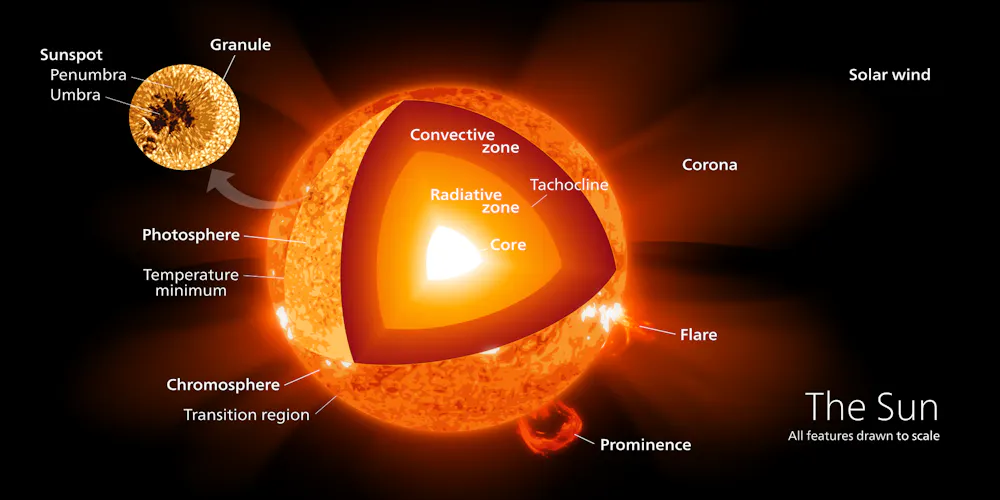
The Sun has a solid core at its center and a dense layer outside the core, where particles of light bounce around, transferring energy outwards. Beyond that layer is a thin line called the tachocline that separates those inner layers from the outer layer. This outer zone is cooler and less dense, allowing plasma to move around.

A diagram showing all the different regions and layers of the Sun
The Sun’s interior is made up of several layers. Kelvinsong/Wikimedia Commons, CC BY-SA

Inside the core, particles collide and release incredible amounts of energy, which radiate out from the Sun in the form of light – a process called nuclear fusion. The light travels outward towards the radiative zone outside the core, before reaching the tachocline.

At the outer layer of the Sun above the tachocline, called the convective zone, the hot plasma travels from deep in the Sun to its surface. As it moves, the plasma cools and contracts, causing it to sink back down. This cyclic process is called convection.

Explaining sunspots, solar cycle and solar dynamo.

The Sun is constantly generating magnetic fields that grow and twist below its surface. Two processes control these magnetic fields by moving the electric charges around in the plasma. One is convection, and the other is the Sun’s rotation.

Scientists think that together, these two processes are ultimately responsible for the Sun’s magnetic activity cycle, during which the Sun shifts from an organized to a less organized magnetic field arrangement. The entire cycle, called the Schwabe Cycle, takes roughly 11 years. Over the course of two Schwabe cycles, the Sun’s magnetic poles flip, and then return to their original orientation.

The Schwabe cycle

When the Sun is in an organized state, the center of the Sun resembles a giant vertical bar magnet with positive and negative ends at the top and bottom, or vice versa – called a magnetic dipole. In the 11-year solar cycle, this phase is known as solar minimum.

A diagram showing the Sun with the top pole labeled '+' and bottom pole labeled '-'. Magnetic field lines come from each pole and curve down vertically to reach the other pole.
During the solar minimum, the Sun’s magnetic field is a simple dipole, with a positive pole and a negative pole on either end. Throughout the solar cycle, the magnetic fields go from simple lines to tangled chaos. NSF/AURA/NSO

Although you cannot see the invisible magnetic field directly, the glowing plasma sticks to these field lines. The magnetic field’s shape during the solar minimum is similar to Earth’s magnetic field, with open-ended magnetic field lines at the north and south poles and closed, looped fields near the equator. After the solar minimum state, the Sun’s magnetic field grows tangled over time. Eventually, it reaches its solar maximum state, where the solar atmosphere resembles tangled up spaghetti.

Two main forces tangle the magnetic field as the Sun rotates and plasma churns away in the convection zone: the Omega and Alpha effects.

Alpha and Omega effects

The Sun doesn’t rotate as a solid body everywhere. The interior of the Sun – the core and radiative layers – spins as a solid sphere, like a basketball. Outside these layers, the convection zone and the surface of the Sun do not spin all together.

By observing the Sun’s visible surface, scientists found out that the solar equator in the center rotates faster than the poles, near the top and bottom of the Sun. It takes the solar equator about 25 days to make a full rotation, while the poles take longer – about 35 days. Because the equator moves faster, it overtakes the poles in a phenomenon called differential rotation.

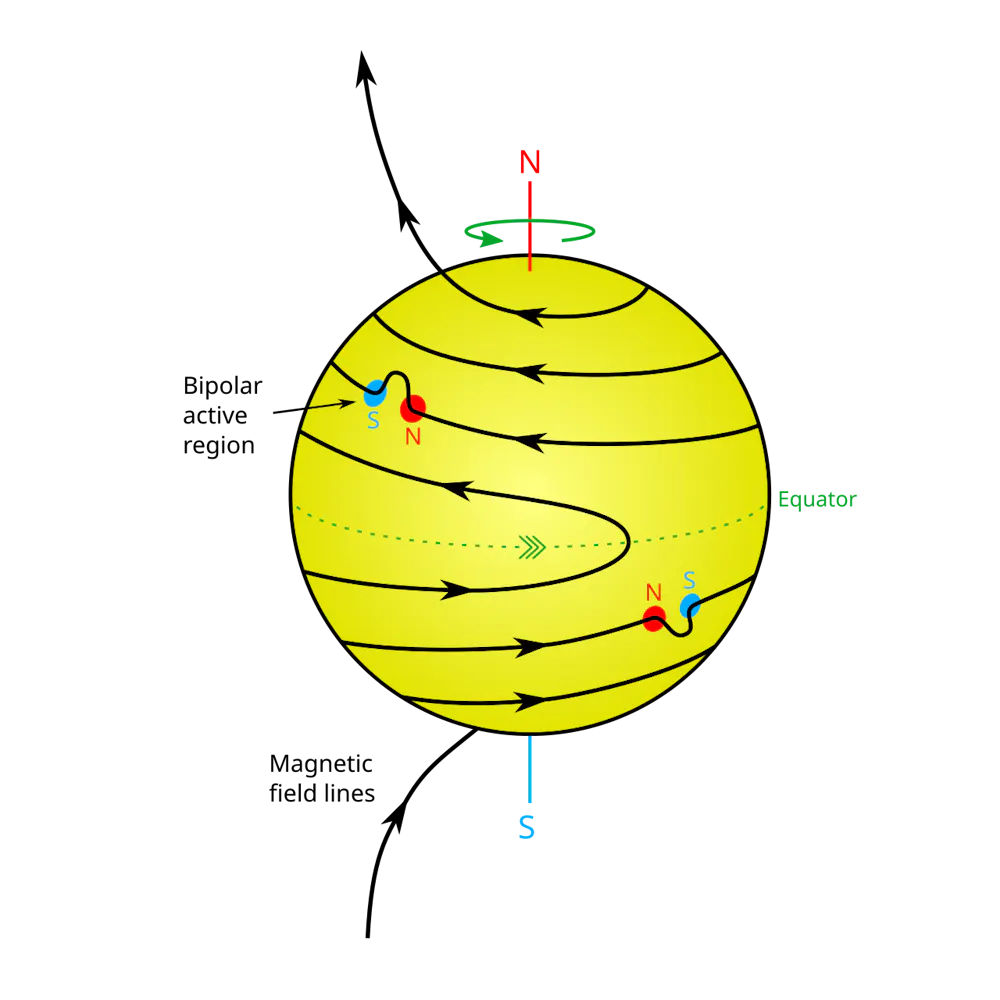
Differential rotation stretches the vertical magnetic field lines around the Sun, causing them to wrap around the Sun horizontally like a belt. The field lines pull on the Sun more tightly as differential rotation continues throughout the solar cycle, in a process known as the Omega Effect.

A diagram showing the magnetic field lines wrapping around the Sun and doubling back.
Differential rotation – where the poles of the Sun rotate more slowly than the center – leads the solar magnetic field lines to stretch as they wrap around the Sun. CoronalMassAffection/Wikimedia Commons, CC BY

The second effect, called the Alpha Effect, is thought to arise from convection taking place below the Sun’s surface coupled with its rotation. Like bubbles rising to the surface in boiling water, the tangled magnetic field becomes buoyant and kinked, popping through the surface to create sunspots.

Sunspots look like clusters of dark spots on the Sun’s surface. Scientists can also identify active regions of intensely strong and complex magnetic field bundles by taking images of the Sun in ultraviolet light, where the bundles appear as bright structures.

Solar eruptions called solar flares and coronal mass ejections occur most frequently in these active regions. The appearance of more sunspots, active regions and solar eruptions all signal to scientists that the Sun is entering its solar maximum phase.

Moving magnetic poles

Over the course of the solar cycle, the Sun’s magnetic poles move. At solar minimum, the magnetic poles are oriented vertically through the Sun’s center. But over the course of the solar cycle, the poles begin to tilt, until the pole previously at the top of the Sun is pointed roughly at its equator.

The Sun flipping its magnetic field.

But at the same time, all the tangled magnetic fields make the poles less defined. This chaotic magnetic state partially leads to sunspots and solar eruptions. After solar maximum, as the Sun’s magnetic state grows more organized again, the poles reappear and continue migrating back towards the top and bottom of the Sun.

However, the magnetic pole previously pointed at the top now points to the bottom, and vice versa. The configuration appears upside down from what it was 11 years ago. A full magnetic cycle takes two Schwabe Cycles – during this time, the Sun’s poles flip twice and return back to the original orientation.

Scientists have observed that several other stars, not just our Sun, have a magnetic activity cycle, though their duration can vary. And, like our Sun, other stars also produce eruptions like stellar flares and coronal mass ejections, likely due to their activity cycles.

Studying magnetic cycles in other stars can help astronomers determine whether distant planets could support life. A star’s magnetic activity directly dictates the amount of space weather the planets around that star experience. These effects can strip away the protective atmospheres around planets, prohibiting them from supporting life.

The Conversation

Yeimy J. Rivera does not work for, consult, own shares in or receive funding from any company or organization that would benefit from this article, and has disclosed no relevant affiliations beyond their academic appointment.

Astrophysicists use ‘space archaeology’ to trace the history of a spiral galaxy

This artist's impression shows the spiral galaxy NGC 1365 colliding and merging with a smaller galaxy. Melissa Weiss/CfA

Billions of years ago, a young spiral galaxy began to grow in a crowded part of the universe. It pulled in gas and small companion galaxies, slowly building up the bright central region and sweeping spiral arms we see today.

In a new study published in March 2026, my colleagues and I used this galaxy’s chemical fingerprints to reconstruct its life story in detail.

Astronomers want to know how spiral galaxies like our own Milky Way came to be, as these galaxies can give us hints about how the elements we rely on, such as oxygen, were created and spread through space over time.

Space archaeology

Like archaeologists sometimes use slices of earth to to turn back the clock and study the Earth’s natural history, we used slices of data of the galaxy’s chemical makeup from different periods in time, alongside sophisticated galaxy evolution models. Together, the data helped us piece together how it formed and grew over 12 billion years.

The galaxy, called NGC 1365, lies relatively nearby, in cosmic terms, and is tilted so we see its spiral disk face-on. Using the du Pont telescope at Las Campanas Observatory in Chile, we mapped oxygen across thousands of star-forming gas clouds.

We then searched through simulations of about 20,000 model galaxies and found one that very closely matched NGC 1365. We looked at a host of factors while matching up the simulations, including the abundance of heavy elements, including oxygen. We used the model to rewind the history of the galaxy and predict how it likely grew over time and merged with other galaxies.

Galaxies form when gravity and dark matter pull material together into their center.

Looking for heavy elements

Heavy elements are forged in stars and released in powerful supernova explosions within galaxies. Over time, this process builds up a traceable record that scientists can look for in the gas – like how archaeologists look for certain key elements in layers of soil.

Research has shown that the center of a galaxy usually ends up richer in heavy elements, while the outer regions have less. That pattern carries clues about when stars formed, how gas flowed in and out, and how often the galaxy collided and merged with others.

For the galaxy NGC 1365, we found that its central region likely formed early in its lifespan and quickly became rich in oxygen. Its outer disk, however, grew more slowly. Over billions of years, the galaxy probably collided with smaller dwarf galaxies, which brought in fresh gas and stars and helped build up the outer spiral arms. A lot of the gas now in the edges of the spiral arms likely arrived relatively late in the galaxy’s life.

Our work is some of the first to use such a detailed “chemical archaeology” technique outside our own Milky Way galaxy. By tying new, super-fine resolution observations directly to state-of-the-art simulations, we’ve opened up a new way to study how distant galaxies assembled over cosmic time.

Unanswered questions

We can reconstruct a history for NGC 1365 using both our simulations and observational data. But some details remain uncertain. Different combinations of gas flows and mergers can sometimes leave similar chemical patterns. We also don’t know yet whether NGC 1365’s life story is typical for large spiral galaxies, or whether it is unusual in ways that aren’t clear to us yet.

A few key things we have yet to uncover include: Do most spiral galaxies build their centers early and their outer disks slowly, as NGC 1365 appears to have done? How much do galaxy mergers versus gas inflow contribute to a galaxy’s growth? And, perhaps most interestingly, how does the history of NGC 1365 compare to that of our own Milky Way?

The Conversation

Lisa Kewley has previously received National Science Foundation and Australian Research Council grants but they did not support her role in this research project.

Many of the Caribbean’s most important reefs are going unprotected

A researcher checks on corals in Banco Chinchorro, off Quintana Roo, Mexico. Lorenzo Alvarez-Filip

Living by the sea in the tropics means being exposed to some of nature’s most powerful forces. Hurricanes can bring storm surges, flooding and destructive waves that threaten homes, infrastructure and livelihoods.

For many communities, coral reefs are a natural first line of defense against these storms. The reefs’ rugged structures break the incoming waves, reducing the waves’ energy by as much as 97%. Globally, reefs prevent about US$4 billion a year in storm damage. Without them, studies suggest, the damage would double.

Yet, these vital ecosystems are under increasing pressure. Rising ocean temperatures, pollution and coastal development are driving the loss of reef-building corals – the species that create the physical structure of coral reefs and underpin their ability to protect coastlines and provide habitat for marine life.

Protecting key coral reefs from these human-caused stresses could help the reefs continue to reduce future storm damage.

But which reefs should be prioritized?

An aerial view of a reef just off shore.
Reefs visible just offshore protect the coastline of Puerto Morelos, Mexico, in part by breaking waves during storms. Lorenzo Alvarez-Filip

We study coral reefs and marine environments. In a new research paper, we examined the likely impact that future warming will have on reefs across the Caribbean over the coming decades, including which reefs are most likely to persist under rising temperatures. Then we looked at which reefs were likely providing the greatest protective benefits for coastlines based on their functional characteristics.

The results show that about half of all the reefs with the greatest potential to continue to protect coastlines as the oceans warm are currently unprotected from human harms.

The Caribbean’s hidden coastal defenders

The value of coral reefs is evident along the Mexican Caribbean coast, where tourism is a major economic driver and the main source of income for local communities. The tourism industry there can generate up to $15 billion in a single year. Much of that value depends directly or indirectly on healthy coral reefs.

Losing the reefs would not only affect fish that rely on coral structures for habitat, and the livelihoods of people who depend on them, it would also cost millions of dollars in increased storm damage. An estimated 105,800 people, along with buildings and other infrastructure worth $858 million, are located in coastal areas protected by reefs in the Mexican Caribbean alone.

An overhead view of a dense coral reef.
Elkhorn corals (Acropora palmata) are among the most important corals in the Caribbean. They can form dense clusters that are highly effective at taking the energy out of waves. Lorenzo Alvarez-Filip

The role of reefs becomes especially clear during extreme events.

In 2005, Hurricane Wilma, a Category 5 storm, struck the coast of Quintana Roo in the Yucatán Peninsula, Mexico. Near the small town of Puerto Morelos, the coral reefs broke the waves, helping lower the wave height that had reached nearly 36 feet (11 meters) offshore to less than 6 feet (2 meters) near the coast. The reefs near Puerto Morelos are part of a protected national park where public access to the reefs is heavily regulated.

Not all reefs protect the coast equally

However, not all reefs provide the same level of protection for coastlines. Our research shows that the differences depend on the reef engineers – the coral species that built the reef.

Reefs dominated by large, complex and rigid corals, such as thickets of elkhorn corals, create rough, elevated structures that can break and slow incoming waves, providing the greatest protection. In contrast, reefs made up of smaller or flatter species offer less resistance.

Knowing which reefs deliver the greatest structural protection can help countries and communities prioritize protecting them from human pressures, such as pollution and ship traffic.

We found that of the highest-priority reefs – based both on functionality and how well they are expected to survive rising water temperatures by midcentury – only 54% were protected. In the Caribbean’s western, southwestern and Florida ecoregions, priority reefs were most likely to be in formal marine protected areas, while the Greater Antilles and Bahamas had several unprotected reefs.

The Bahamas, Puerto Rico, Turks and Caicos, and Cuba have many high-value reefs that remain unprotected, meaning there are opportunities to increase protection on these important reefs. The reefs that we identified as important for conservation based on their physical functionality have also been reported to support high levels of biological diversity.

A coral reef with large groups of corals.
Reefs dominated by complex and rigid structures are often the most functional for protecting coastlines. They also provide important habitat for fish. Lorenzo Alvarez-Filip

While a large percentage of coral reefs off Belize, Honduras and Puerto Rico are protected, we found that several reefs with the greatest potential for protecting coastlines were not within marine protected areas.

Why does this matter in a warming world?

Ocean warming is driving more severe and frequent coral bleaching events. When water temperatures rise too high, corals expel zooxanthellae – the algae that live in their tissues, provide them with energy and give corals their color. If heat stress is too intense or prolonged, many corals won’t recover.

As corals die, the reef structures they built break down and lose complexity over time. The coastal defenses they provide disappear.

At the same time, high-intensity hurricanes are becoming more frequent.

This creates a dangerous combination: stronger storms hitting coastlines that are less protected.

Protecting coral reefs is essential, not only for the sake of marine biodiversity, but for safeguarding coastal communities, their economies and the millions of people who live there.

The Conversation

Sara M. Melo Merino received a scholarship from Secretaría de Ciencia, Humanidades, Tecnología e Innovación (Secihti No. 246257).

Lorenzo Alvarez-Filip and Steven Canty do not work for, consult, own shares in or receive funding from any company or organization that would benefit from this article, and have disclosed no relevant affiliations beyond their academic appointment.

❌
Subscriptions