Normal view

In this year’s budget, Chalmers has to keep a lid on spending – or risk stoking inflation

Crafting a federal budget is never easy. Tonight’s budget is harder than most.

The government faces irreconcilable pressures: spend more to meet community demands, spend less to keep inflation down.

The Reserve Bank is concerned about inflation. Governor Michele Bullock has signalled a preparedness to drive Australia into recession rather than let inflation get out of control.

Treasurer Jim Chalmers and his advisers are well aware that increased government spending will push up inflation. It is not the main driver at present – that dubious honour goes to the impact of the Iran war on global prices – but it does contribute.

The government therefore has to keep a lid on spending, or increase taxes – or most likely do both – to reduce the likelihood of further interest rate increases.

Here’s a rundown of what to expect in tonight’s federal budget.

Tax changes are coming

Tax will be the centrepiece of the budget. The government has signalled it intends to reduce:

There are two good reasons for this – to help the budget bottom line, and intergenerational equity.

The Parliamentary Budget Office has estimated the combination of the CGT discount and negative gearing of residential property cost the budget A$13.4 billion in lost revenue this year.

Equity arguments apply especially to the CGT discount. Young people are being locked out of home ownership as house prices rise due to the favourable treatment of property investors.

The details of how this will be implemented, to be revealed on budget night, are crucial to whether the changes have any significant impact on the budget bottom line or on housing affordability.

Grandfathering” changes (not applying them to people’s current assets) could take many forms. Options include no grandfathering at all; having changes apply from budget night; or exempting any current assets until they are eventually sold.

The third option could tempt the government. It means the change will not take full effect for years, or in many cases decades.

But exempting current assets would deliver less revenue for the budget and is bad economics. It would create an incentive for people to hold on to assets that have a CGT discount attached. This means those assets are not used in the most productive manner.

However, budgets are always political as well as economic. An economically poor option for grandfathering is a distinct possibility.


Read more: Negative gearing tax breaks could finally be tightened in the May budget. What options are on the table?


A long list of extra spending

At the same time, cost of living pressures are hurting voters. The government will be looking for ways to respond and assist without a spending blowout.

This means cost-of-living assistance should be tightly targeted to those in greatest need, while the government will have to make savings in other programs. There is speculation assistance could be in the form of a one-off tax cut.

The government has also promised more spending, totalling more than $60 billion, including:

Savings to be made

Last week, in a warning to the government, RBA Governor Bullock said:

it doesn’t take much additional spending to make the job of returning inflation to target more challenging.

The treasurer now has even more reasons to find savings.

Most of this has been foreshadowed, with savings of $64 billion announced. The government has predicted large savings from sweeping reform of the National Disability Insurance Scheme (NDIS).

The risk here is that savings – based on changes to eligibility criteria, assessments on evidence and cracking down on fraud – are uncertain. They rely on assumptions about how people will respond, and whether the government can control fraud.

Unfortunately, history tells us that smart operators often find ways to exploit a government entitlement program, no matter how tight the guardrails.

There are other savings in the wind. For example, government departments are reportedly expecting cuts in departmental expenses. Some are offering staff redundancy packages now (paid for out of this year’s budget, naturally) to lower costs next year. These will cause pain in the public service, but are small by comparison with NDIS savings.

A slowing economy

One variable that affects how much room the government has for spending is its economic forecasts.

Although some commentators predict higher global commodity prices will boost the budget bottom line, Chalmers is not so optimistic. A small reduction in deficits is expected.

A key determinant of the budget is economic growth. When the economy slows, the budget deficit increases for two main reasons: lower income and company tax receipts, and higher Jobseeker payments.

If the likely economic downturn is bad enough, this effect will outweigh gains from commodity prices. We are not in a recession yet, but could be if the RBA raises interest rates further.

Budgets never forecast a recession. That would be a self-fulfilling prophecy, causing a loss of confidence in the community and a slump in investment.

However, if the budget forecasts are too optimistic on growth, the likely result is that the mid-year review in December will show the budget bottom line in a much worse state.

This budget has to strike just the right balance: doing more to support Australians in a global crisis, without doing too much and triggering further interest rates hikes.

The Conversation

Stephen Bartos does not work for, consult, own shares in or receive funding from any company or organisation that would benefit from this article, and has disclosed no relevant affiliations beyond their academic appointment.

Nudge theory was all about taking responsibility – but it allowed big business to look the other way

Piyaset/Shutterstock

Feelings of despair at the state of the world can be overwhelming. Social and environmental problems persist, but political discourse is polarised, divisive and often ineffective.

A couple of decades ago, some behavioural scientists – ourselves included – began to think there might be a better way of addressing these challenges.

Instead of relying on governments to change things, we figured, perhaps we should switch the focus to people’s own actions. And maybe improving their choices would provide an alternative route to social and environmental transformation.

The idea developed from the fact that people sometimes make bad decisions which may be harmful – to themselves, to others or to the environment.

So what if we tried to discourage things like smoking or frequent flying, not with the heavy hand of government, but by appealing directly to the psychology of the individual?

Two pioneers of this approach, Richard Thaler and Cass Sunstein, argued that governments and institutions could “nudge” people by subtly redesigning the decision-making process. A typical nudge might involve making certain arrangements the default option, such as automatic enrolment into pension schemes. Or it might mean placing healthier meals first on menus.

In these situations, nothing needs to be banned. The undesirable options remain available – they’re just tucked away or more difficult to access.

Behaviour gets nudged along in personally and socially beneficial directions, without removing freedom of choice, and without getting into politically contentious territory. Like many enthusiasts, we were optimistic that focusing on individual behaviour might prove to be an effective route to a better world.

Sadly, things turned out rather differently.

Recent results from large meta-analyses (studies that bring together findings from many previous experiments) suggest that the effects of nudges and other individualistic interventions are disappointingly small.

Some authors have even concluded that there may be no reliable evidence that nudges work at all. Other evidence suggests that even when nudges do have an effect, those effects are small, short lived and difficult to scale up.

And there is another problem, as we argue in our new book It’s On You. By focusing attention on individual responsibility for the world’s problems, behavioural scientists may have inadvertently assisted a broader process known as “responsibilisation”“.

Responsibilisation means placing the burden of blame onto individual consumers – deflecting attention from the need to regulate or constrain big businesses which benefit and profit from maintaining the status quo.

Oil companies for example, might want the world to focus on the responsibility of individual car drivers and frequent flyers. Plastics and packaging companies stress the scourge of individual littering. Manufacturers of ultra-processed foods and sugary drinks want us to blame ourselves for poor diets.

In each case, individual behaviour is placed centre stage, while the need for regulations to shift corporate practices recedes from view.

And persuading us to place responsibility on the individual goes very much with the grain of human psychology. Our social lives are built around interacting with small numbers of other people, even while we are governed by complex systems of norms, conventions and rules that change slowly. Systems that we largely take for granted, do not control and rarely even notice.

Taking responsibility

It is hardly surprising then, that when we look for explanations for social problems such as climate change or gun violence, we naturally attribute them to the actions of bad people. It’s the drivers of big cars or violent types with mental health problems.

This means that people are wired to be all too ready to buy into the responsibilisation narrative that individuals, including ourselves, are at the heart of the problems that bedevil society.

Illustration of a human figure bring pushed by an large pointed finger.
A little nudge in the right direction? eamesBot/Shutterstock

But when social problems arise and intensify, it is unlikely that human nature has suddenly deteriorated en masse.

It is far more plausible that large-scale systemic forces – changes in regulation, market structure, technology and incentives – are at work. And when problems are systemic and self-reinforcing, systemic solutions are what is required.

In a world that feels increasingly contentious and imperilled, it is tempting to hope that individual consumers can really make a difference – to imagine that we can improve the world one recycled yoghurt pot at a time. And each of us should, of course, do our bit by making good consumer choices where we can.

But we must not allow a focus on the individual to distract us from the need for deeper systemic change. Gentle nudges will never be enough. To address our persistent social and environmental challenges, we need the collective political will to reshape the rules that govern all of our lives.

The Conversation

Nick Chater receives funding from UKRI and NSF. I am also a co-founder of Decision Technology, a behavioural science consulting company founded in 2002 (and I continue to be a share-holder and director). The company doesn't stand to benefit from this article (if anything, the reverse!).

George Loewenstein does not work for, consult, own shares in or receive funding from any company or organisation that would benefit from this article, and has disclosed no relevant affiliations beyond their academic appointment.

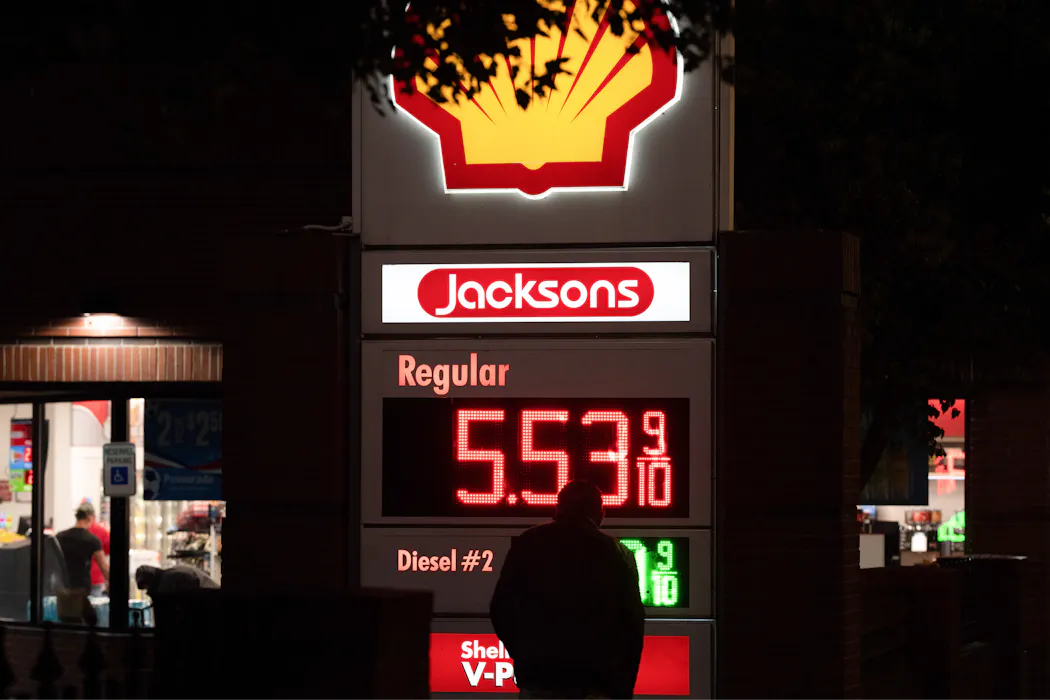
What’s in the price of a gallon of gas?

Gas prices were well over $4 a gallon on April 28, 2026, in Brooklyn, N.Y. Spencer Platt/Getty Images

The U.S. Energy Information Administration expects nationwide retail gasoline prices to average near US$4.30 a gallon for April 2026 – the highest monthly average of the year. The political response has been familiar. Georgia has suspended its state gas tax, other states are weighing their own tax holidays, and the White House has issued a temporary waiver of a law known as the Jones Act in hopes of moving more domestic fuel to East Coast ports.

As an energy economist, I am often asked about what contributes to gas prices and what different policies can do to affect them.

The price of a retail gallon of gas is the sum of four things: the cost of crude oil, refining, distribution and marketing, and taxes.

In nationwide figures from January 2026, crude oil accounted for about 51% of the pump price, refining roughly 20%, distribution and marketing about 11% and taxes about 18%. That mix shifts with conditions: When crude oil prices spike, that can drive more than 60% of the price; when the price drops, taxes and logistics are larger shares of the cost.

Crude oil is the biggest ingredient

Because the price of crude oil is the largest element, most of the price at the pump is derived from the global oil market.

Usually, big swings in crude prices come mainly from shifts in global demand and expectations – not from supply disruptions, according to widely cited research in 2009 by the economist Lutz Kilian.

But what is happening in early 2026 with the war in Iran is one of the exceptions: a classic supply shock. Severe disruptions to shipping through the Strait of Hormuz and attacks on Middle East oil infrastructure have taken millions of barrels a day off the global market.

Most drivers generally can’t quickly reduce how much they drive or how much gas they use when prices rise, so gasoline demand doesn’t change much in the short run. That means a jump in crude costs tends to result in people paying more rather than driving less.

Refining, regulations and the California puzzle

Refining turns crude into gasoline at industrial scale. The U.S. doesn’t have a single gasoline market, though. Roughly a quarter of U.S. gasoline is a cleaner-burning blend of petroleum-derived chemicals called “reformulated gasoline,” which is required in urban areas across 17 states and the District of Columbia to reduce smog.

California uses an even stricter formulation that few out-of-state refineries make. California is also geographically isolated: No pipelines bring gasoline in from other U.S. refining regions.

California’s gasoline prices have long run above the national average, explained in part by higher state taxes and stricter environmental rules. But since a refinery fire in Torrance, California, in 2015 reduced production capacity, the state’s prices have been about 20 to 30 cents a gallon higher than what those factors would indicate.

Energy economist and University of California, Berkeley, professor Severin Borenstein has called this the “mystery gasoline surcharge” and attributes it to the fact that there isn’t as much competition between refineries or gas stations in California as in other states. California’s own Division of Petroleum Market Oversight says the surcharge cost the state’s drivers about $59 billion from 2015 to 2024. It’s not exactly clear who is getting that money, but it could be gas stations themselves or refineries, through complex contracts with gas stations.

A person stands near a long metal truck in front of a gas station.
A tanker truck delivers fuel to a gas station. AP Photo/Erin Hooley

Getting the gas into your car

The distribution and marketing category covers the costs of everything involved in getting the gasoline from the refinery gate to your tank.

Gasoline moves by pipeline, ship, rail and truck to wholesale terminals, and then by local delivery truck to service stations.

At the retailer’s end, the key factors are station rent and labor, the cost to buy gasoline in bulk to be able to sell it, credit card fees of as much as 6 to 10 cents a gallon at current prices, and franchise fees paid to the national brand, such as Sunoco or ExxonMobil, for permission to put their branding on the gas station.

Most gas station operators net only a few cents per gallon on fuel itself – which is why many gas stations are really convenience stores with pumps out front. Borenstein and some of his collaborators have also documented that retail gas prices rise quickly when wholesale costs climb but fall slowly when wholesale costs drop.

The question of gas tax holidays

The federal government charges a tax on fuel, of 18.4 cents a gallon for gasoline and 24.3 cents a gallon for diesel. States charge their own taxes, ranging from 70.9 cents a gallon for gas in California to 8.95 cents in Alaska.

When gas prices rise, many politicians start talking about temporarily suspending their state’s gas tax. That does reduce prices, but not as much as politicians – or consumers – might hope. Research on past gas tax holidays has found that consumers get about 79% of the reduction in gas taxes. That means oil companies and fuel retailers keep about one-fifth of the tax cut for themselves rather than passing that savings to the public.

Gas tax holidays also reduce funding for what the taxes are designed to pay for, typically roads and bridges. That pushes road and bridge upkeep costs onto future drivers and general taxpayers.

There is an additional problem, too: Taxes on gasoline are supposed to charge drivers for some of the costs their driving imposes on everyone else – carbon emissions, local air pollution, congestion and crashes. But Borenstein has found that U.S. fuel tax levels are already far below the true cost to society. Removing the tax on drivers effectively raises the costs for everyone else.

A fisherman holds a pole in the foreground as an oil tanker sails by at sunset
Suspending the Jones Act allows foreign-based oil tankers to sail between U.S. ports. AP Photo/Eric Gay

The Jones Act: A small number that adds up

The 1920 Jones Act is a federal law that requires cargo moving between U.S. ports to travel on vessels built and registered in the U.S., owned by U.S. citizens, and crewed primarily by U.S. citizens and permanent residents. Of the world’s 7,500 oil tankers, only 54 meet this requirement. Only 43 of these can transport refined fuels such as gasoline.

So, despite significant refining capacity on the Gulf Coast, some U.S. gasoline is exported overseas even as the Northeast imports fuel, in part reflecting the relatively high cost of moving fuel between U.S. ports.

Economists Ryan Kellogg and Rich Sweeney estimate that the law raises East Coast gasoline prices by about a penny and a half per gallon on average, costing drivers roughly $770 million a year. In light of the war’s effect on gas prices, the Trump administration has temporarily suspended the Jones Act requirements – an action more commonly taken when hurricanes knock out Gulf Coast refineries and pipeline networks.

What moves the number

The result of all these factors is that the price that drivers see at the pump mostly reflects the global price of crude, plus a stack of domestic costs, only some of which are inefficient.

Tax holidays give a partial, short-lived rebate. Jones Act waivers trim pennies, though permanent repeal may cause more fundamental changes, such as reduced rail and truck transport of all goods, which could lower costs, emissions and infrastructure damage associated with cargo transportation. Harmonizing fuel blends across states and seasons may lower prices somewhat, but likely at the expense of increased emissions.

Ultimately, the best protection against oil price shocks is a more efficient gas-burning vehicle, or one that doesn’t burn gasoline at all. In the meantime, the best I can offer as an economist is clarity about what that $4.30 actually buys.

The Conversation

Robert I. Harris does not work for, consult, own shares in or receive funding from any company or organization that would benefit from this article, and has disclosed no relevant affiliations beyond their academic appointment.

Amid rising tensions, ‘friendshoring’ might keep global trade alive

Blossom Stock Studio/Shutterstock

The world economy is at a crossroads. International trade is slowing, economic uncertainty is rising, and trade between the US and China – the world’s two largest economies – risks pulling apart. And it is not just trade: the two countries also invest less in each other than they did just a few years ago.

What is driving this reconfiguration of trade? For some large economies, including the US under President Donald Trump, a desire for greater self-reliance is central. Between 2017 and 2023, American imports fell most sharply in the very products where the US had been most reliant on China – including industrial machinery, computers and computer parts, and other electronic equipment such as monitors.

This has important implications for global value chains (GVCs). GVCs are the backbone of international trade – production activities from research and product design to assembly are distributed across various locations, with “value” being added at each stage. This redistribution can take place across several countries, co-ordinated by multinational firms.

The reconfiguration of GVCs is accelerating, and so industrialised economies now have two main options. They can reshore production, bringing manufacturing back to their own countries (a stated priority for the current US administration).

Or they can “friendshore”, shifting imports and investments towards economies that are either geographically closer, or with which they have long-standing relationships.


Read more: After a year of Trump, who are the winners and losers from US tariffs?


For developing countries, the balance between these two strategies is crucial. If advanced economies reshore a substantial share of production, developing countries could suffer as investment and jobs are lost.

And automation and digitisation now make it more convenient for advanced countries to produce goods at home, making this a greater risk to these poorer countries than it was a decade ago.

For consumers though, this reshoring could mean higher prices for everyday goods, at least in the short term, because of the higher costs of manufacturing in more advanced economies. It should be said, however, that the empirical evidence for this remains limited.

Risks and opportunities

But friendshoring offers an alternative. Early signals from countries like Mexico and Vietnam – which have recently seen an increase in investment and factory expansions from multinational firms – suggest that friendshoring can create opportunities. When paired with supportive government policies such as investment incentives or help to upgrade technology, these shifts can ensure that more production takes place domestically. This can lead to greater technology spillovers and learning.

To understand the risks and opportunities, we examined the specific products where US-China decoupling is most pronounced (that is, where trade is reducing). From this analysis, two broad clusters emerged, each with different implications for developing economies.

The first group mainly includes relatively complex goods – things like consumer electronics, vehicle components, chemicals and machinery. Here, the US is both diversifying its imports quickly and is already producing these goods competitively.

The products and sectors at the heart of the reconfiguration of GVCs

These products can easily be reshored, particularly if automation lowers costs. Semiconductors, for instance, are already the focus of major US reshoring efforts. Yet the risk to current producers of the US reshoring appears limited for now. While the US has reduced imports from China of these products, other developing regions have not experienced a similar trend.

In the second group, the US is diversifying but is not competitive enough to bring production home. This group accounted for just over 6% of finished products that the US imported in 2023 – roughly US$181 billion (£134 billion). This is a small share overall, but economically significant.

Within this group, two types of opportunity emerge. Technologically complex goods, such as electrical equipment, computers and car parts, offer the greatest potential for middle-income economies with strong manufacturing experience to win contracts and investments. Lower-tech goods like textiles and furniture are better suited to lower-income countries. In both cases, governments need to negotiate carefully to ensure investments add value locally, support skills development and avoid social or environmental harm.

For consumers worldwide, friendshoring offers a more benign outlook than reshoring or tariffs. Goods may simply be made in different countries, with prices remaining broadly stable.

Who could gain?

So far, east and south-eastern Asia – including Vietnam, Thailand, Malaysia and Indonesia – have captured the largest share of these friendshoring opportunities, particularly in high-tech sectors like computers. Their exports to China have also risen, reinforcing their central role in Asian manufacturing networks. But whether this momentum continues will depend on tariffs, production costs and the pace of automation.

Other beneficiaries could include Latin America and Caribbean nations, led by Mexico. Here, the automotive sector dominates export growth. South Asia could also benefit, with India expanding in both high- and low-tech products, and Bangladesh at the lower-tech end. In contrast, Africa and western Asia remain largely absent from the emerging friendshoring landscape.

The risk to these countries of large-scale reshoring remains limited for now but cannot be ignored amid shifting global trade and investment patterns. But friendshoring could offset or even exceed potential losses, offering new pathways for industrialisation.

As economic uncertainty and technology reshape global value chains, developing economies that invest in production capabilities – and implement smart industrial policies – will be best placed to harness opportunities. In some cases, friendshoring may even allow them to leapfrog into more sophisticated activities faster than traditional development paths would allow.

For consumers, there are benefits too. The label on our next laptop, charger or T-shirt might change, but prices will remain broadly stable – at least before tariffs kick in. In this sense, globalisation will not disappear. But it will take on a different geographical shape.

The Conversation

This article builds on UNIDO IID Policy Brief 28, "Navigating a fragmenting global economy: What GVC reconfiguration means for future industrial development". The views expressed in the Policy Brief and in this article are those of the authors, based on their research and expertise, and do not necessarily reflect the views of UNIDO.

Carlo Pietrobelli and Nicolò Geri do not work for, consult, own shares in or receive funding from any company or organisation that would benefit from this article, and have disclosed no relevant affiliations beyond their academic appointment.
Sorry, Tampa Bay, mixed-use districts don’t reverse the dismal economics of sports venues

The plan for a new Rays stadium looks promising. But will it deliver for Tampa taxpayers? Tampa Bay Rays

When the Atlanta Braves opened Truist Park in 2017, Major League Baseball Commissioner Rob Manfred called it a “watershed” moment.

What drew so much attention to the new Braves’ stadium in suburban Cobb County, Georgia, at the time was its construction within a mixed-use development, known as The Battery Atlanta. Truist Park anchors a live-work-play campus that includes restaurants, shops, hotels, offices and residences. The idea was to create a year-round attraction rather than build a standalone stadium that serves only as a game-day destination.

Manfred declared that this sort of mixed-used district “provides a road map for clubs to get new stadiums built.” And he’s not alone in that belief.

The Tampa Bay Rays’ new owner, Florida home-building mogul Patrick Zalupski, hopes to mimic the Braves’ approach, calling it “the gold standard of what we want to build and develop here in Tampa Bay.”

But what do mixed-use projects like The Battery mean for host communities?

As an economist – and lifelong Braves fan – who lives a few miles from the complex, I’ve had the unique opportunity to experience The Battery as a community member, as well as study it as a scholar. I’ve attended many games, visited on off-days and examined its impact on surrounding businesses, county property values, sales tax receipts and tourism. My forthcoming book, “This One Will Be Different: False Promises and Fiscal Realities of Publicly Funded Stadiums,” looks at the history and economics of public stadium projects, including my hometown Truist Park.

Tampa as a public partner

Critical to Zalupski’s proposal to build a new US$2.3 billion ballpark is a hefty contribution from taxpayers. He is asking the city of Tampa and Hillsborough County to fund at least $1 billion of the cost.

That’s more than triple the $300 million Cobb County devoted to build Truist Park in Georgia, which was funded by a combination of property, hotel and rental car taxes.

In addition to that $1 billion, the state of Florida is offering $180 million for transportation improvements and rebuilding Hillsborough College, whose land would be donated to host the new development.

Rays CEO Ken Babby insists that the immense public outlay is worth it. He described it as “a generational opportunity” for the community that “will strengthen the region by creating jobs, encouraging economic investment and supporting long-term growth.”

But 50 years of consistent research findings show that sports venues don’t generate a financial windfall for host cities. The overwhelming evidence regarding the limited economic benefits of stadiums has produced a strong consensus among economists that sports venues are not worthwhile public investments.

It may seem counterintuitive that stadium events fail to boost local economies, because fans clearly do spend vast sums of money attending games. But most of the spectators in the crowd are locals, who reallocate their spending from other area merchants, rather than generating new commercial activity.

Mixed-use to the rescue?

When the Braves and Cobb County leaders announced their stadium vision, they confidently predicted that The Battery was the key that would unlock the economic potential of the stadium. Truist Park’s complementary development was touted as a game changer that would propel its economic success.

Knowing that past stadium deals had been unprofitable for surrounding communities, the team acknowledged that a standalone venue was unlikely to pay off financially. But with The Battery, president of the Braves Development Company Mike Plant promised, “We’re going to build a city, and we’re going to create tons of jobs, tons of density and year-round tax revenues.”

Now that Truist Park is entering its 10th season, we can assess what the stadium development has meant for the local economy using historical data.

The Braves’ mixed-use development has indeed boosted the team’s bottom line. In 2025, for example, Atlanta Braves Holdings reported that the mixed-use component added $97 million in revenue – primarily from rent, parking and advertising – on top of $635 million from baseball operations.

With those numbers, it’s no wonder the Rays want to follow the Braves’ blueprint.

side-by-side photos of The Battery during the off season and on game day
On the left, fans walk through The Battery to Truist Park on game day, April 11, 2022. On the right, The Battery during the off-season, Feb. 22, 2022. J.C. Bradbury

Unfortunately, the Battery hasn’t been a boon for taxpayers. My research shows that the relocation of the Braves did attract some new spending into Cobb County. But the gains have been far too small to cover the county’s debt service and other funding obligations, generating an annual loss of around $15 million.

And what spending may be imported into Cobb happens during the baseball season. In other words, The Battery has not been a year-round attraction.

Why didn’t Truist Park’s ancillary development strategy work?

Just as spending inside the ballpark mostly represents a reshuffling of local commerce, purchases within the surrounding district largely come at the expense of other off-campus area businesses. And though nearly $100 million in revenue from the mixed-use development may seem impressive, it’s trivial in comparison to Cobb County’s $80 billion economy.

A new gold standard or fool’s gold?

If the Braves’ mixed-use development hasn’t been able to pay off Cobb’s much smaller $300 million subsidy, it casts serious doubt on Tampa’s ballpark-village strategy to cover its billion-dollar ask of taxpayers.

The evidence shows that stadiums aren’t capable of funding themselves, even with a mixed-use component. The public funding has to come from someone, and it’s local taxpayers who ultimately pick up the tab.

I believe the Rays’ plan and similar stadium developments being discussed in Kansas City, Chicago, Denver and elsewhere should be viewed as risky bets rather than sound public investments.

Read more of our stories about Florida.

The Conversation

J.C Bradbury is a faculty affiliate of KSU's Bagwell Center for the Study of Markets and Economic Opportunity, which has previously provided him with a summer research support (last received in 2022).

When oil prices spike, where does the money go?

The oil industry is all about the Benjamins. Diy / iStock / Getty Images Plus

The market for oil is global, which is why events like the war in Iran affect oil prices – and prices of the wide range of products made from oil – literally everywhere. Federal data shows that the price at the primary crude oil hub in the U.S. was US$66 a barrel in late February 2026 – before the U.S. and Israel attacked Iran – and $101 a barrel on April 13. Similar price increases have reverberated around the globe.

As an energy economist and an international trade economist, we field a lot of questions during such episodes, because when oil prices go up, manufacturers, businesses and ultimately consumers pay more.

Some basic economics

Crude oil may be the most important commodity in the global economic system.

It’s a literal fuel for the industrial economy. It powers the engines that drive transportation and paves the roads vehicles drive on. It’s a source for plastics from which the world’s products get made and packaged, and a key ingredient at some point in almost every supply chain. Even fertilizers that boost the food supply are made from it. In short, it is difficult to imagine modern life without oil and its derivatives.

And when its supply changes, its price changes. Economists explain this using a fundamental model of our field: the supply-demand diagram. When there’s less of something to go around, competition among consumers who want it and companies that need it can drive the price up.

A schematic shows the relationship between supply, demand and pricing.
In general, when supply of a product is reduced, prices rise. As a result, even when demand remains stable, the quantity consumers buy decreases because of higher prices. Matthew E. Oliver and Tibor Besedeš, CC BY-NC-ND

Sometimes this process can play out over time, allowing people to adjust their purchasing or activities to dampen price shocks. But when a significant source of the world’s oil is effectively blocked without much advance notice, such as when the the U.S. and Israeli attacks on Iran closed the Strait of Hormuz, prices can rise sharply in a short period of time.

A natural question many people ask when oil prices spike is: Where does all that additional money go, and who benefits from it?

Some people have written entire books dissecting all the places that money goes when it leaves consumers’ pockets. But ultimately, the bulk of the money heads in the direction of the source of the oil itself – the oil companies.

What they do with the money varies widely, depending on where in the world an oil company is operating and who owns it. What also matters is the business environment – the set of laws and regulations – in which the company operates.

An overhead view shows a heavily developed industrial area with burned buildings and smoke rising.
A satellite photo shows damage from the war at Saudi Arabia’s Ras Tanura oil refinery, which must be repaired before full operations can resume. Satellite image (c) 2026 Vantor via Getty Images

Middle East faces danger

Oil producers in the Middle East face significant new risk because of the war in Iran, including threats to production, processing locations and shipping routes. These risks raise their costs for insurance, security and transportation.

But production costs in the region are relatively low, so higher global oil prices typically still translate into strong profits.

For a major exporter such as Saudi Arabia, the government owns and controls nearly all oil production, so high prices generally benefit the government’s finances and investments, even during a war. In Saudi Arabia, oil revenue has historically been used to fund public spending.

West Texas gets a windfall

The Permian Basin, the largest oil field in the U.S., is a long way from the Persian Gulf. When global oil prices rise because of the war in Iran, oil companies operating in West Texas effectively get a windfall gain: Prices rise more quickly than costs, at least in the short run.

The immediate effect is more income from higher prices. The money largely goes to company owners – meaning shareholders – through dividends, debt reduction, company-backed purchases of its own stock, and reinvestment in drilling and production. Over time, companies may decide to spend some of that windfall on building more production capacity or pipelines to get more oil and gas to market.

A large platform rises on a pillar out of the ocean, with a ship in the foreground.
Drilling rigs in the North Sea are still operating and shipping oil. AP Photo/James Brooks

North Sea boosts government revenue

In the North Sea, between the island of Great Britain and Scandinavia, a mix of multinational and government-owned companies produce most of the oil.

In the U.K., private shareholders are the primary beneficiaries of higher profits from increased oil prices, though an additional tax on oil and gas companies’ profits means the government also collects a significant share of the money, which it uses to help pay public expenses.

In Norway, oil revenues flow into the Government Pension Fund Global, the world’s largest sovereign wealth fund, valued at over $2 trillion. Laws govern how much, and for what purposes, money can be withdrawn from the fund, supporting public spending and preserving wealth for future generations. This is a similar model to Alaska’s state-owned program, funded by oil revenue, that pays for government services and sends an annual dividend to every permanent resident.

Russian oligarchs get rich

Russian oil is subject to stringent economic sanctions imposed by major industrial countries as a response to the Russian invasion and occupation of parts of Ukraine. While the U.S. cannot control how much Russia charges for its oil, it can control services needed to move Russian oil around the world. Under current price sanctions, Western shipping, insurance and financing can be used to ship and sell Russian crude oil only if the price is below $60 per barrel.

Russia’s oil industry is dominated by government-controlled companies whose leaders maintain close ties to President Vladimir Putin. The dealings of those shadowy figures are often shrouded in secrecy, but it is likely that they and Putin’s military-industrial complex – not the Russian people – are the main beneficiaries of high oil prices.

What this means for you

Everyday U.S. consumers may not like the idea of their hard-earned cash going into the already deep pockets of any of these groups. But in the short run, there’s not much to do but pay the price. For the long run, however, people around the world are already thinking and talking about, and opting for, sources of energy that don’t depend on fossil fuels.

The Conversation

The authors do not work for, consult, own shares in or receive funding from any company or organization that would benefit from this article, and have disclosed no relevant affiliations beyond their academic appointment.

❌