
Normal view

Received — 16 April 2026 The Conversation

One-way attack drones: Low-cost, high-tech weapons ‘democratize’ precision warfare

Iran's Shahed drone is essentially a poor man's cruise missile. AP Photo/Efrem Lukatsky

Wars in Ukraine and the Middle East have propelled drones into the headlines. The word “drone” now stretches to cover everything from hobbyist camera rigs available on Amazon to the Predator and Reaper systems the United States has relied on to fight terrorist organizations over the past 20 years.

A common ancestor in the animal kingdom can give rise, under sufficient environmental pressure, to distinct species that demand their own classification. Drones have undergone their own rapid speciation: the one-way attack drone, the medium-altitude, long-endurance and high-altitude, long-endurance drones, the collaborative combat aircraft drone – these share a lineage and a label, but in terms of cost, range and use, increasingly little else.

Nowhere is this variation more consequential than in the category of one-way attack drones: systems designed not to return home like an airplane, but to fly directly into a target and destroy it, like a bullet or a missile. Russia and Ukraine have fired millions of these at each other since 2022, and Iran has launched thousands at United States military bases and embassies, Israel and other countries in the Middle East in 2026.

The world is now in an era we call “precise mass.” In the past, military power was often determined by size – the number of knights, soldiers, guns or tanks, depending on the era, that an army had. Since the Cold War, advanced militaries have emphasized precise munitions, such as cruise missiles, gaining advantage with fewer but more accurately targeted weapons. Inexpensive but technologically sophisticated drones bring mass and precision together.

Commercial manufacturing, precision guidance and advances in artificial intelligence and autonomy have democratized the ability of militaries and militant groups to accurately strike their adversaries. This includes first-person-view, or FPV, drones – a type of one-way attack drone with interfaces like video games – that groups aligned with Iran are already using to target American forces in the Middle East.

One-way attack drones

One-way attack drones have featured most prominently in the war between Russia and Ukraine, and in the Middle East today. The first category of one-way attack drones is longer range and can travel hundreds or even thousands of miles to strike targets deep in an adversary’s territory. They are like extremely cheap cruise missiles – Iran’s Shahed-136 one-way attack drone, for instance, has a reported range of up to 1,250 miles (2,000 km) and costs between US$20,000 and $50,000 each. In comparison, America’s Tomahawk cruise missile costs $2 million each.

Russia acquired the Shahed technology almost immediately after Iran debuted it in 2022, creating its own version, the Geran-2, and has since used these drones to pummel Ukrainian cities and energy infrastructure. Most recently, the U.S. military has followed Russia’s lead and reverse-engineered its own version, the LUCAS, which debuted in the earliest days of Operation Epic Fury, the U.S. military operation against Iran that started on Feb. 28, 2026.

Since late February 2026, Tehran has fired thousands of one-way attack drones at targets across the Middle East. Iran’s one-way attack drones have hit buildings in Bahrain, Kuwait and the United Arab Emirates, and damaged the United States Embassy in Saudi Arabia. The UAE alone was targeted by nearly 700 Iranian drones in the war’s early days. Iran’s one-way attack drones have killed U.S. service members and destroyed critical American radar systems.

Because long-range, one-way attack drones are so slow, they are easier to shoot down than, say, a Tomahawk missile, but attackers can fire so many of them that they can overwhelm air defense systems.

The second category of one-way attack drones operates more like traditional artillery – typically from short distances, up to about 100 miles (160 km). Ukraine’s battlefield has showcased these systems extensively, where they generate 60%-70% of the casualties on the front lines.

a man in military clothing and wearing goggles holds a device in his hands as a quadcopter hovers in front of him
First-person-view drones are small, cheap and controlled much like a video game. AP Photo/Andrii Marienko

FPV drones

One of the most common types of short-range, one-way attack drones is the FPV drone, sometimes built for a few hundred dollars each from commercial parts purchased online. In Ukraine, operators wearing video goggles fly FPV drones directly into Russian vehicles, fortifications and troops, and they feature guidance interfaces for remote operators that are not dissimilar to those of first-person video games.

FPV drones are not magic. Operating them requires a continuous data link between the operator and the drone, making them vulnerable to electronic jamming that can disrupt radio signals. To address this vulnerability, many Ukrainian FPV drones now use physical communication lines in the form of fiber-optic cables to avoid jamming, but the cables can be cut, and that limits the range of these systems. FPV drones with fiber-optic cables have ranges of about 12 miles (20 km). Effectively using FPV drones also requires skilled operators.

America and Israel’s war with Iran hit the pause button on April 7, but if it starts again and the U.S. deploys ground forces, they would likely face the kind of short-range, one-way attack drone barrages that have come to terrorize both Russian and Ukrainian forces alike.

The threat has proved so hard to stop that Ukraine has resorted to low-tech solutions: Hundreds of kilometers of roads are now covered with nets, donated by European fishermen and farmers. The nets stop FPV drones by tangling their propellers. Nets cover tanks and hospital courtyards and line supply routes and city streets. Ukraine’s government plans to install about 2,500 miles (4,000 km) of them on key roads by the end of 2026.

a road lined with poles on both sides supporting netting over the road
Many roads near the front lines in Ukraine now sport netting to protect against attack drones. AP Photo/Efrem Lukatsky

Iranian forces could similarly deploy one-way attack drones against American convoys, personnel or parked aircraft in ways that are difficult to defend against. Additionally, just as American adversaries such as ISIS and al-Qaida used video footage of attacks to try to scare the American public, Iran is likely to use FPV strike footage – the operator’s-eye view of the attack, easily edited and uploaded – to try to shape American attitudes.

In March 2026, an Iran-backed militia used FPV drones to strike a parked U.S. Army medevac Black Hawk helicopter and destroy an air defense radar at the Victory Base Complex near Baghdad. The attackers then released footage from the drone’s perspective as propaganda, blurring out the red crosses identifying the Black Hawk as a medevac aircraft.

The new reality

Short-range, one-way attack drones have redefined the front lines; long-range ones have changed what it means to wage war at strategic distances. Iran’s battlefield record – thousands of drones launched, air defenses nearing exhaustion across multiple targeted countries, American troops killed – demonstrates what a mid-tier military can achieve with precise mass.

Any military that fails to invest in these capabilities – and in the ability to defend against them – places itself at risk, including the U.S. military.

The Conversation

Michael C. Horowitz is a senior fellow with the Council on Foreign Relations. From 2022 to 2024 he was Deputy Assistant Secretary of Defense and Director of the Emerging Capabilities Policy Office at the United States Department of Defense. The views, thoughts, and opinions expressed in an article are solely those of the author and do not represent the official policy, position, or endorsement of any U.S. government department, agency, or branch of service

Lauren Kahn does not work for, consult, own shares in or receive funding from any company or organization that would benefit from this article, and has disclosed no relevant affiliations beyond their academic appointment.

How Trump’s repeated efforts to fire Federal Reserve Chair Powell harm the economy – and make battling inflation harder

President Donald Trump has repeatedly threatened to fire Fed Chair Jerome Powell. AP Photo/Julia Demaree Nikhinson

President Donald Trump has again threatened to oust Federal Reserve Chair Jerome Powell, putting at risk a keystone of good economic policy and inflation management: central bank independence.

The president said on April 15, 2026, that he would fire Powell if the Fed chair stayed on in that role after his term officially ends on May 15. Powell has said he intends to remain at the helm after that if his replacement has not yet been confirmed by the Senate. Legally, Powell is allowed to do this.

Trump has promised to fire Powell a number of times, and his Department of Justice has launched a criminal investigation into renovations at the Fed building. Trump has also tried to oust another Fed governor, Lisa Cook, over allegations of mortgage fraud. In an unprecedented video response to the investigation, Powell called it and other actions “pretexts” for Trump’s ultimate goal of getting the Fed to lower interest rates.

While Trump’s actions are seen as particularly aggressive, as political economists, we are not surprised to see politicians try to exert influence on central banks. For one thing, central banks remain part of the government bureaucracy, and independence granted to them can always be reversed – either by changing laws or backtracking on established practices.

An economic power struggle

At the heart of threats to Powell and Cook – and other moves to undermine the Fed by the Trump administration – is a power struggle.

Central banks, which are public institutions that manage a country’s currency and its monetary policy, have an extraordinary amount of power. By controlling the flow of money and credit in a country, they can affect economic growth, inflation, employment and financial stability.

These are powers that many politicians would like to control or at least manipulate. That’s because monetary policy can provide governments with economic boosts at key times, such as around elections or during periods of falling popularity.

The problem is that short-lived, politically motivated moves may be detrimental to the long-term economic well-being of a nation. They may, in other words, saddle the economy with problems further down the line.

That is why central banks across the globe tend to receive significant leeway to set interest rates independently and free from the electoral wishes of politicians.

In fact, monetary policymaking that is data-driven and technocratic, rather than politically motivated, has been seen as the gold standard of governance of national finances since the early 1990s and has largely achieved its main purpose of keeping inflation relatively low and stable.

But despite independence being seen to work, central banks over the past decade have come under increased pressure from politicians.

Trump is one recent example. In his first term as president, he criticized his own choice to head the Federal Reserve and demanded lower interest rates.

Attacks on the Fed have accelerated in Trump’s second administration. In April 2025, Trump lashed out at Powell in an online post, accusing him of being “TOO LATE AND WRONG” on interest rate cuts, while suggesting that the central banker’s “termination cannot come fast enough!” And in August, Trump took the unprecedented step of firing Cook, which a court later blocked. The Supreme Court is expected to issue a ruling in the case this year.

Moreover, the reason politicians may want to interfere in monetary policy is that low interest rates remain a potent, quick method to boost an economy. And while politicians know that there are costs to besieging an independent central bank – financial markets may react negatively, or inflation may flare up – short-term control of a powerful policy tool can prove irresistible.

a white man and a Black woman sit at chairs at a table
Fed Governors Jerome Powell and Lisa Cook have both been on the receiving end of Trump’s attacks. AP Photo/Mark Schiefelbein

Legislating independence

If monetary policy is such a coveted policy tool, how have central banks held off politicians and stayed independent? And is this independence being eroded?

Broadly, central banks are protected by laws that offer long tenures to their leadership, allow them to focus policy primarily on inflation, and severely limit lending to the government.

Of course, such legislation cannot anticipate all future contingencies, which may open the door for political interference or for practices that break the law. And sometimes, central bankers are unceremoniously fired.

However, laws do keep politicians in line. For example, even in authoritarian countries, laws protecting central banks from political interference have helped reduce inflation and restricted central bank lending to the government.

In our own research, we have detailed the ways that laws have insulated central banks from the rest of the government, but also the recent trend of eroding this legal independence.

Politicizing appointees

Around the world, appointments to central bank leadership are political – elected politicians select candidates based on career credentials, political affiliation and, importantly, their dislike or tolerance of inflation.

But lawmakers in different countries exercise different degrees of political control.

A 2025 study shows that the large majority of central bank leaders – about 70% – are appointed by the head of government alone or with the intervention of other members of the executive branch. This ensures that the preferences of the central bank are closer to the government’s, which can boost the central bank’s legitimacy in democratic countries, but at the risk of permeability to political influence.

Alternatively, appointments can involve the legislative power or even the central bank’s own board. In the U.S., while the president nominates members of the Federal Reserve Board, the Senate can and has rejected unconventional or incompetent candidates.

Moreover, even if appointments are political, many central bankers stay in office long after the people who appointed them have been voted out. At the end of 2023, the most common length of the governors’ appointment was five years, and in 41 countries, the legal mandate was six years or longer.

And the Fed chair position has traditionally been protected by law, as Powell himself acknowledged in November 2024: “We’re not removable except for cause. We serve very long terms, seemingly endless terms. So we’re protected into law. Congress could change that law, but I don’t think there’s any danger of that.”

In the 2000s, several countries shortened the tenure of their central banks’ governors to four or five years. Sometimes, this was part of broader restrictions in central bank independence, as was the case in Iceland in 2001, Ghana in 2002 and Romania in 2004.

fruits on sale at a market
One of a central bank’s most important duties is to keep consumer prices in check, which becomes harder when its independence is questioned. AP Photo/Matt Rourke

The low inflation objective

As of 2023, all but six central banks globally had low inflation as their main goal. Yet many central banks are required by law to try to achieve additional and sometimes conflicting goals, such as financial stability, full employment or support for the government’s policies.

This is the case for 38 central banks that either have the explicit dual mandate of price stability and employment or more complex goals. In Argentina, for example, the central bank’s mandate is to provide “employment and economic development with social equity.”

Conflicting objectives can open central banks to politicization. In the U.S., the Federal Reserve has a dual mandate of stable prices and maximum sustainable employment. These goals are often complementary, and economists have argued that low inflation is a prerequisite for sustainable high levels of employment.

But in times of overlapping high inflation and high unemployment, such as in the late 1970s or when the COVID-19 crisis was winding down in 2022, the Fed’s dual mandate has become active territory for political wrangling.

Since 2000, at least 23 countries have expanded the focus of their central banks beyond just inflation.

Limits on government lending

The first central banks were created to help secure finance for governments fighting wars. But today, limiting lending to governments is at the core of protecting price stability from unsustainable fiscal spending.

History is dotted with the consequences of not doing so. In the 1960s and 1970s, for example, central banks in Latin America printed money to support their governments’ spending goals. But it resulted in massive inflation while not securing growth or political stability.

Today, limits on lending are strongly associated with lower inflation in the developing world. And central banks with high levels of independence can reject a government’s financing requests or dictate the terms of loans.

Yet over the past two decades, almost 40 countries have made their central banks less able to limit central government funding. In the more extreme examples – such as in Belarus, Ecuador or even New Zealand – they have turned the central bank into a potential financier for the government.

Scapegoating central bankers

In recent years, governments have tried to influence central banks by pushing for lower interest rates, making statements criticizing bank policy or calling for meetings with central bank leadership.

At the same time, politicians have blamed the same central bankers for a number of perceived failings: not anticipating economic shocks such as the 2007-09 financial crisis; exceeding their authority with quantitative easing; or creating massive inequality or instability while trying to save the financial sector.

And since mid-2021, major central banks have struggled to keep inflation low, raising questions from populist and antidemocratic politicians about the merits of an arm’s-length relationship.

But chipping away at central bank independence, particularly in the name of lowering interest rates to boost the economy, as Trump appears to be doing by threatening to fire the Fed chair and his attempted removal of a member of the bank’s Board of Governors, is a historically sure way to high inflation.

This is an updated version of an article that was originally published on June 14, 2024.

The Conversation

The authors do not work for, consult, own shares in or receive funding from any company or organization that would benefit from this article, and have disclosed no relevant affiliations beyond their academic appointment.

Received — 11 April 2026 The Conversation

4 ways the war in Iran has weakened the United States in the great power game

China and Russia view the U.S. grand strategy as increasingly out of focus. AP Photo/Julia Demaree Nikhinson

“Never interrupt your enemy when he is making a mistake.”

Napoleon Bonaparte’s maxim may well have been in the minds of policymakers in Moscow and Beijing these past weeks, as the U.S. war in Iran dragged on. And now that a 14-day ceasefire between Tehran and Washington is in effect – with both sides claiming “victory” – Russian and Chinese leaders still have an opportunity to profit from what many see as America’s latest folly in the Middle East.

Throughout the weekslong conflict, China and Russia struck a delicate balance. Both declined to give Iran – seen to a varying degree as an ally of both nations – their full-throated support or sink any real costs into the conflict.

Instead, they opted for limited assistance in the form of small-scale intelligence and diplomatic support.

As a scholar of international security and great power politics I believe that is for good reason. Beijing and Moscow were fully aware that Iran could not “win” against the combined military might of the United States and Israel. Rather, Iran just needed to survive to serve the interests of Washington’s main geopolitical rivals.

Below are four ways in which the U.S. war in Iran has damaged Washington’s position in the great power rivalries of the 21st century.

1. Losing the influence war in the Middle East

As I explore in my book “Defending Frenemies,” the U.S. has long struggled to balance competing objectives in the Middle East. During the Cold War, this meant limiting the Soviet Union’s influence in the region, while contending with the development of nuclear weapons by two troublesome allies, Israel and Pakistan.

By the 2020s, the priorities in Washington were aimed at restricting the influence of the U.S.’s great power rivals – China and to a lesser degree Russia – in the Middle East.

Three meet greet each other in diplomatic setting.
Russian, Chinese and Iranian diplomats have a confab in 2025 in Beijing. Lintao Zhang/Pool Photo via AP

Yet under Presidents Xi Jinping and Vladimir Putin, China and Russia have sought to increase their footprint in the region through a variety of formal alliances and informal measures.

For Russia, this took the form of aligning with Iran, while also partnering with Tehran to prop up the now-ousted regime of President Bashar Assad during the Syrian civil war. Meanwhile, China increased its diplomatic profile in the Middle East, notably by acting as a mediator as Saudi Arabia and Iran restored diplomatic ties in 2023.

The irony of the latest Iran war is that it follows a period in which circumstances were unfavorable to Russian and Chinese aims of increasing their influence in the Middle East.

The fall of Assad in December 2024 deprived Russia of its one reliable ally in the region. And Trump’s May 2025 tour of the Gulf states, in which he secured major technology and economic deals with Saudi Arabia, the United Arab Emirates, Qatar and Bahrain, was aimed at countering China’s growing economic and diplomatic influence in those countries.

With Washington perceived as an increasingly unreliable protector, the Gulf states may seek greater security and economic cooperation elsewhere.

2. Taking US eyes off other strategic goals

In expanding military, diplomatic and economic ties in the Middle East, Russia and China over the past two decades were exploiting a desire by Washington to move its assets and attention away from the region following two costly wars in Iraq and Afghanistan.

Trump’s decision to wage war against Iran directly contradicts the national security strategy his administration released in November 2025. According to the strategy, the administration would prioritize the Western Hemisphere and the Indo-Pacific, while the Middle East’s importance “will recede.”

In co-launching a war in Tehran with Israel, without any prior consultation with Washington’s other allies, Trump has shown a complete disregard for their strategic and economic concerns. NATO, already riven by Trump’s repeated threats to the alliance and designs on Greenland, has now shown further signs of internal divisions.

That offers benefits for China and Russia, which have long sought to capitalize on cracks between America and its allies.

The irony, again, is that the war in Iran came as Trump’s vision of the U.S. as the hegemonic power in the Western Hemisphere was making advances. International law and legitimacy concerns aside, Washington had ousted a thorn in its side with Nicolás Maduro in Venezuela and replaced him with a more compliant leader.

3. Disproportionate economic fallout

Iran’s closure of the Strait of Hormuz, where some 20% of the world’s oil passes, was as predictable as it was destructive for U.S. interests.

But for Russia, this meant higher oil prices that boosted its war economy. It also led to the temporary but ongoing easing of U.S. sanctions, which has provided Moscow an indispensable lifeline after years of economic pressure over the war in Ukraine.

While a prolonged closure and extensive damage to oil and natural gas infrastructure in Iran and the Gulf states no doubt hurts China’s energy security and economy, these were risks Xi appears willing to accept, at least for a time.

And by building up a domestic oil reserve and diversifying energy sources to include solar, electric batteries and coal, China is far better positioned to weather a prolonged global energy crisis than the U.S. Indeed, Beijing has made strides in recent year to encourage domestic consumption as a source of economic growth, rather than be so reliant on global trade. That may have given China some protection during the global economic shock caused by the Iran war, as well as push the economy further down its own track.

The more the U.S. loses control over events in the strait, the more it loses influence in the region – especially as Iran appears to be placing restrictions on ships from unfriendly nations.

Three men greet during a diplomatic meeting.
China’s former foreign minister looks on as Iranian and Saudi diplomats shake hands during Beijing-mediated talks in 2023. Iranian Foreign Ministry via AP

4. Loss of global leadership

Trump’s willingness to abandon talks to go to war, and the contradictory rhetoric he has employed throughout the Iran conflict, has weakened the perception of the U.S. as an honest broker.

That provides a massive soft power boost for Beijing. It was China that pressed Iran to accept the 14-day ceasefire proposal brokered by Pakistan. Indeed, China has slowly chipped away at America’s longtime status as global mediator of first resort.

Beijing has successfully mediated in the past between Iran and Saudi Arabia, and it attempted to do the same with Russia and Ukraine and Israel and the Palestinians.

In general, the Iran war adds weight to Beijing’s worldview that the U.S.-led liberal international order is over. Even if China benefited at some level from the war continuing, its decision to help broker the ceasefire shows that China is increasingly taking on the mantle of global leadership that the U.S. used to own.

And for Russia, the Iran war and the rupture between Trump and America’s NATO allies over their lack of support for it, shift world attention and U.S. involvement from the war in Ukraine.

The Conversation

Jeffrey Taliaferro does not work for, consult, own shares in or receive funding from any company or organization that would benefit from this article, and has disclosed no relevant affiliations beyond their academic appointment.

Received — 9 April 2026 The Conversation

From a vaccine mascot to business leadership, lessons for the US from Brazil’s public health system in building public trust and keeping it

Business leaders and community groups across Brazil stepped in to counter the government's anti-vaccine messaging and to help develop and distribute vaccines. Wang Tiancong/Xinhua via Getty Images

Public health institutions are under threat by populist governments across the globe.

From Budapest to Jakarta, Indonesia, public health agencies are being stripped of funding and independence. Meanwhile, disinformation has sown distrust in scientific experts. The results are already visible through the return of diseases once thought eliminated or controlled, like measles and whooping cough.

The United States is no exception to this trend. Since Robert F. Kennedy, Jr. was confirmed as secretary of Health and Human Services in February 2025, he has fired over 10,000 staff, cut budgets and attempted to gut childhood vaccine recommendations. Though medical and public health groups have pushed back with some success, key government health institutions face a leadership vacuum, and national public health policy has fractured into “health alliances” formed by groups of states.

Doctors and scientists across the country worry about long-term damage to the country’s health system.

As a researcher studying the politics of health care, I believe it’s helpful to look to countries that have successfully managed similar threats. As my co-authors and I have argued, Brazil’s experience offers insights into how public health institutions can preserve power and authority in the face of assault.

Much like the U.S., Brazil has a fragmented and polarized Congress, it has powerful self-interested lobbies, and it has a federal system of government. And much like in the U.S., health outcomes suffer from stark race and income gaps.

But when a populist president attacked the Brazilian health care system during COVID-19, the public successfully rallied to its defense

People hold signs during a protest against COVID-19 vaccine passports and mandatory COVID-19 vaccinations in Brazil.
Former President Jair Bolsonaro’s administration, from 2019 to 2022, shook Brazilians’ long-held trust in vaccines and public health. Sergio Lima/AFP via Getty Images

A health system under attack

Brazil’s health system, established in its current form in 1990, provides free universal health care to all its citizens. Despite some significant flaws, including unequal access to care in poor and rural areas, its focus on preventive care is widely considered a model worldwide.

Prior to the administration of right-wing populist Jair Bolsonaro, from 2019 to 2022, Brazilians had trust in vaccines. They had what public health experts call a vaccine culture, thanks to the hard work of health workers who had spent years promoting them and making them easily accessible. Vaccines even had a beloved national mascot in Zé Gotinha (Joe Droplet), a cartoon vaccine droplet with a Pillsbury Doughboy-like visage.

When COVID-19 hit Brazil in March 2020, Bolsonaro – dubbed by many as the “Trump of the Tropics” – launched unprecedented attacks on Brazil’s vaccine program. Among other measures, he fired the senior leadership of the health ministry and appointed as minister an active-duty military officer with no health credentials.

A white vaccine droplet with a smiling face and the logo of Brazil's public health system on its belly.
A walking vaccine droplet named Zé Gotinha – Joe Droplet – is Brazil’s vaccine mascot. Vinicius Loures/Câmara dos Deputados via Wikimedia Commons, CC BY-SA

Bolsonaro’s attacks on the vaccine program – a backbone of Brazil’s preventive health efforts – were especially strong. He pressured Brazil’s drug regulatory agency to ban pediatric vaccines. He blocked resources for vaccine procurement, and he spread misinformation, notoriously suggesting the vaccine could give people AIDS.

After Bolsonaro’s initial attacks on Brazil’s COVID-19 response efforts, the entire health system appeared on the verge of collapse. However, Brazil’s public health workers then marshaled broad support to defend their vaccine program.

Opposition governors offered important but limited help by producing their own vaccine guidance and procuring their own vaccines. But political support, on its own, couldn’t overcome Bolsonaro’s attacks.

That’s because Brazil’s vaccine program depended not just on independence, but also on resources to operate. And governments with an anti-science bent have many ways to deprive even well-established agencies of resources without broad congressional approval.

Brazil’s vaccine program ultimately survived because allies outside government stepped in to defend it not only with political advocacy, but by donating money and resources and with social activism.

Jair Bolsonaro launched an attack against Brazil’s health system during the COVID-19 pandemic.

Business leaders to the rescue

Businesses filled gaps in government resources with donations of private-sector funding. Two business coalitions gave a total of over 270 million real (US$54 million) to help two public laboratories, the Institute of Technology in Immunobiology, known as BioManguinhos, and the Butantan Institute.

One of the largest foundations in Brazil, the Lemann Foundation, paid for AstraZeneca’s clinical trials in Brazil. Ambev, one of the largest firms in South America, lent its logistics team to help BioManguinhos acquire supplies and equipment.

Women of Brazil, a nonpartisan network of female business leaders, even built a campaign called United for the Vaccine to help towns and cities acquire the vaccine distribution equipment they needed. They provided local health officials with cheap supplies, like coolers and refrigerators, as well as costlier investments, such as boats and even planes for carrying vaccines to the isolated communities of the Amazon.

As pulmonologist Margareth Dalcolmo, who consulted for United for the Vaccine, emphasized to me in an interview: “All their requests were met, without one cent of government money being used.”

From the ground up

Another hugely important component of defending Brazil’s vaccine program was support from trusted local grassroots groups.

When vaccines became available, community-based groups across the country jumped in to combat disinformation with their own locally produced information campaigns – especially in underserved communities.

One group I spoke to distributed 5,000 informational posters across their neighborhood. Another, Tamo Junto Rocinha, or We’re in it Together Rocinha, published a book with lessons for kids to do with their parents while school was canceled – all with vaccination information embedded. Voz das Comunidades, or Voice of the Communities, a neighborhood news service, even created a smartphone application to combat misinformation while also notifying community members of daily death tallies.

A commuter wearing a facemask gets his COVID-19 vaccine at a Rio de Janeiro bus station.
A long-term investment in building trust in public health helped fuel the groundswell of support for COVID-19 vaccine efforts. Mauro Pimentel/AFP via Getty Images

So many grassroots groups organized to counter Bolsonaro’s attacks on COVID-19 vaccines that researchers began to map the campaigns bubbling up across the country. By early 2021, one map had identified over 1,300 grassroots efforts and over 800 organized by universities.

By August 2022, despite Bolsonaro’s disinformation campaigns, 81% of Brazil’s adult population was fully vaccinated against COVID-19. These vaccination rates equaled those of New Zealand and the Netherlands and were well above that of the United States, where only 67% were fully vaccinated at the time.

This is not to say that Brazil was immune to disinformation campaigns. Vaccination rates for some diseases, such as measles, declined, as they have across the world.

But in many ways, the attacks on Brazil’s vaccine program paradoxically strengthened it. By the end of 2022, thanks to donor support, BioManguinhos had already built a new testing laboratory, and Butantan was constructing a new vaccine production facility. Brazil even had a new national health surveillance institute. By 2024, once Bolsonaro was voted out, overall spending on the health system had increased from the prior year by 27%.

Playing the long game with public health

In my view, these emergency countermeasures in Brazil worked effectively because the country had already spent years building a foundation of trust in – and ownership of – the shared goals of its public health system.

Decades ago, in the 1980s, Brazilians successfully demanded that their politicians make health care accessible to all – driving the genesis of the country’s universal public health system, known by the acronym SUS.

Brazil’s health ministry continues to invest heavily in making sure citizens take ownership of it. Cities and towns are postered with signs declaring “SUS is ours!” or “Health care is your right!”

As I found in my recent research in Brazil, this kind of advertising makes people feel their institutions are an earned right and reduces the power of partisan messaging.

Brazil also invests in integrating health workers into the communities they serve and cultivating public trust in their expertise. Government health care workers routinely set up shop in public plazas to advertise cancer screenings or give vaccinations. They regularly visit schools, where doctors or nurses talk to young people in accessible language about what the nation’s public health system offers its citizens. As one health care worker told me: “It’s like they are constantly saying, ‘Look, the doors are open. You can come. You’ll be seen and supported.’”

These long-term relationships between communities and the public health system helped lay the groundwork in Brazil for mounting a unified defense when political turbulence threatened public health agencies. Worldwide, a long-term view toward building or strengthening these relationships may help the public embrace the idea that public health institutions are worth defending.

The Conversation

Jessica A.J. Rich does not work for, consult, own shares in or receive funding from any company or organization that would benefit from this article, and has disclosed no relevant affiliations beyond their academic appointment.
When a president is unfit for office, here’s what the Constitution says can happen

President Donald Trump mimics an Iranian protester being shot while holding a news conference in the White House on April 6, 2026. Tom Williams/CQ-Roll Call, Inc via Getty Images

Bipartisan calls for President Donald Trump’s removal from office increased on April 7, 2026, after he issued threats to destroy “a whole civilization” if Iran refuses to reopen the Strait of Hormuz.

These calls have come from across the political spectrum, from Democratic Reps. Alexandria Ocasio-Cortez of New York and Melanie Stansbury of New Mexico to former Rep. Marjorie Taylor Greene and right-wing pundit Alex Jones. Unlikely allies seem to agree that the president has gone too far and needs to be reined in.

Their concerns have emerged as Iran has walked away from talks to end the war and Trump’s language suggests that he plans to escalate it by destroying the country’s power plants and bridges.

Concerns over Trump’s fitness for office have grown in recent weeks as his commentary has become more erratic.

If lawmakers do attempt to remove Trump from office, here’s what would happen:

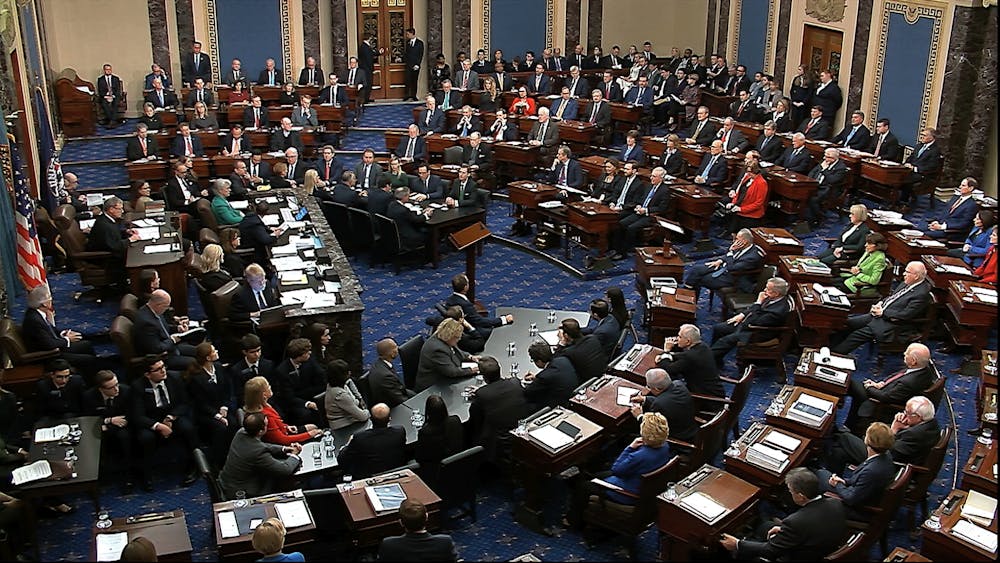
A scene of the Senate voting in Trump's impeachment trial in 2020
Donald Trump has been impeached twice, but has not convicted. Senate Television via AP

25th Amendment

The Constitution’s 25th Amendment provides a way for high-level officials to remove a president from office. It was ratified in 1967 in the wake of the 1963 assassination of John F. Kennedy – who was succeeded by Lyndon Johnson, who had already had one heart attack – as well as delayed disclosure of health problems experienced by Kennedy’s predecessor, Dwight Eisenhower.

The 25th Amendment provides detailed procedures on what happens if a president resigns, dies in office, has a temporary disability or is no longer fit for office.

It has never been invoked against a president’s will, and has been used only to temporarily transfer power, such as when a president is undergoing a medical procedure requiring anesthesia.

Section 4 of the 25th Amendment authorizes high-level officials – either the vice president and a majority of the Cabinet or another body designated by Congress – to remove a president from office without his consent when he is “unable to discharge the powers and duties of his office.” Congress has yet to designate an alternative body, and scholars disagree over the role, if any, of acting Cabinet officials.

The high-level officials simply send a written declaration to the president pro tempore of the Senate – the longest-serving senator from the majority party – and the speaker of the House of Representatives, stating that the president is unable to discharge the powers and duties of his office. The vice president immediately assumes the powers and duties of the president.

The president, however, can fight back. He or she can seek to resume their powers by informing congressional leadership in writing that they are fit for office and no disability exists. But the president doesn’t get the presidency back just by saying this.

The high-level officials originally questioning the president’s fitness then have four days to decide whether they disagree with the president. If they notify congressional leadership that they disagree, the vice president retains control and Congress has 48 hours to convene to discuss the issue. Congress has 21 days to debate and vote on whether the president is unfit or unable to resume his powers.

The vice president remains the acting president until Congress votes or the 21-day period lapses. A two-thirds majority vote by members of both houses of Congress is required to remove the president from office. If that vote fails or does not happen within the 21-day period, the president resumes his powers immediately.

The 25th Amendment
The 25th Amendment to the U.S. Constitution. National Archives via AP

The case for impeachment

Article II of the Constitution authorizes Congress to impeach and remove the president – and other federal officials – from office for “Treason, Bribery, or other high Crimes and Misdemeanors.” The founders included this provision as a tool to punish a president for misconduct and abuses of power. It’s one of the many ways that Congress could keep the president in check, if it chose to.

Impeachment proceedings begin in the House of Representatives. A member of the House files a resolution for impeachment. The resolution goes to the House Judiciary Committee, which usually holds a hearing to evaluate the resolution. If the House Judiciary Committee thinks impeachment is proper, its members draft and vote on articles of impeachment. Once the House Judiciary Committee approves articles of impeachment, they go to the full House for a vote.

If the House of Representatives impeaches a president or another official, the action then moves to the Senate. Under the Constitution’s Article I, the Senate has the responsibility for determining whether to remove the person from office. Normally, the Senate holds a trial, but it controls its procedures and can limit the process if it wants.

Ultimately, the Senate votes on whether to remove the president – which requires a two-thirds majority, or 67 senators. To date, the Senate has never voted to remove a president from office, although it almost did in 1868, when President Andrew Johnson escaped removal from office by one vote.

The Senate also has the power to disqualify a public official from holding public office in the future. If the person is convicted and removed from office, only then can senators vote on whether to permanently disqualify that person from ever again holding federal office. Members of Congress proposing the impeachment of Trump have promised to include a provision to do so. A simple majority vote is all that’s required then.

This is an updated version of an article originally published on Jan. 9, 2021.

The Conversation

Kirsten Matoy Carlson does not work for, consult, own shares in or receive funding from any company or organization that would benefit from this article, and has disclosed no relevant affiliations beyond their academic appointment.

75 years after she led a student strike that helped end school segregation, Barbara Rose Johns now stands in the US Capitol where Robert E. Lee once did

A statue of civil rights activist Barbara Rose Johns is unveiled in Emancipation Hall at the U.S. Capitol on Dec. 16, 2025, in Washington. Chip Somodevilla/Getty Images

The 250th anniversary of the Declaration of Independence isn’t the only important anniversary in 2026. This year also marks the 75th anniversary of an extraordinary case of student activism that helped lead to the Supreme Court’s decision outlawing segregated schools.

In April 1951, 16-year-old Barbara Rose Johns organized a student strike to protest the shabby conditions and inadequate education at her segregated Black high school in Prince Edward County, Virginia.

Prince Edward County is located about 65 miles southwest of Richmond and around 30 miles east of Appomattox, or 48 kilometers, in a part of Virginia known as Southside. African Americans constituted almost half the population, but they were largely prevented from voting before passage of the Voting Rights Act in 1965 and could not eat in local restaurants before passage of the Civil Rights Act of 1964. The public schools were segregated, and for decades there was no Black high school at all.

In 1939, following years of pressure by Black residents, the white authorities opened a high school for African Americans. That segregated institution was named for Robert Roosa Moton, who had been raised in Prince Edward County and served as an administrator at Hampton Institute in Virginia before being appointed as the second head of Tuskegee Institute following the death of Booker T. Washington.

The new building became severely overcrowded almost immediately. Although it was designed for a maximum enrollment of 180, attendance reached 219 the year after it opened and 377 in 1947.

The following year, the school board put up three temporary outbuildings to accommodate the overflow. Many Black residents scorned these buildings as “tar paper shacks” because of their covering and dilapidated condition. They had inefficient wood stoves that provided limited heating, and their thin walls often leaked when rain fell.

The shabbiness of these interim structures became a source of continuing tension, as negotiations between the Black community and white authorities for a more permanent facility dragged on inconclusively into early 1951.

Johns makes her move

As an 11th grader at Moton High School, Johns began talking with some of her fellow students about taking action to protest the shacks and improve their education.

On April 23, 1951, someone lured Moton’s principal, Boyd Jones, out of the building on the pretext that two students were in trouble elsewhere in town. After Jones left, Johns summoned the student body to the auditorium, where she exhorted her peers to walk out to protest the deplorable condition of their school.

Johns also sent a letter to Oliver W. Hill and Spottswood W. Robinson III, two Richmond civil rights lawyers who worked closely with the NAACP, asking for their legal assistance.

The strike went on for two weeks. During that time, Hill and Robinson met twice with hundreds of students and parents. The meetings grew out of the lawyers’ initial skepticism about litigating over school conditions in rural Prince Edward County, where they feared that plaintiffs would be subject to severe physical and economic retaliation.

Those meetings persuaded Hill and Robinson that the Black community broadly supported an effort to obtain desegregation rather than mere improvements in the separate Black schools. The lawyers therefore filed their lawsuit in the United States District Court for the Eastern District of Virginia on behalf of scores of Black students and parents, alleging that segregated schools violated the 14th Amendment.

Victory – and messy history

Johns’ initiative had both short- and long-term consequences.

In the immediate aftermath of the strike, the all-white school board fired Jones, whom they regarded as having put the students up to their activism despite his – and the students’ – insistence that the whole affair was a student initiative.

The lawsuit – and other similar suits filed in South Carolina, Delaware and Kansas – failed in the lower court. The plaintiffs appealed to the Supreme Court, which reversed those judgments and ruled in the consolidated case called Brown v. Board of Education that segregated public schools were unconstitutional.

A yellowed page from a legal decision with the name 'SUPREME COURT OF THE UNITED STATES' at the top.
The first page of the printed copy of the Supreme Court’s desegregation decision in Brown v. Board of Education, May 17, 1954. Smithsonian National Museum of American History

Meanwhile, in the wake of the student strike at Moton, Johns’ family feared that she would be in physical danger if she remained in Prince Edward County for her senior year. They sent her to live with her uncle Vernon Johns, a minister and outspoken civil rights advocate, in Montgomery, Alabama.

Johns graduated from Drexel University and worked for many years as a public school librarian in Philadelphia before her death in 1991.

The post-Brown history of Prince Edward County is very complicated. White authorities closed the public schools for five years to avoid desegregation. For a long time afterward, virtually all the white children went to a private academy that opened when the public schools closed.

But that messy history cannot detract from the courage and impact of Barbara Johns.

In December 2025, her statue replaced that of Robert E. Lee as one of the two Virginians displayed in the U.S. Capitol. Johns is there – along with George Washington.

The Conversation

Jonathan Entin does not work for, consult, own shares in or receive funding from any company or organization that would benefit from this article, and has disclosed no relevant affiliations beyond their academic appointment.

❌