Normal view

Supreme Court bolsters donors’ free speech rights in unanimous crisis pregnancy center ruling

State governments have had trouble regulating what crisis pregnancy centers should tell their clients and donors. AP Photo/Mark Zaleski

The U.S. Supreme Court has cleared the way for a chain of crisis pregnancy centers based in New Jersey to challenge a subpoena from New Jersey’s attorney general.

First Choice Women’s Resource Centers operates at several locations throughout New Jersey. There are more than 2,500 of these Christian-led nonprofits in the United States. Most try to discourage pregnant women from obtaining abortions. Some offer free medical services, such as over-the-counter pregnancy tests and sonograms. Many give their clients clothing, diapers and other items that the parents of babies require.

First Choice caught the attention of Matthew Platkin in 2023 while he served as the state’s attorney general. He suspected that it violated New Jersey’s Consumer Fraud Act by misleading its donors about its mission and operations. According to court filings, Platkin wanted to determine if First Choice had misled its donors and patients into believing that the centers provide “comprehensive reproductive health care services, including abortion care and contraception, when they in fact have an objective of deterring individuals from seeking such services.”

As part of New Jersey’s investigation, Platkin issued a subpoena demanding that First Choice produce donation records, including the personal information of the donors, over a 10-year period so that his office could “contact a representative sample” of them to determine if they had “been misled” by First Choice about what the group does – that is, whether or not it provided abortions.

First Choice asserted that the subpoena violated its First Amendment rights, and that it had a right to sue New Jersey’s attorney general in federal court to quash the subpoena.

The Supreme Court sided with First Choice in its unanimous ruling on First Choice Women’s Resource Centers, Inc. v. Davenport. The case now bears the name of New Jersey’s current attorney general, Jennifer Davenport.

In my view as a privacy and constitutional law scholar, the court ruled correctly by concluding that issuing a subpoena for personal information regarding a crisis pregnancy center’s donors may deter those donors from supporting the organization.

Quashing New Jersey’s subpoena

After First Choice sued to block the subpoena, Platkin argued that federal courts lacked jurisdiction to decide the case. That’s because First Choice’s alleged injury – deterring donors from supporting the organization – had not yet materialized because New Jersey had not yet tried to enforce the subpoena in court.

In other words, Platkin argued that the case was premature.

But First Choice argued that merely issuing a subpoena can deter donors from making a gift. To further its argument, First Choice presented what it said was an “anonymous declaration from several donors describing the present chill on their First Amendment-protected association.” In its view, the injury was real and concrete enough for the federal courts to decide the case.

The justices have now cleared the way for First Choice to continue with its lawsuit against New Jersey authorities in federal court.

Court ruled on a related case in 2018

The First Choice case might sound similar to a case the court decided in 2018.

In National Institute of Family and Life Advocates v. Becerra, the Supreme Court considered a different First Amendment claim asserted by a California-based organization that counsels crisis pregnancy centers.

In 2015, California enacted the Reproductive Freedom, Accountability, Comprehensive Care, and Transparency Act, better known as the Reproductive FACT Act. That law required clinics to inform their patients of California’s free or low-cost access to family-planning services, prenatal care and abortion. Several anti-abortion groups objected to California’s mandate, claiming the Reproductive FACT Act unconstitutionally compelled crisis pregnancy centers to disclose a message they do not support.

The Supreme Court agreed. Justice Clarence Thomas, writing for the court, concluded that the Reproductive FACT Act required clinics to “provide a government-drafted script about the availability of state-sponsored activities” that the clinics opposed.

In the court’s view, this violated the clinics’ First Amendment rights because it compelled them to speak a message containing an implicit viewpoint – support for abortion – that the clinics fundamentally opposed.

Both cases sit at the intersection of abortion politics and the First Amendment, but they raise distinct questions. The prior one, which addressed California’s attempt to regulate crisis pregnancy centers, asked whether the government can force those centers to make mandated statements. This new one, First Choice, asks whether the government can force the centers to disclose their donors’ identities.

A woman who supports abortion rights protests outside the Supreme Court building.
An abortion rights supporter protests outside the Supreme Court building in 2018, when the court heard a different crisis pregnancy center case. AP Photo/Carolyn Kaster

Precedent set in an old NAACP case

The court has found previously that donations are a form of protected speech, including in its Citizens United v. Federal Elections Commission ruling. In that 2010 decision, the majority recognized that “All speakers, including individuals … use money amassed from the economic marketplace to fund their speech.”

As Justice Neil Gorsuch wrote in the Free Choice ruling, each right protected by the First Amendment “necessarily carries with it a corresponding right to associate with others.” Without such a right, he added, “no two men could safely share the same soapbox.”

This crisis pregnancy center ruling also reaffirms what the court decided about seven decades earlier in NAACP v. Alabama. The NAACP, founded in 1909, is one of the nation’s biggest civil rights groups.

In this 1958 ruling, the court concluded that any government actions that “may have the effect of curtailing the freedom to associate” warrant the highest form of protection under the First Amendment.

That ruling protected the privacy of NAACP members in Alabama. While there were no donors involved in that case, I believe that the rights of donors in the First Choice case are analogous to the rights of the NAACP’s members in the 1958 case – in that both have the right to the protection of their privacy.

In the 1950s, Alabama Attorney General John Patterson wanted to shut down the local NAACP chapter, based on his belief that the civil rights organization was “causing irreparable injury to the property and civil rights of the residents and citizens of the State of Alabama” by operating within the state as an unincorporated association.

As a part of his effort to oust the NAACP from Alabama, Patterson sought the membership lists of the local chapter, which, if disclosed, would have unquestionably caused “intimidation, vilification, economic reprisals, and physical harm.”

Similarly, in the 2026 First Choice case, Gorsuch, who wrote the 9-0 decision, “demands for private donor information inevitably carry with them a deterrent effect on the exercise of First Amendment rights.”

That is similar to Alabama’s demand for the NAACP’s membership list in 1958.

“It is hardly a novel perception that compelled disclosure of affiliation with groups engaged in advocacy may constitute as effective a restraint on freedom of association,” Supreme Court Justice John Marshall Harlan II declared in the ruling, which essentially shut down Alabama’s effort to ban the NAACP.

“This Court has recognized the vital relationship between freedom to associate and privacy in one’s associations,” Harlan added.

How to read this ruling

Many conservatives today will surely see the court’s decision as a win for the anti-abortion movement and its associated organizations. And many progressives will perceive it as another ruling from a supermajority conservative court that favors the rights of Americans who oppose access to abortion over those who support abortion rights.

The court, for example, overturned the nationwide right to abortion in 2022 in its Dobbs v. Jackson’s Women’s Health Organization ruling.

I think both interpretations are wrong because this case is more about free speech than abortion.

The fundamental principle the court asserted in NAACP v. Alabama remains intact – there is a vital relationship between the right to privacy and the freedom to associate.

Since its ratification in 1791, the First Amendment has protected much more than the rights that are expressly mentioned in its text. It protects the right to speak freely, just as it protects the right not to speak and the right to speak anonymously.

The First Amendment protects the right to associate with groups and organizations, just as it protects the right to associate with those groups and organizations anonymously.

It protects the right to think freely, to hold certain beliefs and to reject others. And as the Supreme Court reaffirmed in the First Choice case, the First Amendment protects individuals’ rights to associate with organizations that align with their beliefs by donating to them.

The Conversation

Wayne Unger does not work for, consult, own shares in or receive funding from any company or organization that would benefit from this article, and has disclosed no relevant affiliations beyond their academic appointment.

Supreme Court considers how much states can protect consumers when federal agencies won’t

As of April 2026, the U.S. government has not required a warning label on Roundup weed killer. AP Photo/Haven Daley

Chemical giant Monsanto has argued for years that if the U.S. Environmental Protection Agency approves a pesticide label without requiring a cancer warning, states cannot hold its manufacturer liable in court for failing to warn consumers about cancer risks. The U.S. Supreme Court has now taken up the question after hearing oral arguments for and against that position on April 27, 2026.

Between 2009 and 2019, the EPA repeatedly concluded there is no evidence that glyphosate causes cancer in humans. The agency has, therefore, allowed glyphosate-based weed killers, including Monsanto’s Roundup, to remain on the market without a cancer warning on its label. That’s despite a 2015 report from the International Agency for Research on Cancer, a branch of the World Health Organization, that classified glyphosate as “probably carcinogenic to humans” based on “limited” evidence of cancer in humans from real-world exposure and “sufficient” evidence of cancer in experimental animals. A 2025 study had similar findings in lab rats.

Several U.S. lawsuits have used the 2015 report to win legal cases claiming that Monsanto failed to warn them of the chemical’s dangers. One of the first, Hardeman v. Monsanto Co., ended in a US$80 million verdict against Monsanto in 2019. The jury found that Edwin Hardeman, a California man who used the weed killer on his properties, had proved that Roundup had caused his cancer and that Monsanto had failed to warn consumers of the dangers of its product. That finding was upheld on appeal.

In the years since, Monsanto, now owned by German chemical giant Bayer, has paid out over $10 billion to settle about 100,000 claims from people who said their health was harmed after they were exposed to Roundup. But Monsanto continues to say that a federal law passed in 1947 and significantly amended in 1972, the Federal Insecticide, Fungicide, and Rodenticide Act, bars states from imposing any labeling requirement beyond what the federal government has approved – meaning state courts cannot hold the company liable for failing to include a warning that the U.S. EPA does not require.

While the law was originally administered by the U.S. Department of Agriculture, today the Environmental Protection Agency regulates the registration, use and sale of pesticides in the United States. Companies that wish to sell pesticides must, according to the law, demonstrate that they will not “cause unreasonable adverse effects on the environment,” including “water, air, land, and all plants and man and other animals … and the interrelationships which exist among these.”

As a scholar of environmental and food law, I know the Supreme Court’s decision in the case will affect tens of thousands of pending cases of those alleging harm from glyphosate.

A group of people gather in front of a large white building with pillars in the front.
A crowd demonstrates at the Supreme Court in favor of consumer protections on April 27, 2026. Tasos Katopodis/Getty Images

A short history of the case

The case before the Supreme Court began in 2019, when John Durnell, a resident of St. Louis, sued Monsanto in a Missouri state court, claiming that his regular use of Roundup in neighborhood beautification efforts over many years had caused him to develop non-Hodgkin lymphoma, a type of blood cancer.

As it had done in previous cases, Monsanto sought to dismiss the lawsuit by claiming the federal law prevented Durnell from making those claims in state court. But the trial proceeded, and in 2023 a Missouri jury found that Monsanto had, in fact, failed to warn Durnell of the danger and awarded him $1.25 million in damages.

In February 2025, a state appeals court upheld the jury’s verdict, ruling that Missouri’s laws requiring companies to warn of dangers are not preempted by federal law. Both Missouri and federal law, the appeals court found, require companies to label products with adequate warnings to protect public health. The fact that the EPA had not required a cancer warning on Roundup did not, in the court’s view, absolve Monsanto of its separate obligation under Missouri law to warn consumers of known dangers.

The Supreme Court agreed to hear an appeal in the case, seeking to determine whether federal law bars states from holding a company liable for failing to include a warning that the EPA reviewed and chose not to require.

At the Supreme Court

During the oral argument, lawyer Paul Clement, representing Monsanto, claimed that Missouri was trying to require a different label than federal law allows, and that the company could not have added a cancer warning on its own. The company argued that EPA regulations prohibit manufacturers from changing safety warnings without the agency’s prior approval, a step Monsanto never took.

Principal Deputy Solicitor General Sarah Harris, a top Justice Department attorney, told the court the Trump administration agrees with Monsanto’s interpretation of the law.

Durnell’s attorney, Ashley Keller, argued that registration of a pesticide with the EPA does not exempt a company from civil liability for its product’s safety.

Legal commentators have suggested the justices are split but that perhaps a majority favors Monsanto’s position.

People wearing protective clothing lie down in the street.
Protests around the world, including this one in Paris in 2019, have objected to the manufacturing and use of glyphosate, the active ingredient in the weed killer sold as Roundup. AP Photo/Rafael Yahgobzadeh

What comes next

A Supreme Court ruling in Monsanto’s favor would block Durnell’s claim. Other efforts are also underway to defend corporations from similar claims by consumers alleging products were dangerous.

In February 2026, President Donald Trump signed an executive order calling glyphosate “crucial to the national security and defense” because of its role in boosting food production by killing weeds in farmers’ fields.

Congress is also considering a proposal that would prevent state and local governments from imposing stricter labeling requirements than approved by the EPA. That legislation could also prevent courts from holding manufacturers liable for harms caused by products whose labels the EPA had approved. Six states have also introduced bills to limit pesticide manufacturers’ liability. If successful, those efforts would effectively shield pesticide companies from lawsuits similar to Durnell’s.

A broader legal principle is also at stake: whether Congress or federal agencies can block states from protecting people when federal regulators have not required companies to warn the public about potential harm.

In April 2026, Sen. Ted Cruz, a Texas Republican, introduced a bill that would prevent people from filing lawsuits in state courts that seek to hold oil and gas companies responsible for environmental damage, including their contributions to climate change. In late 2026 or early 2027, the Supreme Court is also expected to hear a case about whether existing federal law already blocks those lawsuits.

Together, these efforts reflect concerted efforts to protect large corporations from consumers’ claims that products have harmed them and to prevent states from holding companies accountable when federal regulation falls short.

The Conversation

Sarah J. Morath does not work for, consult, own shares in or receive funding from any company or organization that would benefit from this article, and has disclosed no relevant affiliations beyond their academic appointment.

Received — 27 April 2026 The Conversation

Donkeys are a symbol of endurance for Palestinians – they are also a target of settler violence and care

A young Palestinian rides a donkey in the occupied West Bank on Sept. 30, 2025. John Wessels/AFP via Getty Images

Donkeys tend to symbolize humility and redemption; in Jewish tradition, the Messiah will arrive on a white donkey.

But in today’s “land of the Bible,” donkeys have become victims of the war in Gaza and, increasingly, targets of the growing settler violence in the West Bank.

Take what happened in December 2025 near Jaba, north of Ramallah. While a Palestinian child watched, seven Jewish settlers from Gur Aryeh, a small illegal outpost, reportedly led away his family’s three donkeys.

When an Israeli peace activist later arrived at the scene, she found one of the donkeys with a rope around the animal’s neck and in severe pain. She later told me how she had to avert her eyes as she shone the flashlight at the stricken donkey for the rescue crew from the Starting Over Sanctuary, a nonprofit dedicated to treating and rehabilitating animals in Israel, the West Bank and Gaza.

The donkey didn’t survive the journey to the hospital.

While violence toward animals tends to be seen as distinct from that directed at humans, the two phenomena are deeply intertwined. As someone who studies settler colonial violence alongside political ecology and human-animal relationships, I argue that Israeli settlers’ attacks on donkeys as well as the care they practice toward these animals reveal how colonial dispossession happens and is in turn naturalized on the ground.

A donkey stands in front of hills.
A donkey owned by a Palestinian herder from Deir Istiya in the northern West Bank in June 2025. Irus Braverman, CC BY-SA

Harming animals through direct attack, deprivation, seizure and forced separation has long accompanied Israeli violence against Palestinian communities. During the Nakba in 1948, in which 750,000 Palestinians fled or were displaced from their land by Zionist forces, farm and domestic animals were killed, seized, left without care or driven to starvation.

A similar pattern has occurred in the war on Gaza following the attack by Hamas and other militants on Israel on Oct. 7, 2023. By August 2025, as many as 97% of farm animals in Gaza were killed through bombing, starvation and the destruction of agricultural infrastructure, according to the Euro‑Mediterranean Human Rights Monitor. Farms were razed, and cats and dogs were left to fend for themselves as families were repeatedly displaced from their homes by the Israeli airstrikes.

Carrying the burden for millennia

Donkeys, in particular, carry a deep history in the region and today face heightened vulnerabilities.

First domesticated approximately 7,000 years ago in the Horn of Africa, they transformed human mobility and are still important in the daily lives of millions of poor people around the world.

To Palestinians, donkeys have become emblems of “sumūd,” or steadfast endurance – an ethic they often emphasize to describe daily life under Israeli occupation.

Prominent Palestinian poet Mahmoud Darwish said in a television interview in 1997: “I wish I was a donkey. A peaceful, wise animal that pretends to be stupid. Yet he is patient, and smarter than we are in the cool and calm manner he watches on as history unfolds.”

Amid the ruins in Gaza and with fuel scarce, donkeys have provided vital transport for the injured as well as for goods and belongings.

Palestinian political analyst Ahmed Najar put it aptly on July 20, 2025: “My mother, who is in Gaza, cannot walk. Since October 2023, my family has been displaced seven times. Every time the bombs fell too close or the leaflets rained down warning my family to flee, the only way she could be moved was on a donkey. … (In) the dust and the terror – donkeys became ambulances, buses, lifelines.”

A destroyed building is seen with a person on a cart pulled by a donkey nearby.
A Palestinian man rides a donkey-pulled cart past a damaged U.N.-run school in the Jabalia refugee camp in the northern Gaza Strip on May 31, 2024. Omar al-Qattaa/AFP via Getty Images

The December abduction of a donkey in Jaba was not an isolated incident. Settlers regularly seize and steal donkeys, alongside other farm animals, in raids on Palestinian pastoralist communities, especially in the Jordan Valley and Hebron Hills.

Since October 2023, such attacks have intensified significantly. In March 2025, U.N. agencies documented the theft or killing of more than 1,400 sheep and goats in one Jordan Valley attack.

Palestinian shepherds often ride their donkeys when taking their flocks out to pasture. But as settler harassment has increased, frequently carried out by armed settler shepherds riding on donkeys themselves, Palestinians rarely take their flocks out. With grazing routes rendered dangerous, Palestinian-owned donkeys are left behind, often spending their days tied to a tree – still loved, still named, but no longer moving across a landscape that has become hostile. They stand as quiet reminders of a disappearing pastoralist tradition.

‘Freedom flights’

A short distance from Jaba, a seemingly different donkey story unfolds. At the Starting Over Sanctuary in central Israel, volunteers prepare donkeys for “freedom flights” to Europe.

Since 2018, the charity has operated as Israel’s largest donkey sanctuary, rescuing and rehabilitating animals subjected to abuse, neglect and hard labor, particularly from the country’s south. Since the early 2020s, the Israeli sanctuary has periodically organized rehoming projects for the donkeys, transferring them by airplanes to partner sanctuaries across Europe. After a yearlong pause amid war-related disruptions, and newly overwhelmed with injured donkeys pouring in from Gaza, the Starting Over Sanctuary recently resumed the flights, airlifting the rescued donkeys to sanctuaries in France and Belgium.

When I visited the sanctuary in December 2025, there were 800 donkeys in residence, many rescued by soldiers or informal networks encountering the injured or abandoned animals near conflict zones.

A white donkey and a white car are seen amongst hay.
A donkey and cat at the Starting Over Sanctuary in Herut, Israel, on Dec. 16, 2025. Irus Braverman, CC BY-SA

While the donkey rescues carried out by the Starting Over Sanctuary are clearly motivated by what its workers describe as a deep love for donkeys, several Palestinian analysts and residents frame these rescues very differently. For them, a donkey taken from the Palestinian community represents another form of settler dispossession, regardless of whether that removal is carried out through acts of care by sanctuary workers near Tel Aviv or through physical violence by Jewish shepherds in the West Bank.

The tension between the cruelty toward Palestinian-owned animals by violent settler shepherds and the compassionate rescue of Palestinian-owned animals by Israeli animal activists exposes how animal and human life are mutually entangled, and morally charged, within the structures of what I and many others see as Israel’s settler colonialism.

The donkey stands at the center of these tensions: a symbol, companion, laborer, witness, target of violence and object of compassion.

Normalizing dispossession

Meanwhile, a third donkey story has been unfolding in the rural landscapes of the Israeli occupied West Bank, where Jewish settlers increasingly use donkeys while grazing sheep across the contested terrain. Settler shepherds on donkeys lead their herds across the open hills in scenes that closely resemble Palestinian herding routines, which were once common in the same areas.

A man sits on a donkey followed by sheep.
An Israeli settler riding a donkey herds his flock of goats and sheep near an outpost in the occupied West Bank on June 29, 2025. Menahem Kahana/AFP via Getty Images

The resemblance is particularly striking because many Palestinians are now barred from practicing their pastoralist traditions in areas where settlers continue to roam freely. The settlers’ use of donkeys evokes a biblical past while recasting pastoralist forms of land use as their inherited birthright, even as Palestinian pastoralism is increasingly framed as backward, ecologically harmful and illegal.

Donkeys thus play an often overlooked role in the broader shift in settler strategy unfolding across the West Bank in the past decade or so – and increasingly since October 2023 – in which small shepherding outposts have moved from the margins to the center of settlement expansion. In recent years, herding has become a key tool for claiming territory beyond the established settlements, allowing settlers to control large swaths of land with minimal infrastructure. These outposts now form a cutting edge strategy for what The Guardian has described as the largest land grab in the West Bank since 1967.

Beyond their material effects, such pastoralist practices by the settler shepherds help normalize this land grab. Donkeys, sheep and cows, alongside olives and other natural entities, are part of ongoing ecological warfare that naturalizes both Palestinian dispossession and settler reclamation, as I explore in an upcoming academic paper in the journal American Anthropologist.

In the occupied West Bank, as in all other places, human and animal vulnerabilities are intertwined. A donkey may be flown to safety, but the humans who depended on her remain in danger. The animal’s rescue, as such, reveals disturbing asymmetries about who gets saved and who is left behind.

The Conversation

Irus Braverman receives funding from the Baldy Center for Law & Social Policy and the National Humanities Center.

Texas proposes Bible readings for K-12 students, reigniting century-old legal battle over their place in public schools

A proposed list of required reading for Texan public schools includes several stories from the Bible. plherrera/E+ via Getty Images

In 2023, Texas passed a law aimed at improving K-12 students’ reading. In part, it called for a required reading list to spell out “at least one literary work to be taught in each grade level.”

An initial list named about 300 texts – many of them from the Bible. The Texas State Board of Education then cut the list by 100 readings but still included more than a dozen biblical texts.

Debate over the Bible’s place in classrooms, if any, has erupted since the list was published. At the board’s April 10, 2026, meeting, all nine Republican members preliminarily approved the materials, while the five Democrats rejected the list. The board plans to take a final vote in June.

Critics argue that mandatory Bible readings in public schools would violate the religion clauses in the First Amendment to the U.S. Constitution.

American courts have considered similar questions for 150 years – with the answer often depending on a lesson’s purpose.

Courts, Bible and schools

The first reported case on the Bible in U.S. schools was in 1872, when the Supreme Court of Ohio affirmed a ban against religious instruction in public classrooms. Conversely, 50 years later, the Supreme Court of Georgia upheld an ordinance to start school days with readings from the King James Version of the Bible.

A black and white photograph, taken from the back of a classroom, shows a few rows of students standing with their heads bowed.
Students in San Antonio, Texas, pray in 1962. Bettmann via Getty Images

Bible reading first reached the U.S. Supreme Court in 1963, in the case of School District of Abington Township v. Schempp. This case, from Pennsylvania, was consolidated with a similar one from Maryland, called Murray v. Curlett.

Opponents in both states challenged mandatory Bible readings and prayer at the start of school days. The plaintiffs argued that these activities violated the establishment clause of the U.S. Constitution’s First Amendment: that “Congress shall make no law respecting an establishment of religion.”

The justices struck down both practices, finding that they did not have a secular purpose and that their main effect was to advance religion.

Attempting to allay concerns they were anti-religious, the justices declared, “It certainly may be said that the Bible is worthy of study for its literary and historic qualities. Nothing we have said here indicates that such study of the Bible or of religion, when presented objectively as part of a secular program of education, may not be effected consistently with the First Amendment.”

Justice William Brennan’s concurrence added, “The holding of the Court today plainly does not foreclose teaching about the Holy Scriptures or about the differences between religious sects in classes in literature or history.”

Similarly, in the following decades, lower courts invalidated classes as violating the establishment clause if the subject matter promoted Christianity – teaching it as religious truth rather than discussing the Bible’s literary and historical qualities. In 1981, for instance, the 5th U.S. Circuit Court of Appeals banned a Bible literature course in Alabama.

Two years later, the 8th Circuit summarily affirmed a judgment striking down a program in Arkansas allowing students to take voluntary Bible classes during school hours.

In 1996, a federal trial court in Mississippi invalidated Bible study classes taught in a rotation with music, physical education and library courses, plus another called A Biblical History of the Middle East. The courts agreed that the classes were unacceptable because they advanced Christianity.

Texas proposal

Returning to Texas, the board’s reading list is far from inclusive. Proposed passages are primarily from a handful of translations of the Bible: the English Standard Version, New International Reader’s Version, King James Version, and one from the Jewish Publication Society. The list does not include translations used by Catholics or sacred texts from non-Jewish and non-Christian faiths.

Two students, facing away from the camera, read text on computers positioned up against a white wall.
Students work under Ten Commandments and Bill of Rights posters in a classroom at Lehman High School in Kyle, Texas, on Oct. 16, 2025. AP Photo/Eric Gay

Texts on the proposed list include well-known biblical lessons such as the Golden Rule for kindergarten, the Parable of the Prodigal Son for first grade, Corinthains’ definition of love for seventh grade, and the Beatitudes for eighth grade – the passage that begins, “Blessed are the poor.” Selections for older students include David and Goliath, The Tower of Babel, and passages from the books of Job and Ecclesiastes – that “for everything there is a season.”

As of now, the proposal permits parents who object to opt their children out of specific readings if they conflict with their religious or moral beliefs.

2 types of teaching

As Brennan noted in Abington, the Supreme Court “plainly does not foreclose teaching about the Holy Scriptures or about the differences between religious sects in classes in literature or history.” However, there is a significant difference between objectively teaching about religion and teaching of religion from a faith perspective.

This difference has been important throughout my own career. For 36 years, I have taught law with a special interest in the relationships between religion, law and education. But in addition to my education and law degrees, I hold a master’s degree in divinity. I previously taught religion, social studies and law to high school students, while teaching college theology part time.

Teaching religion at two Catholic high schools before and after law school, my job was to inculcate Roman Catholic values in my students. Conversely, teaching theology to adult students, I emphasized 11th-century theologian Anselm of Canterbury’s dictum that theology represents “faith seeking understanding.” In other words, my goal was to enable them to make their own judgments about whether to follow religious teachings.

In many cases, I have argued that increasing religious practices in public life is constitutional. My concern about Texas, however, is that the readings fail to distinguish between teaching about and of religion. Expanding students’ horizons and advancing tolerance by exposing them to religious perspectives is a good intention. Yet the breadth of selections is hardly inclusive, given its focus primarily on Christianity, to the exclusion of other faiths. Texas certainly can promote teaching about religion to enhance understanding of others, but it must be careful not to teach religion.

The Conversation

Charles J. Russo does not work for, consult, own shares in or receive funding from any company or organization that would benefit from this article, and has disclosed no relevant affiliations beyond their academic appointment.

Received — 24 April 2026 The Conversation

Justice Department’s effort to strip citizenship from naturalized Americans could face widespread judicial pushback

Dozens of immigrants from 18 nations take the oath to become U.S. citizens on Jan. 27, 2025, in Topeka, Kan. AP Photo/John Hanna

The Justice Department has identified 384 foreign-born Americans whose citizenship it wants to revoke as “the first wave” of such measures, according to recent reporting by The New York Times. These cases are being assigned to prosecutors in 39 U.S. attorney’s offices across the country.

The administration has ordered Department of Homeland Security staffers to refer upward of 200 denaturalization cases per month to the Justice Department as part of its crackdown on immigration, compared to an average of 11 cases per year between 1990 and 2017.

This shift comes as the Justice Department faces a severe staffing crisis, having lost nearly 1,000 assistant U.S. attorneys in resignations and firings. The strategy of distributing cases to regional offices appears designed both to increase capacity and to work around the expertise gap created by staff departures.

As we document in recent research, denaturalization risks becoming a tool of political control and intimidation. The lack of any statute of limitations in civil denaturalization gives prosecutors what the Supreme Court in 2017, in Maslenjak v. United States, warned against: “nearly limitless leverage” over naturalized citizens – creating permanent vulnerability for over 20 million naturalized Americans.

A brief history

Denaturalization is different from deportation, which removes noncitizens from the country. With civil denaturalization, the government files a lawsuit to strip people’s U.S. citizenship after they have become citizens, turning them back into noncitizens who can then be deported.

The government can only do this in specific situations. It must prove someone “illegally procured” citizenship by not meeting the requirements, or that they lied or hid important facts during the citizenship process.

The Trump administration’s “maximal” enforcement approach, outlined in a June 2025 Justice Department memo, means pursuing any case where evidence might support taking away citizenship, regardless of priority level or strength of evidence. As our earlier research documented, this has already led to cases like that of Baljinder Singh, whose citizenship was revoked based on a name discrepancy that could easily have resulted from a translator’s error rather than intentional fraud.

For most of American history, taking away citizenship has been rare. But it increased dramatically during the 1940s and 1950s during the Red Scare period characterized by intense suspicion of communism. The United States government targeted people it thought were communists or Nazi supporters. Between 1907 and 1967, over 22,000 Americans lost their citizenship this way.

Everything changed in 1967 when the Supreme Court decided Afroyim v. Rusk. The court said the government usually cannot take away citizenship without the person’s consent. It left open only cases involving fraud during the citizenship process.

After this decision, denaturalization became extremely rare. From 1968 to 2013, fewer than 150 people lost their citizenship, mostly war criminals who had hidden their past.

A man dressed in a suit and tie speaks and points his right index finger.
Sen. Joseph McCarthy appears at a March 1950 hearing on his charges of communist infiltration at the State Department. AP Photo/Herbert K. White

How the process works

In criminal lawsuits, defendants get free lawyers if they can’t afford one. They get jury trials. The government must prove guilt “beyond a reasonable doubt” – the highest standard of proof.

But in most denaturalization cases, the government files a civil suit, where none of these protections exist.

People facing denaturalization get no free lawyer, meaning poor defendants often face the government alone. There’s no jury trial – just a judge deciding whether someone deserves to remain American. The burden of proof is lower – “clear and convincing evidence” instead of “beyond a reasonable doubt.” Most important, there’s no time limit, so the government can go back decades to build cases.

As law professors who study citizenship, we believe this system violates basic constitutional rights.

The Supreme Court has called citizenship a fundamental right. Chief Justice Earl Warren in 1958 described it as the “right to have rights.”

In our reading of the law, taking away such a fundamental right through civil procedures that lack basic constitutional protection – no right to counsel for those who can’t afford it, no jury trial, and a lower burden of proof – seems to violate the due process of law required by the Constitution when the government seeks to deprive someone of their rights.

The bigger problem is what citizenship-stripping policy does to democracy.

When the government can strip citizenship from naturalized Americans for decades-old conduct through civil procedures with minimal due process protection – pursuing cases based on evidence that might not meet criminal standards – it undermines the security and permanence that citizenship is supposed to provide. This creates a system where naturalized citizens face ongoing vulnerability that can last their entire lives, potentially chilling their full participation in American democracy.

The Justice Department memo establishes 10 priority categories for denaturalization cases. They range from national security threats and war crimes to various forms of fraud, financial crimes and, most importantly, any other cases it deems “sufficiently important to pursue.” This “maximal enforcement” approach means pursuing not just clear cases of fraud, but also any case where evidence might support taking away citizenship, no matter how weak or old the evidence is.

This creates fear throughout immigrant communities.

About 20 million naturalized Americans now must worry that any mistake in their decades-old immigration paperwork could cost them their citizenship.

A 2-tier system

This policy effectively creates two different types of American citizens. Native-born Americans never have to worry about losing their citizenship, no matter what they do. But naturalized Americans face ongoing vulnerability that can last their entire lives.

This has already happened. A woman who became a naturalized citizen in 2007 helped her boss with paperwork that was later used in fraud. She cooperated with the FBI investigation, was characterized by prosecutors as only a “minimal participant,” completed her sentence, and still faced losing her citizenship decades later because she didn’t report the crime on her citizenship application – even though she hadn’t been charged at the time.

A woman accepts a small American flag handed to her from a man across a counter.
A woman receives a U.S. flag after passing her citizenship interview in Newark, N.J., on May 25, 2016. AP Photo/Julio Cortez

The Justice Department’s directive to “maximally pursue” cases across 10 broad categories – combined with the first Trump administration’s efforts to review over 700,000 naturalization files – represents an unprecedented expansion of denaturalization efforts.

The Trump administration’s strategy of distributing denaturalization cases across 39 U.S. attorney’s offices – many now staffed by less-experienced prosecutors handling unfamiliar constitutional terrain – may prove counterproductive.

These cases will come before dozens of federal judges, creating opportunities for multiple courts to rule against the policy. This pattern has already been seen with the administration’s detention policy: Federal courts have systematically rejected the administration’s attempt to drastically expand immigrant detention without hearings, with immigrants prevailing in 350 out of 362 cases decided by over 160 judges nationwide.

Denaturalization cases raise even more serious constitutional concerns and could face similar widespread judicial pushback.

The Supreme Court, in Afroyim v. Rusk, was focused on protecting existing citizens from losing their citizenship. The constitutional principle behind that decision – that citizenship is a fundamental right which can’t be arbitrarily taken away by whoever happens to be in power – applies equally to how the government handles denaturalization cases today.

The Trump administration’s directive, combined with court procedures that lack basic constitutional protections, risks creating a system that the Afroyim v. Rusk decision sought to prevent – one where, as the Supreme Court said, “A group of citizens temporarily in office can deprive another group of citizens of their citizenship.”

This is an updated version of an article originally published on July 10, 2025.

The Conversation

The authors do not work for, consult, own shares in or receive funding from any company or organization that would benefit from this article, and have disclosed no relevant affiliations beyond their academic appointment.

Boom in cremation hides surprising truths about what Americans really want when they die

24 April 2026 at 12:32
A striking 51.7% of Gen Z respondents ranked casket burial as their first choice, compared with just 27.1% of baby boomers. Ashley Cooper/The Image Bank via Getty Images

Nearly two-thirds of Americans now opt for cremation – a figure that has been steadily increasing over five decades.

On the surface, that proportion tells a simple story: The nation has embraced cremation, while its preference for casket burials has fallen off.

But as a scholar of funeral and cemetery law, I decided to dig deeper into this trend.

I wanted to know whether people were embracing cremation because they actually preferred it, or if they were rejecting casket burial for one reason or another. I also explored whether consumers were open to new options in death care, like water cremation and human composting.

You’re dead – what’s next?

With funding from the Cremation Association of North America and the Order of the Good Death, a nonprofit organization that promotes more informed and less fear-driven conversations about death and dying, I launched the first academic survey on consumer preferences in death care in 2024.

The survey presented over 1,500 American adults in a nationally representative sample with the definitions of six legal methods of disposition in a random order. It asked respondents whether they had “heard” of that method and whether they would “consider” that method. The six methods were cremation, casket burial, green burial, donation to science, water cremation and human composting.

At the end of the survey, respondents were asked to rank the six methods of disposition in terms of preference.

While cremation, casket burial and donation to science are nearly universally available in the U.S., the other three methods of disposition are not.

Green burial – defined as the burial of human remains without embalming, contained only in a biodegradable shroud or casket – is legal in all 50 states and Washington, but is only offered by a small share of cemeteries.

Water cremation, also known as alkaline hydrolysis, is a process in which human remains are placed in a pressurized chamber filled with water and chemicals and eventually reduced to powder. Water cremation is legal in 28 states but not offered by many funeral homes.

Human composting, also known as natural organic reduction, is a process in which human remains are placed in a container filled with natural materials and microorganisms that break the body down to soil. It is legal in 14 states and currently commercially available in only three.

The cremation paradox

A central tension emerged in the survey results: While 72.6% of respondents said they would consider cremation, only 33.4% ranked it as their actual first choice. Casket burial edged it out at 35.9% as the top-ranked preference. Yet the real-world cremation rate – 62% – is nearly double the stated first-choice rate.

So what’s going on?

The survey didn’t ask respondents to explain their reasoning, and it intentionally left out costs because they vary dramatically by region. But the numbers strongly imply that many Americans are choosing cremation not because it is their top preference, but because their actual first choice is either unavailable or too expensive.

For example, 40.4% of respondents indicated that they would consider human composting, and 5.9% ranked it as their first choice. But currently fewer than 1,000 bodies are composted in the United States each year.

That is likely because the vast majority of funeral homes do not offer the service, and consumers may have a difficult time locating the handful of providers. Human composting is also more expensive than cremation. The average cost for a direct cremation is approximately US$2,000, while human composting typically costs $5,000 to $7,000. Given these barriers, it’s certainly possible that many consumers are simply pivoting to their second choice: cremation.

The pattern holds across every region of the country, where actual casket burial rates closely match stated first-choice rates, while cremation rates far exceed them. For example, in the South, the burial rate closely tracked the 45.7% who ranked it as their first preference. But the cremation rate was 53.5%, nearly double the 27.3% who ranked it first.

Baby boomers – the generation currently at the forefront of end-of-life planning – are the most willing to consider cremation at 78.8% and the least willing to consider casket burial at just 54.8%. But are they eagerly choosing cremation or simply defaulting to it due to logistical or financial constraints?

Neo-traditional Gen Zs?

At the same time, the data suggests that the youngest adults in the survey are moving in the opposite direction.

A striking 51.7% of Gen Z respondents ranked casket burial as their first choice, compared with just 27.1% of baby boomers. Only 55.9% of Gen Z was even willing to consider cremation – less than today’s actual cremation rate.

It’s tempting to connect this to widely reported trends among Gen Z toward social conservatism, which includes the generation’s embrace of religions with burial traditions.

The survey does show that conservative respondents strongly preferred casket burial over cremation – 53.1% to 28.4% – and that Roman Catholic or Protestant respondents were significantly more likely to favor casket burial. If Gen Z is trending in those directions, a preference for traditional burial would make sense.

But Gen Z may not understand what casket burial involves.

Nearly half who ranked it first also said they would not consider embalming, even though embalming is typically part of the process. Some young respondents may be confusing casket burial with green burial, or may not grasp the financial realities of their stated preference. A standard viewing followed by a casket burial in the United States generally costs at least $10,000, depending on the cost of the burial plot.

Members of Gen Z, who are roughly between 15 and 30 years old, may also feel a stronger connection to their childhood homes. Other studies have found a correlation between geographic mobility and burial preference, perhaps because burial connects a person to a place in perpetuity.

Only longitudinal data, collected year after year, will reveal whether this data indicates a sticky generational shift or an age effect that fades.

Going green

Although Americans have, for a long time, largely limited themselves to two options, burial or cremation, the survey revealed remarkable openness to new methods.

Only 47.5% of respondents had even heard of a green burial. Yet after reading a brief definition, 56.4% said they would consider it. One-third ranked it as their first or second choice.

Water cremation showed an even more dramatic shift: Only 24% had heard of it, but 39.3% were willing to consider it after learning about it.

These numbers suggest significant unmet demand. Human composting was the first choice of nearly 6% of respondents – a striking figure for a method that has existed for only six years and is available in just a few states.

The big takeaway is that the cremation rate may be artificially inflated because of limitations on awareness, availability and legal access to greener alternatives.

The future of American death care probably isn’t a march toward more cremation. Instead, it’ll probably be a bumpy road of unmet wants, generational surprises and alternatives that need a little more time to get on people’s radars.

The Conversation

Tanya D. Marsh is a board member for Recompose, a funeral home in Washington state that exclusively offers natural organic reduction and a board member for the North Carolina Funeral Consumers Alliance. Funding for the Wake Forest Law Survey on Consumer Preferences in Death Care was provided by the Cremation Association of North America and the Order of the Good Death.

Supreme Court’s ‘shadow docket’ brings hasty decisions with long-lasting implications, outside of its usual careful deliberation

The U.S. Supreme Court is being criticized for decisions that are made quickly and outside of public view. Al Drago/Bloomberg via Getty Images

The recent publication of confidential Supreme Court memoranda by The New York Times has brought to light a pivotal moment in the court’s history. “The birth of the Supreme Court’s shadow docket has long been a mystery,” wrote reporters Jodi Kantor and Adam Liptak. “Until now.”

Originally coined by legal scholar William Baude, the term “shadow docket” refers to the Supreme Court’s emergency docket, which, as Baude wrote, includes “a range of orders and summary decisions that defy its normal procedural regularity.”

That’s law professor-speak for cases that are given abbreviated consideration and accelerated review by the justices, all out of public view – what The New York Times story referred to as the court “sprinting.” These cases aren’t included in the annual list of cases the justices have chosen to consider and that are presented by attorneys in public sessions, called “oral argument,” at the court.

During the second Trump administration, such shadow docket cases have proliferated as President Donald Trump has continued to push boundaries, challenge precedents and expand executive power. These cases have typically involved a request by the presidential administration “to suspend lower court orders” that temporarily block “an administration policy from taking effect,” according to liberal legal advocacy group the Brennan Center for Justice at New York University School of Law.

The lack of transparency in considering and ruling on the shadow docket, combined with the weight of the issues presented to the court via that docket, mean that the practice has come under strong criticism by many court watchers. Here’s how the process works and what you need to know to evaluate it.

A man with short hair, wearing a black robe over a white shirt and blue tie.
Supreme Court Chief Justice John Roberts played a key role in pressing for the court to consider a major case first through the shadow docket. Leah Millis-Pool/Getty Images

The merits docket

The emergency docket is different from the court’s merits docket, which is the customary path for cases to reach the Supreme Court.

Ordinarily, in federal courts, a case begins in a federal district court. An appeal of the decision in the case is made to a federal appeals court. If a party in the case wants to appeal further, they can aim for U.S. Supreme Court review. That requires filing a “petition for writ of certiorari” to the court.

The Supreme Court does not take all the cases for which it has been petitioned. The court holds complete discretion to choose which cases to consider each term and always rejects the vast majority of petitions that it receives. By custom, the court agrees to consider a case if at least four justices vote to grant the writ of certiorari.

For the cases that the court agrees to consider, the parties to that case file briefs – written legal arguments – with the Supreme Court. Third parties can also file briefs with the court to assert their own arguments; these are known as “friend of the court” or amicus curiae briefs.

The justices then read those briefs and hear oral arguments in the case in a public session, during which they can question attorneys for both sides, before they meet and confer. At the end of this conference, the justices vote on the outcome in the case before assigning an author to draft the opinions.

The merits docket – the ordinary process – is methodical. It promotes deliberation and reasoned decision-making resulting in lengthy opinions that explain the justices’ rationale and provide guidance for lower courts in future cases.

The emergency docket

On the other hand, the emergency docket is a process whereby the court makes quick decisions without full briefing and deliberation, and it produces orders and rulings that almost always present little to no explanation.

As Baude wrote, “Many of the orders lack the transparency that we have come to appreciate in its merits cases.”

Most of the court’s rulings and orders in cases on the emergency docket go without explanation. On occasion, however, the court produces short opinions that provide some explanation in emergency docket cases, albeit these are often dissents from the justices who disagree with the ruling.

Transparency is important, especially for the Supreme Court, because it builds trust and legitimacy. According to Gallup, as of September 2025, 42% of respondents approve, 52% disapprove and 6% have no opinion of the Supreme Court. A 2025 Pew Research Center poll found that 48% of Americans have a favorable view of the court, down from 70% five years earlier.

As a constitutional law scholar, I’ve written elsewhere that the low approval might be attributable to the court’s undisciplined overruling of landmark cases regarding individual rights, such as the abortion rights case Roe v. Wade. In my view, it is reasonable to conclude that the court’s lack of transparency, specifically with its growing emergency docket, contributes to distrust in the court.

As the late Justice Sandra Day O’Connor stated, “The Court’s power lies … in its legitimacy, a product of substance and perception that shows itself in the people’s acceptance of the Judiciary as fit to determine what the Nation’s law means and to declare what it demands.”

Conversely, a lack of transparency breeds distrust and erodes institutional legitimacy.

Unprecedented action

The 2016 case at the center of the memoranda published by The New York Times –West Virginia v. EPA – concerned environmental regulation. As the justices’ memoranda illustrate, West Virginia, North Dakota and several energy companies sued the Obama administration over its Clean Power Plan and sought to block the new, transformative regulation from going into effect.

The Clean Power Plan would have required states and energy companies to shift electricity production from higher-emitting to lower-emitting production methods to reduce carbon dioxide emissions.

After losing at the trial court, the states and energy companies filed an emergency appeal to the Supreme Court asking the justices to pause the Obama regulation from going into effect while the parties litigated the case in the lower courts.

This was a highly unusual request because, as Taraleigh Davis at SCOTUSblog confirms, “nobody had previously asked the court to halt such a major executive regulatory action before any appellate court had ruled on it.”

The court granted the unprecedented stay on Feb. 9, 2016, without any explanation as to why it temporarily blocked the Clean Power Plan. It eventually struck down the plan on June 22, 2022.

Defenders of the emergency docket frequently claim that the court’s conduct is permissible because its orders are temporary. In West Virginia v. EPA, the court temporarily blocked the Clean Power Plan from going into effect until it eventually struck it down after hearing the case on its merits docket.

What is overlooked, however, is that even temporary orders from the court can have lasting implications that are difficult, and in some cases impossible, to undo.

Damage done

A group of people holding signs and speaking in front of a large, white building with pillars.
Advocates for Haitians holding temporary protected status appear at a press conference on March 16, 2026, in front of the Supreme Court, which has agreed to rule through its shadow docket on whether they can remain in the U.S. Roberto Schmidt/AFP via Getty Images

Consider the example of one of Trump’s immigration actions.

The administration seeks to terminate the temporary protected status for Haitian nationals, which had shielded them from deportation. But a federal district court temporarily blocked the president from doing so as the litigation continued.

The administration then filed an emergency appeal to the Supreme Court – still pending as of this writing – asking the court to overrule the district court. If granted, the court effectively would allow the administration to revoke TPS for Haitian nationals.

As an amicus brief in the case articulated, if TPS is revoked, Haitians “will be forced to face the untenable options of leaving behind their citizen children and/or partners, bringing family members with them to a country submerged in crisis, violence, and food insecurity, or staying in the U.S. without any legal status or work authorization and facing the constant threat of deportation.”

In other words, if the Supreme Court overrules the district court in this case on its emergency docket, then the Trump administration could deport the Haitian nationals even as their cases challenging the revocation of their TPS continue.

If the Haitian nationals ultimately prevail, reversing their deportation would be exceptionally difficult to do.

The Conversation

Wayne Unger does not work for, consult, own shares in or receive funding from any company or organization that would benefit from this article, and has disclosed no relevant affiliations beyond their academic appointment.

Received — 23 April 2026 The Conversation

What we lose when artificial intelligence does our shopping

Amazon's AI shopping assistant, Rufus, on a computer monitor on Dec. 1, 2024, in New York. Company apps, including Rufus, may make it easier to shop, but consumers might balk at giving up too much of the shopping experience AP Photo/Peter Morgan

Americans spend a remarkable amount of time shopping – more than on education, volunteering or even talking on the phone. But the way they shop is shifting dramatically, as major platforms and retailers are racing to automate commercial decision-making.

Artificial intelligence agents can already search for products, recommend options and even complete purchases on a consumer’s behalf. Yet many shoppers remain uneasy about handing over control. Although many consumers report using some AI assistance, most currently say they wouldn’t want an AI agent to autonomously complete a shopping transaction, according to a recent survey from the consultancy firm Bain & Company.

As scholars studying the intersection of law and technology, we have watched AI-assisted commerce expand rapidly. Our research finds that without updated legal measures, this shift toward automated commerce could quietly erode the economic, psychological and social benefits that people receive from shopping on their own terms.

Caveat emptor

Part of shoppers’ hesitation is about privacy. Many are unwilling to share sensitive personal or financial information with AI platforms. But more profoundly, people want to feel in control of their shopping choices. When users can’t understand the reasoning behind AI-driven product recommendations, their trust and satisfaction decline.

Shoppers are also reluctant to give away their autonomy. In one study involving people booking travel plans, participants deliberately chose trip options that were misaligned with their stated preferences once they were told their choices could be predicted – a way of reasserting independence.

Other experiments confirm that the more customers perceive their shopping choices being taken away from them, the more reluctant they are to accept AI purchasing assistance.

Although the technology is expected to get better, there have been some well-publicized missteps reported in financial and tech media. The Wall Street Journal wrote about an AI-powered vending machine that lost money and stocked itself with a live fish. The tech publication Wired cataloged design flaws, like an AI agent taking a full 45 seconds to add eggs to a customer’s shopping cart.

The business case for AI shopping

Consumers have good reason to be cautious. AI agents aren’t just designed to assist; they’re designed to influence. Research shows that these systems can shape preferences, steer choices, increase spending and even reduce the likelihood that consumers return products.

And companies are hyping these capabilities. The business platform Salesforce promotes AI agents that can “effortlessly upsell,” while payments giant Mastercard reports that its AI assistant, Shopping Muse, generates 15% to 20% higher conversion rates than traditional search – that is, pushing shoppers from browsing to completing a purchase.

A man seated in front of a laptop holds a credit card in one hand while making an online purchase with the other.
To retailers, AI tools are one way to convert searches into actual purchases. Rupixen on Unsplash., CC BY

For companies, the appeal is obvious. From Amazon’s Rufus app and Walmart’s customer support to AI-enabled grocery carts, companies are rapidly integrating these tools into the shopping experience.

Assistants with names like Sparky and Ralph are being promoted as the future of retail, while technologists are calling on companies to prepare their brands for the era of agentic AI shopping.

The real concern is not that these systems might fail, but that they may succeed all too well.

The human side to shopping

AI shopping agents do offer considerable benefits.

For example, they can scan numerous products in seconds, compare prices across sellers, track discounts over time, sift through thousands of product reviews, and tailor recommendations to the user’s preferences and needs. They can even read through terms of service and privacy policies, helping consumers detect unfavorable fine print.

But there’s more at stake than these considerations.

While consumers have reason to focus on privacy and control, AI shopping agents carry some overlooked emotional risks, such as squashing the joy of anticipation. Psychologists have shown that the period between choosing a purchase and receiving it generates substantial happiness – sometimes more than the product or experience itself. We daydream about the vacation we booked, the outfit we ordered, the meal we planned. Automated buying threatens to drain this anticipatory pleasure.

Two young Black women with shopping bags smile and laugh as they take a selfie after a mall sale.
Consumers still value the social connection that shopping in real life fosters. Vitaly Gariev on Unsplash, CC BY

This anticipation connects to another value: a sense of personal and ethical authorship. Even mundane shopping decisions allow people to exercise choice and express judgment. Many consumers deliberately buy fair-trade coffee, cruelty-free cosmetics or environmentally responsible products. The brands and products we choose, from Patagonia and Harley-Davidson to a Taylor Swift tour shirt, help shape who we are.

Shopping, moreover, has a communal dimension. We browse stores with friends, chat with salespeople and shop for the people we love. These everyday interactions contribute considerably to our well-being.

The same is true of gift-giving. Choosing a gift involves anticipating another person’s preferences, investing effort in the search and recognizing that the gesture matters as much as the object itself. When this process is outsourced to an autonomous system, the gift risks becoming a delivery rather than a meaningful gesture of attention and care.

Keeping human agency alive

AI shopping agents are likely to become part of everyday life, and the regulatory conversation is beginning to catch up, albeit unevenly.

Transparency has emerged as a central concern. Past experience with recommendation engines shows that undisclosed conflicts of interest are a real risk. The European Union has proposed a disclosure framework around automated decision-making, although its implementation was recently delayed. In Congress, U.S. lawmakers are considering bills to require companies to reveal how their AI models were trained.

So far, consumers seem to want to choose their own level of engagement – a signal that shopping, for many people, is more than just the efficient satisfaction of preferences. Perhaps the least-settled, yet most crucial question is whether AI shopping tools will be designed and regulated to serve users’ interests and human flourishing – or optimized, as so many digital tools before them, primarily for corporate profit.

The Conversation

The authors do not work for, consult, own shares in or receive funding from any company or organization that would benefit from this article, and have disclosed no relevant affiliations beyond their academic appointment.

Received — 17 April 2026 The Conversation

Why the future of marijuana legalization remains hazy despite high public support

Cannabis plants are seen at Harborside Oakland Dispensary on Aug. 11, 2025, in Oakland, Calif. Justin Sullivan/Getty Images

Thousands of Americans will soon gather to celebrate April 20 – or “4/20” – the most important day of the year for cannabis enthusiasts.

But this year, a cloud of uncertainty will hang over these celebrations. After years of success, the movement to legalize recreational and medical cannabis has stalled.

It’s a moment unlike any that I have seen in the 12 years that I’ve been researching cannabis legalization as part of my broader interest in U.S. drug policy.

Not so long ago, the movement had so much momentum that nationwide cannabis legalization felt virtually inevitable. That momentum is now gone.

The strategy to legalize cannabis through ballot initiatives is no longer working. The coalition of supporters that made this strategy work has frayed, and new research is raising concerns about the health impact of regular cannabis use. All of this constitutes the most significant challenge to the movement since it went mainstream in the 21st century.

Years of success

As a social movement, cannabis legalization has been extremely successful. Since 2012, 24 states and Washington have legalized recreational cannabis use. Forty-nine states and Washington have legalized medical cannabis use, though programs vary from state to state.

While cannabis remains illegal at the federal level, changes have happened there, too.

The 2018 Farm Bill, for instance, legalized hemp, a non-psychoactive derivative of the cannabis plant used to make textiles, rope and other consumer goods. While it wasn’t lawmakers’ intent, entrepreneurs figured out how to make products from hemp that contain enough of the chemical compound tetrahydrocannabinol, or THC, to be psychoactive. This fueled growth of the hemp market, which in 2023 was valued at US$1.63 billion.

Additionally, the Biden administration in 2024 began the process of rescheduling cannabis under the Controlled Substances Act. It’s a course that has continued under the second Trump administration.

The scheduling system classifies substances based on accepted medical use and potential for abuse. Federal rescheduling would not legalize cannabis, but it would move it from the most restrictive Schedule I – which includes substances like heroin and LSD – to Schedule III, with substances like anabolic steroids, ketamine and codeine. It would recognize cannabis as having medical use.

A man in a cannabis store attends to a customer.
A budtender helps customers purchase marijuana at California Street Cannabis Company on Aug. 11, 2025, in San Francisco. Justin Sullivan/Getty Images

Challenges emerge

With rescheduling still underway, it may seem odd to say that the legalization movement has stalled. But a closer look reveals significant challenges.

The biggest challenge can be found at the ballot box. The 2024 election was the legalization movement’s worst showing in years.

All three recreational legalization ballot measures failed. Only Nebraska’s medical legalization measures passed, but it has yet to be fully implemented due to ongoing political and legal challenges.

Then there’s the 2025 tax and spending package approved by Congress. When its new provisions go into effect later this year, they will dramatically alter the hemp market.

Many hemp products currently on shelves, like THC-infused beverages and gummies, will become illegal. Many businesses currently selling these products will be forced to close.

Some of this is already happening, as states like Tennessee and Iowa rush to pass restrictions on hemp products.

For instance, the dispensary closest to my university in Iowa has just closed. Once a growing business that employed 30 people, it was forced to shut down after new state laws significantly limited what they could sell. This crackdown on the hemp market is particularly significant in states like Iowa that have no legal market for recreational marijuana use and only a limited medical marijuana market.

No single reason for current slump

Several factors are driving these changes.

One is politics. While the vast majority of Americans support marijuana legalization, the approval is much higher among Democrats and independents than it is among Republicans.

Of the 26 states where recreational marijuana has not been legalized, 20 of them have state governments that are under total Republican control. Another four have Republican-controlled legislatures. Pennsylvania’s legislature is split between Republicans and Democrats. Only Hawaii has a Democrat-controlled state government that has not legalized recreational cannabis.

A man sitting at a desk is surrounded by people wearing white medical coats.
President Donald Trump speaks in the Oval Office on Dec. 18, 2025, before signing an executive order easing restrictions on marijuana. Brendan Smialowski/AFP via Getty Images

Then there is the health issue. A growing body of evidence is raising concerns about the negative impact of regular cannabis use that includes the risk of cannabis addiction, psychosis, anxiety and depression.

Researchers are also questioning cannabis’ efficacy as medicine. Several recent reviews have concluded that there is insufficient scientific evidence to support the therapeutic use of cannabis for most of the conditions for which it is consumed, such as insomnia and acute pain. A review of cannabis’s use for treating mental health conditions came to a similar conclusion.

Citing such evidence, The New York Times editorial board recently recanted some of its earlier support for legalization. The newspaper wrote, “The unfortunate truth is that the loosening of marijuana policies … has led to worse outcomes than many Americans expected,” adding, “It is time to acknowledge reality and change course.”

The coalition of supporters frays

Still another issue is conflict within the legalization movement itself, particularly between the business and activist wings.

The tension between these groups is long-standing, with activists often accusing members of industry of being more focused on money than justice. And as the cannabis industry has grown, these tensions have become more acute.

In 2022, for example, the pro-cannabis organization True Social Equity in Cannabis sued three Illinois cannabis companies for engaging in coordinated anticompetitive practices and violating federal antitrust laws. In court documents, they called the three companies the “Chicago cartel,” before voluntarily dismissing the case.

Florida Gov. Ron DeSantis used a similar strategy in 2024 in his successful campaign against the legalization of marijuana for recreational use in the state. He consistently criticized “corporate cannabis,” a catchall phrase often used by critics to describe the large cannabis companies that increasingly dominate state markets. He warned voters that the law would create a “weed cartel.”

Prominent cannabis activists like former Massachusetts regulator Shaleen Title have also called out corporate cannabis in their accounts of what’s wrong with the legalization movement.

In many ways, these challenges are the result of the movement’s earlier success. Making marijuana legal has meant more people trying it, more people studying it and more people making money from it.

The insights from the past 12 years could help inform whatever comes next. The fact that public support for legalization remains high suggests that a return to the days of blanket prohibition is unlikely.

Still, as the history of cannabis law and policy has shown, there are no guarantees.

The Conversation

William Garriott’s work has been supported by the Wenner-Gren Foundation for Anthropological Research.

Received — 9 April 2026 The Conversation

When a president is unfit for office, here’s what the Constitution says can happen

President Donald Trump mimics an Iranian protester being shot while holding a news conference in the White House on April 6, 2026. Tom Williams/CQ-Roll Call, Inc via Getty Images

Bipartisan calls for President Donald Trump’s removal from office increased on April 7, 2026, after he issued threats to destroy “a whole civilization” if Iran refuses to reopen the Strait of Hormuz.

These calls have come from across the political spectrum, from Democratic Reps. Alexandria Ocasio-Cortez of New York and Melanie Stansbury of New Mexico to former Rep. Marjorie Taylor Greene and right-wing pundit Alex Jones. Unlikely allies seem to agree that the president has gone too far and needs to be reined in.

Their concerns have emerged as Iran has walked away from talks to end the war and Trump’s language suggests that he plans to escalate it by destroying the country’s power plants and bridges.

Concerns over Trump’s fitness for office have grown in recent weeks as his commentary has become more erratic.

If lawmakers do attempt to remove Trump from office, here’s what would happen:

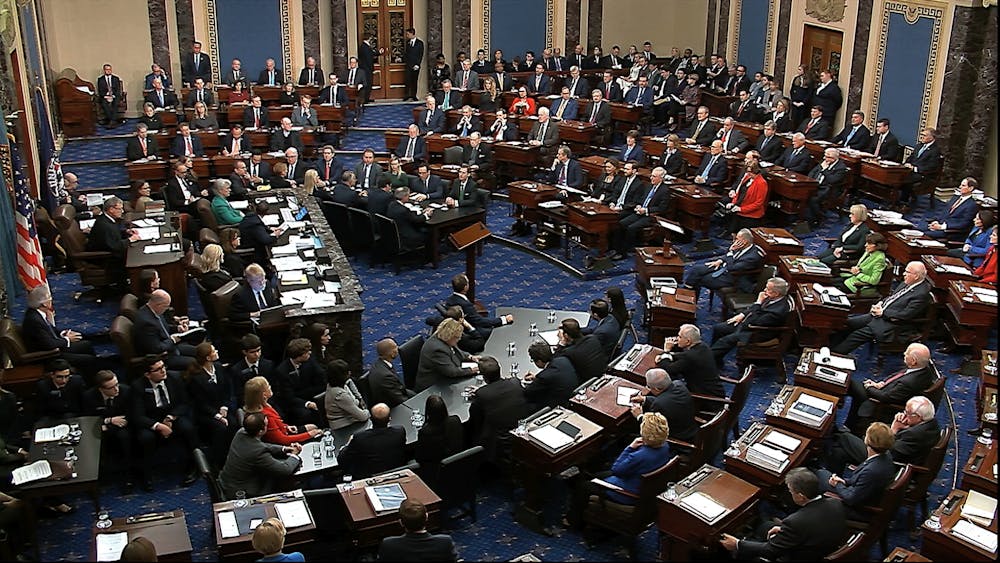
A scene of the Senate voting in Trump's impeachment trial in 2020
Donald Trump has been impeached twice, but has not convicted. Senate Television via AP

25th Amendment

The Constitution’s 25th Amendment provides a way for high-level officials to remove a president from office. It was ratified in 1967 in the wake of the 1963 assassination of John F. Kennedy – who was succeeded by Lyndon Johnson, who had already had one heart attack – as well as delayed disclosure of health problems experienced by Kennedy’s predecessor, Dwight Eisenhower.

The 25th Amendment provides detailed procedures on what happens if a president resigns, dies in office, has a temporary disability or is no longer fit for office.

It has never been invoked against a president’s will, and has been used only to temporarily transfer power, such as when a president is undergoing a medical procedure requiring anesthesia.

Section 4 of the 25th Amendment authorizes high-level officials – either the vice president and a majority of the Cabinet or another body designated by Congress – to remove a president from office without his consent when he is “unable to discharge the powers and duties of his office.” Congress has yet to designate an alternative body, and scholars disagree over the role, if any, of acting Cabinet officials.

The high-level officials simply send a written declaration to the president pro tempore of the Senate – the longest-serving senator from the majority party – and the speaker of the House of Representatives, stating that the president is unable to discharge the powers and duties of his office. The vice president immediately assumes the powers and duties of the president.

The president, however, can fight back. He or she can seek to resume their powers by informing congressional leadership in writing that they are fit for office and no disability exists. But the president doesn’t get the presidency back just by saying this.

The high-level officials originally questioning the president’s fitness then have four days to decide whether they disagree with the president. If they notify congressional leadership that they disagree, the vice president retains control and Congress has 48 hours to convene to discuss the issue. Congress has 21 days to debate and vote on whether the president is unfit or unable to resume his powers.

The vice president remains the acting president until Congress votes or the 21-day period lapses. A two-thirds majority vote by members of both houses of Congress is required to remove the president from office. If that vote fails or does not happen within the 21-day period, the president resumes his powers immediately.

The 25th Amendment
The 25th Amendment to the U.S. Constitution. National Archives via AP

The case for impeachment

Article II of the Constitution authorizes Congress to impeach and remove the president – and other federal officials – from office for “Treason, Bribery, or other high Crimes and Misdemeanors.” The founders included this provision as a tool to punish a president for misconduct and abuses of power. It’s one of the many ways that Congress could keep the president in check, if it chose to.

Impeachment proceedings begin in the House of Representatives. A member of the House files a resolution for impeachment. The resolution goes to the House Judiciary Committee, which usually holds a hearing to evaluate the resolution. If the House Judiciary Committee thinks impeachment is proper, its members draft and vote on articles of impeachment. Once the House Judiciary Committee approves articles of impeachment, they go to the full House for a vote.

If the House of Representatives impeaches a president or another official, the action then moves to the Senate. Under the Constitution’s Article I, the Senate has the responsibility for determining whether to remove the person from office. Normally, the Senate holds a trial, but it controls its procedures and can limit the process if it wants.

Ultimately, the Senate votes on whether to remove the president – which requires a two-thirds majority, or 67 senators. To date, the Senate has never voted to remove a president from office, although it almost did in 1868, when President Andrew Johnson escaped removal from office by one vote.

The Senate also has the power to disqualify a public official from holding public office in the future. If the person is convicted and removed from office, only then can senators vote on whether to permanently disqualify that person from ever again holding federal office. Members of Congress proposing the impeachment of Trump have promised to include a provision to do so. A simple majority vote is all that’s required then.

This is an updated version of an article originally published on Jan. 9, 2021.

The Conversation

Kirsten Matoy Carlson does not work for, consult, own shares in or receive funding from any company or organization that would benefit from this article, and has disclosed no relevant affiliations beyond their academic appointment.

What a US attorney general actually does – a law professor spells it out

U.S. Attorney General Pam Bondi answers questions from the media at the U.S. Capitol on March 18, 2026. Matt McClain/Getty Images

President Donald Trump fired Attorney General Pam Bondi on April 2, 2026, only 14 months after she was sworn into office, making her time in the role the shortest in 60 years.

While much recent attention has focused on Trump’s decision to fire Bondi, there has been less attention on what the attorney general actually does, or what happens when the attorney general gets fired.

The attorney general is the lawyer appointed by the president and confirmed by the Senate to lead the Department of Justice, known as the DOJ. Because the attorney general’s expansive responsibilities place the office at the forefront of both politics and the law, the position is one of the most important in the federal executive branch.

Two men in suits walking through a crowd outside.
NAACP leader Roy Wilkins walks in front of U.S. Attorney General Robert Kennedy during an NAACP march on June 24, 1964, in Washington, protesting the disappearance of three civil rights workers in Mississippi. Washington Bureau/Getty Images

File lawsuits, give advice

Congress created the position of attorney general in 1789 so the national government had a designated lawyer to conduct federal lawsuits for crimes against the United States such as counterfeiting, piracy or treason, and to give legal advice to the president and cabinet officials, such as the secretary of the Treasury.

Initially, the attorney general served part time. Indeed, for the first few decades of U.S. history, most attorneys general maintained private law practices and even lived away from the capital. But as the federal government began to do more, the role of the attorney general grew and became a full-time job.

The attorney general represents the United States in all legal matters. In doing so, the attorney general supervises federal prosecutions by the 93 U.S. attorneys who live and work across the United States to enforce federal laws. The attorney general also supervises almost all legal actions involving federal agencies – from the Department of Homeland Security and the Environmental Protection Agency to the Social Security Administration.

For example, in the past few months, DOJ lawyers supervised by the attorney general have charged people with conspiring to smuggle artificial intelligence technology to China and negotiated an agreement requiring Ford Motor Company to clean contaminated groundwater in New Jersey. They have also worked with Wisconsin to successfully prosecute deceptive timeshare exit services targeting elderly customers.

Additionally, the attorney general gives legal advice to the president and heads of the cabinet departments. This includes providing recommendations to the president on whom he should appoint as federal judges and prosecutors.

In combination, these two aspects of the job, representing the U.S. and advising the cabinet departments, mean that the attorney general plays a key role in helping the president perform his constitutional duty to take care that the laws of the United States are faithfully executed.

115,000 employees

Since 1870, attorneys general have had an entire executive department – the Department of Justice – to help them execute their duties.

Today’s department contains over 70 distinct offices, initiatives and task forces, all of which the attorney general supervises. There are currently over 115,000 employees in the department.

The DOJ contains litigation units divided by subject matter like antitrust, civil rights, tax and national security. Each of these units conducts investigations and participates in federal lawsuits related to its expertise.

The Justice Department also has several law enforcement agencies that help ensure the safety and health of people who live in the United States. The most well-known of these agencies include the FBI, the Drug Enforcement Administration and the U.S. branch of the International Criminal Police Organization, known as Interpol.

Additionally, the DOJ contains corrections agencies like the Federal Bureau of Prisons and the U.S. Parole Commission. These agencies work to ensure consistent and centralized coordination of federal prisons and offenders.

Finally, the department manages several grant administration agencies. These agencies, such as Community Oriented Policing Services, the Office of Justice Programs and the Office of Sex Offender Sentencing, Monitoring, Apprehending, Registering and Tracking, or SMART, provide financial assistance, training and advice to state, local, tribal and territorial governments as they work to enforce the law in their own communities.

A formal portrait of a man with dark hair and colonial dress.
Edmund Jennings Randolph, appointed by President George Washington as the nation’s first attorney general in 1789 and then, in 1794, secretary of state. The Diplomatic Reception Rooms, U.S. Department of State, Washington, D.C.

Separating politics from law

Given all the attorney general’s responsibilities, the role is both political and legal. As such, attorneys general historically have a difficult task in separating their jobs as policy adviser from their duties as chief legal officer of the United States.

For example, President George W. Bush’s attorney general, Roberto Gonzales, resigned from office amid accusations of the DOJ’s politicized firing of U.S. attorneys and misuse of terrorist surveillance programs. And Loretta Lynch, President Barack Obama’s attorney general, was criticized for meeting privately with former President Bill Clinton while former Secretary of State Hillary Clinton was under investigation by the DOJ.

The attorney general’s job is complicated by the fact that the president has the constitutional power to fire them for political reasons.

During his first term, Trump replaced Attorney General Jeff Sessions after Sessions angered Trump by recusing himself – removing himself – from overseeing the Mueller investigation into Russian interference in the 2016 election.

Given the attorney general’s connection to the president and the attorney general’s position as the head of the DOJ, when Bondi originally got the job critics saw her as a key part of Trump’s plan to control the department’s agenda, including through the use of the FBI to pursue his perceived enemies.

And now Trump has reportedly fired Bondi for failure to execute his vision.

What next?

Under current law, the president can designate a Senate-confirmed official in the administration or another high-ranking person who has worked within the DOJ for 90 days to serve as acting attorney general. Presidents across both parties historically have relied on these temporary appointments to steer the department as they decide whom to nominate officially for the position.

President Trump has named Todd Blanche as acting attorney general. Blanche, who served as deputy attorney general under Bondi, represented Trump in three of the four major criminal lawsuits he faced before the 2024 presidential election.

Trump is rumored to have discussed Lee Zeldin, the current head of the Environmental Protection Agency, to be Bondi’s permanent replacement. Zeldin worked as part of Trump’s legal defense team during his first impeachment trial.

Blanche’s temporary appointment and Zeldin’s potential nomination have spurred more questions about the politicization of the DOJ.

A recent Associated Press study found that only two in 10 Americans have a great deal of confidence in the department. In part, this is a result of the longstanding political connections between the presidents and their attorneys general.

Ultimately, the fate of the nation’s top law enforcement official is in the hands of politicians.

This is an updated version of an article originally published on Dec. 19, 2024. It is part of a series of profiles explaining Cabinet and high-level administration positions.

The Conversation

Jennifer Selin does not work for, consult, own shares in or receive funding from any company or organization that would benefit from this article, and has disclosed no relevant affiliations beyond their academic appointment.

Supreme Court ruling on Colorado conversion therapy case is not a clear win for conservatives

3 April 2026 at 12:44
The U.S. Supreme Court found a Colorado law banning conversion therapy for gay and transgender minors likely violates free speech. Roberto Schmidt/Getty Images

In an 8-1 decision authored by Justice Neil Gorsuch, the Supreme Court held on March 31, 2026, that a Colorado law prohibiting licensed counselors from performing “conversion therapy” on minors was likely unconstitutional as applied to talk therapy. Justice Elena Kagan filed a separate concurrence, joined by Justice Sonia Sotomayor. Justice Ketanji Brown Jackson dissented.

I am a law professor and political scientist who teaches and writes on free expression and discrimination. I see this holding as a potentially important decision at the intersection of free speech and health care.

Colorado’s law defines conversion therapy broadly. It bans practices that attempt not only to “change an individual’s sexual orientation or gender identity” but also to reduce same-sex attraction. The law allows therapists to provide “acceptance, support, and understanding” of gay or transgender identity. However, they may not help a client suppress those identities. Penalties include fines, probation and loss of license.

People hold signs outside a tall building under construction protesting conversion therapy.
Demonstrators with the Human Rights Campaign stand outside the United States Supreme Court during oral arguments in October 2025. The court released its decision on a free speech challenge to a ban on conversion therapy on March 31, 2026. Jabin Botsford/The Washington Post via Getty Images

Kaley Chiles challenged the law as a violation of her First Amendment free speech rights. As a therapist who only offers talk therapy, Chiles’s objection was limited to her talk therapy. She didn’t contest the ban on what she called “long-abandoned, aversive” conversion practices. And – notably, considering she is an evangelical Christian – Chiles said she never set out to convert her clients. She says she respects her clients’ “fundamental right of self-determination” and determines her therapy approach only after a client identifies his or her own objectives. But she argued that some of her clients wish to “reduce or eliminate unwanted sexual attractions (or) change sexual behaviors,” and the law prevents her from expressing support for any of those goals.

Colorado’s failed ‘professional speech’ argument

Colorado faced a major obstacle in defending the Colorado conversion therapy law. The law was transparently driven by the government’s views about the well-documented inefficacy and harmful effects of conversion therapy. And outside of certain contexts, such as government grants, public employees, advertising and threats, courts have treated such viewpoint-based laws as constitutionally dead on arrival.

Colorado’s best hope in defending the law, then, was to argue that it wasn’t principally a restriction on speech at all. Rather, the state framed the law as a restriction on professional conduct — an area where states have broad regulatory latitude. That framing would mean the law burdened Chiles’ speech only incidentally.

A CBS News Colorado report on Coloradans’ conflicted feelings about the Supreme Court ruling.

In NIFLA v. Becerra, decided in 2018, the court rejected the argument that professional speech was a less-protected category. But it acknowledged that laws “regulating conduct in ways that incidentally sweep in speech” – particularly where they “fall within the traditional purview of state regulation of professional conduct” – might survive under a lower standard of scrutiny.

Colorado attempted to demonstrate such a tradition here, citing medical licensing laws, informed-consent requirements and malpractice liability.

A divided 10th U.S. Circuit Court of Appeals had agreed with Colorado’s argument, as did Jackson in her dissent. But the Supreme Court majority rejected it. Gorsuch wrote that a government cannot evade First Amendment scrutiny by relabeling restricted speech as “conduct,” “treatment” or a “therapeutic modality.” Quoting the dissent of U.S. Circuit Judge Harris Hartz, he called Colorado’s argument a “labeling game.”

For Gorsuch, the key question is whether the law restricts speech in practice. And in Chiles’ case the answer was yes. Colorado was plainly restricting what she wished to tell her clients about their sex and gender issues.

Not just content but viewpoint discrimination

More than that, the majority noted, Colorado’s law doesn’t regulate therapists’ speech based on its content. The law discriminates based on viewpoint, permitting expressions of acceptance and support for a client’s self-identity while forbidding expressions that attempt to change it.

Under 1995’s Rosenberger v. University of Virginia, viewpoint discrimination is an “egregious form” of content regulation. Governments must “nearly always abstain” from it. The court remanded the Colorado case back to the 10th Circuit to resolve the case under this standard.

Jackson’s dissent: Medical treatment, not speech

Jackson’s solo dissent emphasizes that states have long enjoyed broad power to regulate how licensed medical professionals treat patients. To Jackson, the First Amendment should not interfere simply because a treatment is applied through words rather than instruments.

The court’s 2018 NIFLA decision, she argues, distinguished between speech restricted “as speech” and speech restricted “incidentally” as part of a medical treatment the state is otherwise entitled to regulate. According to Jackson, the majority arbitrarily collapses that distinction simply because the treatment is delivered orally. A talk therapy session and a drug infusion are both medical treatments, she argues, and the analysis should not turn on whether the provider uses a syringe or a sentence.

Jackson’s dissent also raises difficult line-drawing problems, such as the validity of less controversial potential prohibitions, such as those on encouraging a patient to smoke or to take their own life.

Implications are broader, narrower than most believe

First, only talk therapy is implicated.

The holding is narrow in this sense. It leaves room for policymakers still hoping to limit the practice of conversion therapy. Because Chiles challenged the statute only as applied to her, the majority’s analysis does not invalidate conversion therapy bans wholesale – neither Colorado’s nor those of more than 20 other states – but applies only to the extent they ban conversion talk therapy.

State legislatures can define conversion therapy a bit more narrowly, for example, by prohibiting the physical and more coercive techniques that initially gave rise to these bans. States can then leave the regulation of talk therapy to other legal and professional mechanisms, such as malpractice or enforcement of professional ethics.

Second, the standard of scrutiny that the lower court must now apply is not strict scrutiny; it is more demanding. Strict scrutiny is a legal test that validates a law if it is “narrowly tailored to achieve a compelling government interest.” Contrary to what some legal commentators have implied, Gorsuch never directs the lower court to use strict scrutiny.

The opinion emphasizes that the law doesn’t just discriminate against certain types of content – a trigger for strict scrutiny; it discriminates based on viewpoint. The strict scrutiny standard is demanding, but laws sometimes survive it. Viewpoint discrimination, on the other hand, is subject to a near-absolute prohibition: Governments must “nearly always abstain” from it. This language is stronger and more categorical than that for strict scrutiny. The implication is that the law should certainly be invalidated as applied to talk therapy.

Not a clear win for conservatives

Finally, the holding is a double-edged sword for conservatives with traditional views of gender identity. And for those discouraged by the outcome, seeing it only as a victory for religious conservatives, the holding’s logic offers a silver lining.

Kagan’s concurrence makes explicit that a “mirror image” law – one barring talk therapy that affirms gender identity – would raise the same constitutional problems.

Dr. John Fryer revolutionized mental health care by speaking publicly about being gay at a 1972 conference of psychiatrists. This NBC News report covers Fryer’s legacy.

The majority makes a similar point. As late as the 1970s, the American Psychiatric Association still classified homosexuality as a mental disorder. Under Colorado’s position, a law from that era prohibiting counselors from affirming gay clients’ identities would have been constitutionally sound.

Today, more than 20 states have moved to restrict gender-affirming care, and the federal government is pressuring state medical boards to adopt skeptical positions on gender transition. It’s not implausible that a legislature would attempt to ban gender-affirming, talk-based therapies. If and when conservative policymakers attempt that move, Chiles will be a formidable obstacle.

Read more of our stories about Colorado.

The Conversation

Kevin Cope does not work for, consult, own shares in or receive funding from any company or organization that would benefit from this article, and has disclosed no relevant affiliations beyond their academic appointment.

❌