
Normal view

The peptide problem: Hype is outrunning the evidence

Health Canada recently warned Canadians not to buy or inject unauthorized peptide drugs sold online, naming products that include BPC-157, CJC-1295, ipamorelin, TB-500 and retatrutide.

The advisory notes these products are being marketed online and on social media for anti-aging, weight loss, injury recovery, sleep, mental focus and general “wellness,” and that Health Canada has already seized several of them.

Peptides, short chains of amino acids (the building blocks of protein), are no longer marketed only to bodybuilders and elite athletes.

A scroll on Instagram and TikTok quickly reveals a broader wellness market in which influencers, including medical doctors, naturopaths and personal trainers, pitch compounds such as BPC-157 and TB-500. The hook? These self-injected compounds are recovery shortcuts, reduce wrinkles, “melt” belly fat and are “anti-aging” with strong and incredible effects.

The problem? Few, if any, of these substances have been tested in human trials.

As a case example, body protective compound 157 (BPC-157) is scientifically interesting. Reviews published in 2025 describe a body of research dominated by animal and cell studies, with signals suggesting effects on angiogenesis (the growth of blood vessels), growth-factor signalling (mainly growth hormone) and musculoskeletal healing.

In one systematic review, 544 papers were screened, 36 met the inclusion criteria, and 35 of those were in rodents or cells; only one involved humans in a musculoskeletal context.

Plausible hypotheses

That is the tension at the heart of the current peptide boom: plausible biology can generate excitement long before it generates reliable clinical evidence. Caution is warranted because animal findings do not reliably map onto what happens in people. Molecular pathway diagrams and rodent healing results are useful for generating scientific hypotheses, but they aren’t evidence that a product improves outcomes in human patients.

Most potential products tested in rodents do not make it to market. The “translational squeeze” — the number of products that begin rodent trials compared to the number that successfully progress from rodent trials to human trials, and from human trials to regulatory approval — is estimated to be greater than 20 to one.

Published human evidence for BPC-157 remains trivial. A retrospective knee-pain report included 16 patients; an interstitial cystitis pilot trial enrolled 12 women; and a recent intravenous safety pilot involved just two healthy adults.

These studies are too small and poorly controlled to establish whether the peptide outperforms natural recovery, the placebo effect or conventional rehabilitation. A randomized, double-blind, placebo-controlled hamstring-strain trial has now been registered, which is exactly the kind of study still missing from the evidence and efficacy base.

Placebo effect and regression to mean

The social power of peptide testimonials is easy to understand. Pain, soreness and recovery are subjective and highly variable outcomes.

The U.S. National Center for Complementary and Integrative Health notes that randomized, placebo-controlled trials are the gold standard because they help determine whether apparent improvement is due to the treatment or to chance. Harvard Health puts the related point bluntly: placebo effects can ease symptoms like pain, fatigue and nausea, but they do not shrink tumours or lower cholesterol.

Symptoms that are severe when people first seek help often improve by the time they are next measured, simply because of natural fluctuation, a phenomenon known as regression to the mean. So when someone injects BPC-157 and feels better two weeks later, several explanations compete: time, rehabilitation, expectation (the person has just spent money on a peptide and perhaps publicly committed to trying it), and regression to the mean. A testimonial saying “it worked,” can generate a hypothesis; it cannot settle causation.

For these reasons, regulatory warnings deserve more attention than influencer enthusiasm. Health Canada states that unauthorized injectable peptides are illegal in Canada, have not been assessed for safety, efficacy or quality, and may contain too much, too little or none of the claimed ingredient.

Notably, labels such as “For Research Use Only, Not for Human Consumption” do not make these products legal for human use.

In the United States, the Food and Drug Administration (FDA) classified BPC-157 as Category 2 for compounding due to adverse immune system reactions, peptide-related impurities and insufficient safety information to determine whether it would cause harm when administered to humans.

Purity certificates and conspiracy theories

A common rejoinder from people buying peptides online is that third-party certificates of analysis show the powder they receive is pure and free of contaminants. That reassurance does not survive scrutiny.

The “third-party” labs that produce these reports are often the vendors themselves and offer assurances of 98 per cent purity, which might seem impressive but would not meet any reasonable drug standards. And what exactly is the other two per cent? The consumer is asked to take the claims of purity as proof, while the peptide-related impurities that concern regulators remain invisible to the end user.

There is a deeper irony embedded in this practice: if buyers believed these products were safe, properly characterized and manufactured to the standards expected of pharmaceutical-grade products, they would not need to commission independent purity tests. The reliance on outside certificates of analysis is itself an admission that the normal guardrails of identity, potency, sterility and quality control are absent.

The conspiracy theory is that useful peptides are ignored by pharma companies because peptide drugs cannot be patented and become real medicines. The facts do not support that.

Semaglutide (used in GLP-1 medications like Ozempic and Wegovy) is a peptide drug, and tesamorelin is an FDA-approved synthetic growth hormone-releasing factor analogue. Peptide therapeutics are not an exotic category that mainstream drug development cannot handle.

What makes BPC-157 different is not that peptide medicine is impossible. But it’s been more than three decades since researchers began studying BPC-157, and public evidence remains dominated by animal- and cell-based papers and small human pilot studies. Journalistic investigation has also noted that much of the BPC-157 literature traces back to a single Croatian research group, another reason to be careful about mistaking repetition for independent confirmation.

Safety concerns

Jurisdictional and approval rules vary across regulators, but a global scan reveals that only a scant few peptides in BPC-157’s broader therapeutic class have achieved any clinically approved use.

A recent FDA 503A update in the U.S. should not be mistaken for a change in that picture. The FDA’s current safety page continues to cite concerns about immunogenicity, peptide impurities and limited safety data, and the agency has stated that a substance may still pose significant safety risks.

BPC-157 or other peptides may yet prove useful for a specific condition, at a specific dose and route of administration. The right response is not to dismiss that possibility, but to insist on the blinded, placebo-controlled human trials that could actually settle the question.

Until then, buying vials of dry powder, reconstituting it in sterile water, and injecting the cocktail with online-purchased needles will not provide proof of anything. It is high-risk, uncontrolled human self-experimentation.

The Conversation

Stuart Phillips owns shares in Exerkine. He receives funding from Nestle, Optimum Nutrition, Danone, and Nutricia. He is affiliated with WndrHlth, Liquid IV, and Myomar.

Received — 28 April 2026 The Conversation

Wearable glucose monitors offer real-time data, but for healthy people no guidelines exist to interpret the numbers

Continuous glucose monitors once required a prescription but can now be purchased over the counter. Jesus Rodriguez/iStock via Getty Images Plus

Keeping tabs on blood sugar throughout the day used to be the exclusive domain of people with diabetes. But in 2026, anyone can buy a user-friendly wearable device that provides minute-by-minute readouts on how their glucose levels respond to food and movement.

These glucose numbers are increasingly being tracked by people who are healthy but want to lose weight or optimize their wellness.

I am a behavioral scientist who has spent the past decade studying how real-time data captured through wearable sensors and mobile technologies can help promote a healthier lifestyle. I’ve found that for people who don’t have diabetes, using such a device for a few weeks can bring insight into how their body reacts to their eating patterns and daily habits.

But researchers still don’t know how these fluctuations affect health for people who don’t have diabetes. In the absence of meaningful metrics for interpreting these numbers, monitoring a constant stream of data doesn’t directly help people make health-related decisions and can lead to confusion and needless anxiety.

What are glucose levels – and why track them?

Glucose is a type of sugar that circulates in the bloodstream after being absorbed from food. It is the body’s primary source of energy.

For people without diabetes, glucose levels generally stay in the range of 70-120 milligrams per deciliter (mg/dL) of blood throughout the day. After eating or drinking, levels could exceed 140 mg/dL but should come down to the normal range within a couple of hours. That’s because the pancreas responds to a glucose spike by releasing a hormone called insulin, which brings the glucose number down.

Blood sugar levels on a spectrum from hypoglycemia to diabetes.
A healthy range for glucose levels is between 70 and 120 milligrams per deciliter. For people with diabetes, glucose levels generally run high. piyaset/iStock via Getty Images Plus

Muscles burn glucose for fuel, so physical activity also helps normalize glucose levels.

Glucose levels generally run high with diabetes. People with Type 1 diabetes, whose bodies don’t make enough insulin, rely on glucose numbers to tell them when to take a dose of insulin. People with Type 2 diabetes use the numbers to monitor the effect of their medications and lifestyle changes and to get a fuller picture of their glucose control.

From test strips to AI-enabled sensors

Devices that track glucose numbers have been around since the early 1970s. Early versions consisted of test strips that detected glucose levels in urine. Finger prick tests, or glucometers, which were developed in the 1980s, are still used by some people today and measure them more directly by applying a tiny blood drop to a test strip.

To make the technology more convenient, companies in the early 2000s developed continuous monitoring devices that consist of tiny sensors inserted just under the skin that detect glucose in fluid that surrounds cells. Initially, these devices could give readings every 15 minutes for several days at a time, but recent versions sample more frequently.

Today, the technology has evolved even further. The most advanced glucose monitors under development come in the form of watches or rings with noninvasive sensors that use light-based techniques to detect glucose in body fluids. Many also rely on machine learning to provide more accurate readings by detecting each person’s unique physiological patterns over time.

For decades, continuous glucose monitors were available only with a doctor’s prescription. But in March 2024, the Food and Drug Administration approved the first over-the-counter continuous glucose monitor in the U.S., making them widely accessible.

Glucose monitoring for diabetes

There’s no doubt that continuous glucose monitors are a game-changer. People living with diabetes rely on these devices to track what percentage of the day their blood glucose stays within healthy limits – a measure called “time in range.” Patients make decisions about managing their condition - for example, when to take insulin – on guidelines developed by researchers and physicians based on that measure.

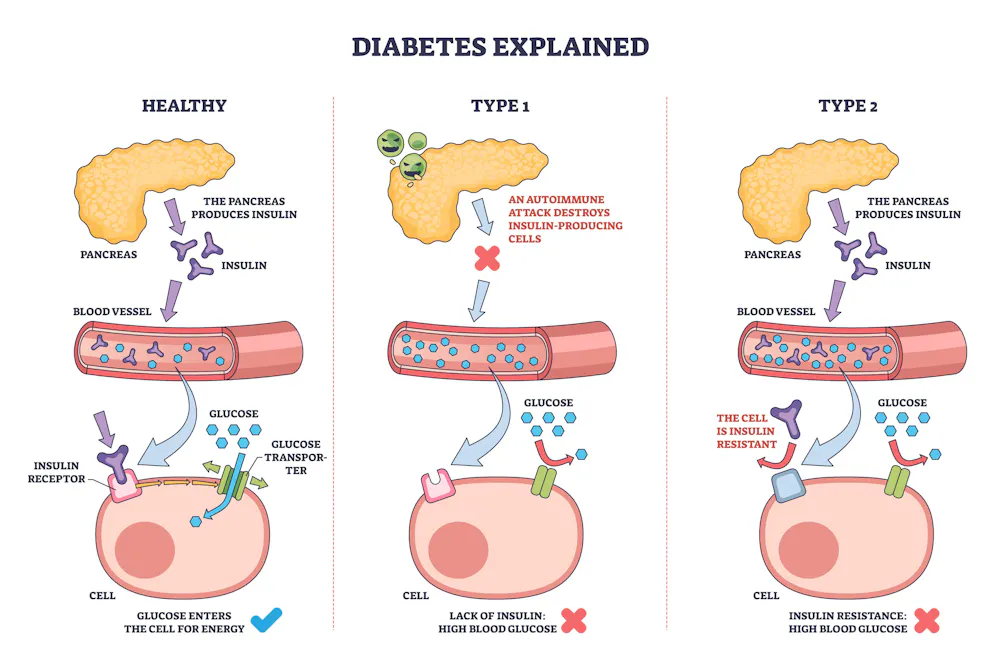
Infographic explaining glucose uptake and response to insulin in type 1 and type 2 diabetes.
In people living with diabetes, cells don’t absorb glucose properly from the bloodstream. VectorMine/iStock via Getty Images Plus

According to a 2026 report from the Centers for Disease Control and Prevention, almost 11 million adults who have diabetes – more than 1 in 4 adults with the condition – are undiagnosed. Type 2 diabetes can develop slowly and silently, often with no noticeable symptoms for years except glucose levels that remain elevated for a majority of the day, including when people are sleeping. Tracking glucose levels might offer clues that glucose is elevated.

Tracking glucose levels may also benefit the 115.2 million Americans – 43.5% of all U.S. adults – who have a condition called prediabetes. Prediabetes is when a person’s metabolic system shows early warning signs of diabetes but they don’t have the full-blown disease.

Prediabetes generally has no noticeable symptoms, but it is reversible – meaning, it’s possible to shift your glucose levels back into a healthy range. Tracking your glucose number can reveal how diet and exercise affect it. Observing how a soda spikes your glucose levels, for example, might give you pause before you drink one next time.

Daily glucose rhythms

Increasingly, though, people who use continuous glucose monitor aren’t diabetic – or even prediabetic. Instead, they want to understand how their bodies react to activities in their daily lives.

Diet, exercise and other lifestyle behaviors have long-term effects on health. Weight loss, for example, happens slowly. Changes in blood glucose, on the other hand, are more immediate. Tracking glucose levels thus offers real-time feedback on how your body responds to the food you just ate or the workout you just finished.

In studies I’ve conducted with colleagues, many people have found this information powerful. They were surprised to learn that eating certain foods – sugary soda, or even something healthy like a banana – causes their glucose levels to spike.

Seeing your glucose levels changing in real time can spur insights, but if you don’t have diabetes there are no guidelines for how to respond to those fluctuations.

One study participant told us that seeing their real-time glucose numbers led them to make more intentional dietary choices, such as cutting back on snacking. “I’m more aware and I’m making the changes,” they explained. Another participant also noted behavior changes prompted by continuous glucose monitoring, such as trying to avoid eating so late in the evening and consuming only half a fast-food meal.

That initial wow factor – and its capacity to motivate people to make healthy lifestyle changes – may be valuable. But it’s not clear how long these changes last, or how exactly people should respond to fluctuations in their glucose number to decrease their diabetes risk or to address other health issues.

Unlike the time in range guidelines for diabetes, there is no clear framework for what daily glucose patterns are abnormal in people who don’t have diabetes – or what patterns may indicate future disease risks.

Mapping the numbers

Researchers like me and my team are exploring exactly these questions.

Building a dynamic picture of how glucose levels fluctuate throughout the day in people without diabetes may point to early indicators for various chronic diseases. For example, my colleague and I recently developed a mathematical model to examine how monitoring glucose levels during sleep might help predict the risk of metabolic diseases – such as Type 2 diabetes, heart disease or fatty liver disease – in people with and without diabetes.

Additionally, continuous glucose data may reveal how people’s bodies might react differently to the same food, workout or other activity. Understanding how each person’s biology responds to the choices they make throughout the day could eventually lead to a more personalized approach to lifestyle changes that can help people maintain their health.

The Conversation

Liao Yue receives funding from the American Institute for Cancer Research, the American Heart Association, the Cancer Prevention & Research Institute of Texas and the Texas Higher Education Coordinating Board.

❌