
Normal view

Received — 5 May 2026 The Conversation

Pollen allergies are brutal this year – a doctor explains why, and how to find relief

Sneezing, wheezing ... it's allergy season. Science Photo Library/Getty Images

Spring means beautiful flowers, fragrant lilacs – and lots of tree pollen coating cars and setting off sneezing, wheezing and headaches.

As an allergist and immunologist at the University of Colorado School of Medicine, I help patients with seasonal allergies and associated allergic diseases manage their conditions, and one question comes up year in and out: Will this season be worse than last year?

With a record warm start to spring 2026 in much of the U.S., the answer is a teary-eyed “yes.”

What are allergies?

More than 1 in 4 U.S. adults suffer from seasonal allergies. That number is expected to increase as climate change results in longer and more intense pollen seasons.

When someone talks about having allergies, they are referring to a condition called allergic rhinitis or allergic conjunctivitis – inflammation of the nose or eyes related to allergen exposure. This results in itchy, watery eyes, runny nose, sneezing, congestion and nasal passage itching. They show up when allergens are in the air, during spring, summer and fall.

The big driver of seasonal allergies is a protein in pollen. Pollen is the male reproductive material that plants release to spread their species.

Pine cones release pollen on a windy April day in Fairfax County, Va. Famartin/Flickr, CC BY-SA

Those pollen proteins become problems when the immune system develops an allergic antibody known as IgE to these proteins. When several IgE molecules bind to the allergen when it lands on the tissues of the eye or nasal passages, the cells release molecules such as histamine, prostaglandins and leukotrienes. These molecules interact with blood vessels and nerves to trigger the symptoms that allergy sufferers know all too well.

Which pollens cause allergy symptoms?

Pollen season starts with the trees.

In late winter and early spring, trees begin releasing pollen in many places in the United States. Not all trees follow this schedule – mountain cedars, or juniper trees, for example, can release clouds of yellow pollen from November through January in Texas, causing a condition known as cedar fever.

As the year progresses, grasses will emerge and their pollen will cause symptoms through most of the summer – typically April to July.

Then ragweed and other weeds release pollen that causes symptoms into the fall until a freeze stops their pollen production.

How pollen season progresses across the United States. Created by Yingxiao Zhang and Allison Steiner, University of Michigan.

What makes one pollen season worse than others?

Several factors can influence how bad a season can be when it comes to seasonal allergies. The two big ones are the length of the growing season and the amount of pollen in the air. Both are expanding.

Over the past several decades, as global temperatures have risen, the growing season has lengthened in many parts of North America. Once temperatures begin to be above about 40 degrees Fahrenheit (4 Celsius), trees will begin to emerge from dormancy.

That’s what the Western U.S. saw in 2026, as an unprecedented warm spring drove the early emergence of tree pollen. In some locations, growing season is two weeks longer on average than in the 1990s and more than four weeks longer than in the 1970s.
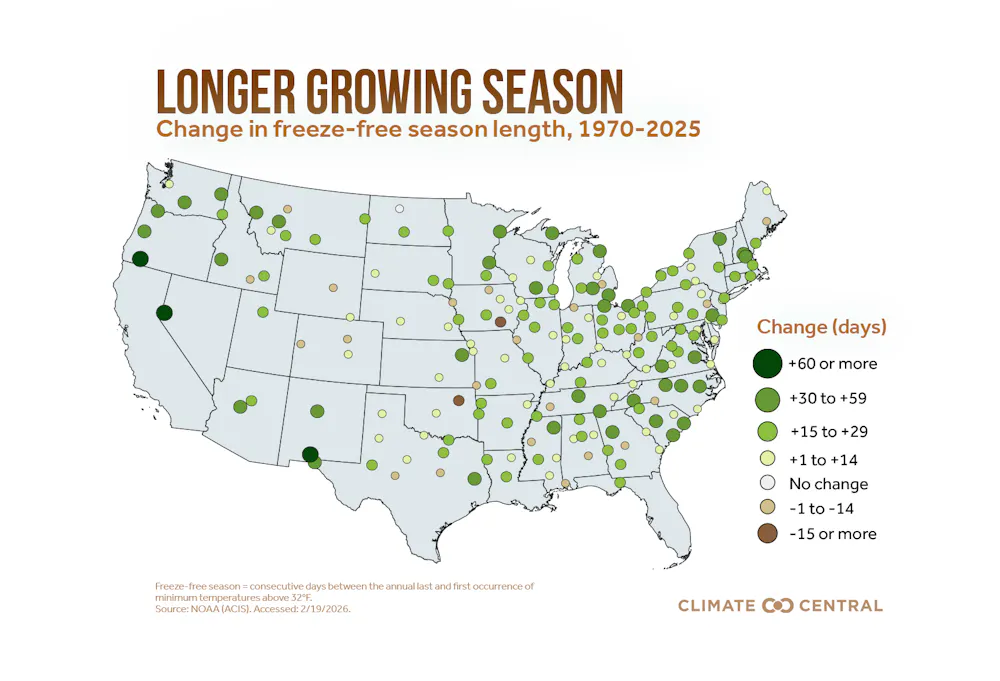
A map shows some areas seeing growing seasons 60 days longer than in the 1970s
Growing seasons are getting longer across the United States. Climate Central, CC BY

Another factor driving pollen production is the increase in atmospheric carbon dioxide, largely from the burning of fossil fuels. Higher carbon dioxide levels increase plant growth, leading to longer pollination periods and more pollen produced by plants. With higher pollen counts, more people can develop symptoms. Consequently, I have been seeing more patients who are experiencing allergies for the first time.

Windy days can also blow pollen into the air and spread it over a wider area.

Rain and humidity can affect pollen counts as well. Rain can temporarily scrub pollen from the air. But humidity and moisture after the rain will result in ruptured pollen granules, resulting in pollen that is easier to carry on the wind and breathe in. This is particularly the case with grass pollen.

So, how can you avoid allergy symptoms?

There are many ways to manage allergy symptoms.

The first is to try to avoid the allergen by making changes in your home to reduce exposure. Keeping windows closed during the pollen season will reduce the amount of allergen that can enter your home. Wiping down pets with a damp towel can reduce the amount of allergens they bring in. Avoiding using clotheslines can reduce pollen levels on washed items.

Changing clothes or showering after being outdoors can reduce the amount of allergens that remain on you.

Someone drew a smiley face and the word Lollen on a car hood covered in yellow pollen grains.
Pollen on a car hood offers a sense of just how much pollen can get into the air. Scott Akerman/Flickr, CC BY

Using HEPA air purification in the home can reduce household allergen levels. Look for non-ionizing air purification; ionizing air filters can generate ozone, which worsens indoor air quality.

To know when allergens are getting worse outside, watch the pollen forecast from the National Allergy Bureau. As a general rule, pollen counts are highest in the morning. However, outdoor air pollutants can increase in the afternoon when pollution, including particulate matter (PM2.5) and ozone, reach peak levels in the midday and afternoon heat.

Do medications work?

Medications can help alleviate symptoms. A saline nasal rinse can reduce mucus and allergens inside the nasal passages. For mild symptoms, daily nonsedating, or second-generation, antihistamine can be effective.

Daily use of nasal steroids can be helpful for people with moderate to severe allergies, but they can take several weeks to reach peak effect. A nasal antihistamine spray can provide additional benefits.

Antihistamine eye drops can also be helpful. In a dry climate like Colorado’s, nasal dryness can contribute to congestion, so using nasal hydration such as saline sprays can ease symptoms.

If medications don’t help, you could speak with an allergist about the possibility of immunotherapy – allergy shots – but they require weekly and monthly shots over several years. While allergy shots are effective at reducing allergy symptoms and the need for medications, they do have side effects, such as local site reactions and asthma symptoms, and they may trigger a severe allergic reaction called anaphylaxis.

Allergies can be miserable but manageable – even in an overproductive year like much of America is seeing in 2026. Understanding what’s causing them and finding the right solutions for you can make it easier to enjoy those flowers and walks in the sunshine.

The Conversation

Levi Keller does not work for, consult, own shares in or receive funding from any company or organization that would benefit from this article, and has disclosed no relevant affiliations beyond their academic appointment.

Received — 28 April 2026 The Conversation

Tapping your genome with AI and quantum computing could deliver on the promise of personalized medicine – but practical and ethical hurdles remain

While quantum computing has a long way to go, it can open tantalizing new doors for the field of genomics. herstockart/iStock via Getty Images Plus

Decades after researches first sequenced the human genome, scientists throughout the world are still working to understand it. Despite diligent global efforts to link uncommon variations in DNA sequences with human disease, progress has been slow, in large part due to limitations in scientific understanding and in part due to limitations in computational technologies.

Artificial intelligence has the potential to help scientists decipher the millions of genetic variations present in the genomes of different people in order to identify which ones lead to disease and which ones do not. In order to fully exploit the power of AI, however, scientists need to compare the genomes of thousands or tens of thousands of people. This task not only requires intense computational effort, it is also prone to error and will take years to complete.

Quantum computing has the potential to facilitate that process. We are researchers with a long-standing interest in finding ways to use genetics in the clinic and developing new technologies to study the human genome. Combining quantum computing with AI has the potential to accelerate genomic analysis far beyond traditional methods. For time-sensitive medical conditions, faster decoding of genetic information can directly inform urgent treatment decisions and, in some cases, be lifesaving.

Conventional vs. quantum computing

In conventional computing, individual bits of information – binary digits, also called bits – can represent only two states: namely, 0 and 1.

However, the qubits used in quantum computing can have more than two distinct states. Adding qubits together increases the number of states exponentially. The power of quantum computers lies in being able to check all the possibilities at once for problems with large numbers of variables, rather than one at a time like even the fastest possible classical computer must do. This allows quantum computers to solve certain types of problems, such as factoring large numbers for today’s encryption schemes and performing combinatorial optimization to find the best route through a large number of points.

Quantum computers work much differently from the computer you’re likely using to read this article.

Still, quantum computing is currently in its infancy. Despite the enormous potential of this technology, computer scientists are dealing with challenges related to its scalability, error correction, hardware development and the setting of standards.

There are also significant time and cost constraints associated with ameliorating these challenges. Experts in the field estimate that it may be at least a decade before quantum computing will be truly useful outside of the laboratory.

Bigger and better data analysis

If researchers are able to overcome these challenges, combining AI and quantum computing may not only enable scientists and clinicians to better understand the human genome but also to leverage that understanding to improve patient care.

Currently, researchers are able to use AI to analyze genomic data in combination with limited amounts of other biological information, such as gene activity, epigenomics, RNA signatures and protein function. Quantum computing could allow AI to process increasingly more massive and highly detailed datasets.

This might look like integrating large-scale genetic, protein and spatial datasets with clinical, demographic and real-time physiological data. This systems-level approach enables a more comprehensive and accurate understanding of complex biological systems beyond DNA sequence alone that could be used to improve public health.

In other words, quantum computing could make it possible to sequence a patient’s genome and combine that information with other information about how their body works at the molecular level to improve the accuracy of diagnoses and determine the best course of treatment in hours instead of months.

Challenges in access and privacy

Like many burgeoning technologies, combining AI with quantum computing has inherent and inescapable challenges. In particular, there are several ethical issues related to healthcare access.

One will be the cost. New technologies are typically expensive and that will likely widen the gap between those who can afford the best healthcare and those who cannot. Anticipating these costs and finding preemptive creative solutions is necessary to allow everyone to benefit equally.

While there are likely many approaches to reducing out-of-pocket expenses for healthcare, federal legislation could mandate affordable or free genetic information-based care to those in greatest financial need. Similar to the 2008 Genetic Information Nondiscrimination Act, which prohibits discrimination based on genetics, a new law could prohibit healthcare providers from withholding genetic information-based care from those who cannot afford it.

Close-up of face of person viewing computer screen, colorful DNA sequence reflected on their glasses
Biological data inherently comes with a privacy risk. Tek Image/Science Photo Library

Another challenge will be availability. These technologies will likely first be available at only the top medical centers in the country, which traditionally have the research funding and the cadre of skilled scientists and clinicians needed to develop new diagnostic methods and treatments. Consequently, the latest advances in health technology will be unavailable to people who physically or financially cannot travel to receive the best medical care.

A combination of telemedicine, centralized laboratories and shared data could potentially help make new technologies more accessible.

There are also privacy concerns intrinsic to sharing personal health data. Truly anonymizing personal information remains a challenge, and privacy concerns are likely to prevent some people from taking advantage of potentially lifesaving technologies.

One approach that may quell these fears is a model called federated blockchain governance. This approach involves sharing control of a blockchain, which is a digital ledger used to track transactions, among a small group of institutions rather than a single entity or the general public. Limiting the number of trusted curators of genetic data reduces the risk of privacy violations or security breaches and subsequently increases the chance that patient data will remain private.

Improving public health

Despite these challenges, combining advances in quantum computing and AI has the potential to significantly drive innovation and improve public health.

When scientists and clinicians are able to accurately identify the genetic basis of disease and potential risk factors, they will not only be able to develop better treatments but also help patients and healthcare providers know what symptoms to look for among those predisposed to certain conditions.

Taken together, this knowledge can improve public health, reduce the cost of healthcare and improve quality of life.

The Conversation

The authors do not work for, consult, own shares in or receive funding from any company or organization that would benefit from this article, and have disclosed no relevant affiliations beyond their academic appointment.

❌