The Men’s World Cup will be a unique sporting event for Canadians — and not merely because it’s being co-hosted on Canadian soil or because soccer is now the most-played youth sport in Canada.
The Canadian men’s national soccer team has the unique opportunity to forge a different vision of Canadian national identity — one that looks quite different from what hockey has historically offered.
This tournament will be especially unique when compared to recent sporting events including the Four Nat
The Canadian men’s national soccer team has the unique opportunity to forge a different vision of Canadian national identity — one that looks quite different from what hockey has historically offered.
A lot of the national enthusiasm was likely stoked by Canada’s tense trade relationship with the United States and not Blue Jays players being directly representative of the lived experiences of most Canadians.
A squad built on multiculturalism
Canada’s men’s soccer team presents a different image: a racially diverse squad whose players embody stories of immigration, offering a more inclusive vision of what Canadian identity can look like.
It is precisely this multicultural framework that’s made the squad possible and given Canada unprecedented strength and depth.
The power of recognition
National sporting events are powerful vehicles for building shared identity. When people connect to sporting events in ways that make their sense of belonging to a country feel personal, sport becomes something more than entertainment.
This World Cup arrives at a politically charged moment, with the United States — a co-host alongside with Mexico — planning to involve immigration enforcement in tournament security. Canada’s multicultural squad offers a counter-narrative in a tournament already shadowed by debates about immigration and belonging.
For the millions of Canadians who immigrated to Canada or who carry their family’s immigration story as a major part of their sense of identity, the men’s national soccer team offers something that the men’s Olympic hockey squad and the Toronto Blue Jays never quite delivered: the possibility of seeing themselves in a more complete representation of Canada’s team.
That is not a small thing. It is, in fact, the realization of the full potential of sport in building Canadian national identity.
Noah Eliot Vanderhoeven does not work for, consult, own shares in or receive funding from any company or organisation that would benefit from this article, and has disclosed no relevant affiliations beyond their academic appointment.
In Hanau, Germany, on Feb. 19, 2020, after Vili-Viorel Pǎun witnessed the beginning of a mass shooting and tried to stop the gunman by chasing him down with his car, he called emergency services three times. No one answered, and Pǎun was shot dead.
Later, Pǎun’s father overheard police officers using a common racial slur while commenting on the supposed impossibility of a Roma person showing civic courage. This was not an aberration; it was a part of the same systemic racism that’s left the vi
Later, Pǎun’s father overheard police officers using a common racial slur while commenting on the supposed impossibility of a Roma person showing civic courage. This was not an aberration; it was a part of the same systemic racism that’s left the victims’ families without true justice six years later.
As sensory studies scholars who focus on racism and migration, we argue that racism is not only interpersonal or even simply structural, it’s also multi-sensory. It shapes how minorities see, hear and move through the world, with consequences that extend from everyday interactions to life-or-death institutional failures.
Systemic failures shaped the tragedy
The gunman , a firm believer in the “Great Replacement” theory, scouted out places where minorities were thought to gather — shisha bars, youth centres and kebab shops — to carry out his attack.
The aftermath and investigation into the event revealed how in Germany the devaluation of minority lives that drove the gunman’s worldview is also present in the way justice, media and politics operate.
What happened at the Arena Bar & Café, the final site of the attack, serves as another example for the families of the victims who argue that the racism in this tragedy is also evidence of systemic issues within policing. The exit had been illegally locked to facilitate police raids, largely driven, investigators found, by racial profiling linking hookah bars with criminality.
The London-based research agency Forensic Architecture, which uses architectural techniques and digital technologies to investigate human rights violations, revealed that five of the nine victims could have escaped through the emergency exit and survived.
There were questions about why it took hours to apprehend the perpetrator, even though his location was known. The special forces stood by his house and waited, which gave the perpetrator time to kill his mother and commit suicide. They never offered a reason for their delayed intervention.
Our research shows that racism is a multi-sensory experience that transforms the ways in which minorities feel and interact with the world. Qualitative research and statistics confirm that people face a loss of trust and the development of health issues when faced with institutional discrimination.
Multi-sensory racism can present through a visual categorization based on skin colour — the discomfort of entering predominantly white spaces, for example. It can manifest through olfactory perception such as comments on “smelly” foods.
It affects everyday social interactions like how and where people choose to safely socialize — and why they may prefer to spend their time within their own communities rather than “integrating.”
These experiences culminate in how institutional behaviour sets up or fails to sanction individual racism.
Beyond moments of tragedy
In the case of Hanau, the failure by politicians and police to acknowledge the ubiquity of the racist worldview that motivated the perpetrator and made his violence possible has prompted survivors and their families to begin a multi-pronged anti-racist effort.
Most prominently, the survivors founded Initiative February 19 Hanau to create a platform that pushes for social action and solidarity for the victims of racist violence. Guided by the principles of remembrance, investigation, justice and accountability, the initiative calls for state responsibility while embracing the notion of #SayTheirNames.
The hashtag underscores the importance of naming those who have been murdered as an act of resistance against racism and systemic violence.
Both Said Etris Hashemi — who still carries shrapnel from the perpetrator’s ammunition in his body — and Çetin Gültekin, brother of the murdered Gökhan Gültekin, released memoirs that deal with the inherent racism of German society and situate it within a broader political struggle of growing far-right movements and their popularity in Germany.
The 2025 documentary Das Deutsche Volk follows the lives of the survivors and their families over the years and captures the ongoing fight for a memorial in Hanau’s city centre.
At one point, Çetin Gültekin suggests a landmark that showcases the deceased as pillars encircling the Brothers Grimm National Monument. The indifference that follows this suggestion has been interpreted by advocates as a lack of recognition for dignified remembrance.
The Hanau attacks, and the ongoing struggle for recognition of migrants’ experiences in a system where German institutions often treat them as third-class citizens, expose a troubling fallacy. It was captured by the words of Ta-Nehisi Coates in his 2015 non-fiction book Between the World and Me: “Race is the child of racism, not its father.”
In societies where race is still treated as a biological fact — rather than a colonial construct used to place people into arbitrary hierarchies — and where structural inequalities are only beginning to be acknowledged, there is still limited understanding of racism as a multi-sensory reality that shapes the everyday lives of minorities.
The work of addressing racist injustice requires sustained, long-term institutional and social change.
The authors do not work for, consult, own shares in or receive funding from any company or organisation that would benefit from this article, and have disclosed no relevant affiliations beyond their academic appointment.
Gold prices are at an all-time high, and we are very worried. As disease ecologists, it’s not the economic instability that concerns us, but the fact that a surge in gold mining could have a devastating impact on human health.
Our team of researchers from Stanford University, Universidade Federal de Mato Grosso, and Universidade Federal de Minas Gerais, Brazil, established and quantified the effects of illegal gold mining on a recent surge in malaria in the Yanomami territory in the Brazilian A
Gold prices are at an all-time high, and we are very worried. As disease ecologists, it’s not the economic instability that concerns us, but the fact that a surge in gold mining could have a devastating impact on human health.
When Jair Bolsonaro became Brazil’s president in 2019, he made environmental deregulation a central tenet of his platform, claiming that environmental and Indigenous land protections hindered the country’s economic development. He also transferred the authority of Indigenous land demarcation from the National Indigenous Foundation (FUNAI) to the Agriculture Ministry.
Furthermore, he issued decrees aimed at deregulating small-scale mining activities in the Amazon region. The decrees made no distinction between regulated (therefore, legal) mining outside of Indigenous territory and mining within Indigenous land, which is universally illegal. Illegal miners flooded the Yanomami territory.
By January 2023, when Lula da Silva secured the Presidency as Bolsonaro successor, the number of illegal gold miners in Yanomami territory — the largest Indigenous territory in the Amazon — had surged to 20,000, roughly two-thirds the number of the local Yanomami population.
Malaria and the Yanomami health crisis
Weeks after Lula da Silva took office, independent news outlet Sumaúmareleased a dispatch citing shocking disease and malnutrition figures among the Yanomami. Threaded with images of suffering Yanomami people, the report motivated the president to declare a humanitarian crisis.
Dr. Andre Siqueira, a researcher from the Oswaldo Cruz research institute (Fiocruz) and a member of the team of doctors sent into the territory upon declaration of the crisis recounted: “The conditions of the population were devastating.” Nearly every person they tested was positive for malaria.
Even small increases in mining can cause a surge in malaria cases
The Sumaúma dispatch, and the Instituto Sociaombientalreport upon which it was based, linked the influx of illegal gold miners during the Bolsonaro administration to the Yanomami health crisis and the proliferation of malaria.
As researchers who focus on how trends in land use contribute to the spread of parasites, we suspected that gold mining and malaria were not separate contributors to the same crisis, but part of one system of cause and effect devastating the territory and its people.
Illegal gold mining can drive malaria in multiple ways. First, when miners tear down forests and open gashes along the edges of rivers to access gold deposits, they create the ideal breeding grounds for the mosquito species that transmits malaria in the Amazon.
Second, when miners travel to the territory, potentially from malaria hotspots across South America, they can carry the parasite into the territory and increase its transmission.
Finally, small-scale gold miners often use mercury to cheaply and easily extract gold particles. This mercury is dumped into waterways across the region, poisoning the people who rely on the rivers for water and for fish, weakening their immune systems and making them more susceptible to malaria infection.
We were shocked by the results. The relationship was far stronger than we suspected. We found that every 0.03% increase in mining led to a 20-46% increase in malaria one to two years later, resulting in a 300% increase in malaria in the Yanomami territory between 2016-2023.
Understanding the association between gold mining and malaria underpinning the Yanomami health crisis is only one part of the puzzle. We hope that this research can serve as a tool to empower Indigenous communities with information about their health and inform policies that protect both human health and the environment. Our data indicates that by preventing illegal mining within Indigenous lands can protect their health and other important natural and cultural heritage.
Improving healthcare access
The Lula government is engaging in important efforts to expel illegal gold miners and establish health centers in the Yanomami territory. Though hospitalizations for malaria have decreased slightly since 2023, malaria rates among Yanomami remain high due to the lagged effect we identified in our research and the difficulty of access to timely diagnoses and treatment in remote regions.
Researchers are making strides to close this accessibility gap. An international team has developed “malakits”, which empower community members without formal medical training to diagnose and treat malaria on site. Such efforts are of critical importance given that the lagged effects of illegal gold mining will continue to cause elevated malaria incidence unless communities have broad access to treatment.
Informed consumers can prioritize purchasing recycled gold or refrain from purchasing gold at all to send a signal that further illegal gold extraction is not worth the human toll. As with the Blood Diamonds campaign in the early 2000s, real change can come from spreading the word about the human and environmental cost of illegal mining and demanding ethical supply chains.
Appeals to protect the Amazon region are often made on environmental terms. We want to make the case that saving the people in Amazon is also a global health imperative. Protecting the forest, investing in Indigenous land rights, fostering healthy economic opportunities for rural communities, and interrogating the role of gold in our global economy are all part of preventing the continued spread of one of the world’s deadliest infectious diseases.
Daniela de Angeli Dutra was funded by a grant from the National Institutes of Health (USA) awarded to Professor Erin Mordecai.
Riley Casagrande não presta consultoria, trabalha, possui ações ou recebe financiamento de qualquer empresa ou organização que poderia se beneficiar com a publicação deste artigo e não revelou nenhum vínculo relevante além de seu cargo acadêmico.
Donald Trump and Xi Jinping are likely to discuss many issues as they meet this week in Beijing. But alongside trade, technology and the war in Iran, one topic of conversation will stand out – the future of Taiwan.
Taiwan has long been a sensitive issue in Sino-American relations. Beijing regards the island as a breakaway province which must be reunited with the mainland. The United States has long opposed such a step. Yet in recent months, Trump has fuelled speculation that he may be ready to
Donald Trump and Xi Jinping are likely to discuss many issues as they meet this week in Beijing. But alongside trade, technology and the war in Iran, one topic of conversation will stand out – the future of Taiwan.
Taiwan has long been a sensitive issue in Sino-American relations. Beijing regards the island as a breakaway province which must be reunited with the mainland. The United States has long opposed such a step. Yet in recent months, Trump has fuelled speculation that he may be ready to change key aspects of US policy on the issue, potentially granting Beijing long-sought concessions.
Trump’s apparent readiness to make these moves means that Taiwan is one of the issues on which we might see the most significant policy developments at the summit. And that could happen simply through the famously voluble president uttering just a few simple words.
The president’s policy towards Taiwan has been inconsistent and seemingly more malleable than that of previous administrations. Advocates for Taiwan point out that his administration recently approved the largest ever US arms sale to the island. But at the same time, he has sowed doubts about the strength of his support for Taiwan’s independence.
US policy towards Taiwan has traditionally been based on two principles. The first is “strategic ambiguity”, which means that the US declines to explicitly state whether it would actively use its military to defend Taiwan from attack by China. This policy is supposed to deter China while also discouraging Taiwan from formally declaring its independence from Beijing.
The second principle is the “one China policy”. According to this policy, the US recognises Beijing as the legitimate government of China, while opposing any violent solution to its dispute with Taiwan. It also retains robust informal links to the Taiwanese government in Taipei.
Observers are concerned that Trump may water down these principles during his summit with Xi. For instance, he might state that the US not only “does not support” Taiwanese independence but actively “opposes” it. Or he might double down on previous comments he has made indicating that whether or not Xi invades Taiwan is “up to him”.
Trump has also explicitly stated that he will discuss future US arms sales to Taiwan with Xi during this week’s summit. This violates one of the so-called Six Assurances that the US has upheld towards Taiwan since the 1980s, and which were endorsed by the US Congress in 2016.
Even securing a discussion of arms sales would be a victory for Xi, who would welcome an opportunity to chip away at the Six Assurances. Presumably he would then try to weaken the US commitment to the other five, which include a US commitment not to change its position on Taiwan’s sovereignty.
More concretely, if Xi succeeds in making US arms sales to Taiwan a legitimate topic of negotiation in Sino-American relations, then he could head them off in the future by offering the US concessions in other areas. For instance, if Trump or a future president asks Beijing for its help settling a conflict like that in Iran, Beijing might demand an end to US arms sales to Taiwan as the price.
High stakes
Given Trump’s reputation as a formidable China hawk, his attitude towards Taiwan may seem surprising. But it’s actually part of a longstanding pattern.
In relations with China, Trump has arguably always prioritised economic issues, while appearing less concerned about the security of America’s regional allies. He has also raised doubts about whether Taiwan is even defensible. In his first term, he reportedly told aides that: “Taiwan is like two feet from China. We are 8,000 miles away. If they invade, there isn’t a fucking thing we can do about it”.
Trump is also both highly transactional and less focused on abstract principles of foreign policy than most previous presidents. He views America’s support of allies such as Taiwan as a gift that it gives them, one that is often not worth the cost. If he can achieve a concrete victory for himself today by trading away support for Taiwan tomorrow, he may well be willing to do so.
All of these developments matter because they make a violent conflict between China and Taiwan, potentially ultimately involving the US, more likely. If Trump makes concessions to Xi, it will be the latest signal that US support for Taiwan is wavering. That made be read in Beijing as permission to violently change the status quo. Even though such an act might belatedly then be met with force from Washington in response, it is made more likely by Trump’s stance today.
Even worse for Trump, the summit comes at a time when American power and the wisdom of its long-term strategy are being visibly called into question in the Middle East. The US is bogged down in an intractable conflict and has severely damaged its deterrent capacity in the Indo-Pacific by burning through advanced munitions at a high rate. Trump’s personal unpopularity is also rising at home amid the war and its economic fallout.
This weakened position makes it even more likely that Trump will want to strike a deal with Xi to help end the war in Iran or ease trade tensions to help the economy at home. Taiwan may be the price of that – and, ultimately, peace.
Andrew Gawthorpe is affiliated with the Foreign Policy Centre in London.
The government has set out its legislative agenda for the new parliamentary session in the king’s speech. Our panel of experts reveals the key points.
Measures to ease high living costs
Jonquil Lowe, Visiting Academic, The Open University
Surveys suggest that the cost of living is still a major concern for UK households, with energy and food prices topping the list of worries. In response, some campaigners have called on the government to use the energy independence bill announced in the king’s speech to break the link between electricity and gas prices and volatile global gas prices. And they want it to provide support, especially for low-income households, to switch away from heating homes with fossil fuels.
Among other measures, the bill aims to ensure landlords upgrade their properties to reduce tenants’ energy bills. These kinds of measure need to be introduced urgently if they are to save households from heftier energy bills expected this winter.
Other cost-of-living reliefs are welcome, although their impact may be small. For example, a move to “strengthen ties with Europe” may ease food inflation by reducing red tape and border checks on some imported foods.
The leasehold and commonhold reform bill (carried over from the previous parliamentary session) will help owners of leasehold flats and houses by capping ground rents at £250 a year, and then reducing them to a negligible amount after 40 years. Meanwhile, the social housing renewal bill aims to increase the stock of affordable social homes.
A ‘Bresignation’ bill: options for UK-EU closer relationship remain limited
Miriam Sorace, Associate Professor in Comparative Politics, University of Reading
The government clearly recognises that to improve the UK’s economic and trade security, strengthening ties with the European Union is paramount. But public attitudes are still characterised by “bresignation” rather than wholehearted “bregret”.
While support for rejoining the EU sits at around 55%, this obscures deep polarisation and strong conditionality. Support drops sharply in rejoining scenarios that require the UK to relinquish its previous opt‑outs, notably euro adoption and participation in the Schengen agreement on free movement. These would probably be among the concessions demanded by the EU, given public opinion across member states. Support for rejoining the single market (48%) or the customs union (50%) lags behind support for rejoining the EU and remains highly polarised.
The least polarising and most popular option is a broadly defined “closer relationship” with the EU, supported by around 63% of the public and even attracting a sizable minority (40%) of Reform UK voters (and 56% of previous Leave voters). Yet this plea reflects a degree of wishful thinking. Given the UK’s and EU’s red lines, marginal adjustments to the Trade and Cooperation Agreement are the only real options short of the various rejoin alternatives.
The status quo is widely disliked (only 33% prefer the current UK-EU relationship), but there is no other politically viable alternative to tinkering around the edges. “Closer relations” is not a concrete policy: it’s the default expression of living under sub-optimal constrained choice. In other words: “bresignation”. The UK is likely to remain locked into a status quo of continual negotiation with the EU for the foreseeable future, unless public opinion shifts towards accepting the significant concessions required to initiate rejoining negotiations.
Tourist taxes – England plays catch-up
Rhys Ap Gwilym, Senior Lecturer in Economics at Bangor University’s Business School
England is set to become the 26th country in Europe to introduce a tourist tax. The overnight visitor levy bill, announced in the king’s speech, follows recent moves in Scotland and Wales allowing local authorities to tax overnight stays.
In Scotland, Edinburgh will lead the way, adding a 5% levy to accommodation bills from July 24 this year. In Wales, Cardiff intends to introduce charges from April 2027: £1.30 per person per night in hotels and Airbnbs, and 75 pence in campsites and hostels. Such measures have proved controversial, with strong opposition from parts of the tourism industry.
The UK government has framed this as “the first step in a new era of fiscal devolution in England”. In practice, it is a modest one. Revenues are likely to be small relative to existing local taxes and mayors may place greater weight on reforms to council tax caps or business rate retention.
That said, international evidence suggests well-designed tourist taxes can work. Even modest revenues can help fund destination management, ease pressures on local communities and improve the visitor experience. The detail of the legislation will ultimately determine whether England achieves these gains.
Plans to make it easier to align UK law with EU agreements
Simon Usherwood, Professor of Politics & International Studies, The Open University
For all the talk from Prime Minister Keir Starmer of putting the UK at “the heart of Europe”, the proposed European Partnership Bill is a relatively modest and technical move. It would give the government powers to make adjustments to domestic legislation to ensure it complies with agreements being made with the EU. This would apply to those currently under negotiation (like youth mobility, food and veterinary standards, or emissions trading) or those that might be considered in future.
This streamlines a process that would have been necessary in any case, and remains reliant on those EU deals actually being struck. So there’s nothing particularly remarkable about the content. However, the repeated mention of “where it benefits the national interest” highlights how the government is trying to package this as something more.
Decisions about when to align are necessarily attached to decisions to sign up to deals with the EU, not to whether to make the domestic adjustments (which international law would consider to be an obligation). Much like Starmer’s flowery rhetoric in his speech on Monday, the substance doesn’t really match up.
Nationalising steel for security – but debts could burden the taxpayer
Phil Tomlinson, Professor of Industrial Strategy and Regional Development, University of Bath
Plans to nationalise British Steel offer some comfort to UK steel workers in the form of preserving jobs and providing stability. More pertinently, the move represents a renewed willingness for the state to intervene in a strategically important industry facing financial difficulties, high energy costs, fierce global competition and the challenges of the green transition.
Steel is a critical element in UK sectors such as car manufacturing and defence, infrastructure projects like railways, and low-carbon technologies including wind turbines. Nationalisation should offer the UK a degree of security over steel supply in an increasingly uncertain geopolitical climate.
The risk is that British Steel continues to lose out in global markets and makes substantial losses. This will impose a huge financial burden on the UK taxpayer, at a time when public finances are tight. But public ownership could align steel production with the UK’s broader industrial strategy goals, such as infrastructure development and net-zero targets.
And state financing could allow for long-term investment in new electric steel furnaces and decarbonisation. In the future, the government could use other levers to ensure a market for British Steel, such as strategies which favour UK-sourced, low-carbon steel for green infrastructure projects.
Plans to clean up our rivers and seas could be watered down
Alex Ford, Professor of Biology, University of Portsmouth
Water bills are rising, public anger over sewage pollution has not abated, and the government has now set out a major overhaul of water regulation in England and Wales in the king’s speech.
The proposed water reform bill signals a shift in emphasis. Rather than focusing solely on water companies, the legislation aims to address pollution more broadly, including contributions from agriculture and industry. This is a welcome change. The bill also promises a more unified regulatory system to end the fragmented oversight that has characterised the sector for decades.
Yet despite the language of reform, the vision looks less like a radical reset and more like a reboot of privatisation. This focus will worry campaigners, as it suggests continuity with an economic model widely blamed for under-investment, rising bills and environmental harm.
Immigration bill to tighten rules on right to family life
Joelle Grogan, Senior Visiting Research Fellow, University College Dublin
The government says the new immigration and asylum bill will “tighten the application” of Article 8 of the European Convention on Human Rights. The Article 8 right to family life is inherently restricted, and both national courts and the European Court of Human Rights generally defer to government migration policy. So more detail of the bill in future will be welcome.
The background briefing notes state that Article 8 is stopping the removal of those living illegally in the UK, saying that 86% of people from January to September 2022 who raised rights-based applications in detention were released. However, this highlights the lack of data – both on how many removals have been stopped by the ECHR and its connection with the number of illegal arrivals. Research on available data on the ECHR and foreign national offenders indicate that numbers are very low.
The bill will define family life to ensure that it is limited to the core family unit of spouse, parents and children. But the European Court of Human Rights emphasises the “dependence” of one family member on another (for example by providing sole financial support) in migration cases as the trigger for Article 8. So by defining “family unit” without the condition of “dependence”, the government may unintentionally widen the definition rather than narrow it.
Simon Usherwood has received funding from the Economic and Social Research Council, as a Senior Fellow of the UK in a Changing Europe initiative.
Alex Ford has received funding from UKRI research councils, EU, charities and industrial partners including the water industry.
Joelle Grogan, Jonquil Lowe, Miriam Sorace, and Phil Tomlinson do not work for, consult, own shares in or receive funding from any company or organisation that would benefit from this article, and have disclosed no relevant affiliations beyond their academic appointment.
Bottom trawlers extract one-quarter of the world’s fisheries catches by weight and raise significant ecological, economic and social concerns. Given that, you’d think there would be an answer to basic questions in fisheries: how many fish species are being caught, and what are they?
In reality, though, bottom trawling is often proceeding blindly.
Bottom trawling is widespread and problematic. Gears operate by dragging large weighted nets across the ocean floor (some as wide as a 45-storey bui
Bottom trawlers extract one-quarter of the world’s fisheries catches by weight and raise significant ecological, economic and social concerns. Given that, you’d think there would be an answer to basic questions in fisheries: how many fish species are being caught, and what are they?
In reality, though, bottom trawling is often proceeding blindly.
Bottom trawling is widespread and problematic. Gears operate by dragging large weighted nets across the ocean floor (some as wide as a 45-storey building is tall), sweeping up most of the life they encounter along the way and destroying habitat.
By far the biggest threat to seahorses is their incidental capture in bottom trawls.(Unsplash/Giulia Salvaterra)
We lead a conservation team called Project Seahorse, dedicated to ensuring there are more fish in the ocean in healthier ecosystems. We focus our work on securing healthy populations of seahorses — and to save seahorses, we have to save the seas.
By far the biggest threat to seahorses is their incidental capture in bottom trawls. As such, seahorses provide an index of the tremendous intensity of bottom trawling.
It was while developing a briefing on bottom trawl impacts that we realized no one knew the actual tally or diversity of fish getting caught up in nets. So we set out to provide an answer and in so doing unveiled more about the pressure bottom trawling is placing on marine species, ecosystems and fisheries worldwide.
Endangered species
Our research was anchored in tedious work as our co-authors took a deep dive into studies and reports hosted on the Food and Agriculture Organization of the United Nations (FAO) document repository, supplemented by an ad hoc exploration of additional literature.
The FAO is an intergovernmental organization that, among other things, collates worldwide fisheries data. We extracted more than 9,000 reports of fish species in bottom trawl catches, spanning from 1895 to 2021.
The first of our worrying findings is that a huge number of species are affected. We documented around 3,000 different fish species in bottom trawl catches but our modelled estimates suggest the true number could be double that.
Our data also showed that bottom trawls extract all or most species in some fish families. These include both the ocean’s most nutritious and commercially critical fish, such as jacks and croakers, and rare, distinct fish such as giant guitarfish and plough-nosed chimera.
Our second discovery is that many of the species we documented are already known to be of conservation concern. Among those on the International Union for Conservation of Nature’s (IUCN) Red List, about one in seven are classified as threatened or near-threatened with extinction. Bottom trawling was also cited in threat assessments for two-thirds of those species.
A giant guitarfish is among the species being caught by bottom trawling.(Sarah Foster)
Insufficient data
Our third finding was that there is limited information on the conservation status for many of the fish caught in bottom trawls. About one-quarter of the species we recorded were listed as “data deficient” or “not evaluated” by IUCN, meaning their conservation status is essentially unknown.
People tend to focus on the threatened species, which certainly need our attention; seahorses among them. However, we also need to be concerned about the species in trawls that lack conservation assessments, which may also be faring badly.
Finally, we found that many species are not even being recorded. Our database includes relatively few records of smaller demersal species (animals that live near the bottom of the sea), with fisheries often just lumping them together as “various” or “trash fish.”
As many fish are so often overlooked or ignored in catch records, we often don’t actually know what bottom trawlers are catching. When species are not recorded, we lose critical information about biodiversity, population status and ecosystem impacts, not to mention the loss of resources that people depend on for food and livelihoods.
Bottom trawl fisheries should be required to demonstrate that they are ecologically, economically and socially sustainable before being considered acceptable. As it stands, the burden of proof falls on those trying to demonstrate harm — not on the industry causing it. This needs to be reversed, paying full attention to all the fish in the nets.
The authors do not work for, consult, own shares in or receive funding from any company or organisation that would benefit from this article, and have disclosed no relevant affiliations beyond their academic appointment.
Rawpixel.comWhether you call it an Irish goodbye, French leave or filer à l'anglaise (leave in the English style), as the French prefer, the act of quietly slipping out of a party without fanfare is a familiar social impulse. The Brazilians called it sair à francesa (French style), the Germans a Polnischer Abgang (Polish departure), and Australians call it ninja bombing. Whatever name it goes by, the concept is the same: one moment you’re there, the next you’ve vanished into the night without a
Whether you call it an Irish goodbye, French leave or filer à l'anglaise (leave in the English style), as the French prefer, the act of quietly slipping out of a party without fanfare is a familiar social impulse. The Brazilians called it sair à francesa (French style), the Germans a Polnischer Abgang (Polish departure), and Australians call it ninja bombing. Whatever name it goes by, the concept is the same: one moment you’re there, the next you’ve vanished into the night without a drawn-out round of explanations, hugs and promises to catch up soon.
The pattern is telling: every culture has a term for it, and every culture blames someone else. That collective deflection suggests we already know, on some level, that slipping out unannounced is a social transgression.
But for those of us with anxiety, that silent exit isn’t rudeness. While etiquette traditionalists will probably insist that leaving without saying goodbye is a social no-no, some psychologists argue that it’s a coping strategy. Here’s why sneaking out without saying goodbye might be the healthiest decision you make all evening.
When you break it down – and let’s be honest, those of us who are anxious, introverted, neurodivergent or dealing with chronic illness have all broken this down into agonising detailed steps – saying goodbye is a loaded cultural ritual. It’s a performance that demands a high degree of social skill, accuracy and nuance.
Goodbyes are high-demand situations and, sadly, by the end of a social occasion, many of us are already depleted and don’t have the energy to handle all the steps involved.
When socialising means constantly adapting yourself to other people’s expectations, the healthy choice becomes using your last bit of energy to recharge and take care of yourself. Don’t leave the party completely drained with nothing left to recover with.
Sometimes we want to leave quietly because leaving loudly feels like shouting out: “I matter! Look at me, I’m leaving!” The fact is, many of us sit with the belief that we don’t really matter that much, so we don’t say goodbye because we don’t feel we are worth the performance.
Sometimes a silent exit is about self-respect, minding your energy reserves, even if you really enjoyed the evening. At other times, though, it’s an act of self-erasure. You leave without saying goodbye because you think no one will care, that you don’t matter enough to make a fuss when leaving.
Leaving quietly can become a way to protect yourself from the discomfort of saying goodbye. But the quiet exit cuts both ways. Ask yourself whether leaving without a word made your life bigger – you conserved enough energy to recover and you’re glad to go back next time – or whether it shrank it, adding another reason to avoid socialising altogether.
If you are going to pick apart your goodbye and negatively assess it, the next goodbye will feel even harder. Be careful to reality-test your post-event ruminations. It’s usually not as bad as you think, especially if you are assessing your performance through the distorting lens of anxiety.
There is always a tension between wanting to belong and wanting to be yourself. If saying goodbye starts to feel so pressured and so performed that you lose any sense of being authentic, then the connection is starting to cost more than it’s worth.
If you feel like you need to be a chameleon to survive the complexities of socialising, the healthiest choice is to find a way to be who you really are. Find a way to tell your friends and family that leaving quietly is something you need because of how your nervous system and psychology are made, and not a reflection of the relationship. Research shows that being your truest self and having the best social connections go hand in hand.
And if you are neurodivergent, being open about what you need can feel like a risk, but it can also be a way to find acceptance, support and understanding when you let people know what you need and like.
If you’re anxious, it’s worth letting your host know in advance that you might need to slip away quietly. Otherwise, there’s a risk that people will read it the wrong way, as coldness or indifference, say.
Get ahead of it by letting people know you’ll leave without saying goodbye, and that you’re grateful to have been invited. Anxious people aren’t bad at relationships. Relationships just work better when everyone understands the other person’s needs.
Less is more
There’s a growing idea that being choosy about your social life isn’t antisocial – some psychologists call it “selective sociality”. Picking your moments carefully means you have more to give when it counts. The goal isn’t to retreat, but to invest in deeper relationships and in real presence, rather than the hollow churn of online contact – unless it supports meaningful connection.
In a world where being seen to do the right thing has begun to outweigh doing the right thing, selective sociality offers a way forward. Knowing our limits and being open about them, when possible, doesn’t weaken connection – it helps create relationships that feel real and sustainable.
If sneaking out without a fuss makes it more likely you will go to the next party, then it’s a choice for more social connection and therefore your health.
Trudy Meehan does not work for, consult, own shares in or receive funding from any company or organisation that would benefit from this article, and has disclosed no relevant affiliations beyond their academic appointment.
Illustration of a Mars mission that utilises nuclear propulsion. NasaNasa is developing ways to use nuclear power to send spacecraft to their destinations. Nuclear propulsion could greatly reduce the journey time to Mars, perhaps cutting a voyage of more than six months to three or four months.
The idea of nuclear propulsion in space goes back to the cold war. But Nasa has been pursuing it more aggressively since Jared Isaacman took over as the agency’s chief in December 2025. Isaacman is a wel
Illustration of a Mars mission that utilises nuclear propulsion.Nasa
Nasa is developing ways to use nuclear power to send spacecraft to their destinations. Nuclear propulsion could greatly reduce the journey time to Mars, perhaps cutting a voyage of more than six months to three or four months.
The idea of nuclear propulsion in space goes back to the cold war. But Nasa has been pursuing it more aggressively since Jared Isaacman took over as the agency’s chief in December 2025. Isaacman is a well-known advocate of the technology and says it can “truly unlock humankind’s ability to explore among the stars”.
In March 2026, the agency even announced an uncrewed, nuclear-powered mission to the red planet, targeted for late 2028.
Every spacecraft begins its journey fighting Earth’s gravity by burning chemical fuel. Rockets mix fuel with an oxidiser, ignite them, and force the expanding gas through a nozzle. According to Isaac Newton’s third law, when gas pushes downward, the rocket gets an equal push upward.
Chemical propulsion is powerful, reliable, and quite simply the only practical way to leave Earth’s gravity. But it comes with a severe limitation. Rockets must carry both their fuel and, in most cases, the oxidiser needed to burn it.
That means much of a rocket’s mass at launch is propellant, not payload. The longer and more ambitious the journey, the more propellant is needed, and the heavier the rocket becomes.
Nasa chief Jared Isaacman has repeatedly made the case for nuclear-propelled spacecraft.NASA/Aubrey Gemignani
Mars is far enough away that a long journey time, the threat to astronauts from cosmic radiation, the mass required to carry life-support systems and constraints on the return journey all pose serious problems for planning a mission.
This is why engineers keep looking for more sustainable alternatives to chemical rockets.
Nuclear thermal propulsion follows a three-step process. First, the nuclear reactor inside the engine splits uranium atoms to generate massive amounts of heat. Second, liquid hydrogen is pumped through the reactor core, where it flash boils and expands into a high-pressure gas. Third, this super-heated gas is blasted out of a nozzle at high velocities to push the spacecraft forward.
How does a nuclear thermal propulsion rocket work? (US Department of Energy)
According to the US Department of Energy, nuclear thermal propulsion can reduce travel times to Mars by up to 25% and, more importantly, limit a crew’s exposure to cosmic radiation. It would also widen the launch windows in which spacecraft can feasibly fly to Mars.
These depend on alignments of Earth and Mars that come along every couple of years. Greater flexibility with launch windows would allow astronauts to abort missions and return to Earth if necessary.
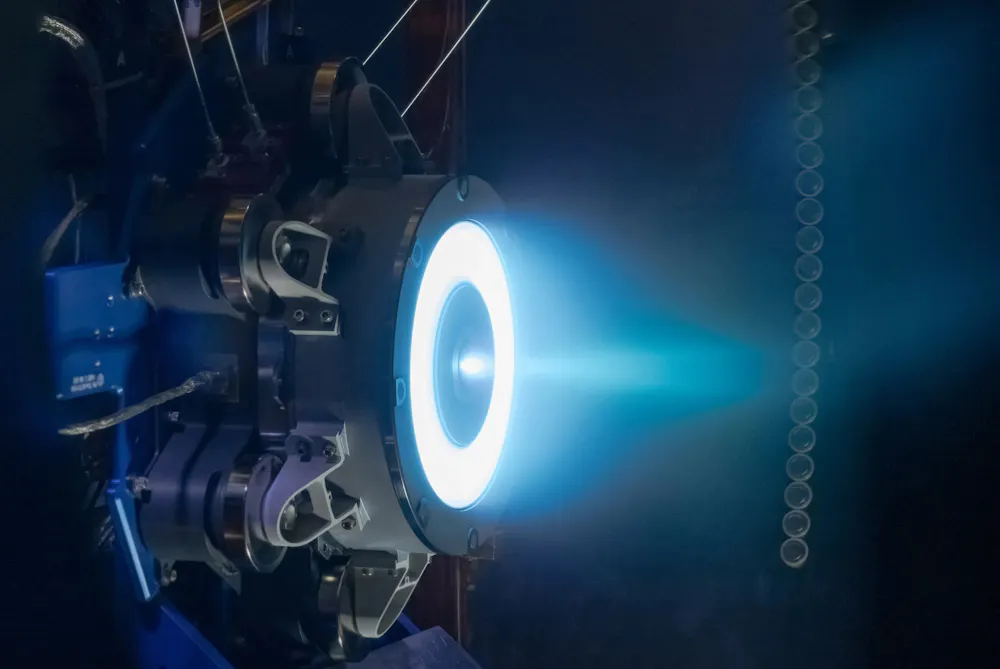
Nuclear electric propulsion, on the other hand, uses a nuclear reactor to generate electricity. This powers a type of engine called an ion thruster that accelerates charged atoms (like xenon) out of a nozzle. If nuclear thermal propulsion is the sprint approach, nuclear electric propulsion is the marathon option. Nuclear electric propulsion produces very low thrust, but it can run continuously for years.
This fuel efficient technology is perfect for sending robot explorers or heavy cargo (like habitats and food supplies) to Mars months before the humans arrive. In deep space, a small thrust applied for a long time can matter enormously.
Ion thrusters, which accelerate charged atoms out of a nozzle, are a key component of nuclear electric propulsion.Nasa / Jef Janis
A chemical rocket is like a powerful kick. Nuclear electric propulsion is more like a persistent hand on the shoulder.
It could make it easier to move heavy cargo through deep space, provide abundant onboard power, and remain effective far from the Sun, where the energy available to solar arrays is weaker.
This is the main idea behind Nasa’s Space Reactor-1 Freedom mission. SR-1 Freedom is a nuclear electric propulsion mission, which Nasa is currently targeting for launch in December 2028.
It would be the first nuclear-powered interplanetary spacecraft. It will journey to Mars to prove that nuclear energy can provide the sustained, high-efficiency power needed for deep space travel.
The SR-1 Freedom mission has been given a very ambitious launch date of 2028.Nasa
On arrival at Mars, roughly one year after its launch, SR-1 Freedom is expected to deploy the Skyfall payload. This is a set of small helicopter drones that will scout the Martian surface.
Nasa says the mission will establish nuclear hardware that can be used on other flights. It could also create a regulatory precedent and activate an industrial base for future systems based on nuclear fission.
For human exploration, the combination of both nuclear electric propulsion and nuclear thermal propulsion is very attractive. Because nuclear electric propulsion is incredibly fuel-efficient, it can move massive amounts of weight (habitats, years of food, rovers, and life-support machinery) using very little propellant.
It might not matter so much if cargo takes more than nine months to arrive on Mars. But our fragile human bodies mean that longer stays in space increase the risk of cancer from cosmic radiation and cause bone and muscle loss.
The second of these issues is because bones and muscles are not being exercised in microgravity. Nuclear thermal propulsion provides the high thrust needed to reach Mars in three to four months, drastically reducing these health risks.
Steep path
Despite the clear benefits, the path to the launch pad is steep, and the 2028 launch of SR-1 Freedom appears incredibly ambitious. A nuclear electric spacecraft needs a reactor, shielding, heat management, power conversion, radiators, electric thrusters, control systems and fault tolerance. Each of these components of the mission requires testing and careful integration for them to work together.
Reactor heat must be controlled without damaging other components. Thrusters
must operate reliably for months. Other factors can interact in ways that only emerge when spacecraft subsystems are put together. If SR-1 Freedom is to make its December 2028 window, Nasa has very little time to assemble a mission that would normally require years of design, integration and review.
If humans are to settle on Mars, space agencies will need faster ways of getting there.Nasa
Nuclear propulsion has spent more than 60 years somewhere between engineering reality and technological myth – even though the physics has always been sound.
What has proved harder is making the technology safe, affordable, licensable (able to meet regulatory safety standards) and ready to fly on a real mission schedule. So far, the US has launched only one fission reactor into orbit, SNAP-10A, in 1965.
SR-1 Freedom could create the pathway for more capable systems to follow. Nuclear electric propulsion will not make Mars easy. But it might start to break down barriers to travelling to Mars, and that is a prospect we should be excited about.
Domenico Vicinanza does not work for, consult, own shares in or receive funding from any company or organisation that would benefit from this article, and has disclosed no relevant affiliations beyond their academic appointment.
The recent attack by Ukraine of a Russian missile-carrying corvette stationed in the Caspian Sea more than 1,500km away from Kyiv has put the spotlight on this large, often overlooked body of inland salt water.
The Caspian Sea hosts major offshore oil and gas fields and critical maritime infrastructure, including ports, pipelines and terminals that connect central Asia to global markets. It is a key node in the so-called middle corridor trading route from China to Europe via central Asia that a
The recent attack by Ukraine of a Russian missile-carrying corvette stationed in the Caspian Sea more than 1,500km away from Kyiv has put the spotlight on this large, often overlooked body of inland salt water.
The Caspian Sea hosts major offshore oil and gas fields and critical maritime infrastructure, including ports, pipelines and terminals that connect central Asia to global markets. It is a key node in the so-called middle corridor trading route from China to Europe via central Asia that avoid increasingly uncertain routes via Russia in the north and Iran in the south.
China views it as a key corridor for energy supplies and its belt and road initiative that is an economic statecraft strategy that uses infrastructure connectivity to expand Beijing’s influence. The middle corridor links mainland China to Europe via Kazakhstan and Azerbaijan. Turkey, meanwhile, uses Caspian links, especially fossil fuel transit projects, via Azerbaijan, to increase its influence across the Turkic world, becoming a regional energy hub.
The 2018 Convention on the Legal Status of the Caspian Sea sets out how the Caspian’s oil, gas, and fishing resources are divided among the bordering nations. Crucially, the agreement also prohibits the deployment of armed forces from third-party countries within the Caspian’s waters. This establishes a regional security order that excludes western military presence.
Russia’s back yard
For Russia, the Caspian Sea has a high value, both as a strategic back yard and a bridge to Iran. There, Moscow maintains the strongest navy and has used the Caspian as a platform for long‑range power projection. This has included missile strikes into other theatres, including against Islamic State targets in Syria in 2015.
Since Russia’s full-scale invasion of Ukraine in 2022, the Caspian Sea has also gained renewed importance as a rear maritime space for Moscow. Indeed, with the Black Sea Fleet increasingly under threat from Ukraine’s drones and missiles, elements of Russia’s naval forces have redeployed away from the contested Black Sea towards the Caspian Sea via inland waterways. That said, Ukraine’s recent attack demonstrates that the Caspian Sea’s role as a sanctuary for Russia’s naval forces is limited.
More importantly, the Caspian Sea plays a structurally important role in enabling strategic coordination between Russia and Iran. As a geographically enclosed maritime space with its own specially designed legal status, it provides a direct logistical and economic corridor between the two states that is largely shielded from western military presence and oversight.
The Russia-Iran connection
This corridor enables not only energy cooperation and trade flows but also the movement of technologies and materials relevant to sustaining both war economies under sanctions pressure. This includes sanctioned goods, drone components and dual-use technologies. The Iran war has accelerated this trading pattern.
In this sense, for the two allies, the Caspian Sea functions as a critical node in a broader resilience architecture. It reinforces bilateral alignment and reduces exposure to external coercion. Its role is therefore less tactical than systemic: it provides a stable logistical, economic and strategic framework that underpins long‑term convergence between Moscow and Tehran.
In late March 2026, Israeli airstrikes reportedly disabled dozens of Iranian Caspian naval assets, including missile boats, a corvette, a shipyard and a command centre.
The strikes are likely to have severely disrupted the Caspian logistics corridor that links Russian ports to Iran’s port at Bandar Anzali, the largest and oldest Iranian port on the Caspian Sea. It also degraded Tehran’s ability to receive supplies via this route. This could force both countries to rely more on riskier overland routes via Azerbaijan or Kazakhstan.
In other words, the Caspian’s attribute as a haven for the two allies is currently under threat. That might force Russia and Iran to spend more on multi-level air defence systems and drone monitoring. They might even need to redeploy troops and military equipment to the region. This would significantly raise the cost and complexity of using the Caspian as a safe space for mil,itary and naval assets and a bridge for trade.
The Caspian Sea has become an increasingly important strategic connector linking two conflicts that are usually thought of as separate. The war in Ukraine and the war in Iran are not isolated theatres but parts of an emerging Eurasian conflict system in which Russia and Iran are mutually dependent.
Iran’s provision of drones and other military support to Russia has directly affected the course of the war in Ukraine. Meanwhile, Russia’s diplomatic, military and economic backing is central to Iran’s capacity to withstand pressure and sustain its regional posture.
The Caspian Sea underpins this alignment by providing a relatively insulated corridor for coordination, logistics and economic exchange.
Recent events, such as Ukrainian and Israeli strikes, however, reveal the limits of this strategic function for both Moscow and Tehran. At the same time, other countries, notably China and Turkey, are investing in the middle corridor. This is raising the value of the Caspian Sea, both economically and in terms of its geographical connectivity.
The Caspian Sea faces an uncertain future. Its north–south Russia–Iran strategic and military axis is increasingly contested by their adversaries. Its east–west trade and energy role, meanwhile, holds the potential to rebalance regional power dynamics towards economic connectivity, rather than conflict. Or, to put it another way, this body of water could become either be a theatre of strategic confrontation or a corridor of trade and exchange. The latter, of course, would be better for all concerned.
Basil Germond does not work for, consult, own shares in or receive funding from any company or organisation that would benefit from this article, and has disclosed no relevant affiliations beyond their academic appointment.
JU.STOCKER/ShutterstockWater bills are rising, public anger over sewage pollution has not abated, and the government has now set out a major overhaul of water regulation in the king’s speech.
The proposed water reform bill signals a shift in emphasis. Rather than focusing solely on water companies, the legislation aims to address pollution more broadly, including contributions from agriculture and industry. This wider lens has long been missing from water policy and is, in principle, a welcome
Water bills are rising, public anger over sewage pollution has not abated, and the government has now set out a major overhaul of water regulation in the king’s speech.
The proposed water reform bill signals a shift in emphasis. Rather than focusing solely on water companies, the legislation aims to address pollution more broadly, including contributions from agriculture and industry. This wider lens has long been missing from water policy and is, in principle, a welcome change.
The bill also promises a more unified regulatory system. The financial regulator Ofwat, the Drinking Water Inspectorate and the water-related arms of the Environment Agency and Natural England would be brought together under a single regulatory umbrella. The intention is to end the fragmented oversight that has characterised the sector for decades.
These proposals follow the recommendations of the Independent Water Commission, as outlined in the 2025 Cunliffe review which critiqued England’s privatised water industry, and Labour’s white paper. Yet despite the language of reform, the vision looks less like a radical reset and more like a reboot of privatisation.
The Clean Water Now coalition – a group of over 40 environmental groups – has put forward proposals that include three main asks: to fix the system, stop the polluters and restore nature.
Public opinion polling consistently shows strong support for bringing water back into public ownership. Labour’s white paper, however, places clear emphasis on “making water a more attractive and reliable sector for investors seeking stable and fair returns”. It is this focus that will worry campaigners, as it suggests continuity with an economic model widely blamed for underinvestment, rising bills and environmental harm.
The government also promises more joined‑up and longer‑term regional planning for water. Solutions don’t just involve tightening regulations and enforcement within the water industry. Everything from agricultural fertilisers, road runoff and chemical factory waste can contribute to pollution. Preventing the release of contaminants is vital, before pollution reaches the water treatment system.
But some of the most pressing challenges appear to receive surprisingly little attention. Climate change, for example, is mentioned only once in the government’s 53‑page white paper, in a brief statement about “future‑proofing” the regulatory framework against emerging pressures.
That omission matters. Changing rainfall patterns are already increasing sewage discharges, placing additional strain on ageing infrastructure. Periods of low river flow and drought make pollution events more damaging, not less, because contaminants are more concentrated in a smaller volume of water. Water scarcity, meanwhile, will intensify demand for water and competition between households, agriculture and industry. Clean water is becoming even more valuable as a commodity.
Ignored warning signs
Ofwat reports from more than 20 years ago warned that climate change would require long‑term planning and major infrastructure investment. The Ofwat annual reports for 2007-08 states: “We have also started to develop guidance for companies to assess the robustness of their infrastructure to extreme events so that they can take best account of the challenges of climate change in planning and delivering services to consumers.” The industry failed to respond and the regulator failed to regulate.
After three decades without a single new reservoir being built, the government is now legislating for several over the coming years – a tacit admission that those warnings were ignored.
The government argues that a new, integrated regulator will provide greater stability, transparency and a clearer view of both economic and environmental performance. That ambition will only be realised if transparency is actively safeguarded.
Decisions about whether revenue is directed towards shareholder returns, infrastructure investment or environmental protection will increasingly sit within a single body. This makes scrutiny of that internal decision-making crucial.
The reforms promise coherence and long‑term thinking. Whether they deliver genuine environmental improvement – or simply a more streamlined version of the status quo – will depend on how robustly the new system is designed, and whose interests it ultimately serves.
Alex Ford has received funding from UKRI research councils, EU, charities and industrial partners including the water industry.
Agriculture is the lifeblood of Africa. More than 60% of African households depend directly or indirectly on the land for their livelihoods. And the continent has nearly 60% of the world’s uncultivated arable land.
Farming is a fragile sector, however. It has to deal with climate change, market volatility, weak infrastructure and demographic pressure. Addressing these challenges requires political commitment and investment. It also requires science, innovation and high-quality research.
I hav
Agriculture is the lifeblood of Africa. More than 60% of African households depend directly or indirectly on the land for their livelihoods. And the continent has nearly 60% of the world’s uncultivated arable land.
Farming is a fragile sector, however. It has to deal with climate change, market volatility, weak infrastructure and demographic pressure. Addressing these challenges requires political commitment and investment. It also requires science, innovation and high-quality research.
I have been involved in scientific research, particularly agricultural research, for more than four decades. My roles have included researcher, member of multiple science academies, director general of the Africa Rice Center/CGIAR, and Senegal’s minister in charge of agricultural research.
Throughout these years, one criticism has repeatedly surfaced: agricultural research is often perceived as expensive while delivering little for people. This perception is widely shared and frequently echoed in political and media debates.
Based on my experience, I believe the criticism rests on a questionable assumption: that the impact of science depends exclusively on those who produce it. When innovations fail to change the world, scientists themselves are often presented as the culprits.
The reality is far more complex. The history of agricultural transformation across the world shows that research alone never changes societies. Impact follows when an agricultural ecosystem effectively connects science to producers, markets, finance, institutions and public policy.
International institutions have highlighted the difficulties many developing countries face in turning scientific knowledge into development. The reasons include weak innovation ecosystems, too little infrastructure and limited institutional coordination.
An example of what success looks like is the Green Revolution in Asia. Scientific breakthroughs improved wheat and rice varieties which transformed agriculture. It was not simply because the science was strong. There were other factors too. They included governments investing in irrigation, extension services, rural infrastructure, credit systems and market organisation.
In India and Vietnam, for example, science operated within a coherent system linking researchers, farmers, institutions and markets.
Science generates knowledge, informs policies, stimulates innovation and opens new possibilities. But it does not change societies on its own.
The missing parts
Recent decades have brought advances on a number of fronts. In seeds, irrigation, soil fertility management, climate adaptation, biotechnology, digital agriculture, agroecology and sustainable food systems.
African researchers, universities and international agricultural research centres have contributed enormously to this progress.
Rwanda and Ethiopia provide useful examples of how coordinated ecosystems can speed up change. In both, stronger links between research, extension systems, public investment and farmer support mechanisms have made a difference. They have contributed to faster uptake of new technologies. And they have led to productivity gains in several strategic crops such as maize, rice, cassava, beans and soybeans.
Another example is rice. During my years at AfricaRice, I saw major scientific advances in rice research. This included the development of New Rice for Africa varieties.
These resulted from years of scientific work combining the high productivity potential of Asian rice with the resilience of African rice, particularly its tolerance to drought, poor soils and local climatic stresses. It wasn’t easy, because the two rice species are genetically distant.
Farmers quickly took up the new varieties. Farmer incomes and food production improved in countries where governments, seed systems, extension services and development partners worked together. In Uganda, Guinea and several west African countries, coordinated programmes helped accelerate adoption among smallholder farmers.
These examples show that effective agricultural innovation will only be adopted and scaled if several conditions are met together. These include:
access to inputs and technologies
accessible financing
efficient extension services
functioning infrastructure
organised markets
coherent, predictable public policies.
Without these conditions, innovations often remain confined to research stations, pilot projects or scientific publications. Where seed systems, rural financing or market organisation are weak, good science makes little difference.
In several African countries, farmers aren’t using improved seed varieties because they can’t get certified seeds at scale. Likewise, promising innovations in irrigation, post-harvest technologies or digital agriculture have struggled because of weaknesses in infrastructure, rural credit or institutional coordination.
What’s needed
Debates on agricultural research in Africa must go beyond simplistic criticism. Agricultural research should not be viewed as a cost. Rather it is a strategic investment in food security, economic sovereignty, environmental sustainability, public health, social stability and human dignity.
Blaming science for lacking impact masks the weaknesses of broader development systems.
As Africa faces the defining challenge of the 21st century – feeding its population without destroying the planet – it would be a mistake to weaken scientific research. The continent must instead strengthen alliances between science, policy, finance, private sector actors, farmers, universities and civil society.
Across Africa, emerging innovation platforms show that when these actors work together, scientific advances can create tangible economic and social change. The challenge now is to broaden this beyond isolated successes.
In the end, the impact of science is a collective responsibility.
And science can only change the world when societies decide to give it the means to do so.
Pape Abdoulaye Seck served as director general of the Africa Rice Center/CGIAR and was Senegal’s minister in charge of agricultural research.
The global economy still largely follows a simple pattern: extract natural resources, manufacture products, use them and then throw them away. This “take, make, dispose” model has driven economic growth for decades. But increasing use of resources has also damaged the environment, contributing to climate change, biodiversity loss and pollution.
Circular economies could be a solution. The idea is to keep materials in use for as long as possible through reuse, repair and recycling. In this way
The global economy still largely follows a simple pattern: extract natural resources, manufacture products, use them and then throw them away. This “take, make, dispose” model has driven economic growth for decades. But increasing use of resources has also damaged the environment, contributing to climate change, biodiversity loss and pollution.
Circular economies could be a solution. The idea is to keep materials in use for as long as possible through reuse, repair and recycling. In this way, goods circulate within the economy rather than ending up on dumpsites as waste.
For rapidly developing economies, this approach is becoming increasingly important.
We are researchers working on waste management, circular economy and sustainability transitions in emerging economies.
In a recent book chapter, we looked at how the original Brics countries – Brazil, Russia, India, China and South Africa – deal with climate change adaptation and pursue sustainability. (Egypt, Ethiopia, Iran, Indonesia and the United Arab Emirates have since joined Brics.)
We chose to study these countries because they are among the world’s largest emerging economies. They face similar challenges of demand for resources and goods and growing amounts of waste. This makes them important case studies for understanding circular economy transitions at scale.
We reviewed existing research on the countries’ policies, technologies and business models to identify the main opportunities, challenges and policy lessons.
Our findings show that circular economy practices are emerging in the countries we studied, but not at the same pace. China stands out as the most advanced. It has strong national circular economy policies and implements these on a large scale.
Brazil and India have made moderate progress, mainly through bio-based systems that use natural products like plants to create environmentally friendly products and chemicals. They’ve also set up innovative ways of recycling.
In contrast, Russia focuses mainly on recycling industrial waste. South Africa is lagging behind because it doesn’t have enough recycling facilities and doesn’t put all its circular economy policies into practice.
The way countries manage resources and waste will shape the quality of urban life, public health and economic opportunities for millions of people.
Why Brics countries face growing pressure
Globally, cities generate more than 2 billion tonnes of waste that is sent to local garbage dumps each year. This will increase as populations grow and consume more and more.
The Brics countries account for more than 40% of the world’s population and roughly a quarter of global economic output. These economies have urbanised rapidly and their industries have expanded, increasing the demand for raw materials, energy and manufactured goods.
This growth has also produced large volumes of waste. But recycling levels remain relatively modest. China currently has the highest recycling rate among the group, recycling about 38% of its waste. Brazil recycles roughly 29%, and India about 24%. Russia and South Africa recycle much smaller shares, at approximately 14% and 12% respectively.
To sustain economic growth while reducing waste and pressure on the environment, our research suggests that these countries must move fast to adopt circular economy practices.
Circular economy in practice
Brazil:
Brazil has developed bioenergy and waste management practices that reuse agricultural residues and improve recycling systems in universities and municipalities. In cities such as Curitiba, residents can exchange recyclable waste for food or transport benefits, improving both recycling rates and social welfare.
Russia:
Russia has focused largely on recycling industrial waste. For example, it has promoted the development of “eco-technoparks”. These house waste processing facilities next to factories so that industrial waste can be used to make new goods. This reduces the amount of waste going to landfills and improves efficiency.
India:
India has experimented with “urban mining”. This is where valuable materials are recovered from electronic waste and reintroduced into manufacturing. For example, India’s e-waste recycling system recovers metals such as gold and copper from discarded electronics.
China:
China has some of the most ambitious circular economy policies among the original Brics countries. Several cities have introduced large-scale recycling programmes and mandatory waste-sorting systems where households must separate their waste into four categories, or pay a fine.
South Africa:
South Africa has begun bringing circular economy ideas into green supply chains. This involves redesigning how products are sourced, produced, transported and disposed of so that materials are reused, waste is minimised, and environmental impacts are reduced. For example, using recycled materials and reducing packaging.
Sustainable manufacturing is another example. South Africa has introduced Extended Producer Responsibility regulations. These require manufacturers to take responsibility for the waste generated by their products across their whole life cycles. This encourages companies to design goods that are easier to reuse or recycle.
Petco brings together producers to manage the extended producer responsibility schemes for packaging in South Africa. It supports collection, recycling, design, and markets to reduce waste and advance a circular economy.
South Africa could speed ahead if it adopted more practices of other Brics countries.
Opportunities for innovation
Circular systems not only reduce waste and lower environmental impacts, they can also create new industries focused on recycling, repair services and re-manufacturing (restoring used products to an almost-new condition). These are badly needed in all the Brics countries and across the African continent.
Digital tools such as artificial intelligence, big data and smart waste-management systems can help. For example, smart bins fitted with sensors can alert collection trucks when they are full. Artificial intelligence systems can automatically separate plastics, metals and paper on conveyor belts in seconds.
Brics countries have large consumer markets. So any new innovations like these could also support the growth of new economic sectors centred on sustainability, and create new layers of jobs.
What needs to happen next
Governments need clear strategies that promote recycling, encourage sustainable production and support resource efficiency.
A major barrier to circular economies in the countries we studied is poor coordination. Fragmented regulations across government levels and sectors, such as municipalities handling waste while national bodies set standards, make it unclear who is responsible for certain tasks.
Another problem is the lack of recycling facilities, waste processing systems and technologies that allow materials to be recovered and reused efficiently.
Businesses might also need incentives to participate in the circular economy as they tend to value short-term profits over sustainability.
Investment by governments and the private sector in green technologies and improved data systems for monitoring how waste and resources are flowing will also be important.
The authors do not work for, consult, own shares in or receive funding from any company or organisation that would benefit from this article, and have disclosed no relevant affiliations beyond their academic appointment.

 Login
Login