
Normal view

How to read the classics in an age of distraction – and 3 short books to get you going

Over the past 15 years, I have witnessed university students’ shrinking patience for reading – especially for reading “long” books. Increasingly, students also opt for audiobooks. While speeding up the reading experience, these fundamentally change what is noticed.

The neuroscientist Maryanne Wolf suggests many students no longer have the “cognitive patience” to read long books due to the complexities of thought and sustained attention required.

One explanation for this shift is the dominance of digital technology in our daily lives, which has rewired our brains for surface-level scanning and multitasking, weakening our capability for prolonged attention. Another is our culture of instant gratification.

Some studies into the “screen inferiority effect” suggest when we read on paper (rather than on screens such as smartphones) the brain often processes more deeply and comprehension is better. Memory and information recall are also stronger.

So where does this leave the classics?


Millions of Australians, both children and adults, struggle with literacy.

In this series, we explore the challenges of reading in an age of smartphones and social media – and ask experts how we can become better readers.


Many books considered “classics” are long. Masterpieces such as Middlemarch or Les Misérables might seem intimidating because in physical form they resemble door stops and they often have complex, demanding language and long, convoluted sentences.

But reading the classics can deliver cognitive, social, emotional and even ethical benefits, helping us strengthen habits of thoughtful attention and develop the skills to communicate with clarity and empathy.

Goodreads

Extending our attention spans increases our ability to connect thoughts and ideas, challenges memory and recall and perhaps helps us attend more patiently to our own lives and the lives of others. In reading Robinson Crusoe, for instance, we share in the patience of the title character, stranded on a desert island. We, too, pay careful heed to details and signs in the world around him.

The complex language of classics can help us discern meaning amid a multitude of voices. When working through multiple sentence clauses and the layered sentences of a meaningful paragraph we need to suspend judgement until we have the fuller picture. Following complex and interwoven narratives also helps us to understand human complexity in real life.

Here are some tips for reading the classics – and some shorter ones to start with.

1. Follow your instincts

Goodreads

Find out which classic novels influenced the development of your favourite genre and you might find a natural fit. My brilliant English teacher at school, Mr Taylor, knew I loved detective fiction, so he kept recommending Wilkie Collins’s The Moonstone as an early example of crime mystery. Eventually taking his advice, I loved it and followed it with Collins’s other classic, The Woman in White.

2. Remove distractions

It can help to set aside dedicated reading time, such as 20–30 minutes a day in which phones, smartwatches and other devices are out of the way. There is an added benefit: research by Mindlab International has shown reading for only six minutes reduces stress levels by 68%.

3. Make a note of memorable sentences

You don’t need a teacher to notice powerful moments or startling language. For example, Charles Dickens’s opening to A Tale of Two Cities (“It was the best of times, it was the worst of times …”) famously captures the coexistence of extremes in the world – of hope and despair, of wisdom and foolishness. Dickens has crafted an enduring truth of human experience.

4. Ask yourself questions

Why is this considered a classic? Why do I dislike this particular character? Why does this scene make me feel uncomfortable? Usually, the author wants you to consider why things were written the way they were (rather than, for example, with a different vocabulary or narrative voice). Asking questions deepens comprehension.

5. Embrace the unknown

If longer sentences or old-fashioned language trip you up, go over them again and then keep going. Kindles offer instant definitions at the touch of the screen but sometimes looking up every word in the dictionary can interfere with the opportunity to deduce meaning from context.

6. Be ready to laugh

Some classic novels are downright funny. I am currently reading Anthony Trollope’s The Warden. The sentences may be long, but they are almost always punctuated with hilarious insights into the hypocrisies of human beings and the naming rights the author deploys are childishly funny.

7. Read aloud

Goodreads

Classic novels were often serialised and read aloud in instalments in families or community groups. As a teenager, some of my most memorable early forays into the classics were shared with a dear cousin while staying with our grandparents in the Blue Mountains, when we would read aloud to each other on wintry, windy nights by the fireplace. Here, I first encountered Daphne Du Maurier’s evocative West Country mystery Rebecca and Dodie Smith’s eccentric and funny I Capture the Castle. Begin your adventure into the classics by reading aloud with a friend or in a book club.

8. Don’t feel too daunted

Remember that getting started with the story, getting to know the writer’s style, gradually piecing together the world of the novel can be the hardest stage. Take your time, be patient and persist. The further you get into a novel like War and Peace, the easier it is to continue because you simply want to know what happens.


Here are three short classics worth the journey.

George Eliot’s Silas Marner

A heartwarming study of the “inward life” of Silas, the weaver, exiled from his fellowship of narrow religious sectarians. He finds purpose in life, first in money and then in the fatherly love he develops for Eppie, the child who wanders into his home. Silas Marner is an accessible taster of Eliot’s longer experiments exploring emotion and “fellow feeling”.

James Joyce’s Dubliners

Goodreads

This book is, strictly speaking, a collection of 12 short stories. Together they form a masterpiece of brutal Anglo-Irish realism interrupted by moments of epiphany. The book contends with questions of action and inaction, betrayal, political idealism and pragmatism. The story of Eveline, who is on the cusp of eloping with the “very kind, manly, and open-hearted” Frank on a night-boat to Buenos Aires to escape the ill-treatment of her ageing, abusive father, leaves the reader astonished by the sudden departure in the final lines from her earlier rational self-analysis.

Virginia Woolf’s Mrs Dalloway

An experimental novel set on one summer’s day in London, 1923. The socialite Clarissa Dalloway prepares a party but the absence of any chapter breaks in the book creates for the reader a sense of the stifling impact of war that still lingers over British family, social and political life. In the trauma of returned soldier Septimus Smith we read an early fictional exploration of shell shock.

The Conversation

Johanna Harris does not work for, consult, own shares in or receive funding from any company or organisation that would benefit from this article, and has disclosed no relevant affiliations beyond their academic appointment.
How a sense of awe can be good for your mental health

Arnaud Mesureur/Unsplash

Words escape you. Your skin tingles. You are overwhelmed by how small and insignificant you really are, bursting with a feeling that is hard to define. This is awe.

Awe is a complex emotional state we experience when the enormity of what we see or feel transcends what we understand. It can be positive or negative.

Astronauts report this feeling when confronted with the vastness of space and Earth’s puny place within it. This experience – sometimes known as the “overview effect” – can change forever how people who’ve seen Earth from afar think about life here.

But you don’t have to travel to the moon and back to experience awe. Beautiful art, a walk in nature or dancing in a crowd can give you this overwhelming, transcendent feeling.

Neuroscience suggests experiences of awe can be good for your mental health – when they’re positive. So, when is awe good for us? And what exactly is going on in the brain?

Awe can be both positive and negative

Positive awe is what probably comes to mind when most people think of awe. If you’ve ever been moved by something immense and beautiful – such as a majestic mountain or sunset – you’ve likely experienced this sense of calm and wonder.

However, psychologists sometimes describe awe as an experience at the boundary of pleasure and fear. Both pleasure and fear can result in similar bodily arousal – racing heartbeat, goosebumps and chills – but the way we interpret this as an emotion will depend on the context. It can be the same when we experience something vast and overwhelming.

Negative awe may occur when we feel threatened or a lack of control, such as during an earthquake or terrorist attack.

Imagine standing in front of a tsunami and seeing it come towards you. You may feel powerless and filled with dread, while also overcome with a sense of insignificance in the face of nature’s majesty and power. This is the complexity of awe.

Trying to make sense of the unexpected

Our brains are constantly making predictions and integrating our experiences into what we already know.

We tend to “filter out” sensory signals that match our expectations, to instead focus on being ready to respond to information that is surprising.

New information is processed by parts of the brain that help to fit it within our pre-existing understanding of the world, knowledge frameworks known as schemata (or schemas).

According to schema theory, we either assimilate this new information into an existing schema, or have to change the schema to fit the new knowledge.

Not all new experiences will evoke awe. It occurs when we experience both the inability to assimilate an experience into current knowledge and a sense of vastness.

For example, you might have a schema for “waterfall” – a mental framework of what you expect (rocks, water, beautiful). But confronted by the roar of Victoria Falls, its size and velocity, the way the sun hits the spray, you experience awe; it’s unlike any waterfall you have ever seen and is beyond your expectations.

Surfer in a massive wave.
Awe can make us feel small and insignificant in the face of something immense. byronetmedia/unsplash

What happens in the brain when we experience awe?

When we feel awe, activity decreases in the brain regions associated with internal or self-referential processing. This network is what drives our memory and understanding of our place in the world.

When activity in these regions decreases, there is a shift away from yourself towards processing external information. This may explain why you tend to “feel small” when you experience awe.

But positive and negative awe may have different effects on our nervous system.

Negative awe is associated with sympathetic nervous system activity, which drives our “fight or flight” response.

Positive awe, however, is associated with increased parasympathetic activity. This reduces heart rate and arousal, which is why we may feel calmer.

How awe can be good for us

If you’re someone who seeks out experiences bigger than yourself – hiking for breathtaking views, enjoying meditation, art or losing yourself in the roar of a crowd – you probably already know awe can make you feel fantastic.

Now, research is exploring why. Emerging evidence suggests awe may be good for mental health and wellbeing in five ways:

  1. improving your nervous system’s ability to relax
  2. diminishing self-focus
  3. making us more likely to help other people
  4. connecting us to others
  5. increasing sense of meaning.

More work needs to be done before we can say whether awe results in long-lasting benefits. But purposefully seeking awe may help you feel less stressed, more satisfied and happier.

Sea of people in a massive crowd.
Sharing awe-filled experiences can help us transcend ourselves and connect with others. Danny Howe/Unsplash

Finding awe in the everyday

What evokes awe will likely be different for different people. But we know some things are more likely to induce this complex feeling, such as experiences of art, music and natural environments that move us.

Many people also find awe in collective experiences, especially those involving shared music or movement, or religious rituals. These help us transcend ourselves and become part of something bigger. Contemplating inspiring and complex “big” intellectual ideas by learning something new may also have this effect.

So, can you actively cultivate awe? One way to start is by taking “awe walks”. These involve walking with the intention of noticing beauty, vastness and wonder. Connecting with your own sense of spirituality – even if you are not religious – can also evoke awe.

In many cases, the vast and overwhelming experience of awe can start with simple acts of noticing.

The Conversation

Nikki-Anne Wilson has previously received funding from the Australian Association of Gerontology and the UNSW Ageing Futures Institute.

From Taylor Swift to Bollywood, stars turn to the civil courts to fight deepfakes

Ethan Miller/Getty Images

Music superstar Taylor Swift has applied to trademark her voice and image to head off the threat of AI-generated impersonations. But the problem extends much further than pop royalty.

Anyone can be manipulated by the powerful technology: AI-created videos of you endorsing a politician you despise, images on social media of you in a skin-tight Spiderwoman outfit you never wore, a simulation of your voice allowing users to indulge their sexual fantasies … all possible.

The rapid development of deepfakes is amplifying calls for better legal protections for individuals’ images and likenesses. The notorious rollout of new picture-editing capabilities by X’s Grok chatbot in late 2025 only added to their urgency.

And the law has begun to respond. Australia now criminalises creating and sharing sexually explicit material online, including digitally created material.

In the US, the 2025 Take it Down Act prohibits non-consensual publication of intimate depictions of individuals, including “digital forgeries”.

In New Zealand, proposed amendments to the Crimes Act and the Harmful Digital Communications Act will improve criminal law responses to sexual deepfakes.

But another legal front is opening up, too: victims are turning to tort law. Part of the civil (rather than criminal) law, tort claims do not require the state to act. People can seek damages and injunctions to shut down or block access to the harmful and humiliating material.

Misappropriation of personality

Some countries, including Canada, South Africa and India, recognise a common law tort of misappropriation of personality.

This targets unauthorised use of a person’s name, likeness and voice, usually for commercial purposes. About half of the states in the US recognise some version of this tort.

Now, the Indian courts are taking the lead in extending the tort to include deepfakes.

Bollywood stars Aishwarya Rai Bachchan and Anil Kapoor have used tort law to shut down websites and other online platforms where deepfakes have been posted – including fake pornographic videos and chatbots.

Elsewhere, including in New Zealand, the United Kingdom and Australia, the law is much more piecemeal because the common law does not recognise a specific tort of misappropriation of personality.

This means protections need to be cobbled together from more established legal claims, including defamation, breach of confidence and and “passing off”.

A court battle is currently raging in the UK over whether a digitally-assisted resurrection of Peter Cushing in the 2016 Star Wars movie Rogue One is a form of “unjust enrichment”. (Cushing starred in a previous Star Wars episode but died in 1994.)

Anil Kapoor and Aishwarya Rai Bachchan at a screening of their 2018 film Fanney Khan in Mumbai. Azhar Khan/SOPA Images/LightRocket via Getty Images

The right to live with dignity

In the Bollywood cases, the courts explained that deepfakes affect victims’ “right to live with dignity”. The judges linked these tort principles to constitutional protections for “life and liberty”.

Canadian judges have said similar things, linking protections for individuals’ personality to rights in the Canadian Charter of Rights.

Human dignity – essentially the right not to be a means to others’ ends – is at the core of these protections and it recognises the inherent worth of all people. Deepfakes cut right across these fundamental legal commitments.

In the case of Anil Kapoor, the court acknowledged additional harms beyond those he suffered. The legal protections were also for “the sake of his family and friends who would not like to see his image, name and other elements being misused, especially for such tarnishing and negative use”.

This recognises an emerging legal concern with connections between people, not only with the rights of individuals. It also aligns with the increasing role of Māori tikanga (law and custom) in New Zealand’s common law.

Another welcome development in the United States is proposed legislation that would enable non-celebrities, not just the rich and famous, to bring damages claims and seek injunctions against deepfakes.

A bill introduced to Congress in April would extend protections to US citizens’ “DNA sequences or traits” that could be used to replicate or misuse identity in commercial applications.

Protecting victims of deepfakes will require an array of legal responses: criminal, civil, technological and regulatory – including trademark law, as Taylor Swift is using.

Unfortunately, few of us have the financial means to bring a torts claim. Even so, the emphasis on human dignity in the Bollywood cases reminds us of what’s at stake: the inherent worth of all people – celebrities and non-celebrities alike.

The Conversation

Graeme Austin does not work for, consult, own shares in or receive funding from any company or organisation that would benefit from this article, and has disclosed no relevant affiliations beyond their academic appointment.

Red button or blue button? What a viral question tells us about game theory and the state of the world

Gabriel Vasiliu / Unsplash

Everyone on earth takes a private vote by pressing a red or blue button. If more than 50% of people press the blue button, everyone survives. If less than 50% of people press the blue button, only people who pressed the red button survive. Which button would you press? BE HONEST.

This question is the latest thought experiment to set off waves of controversy on social media, following classic examples such as the trolley problem and the prisoner’s dilemma.

Most people think the choice is extremely obvious. However, not everyone agrees whether the obvious answer is blue or red – and they want to argue about it.

What’s going on here? From the point of view of philosophy and game theory, the question shows two different intuitions and views of decision-making with starkly contrasting results. And the very popularity of the question highlights the fraught existential stakes many of us feel in modern life.

Red or blue? It’s complicated

The case for red seems simple. If more than 50% of people press the blue button, red pressers survive. If not, red pressers survive anyway. So basic self-interest leads to red.

In game theory, this choice leads to what is known as the Nash equilibrium. This is the best choice for a participant looking to advance their own interests.

However, in several polls, the majority of respondents pick blue. At first glance, this may seem irrational and self-destructive.

Why would anyone stake their own life on the collective decisions of others? This is where, as with any good thought experiment, the real value of the provocation shows itself, as we ponder the “why” behind the choice.

Blue pressers might proffer a diverse set of responses: “I’m worried my family and friends might pick blue and I want them to survive”; “I’m concerned people might find out if I pick red and judge me”; “If I picked red I would feel responsible for the potential deaths of others”; “I believe humanity is inherently good”, and so on.

Such responses hint at what game theorists call the Pareto-optimal outcome, where the least potential damage is done by one’s choice.

Why now?

What’s also interesting is why such a thought experiment has gone viral in 2026. In any society, what cultural theorist Raymond Williams called a “structure of feeling” holds sway: an affective atmosphere, a set of moods and emotions that are most visible in its symbolic output.

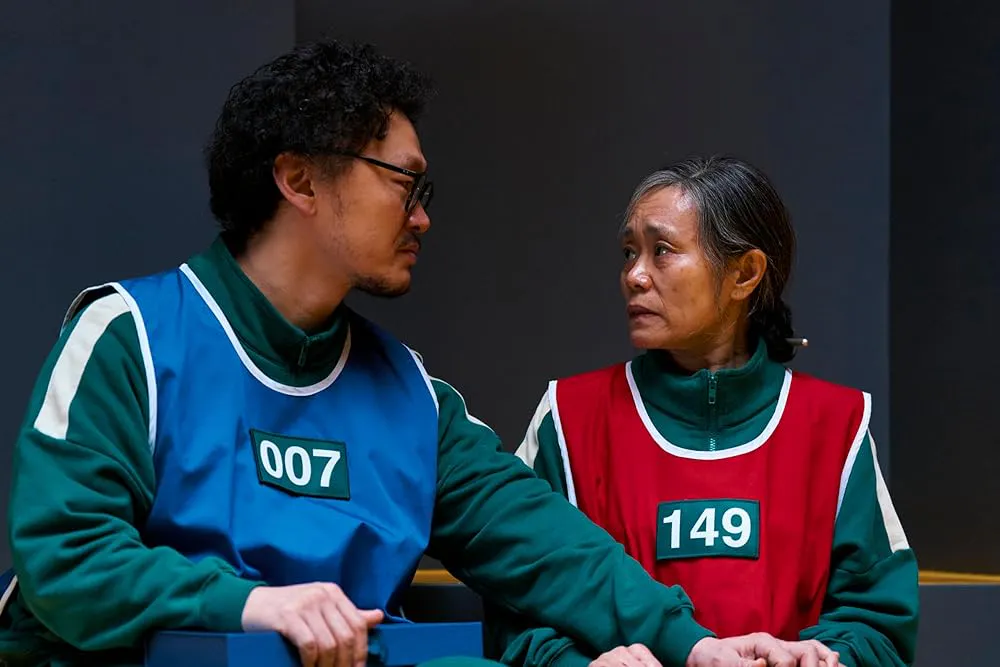
We can here point to popular culture. Shows such as Netflix’s hit series Squid Game, the glut of Survivor-style reality TV shows, the digital game Among Us and the Hunger Games books and films rely on similar setups.

A man in a blue vest and a woman in a red vest stare at each other
Shows like Squid Game show the current appeal of the gamified moral dilemma. Netflix

The fundamental questions tend to remain the same. Who can be trusted? How do incentives change our moral stance? Do systems reward altruism or selfishness?

More than at any time in human history, we are interdependent on a global scale: politically, economically, militarily, technologically, culturally. When a domino falls on one side of the planet, we now see it, hear it and feel it on the other side.

This engenders a distinct sense of vulnerability and precarity. We are bombarded every day with information from all around that can stress, enrage, and exhaust us.

Why here?

The specific formulation of the thought experiment, condensed down into a simple binary choice, is also perfect for social media, where hot takes dominate and extremity is rewarded by the algorithm: yes or no, right or wrong, gold-and-white dress or blue-and-black.

It’s also where similar questions are often asked of influencers, who might sacrifice their own moral viewpoints in pursuit of attention and visibility. It’s a perfect quick moral apocalypse for a doomscrolling public.

Another useful idea here is the “Promethean gap” described in 1956 by philosopher of technology Günther Anders. The idea is that the more technological capacity grows, the less humanity can comprehend emotionally, intellectually and morally.

We have, in a sense, outsourced too much of ourselves to technology. In doing so, we have let some crucial competencies atrophy, and so the gap grows.

Under rapidly advancing technology, our capacity for action exceeds our capacities for moral imagination.

This fear is readily apparent in the thought experiment: the world ended at the push of a button. By comparison, the stakes of the prisoner’s dilemma or the trolley problem seem positively quaint.

The Conversation

Steven Conway does not work for, consult, own shares in or receive funding from any company or organisation that would benefit from this article, and has disclosed no relevant affiliations beyond their academic appointment.

Chinese companies are increasingly taking on foreign governments. It’s not just the Port of Darwin

David Gray/Getty

The Chinese-owned firm that operates the Port of Darwin isn’t happy about the federal government’s push to return it to an Australian owner. Now, the situation is escalating, with the stage set for an international legal showdown.

The Albanese government has been in talks with Landbridge Group, whose parent company is headquartered in Shandong province, China, to return the port to an Australian owner, following an election promise.

But in late April, Ye Cheng, the Chinese billionaire who founded Landbridge, initiated proceedings against Australia at a World Bank tribunal, the International Centre for Settlement of Investment Disputes. The government has said it will defend the claim.

This case may take years to resolve. But it’s not the only example of a Chinese company taking on a national government, claiming to be unfairly excluded based on national security or other concerns.

Right now, many of these cases are still pending. But these rulings could have major financial implications if they provide a route for Chinese firms to demand compensation from governments for any losses caused by political decisions.

How we got here

Back in 2015, Landbridge secured a 99-year lease to operate the port from the Northern Territory government, in a deal worth A$506 million.

The decision was not opposed at the time by the Turnbull federal government, although US President Barack Obama raised concerns, with US marines on rotation through the port.

Other groups also raised concerns about leasing the strategically important port to a Chinese firm. In the lead-up to the last federal election, both Labor and the Coalition committed to returning the port to an Australian owner if elected.

In a statement on the new proceedings, Landbridge said the move to return the port to an Australian owner was “discriminatory”. The company said it was “inconsistent with Australia’s obligations” under a major bilateral trade pact, the China-Australia Free Trade Agreement.

In a statement, the federal minister for transport and infrastructure, Catherine King, said the government was “disappointed” by the decision to lodge a case. King said the government has been in “good faith discussions” to reach a “mutually acceptable deal” with Landbridge, and intended to continue these discussions.

An international investment umpire

The International Centre for Settlement of Investment Disputes was established in 1966.

Headquartered in Washington, this body exists to settle disputes between international investors and nation-states under bilateral investment treaties. This includes the China-Australia Free Trade Agreement at the centre of this case.

The centre provides an independent arbitration panel for each dispute, not including the two countries involved.

The panel ultimately decides whether there has been unfair treatment. If so, it rules on whether a government’s proposed action should be halted or reversed, or if a company deserves compensation.

Pending cases

Since 2021, 11 cases have been brought by Chinese companies against different governments around the world. Eight of these are pending.

Many of these cases centre on purely economic claims of being treated unfairly. For example, in one case, a Chinese-owned lithium company is seeking compensation following the Mexican government’s decision to nationalise its lithium mining industry and expropriate the company’s planned mine in Mexico.

But others, like the Landbridge case, centre on claims a government has overreached by excluding a company based on national security concerns.

One of the most high-profile is a case launched by Huawei against the Swedish government in 2022. This came after Sweden banned Huawei and ZTE (another Chinese telecom company) from participating in the country’s 5G rollout, citing national security concerns.

Huawei is seeking compensation of US$569 million (about A$790 million) for the market losses it claims will result from this exclusion.

If the tribunal finds in favour of Huawei in this case, it could lead to further actions launched against countries (including Australia) where Huawei was banned. It could also impact other Chinese companies that have lost markets due to national security concerns.

The question of fairness

In its statement on the new proceedings, Landbridge said it had won the lease through a “fair, open and competitive process”.

It said the government’s own reviews did not find a national security risk.

Landbridge is likely to argue this means the government’s decision to exclude them is arbitrary. They are also likely to argue a forced sale would bring a lower price, and the government therefore owes the company compensation.

Compensation, if awarded, can include not just the current value of the port lease but also potential future earnings that have been forfeited due to a forced sale.

The rules-based order

The increase in Chinese companies using panels like the World Bank’s to resolve their disputes demonstrates their commitment to this international institution that was established with US and Australian support to enforce the rules-based international trading system.

These disputes may not prevent governments from making decisions based on national security. But they may cause them to think twice about the financial implications of those decisions.

The Conversation

Colin Hawes is a research fellow at the UTS Australia-China Relations Institute.

Copyright law is being used to hide alleged animal abuse. Here’s what’s at stake

Over the decades, journalists and activist groups have revealed horrendous animal cruelty using covert recordings. A 2011 Four Corners investigation of abuse of Australian cattle in Indonesia is among the most well-known examples.

Many attempts to record agricultural operations have involved activists breaking the law to do it. Court cases are not uncommon.

But the most recent case, being heard by the High Court of Australia this week, is different. In this instance, an abattoir has been awarded copyright ownership of footage shot by animal welfare activists. As a result, the footage, which the activists say depicts animal cruelty, can’t be made public.

In the case, Farm Transparency International v The Game Meats Company of Australia, the court will consider whether the activists’ illegal conduct disqualifies the future use and release of the footage.

The proceedings could be highly significant for both humans and animals, with potential implications for press freedom and the public’s right to know.

Trespassing for transparency

Founded in 2014, the Australian animal advocacy organisation, Farm Transparency Project, seeks to “force industry transparency and educate consumers” about routine operations in the animal agriculture industry.

Controversially, this has involved members of the organisation trespassing on commercial properties.

In 2024, several Farm Transparency employees gained access to a Victorian slaughterhouse operated by the Game Meats Company on seven occasions. These trespasses involved the installation of cameras in the ceilings of Game Meats Company’s goat slaughter sites.

The footage of slaughtering processes at the abattoir was then used to produce a short film. Farm Transparency alleges the vision depicts breaches of animal welfare laws.

As the Federal Court judge observed in the initial case ruling, some of the goats “are shown being manhandled after escaping from a restraint apparatus” while others “appear not to be unconscious (or, perhaps, wholly unconscious) at the point that they are [killed]”.

Game Meats has denied any wrongdoing.

The case before the High Court

Copyright is a type of intellectual property right founded on a person’s skill and labour. Under the Copyright Act, the general position is that copyright vests with the footage-maker. In this case, that’s Farm Transparency.

But in a novel legal argument, Game Meats has argued copyright should be assigned to them.

This was first considered by a single Federal Court judge. The judge concluded “the court should proceed with caution”, suggesting that assigning copyright to Game Meats was better left to a higher court.

That’s what happened when the ruling was appealed. Three Federal Court judges found copyright of the footage and film should be assigned to Game Meats via a trust because of the circumstances in which the footage was obtained.

In reaching its decision, the appeal court drew analogies between the response to Farm Transparency’s “surreptitious intrusion” on Game Meats’ property, and the need to return property obtained by a “fraudster or thief”.

Farm Transparency appealed against that decision. The case will now be heard by the High Court, which will determine who should hold the copyright.

Private dispute, profound implications

This is not the first time a case involving Farm Transparency has been brought before the High Court.

In 2021, the organisation challenged New South Wales’ Surveillance Devices Act, arguing that it impermissibly infringed on the freedom of political communication recognised in the Australian Constitution. It was unsuccessful.

The current High Court appeal has potentially far-reaching implications. In its written submissions to the High Court, Farm Transparency argues the Federal Court’s evaluation of the “moral calibre” of the group’s conduct is “transformative of legal relations not just between the parties but the world”.

The Human Rights Law Centre and the Alliance for Journalists’ Freedom are making advisory submissions as “friends of the court”.

Both groups are concerned about how the High Court decision may impact the legitimate work of journalists and whistleblowers.

The case is also an example of “ag-gag” (agricultural gag) laws. Ag-gag refers to laws whose common feature is to “keep evidence of the unflattering, and sometimes criminal, practices of farms and slaughterhouses from public view”.

Such laws are increasingly being used in Australia to curtail the speech of animal advocates who seek to expose conditions in animal production industries.

The Game Meats Company’s case is the first time copyright law is serving as a form of ag-gag. Using copyright law in this way prevents footage of alleged harm to farmed animals being shared with the public.

Ends justifying the means?

The activities of Farm Transparency’s predecessor, “Aussie Farms”, were a key driver for a Victorian parliamentary inquiry into the potential impacts of animal activism on the state’s agriculture industries.

At the inquiry, farmers and industry groups expressed concern about being targeted, and at times intimidated, by activists.

At the same time, Farm Transparency has done much to share the realities of animal agriculture with the Australian public. The organisation produced the 2018 award-winning documentary, Dominion. It featured covert footage primarily from Australian animal agriculture operations, shot by members of Farm Transparency.

In 2023, Farm Transparency’s covert filming of pigs being suffocated to death with carbon dioxide gas formed the basis of a high-profile media report, and sparked another parliamentary inquiry into pig welfare in Victoria.

If the High Court accepts Game Meats’ argument, similar releases in the future could be prevented by law.

Uncertainty abounds

Animal welfare is an issue Australians care about. The way to ensure strong animal welfare in the animal agriculture industry is certainly not to encourage trespass or covert filming on private property.

However, the reality is that farmed animal welfare is woefully under-regulated. Scandals surrounding the mistreatment of animals are regularly uncovered by activists, journalists and whistleblowers, rather than in the course of standard compliance processes.

So the High Court must now decide whether the law should allow for such vision to be made public, potentially uncovering grave suffering, or keep it safely out of sight.

The Conversation

Lev Bromberg previously received a Commonwealth Government Research Training Program Scholarship. He is affiliated with the Australasian Animal Law Teachers and Researchers Association.

Serrin Rutledge-Prior received a Commonwealth Government Research Training Program Scholarship during her doctoral studies, and previously volunteered for the Animal Defenders Office, a non-profit legal service.

Themes of peace and human dignity have been central to Pope Leo as he marks his first year in office

Pope Leo XIV arrives for his weekly general audience in St. Peter's Square at the Vatican on April 29, 2026. AP Photo/Alessandra Tarantino

When he was elected pope on May 8, 2025, Robert Prevost, who took the name Leo XIV, greeted the crowd with Christ’s words to his disciples: “Peace be with you.”

Peace has become a central theme of the pontificate of the first American pope. In recent months, opposing the war in the Middle East, Leo has said that the “world is being ravaged by a handful of tyrants.” He led a “Prayer Vigil for Peace” on April 11, 2026, in which he criticized how the name of God has been used to justify war and death. He has also said that “military action will not create space for freedom” because true freedom can come only from patient dialogue.

Prayer vigil for peace.

Combined with his calls for peace is Leo’s equally outspoken emphasis on human dignity. In an age where power is concentrated in the hands of a few, the pope has urged Christians to make a “radical choice in favor of the weakest.” Technological advances, especially the rise of artificial intelligence, also endanger human dignity by threatening to override “human creativity, imagination and intellect,” he has cautioned.

In my view as a scholar of global Catholicism, the themes of peace and human dignity are crucial for understanding Leo’s first year as the 267th leader of the Catholic Church.

Calls for peace

During his speech for the 59th World Day of Peace, on Jan. 1, 2026, Leo echoed remarks he made after his election by saying the world should look to Jesus Christ as “our peace.” He called for “unarmed and disarming peace, humble and persevering,” contrasting peace built on military strength versus peace built on love.

In advocating for peace, Leo is echoing his predecessors. Pope Francis invited Presidents Shimon Peres of Israel and Mahmoud Abbas of the Palestinian National Authority to pray for peace in 2014. Benedict XVI condemned “the useless slaughter of war” when recalling Benedict XV’s condemnation of World War I nearly 100 years earlier. Pope John Paul II also argued that war should be “part of humanity’s tragic past” when he visited Coventry, England, which had been devastated during World War II.

Leo has specifically criticized war in Gaza by rejecting the “collective punishment” and “forced displacement” inflicted on Palestinians after Hamas’ attacks on Israelis on Oct. 7, 2023.

Although he is repeating condemnations of war made by other popes, Leo has been drawn into an unprecedented conflict with a U.S. president. In criticizing the U.S. and Israel’s war with Iran, the pope has condemned the loss of life and the failure of negotiations.

In response, President Donald Trump has called the pope “terrible for Foreign Policy.” For his part, Leo has said that he does not look at policy through “the same perspective” as the U.S. president and his words should not be interpreted as a personal attack.

The Catholic Church does have a tradition of “just war theory,” which argues that war can be waged ethically. Vice President JD Vance has stated that the pope is ignoring this tradition. After World War II, however, the Catholic Church has stated its opposition to war clearly and consistently, since modern warfare is so destructive.

Affirming human dignity

In response to ongoing violence between and within nations of the world, Leo has called for dialogue and respect for humanitarian law. His emphasis on human rights affirms the God-given dignity of all people, especially those whom society has cast aside.

The pope holds a cross as he stands beside a man in a saffron top, while others look on.
Pope Leo visits Bata Prison in Equatorial Guinea on April 22, 2026, emphasizing that incarceration should not strip individuals of their humanity. AP Photo/Andrew Medichini

Human dignity has been an important theme among the popes who have come before Leo. John Paul II spoke about the dignity of the unborn and the elderly in his 1995 encyclical The Gospel of Life. Benedict XVI emphasized how each and every human being has dignity because they are made in the image of God. Francis called attention to “throwaway culture” that ignores the poor.

Leo has reiterated all these themes in various contexts.

Overall, however, Leo is most clearly following the teachings of Francis on human dignity and applying them more specifically to ongoing international crises.

He has spoken about the challenges to human rights and dignity in conflicts in many areas of the world: Ukraine, Venezuela, the Great Lakes region of Africa, the Caribbean Sea and Myanmar. As a missionary, teacher and bishop for over two decades in Peru, Leo’s perspective is shaped by his understanding of issues facing the Global South and how they relate to larger political and economic dynamics.

During his yearlong papacy he has given sustained attention to the challenges faced by migrants and the poor. Following his trip to Africa in April 2026, he stated that migrants and refugees are “treated worse than … house pets or animals.” His focus on migration is also reflected in his appointment of Evelio Menjivar-Ayalaa former undocumented migrant – as bishop of the diocese of Wheeling-Charleston, West Virginia.

In his Oct. 4, 2025, apostolic exhortation Dilexi Te – “I Have Loved You” – Leo says that “in every rejected migrant, it is Christ who knocks at the door of the community.” Using the words of Francis, Leo describes the Catholic Church’s mission to migrants as “welcome, protect, promote and integrate.”

Dilexi Te’s main focus is the conditions facing the poor. In criticizing the pursuit of wealth at “all costs,” Leo argues for a cultural change that removes the social and economic aspects of poverty. In making this argument, Leo identifies Jesus as the “Poor Messiah” who has a special love for those rejected by the world. The poor have dignity, the pope observes, precisely because they show society the face of Jesus.

The challenge of technology

An emerging concern for Leo is how advances in artificial intelligence also relate to peace and human dignity.

The pope has said that he is not against technological progress that aids human development. But, at the same time, he argues that society should be aware how technology can diminish human responsibility and true intimacy between people. For example, Leo has observed how social media algorithms create “bubbles of easy consensus and easy indignation” that prevent authentic dialogue.

For Leo, the struggle for peace and human dignity is not just a matter of war or economic systems. It is also shaped by the way people lead their everyday lives along with increasingly powerful technology.

The Conversation

Mathew Schmalz does not work for, consult, own shares in or receive funding from any company or organization that would benefit from this article, and has disclosed no relevant affiliations beyond their academic appointment.

Canada’s fragmented electronic health records harm patients and cost taxpayers billions: New research

In most Canadian provinces and territories, patient health information is siloed in separate software programs in different offices, designed by multiple vendors with differing standards. (Unsplash)

Canada’s health systems began shifting from paper charts to electronic health records decades ago. These records hold patients’ critical health information, including medications, diagnoses, clinical notes, test results, specialist consults and plans for care.

Our research, published today in the Canadian Medical Association Journal, raises major concerns about the state of these electronic health records nationwide.

In most provinces and territories, information is currently siloed in separate software programs in different offices, designed by multiple vendors with differing standards. This fragments patients’ health records across services and leaves clinicians without the information they need to provide safe care.

This is harming patients, costing taxpayers $9.4 billion annually and hindering health-system improvement.

Canada’s missed opportunity

Ideally, patients’ health information should follow them over time and across locations. Some might assume that’s how it works now. After all, hotel chains remember whether we prefer foam or feather pillows, no matter what country we are in. Uber ratings follow us everywhere.

Unfortunately, in health care, things aren’t so seamless. In the rush to abandon paper charts and transition to electronic records, Canada missed a major opportunity for standardization.

Without an overarching plan, clinics, hospitals and jurisdictions chose from dozens of incompatible platforms sold by vendors competing for market share, without considering the need for personal health information to follow the patient.

A provincial and territorial legislative focus on the privacy of patient records has also fostered an environment that splinters patient information between health services.

The Connected Care Scorecard

Collecting, tracking and exchanging patients’ health information is key to safe, co-ordinated care. In some jurisdictions, like Taiwan, electronic health records from different vendors dock securely together. If a family doctor changes a medication, then pharmacy, hospital and specialist records are automatically updated. A treatment plan from a specialist lands directly in a family doctor’s electronic record, without need for faxing, scanning or uploading.

In Canada, hospitals, specialists and primary-care services still rely heavily on fax machines and mail, rather than automated, instant, accurate data exchange.

As part of our research, we created a Connected Care Scorecard that reveals where each province and territory stands in connecting its health records.

the connected care scorecard
Curious how interoperable your home province or territory’s electronic health records are? (Connected Care Scorecard)

In British Columbia, for example, dozens of incompatible electronic health record systems are used in community clinics alone. Hospitals, even within the same health authority, run on different platforms. A patient who visits an emergency room in downtown Vancouver will have to tell their story again if they later seek care in Burnaby. Clinicians may end up retesting for illnesses already ruled out.

Prince Edward Island does much better — with one electronic health record uniting all hospitals and a single platform for primary-care clinics. The hospital record feeds information into primary care so details are available for follow-up.

Interoperability matters

Connected, integrated electronic health records allow all clinicians to work together on a common plan. Sharing patient information is critical for team-based care. It improves outcomes like medication safety and enables patients’ access to records, making them part of the care team.

Most jurisdictions do have patient portals where some people can see portions of their health information, like lab results or prescriptions. However, a 2025 study found that only 13.2 per cent of adult Canadians have electronic access to such records.

Despite tremendous hype and opportunity to improve care through artificial intelligence, most health systems can’t use it at scale. That’s largely because the opportunities it offers — assisting with diagnoses and prompting clinicians to order the tests and treatments patients need — are wholly dependent on ready access to comprehensive, accurate patient health data.

Interoperable electronic health records would also help health systems access population-based information to inform planning. Data could help predict disease outbreaks and spot bottlenecks in hospital flow. It could improve cancer care and ensure patients with the greatest needs are prioritized.

Our research shows that although most jurisdictions use some hospital data for planning, information in electronic health records, especially from primary care, rarely gets used to improve health systems. This has long-term implications: you can’t manage what you don’t measure.

All of this adds up to massive costs for taxpayers, patients and clinicians.

Common health data standards

The federal government recently reintroduced the proposed Connected Care for Canadians Act, which would require vendors to adopt common standards for exchanging information across systems. It’s a solid first step, but more is needed.

Most importantly, governments must establish clear accountability — nationally, provincially and territorially — for health data oversight. This must balance minimizing privacy breaches with limiting all other forms of harm arising from disconnected records, including damage to patients, clinicians and health systems.

Jurisdictions must also establish common health data standards, tools and incentives to improve data coordination.

Our challenge is not adopting electronic health records, but connecting them. Without that, our investment simply won’t pay off. Care will continue to suffer.

Dr. Ewan Affleck, physician, senior medical advisor in health informatics at the College of Physicians and Surgeons of Alberta and chair of Networked Health, co-authored this article.

The Conversation

The authors do not work for, consult, own shares in or receive funding from any company or organisation that would benefit from this article, and have disclosed no relevant affiliations beyond their academic appointment.

Climate disasters don’t just destroy homes, they change lives forever. We spoke with cyclone survivors in Zimbabwe

When environmental hazards strike, the damage is usually counted in numbers: how many people died, how many homes were destroyed, how many people were displaced, and how much money it will take to rebuild.

But not all losses and damage can be measured in financial terms. Some of the most profound impacts of climate-induced disasters are emotional, cultural and social, affecting how people feel, relate to each other and think about their world.


Read more: Tropical cyclone Idai: The storm that knew no boundaries


We are scientists who research environmental hazards, climate change impacts and development practice. We wanted to find out what recovery meant for survivors of Tropical Cyclone Idai, which hit eastern Zimbabwe’s Chimanimani District for five days in 2019, turning mountains into mudslides and leaving hundreds of people dead.

We interviewed community members, including survivors and local leaders, and held discussions with government officials and aid organisations. We also spent time in affected communities, observing daily life and listening to how people spoke about the disaster and its aftermath. This allowed us to capture not just what had happened, but what it meant to those who’d lived through it.

Our research found that survivors of climate disasters didn’t only speak of losing their houses and other material goods. They also talked of grief, dislocation, loss of places of cultural significance, and a lingering sense that life would never return to what it once was.


Read more: Cyclone Idai is over – but its health effects will be felt for a long time


These experiences are harder to quantify, but no less important. If recovery efforts overlook these less visible losses, they leave deep social and emotional wounds unaddressed.

Disaster recovery is not just about rebuilding material objects or infrastructure. It is about rebuilding lives.

The hidden losses

Tropical Cyclone Idai affected over 3 million people across Malawi, Mozambique and Zimbabwe. In many places, it destroyed whole communities. In eastern Zimbabwe’s Chimanimani District hundreds died, many people went missing, and thousands were displaced from their ancestral lands.

Cyclone Idai, 2019. Al Jazeera.

The cost of the economic losses and damage was more than US$2 billion. This amount does not include the non-economic losses – the damage to people’s sense of belonging, identity, relationships and emotional well-being that cannot be measured by money.

Our findings show that Cyclone Idai caused four major types of non-economic loss:

Loss of life and lasting trauma

The cyclone caused floods in the middle of the night, while people were sleeping, leaving them little chance to escape to higher ground before their houses collapsed or were washed away. Many families lost loved ones and said that grief remained a constant presence. A survivor told us:

What changed most is that we were a big family, but we lost two kids due to the cyclone. That alone has changed our lives and has affected us very much. We can hardly move forward because of these bad memories that we still have.

More than two years after the cyclone, some people said they still lived with injuries that prevented them from working or living as they once did. Mental health impacts, including anxiety, insomnia and post-traumatic stress, are widespread yet rarely addressed in formal recovery efforts.

Loss of sense of place and belonging

Displacement was one of the most significant consequences of the tropical cyclone. Families were moved to temporary camps and, later, resettled in new areas that were often very different from their original homes.

For example, people who had survived by farming and selling bananas were moved to a government housing compound (Runyararo village), where low rainfall makes it difficult to grow the fruit.


Read more: Rwanda has moved people into model ‘green’ villages: is life better there?


Their new area also has no tarred roads or electricity, yet people who had lived in urban and peri-urban areas were moved there. For many, this meant more than just relocation. It involved losing connection to ancestral land, familiar environments and ways of life. As one survivor described, it felt like being uprooted not just physically, but emotionally and culturally.

Breakdown of social networks

Before the cyclone, communities in Chimanimani were tightly connected through kinship, shared histories and mutual support systems. The disaster fractured these networks by separating families and neighbours. One survivor said:

We lost our younger daughter to the tropical cyclone. The older one is now living with my parents in another village, as we no longer have space … Since then, we have been helpless.

Well-intentioned aid agencies had various ways of describing the cyclone survivors – as “victims”, “directly affected people” or “beneficiaries or non-beneficiaries of disaster aid”. Our research found that using different labels for the survivors created new social tensions within communities that were already under strain.

Disruption of cultural and spiritual life

Tropical Cyclone Idai also disrupted cultural practices and belief systems. Sacred sites were destroyed, and burial rituals, which are deeply significant in local traditions, could not always be properly observed. Bodies were handled hastily due to damaged mortuaries, the absence of electricity, and acute labour shortages.

Some people were buried in pairs, which is against the Ndau culture of the area. A cultural leader said:

It was not proper to bury people who were not related, who did not share a totem, in one grave.

Breaking with established burial customs created a sense of spiritual unease and disturbed the moral and cultural order that helps people make sense of life and death.

A more human approach to disaster response

Climate change has been shown to intensify extreme weather events like Cyclone Idai, increasing both their severity and impacts. This is why disaster policies matter, including what governments and agencies do after extreme weather catastrophes.

Our research shows that disaster response must go beyond financial compensation and physical reconstruction. It must support survivors with the emotional and non-material dimensions of well-being.


Read more: Loss and damage: Who is responsible when climate change harms the world’s poorest countries?


Most importantly, it should involve affected communities in decision-making, ensuring that their experiences and priorities are recognised.

This is also a matter of justice. Whose losses are acknowledged? Whose voices are heard, and who gets support?

The stories from Chimanimani remind us that extreme weather and climate disasters tear apart the very fabric of life. When attention is focused mainly on what can be seen and measured, other forms of suffering remain invisible. But these “invisible” losses shape how people recover.


Read more: Mental health distress in the wake of Bangladesh cyclone shows the devastation of climate-related loss and damage


Emotional trauma can affect livelihoods. Loss of social networks can weaken resilience. Disconnection from place and culture can make it harder to rebuild a meaningful life.

Listening to these experiences is essential for building recovery efforts that are both effective and humane.

The Conversation

The authors do not work for, consult, own shares in or receive funding from any company or organisation that would benefit from this article, and have disclosed no relevant affiliations beyond their academic appointment.

Nigeria’s budget is treated like a government secret: how an online public monitoring system could fight corruption

Nigerians have no reliable way of scrutinising the national budget. The citizen’s portal of the Nigerian Budget Office of the Federation is often offline, and when it is online, it is highly technical and difficult for ordinary citizens to understand.

Data on the Nigerian budget sourced elsewhere online is also frequently hard to find and incomplete. As a result, the Nigerian budget is treated like a government secret and Nigerian citizens are unable to effectively scrutinise the government’s income and expenditure decisions.

My research shows that this disrupts the social contract between the citizens and the government of Nigeria and creates an opportunity for corruption.

The World Justice Project estimates that corruption has cost the Nigerian economy more than US$550 billion since 1960. And a report by the accounting firm PwC shows that corruption in Nigeria could cost up to 37% of the nation’s GDP by 2030 if it’s not dealt with immediately.

I am an economist whose research focuses on poverty and corruption reduction. In a recent paper, I show how secrecy fuels corruption in the management of Nigeria’s finances. I set out how citizen monitoring and digital engagement can enhance transparency and accountability.

I also identify some obstacles to making this a reality in Nigeria. These include technical capacity limitations, weak enforcement mechanisms, and political resistance.

To overcome these challenges, the government must invest in digital infrastructure. Fostering civic engagement and independent oversight, too, can ensure sustained accountability and effective implementation.

Budgetary secrecy and corruption in Nigeria

The Open Budget Survey is produced by the International Budget Partnership. It provides the main global assessment of budget accountability in the world and evaluates:

  • public participation: formal and meaningful opportunities for the public to engage in the national budget process

  • oversight: institutions such as the legislature, national audit office and independent bodies

  • transparency: comprehensive budget information, made available to the public in a timely and accessible manner.

Nigeria performed poorly in the 2023 survey. It scored 19/100 in public participation, 61/100 in oversight, and 31/100 in transparency. It ranked 92 out of 125 countries. This was below several African peers and the global average of 45.

This marks a decline from 2021. Nigeria scored higher then in public participation (26) and transparency (45), while oversight has remained unchanged.

The drop is largely due to the government’s failure to publish key fiscal reports on time. These include in-year reports and mid-year reviews.

The source of the problem

My research found that government budgetary secrecy and corruption in Nigeria have historical roots. They stem from the era of colonial taxation, when colonialists collected taxes but didn’t invest in the people’s wellbeing.

But these bad practices have intensified since independence. About 47% of Nigeria’s 232.68 million people live in multidimensional poverty. This is a clear sign that Nigeria is not spending its resources wisely. Development, job creation and service delivery are all lacking.

My research found that even when funds are budgeted, secrecy facilitates fraud in a number of ways.

The first way is through vaguely specified budgeted projects. Many projects are listed without quantity or location. They use terms like “empowerment and sensitisation” or “provision of infrastructure”.

Secondly, through the budgeting of non-beneficial initiatives. Nigeria’s approved federal budget for 2025 included US$1.5 billion for health, US$2.5 billion for education and US$1.7 billion for agriculture. However, a whopping US$17 billion was allocated for the presidency.

Thirdly, through inflated figures for budgeted items. For example, the purchase of a car for ₦375 million (US$278,000).

Fourth, through the under-delivery and abandonment of projects.

Nigeria’s budgetary corruption is reinforced by a complex three-tier system of budgeting at the federal, state, and local government levels.

  • At the federal level, the budget is prepared by the executive (president and ministries). It is coordinated by the Budget Office, approved by the National Assembly, and enacted as the “Appropriation Act”. However, limited and delayed fiscal disclosures enable budget padding, vague allocations, and weak expenditure tracking.

  • At the state level, budgets are prepared by governors and state ministries. They are approved by the State Houses of Assembly, focusing on state needs. However, inconsistent publication of budgets and reports at this level makes it difficult to monitor spending and creates room for misallocation.

  • At the local level, budgets are prepared by local government officials. However, they are heavily influenced by state governments and approved by local councils. Here, a lack of financial autonomy and state control over funds leads to diversion, ghost projects, and minimal accountability to citizens.

The solution

The Nigerian government says it also has an Open Treasury Portal that provides transparency in its budgeting system. My research shows that this platform also suffers from technical glitches, incomplete data, and low enforcement.

BudgIT, a Nigerian civic technology organisation, uses data visualisation and storytelling to try to make the government budget more accessible to citizens, but its impact is also limited by insufficient data availability.

Advances in information technology make it possible for Nigeria to build a real-time online government budget system that the public can access and monitor. This would cover financial statements and reports across federal, state and local governments. Nigerians could also use a system like this to vote on projects the government should focus on.

South Korea has a similar model. Known as the Digital Budget and Accounting System (dBrain), it is a fully integrated system for budget planning, execution and monitoring of government finances across agencies in real time.

Another country, Georgia, has an e-budget transparency system. It provides real-time budget execution data and is integrated with the goverment’s e-procurement and treasury systems.

The US also has the USAspending.gov service, which tracks federal spending in real time and provides publicly accessible and searchable data on what the federal government spends.

Importantly, real-time online budget monitoring enables quick detection of corruption, but its effectiveness depends on clear and consistently enforced penalties.

What needs to be done

An online government budget system which the public could monitor would improve transparency and accountability in Nigeria. Technologies such as Enterprise Resource Planning systems and Integrated Financial Management Information systems enable real-time budget tracking and integrated financial management. Blockchain can further strengthen transparency through secure records. Also, cloud computing can improve accessibility and data security.

Data analytics and AI can enhance forecasting, automate monitoring, and improve decision-making. This would make budgeting more efficient, transparent and responsive.

The Nigeria Tax Administration Act has introduced a digital tax system requiring Nigerian taxpayers to keep accurate transaction records.

The Nigerian government aims to use this to improve efficiency, accuracy and transparency in its tax system. The government should implement a similar system for all its own financial transactions.

The Conversation

Tolu Olarewaju does not work for, consult, own shares in or receive funding from any company or organisation that would benefit from this article, and has disclosed no relevant affiliations beyond their academic appointment.

What’s stopping kids from learning useful skills? Short answer: exams

Image by DC Studio on Magnific, CC BY

Across Africa and beyond, education systems are shifting to curricula designed to build critical thinking and problem-solving skills.

Competency-based curricula put learners at the centre. They are meant to prepare students for a rapidly changing world, where success depends on the ability to adapt, think critically and solve complex problems.

Unlike traditional curricula, which often emphasise covering content and memorising facts, competency-based curricula focus on how students apply what they learn in real-world situations. For example, instead of simply recalling scientific definitions, students might be asked to use a concept to explain how diseases spread.

Much of the discussion around this shift in education has focused on familiar challenges, including teacher preparedness, availability of learning materials, and how faithfully the curriculum is implemented.

While these factors are important, they do not fully explain why reforms often fall short of their intended goals, particularly in improving how students learn and develop competencies.

In a recent study I co-authored, published in Discover Education, we reviewed evidence from different countries, including Ghana, Kenya and Vietnam, about what is undermining learner-centred education. We found that the main constraint to reforms in teaching is assessment systems. Teaching and testing systems are mismatched. While curricula promote skills like critical thinking and problem-solving, national exams want learners to memorise facts and follow routine procedures. So that’s what teachers concentrate on.

The misalignment is holding students back from success: being able to apply what they learn in real-world situations. This ability is essential for further education, employment and everyday decision-making.

Exams shape what counts

In our study, we set out to understand why learner-centred reforms, which are central to competency-based education, often fail to produce meaningful changes in classroom practice. We reviewed research and policy evidence from multiple countries across Africa, Asia and beyond, focusing on how national assessment systems interact with curriculum reforms.

We found a pattern: high-stakes exams do more than assess learning; they shape what teachers teach and what students focus on.

Our analysis shows that this creates a “double bind” for teachers. They are expected to promote critical thinking and problem-solving, while also preparing students for exams that reward recall and procedural accuracy. In practice, this often leads to surface-level reforms. New methods are introduced but teaching remains focused on memorisation.

In many African countries, examinations such as the West African Senior School Certificate Examination and Kenya’s National Secondary School Exams exert strong pressure on teachers.


Read more: Ghana’s colonial past and assessment use means education prioritises passing exams over what students actually learn – this must change


As a result, learning narrows to what can be tested. This limits the impact of reform.

In effect, exams become the real curriculum, regardless of what official documents say.

Rethinking what assessment does

The stakes are high.

If competency-based education is to succeed, assessment systems need to be rethought, not just adjusted at the margins.

This does not mean abandoning national exams. Rather, it means redefining what they are designed to measure.


Read more: Should Kenya abolish all school exams? Expert sets out five reasons why they’re still useful


Assessment should focus less on what students can recall and more on what they can do with what they know. This could include tasks that require analysis, problem-solving and application in real-world contexts.

It also means moving beyond a single high-stakes test. Combining national examinations with school-based assessments (such as projects or portfolios) can provide a more complete picture of learning.

The challenge is to do this in ways that remain fair, reliable and scalable across entire education systems.

A practical way forward

In our study, we propose a practical way to address this misalignment. We call it the LEARN model (Learner-centred assessment design; Evidence of competence; Adaptive to context; Reflective and feedback oriented; Nationally relevant and scalable). It offers a system-level framework for policymakers and education systems to redesign assessment so that it supports curriculum reforms.


Read more: Ghana’s high school system sets many students up for failure: it needs a rethink


The model is built around five ideas:

  • designing assessments that reflect how students learn, using tasks that require applying knowledge rather than simple recall

  • focusing on evidence of competence rather than recall, emphasising what students can do with what they know

  • allowing flexibility to adapt to different classroom and national contexts

  • integrating feedback into assessment so that it supports learning, instead of just measuring it

  • ensuring that systems remain nationally relevant while still being practical to implement at scale.

The model shifts the focus from standardising test formats to aligning what is assessed with what matters.

Our model shows it is possible to balance two goals that are often seen as competing: maintaining national standards while supporting meaningful learning.

The Conversation

Frank Quansah does not work for, consult, own shares in or receive funding from any company or organisation that would benefit from this article, and has disclosed no relevant affiliations beyond their academic appointment.

Uganda’s Bobi Wine on the books (and songs) that shape his politics

Robert Kyagulanyi Ssentamu, popularly known as Bobi Wine, is a Ugandan music star and political leader currently in exile. Framing his movement as a “people power” struggle by young Ugandans for democratic transition, he is a vocal critic of the regime.

After a disputed election in January won by long time ruler Yoweri Museveni, his home was besieged by soldiers, and he managed to escape with the help of his supporters. He fled to the US.

Before politics, Bobi Wine was known as a musician. He is one of east Africa’s major artists, having built a huge fan base with his socially conscious reggae and dancehall songs.


Read more: Bobi Wine’s decision to flee Uganda points to a shrinking landscape for opposition politics


During his recent tour of Harvard University, where he met students and members of the Ugandan diaspora, I had the opportunity to talk with him. As a scholar of African literature, I was keen to know about the stories and ideas that sustain his conviction.

Listening to him was a reminder that political imagination is often rooted in artistic and intellectual traditions. He continues to draw on some of these traditions as he navigates the demands of public life.


Tinashe Mushakavanhu: You come from Kampala, a city that was once a gathering place for African writers and intellectuals. Which writers – Ugandan, African, or beyond – have most influenced your thinking?

Bobi Wine: (Nigerian novelist) Chinua Achebe’s Things Fall Apart. It was the first book I ever read cover to cover, and it made me fall in love with African writers. I was also inspired by writers like (Kenyan author and academic) Ngũgĩ wa Thiong’o, and (Ugandan surgeon and author) Tumusiime Rushedge.

Of course, I must add that we do not have that same space anymore, because many of our writers face repercussions. Recently, a great writer called Joe Nam was gunned down in his house after he published a book called The Day Museveni Goes: Reflections, Questions, Fears, Hope. We strongly believe it was because of the book.

Dr Olive Kobusingye’s book The Correct Line? Uganda Under Museveni was also banned. She is sister of the opposition stalwart Kizza Besigye.


Read more: Ngũgi wa Thiong’o and the African literary revolution


So it is tough. I mean, you cannot find these works anywhere, but the revolutionary and stubborn spirit keeps leading us to where we want to go, and keeps us giving all we have, even when we might otherwise have given up. It keeps us speaking even when it is dangerous.

And also, online has helped a great deal, people can now get books from the internet. Writers have been constantly targeted and killed, and this goes back to the days of Idi Amin, when writers were brazenly persecuted and killed. I was, and will continue to be, influenced by great writers and great books.

Tinashe Mushakavanhu: You studied theatre; who are your favourite playwrights?

Bobi Wine: My favourite playwrights include (Nigeria’s) Wole Soyinka and all my teachers at Makerere.


Read more: Wole Soyinka at 90: writer and activist for justice


Tinashe Mushakavanhu: As a graduate of Makerere University in Uganda, home to the historic 1962 Conference of African Writers of English Expression, how do you see yourself in relation to that literary legacy? Are there Ugandan writers whose work you feel particularly connected to today?

Bobi Wine: Today, it is not only about writers and literature; it has largely broadened. It is about poets, comics, visual artists, singers, and especially rappers, who are the philosophers of the people.

I always wanted to be a writer myself, but studying our people taught me something: they don’t read as much as before – they listen, they dance, they gather around sound. So I meet them where they are, in the studio, on the stage, on the dance floor, and that’s where I deliver my message.

Tinashe Mushakavanhu: Is there a book or books you find yourself returning to, one that continues to offer new meaning at different moments in your life; perhaps one that is always in your carry-on bag or on your bedside table?

Bobi Wine: Betrayed by My Leader, written by John Kazoora, one of (Ugandan president Yoweri) Museveni’s former comrades, who also died under suspicious circumstances. He writes about the hope and disappointment of the armed struggle that brought Museveni to power. He was a grounded man; he was a revolutionary. It is this book that touches me most deeply. It shows me the pain of trust, but also reminds me of what can happen.

Tinashe Mushakavanhu: As both a political leader and a musician, how do you see the relationship between music, literature and political expression in your work?

Bobi Wine: Music and literature are not separate, they move together. Historically, they go back to the days of slavery, the days of colonialism, the days of the armed resistance against dictatorship, music has always carried the message.

It is art, it is music, it is the recital of powerful ideas and spoken word that carries memory, protest and truth. It is the most effective way of carrying messages from one generation to another, from one group to another, from one region to another. So you can’t separate them.

No wonder art is now also being used against the people, to the extent that artists are bought and paid for. They’re compromised to change their values. I am a musician, and my music is banned in Uganda. Why? Because of the effectiveness of music.

Tinashe Mushakavanhu: Finally, if you were to create a short playlist to accompany a reading list – songs that speak to the same themes as the books that inspire you – what would be on it?

Bobi Wine:

Three Little Birds – Bob Marley

Buffalo Soldier – Bob Marley

Soweto (Say No to Apartheid) – Peter Tosh

Everything is Gonna Be Alright – Bobi Wine

Freedom – Bobi Wine

They Don’t Care About Us – Michael Jackson

Gimme Hope Jo’anna – Eddie Grant

The Conversation

Tinashe Mushakavanhu does not work for, consult, own shares in or receive funding from any company or organisation that would benefit from this article, and has disclosed no relevant affiliations beyond their academic appointment.

❌