
Normal view

Received — 29 April 2026 Oceania and SE Asia

Climate change hits South African women unevenly: why race, class, age and power matter

As heat, floods and drought intensify, governments, donors and cities rely on climate risk assessments to decide who gets support and where money goes. A climate risk assessment uses information on climate hazards, exposure, vulnerability and responses to identify where, who or what is most at risk to climate impacts.

When climate shocks such as heat waves, droughts or floods strike, women are often described as vulnerable. But women are not a uniform group and they don’t all experience climate impacts in the same way.


Read more: Extreme weather affects mental health: what vulnerable women in Kenya told us


Their vulnerability to climate shocks is shaped by far more than gender alone. Factors like race, ethnicity, age, disability and class play a role in making some women more vulnerable than others. Power relations, such as ableism, racism, sexism and ageism, can also privilege some women while marginalising others.

This is known as intersectionality. Critical race theory scholar, professor of law and activist Kimberlé Crenshaw came up with the term “intersectionality” in 1989. It describes how overlapping identities can create forms of harm that remain invisible when problems are framed through only one lens. For example, separate frames for “Black people” and “women” can miss the distinct experiences of “Black women”.

If climate risk assessments don’t look at how identities and power overlap, they can miss why some women are far more at risk than others. For example, women who are impoverished and live in flood prone areas are more at risk and will find it more difficult to recover from climate disasters.


Read more: Women are seen as ‘saviours’ or ‘victims’ in climate change debates: why this is a problem


Women are more vulnerable to climate change if their opportunities are limited and if they’ve suffered as a result of economic structures that concentrate wealth and resources in the hands of a few.

Together with our co-author Songo Benya, we wanted to better understand women’s climate vulnerability in South Africa. Rather than treating women as a group of people who are all the same, we wanted to find out which women are most vulnerable to the impact of climate change and why.


Read more: Forest loss in Malawi: how having women at the table affected debates and decisions about solutions – research


We reviewed all the South African scientific literature published between 2004 and 2024 on how income, education, household roles and resources combine to shape women’s ability to respond to climate change.

Our research found that treating women as a single group can hide differences in vulnerability, exposure and responses to climate impacts. Women who lacked secure land tenure, access to credit, decision-making power or climate information often faced greater barriers to adopting adaptation strategies.

Understanding which women are worst affected by climate hazards

The country’s inequality is still rooted in apartheid, for example by shaping who gets good quality health services and who doesn’t. When climate shocks hit, these gaps decide who is most exposed and who has the means to cope or recover.

1. Economic factors

These are the biggest drivers that intersect with gender to shape climate vulnerability. We found that Black women were more often engaged in lower-income or climate-sensitive livelihoods, such as smallholder farming or informal trade. They faced barriers to accessing finance, credit and productive assets. These constraints limited women’s ability to invest in adaptation strategies or recover from climate shocks.

2. Limited land ownership

In many rural areas, customary land tenure systems favour male inheritance. They hamper women’s ability to make decisions about land use, adopt climate-resilient farming practices or access agricultural support. Access to knowledge, education and climate information also affected vulnerability.

3. The burden of housework

Household responsibilities were a major factor, intersecting with economic status and gender. Women are often primarily responsible for childcare, water collection, food provision, and caring for elderly relatives. Household labour limited the time and resources available to adopt new livelihoods or adaptation strategies. Caring for children increased risks, but also motivated women to persist and find ways through hardship.

4. Power dynamics and wider social exclusion

Women had less say in decision-making in homes led by men compared to those led by women. However, homes led by women often had lower levels of education, which limited their influence beyond the home. In some cases, women were more climate vulnerable if they lacked social ties to community leaders. This made it harder to access resources.


Read more: What does a house mean to you? We asked some women who head households in South Africa


Where women lived, and the condition of their homes and services, influenced by race and income inequalities, made some women more vulnerable. Many women, particularly Black women in peri-urban and informal settlements, faced greater exposure to climate risks like flooding due to poor housing quality, limited infrastructure and inadequate services.

What needs to happen next

All the literature we reviewed showed that women were barely coping with the impact of climate change. This included loss of life; decreased health, income, learning, wellbeing and livelihoods; and damage to resources and infrastructure.

Reported responses for the women described in the literature were often short-term measures. Sometimes these were maladaptive, such as depleting savings, taking on risky debt, or engaging in transactional sex.


Read more: Climate change is hurting Kenyan women working in coastal tourism – they explain how


Collective strategies, such as community solidarity and social learning networks, appeared less often. (These are spaces where different people involved in the issue, such as local women farmers, extension officers, non-governmental organisation representatives and others, come together to learn from each other.) Where they did appear, they tended to reduce vulnerability more effectively.

More gender-sensitive climate action is needed. In South Africa, this means prioritising women’s real, day-to-day needs, especially by strengthening women’s access to income, and in the informal trade and smallholder farming sectors. Women informal traders can be supported by governments through better planning, and infrastructure like sheltered trading areas that are protected from extreme weather.


Read more: African women entrepreneurs are a smart bet for climate change investment: research shows why


Adapting to a warming climate also requires confronting the deeper social issues that increase risk. These include patriarchal norms and unfair division of household labour. This will free up their time, security and resources to respond to climate challenges.

More broadly, climate risk assessments need to consider how different identities, contexts and power relations influence women’s lives. This is especially important considering that these assessments can influence who gets climate funding and support. Climate policies may respond to climate risks. But without an intersectional approach, they’ll fail to reach the women who need the support the most.

The Conversation

Petra Brigitte Holden receives funding currently from the European Union, FCDO, IDRC, and Frontiers Planet Prize.

Gina Ziervogel receives funding currently from IDRC, FCDO and AFD.

Leigh Stadler does not work for, consult, own shares in or receive funding from any company or organisation that would benefit from this article, and has disclosed no relevant affiliations beyond their academic appointment.

The race to mine critical minerals for AI and clean energy is creating ‘sacrifice zones’ that harm water and health of world’s poor

An artisanal miner holds a cobalt stone at a mine near Kolwezi, Congo, in 2022. About 20,000 people work there among toxic materials. Junior Kannah/AFP via Getty Images

There is a troubling contradiction at the heart of the global transition to a cleaner, greener, tech-driven future: Modern technologies – everything from AI to wind turbines, as well as cellphones, electric vehicles and defense systems – depend on critical minerals. But many of the communities where those minerals are mined end up with polluted water and poorer health because of the mining.

Lithium powers batteries. Cobalt stabilizes them. Copper carries electricity. Rare earth elements make wind turbines and digital devices efficient and durable. Each of these are essential to the technologies of the fourth industrial revolution, but they are also toxic and require enormous amounts of water to extract.

As researchers at the United Nations University Institute for Water, Environment and Health, we have been studying the impacts of critical mineral mining on communities around the world. Our new report shows why mining will end up worsening the lives of some of the world’s poorest people if critical mineral supply chains are not monitored and regulated.

One of us is from the Middle East, a region still suffering from the long-term consequences of supplying the fuel consumed for the remarkable economic developments of the 20th century. And one of us comes from Africa, the continent that is now serving as a major supplier of the critical minerals that fuel technological advancements in the 21st century.

Based on our experiences and our research, we believe that if there aren’t major changes in how countries, corporations and communities manage critical minerals, humanity risks reproducing the injustices of the oil extraction era, this time with the technological advancements meant to address the problems fossil fuels created.

Mining contributes to growing water bankruptcy

One of the most significant impacts of critical minerals extraction is its effect on water.

In 2024 alone, global lithium production required an estimated 456 billion liters of water. That is equivalent to the annual domestic water needs of roughly 62 million people in sub‑Saharan Africa. At the same time, much of the world is facing water bankruptcy, meaning people and industries are using more fresh water than nature can replenish, leading to irrecoverable ecosystem damages.

A worker in protective gear and a face mask drags a large hose beside brine pools.
Workers perform maintenance at pools where evaporation concentrates lithium-rich brine in Chile’s Atacama Desert in 2023. To extract lithium, mines pump water from beneath the salt flats. AP Photo/Rodrigo Abd

In arid regions such as Chile’s Salar de Atacama, mining activities account for up to 65% of total regional water use, competing with agriculture and ecosystems. Groundwater levels have dropped, salt lagoons have shrunk, and freshwater aquifers are increasingly at risk of being depleted and contaminated.

Water pollution compounds problems like this. Mining generates large quantities of toxic waste and wastewater containing heavy metals, acids and radioactive residues.

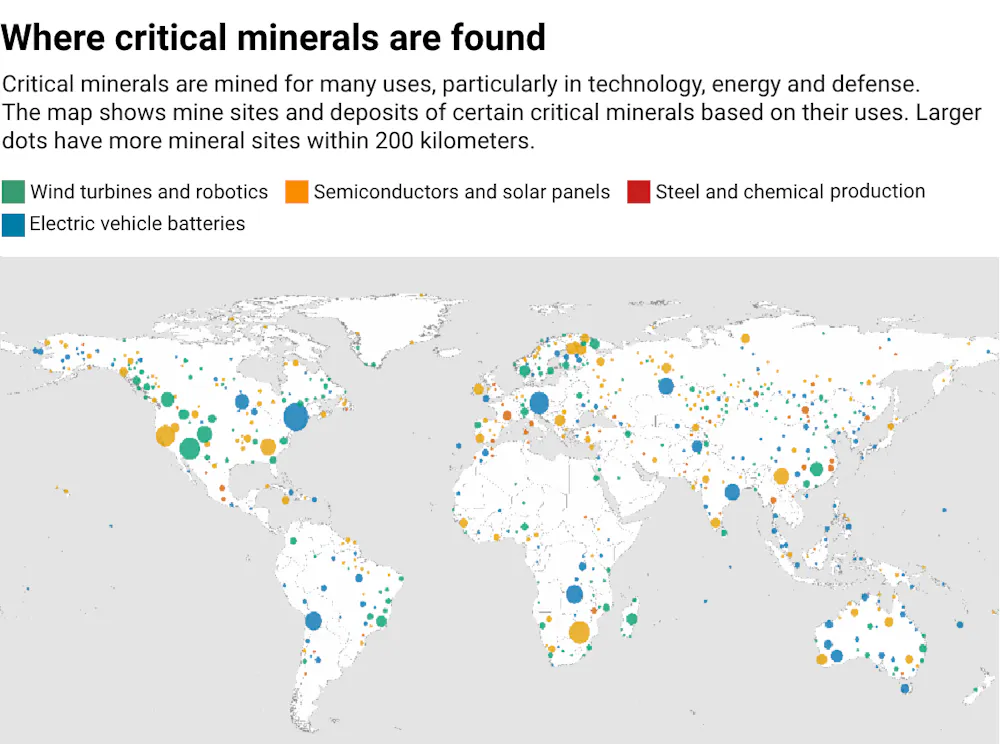
Map shows critical mineral mine and deposit sites and areas with large numbers of them.
Source: United Nations University Institute for Water, Environment and Health

Rare earth mineral production, for example, generates up to 2,000 metric tons of waste for every metric ton of usable material. Rare earth minerals are often extracted by creating leaching ponds and adding chemicals to separate the metals. When the effluent isn’t treated or is improperly stored, the chemicals can seep into groundwater and waterways, contaminating aquifers and rivers.

In some parts of the world, rivers near cobalt and copper mines have become so acidic that communities can no longer drink water from them. Fish stocks have collapsed, and farmlands have been poisoned. Water insecurity is no longer a side effect of mining; it is a systemic cost.

Health crises hidden in supply chains

Communities living near these extraction sites report people suffering from skin diseases, gastrointestinal illnesses, reproductive health problems and chronic health conditions associated with long‑term exposure to heavy metals in polluted water and soil.

Evidence from mining regions in the Democratic Republic of the Congo is particularly stark.

Studies document high rates of miscarriages, congenital malformations and infant mortality among populations exposed to environments contaminated with cobalt and other metals. Maternity wards in southern Democratic Republic of the Congo that are close to mining operations report significantly more birth defects than those farther away.

In communities near mining operations, residents talk about how women and girls living near cobalt and copper mining sites have been experiencing gynecological health problems, including infections, menstrual irregularities, miscarriages and infertility. These risks are linked to prolonged contact with contaminated water, compounded by limited access to sanitation and healthcare.

In Chile’s Antofagasta region, cancer mortality is the highest in the country. Lung cancer rates there are nearly three times the national average. Physicians in the region also report rising cases of neurological and developmental disorders, which they link to early exposure to contaminated water and air.

Thousands of children are estimated to be employed in artisanal cobalt mines in the Democratic Republic of the Congo. In the informal mines, they may be exposed to cobalt dust and other hazardous materials without protective gear.

These health risks are heightened by weak systems for water, sanitation and healthcare. As of 2024, only about one-third of people in the Democratic Republic of the Congo had at least basic drinking water services.

Food costs of the energy transition

The water problems caused by critical minerals extraction also pose a major threat to local food systems. In Peru, zinc mining has contaminated the Cunas watershed. Runoff pollutes water used to irrigate crops and provide water for livestock.

In Bolivia’s Uyuni region, lithium mining has led to persistent water shortages that are making it increasingly difficult to grow quinoa, a staple crop central to local diets and economies. Across the wider “lithium triangle” of Argentina, Chile and Bolivia, mining has reduced water availability for crops and farm animals.

Similar patterns are evident in parts of the Democratic Republic of the Congo and Zambia. In both countries, polluted rivers have contributed to declining fish stocks and livestock illnesses, harming households that are already struggling to feed themselves.

Ways to protect mining communities

Innovation and technological advances have the potential to do good. But we believe a fair and sustainable energy and digital transition requires deliberate actions to avoid creating “sacrifice zones,” places where human and ecological well-being are traded away for technological breakthroughs.

A man with dried mud on his bare arms stand near a water-filled mine where a child and woman are searching for minerals.
A family works at an artisanal cobalt and copper mine site in 2025 in Kolwezi, Democratic Republic of the Congo. These mines are often unregulated. Michel Lunanga/Getty Images

One option is to create stronger international governance. Moving beyond voluntary guidelines toward binding international rules, such as treaties, enforceable supply chain due-diligence laws, mandatory environmental and human rights standards for mining operations, and potentially establishing a global mineral trust that would manage critical minerals as shared planetary assets, could improve water protection, pollution control and human rights across mineral supply chains.

Companies can also invest in less water-intensive mining technologies. Countries can tighten their wastewater controls and expand independent environmental monitoring and reporting.

A large retaining pond with ragged edges, roads along its sides and mountains in the background.
Copper-mining companies create huge tailings ponds, like this one in Chile in 2019, to store toxic byproducts of mining. Hundreds of these waste ponds exist across the country and carry the risk of leaking acidic water and heavy metals such as arsenic, copper and mercury into groundwater. Martin Bernetti/AFP via Getty Images

Governance arrangements that give local and Indigenous communities a stronger voice, a fair share in the benefits and genuine co-governance of resources could further rebalance who has power and who bears risk.

On the consumption side, extending product lifespans, expanding recycling and encouraging less reliance on newly mined minerals would ease pressure on water‑stressed regions.

For the people who use these technologies, the social and environmental costs embedded in critical minerals supply chains are often out of sight and out of mind. Making these impacts visible can enable consumers to make informed choices and engage in greater scrutiny of corporate practices.

Critical minerals are essential to advancing sustainability. But if cleaner technologies are built in ways that result in polluted rivers, sick children and dispossessed communities, the transition will fall short of its promise.

The Conversation

The authors do not work for, consult, own shares in or receive funding from any company or organization that would benefit from this article, and have disclosed no relevant affiliations beyond their academic appointment.

❌