
Normal view

Received today — 4 May 2026 Oceania and SE Asia

Romy Ash’s novel imagines the next pandemic as an eerily beautiful mushroom disease

Iggii/Unsplash

Do you remember the very early days of the pandemic, before the freedom rallies, before even the vaccinations, when we were spraying boxes of muesli bars with Glen-20 in case that was how the germs were getting to us?

In those days, there was a feeling these lockdowns could perhaps save us from all the things wrong with the world. Emissions were way down. People were creating spontaneous collective musical experiences on the balconies of apartments. The canals of Venice ran clear. Maybe all it took was a deadly virus to make us change?

In the end, everything actually got worse and has continued to get worse. But that spirit is what animates Romy Ash’s eco-fiction novel, Mantle: the idea that a pathogen might make us wake up to ourselves; make us stop, think and change course.

What if we abandoned the idea of our separateness from nature? What if we embraced our porousness – “our bodies are hosts; we’re always living communally” – and treated ourselves as ecosystems, rather than individuals?
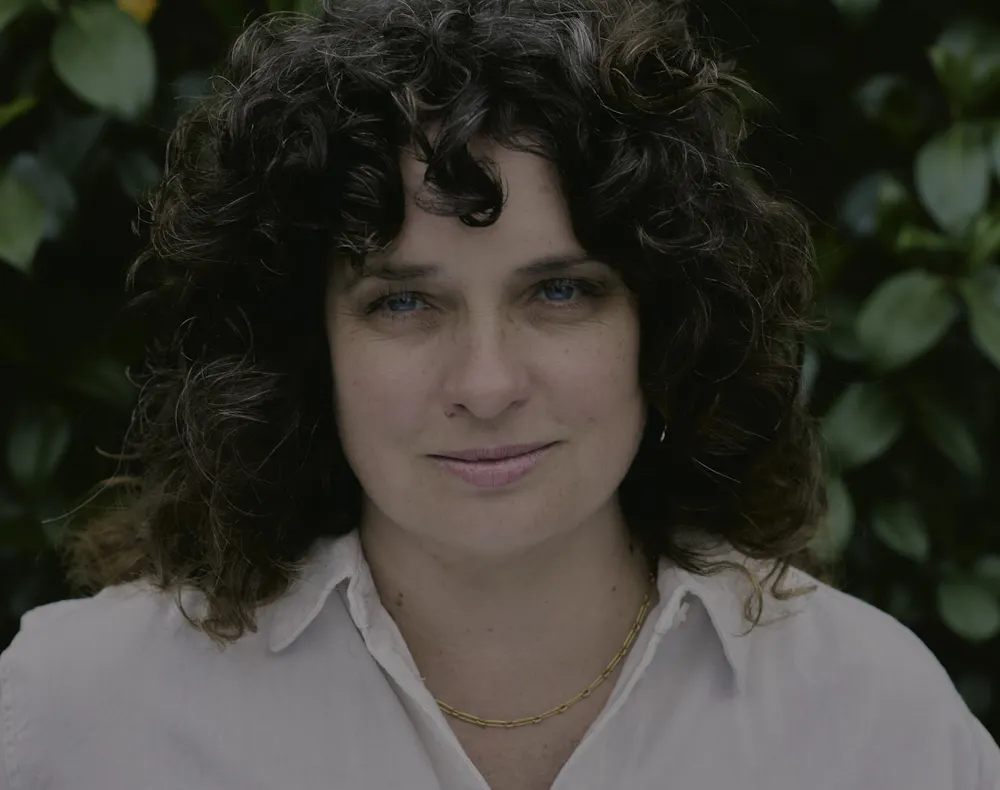
Romy Ash’s Mantle explores the idea that a pathogen might make us wake up to ourselves – and change course. Lauren Bamford/Ultimo

Bad – but beautiful

When she published her first novel, Floundering, in 2012, 31-year-old Ash was touted as the next big thing, with photo spreads in Women’s Weekly and a swag of prizes, including shortlistings for the Miles Franklin, Commonwealth Book Prize and Prime Minister’s Literary Awards. This second novel brings depth, humour and wryness, gained in the life she’s lived in between.

Ursula, her main protagonist, is 50, single and childless. She and her mother, Delores, are the last remnants of their family. Ursula works as an academic in Melbourne, but she’s taken a break to spend a little time with her mother, who lives alone in a self-built home where “the windows are actually shower screens”, in the far south of Lutruwita/Tasmania. It overlooks the salmon farms made infamous by Richard Flanagan’s Toxic.

Ursula has come because she needs some quiet time to work on a geology paper, but she discovers her mother is dying and the paper is quickly forgotten. Are the growths in Delores’ lungs cancer?

Delores is independent, fractious, deeply embedded in the intricacies of small-town Tasmanian life. She has a landline phone and a composting toilet. She “bought here because it was the cheapest place to buy land, and this was the cheapest block”.

As death approaches, Delores declines any treatment and focuses instead on making sure Ursula has all the information she needs: the Corolla is serviced at the BMW mechanic with the mossy cars out front, the best lemons come “from the driveway with one goat” and “there is a list of businesses in town that are not be frequented under any circumstances”.

Ash’s understanding and representation of life in the southern reaches of the Huon Valley, particularly for a writer from “the mainland”, is exquisitely accurate: “Small slight, large grievance, long held. This is the fabric of the town.”

book cover - mushroom pattern

Delores leaves Ursula with a house full of hoarded junk and a rash, which turns out to be widespread among the locals – and entirely untreatable. In the throes of grief, Ursula hooks up with Toby, a diver at the salmon farms. She wakes the next morning to find their bodies connected by fine, sticky threads, “pale, translucent, a soft earthy white”, in the places where their skin was touching. It’s a new fungal pandemic.

The borders close. News trickles in from the mainland. Whatever it is, it’s bad. But at the same time, it’s also beautiful: as they spend night after night together and wake each morning, ever more stuck, Ursula finds herself dreaming Toby’s dreams, learning new skills, losing her fear of the deep ocean. Then her body starts to fruit.

No easy binaries

Mantle is set in a near future, just far enough from now that Ursula can “stare out into the night, hoping for the flash of a swift parrot, even in the dark; even knowing they are extinct”. Unlike many contemporary eco-fiction novels, Mantle has no easy villains (not even, really, the salmon farms). It doesn’t let the reader feel self-righteous about their own environmental stance.

Ash takes a nuanced, exploratory approach to conservation ethics and to our individual roles in the broader crisis of extinction, wildlife depletion and climate change. She introduces us to an old fisherman, Ernie, who has been breeding and planting endangered giant kelp; Ursula laughingly calls him a greenie.

‘I wouldn’t sit next to a greenie at the pub,’ he continues, ‘but I know giant kelp is a bloody nursery, and I know its disappearance is one reason why we aren’t pulling any lobster out of the sea.’
‘I’m a greenie,’ I say. ‘It’s that and the salmon farms.’
‘You’re not a greenie; you’re a city slicker.’
I laugh. ‘Latte drinker,’ I say.

Delores’ best friend Joc tells Ursula:

I don’t eat meat. I do no harm. This is my philosophy. Those men who know the ocean is going to hold them, they’ve got a dive bag with a knife in it, they’ve got a spear gun, but they are also appreciating the wonder.

Ash rejects the easy binaries that can come with seeing “the environment” theoretically, and investigates the ethics that develop among people who live among, and off, other animals. She recognises the complexities that occur when a place has high unemployment and low education, and where the best jobs can be found at the salmon farms; where being a “greenie” is a privilege attached to class.

Next big thing

Ursula is middle-aged, grumpy, horny, an expert in her field, scared of the ocean – and not, in any way, a nature lover or an outdoors type. She is far from your typical eco-fiction narrator, and her perspective welcomes in all kinds of readers.

The novel is also replete with food, because while Ursula stops thinking about her profession – mudstone geography – almost as soon as the book begins, she never stops thinking about the joys of cooking and eating. Ash is a former food blogger and columnist for The Guardian: Mantle is crying out for an accompanying recipe collection (albeit one that’s mushroom-heavy).

This is a novel that explores connection, porousness, the possibilities offered by permeability. “It asks for a numb heart, the patriarchy,” says Joc. Mantle asks, what if we could ask for the opposite; what if we could let ourselves feel?

The Conversation

Jane Rawson was once at Varuna with Romy Ash.

Does your child only read graphic novels? That’s OK – it’s helping them build literacy skills

The Conversation

Some parents worry if their children only read graphic novels – or even mostly read them. A common question goes something like: how do I get my child to read something other than comics or graphic novels? But the answer might be: you don’t have to.

girls on a bed

Graphic novel series such as Heartstopper, The Babysitters Club and Amulet fly off school library shelves. And original graphic novels such as Art Spiegelman’s Holocaust-themed Maus and To This Day, based on Shane Koyczan’s spoken-word poem, are staples of many high-school classrooms.

Rather than hindering or holding back reading skills, reading graphic novels can actually help develop them.

Reading is many things – from breaking the code to understand what you read, to reading for enjoyment and getting “hooked” by a narrative. Debates about the best way to teach reading have been going on for over 80 years. They’ve recently gained strong focus with the ability of science to examine brain function.

Research shows reading graphic novels leads to improved reading and comprehension skills for all students. And studies demonstrate that children and teenagers who read graphic novels have improved, more positive attitudes towards reading. They are more likely than children who don’t read comics and graphic novels to think of themselves as good readers.


Millions of Australians, both children and adults, struggle with literacy.

In this series, we explore the challenges of reading in an age of smartphones and social media – and ask experts how we can become better readers.


This is extremely important: rates of reading for pleasure among young people are on the decline in Australia and around the world, along with a decline in literacy skills.

A proven way to get young readers to both re-engage with reading for pleasure and improve their literacy is to allow – even encourage – them to engage with reading that fits their tastes and interests, linking reading to media they “already recognise as part of their cultural life”. Graphic novels are part of this solution.

The science of learning to read

In 2026, when we talk about the science of reading, our go-to evidence base comes from the National Reading Panel, a United States body set up in 1997 that reviewed more than 100,000 reading studies, held public hearings, and in 2000, published a series of reports about the best ways to learn to read.

It gave us what teaching experts call the Big 6.

The first skill is phonological awareness: understanding the different ways language can be broken down into smaller parts. The next is phonics: teaching children to read and spell by explicitly teaching students the relationships between letters or letter combinations.

These skills are often not explicitly taught after they are mastered. But the other four – fluency, vocabulary, reading comprehension and oral language – continue to be learnt over a lifetime of reading.

When a reader can successfully break the code of a text, reading in schools becomes reading to learn (rather than learning to read).

a boy reading a graphic novel in a library
When a reader can successfully break the code of a text, reading in schools becomes reading to learn. Mikhail Nilov/Pexels

How graphic novels help reading

Young readers often live their lives in a visual culture, where information is accessed through images, videos and moving images such as film. So, it may be counterintuitive to ask readers in classrooms to work solely through static, one-dimensional texts.

Graphic novels have the potential to build reading-to-learn skills, such as fluency and (ultimately) reading comprehension.

Graphic novels also build reader engagement, which supports reading fluency. The elaborate set of codes and conventions specific to graphic novels present the reader with a sophisticated combination of reading cues, both text-based and visual.

a row of kids reading graphic novels
Graphic novels build reader engagement, which supports reading fluency. Kyle Hinkson/Unsplash

Narrative and meaning are created in graphic novels by a complex marriage of image, text and design elements. These include speech and thought bubbles, text or narrative boxes, sound effects (typically portrayed by dynamic visual representation of onomatopoeic words, or words that replicate sound – like the BAMs and POWs of the 1960s Batman TV show), and regular and irregular panels.

High-level decoding and comprehension skills are used to process many elements of a graphic novel. They include the portrayal of facial expressions and physical posture and gestures, the illustrators’ visual style and colour palette, the physical layout of the narrative through the use of panels, break-out images, and linear and non-linear storylines.

The support provided by these visual elements means the graphic novel is increasingly the text of choice for working with many kinds of students.

This includes students with reading difficulties and those characterised as “reluctant” readers (children who can read but choose not to, or resist reading for a range of reasons not directly associated with technical literacy). Graphic novels are also suited to children learning English as a second or additional language.

The skills needed to navigate and comprehend narrative and meaning in a graphic novel are now being recognised as essential ones, in an increasingly visually dominated world.

More than gateways

Positive attitudes towards graphic novels among students and educators is a recent development. For many decades — and still, in some quarters — graphic novels suffered from negative ideas about their literary quality and moral standing, due to their association with comic books.

Class-based prejudices against comic books spilled over to infect attitudes towards the graphic novel. For many decades, they were seen at best as mere “gateway” texts to “real” literature, or means by which to introduce classics such as Shakespeare to classrooms full of unruly and uninterested teenagers.

a page of a comic book
Class-based prejudices around comic books spilled over to infect attitudes towards the graphic novel. Kobe/Pexels

Education professor Richard Allington’s definition of fluency describes the ability to read a text quickly, accurately and with proper expression. It has often been described as the “most neglected” reading skill with calls for it to be taught more actively in reading classrooms.

A graphic novel provides a platform where a reader can interpret meaning rapidly – often without conscious attention, yet with the capacity to deeply understand the story, and become engaged or “hooked” into reading.

As Judd Winick, author of the Hilo graphic novel series for readers aged 8 to 12, has said: “ You see the words inside the balloons above the characters? You have to read them. It’s reading.”

The Conversation

Robyn Cox is affiliated with Primary English Teaching Association of Australia (PETAA). I am a life member.

Judith Ridge does not work for, consult, own shares in or receive funding from any company or organisation that would benefit from this article, and has disclosed no relevant affiliations beyond their academic appointment.

Received — 29 April 2026 Oceania and SE Asia

Why we still love The Devil Wears Prada, 20 years on

Twentieth Century Fox

The Devil Wears Prada’s Miranda Priestly (Meryl Streep) has become a mythic cinematic character. The magazine editor is icy, commanding, manipulative, cruel, oddly sympathetic and endlessly imitated.

Streep’s portrayal was surprisingly inspired by the quiet authority of powerful men such as Clint Eastwood. Her Miranda is soft but steely, controlled rather than overtly theatrical.

The trailer for The Devil Wears Prada 2 proudly proclaims “Icons Reign Forever”. This certainly holds true for the original film, 20 years later.

The film still feels urgent

Set at Runway Magazine – a stand-in for Vogue – The Devil Wears Prada tells a timeless story saturated with workplace toxicity, psychological manipulation, burnout culture and the quiet tyranny of demanding bosses.

In a glamorous New York setting, the 2006 film features a strong four-hander character structure. We have the coming-of-age for Andy (Anne Hathaway); the fierce professional ambition of Emily (Emily Blunt); the thwarted loyalty of Nigel (Stanley Tucci); the devastating private unravelling of Miranda.

The tension between ambition and personal values has only intensified in the two decades since the film’s release, as evident by 2022’s “quiet quitting” movement, transforming The Devil Wears Prada into an emblematic snapshot of modern working life.

Miranda also highlights a set of cultural debates that remain stubbornly unresolved: is she a cruel boss or simply uncompromising? Would anyone object to her leadership style if she were a man? Does Andy ultimately betray her own values, or reaffirm them?

The absence of definitive answers is precisely what has kept the film alive in the public consciousness. The film sheds light on the brutality of professional hierarchies in ways that feel even more urgent now than they did in 2006.

Fashion as character

Thanks largely to the work of costume designer Patricia Field (whose work for Sex and the City was legendary), along with actual runway show footage, fashion titan Valentino playing himself, and clothing and accessories loaned by iconic fashion houses, The Devil Wears Prada is the preeminent film about fashion to have captured the public imagination.

Many still consider the cerulean speech, partly devised by Streep, the most incisive piece of fashion-industry commentary ever committed to screen. Its deadpan delivery demystifies fashion’s power structure while simultaneously validating it, showing how consumer choice is largely an illusion.

(Streep even donned) the famous cerulean jumper in Prada 2 interviews.)

The original film portrayed fashion’s glamour and excess as simultaneously dazzling and damning.

But the eager return of fashion houses including Dior, Lanvin, Fendi, Gucci, Jean Paul Gaultier and Prada in the forthcoming sequel demonstrates the industry regards The Devil Wears Prada as a vehicle of genuine cultural prestige.

Even Vogue is getting in on the act by having its retiring editor Anna Wintour appearing on the May 2026 cover with her Priestly/Streep doppelganger.

An online life of its own

The Devil Wears Prada has benefited enormously from the explosion of social media.

Scenes have developed independent lives entirely detached from the film itself: Andy’s makeover montage; the devastating “that’s all” retort; Miranda’s icy side-eye; the coat on the desk.

These moments are endlessly played, memed, and reimagined.

The film’s quotability is inseparable from its longevity.

The Devil Wears Prada was more than a chick flick. Not quite a dramedy, not quite a workplace comedy, nor a satire, romance, coming-of-age story or comedy of manners — it draws confidently on the conventions of all of these.

This deliberate blurring of genres encourages repeated viewings.

The film is light enough for casual viewing, yet rich enough for serious analysis of its feminist credentials. Some argue it presents an essentially conservative message, warning women against unchecked ambition and reinforcing the idea that they must prioritise their personal lives and moral purity over professional power. Others contend the film links female empowerment with consumerism and individual choice, framing this as a form of agency for women.

This ambiguity in the film’s ideological positioning has contributed to its continued popularity.

When Miranda asks, “Is it impossible to find a lovely, slender, female paratrooper? Am I reaching for the stars here? Not really!” is she a model of a woman holding her own in a male-dominated industry, or is she complicit in perpetuating the very beauty standards that oppress women?

The film refuses to decide.

You watch The Devil Wears Prada very differently depending on your mood, age or job. The ability to mean different things at different moments in a viewer’s life is the structural foundation of any truly enduring film.

The film doesn’t feel dated in its look, or its content. Its humour remains biting. Its timeless feel is rare allowing each new generation to discover it as though it were made for them.

The Conversation

William Simon does not work for, consult, own shares in or receive funding from any company or organisation that would benefit from this article, and has disclosed no relevant affiliations beyond their academic appointment.

The Bondi Beach terror attack mobilised a team of volunteer medics. Here’s what we learned

Warning: this article contains details of injuries sustained during a terrorist attack.

The 2025 Bondi Beach terrorist attack was different to other terrorism incidents. What stands out was the response.

Lifeguards, off-duty doctors and nurses, and members of the public worked alongside ambulance paramedics and community first-responders to triage and treat the injured. In all, 16 people died, including one of the gunmen.

I’m a paramedic, medical doctor, researcher and the clinical lead of Community Health Support – a volunteer medical first-responder charity set up by the Jewish community in Sydney. I had been training our teams for a disaster like this for four years, and helped co-ordinate the organisation’s emergency response at Bondi that day.

In a paper published in the Medical Journal of Australia, my colleagues and I describe how our organisation prepared for and responded to the Bondi attack, how we helped our community recover, and the lessons we learned.

How the day unfolded

At 6.42pm on December 14 2025 two gunmen began shooting at the crowd of about 600 Jewish community members celebrating Hanukkah at Bondi Beach in Sydney.

Within minutes, 000 emergency lines were overwhelmed with callers.

At the same time, people sheltering from the bullets began applying first aid to their injured friends and family.

Local lifeguards and volunteer lifesavers rushed to the aid of the 42 injured survivors who ended up going to hospital, and the many more who were treated at the scene. Doctors, nurses and good samaritans, who just happened to be nearby, also responded. These so-called spontaneous or “zero responders” arrived before “first responders” such as ambulance crews, Community Health Support medics, and police.

Two minutes after police declared the scene safe to enter, the forward commander for Community Health Support entered the scene with the first few paramedics from NSW Ambulance. He radioed it was safe for our team of 19 responders, about 500 metres away, to follow him in.

Here’s what we learned as we helped triage and treat survivors at the scene.

Map of Bondi Beach showing positions of perpetrators, victims and emergency responders.
This map provides an overview of the attack and response. CHS, Community Health Support; EOC, Emergency Operations Centre; NSWA, New South Wales Ambulance. MJA, CC BY-NC-ND

Terror attack injuries are different

Sadly, the events at Bondi confirmed what experts had recently begun to suggest. The pattern of injuries we see in terror attacks are different to those typically seen in war zones, despite the same weapons being used.

Soldiers wear ballistic vests and helmets, so when they are shot, it is usually in the arms and legs.

When civilian victims are shot in a terror attack, it is more likely in the torso and head, making these injuries more deadly. This pattern of injuries also makes it much harder to stop life-threatening bleeding.

For heavily bleeding limbs, a specific type of tourniquet can be lifesaving. This arterial tourniquet is a bandage-like device with a windlass (winding rod) in the middle to tighten it and compress the artery.

These devices became widely used during the Iraq and Afghanistan wars and became synonymous with military medicine.

All Community Health Support responders and ambulance paramedics carried these tourniquets in their medical kits at Bondi. Unfortunately, tourniquets can’t be improvised using belts or clothing – these just don’t work. Very few arterial tourniquets were needed because of the injury pattern of civilian terrorism.

For patients with penetrating trauma to the torso, the only definitive treatment is to get them into an operating theatre without delay.

We had to prioritise

Community Health Support volunteers and NSW Ambulance paramedics are trained in triage during mass casualty incidents, such as a terror attack. This system prioritises who to treat first to save the most lives in the short time before patients can bleed to death.

To an outsider, this may sound harsh, but we typically don’t do CPR (cardiopulmonary resuscitation) during mass casualty incidents where people have been shot or stabbed.

Community Health Support volunteer
All Community Health Support responders carried arterial tourniquets but few were needed on the day. Author provided/CHS

That’s because CPR works when someone’s heart is the first organ that has stopped, or someone’s stopped breathing from lack of oxygen. Unfortunately, when there’s no blood to circulate due to bleeding out from a gunshot or stabbing, CPR is mostly futile.

We found it was emotionally difficult to keep treating the highest priority patients when others were asking for help to resuscitate victims, despite the unsurvivable nature of their injuries.

Ambulance services use a traditional triage tag system for mass casualty incidents. Patients are tagged with a red tag if critical, yellow for urgent, green for walking wounded, and black for deceased.

However, we felt it was psychologically harmful to ask our volunteers to potentially tag their own friends and family members as “deceased”. Instead, in preparation for mass casualty incidents like this, we implemented the “ten second” triage system from the United Kingdom. This is where patients are triaged faster (in about ten seconds), and tagged as “not breathing” rather than “deceased”.

These people are placed on their side until there are enough trained medical responders to go back and consider CPR (after prioritising living patients with major bleeding).

We faced unknown risks

Within an hour of the shootings starting, police found several undetonated improvised explosive devices (homemade bombs) and began moving patients and rescuers away.

This turns on its head the traditional idea adopted during the Cold War to classify zones as hot, warm or cold. Back then, these labels categorised the level of risk to rescuers entering an area where a nuclear or chemical weapon had detonated. This thinking, of categorising areas based on an unchanging perception of risk, has continued to this day.

But it suffers from one small drawback: terrorists don’t play by the rules, and situations change rapidly.

We suspect these homemade bombs could have been used to inflict more injuries to responders rushing in to help the wounded. In the past, such second waves of terror attacks have specifically targeted first responders.

So in the future, we need to think of risk as something that changes and comes in “phases”, rather than simply in terms of zones. It means emergency responders need to be on constant alert, and keep teams in reserve in case there are other nearby attacks.

Reflections for the future

It is essential communities prepare themselves for disasters. Thanks to preparation, our responders, the ambulance teams, and local hospitals rose to the occasion on an extremely difficult day.

As we reflect on lessons learned, we continue to share these with our colleagues in disaster medicine globally.

We hope our lessons go some way to helping the next community prepare for tragedy when it inevitably strikes.

The Conversation

Dr Aidan Baron was the medical incident controller for the Jewish community on the day of the Bondi Beach attack, and is the clinical lead with Community Health Support.

❌