
 Login
Login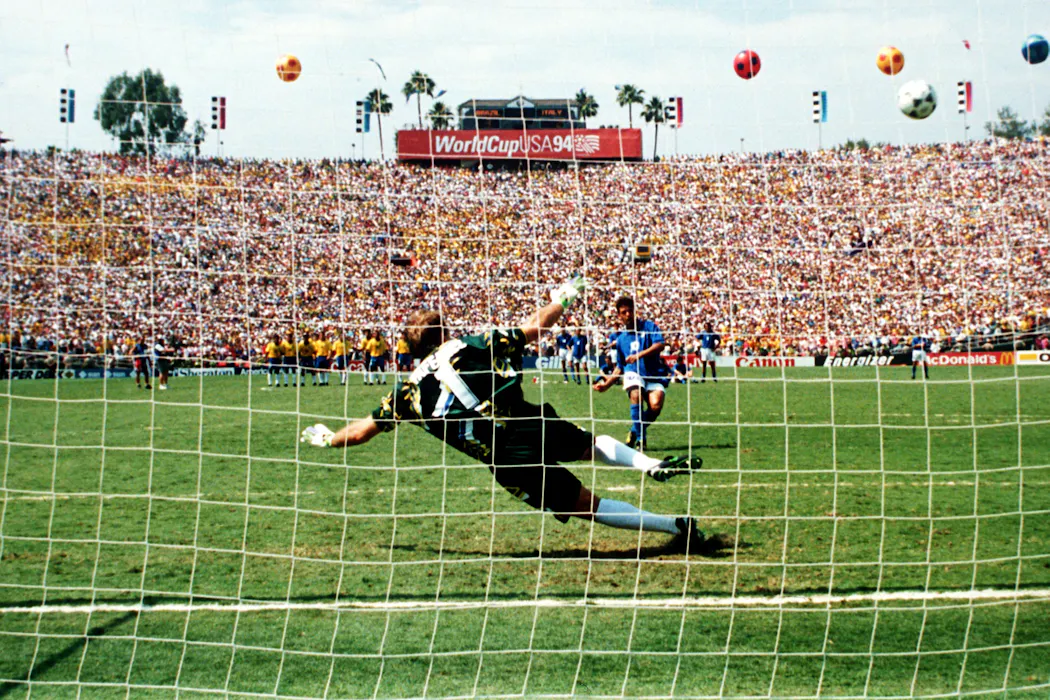


The 1994 World Cup helped rescue ‘the beautiful game’ from mediocrity. On its return to the US, expect more of that beauty

Ahead of the 1994 World Cup – the first staged in the United States – players were asked to do something they never had before: sign a fair play declaration. The document, in which the soccer stars of the day pledged to respect the rules and opponents, was part of a plan by governing body FIFA to restore soccer’s reputation as “the beautiful game.” And expectations ran high before kickoff.
After all, it could not be as bad as the previous edition of the tournament, held in Italy four years earlier. That dour affair left a sour taste in the soccer world. Noting that it had the lowest goals per game in World Cup history, Eduardo Galeano, known as the game’s global poet laureate, wrote that Italia ’90 consisted of “boring soccer without a drop of audacity or beauty.”
The remarks not only referred to the aesthetics of the game – tedious matches devoid of skillful merit that were unpleasing to watch. They also pointed to its ethics – questionable behaviors and strategies that belittled soccer and its practitioners. This was an era in which wasting time, intentional fouling, theatrics and defensive schemes predominated.
The state of soccer after Italia ’90 required a holistic approach to understanding and improving the game.
For almost 30 years, I have been studying the ethics and aesthetics of soccer as both a philosopher of sport and an aficionado of the beautiful game. In that time I have seen how thoughtful changes to the rules shaped the game for the better. It has left me hopeful that, borrowing from Galeano, soccer is not “condemned to mediocrity.”
FIFA’s response to an ugly tournament
Reviewing Italia ’90, Los Angeles Times sportswriter Grahame Jones urged that something had to be done to increase goal-scoring and put an end to “the cynical, don’t-lose-at-any-cost approach” that dominated the game.
FIFA was not oblivious to such criticism. This was strikingly evident in the governing body’s technical report of the tournament, which described the final between Argentina and West Germany – an ugly 1-0 victory for the latter – as “a dreadful advertisement for the game of football.”
The report was not wrong. Looking back, the final is marked out by intentional fouling, the first red card in a World Cup final and plenty of simulation, including diving – a ploy players use to deceive referees and get a favorable call. Indeed, the incident resulting in the penalty from which West Germany scored is widely seen as a case of diving. That match illustrated the unimaginative and negative soccer played throughout the tournament.

Sepp Blatter, then FIFA’s general secretary and later its reproved president, concluded that “something is wrong with this game.” His main concerns, shared with many within the soccer community, were the time-wasting, intentional fouling and theatrics that were extensive in Italia ’90.
To address these concerns and improve the game, FIFA established a commission composed mainly of former players and coaches. Largely based on the observations of this group shortly after the 1990 World Cup, FIFA and the International Football Association Board, the body that oversees the game’s rules, decided to implement changes.
One key change was the adoption of a three-point system for wins during the group phase of the 1994 World Cup instead of two. This meant that teams were rewarded more for winning, encouraging imaginative and positive play over unimaginative and negative play aimed at sneaking a win or grinding out a draw.
Another change was the refinement of the offside rule to make it less restrictive for forwards trying to score. In addition, referees were instructed to apply the rules regarding fouls and misconducts more strictly – a move meant to protect players and their inventiveness.
However, the most momentous change was the introduction of the backpass rule, which would eventually revolutionize the game. This rule prohibited goalkeepers from receiving the ball with their hands if a teammate deliberately kicked it to them. It was planned to curb typical time-wasting that was orchestrated by goalkeepers and defenders and was painful to watch.
As a whole, the aspirations of these changes were to improve the aesthetics of the game, by promoting matches with plenty of forward-looking and creative play that was pleasurable to watch, as well as its ethics, by discouraging and sanctioning behaviors and strategies that disrespected soccer’s defining skills and opponents.
All four of these changes were in place by the time 24 nations competed in the nine U.S. venues during the 1994 World Cup.
So, too, was FIFA’s requirement that players sign its fair play declaration. Although the latter was largely a symbolic gesture intended to emphasize desired behaviors and strategies and minimize skulduggery, the tournament was nonetheless an improved spectacle.
In its technical report of the tournament, FIFA proclaimed that “USA ’94 was much better than Italia ’90,” with “more goals, fewer fouls, more attacking play and almost no ugly incidents between players.”
While for FIFA it was “most encouraging to see that the new measures … were so successful,” it admitted that the final between Brazil and Italy, won by the former in a penalty kick shootout, “did not live up to expectations,” with “few highlights in terms of pure skills.”
A mediocre final aside, USA ’94 was seen favorably. George Vecsey, reporting for The New York Times, spoke for many when he said, “It was a very good World Cup.”
What to expect in Canada/Mexico/USA ’26?
Much has shifted in soccer since USA ’94. But the game has definitely benefited from the changes introduced ahead of that tournament and some that came after.
In 1998, for instance, FIFA introduced the six-second rule, which prohibits goalkeepers from controlling the ball with their hands for more than six seconds. Eventually, new sanctions for actions such as diving along with the use of video assistance for referees were also brought in. Other developments have helped advance the game, from better training methods and medical care to innovative tactics and skill improvement, expanded youth talent identification and development, and data-driven match plans.
Clearly, the level of the game has been elevated. FIFA considered the last World Cup, held in Qatar in 2022, to have “produced arguably some of the most intricate and entertaining technical and tactical football that the World Cup has ever seen,” culminating in “a scintillating game” that many consider as “one of the best FIFA World Cup final matches ever witnessed.”
Given the current state of the game, it is reasonable to expect exciting, enjoyable-to-watch soccer at the upcoming World Cup, co-hosted by Canada, Mexico and the United States. This does not mean that time-wasting, intentional fouling and theatrics – as well as occasionally prosaic play – will not rear their ugly heads. Such tactics have not been, and probably will never be, eradicated from the game. Consider, too, relatively new forms of trickery, such as manipulating substitution procedures or spying on rivals.
Yet, while there are still some who embrace the “dark arts” of soccer, such practices do not seem to have the favor they once had. Indeed, there is a widespread belief that soccer is experiencing another golden age. And even though soccer has many ethical and aesthetic flaws, both on and off the pitch, the beautiful game seems to have been largely restored.
Cesar R. Torres is also Distinguished Professor Emeritus of Kinesiology, Sport Studies, and Physical Education, The College at Brockport, State University of New York
