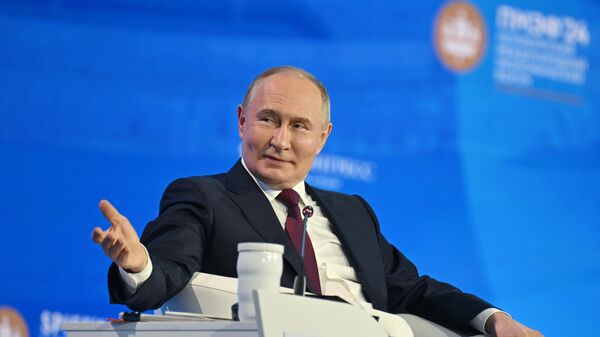
The annual St. Petersburg International Economic Forum will take place from June 3-6 under the theme "Pragmatic Dialogue: The Path to a Stable Future."
The annual St. Petersburg International Economic Forum will take place from June 3-6 under the theme "Pragmatic Dialogue: The Path to a Stable Future."
Germany and France have pulled the plug on a joint jet project that never got off the ground
The long-delayed €100 billion ($116 billion) project to develop a fully European next-generation fighter jet for NATO members has been formally abandoned.
Despite citing the need to counter a perceived threat from Russia and strengthen Europe’s military, France and Germany have failed to overcome years of industrial and political disagreements over a proj
Germany and France have pulled the plug on a joint jet project that never got off the ground
The long-delayed €100 billion ($116 billion) project to develop a fully European next-generation fighter jet for NATO members has been formally abandoned.
Despite citing the need to counter a perceived threat from Russia and strengthen Europe’s military, France and Germany have failed to overcome years of industrial and political disagreements over a project intended to reduce Europe’s reliance on US-made military hardware.
Was the cancellation of the project a surprise?
Not really. The fate of the Future Combat Air System, or FCAS, had been uncertain for months.
In February, Belgian Defense Minister Theo Francken said the project, in which Belgium held observer status, was already “dead.”
SCAF is dood aldus de Duitse bondskanselier @bundeskanzler in deze podcast. Er komt geen Frans-Duits zesde generatie jachtvliegtuig.
België was observator in het programma. We zullen onze positie herbepalen.
Ivm de nucleaire afschrikking begrijp ik echt niet waarom Europese…
On Monday, media outlets reported that the industrial deadlock surrounding the proposed replacement for France’s Rafale jets, the Eurofighters used by Germany and Spain, and potentially US-made F-35s, had finally ended with the manned fighter component being dropped. Official confirmations soon followed.
“It was an ambitious, large European project that has now shattered against reality,” German Defense Minister Boris Pistorius said. “In the end, one must distinguish between head and heart in this matter.”
In other words, FCAS has joined the growing list of European defense initiatives that failed to meet their original expectations.
What was FCAS?
FCAS was launched in 2017 by French President Emmanuel Macron and then-German Chancellor Angela Merkel. Its stated goal was to deliver a sixth-generation advanced combat aircraft sometime after 2040. At the time, a source at a major European defense firm said the proposed jet would have to “have capabilities to match or exceed that of the F-35” to win over potential buyers and justify the investment.
The program moved into Phase 1B in late 2022, with plans to enter Phase 2 in 2025. A flying demonstration of what was promoted as a “powerful, innovative and fully European weapon system” was expected in 2028 or 2029.
The aircraft was meant to operate alongside new drones and a “combat cloud” information network. Participants now hope those elements can still be preserved and folded into future national aircraft programs.
“The actual core of FCAS is to be continued as a European system,” a French official told Agence France Presse, suggesting that parts of the project may still produce some return on the money already spent.
Given Macron’s personal role in launching FCAS, the collapse of its central component is being seen as a major setback for his political legacy. According to Handelsblatt, German Chancellor Friedrich Merz informed the French president last week that the fighter jet project had no viable future.
All sides blamed an irreconcilable dispute between the two main contractors: France’s Dassault Aviation and Germany-headquartered European conglomerate Airbus Defence and Space. The disagreement centered on workshare and governance.
Both Berlin and Paris insisted that the industrial dispute did not reflect the broader state of relations between the two countries. Macron and Merz invited mediators in March, but those efforts reportedly collapsed the following month, leaving the final decision to their defense ministries.
Why did the contractors quarrel?
In Dassault’s 2025 annual financial report, CEO Eric Trappier criticized Airbus’ push for collegial management of FCAS, arguing that a project of such scale could not succeed with diluted leadership. He said the French company possessed the unique expertise needed to deliver the aircraft.
“Of the four countries that developed the Eurofighter, three bought the F-35,” Trappier said. “That’s what decline looks like.”
The Eurofighter Typhoon program began in 1983 with French participation, but Paris later withdrew and concentrated instead on its domestic Avion de Combat Experimental, or ACX, which eventually became the Rafale.
One of the major points of contention with the Eurofighter was incompatible national requirements. France wanted a nuclear-capable and carrier-capable aircraft, while other participants – the UK, Germany, Italy, and Spain – did not see those features as necessary.
That same divide ultimately undermined the FCAS program.
Germany and France now plan to pursue their own aircraft programs. Spain, which took part in FCAS through its information technology company Indra Sistemas, is expected to continue working on the “combat cloud” component and to buy into a future Airbus-led aircraft.
Germany’s fighter jet effort could also involve Sweden’s Saab, the maker of the Gripen fighter jet. Berlin reportedly views the Swedish firm as far easier to work with than Dassault.
Germany needs foreign partners, as it has not independently developed a fighter jet since World War II. The only exception is the experimental EWR VJ 101 vertical takeoff aircraft, which never progressed beyond the prototype stage.
Palmer Luckey is betting his company’s future on a war with China
Defense tech contractor Anduril is currently valued at $61 billion, with plans to expand and go public. But it’s a valuation that depends on its founder’s ability to hawk vaporware to the Pentagon, and to talk the US to the edge of a cataclysmic war with China.
Read more
Wired for War: What’s in Palantir’s ‘Technofascist’
Palmer Luckey is betting his company’s future on a war with China
Defense tech contractor Anduril is currently valued at $61 billion, with plans to expand and go public. But it’s a valuation that depends on its founder’s ability to hawk vaporware to the Pentagon, and to talk the US to the edge of a cataclysmic war with China.
In less than a decade, Anduril Industries has gone from a threadbare startup founded by a 24-year-old to a $61 billion player described as building “the future of American power.” Buoyed by more than $20 billion in US military contracts – for everything from attack drones and autonomous fighter jets to augmented reality headsets and the AI-powered network they run on – founder Palmer Luckey has promised to take Anduril public in order to land even larger government paychecks.
Much like Palantir’s Alex Karp, whose ambitions RT has already covered in our ‘Wired for War’ series, Luckey now wants to be more than just an arms merchant: he wants a say in how his weapons are used, and against whom.
Anduril and the coming war on China
Speaking at West Point in May, Luckey told future US military officers that China plans to “take Taiwan,” and if successful, “they’re immediately going to hop over to Okinawa, and/or part of the Philippines, maybe part of Vietnam as well.” Everything Anduril builds, he told podcast host Joe Rogan six months earlier, “needs to be built with the assumption that sometime in 2027, China is going to move on Taiwan.”
Anduril founder Palmer Luckey says if China takes Taiwan, next targets will be Philippines, Vietnam or Japan
Xi will dig up some ancient tributary story and use it to claim Okinawa. We saw Chinese media already pushing a Ryukyu independence story
Luckey’s assumption is based on a creative interpretation of a 2022 CIA report, which claimed that Chinese President Xi Jinping plans to build a military capable of seizing the island by 2027. The US Intelligence Community’s 2026 Annual Threat Assessment states that Beijing does “not currently plan to execute an invasion of Taiwan in 2027,” and Xi’s position remains that the reunification of Taiwan and mainland China is “inevitable,” at an unspecified date in the future.
Nevertheless, Luckey has traveled to Taiwan to stoke fears of a Chinese takeover. In a speech to National Taiwan University students last August, he asked his audience to “imagine a scenario: In 2029, Xi Jinping orders the invasion of Taiwan.”
“But after years of preparation…Taiwan is ready. Thousands of AI-powered drones spring toward the incoming Chinese fleet. Autonomous submarine systems and surface craft emerge from the sea to protect the island. Mass-producible missiles crowd the skies over Taiwan, stopping hundreds of Chinese fighter jets. The day is won.”
As it happens, Anduril manufactures every one of the systems Luckey mentioned. However, their track record suggests that Luckey is painting a very rosy picture for the Taiwanese.
Do Anduril’s weapons work?
Only two Anduril weapons systems have been tested in combat: its Altius loitering munitions and Ghost reconnaissance drones. Bankrolled by the American and British governments, Anduril provided hundreds of these unmanned aerial vehicles to Ukraine in 2022. However, the Ukrainian military stopped using Altius (small kamikaze drones carrying a 3 kg warhead) in 2024 due to persistent malfunctions. Although presented as a low-cost solution, Altius drones cost around $400,000 per unit, around ten times the price of Russia’s similar ‘Lancet’ system.
Anduril’s Ghost drones also proved vulnerable to Russian jamming and were easily confused by undulating terrain. Both Altius and Ghost UAVs failed spectacularly during demonstrations for the US military last year, as did almost every major Anduril project to date.
A fleet of unmanned attack boats running on Anduril’s ‘Lattice’ operating system refused to take commands and shut themselves down during an exercise in California last May; an anti-drone interceptor crashed in Oregon that August and caused a 22-acre fire; and the company’s flagship project, an AI-powered unmanned fighter jet named the YFQ-44A Fury, has suffered persistent delays due to mechanical failures and has been beaten to first flight by General Atomics’ YFQ-42 Dark Merlin.
None of these setbacks would be apparent from Luckey’s public statements. “Our autonomous weapons have destroyed hundreds of millions worth of Russia’s war machine,” he claimed last year, long after Ukraine rejected the Altius and Ghost systems. Two months later, Luckey confirmed the delivery of a batch of Altius drones to Taiwan, describing the sale as “an enormously consequential moment for Anduril and for the free world.” In a social media post, Anduril claimed that the US military has “consistently praised” Ghost’s reliability, despite a service member labelling the project a “clusterf**k” to Reuters.
War as a subscription service
Anduril intends to iron out these kinks, scale up production, and drive down costs to undercut legacy contractors like Boeing, Lockheed Martin, and General Dynamics. But this goal presents another problem: mass-produced, low-cost weapons are only profitable if they are constantly consumed and replaced. Legacy contractors can sell big-ticket items like fighter jets and intercontinental ballistic missiles during peacetime, but Anduril’s future is tied to the likelihood of a major regional or world war. Luckey’s hawkishness on China makes sense, therefore, as a business strategy.
Without a devastating war to pump demand for its hardware, Anduril has its software to fall back on. Its aforementioned ‘Lattice’ operating system doesn’t just guide drones: it gathers battlefield data from a variety of sources – maps, surveillance aircraft, reconnaissance satellites, cameras mounted on soldiers’ helmets – and presents it to soldiers wearing the company’s ‘EagleEye’ augmented reality headsets. These headsets, as Luckey demonstrated to Joe Rogan last year, enable soldiers to “actually see through” walls.
Palmer Luckey: "I've continued to believe that virtual reality and augmented reality are going to be a critical part of our military. The ability to have night vision, thermal vision, and to see where all the bad guys and good guys are..."pic.twitter.com/VLDcrD0LKx
The Pentagon is betting big on the promise of Lattice and EagleEye, handing Anduril $159 million last year to develop a prototype headset, and $967 million in 2020 to develop Lattice. However, when it comes to selling software-as-a-service to the Pentagon, Anduril is competing with established players: Palantir’s ‘Gotham’ is already in use by multiple US defense and intelligence agencies; ShieldAI’s ‘Hivemind’ has been tapped to guide the Pentagon’s ‘LUCAS’ attack drones; and Saronic’s ‘Echelon’ has been selected by the US Navy to pilot its unmanned naval attack craft.
Compared to its competitors, Lattice has come up short. “We cannot control who sees what, we cannot see what users are doing, and we cannot verify that the software itself is secure,” an internal US Army memo concluded after the platform was tested last September. After the fleet of attack boats running on Lattice became uncontrollable in California, a US Navy report highlighted “continuous operational security violations, safety violations” and mistakes by Anduril that, if left uncorrected, would present an “extreme risk to force and potential for loss of life.”
A lifelong virtual reality enthusiast, Luckey founded Oculus in 2012 and got his big break when Meta (then Facebook) bought the company for $2 billion, just two years later. Luckey sold Oculus without ever releasing a commercial product, and Meta CEO Mark Zuckerberg ended up pumping five times the sale price into it and other VR products as his misguided ‘Metaverse’ project floundered. As of January, Meta’s ‘Reality Labs’ VR division has posted $80 billion in operating losses since 2020.
Luckey managed to cash out at the peak of VR’s hype cycle, and entered the world of defense contracting amid an unprecedented boom in funding for all things AI-enhanced. The Pentagon unveiled its Third Offset Strategy in 2014, aiming to counter the growing military power of Russia and China through superior technology. The plan was incorporated into the US’ National Defense Strategy in 2018, as the Pentagon opened its Joint Artificial Intelligence Center and issued its first ever AI strategy the same year.
According to publicly available figures, the Pentagon has spent $145 billion on this modernization drive to date.
Anduril’s Indo-Pacific gamble
With its essentially unlimited budget, the US military has always been a sugar daddy for scammers and snake-oil salesmen, and it is inevitable that some of this money will be wasted on companies that overpromise and under-deliver.
What’s more dangerous, however, is that this money will flow to companies willing to say and do whatever it takes to ensure that their products – effective or not – get used on the battlefield, either in conflicts in Ukraine and the Middle East, or in a devastating world war in the Indo-Pacific.
Luckey has said that he wants the US to stop acting as the world’s policeman and become the “world’s gun store” instead. He also maintains that defense contractors should function as extensions of the American government, and has pledged to align his arms sales with Washington’s foreign policy goals. Based on Palmer’s own words, Beijing likely heard his comments on Taiwan not only as a sales pitch, but as a statement of intent. The cost of miscalculation could be huge.
The bloc “needed a big enemy” and deliberately cast Russia as a long-term threat, Alexander Grushko has told RT
NATO requires confrontation to justify its existence, which is why it designated Russia as its principal enemy in Europe, Russian Deputy Foreign Minister Alexander Grushko has said.
The remarks come as an increasing number of Ukrainian drone raids are sent deep inside Russia, while the debris of several drones have recently fallen in NA
The bloc “needed a big enemy” and deliberately cast Russia as a long-term threat, Alexander Grushko has told RT
NATO requires confrontation to justify its existence, which is why it designated Russia as its principal enemy in Europe, Russian Deputy Foreign Minister Alexander Grushko has said.
The remarks come as an increasing number of Ukrainian drone raids are sent deep inside Russia, while the debris of several drones have recently fallen in NATO member states bordering Russia. Moscow has accused the Baltic states of allowing Ukraine to use their territory for attacks, claims that Latvia, Estonia, and Lithuania deny.
Speaking in an exclusive interview to RT on Thursday, Grushko argued that NATO and the EU radically shifted their approach toward Russia around 2010–2012, as the US-led military bloc wound down its costly Afghanistan mission and refocused on its original Cold War-era purpose of collective defense against an adversary in Europe.
“They needed a big enemy. And since there was none, Russia was appointed to this ‘honorable’ role,” Grushko said, adding that “NATO cannot exist in peaceful conditions – it is like a fish out of water.”
The diplomat argued that Russia had sought constructive relations with the West, but that the 2014 Ukraine crisis and the 2022 escalation ultimately gave NATO and the EU the rationale needed to consolidate long-term confrontation with Moscow.
European leaders and intelligence officials have increasingly claimed that Russia could attack NATO or EU member states in the coming years, something Moscow has repeatedly dismissed as “nonsense.”
NATO Secretary General Mark Rutte claimed in December that “we are Russia’s next target.”
Since 2022, NATO has expanded battlegroups across Eastern Europe, intensified air and maritime patrols in the Baltics, and increased military exercises near Russia’s borders. Estonia, Latvia, and Lithuania have also accelerated border fortification projects, including anti-tank defenses and bunker networks.
Grushko, however, argued the Baltics had historically been one of Europe’s calmest regions before NATO expansion transformed it into “an arena of confrontation.”
Watch the full interview with the Russian deputy foreign minister below.
‘The Defense of Sevastopol’ panorama was previously damaged in shelling by Nazi German forces in 1942
An iconic Russian panorama painting more than a century old has been “almost completely destroyed” in a Ukrainian drone strike on a museum in the Crimean port of Sevastopol, local governor Mikhail Razvozhaev has said.
In a Telegram post on Wednesday, Razvozhaev said ‘The Defense of Sevastopol (1854–1855)’ by Russian artist Franz Roubaud was sever
‘The Defense of Sevastopol’ panorama was previously damaged in shelling by Nazi German forces in 1942
An iconic Russian panorama painting more than a century old has been “almost completely destroyed” in a Ukrainian drone strike on a museum in the Crimean port of Sevastopol, local governor Mikhail Razvozhaev has said.
In a Telegram post on Wednesday, Razvozhaev said ‘The Defense of Sevastopol (1854–1855)’ by Russian artist Franz Roubaud was severely damaged in a blaze caused by an overnight UAV attack.
The panorama, which was 115 meters in length and 14 meters high, depicted the defense of Sevastopol by the Russian army from the British and French invading forces during the Crimean War.
Roubaud worked on the massive painting for several years before completing it in 1904. It was moved to Sevastopol the same year and had been on display in the city since then, becoming one of its symbols.
More than 80 firefighters and 22 units of specialized equipment were deployed to tackle the blaze at the museum in the Russian city, Razvozhaev said.
“Those barbarians… deliberately attacked what is dear to us, trying to destroy our very essence. Only complete degenerates would do such a thing,” he stressed.
Ukraine’s Vladimir Zelensky “will never destroy what is embedded in our genetic code. We will restore everything,” Razvozhaev insisted.
The governor recalled that the panorama had already been severely damaged in shelling by Nazi German forces in late June 1942, during the Great Patriotic War.
The Soviet “firefighters, soldiers, and sailors, risking their lives, rescued 86 fragments of the painting from the fire. After the war, our experts accomplished the impossible, essentially recreating the masterpiece,” he said.
Later on Wednesday, a representative of the museum told RT that some fragments of Roubaud’s work have been saved following the Ukrainian attack and will become part of a separate exhibition.
Kremlin spokesman Dmitry Peskov assured journalists that the panorama in Sevastopol will be restored and look even better than before. Ukrainian attacks on historical heritage sites are more proof of “Russia’s righteousness in the struggle for its regions. This struggle will end with victory,” Peskov insisted.
A total of 326 Ukrainian drones were shot down by air defenses across more than a dozen Russian regions overnight, the Defense Ministry in Moscow said on Wednesday.
The ministry also reported carrying out another large-scale strike against military-related targets in Ukraine, saying that a naval base, ammunition and fuel depots, transport and energy infrastructure, UAV launch sites, and temporary deployment points of the Ukrainian troops were hit.
The Russian president has given his take on an “open letter,” in which the Ukrainian leader reiterated Kiev’s demands while calling for one-on-one talks
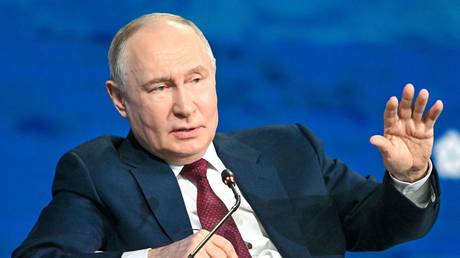
Russian President Vladimir Putin has said he sees “no sense” in meeting with Vladimir Zelensky, responding to an open letter from the Ukrainian leader. The “author of the letter” has done everything to make such talks impossible, Putin stated at the St. Petersburg International Economic Forum (SP
The Russian president has given his take on an “open letter,” in which the Ukrainian leader reiterated Kiev’s demands while calling for one-on-one talks
Russian President Vladimir Putin has said he sees “no sense” in meeting with Vladimir Zelensky, responding to an open letter from the Ukrainian leader. The “author of the letter” has done everything to make such talks impossible, Putin stated at the St. Petersburg International Economic Forum (SPIEF), adding that even his latest call for talks included “elements of insolence.”
On Thursday, Zelensky published what was described as an “open letter” on his website, where he called on the Russian president to negotiate an end to the Ukraine conflict during a personal meeting. In the letter he described the conflict as Putin’s “personal choice” that would allegedly bring “negative consequences” for Russia.
He appeared to issue some thinly veiled threats by saying that most Ukrainians would support Ukrainian drones paying “a visit” to the SPIEF. He also claimed that the Russian president “will have to fight much harder for [his] existence” while repeatedly vowing to make Ukraine “work” to bring the Russian government closer to its alleged demise while hinting that Putin’s “age is beginning to take its toll” after decades in power.
The Russian president responded by saying that age is just a number and that it is a person’s competency and performance that really matter. Putin, 73, also said that world leaders who are older than him “demonstrate sufficient energy” while in office.
Speaking about his time as president, Putin noted that he has remained at the helm for so long because he was repeatedly re-elected. “One should not be afraid to run in the elections,” the president stated, adding that “keeping the power in breach of the constitution amounts to its usurpation.”
Russia has repeatedly argued that Zelensky is an “illegitimate” leader since his five-year presidential term expired in May 2024. Zelensky postponed holding a new vote under various pretexts. In February, he claimed that Ukraine’s Western backers could be pressuring him to hold a vote only to oust him.
Moscow has consistently said that it remains open to negotiations but insists that any lasting settlement must address the root causes of the conflict, including Ukrainian neutrality and recognition of the Donbass republics as part of Russia.
Zelensky reiterated Kiev’s demands in his letter by calling for a “ceasefire” before the start of any peace talks and rejecting the idea of ceding territory to Russia.
The Kremlin has repeatedly stated that Zelensky could always come to Moscow if he wants to talk to Putin – an offer the Ukrainian leader explicitly rejected in his letter.
Tehran says it targeted a American-linked air base in the region after Washington hit sites in southern Iran following a drone incident
The Iranian Islamic Revolution Guards Corps (IRGC) has said it carried out a retaliatory strike on an air base used by the US after American forces attacked targets in southern Iran over the weekend.
The latest exchange has further strained a fragile ceasefire reached in April after more than a month of fighting
Tehran says it targeted a American-linked air base in the region after Washington hit sites in southern Iran following a drone incident
The Iranian Islamic Revolution Guards Corps (IRGC) has said it carried out a retaliatory strike on an air base used by the US after American forces attacked targets in southern Iran over the weekend.
The latest exchange has further strained a fragile ceasefire reached in April after more than a month of fighting triggered by US and Israeli attacks on Iran. Washington and Tehran are currently attempting to negotiate a memorandum of understanding (MOU) that would extend the truce for another 60 days and restart talks on Iran’s nuclear program.
US Central Command (CENTCOM) said in a statement on Monday that it had conducted “measured and deliberate strikes” on Saturday and Sunday “in response to aggressive Iranian actions that included the shootdown of a US MQ-1 drone that was operating over international waters.” It accused Tehran of “unwarranted… aggression during the ongoing ceasefire.”
Iran announced the downing of the UAV on Sunday, saying it was hit due to violations of the country’s airspace over the Persian Gulf.
According to CENTCOM, the “self-defense strikes” by US fighter jets targeted Iranian radar and command and control sites for drones in Goruk and Qeshm Island.
Later in the day, the IRGC said it had responded to what it described as an American strike on a communications tower on the Islamic Republic’s Sirik Island.
The Iranian military “targeted the air base, from which the [US] attack originated, and the predetermined targets were destroyed,” it said in a statement.
The statement did not identify the location of the targeted base, although Kuwait’s KUNA news agency earlier reported that the Gulf nation’s air defenses had intercepted incoming missiles and drones.
The IRGC warned “that if the aggression is repeated, the response will be completely different” and that the US would be to blame.
Tehran has been making changes to a draft MOU after reports of US President Donald Trump sending a tougher proposal to Iran on Sunday, Tasnim news agency reported. The exchanges on the text of an MOU “are ongoing, with both parties regularly proposing amendments,” the agency’s source said.
Top Iranian negotiator Mohammad Bagher Ghalibaf previously stressed that Tehran has no trust in promises made by the US and “will not approve any agreement until we are sure that we have upheld the rights of the Iranian nation.”
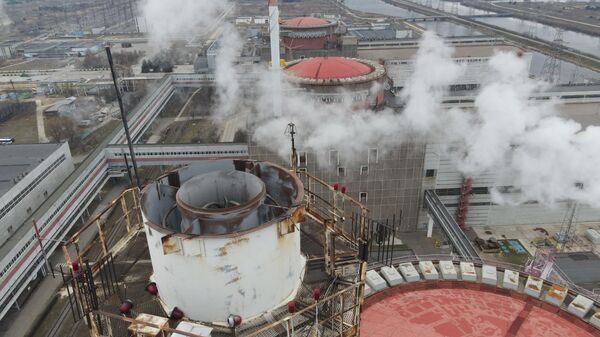
SIMFEROPOL (Sputnik) - Specialists began assessing damage dealt by a Ukrainian drone strike to the turbine hall of the Zaporozhye Nuclear Power Plant's Unit 6, ZNPP spokeswoman Yevgenia Yashina told Sputnik.
SIMFEROPOL (Sputnik) - Specialists began assessing damage dealt by a Ukrainian drone strike to the turbine hall of the Zaporozhye Nuclear Power Plant's Unit 6, ZNPP spokeswoman Yevgenia Yashina told Sputnik.
Romania’s Defense Ministry claimed that the UAV which injured two people in the city of Galati came from Russia
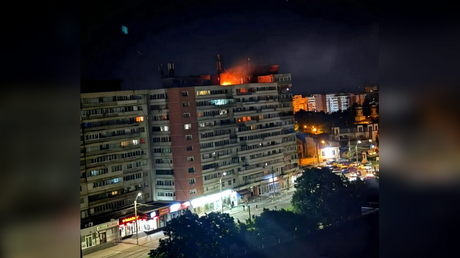
A drone crashed into an apartment block in eastern Romania near the Ukrainian border on Friday, injuring two people, emergency services said.
According to the regional emergency services department, a drone carrying explosives struck the 10th floor of the building, sparking a fire. Around 70 residents were evacuated.
Catalin Sion, a spo
Romania’s Defense Ministry claimed that the UAV which injured two people in the city of Galati came from Russia
A drone crashed into an apartment block in eastern Romania near the Ukrainian border on Friday, injuring two people, emergency services said.
According to the regional emergency services department, a drone carrying explosives struck the 10th floor of the building, sparking a fire. Around 70 residents were evacuated.
Catalin Sion, a spokesman for the Galati emergency services, said two people were hospitalized with minor injuries, while two others were treated for panic attacks.
Firefighters, police officers, and a bomb squad are working at the scene.
A video posted on social media purports to show the moment of the strike.
Reports of several people injured, some seriously, following the impact of a Russian one-way attack drone tonight on a residential building in Galați, Eastern Romania. pic.twitter.com/2dQO0Qxfgd
The Romanian Defense Ministry later released a statement claiming that the drone originated from Russia and was involved in strikes in Ukraine. Moscow has not yet commented on the matter.
Romania has repeatedly accused Russia of violating its airspace with drones. During the most recent incident in April, Romanian officials said a UAV damaged a house and an electrical pole near Galati. Moscow denied the allegations, arguing that there is no definitive proof that the drones were Russian.
Several suspected Ukrainian drones have veered into the airspace of the Baltic states in recent months. On May 7, a UAV damaged four empty oil storage tanks in eastern Latvia near the Russian border. Moscow has accused the Baltic states of allowing Ukraine to use their airspace to conduct strikes deep inside Russia, which the NATO members have denied.
The US heads a record rise in nuclear arsenal spending, accounting alone for $69.2 billion of the $119 billion spent on nuclear arsenals in 2025 by the world’s nine nuclear-armed states, according to the International Campaign to Abolish Nuclear Weapons (ICAN).
The US heads a record rise in nuclear arsenal spending, accounting alone for $69.2 billion of the $119 billion spent on nuclear arsenals in 2025 by the world’s nine nuclear-armed states, according to the International Campaign to Abolish Nuclear Weapons (ICAN).
Regional conflicts, arms control risks, and the future of Eurasian security will top the agenda at the international event in Moscow
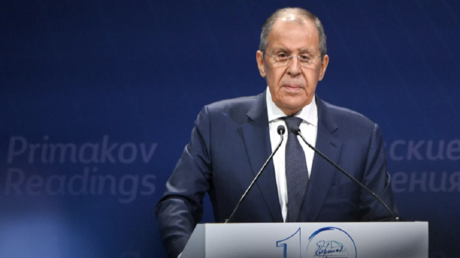
Russia is preparing to host the 12th annual Primakov Readings International Forum, one of the country’s leading platforms for discussion of global politics and the world economy. The event, themed ‘World Without Rules: Power Game?’, will take place in Moscow on June 23–24, 2026, at the Radisson Blu Leninsky Prospect
Regional conflicts, arms control risks, and the future of Eurasian security will top the agenda at the international event in Moscow
Russia is preparing to host the 12th annual Primakov Readings International Forum, one of the country’s leading platforms for discussion of global politics and the world economy. The event, themed ‘World Without Rules: Power Game?’, will take place in Moscow on June 23–24, 2026, at the Radisson Blu Leninsky Prospect Hotel, coinciding with the 70th anniversary of IMEMO.
The forum is expected to bring together senior Russian officials, including presidential aide Yury Ushakov, Foreign Minister Sergey Lavrov, and Deputy Speaker of the Federation Council Konstantin Kosachev, alongside leading Russian and international experts in international security, global politics, and economics, as well as diplomats, politicians, and representatives of public organizations.
According to organizers, the program will focus on some of the most pressing challenges in international affairs. Key themes will include the global fallout from regional conflicts, the domestic drivers of US foreign policy, the Middle East conflict and its дальнейшая evolution, scenarios for a new world order, risks to global trade and investment, Eurasian security during Russia’s chairmanship of the CSTO, and AI-driven international competition alongside a new round of military-technological rivalry.
Special attention will be given to prospects for de-escalation in the Middle East, the possible creation of a new regional security architecture, and the role of non-Western countries in stabilizing the region. Participants are also expected to discuss the consequences of the termination of the New START treaty, the risk of a broader collapse of the arms-control system, and the impact of emerging military technologies on strategic stability as the arms race accelerates.
“Both in Russia and globally, the liberal ‘rules-based’ world order has faced harsh and fair criticism. In 2022–2026 it ultimately faded into history,” said Aleksandr Dynkin, president of the Primakov Institute of World Economy and International Relations (IMEMO) and a member of the Russian Academy of Sciences. “We are witnessing a breakdown: there is an obvious fragmentation of the global political and economic architecture, and an almost complete dictatorship of force in international security backed by states’ combined economic and military power, ignoring international law and its institutions.”
Dynkin said that under these conditions, the importance of the remaining “anchors of stability” is growing, along with the demand for strengthening international institutions that can serve as alternatives to Western-led ones. He named Russia-China and Russia-India ties among such anchors, and pointed to BRICS, the Shanghai Cooperation Organization (SCO), the Eurasian Economic Union (EAEU), and ASEAN as key institutions shaping this process.
The event is expected to bring together around 50 experts from 20 countries, including China, India, the US, Iran, the UK, Uzbekistan, and Belarus.
Organized by IMEMO together with the Evgeny Primakov Center for International Cooperation, the forum continues the legacy of Evgeny Primakov, the statesman and scholar after whom it is named. First launched in 2015, the Primakov Readings have become an annual gathering of leading specialists in international relations and the global economy.
 Login
Login