Normal view

Received yesterday — 14 May 2026 The Conversation – Articles (US)

Who shops at farmers markets in the US?

People who shop at the more than 8,700 farmers markets operating in the U.S. either year-round or seasonally generally fall into six distinct groups. Three of them are more interested in farmers markets than the others. I study local food systems as a strategic communications scholar, and that’s the main takeaway from a study that I conducted with several colleagues.

As we explained in the March 2026 edition of British Food Journal, people who fall into those groups have different levels of interest in farmers markets but also have some things in common. Most people who shop at them are motivated to go because they want healthy, fresh food, they support local farmers and they think going to the farmers market is fun.

This is not a niche activity. An earlier study I worked on found that 81% of U.S. adults said that they shop at a farmers market at least once a year.

For both studies, we pulled survey data from a nationally representative sample of 5,141 U.S. consumers that was conducted Aug. 2-11, 2023. It had a margin of error of plus or minus 1.8 percentage points.

Researchers define farmers markets and local food in different ways. So we asked respondents to simply think of farmers markets as places where they can buy food directly from more than one vendor and where all or most of the items are locally grown, raised or made. We defined local food as being grown in their state or 250 miles or less from their homes.

Highly engaged, health-focused and emerging interest

We determined that about 18% of those surveyed are “highly engaged” farmers market shoppers. They care a lot about food and enjoy buying, preparing and eating fresh food. They are excited about many aspects of farmers markets, which are places where this group shops for a variety of reasons, such as supporting local farmers, buying nutritious, delicious food and connecting with community.

Nearly 65% of these shoppers were women. This group was the most diverse, with 27% of respondents identifying as Hispanic, 20% Black and 4% multiracial. They also had significantly lower average annual household incomes than other groups, averaging US$40,000-$50,000.

We found that another 18% of the people surveyed were “health-focused.” Like the highly engaged shoppers, they make buying and eating healthy food a high priority. However, this group doesn’t enjoy cooking as much. The health-focused group tends to avoid genetically modified foods, as well as convenient options like takeout food, frozen dinners and microwave-ready meals.

About 58% of them were women and their average age was 57, making them the oldest of the groups. Roughly 70% of the health-focused group was white, making it less diverse than the highly engaged group but more diverse than some of the other groups.

Finally, about 19% of the respondents were what we called “emerging interest” farmers market shoppers. They value convenience and learning about food. This group was the most likely to see going to the farmers market as a fun activity.

Emerging interest shoppers were nearly evenly split by gender, with 52% women. Their average age was 44 years old, making them the youngest of the groups.

People buy vegetables from a farmers market vendor
It’s not always a love of radishes that draws shoppers to these stalls. Lev Radin/Pacific Press/LightRocket via Getty Images

Convenience, practicality and happenstance

We also identified three groups of consumers who were less interested in farmers markets than the highly engaged, health-focused and emerging interest shoppers, even if some of them do occasionally shop at the markets anyway.

About 16% of farmers market shoppers are people we identified as “convenience” shoppers. They are more likely to eat frozen dinners and buy takeout. They rarely cook meals from scratch using produce and other fresh ingredients.

About 43% of them say they never or rarely shop at a farmers market. Around 59% of them are men and 37% are people of color.

A vendor sells prepared foods at a market stall.
Tashana Small sells mac and cheese ‘cupcakes’ topped with pulled pork, Buffalo chicken tenders and Cajun shrimp at a farmers market on Long Island in 2023. Erica Marcus/Newsday RM via Getty Images

Roughly 17% of these shoppers fall into a “practical” category. They methodically plan their grocery shopping and are among the least interested in farmers markets, with more than half saying that they either rarely or never shop at them.

Practical consumers were close to evenly split by gender; 53% were women. Their income tended to be the highest of the groups, typically in the $60,000-$75,000 range.

We called the 12% of the shoppers in the final group we surveyed “uninvolved.” This group showed very little interest in farmers markets or any other food-related activities. About 3 in 4 rarely or never go to farmers markets. Nearly 70% of uninvolved farmers market shoppers were men and 76% were white.

When someone in the uninvolved group goes to a farmers market, they may be going out of happenstance or because someone in their life wants them to go – not due to any personal interest.

If you forget, you’ll miss it

We believe this information could help farmers markets better serve their customers and perhaps attract more shoppers.

People can, of course, go to farmers markets for more than one reason, and not everybody fits neatly into one of these categories. And everyone we surveyed had something in common: Forgetting to go was the biggest reason shoppers of all kinds didn’t make a trip to the farmers market in a given week.

The Conversation

Bret Shaw's work tied to this article was supported by the U.S. Department of Agriculture National Institute of Food and Agriculture (USDA NIFA, award no. 2023-68006-38984).

A ‘super El Niño?’ Why it’s too early to forecast one with certainty, but not too soon to prepare

El Niño can mean a rainy U.S. Southwest, warmer winters in the North and less Atlantic hurricane activity – but not always. Bill Tompkins/Getty Images

Talk of a “super El Niño” developing in 2026 is gaining momentum, with concerns rising that this climate pattern could bring extreme rainfall, heat, drought and destructive flooding around the world.

The signals appear to be in place: The tropical Pacific is warming along the equator, and computer models point toward extreme conditions by the end of the year.

However, forecasting El Niño is not like predicting next week’s weather. Forecasts for El Niño typically aren’t reliable before late spring – not because scientists don’t understand the system, but because we understand its limits.

A global map showing a streak of high ocean temperatures off South America in the Pacific along the Equator.
Sea surface temperature data on May 12, 2026, shows warming along the equator west of South America, often a sign that El Niño conditions are developing. NOAA Coral Reef Watch

As an ocean-atmospheric scientist who studies El Niño, I spend a lot of time thinking about what scientists can forecast confidently – and what remains uncertain. Here’s what we know about the current event, what we still don’t, and why many regions should begin preparing now, even if a strong, or “super,” El Niño never fully materializes.

Why is El Niño hard to forecast in spring

The starting point for any El Niño forecast is the heat stored beneath the surface of the eastern equatorial Pacific Ocean. Computer models use data about those conditions to simulate how ocean temperatures will evolve over the coming months, and how they affect weather patterns around the world.

Right now, an exceptionally large reservoir of warm water sits beneath the surface there. In principle, this ocean heat should be a reliable signal of El Niño developing. In practice, what happens next depends heavily on what the atmosphere does.

The warm reservoir was shaped by a burst of wind activity in early 2026. Normally, the Pacific trade winds blow from east to west along the equator, pushing warm water toward Asia and leaving cooler water near South America. But in April, a pair of cyclones straddling the equator caused the wind direction to reverse. This short-lived reversal triggered a downwelling Kelvin wave – a pulse of energy beneath the ocean surface moving eastward along the equator.

That subsurface pulse has now reached the eastern Pacific, helping fuel intense warming off South America. At the ocean surface, this can resemble the early stages of a strong El Niño.

But there is a catch.

For El Niño to develop fully, the ocean and atmosphere need to lock into a feedback loop: Warmer surface waters weaken the trade winds, triggering more downwelling Kelvin waves that push warm water eastward and reinforce the warming. But that loop doesn’t engage automatically. It requires repeated bursts of eastward winds to sustain the process.

Until that feedback loop takes hold, the ocean-atmosphere system is in an unpredictable phase. It might tip into a super El Niño. It might not.

Spring is precisely when forecasts are most uncertain. Impressive early signals can fade if the winds don’t cooperate.

A line chart shows the relative oceanic Nino index, tracking sea surface temperature anomalies compared to average.
El Niño forms when surface temperatures in the tropical Pacific Ocean are about 0.5 degrees Celsius (0.9 Fahrenheit) warmer than normal for three months. A strong El Niño has temperatures over 1.5 C (2.5 F). The chart shows the Relative Oceanic Niño Index (RONI), a three-month running average that accounts for the background warming trend. Some forecasts still rely on the Oceanic Niño Index, based on absolute temperatures, which can overstate El Niño’s strength in a warming climate. NOAA

There’s a further complication: When models detect strong subsurface warming, they can simulate a stronger feedback loop than actually develops.

The result is that models can look too confident – even alarming – despite the system not being locked in. As of mid-May 2026, the wind patterns needed to amplify the warming have not clearly emerged.

We’ve seen this scenario play out before. In both 2014 and 2017, forecast models were pointing toward strong El Niño conditions by midyear. In both cases, the anticipated wind patterns never fully materialized and El Niño either stayed weak or returned to a neutral state. The early signals were real, but the expected follow-through didn’t happen.

So what do the forecasts suggest?

The current forecasts for 2026-27 still span a wide range in mid-May – from expecting weak to strong El Niño conditions.

How the winds behave in the coming weeks will determine what develops. If trade winds weaken again at the right moment, it could tip the system into self-sustaining warming – the kind that’s hard to stop.

As of mid-May, long-range weather forecasts weren’t showing strong eastward wind bursts on the horizon that could strengthen El Niño. In fact, quite the opposite was expected for the second half of May: a burst of winds blowing in the opposite direction. A full month without major eastward wind activity would be a meaningful brake on ocean warming.

The Pacific has loaded the dice for El Niño, and the National Oceanic and Atmospheric Administration’s May outlook reflects elevated odds of El Niño developing and potentially strengthening later in the year. By NOAA’s mid-June update, the picture should be substantially clearer.

El Niño intensity matters for weather worldwide

The difference between a weak El Niño and an extreme one is not subtle. It reshapes climate patterns across the globe – and with them, real-world risks.

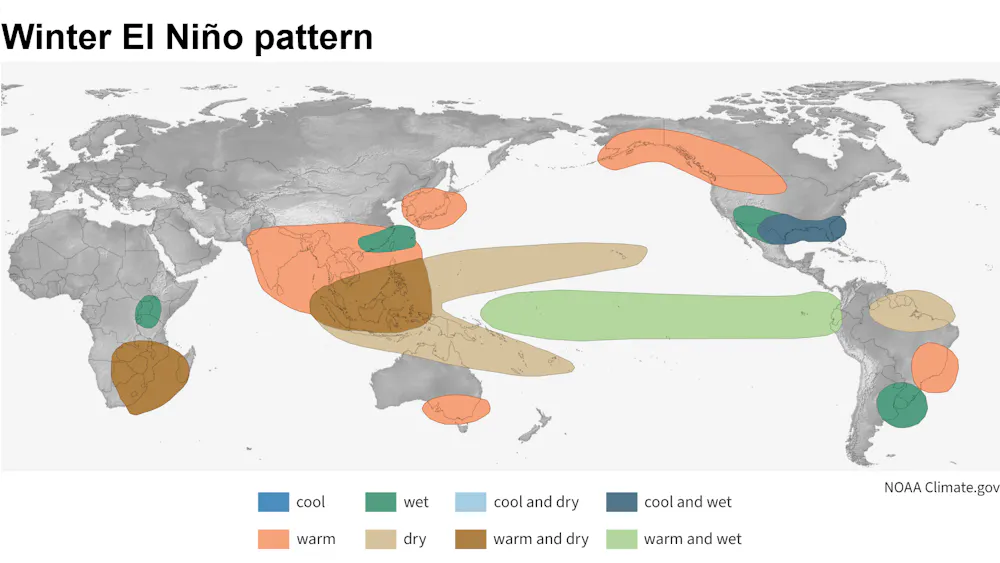
If El Niño intensifies into a strong or “super” event, it can drive drought in the Amazon, fires in Indonesia, flooding in Peru and heavy rainfall in parts of California and southern South America. These effects could materialize by the Northern Hemisphere winter, when El Niño typically peaks.

A world map shows cool, wet conditions across much of the southern U.S., warmer in the Northwest through Canada and Alaska.
How El Niño tends to affect the weather and climate around the world. El Niño’s affects vary based on many factors, so not every El Niño year will look exactly like this. NOAA

In some regions, the stakes are immediate.

In India, the monsoon rains, which support agriculture and water supplies for hundreds of millions of people, have historically weakened during strong El Niño events. Even modest shifts in monsoon strength can bring food and water shortages, and harm economies.

At the same time, when El Niño is strong, hurricane activity in the Atlantic is typically suppressed – a rare upside – while the eastern Pacific often becomes more active with storms.

NOAA scientists explain how El Niño affects weather across the U.S.

El Niño can even push global temperatures temporarily higher, as changes in cloud cover and the amount of heat the ocean releases alter the planet’s energy balance.

In contrast, a weak El Niño produces far more muted effects. This is why predicting intensity matters.

Using uncertain forecasts in real-world decisions

Because El Niño forecasts deal in probabilities, deciding how to prepare for the seasons ahead should be based on managing risk – not waiting for certainty.

El Niño’s impact does not occur everywhere at once. Some effects emerge quickly. Its impact on the Indian monsoon and Atlantic hurricane activity unfold over the summer and early fall.

Other impacts arrive later, toward the end of the year when El Niño peaks, bringing extreme rainfall to parts of South America between November and January. In Southeast Asia, scorching heatwaves often emerge even later, in April of the following year.

In regions like India, decisions about how to respond to El Niño risks cannot wait for more certainty. Communities need to prepare their water infrastructure now in case El Niño means the monsoon season brings too little rain.

Even where forecasts suggest reduced risks – such as a quieter Atlantic hurricane season – it would be a mistake to assume safety. Destructive hurricanes still hit in otherwise quiet years.

The Conversation

Pedro DiNezio receives funding from NSF and NOAA. He is affiliated with the ATLAS Institute at the University of Colorado.

How much is a bat worth? Protecting these tiny insect-eaters isn’t just good for farms – their deaths cost taxpayers and the wider economy

A healthy bat hangs in a cave, resting up to eat its weight in bugs at dusk. Liz Hamrick/TVA

Most Americans tend to think about bats only around Halloween, but the U.S. economy benefits from these furry flying mammals every day.

Bats pollinate plants, including many important food crops, when they stop by flowers to drink nectar. Their guano is mined from caves for fertilizer. And they eat a lot of bugs – the kinds that bother people (think mosquitoes) and others that destroy crops that humans depend on for food.

Sadly, bat populations are declining rapidly in North America. A driving force is a fungal disease known as white-nose syndrome, which has spread among bats throughout the United States. When a bat population crashes, fewer bats are around to eat bothersome insects. All those additional insects can do serious damage.

So, when bats disappear, farms become less productive, and that has broad implications for the agricultural economy, human health, rural governments and even financial markets.

Bats love to eat the bugs that bother people

First, consider how many insects bats eat.

A reproductive female big brown bat can eat its body weight in insects every night in the summer, precisely when farmers are growing food.

Hundreds of bats fly out of a cave.
Mexican free-tailed bats head out of Bracken Bat Cave, near San Antonio, Texas, for an evening of feasting on insects. In summer, the cave is home to the largest bat colony in the world. Ann Froschauer/U.S. Fish and Wildlife Service

One of those insects is the cucumber beetle, which matures from rootworm – a scourge of U.S. cornfields. Rootworm destroys more than 340 million bushels of corn across the U.S. Midwest and South each year, even as farmers spend US$1 billion annually on pesticides to control outbreaks.

A colony of 150 big brown bats can consume 600,000 cucumber beetles in a single year. If each female cucumber beetle – assuming half are female – had 110 rootworm larvae, the typical brown bat colony would prevent the production of 33 million rootworms.

Farmers experience economic damage when rootworm concentrations exceed about 0.5 per corn plant. Typical planting densities exceed 30,000 corn plants per acre in the Midwest. Therefore, the rootworms that would have hatched could damage more than 2,000 acres of corn – if bats weren’t around to eat the cucumber beetles first.

That is a significant amount of pest control provided by bats!

The disaster known as white-nose syndrome

In the winter of 2006, the fungus that causes white-nose syndrome, the aptly named Pseudogymnoascus destructans, was first detected in the U.S. near Albany, New York.

From there, it spread across the country, infecting 12 species of bats, three of which are listed as endangered under the Endangered Species Act. A 2010 study found white-nose syndrome had killed between 30% and 99% of the bats in infected colonies.

A little brown bat with the telltale signs of white-nose syndrome, a fungal infection that saps the bats’ energy. Ryan von Linden/New York Department of Environmental Conservation

As of March 2026, the fungus causing white-nose syndrome had been detected in 47 states, reaching as far west as California, Washington and Oregon. White-nose syndrome spreads primarily through bat-to-bat contact, though humans also contribute to the spread when cave explorers carry the fungus from one cave to another.

Despite coordinated efforts by state and federal wildlife agencies to limit access to caves where bats live and slow the transmission, white-nose syndrome continues to spread rapidly. When bats get infected, they wake up early from hibernation and use more energy over the winter. This depletes their fat reserves and causes them to die of starvation, leading to plummeting populations.

Bats’ role in food production

After white-nose syndrome arrives in an area, the loss of bats has significant consequences for farmers.

Yields fall as pests consume crops. To protect their crops, farmers purchase more chemical pesticides, so their costs rise as yields decline. The estimated agricultural losses from white-nose syndrome exceeded $420 million per year as of 2017.

A bat hovers by a large flower as it feeds on nectar.
A lesser long-nosed bat (Leptonycteris curasoae) feeding on an agave blossom in Arizona, spreading the flower’s pollen in the process. Rolf Nussbaumer/imageBROKER

Greater pesticide use is also associated with human health problems that can be avoided if bat populations remain healthy.

Losing bats hurts local governments financially

The story does not stop at the farm.

Counties in all U.S. states tax agricultural land based on its “use value” – in other words, based on how profitable the land is in agriculture. Without healthy bat populations, lower profits shrink the tax base, leaving county governments with less revenue.

Those governments must respond by reducing services, raising taxes or increasing how much money they borrow – often at a greater cost of borrowing. The effect is especially pronounced in rural counties, where agriculture makes up a large share of property tax revenue.

Our recent research finds that rural county governments lost almost $150 per person in annual revenue after the arrival of white-nose syndrome. For an average-size rural county, that is nearly $2.7 million in lost revenue each year.

How losing bats can hit the bond markets

The loss of county revenue makes municipal bond investors nervous. Buying a municipal bond is a bit like lending money to the county, and the interest rate is what the county pays you for taking on that risk.

When bats disappear, the risk goes up, and the county has to pay about 11.47 hundredths of a percentage point more in interest. That may sound small, but it is 27% larger than the typical risk premium investors already demand from county governments.

The higher interest rate raises borrowing costs for county governments. For example, the borrowing costs on a typical 15-year, $1 million bond would increase by more than $33,000.

Two bats hanging in a cave.
Bats snuggle up in a cave. Liz Hamrick/TVA

Higher yields also mean lower bond prices for investors, including retirement funds. For example, our research suggests that investors would discount a $1 million bond issued by a rural county by nearly $14,000 if that county’s bats have become infected by white-nose syndrome.

Economic benefits of saving bats

The good news is that the benefits from healthy bat populations create opportunities to make money from bat conservation.

Farmers can increase their incomes. Local governments can recover property tax revenue to fund public services, such as road maintenance, health infrastructure and public schools. Bond investors can earn financial returns from healthier bat populations.

No silver bullet exists for protecting or restoring bat populations affected by white-nose syndrome, but promising efforts are underway.

A fungal vaccine is being tested by the U.S. Geological Survey and partners. Designing artificial roosts and adding cave protections can also help preserve healthy bat populations. Researchers are also working to better understand bat resistance to the disease to explore whether improving resistance alone can stabilize bat populations.

As these solutions develop, opportunities will emerge for farmers, local governments and investors to earn financial returns through bat conservation. In other words, saving bats isn’t just good ecology – it’s good economics.

The Conversation

Eli Fenichel receives funding from the Knobloch Family Foundation. He is a professor at Yale University in the School of the Environment.

Anya Nakhmurina and Dale Manning do not work for, consult, own shares in or receive funding from any company or organization that would benefit from this article, and have disclosed no relevant affiliations beyond their academic appointment.

Is AI really ‘writing’? From a priestess to philosophers, ancient authors would have said ‘no’

An ancient disk shows the priestess Enheduanna, third figure from the right, during a ritual. Mefman00/Wikimedia Commons, CC BY

I teach writing and rhetoric, but my college students and I often overlook a surprisingly complicated question: What is writing?

And can artificial intelligence really do it?

Many people think of “writing” as putting words on a page. However, even from very early on, writers have seen their craft as something more. From Enheduanna, the first named author on record, to Plato and Aristotle, writing has been portrayed and defined in ways that suggest AI may not be “writing” at all.

If not, what should we call AI text? ChatGPT and I have an idea.

Praising and pleading

Enheduanna, who lived around 2,300 B.C.E., was a powerful princess, priestess and poet of the Akkadian Empire, in what is now Iraq. She has been celebrated as the earliest known writer, though the authorship of her poems and hymns is debated.

One of her poems, “The Exaltation of Inanna,” reveals a sense of what writing is and does – portraying it as a living medium that expresses experience and shapes the future.

First, the poem praises the ancient Mesopotamian goddess Inanna, who was associated with fertility and war, among other powers. “My Lady, you are the guardian / Of all greatness,” Enheduanna says, in a translation by Jane Hirschfield.

A rectangular tablet covered with tiny, cuneiform-like text.
A tablet in the Penn Museum in Philadelphia inscribed with a copy of Enheduanna’s ‘Exaltation of Inanna.’ Masha Stoyanova/Flickr via Wikimedia Commons

That praise may be strategic. It is followed by Enheduanna’s plea to overthrow Lugal-Ane, a rebel king who she describes exiling her and taking her post at the temple of Ur. “Now I have been cast out / To the place of lepers,” she writes, describing her suffering. “Day comes, / And the brightness / Is hidden around me.”

Grieving, Enheduanna writes a new destiny. In a translation by Sophus Helle, the priestess envisions Inanna coming to her aid and “tear[ing] off this fate, Lugale-Ane.” And her pleading seems to be successful: The end of the poem depicts Enheduanna restored to her post.

In Enheduanna’s poetry, writing does not simply communicate information. It interacts with the present and changes the future. The priestess’s pleas please the goddess, move her heart, and she restore Enheduanna to her post – though historians have little evidence of whether an exile and return really happened.

But her poetry did have real-world influence, helping to create religious and political unity in the world’s first empire. For example, her writing merged the Sumerian goddess Inanna with the Akkadian goddess Ishtar, describing a single “Queen of Heaven.”

AI writing can be used to try to create change, such as by swaying someone’s political opinion. But it lacks the human emotions that make experiences like praise, gratitude and suffering possible – the emotions and motivations that make writing a living medium with real-world effects.

Transforming over informing

Two thousand years after Enheduanna, Plato and his student Aristotle offered another influential view of writing – one that complements hers.

In the “Phaedrus,” which discusses the relationship between love and rhetoric, Plato famously defines writing as a poor copy of speech. Speech’s job is to represent thoughts; thoughts, in turn, represent knowledge and truth. Similarly, Aristotle writes, “Spoken words are the symbols of mental experience and written words are the symbols of spoken words.”

A hexagonal tile shows two men in loose robes holding up a book and their hands as they debate.
A relief of Plato and his student Aristotle by Italian Renaissance sculptor Luca della Robbia. sailko/Wikimedia Commons, CC BY-SA

Even that definition marks a sharp contrast with AI, which lacks thoughts and mental experiences. Its output proceeds from data aggregation and text generation.

To understand what writing is, we also need to look at what it does. Although Plato elevates speech over writing, he suggests in “Phaedrus” that good writing may lead a learner toward truth and knowledge. Similar to Enheduanna, he employs writing as a tool for change, both inside and outside the text.

In Plato’s dialogues, characters often radically change their opinions. And today, almost 2,500 years after his death, the philosopher’s real-world impact is clear. For instance, universities and colleges today are collectively called the “Academy” because that was the name of Plato’s group, the first institution of higher learning in the West. English scholar Alfred North Whitehead famously wrote that all Western philosophy is “a series of footnotes to Plato.”

Aristotle’s voluminous works, too, show writing’s purpose transcends communication. In “Rhetoric,” for instance, he details ways to make writing persuasive. Aristotle defines rhetoric as a way of “moving souls,” not just exchanging knowledge.

For both of the Greek philosophers, then, writing is more about transformation than information.

A dark brown material with so many holes it barely holds together, printed with small text in black ink.
This second-century papyrus of Plato’s ‘Phaedrus,’ found in modern-day Egypt, was reconstructed from several fragments. Oxyrhynchus Papyri Collection/Oxford's Art, Archaeology and Ancient World Library via Wikimedia Commons

Today, however, AI tools’ popularity may make writing less dynamic and less moving. Use of AI risks a “blandification” of writing, according to a study led by computer science professor Natasha Jaques. In other words, much AI writing today lacks distinct voices, making it sound the same – which could make people’s thinking more similar, too.

‘Generwriting’

Overall, these three ancient authors agree that writing emerges from thoughts and experiences – a process that strives to create change. Enheduanna, Plato and Aristotle also agree that writing’s essence transcends the simple summaries and information transmission common to AI output today.

Although AI can generate creative texts, its writing may not “move souls” the way human writing does. Several studies show a “pro-human attribution bias” or an “AI penalty,” meaning that people prefer human writing even when AI writing is stylistically similar. People want to read what other people write, not what an algorithm pumps out.

Perhaps we need a different word for AI’s output. Common terms today include “generative content” and “synthetic text,” but I wondered if I could land on something simpler – and involve AI itself. After prompting and tweaking ChatGPT over and over, I settled on one word: “generwrite.”

Though AI is here to stay, new words may help distinguish types of text. And as Enheduanna, Plato and Aristotle remind us, there are elements of writing that may always be unique to embodied, thinking beings striving to move souls.

The Conversation

Ryan Leack does not work for, consult, own shares in or receive funding from any company or organization that would benefit from this article, and has disclosed no relevant affiliations beyond their academic appointment.

TikTok’s popular microdramas shrink TV into bite-sized chunks

Actress and writer Issa Rae speaks at the Fast Company Innovation Festival in New York in 2024. Her new microdrama, 'Screen Time,' has already garnered over 100 million views. Eugene Gologursky/Getty Images for Fast Company

Some of the hottest casting calls in Hollywood right now aren’t for Netflix, Disney or HBO.

They’re for TikTok.

In January 2026, TikTok rolled out PineDrama in the United States and Brazil, an app devoted to microdramas, also known as “verticals.”

Unlike TikTok’s traditional user-generated content, PineDrama primarily features scripted series produced by studios, production companies and media partners. These are short, serialized shows meant to be watched in one-minute increments, and they often feature melodramatic tales of romance, revenge or the supernatural.

By March, TikTok was already casting for new PineDrama series, just as professionally produced microdramas such as “Love at First Bite,” “The Officer Fell For Me” and “The Return of Divorced Heiress” were attracting millions of views on the platform.

By late April, actress Issa Rae had premiered her seriesScreen Time,” a PineDrama exclusive about a double date gone awry that has already garnered over 100 million views.

At first glance, a social media app becoming a television studio might seem like a radical shift.

But in our recently published research paper, we argue that TikTok’s move into scripted storytelling is not a break from television; it is a continuation of it. In fact, TikTok’s success can be attributed, in part, to the ways it has pulled from both the business model and programming conventions of the television industry.

A business model that looks a lot like TV

Media scholars have used the term “flow” to describe how television is experienced not as an individual program, but as a continuous stream of content. Live broadcasts, scripted shows, commercials and promos blend together into a seamless viewing experience.

TikTok recreates this dynamic, but replaces network scheduling with algorithmic curation. Ads are embedded directly into the viewing experience, appearing between videos in a way that mirrors television commercial breaks.

Advertising dollars have long fueled traditional television, which sold audiences – particularly the coveted 18-to-49 demographic – to advertisers. TikTok relies on a similar advertising model, but uses user data and algorithmic recommendation systems to curate a continuous stream of personalized content and targeted ads.

TikTok’s content has also long been shaped by other norms of the television industry.

For example, even before the emergence of microdramas, creators often produced videos as part of ongoing series, a format that encourages viewers to return for updates or to see what happens after being left with a cliffhanger. This kind of serialized storytelling is central to television.

Meanwhile, genres that originated on television – talk shows, reality shows and confessional storytelling – are everywhere on TikTok. Even though these clips are only minutes long, they often rely on cliffhangers, “Part 2” reveals, emotional confessions and recurring characters to encourage repeat viewing in ways that mirror broadcast television.

The experience of using TikTok is analogous to watching TV. Users can scroll to a new video as soon as the one they’re watching no longer entertains, much like channel surfing. At the same time, users can fall into “TikTok holes,” endlessly scrolling through videos for hours in a form of binge-watching that mirrors today’s streaming culture.

Why TikTok might succeed where Quibi failed

PineDrama may sound a bit like the failed mobile streaming service Quibi.

Launched by former Disney executive Jeffrey Katzenberg, Quibi raised nearly US$2 billion to produce short-form, mobile-first video content featuring major Hollywood stars.

But despite its high-profile launch in April 2020, the platform shut down less than a year later after struggling to attract subscribers and compete in an increasingly crowded streaming market.

Like Quibi, PineDrama centers on professionally produced short-form video designed specifically for smartphone viewing. Both platforms have attempted to merge Hollywood-style storytelling with mobile-first viewing habits.

But the comparison only goes so far.

When Quibi debuted, the market was being saturated with new streaming services. Disney+, HBO Max and NBC’s Peacock had all entered the market in late 2019 or the first half of 2020. The platform also struggled because its content was locked behind a paid subscription model. Furthermore, it lacked the social sharing and algorithmic discovery mechanisms that have helped apps like TikTok thrive.

People wearing masks in a subway station walk past an advertisement featuring a young woman and the text 'quick bites, big drama.'
The rise and fall of the streaming app Quibi serves as a cautionary tale, but there’s still an appetite for microdramas. Alexi Rosenfeld/Getty Images

TikTok, on the other hand, has a much stronger track record of innovation, investment and resilience. It has survived repeated attempts to ban or restrict the app in the United States. Its parent company, ByteDance, was reportedly valued at roughly $550 billion in early 2026, giving TikTok enormous financial resources to invest in new ventures like PineDrama. And it doesn’t have to build an audience from scratch, since it can take advantage of its own massive, preexisting user base on the TikTok app. Through sponsored posts and algorithmic recommendations, the company can direct its TikTok users to PineDrama’s microdramas.

Microdrama apps such as ReelShort, DramaBox and ShortMax have already demonstrated that audiences are willing to spend time and money on this emerging form of entertainment. TikTok’s advantage lies in its ability to integrate microdramas into its preexisting social media ecosystem.

The Conversation

Jessica Maddox is affiliated with the American Influencer Council and the academic journal Creator & Influencer Studies.

Krysten Stein is affiliated with the American Influencer Council and the academic journal Creator & Influencer Studies.

Will future missions to the Moon be sustainable? It may depend on whom you ask

Earth draws closer to passing behind the Moon in this image captured by the Artemis II crew during their lunar flyby. NASA

There’s a new space race to the Moon, and this time the ambitions are not just to visit but to stay. NASA’s Artemis program aims to establish a long-term human presence on the lunar surface in the 2030s. China, India, Japan and a number of private companies all have lunar mission programs of their own.

As of now, the human footprint on the Moon is small. That could change with the planned increase of lunar missions.

National space agencies are focused on science and exploration, while private companies aim to develop a lunar economy – potentially with mining operations. In the coming years, these groups will test technology and build some initial infrastructure on the Moon. From 2030 onward, Moon bases could become a reality.

But what are the long-term consequences of lunar missions for the Moon itself? The Artemis program’s goals are sustainable exploration and setting up a sustainable presence on the Moon. However, sustainability is a broad concept with a variety of definitions and uses when it comes to space exploration. As a sustainability scholar, a space systems engineer and a planetary scientist, we’ve been trying to pin down what sustainability means in a lunar context.

The delicate lunar environment

Unlike Earth, the Moon has no biodiversity, climate as we typically think of it, or oceans. But it does have its own active environment. While the Moon may seem unchanging and indestructible, it is surprisingly sensitive to human activity. Without the wind, water or other natural forces that reshape the Earth, things that happen on the Moon tend to leave a mark – sometimes for thousands, or even millions, of years.

When a rocket lands on the Moon, its engines blast the surface with exhaust gases and send fine dust particles flying at enormous speeds. A single landing by a large modern spacecraft, such as SpaceX’s Starship, could disturb an area of the lunar surface two to five times larger than the Apollo missions did in the 1960s and 1970s.

Some of those ejected dust particles can travel tens of miles across the surface, and the finest grains can reach the Moon’s orbit, potentially threatening other spacecraft. Images from satellites in lunar orbit show that changes to the uppermost layer of the surface from a single landing can remain visible for decades.

Landings can also release water vapor, carbon dioxide and other gases into the lunar exosphere – an extremely thin layer of atoms hovering above the surface – and create a temporary atmosphere.

And all these effects can come from just one mission. Future missions will focus on the polar regions, which have ideal spots for collecting solar energy atop peaks, as well as water in the form of ice in craters. Scientists don’t yet understand what the cumulative effects of the dozens of missions planned over the coming decade on the lunar environment – its surface, its thin atmosphere and its scientifically precious polar regions – will be, and whether they’re reversible.

A close-up view of an astronaut's bootprint in the lunar soil.
Without weather, footprints from human missions to the Moon last much longer than on Earth. NASA

The concept of sustainability

On Earth, the concept of sustainability balances protecting the environment, maintaining economic well-being and caring for society – current as well as future generations.

But what does sustainability mean on the Moon? To find out, we sent out a survey asking people with a demonstrated interest in space and lunar exploration to define sustainability in this new context. We received 277 complete responses from academics, space industry professionals, space agency staff and engaged members of the public.

We found that people mean very different things when they talk about lunar sustainability – and those differences often track closely with who they are and where they work.

People working in the space industry tended to think about sustainability in financial and operational terms: keeping missions affordable, making infrastructure reusable, and developing the Moon’s resources to support a self-sustaining economy.

Academics, on the other hand, related lunar sustainability to environmental and ethical concerns more frequently. A significant portion of all respondents – roughly 1 in 5 – were opposed to large-scale human activity on the Moon altogether. Their responses echoed a “leave no trace” philosophy: Don’t disturb natural conditions, don’t commercialize what belongs to all of humanity, and don’t plant flags in places that shouldn’t be owned.

The majority of respondents fell somewhere in between, calling for a careful balance of scientific, commercial and environmental interests.

The Apollo 15 lander sitting on the surface of the Moon, with a panoramic view of the dusty, rocky lunar landscape.
Human activity, from robotic landers to crewed missions – such as Apollo 15, shown here – has the potential to reshape the surface of the Moon. NASA

A continuing conversation

This diversity of perspectives on what sustainability means on the Moon is not a surprise. Even for the Earth, people do not have a universally agreed-upon perspective.

However, the shared cultural significance of the Moon calls for conversations between many groups of people, from space agencies to communities living near rocket launch sites, and from space industry professionals to amateur lunar enthusiasts.

The Moon has always been Earth’s closest celestial companion in our planet’s journey through space. As it becomes a destination for space agencies and some companies, the decisions made now will shape what the lunar surface looks like, and what the Moon means to people, for generations to come.

Some of those decisions may be irreversible. Researchers are only beginning to explore the cumulative effects of human activity on the lunar environment. And policymakers are even further behind in developing the governance frameworks needed to make collective decisions about it.

The conversation about what sustainability means for lunar missions is becoming increasingly relevant as plans for lunar bases move forward.

The Conversation

Marco A. Janssen received funding from NASA.

Afreen Siddiqi received funding from NASA.

Parvathy Prem receives funding from NASA.

Astrophysicists use ‘space archaeology’ to trace the history of a spiral galaxy

This artist's impression shows the spiral galaxy NGC 1365 colliding and merging with a smaller galaxy. Melissa Weiss/CfA

Billions of years ago, a young spiral galaxy began to grow in a crowded part of the universe. It pulled in gas and small companion galaxies, slowly building up the bright central region and sweeping spiral arms we see today.

In a new study published in March 2026, my colleagues and I used this galaxy’s chemical fingerprints to reconstruct its life story in detail.

Astronomers want to know how spiral galaxies like our own Milky Way came to be, as these galaxies can give us hints about how the elements we rely on, such as oxygen, were created and spread through space over time.

Space archaeology

Like archaeologists sometimes use slices of earth to to turn back the clock and study the Earth’s natural history, we used slices of data of the galaxy’s chemical makeup from different periods in time, alongside sophisticated galaxy evolution models. Together, the data helped us piece together how it formed and grew over 12 billion years.

The galaxy, called NGC 1365, lies relatively nearby, in cosmic terms, and is tilted so we see its spiral disk face-on. Using the du Pont telescope at Las Campanas Observatory in Chile, we mapped oxygen across thousands of star-forming gas clouds.

We then searched through simulations of about 20,000 model galaxies and found one that very closely matched NGC 1365. We looked at a host of factors while matching up the simulations, including the abundance of heavy elements, including oxygen. We used the model to rewind the history of the galaxy and predict how it likely grew over time and merged with other galaxies.

Galaxies form when gravity and dark matter pull material together into their center.

Looking for heavy elements

Heavy elements are forged in stars and released in powerful supernova explosions within galaxies. Over time, this process builds up a traceable record that scientists can look for in the gas – like how archaeologists look for certain key elements in layers of soil.

Research has shown that the center of a galaxy usually ends up richer in heavy elements, while the outer regions have less. That pattern carries clues about when stars formed, how gas flowed in and out, and how often the galaxy collided and merged with others.

For the galaxy NGC 1365, we found that its central region likely formed early in its lifespan and quickly became rich in oxygen. Its outer disk, however, grew more slowly. Over billions of years, the galaxy probably collided with smaller dwarf galaxies, which brought in fresh gas and stars and helped build up the outer spiral arms. A lot of the gas now in the edges of the spiral arms likely arrived relatively late in the galaxy’s life.

Our work is some of the first to use such a detailed “chemical archaeology” technique outside our own Milky Way galaxy. By tying new, super-fine resolution observations directly to state-of-the-art simulations, we’ve opened up a new way to study how distant galaxies assembled over cosmic time.

Unanswered questions

We can reconstruct a history for NGC 1365 using both our simulations and observational data. But some details remain uncertain. Different combinations of gas flows and mergers can sometimes leave similar chemical patterns. We also don’t know yet whether NGC 1365’s life story is typical for large spiral galaxies, or whether it is unusual in ways that aren’t clear to us yet.

A few key things we have yet to uncover include: Do most spiral galaxies build their centers early and their outer disks slowly, as NGC 1365 appears to have done? How much do galaxy mergers versus gas inflow contribute to a galaxy’s growth? And, perhaps most interestingly, how does the history of NGC 1365 compare to that of our own Milky Way?

The Conversation

Lisa Kewley has previously received National Science Foundation and Australian Research Council grants but they did not support her role in this research project.

Why a growing number of Trump supporters are experiencing voter’s remorse

Phoenix residents watch presidential candidate Donald Trump speak at the Republican National Convention on July 18, 2024. AP Photo/Ross D. Franklin

In recent months, some prominent conservatives and erstwhile allies of President Donald Trump – former U.S. Rep. Marjorie Taylor Greene and journalist Megyn Kelly, for example – have voiced their displeasure with him on several issues. They range from Trump’s handling of the Iran war and the economy to the release of information concerning his relationship with convicted sex offender Jeffrey Epstein.

Most notably, political commentator Tucker Carlson, once one of Trump’s most stalwart loyalists, expressed remorse for his previous support for the president, declaring in April 2026, “It’s not enough to say, well, I changed my mind – or like, oh, this is bad, I’m out.” Carlson said he will be “tormented” by his support for Trump “for a long time” and that he is “sorry for misleading people.”

Growing unease with the Trump administration among these former allies comes amid some of the worst polling of Trump’s career. According to data compiled by pollster G. Elliott Morris, Trump’s popularity has been steadily declining over the past year. Americans are seriously questioning his handling of key issues, such as inflation, immigration, jobs and foreign affairs.

But beyond former prominent Trump allies, are there other Trump supporters having second thoughts about their votes in the 2024 presidential election? To answer this question, we conducted a nationally representative poll of 1,000 U.S. adults who were recruited from an online panel maintained by YouGov, a survey research firm.

We asked self-identified Trump voters about their votes in the 2024 election. Our results suggest that a growing number of them – especially moderates, African Americans and young people – are experiencing voter’s remorse.

A hand picks up a sticker off a table.
In our poll, roughly one-third of political moderates and African Americans who voted for Trump in 2024 said they would vote otherwise if the election were held again. AP Photo/George Walker IV, File

Support for Trump remains strong

To be clear, our survey shows that most Trump voters remain in the president’s camp.

We found that 84% of 2024 Trump voters say they would vote for Trump if given the chance to vote again in the 2024 election. That’s down 2 percentage points since we previously asked this question in July 2025.

Over 90% of members of Trump’s core base of voters – including 93% of self-identified Republican Trump voters, 95% of self-identified conservative Trump voters and 92% of Trump voters over age 55 – said they would vote for Trump as they did in 2024 if given a second chance.

Regretful Trump voters

But some groups of Trump voters are having second thoughts. The most regretful are those with whom Trump made significant gains in 2024. They include political independents, African Americans, younger people and those with more education.

Roughly 3 in 10 2024 Trump voters who identify as political moderates and African Americans said they would vote differently if the election were held again. And roughly a quarter of young and middle-aged Trump voters also suggested they would not vote for Trump if they could redo their 2024 vote.

Twenty percent of Trump supporters with postgraduate degrees expressed a reluctance to vote for Trump if given a second opportunity. Voters with some college experience and those making less than $40,000 annually reported the same sentiment in similar percentages.

Perhaps most politically perilous, 31% of independents who voted for Trump in 2024 would not vote for him again in an election do-over.

Several people wearing baseball hats watch a man speak on TV.
New York City residents watch Donald Trump speak as votes are tallied for the presidential election on Nov. 6, 2024. Fatih Aktas/Anadolu via Getty Images

Cracks in the coalition

What is pushing Trump voters away from the president?

There is no single cause, but our results suggest that negative perceptions of Trump’s performance on high-profile issues are playing a big role. A substantial portion of Trump voters who give the president a negative grade on the economy (22%), the Epstein files (37%) and the Iran war (49%) say they would not vote for him in an election redo.

Our results suggest that cracks are forming in the Trump coalition and that they are concentrated among the groups that before 2024 were less likely to vote for the president.

Trump may take solace in the continued loyalty of his strongest supporters. But in a close election every vote counts, and lingering dissatisfaction could undermine Republicans’ ability to mobilize key swing voters.

As Republicans face the electorate in upcoming midterms, Trump and the GOP will have to work to reclaim the support of regretful voters. Failure to do so could cost Republicans Congress in 2026 and, ultimately, the presidency in 2028.

The Conversation

Jesse Rhodes has received funding from the National Science Foundation, the Spencer Foundation, Demos, and the University of Massachusetts Amherst.

Adam Eichen and Tatishe Nteta do not work for, consult, own shares in or receive funding from any company or organization that would benefit from this article, and have disclosed no relevant affiliations beyond their academic appointment.

John Adams and Thomas Jefferson disagreed about the American Revolution’s meaning even as they lay dying

The men responsible for producing the Declaration of Independence, known as the Committee of Five, were, left to right: Benjamin Franklin, Thomas Jefferson, Roger Sherman, John Adams and Robert R. Livingston. Vintage etching circa late 19th century, digital restoration by Pictore via Getty Images

Like Americans today, the people living in the United States in 1826 were preparing to celebrate a milestone for their country. July Fourth of that year marked the 50th anniversary of the Declaration of Independence.

As what was known as the “Jubilee” of American independence approached, Americans realized that the founding generation was dying off. They wanted to take advantage of the founders’ insight while they still could.

This meant soliciting memories and advice from the signers of the Declaration, only three of whom were still alive. Thomas Jefferson and John Adams were the men most closely associated with the independence movement, yet they both lay dying and both declined invitations to attend the festivities planned for July Fourth.

But they were able to answer letters from younger men interested in their perspective on the revolution and subsequent history they had helped shape.

As an Adams scholar and someone interested in how he is remembered, I have studied with interest his response to the questions posed to him. He also wrote a good deal about the revolution to his friend and onetime rival, Jefferson.

These two men – who had worked well together during the American Revolution – could not have been more different. Both had thought long and hard about what the American Revolution meant to them. They did not always agree.

If Americans today are looking for a unified vision of their country in their own 250th celebrations, they will not find it with Adams or Jefferson.

A single page publication with the title 'FUNERAL THOUGHTS EXCITED BY THE DEATH OF JOHN ADAMS AND THOS. JEFFERSON'
A broadside published in Boston following the deaths of John Adams and Thomas Jefferson on July 4, 1826. Library of Congress Printed Ephemera Collection

Rival friends

After the Revolutionary War, Adams and Jefferson became political rivals. They disagreed about how powerful the federal government should be and on foreign policy at a time when England and France, once again at war, were presenting challenges to the new country..

Jefferson founded the Democratic-Republican Party to counter the influence of Alexander Hamilton’s Federalist Party. While Adams never formally aligned with the Federalists, he agreed with many of their policies, especially on foreign policy.

As a result, the friendship between Adams and Jefferson unraveled. For years, they did not speak or correspond until a mutual friend, Benjamin Rush, encouraged their reconcilation.

On New Year’s Day, 1812, Adams was the first to reach out. He used the excuse of sending to Jefferson a pamphlet written by his son, John Quincy, saying that it was from “One who was honoured in his youth with Some of your Attention and much of your kindness.” Adams continued, in casual language, to tell Jefferson about the family and wished him a happy new year.

Jefferson responded warmly, telling Adams, “A letter from you calls up recollections very dear to my mind.”

From that time on, the two wrote to each other on a regular basis, discussing every topic imaginable, from agriculture to religion. Yet it was clear that their past rift was on Adams’s mind when he wrote, “You and I, ought not to die, before We have explained ourselves to each other.”

In the process, they revisited the days when they worked together to form a new nation. As they reflected on the meaning of the United States’ birth, they agreed that writing a history of the American Revolution was next to impossible.

Adams wrote to Jefferson: “Who shall write the history of the American revolution? Who can write it? Who will ever be able to write it?”

The problem, as Adams saw it, was that so much was done in secret. Nobody recorded the debates and speeches of the Continental Congress, the governing body during the revolution. Therefore, how could a true history ever exist?

Jefferson agreed. After restating Adams’ question about who could write a true history, Jefferson’s response was “nobody; except merely it’s external facts.”

On this, they could agree. On some of the specifics, they did not.

Five men in colonial dress, standing next to a table covered with papers.
The Committee of Five – left to right: John Adams, Roger Sherman, Robert Livingston, Thomas Jefferson, Benjamin Franklin – presenting their draft of the Declaration of Independence to the Second Continental Congress in Philadelphia. Detail from John Trumbull's 1818 painting in the U.S. Capitol, via Wikipedia

Fundamental difference

In old age, Adams remembered vividly how he convinced Jefferson to write the Declaration of Independence. One historian has argued that Adams’ memory seems a bit too clear, and suggested that he was working to elevate himself in the process of telling the story by claiming that he alone persuaded a reluctant Jefferson to take on the task.

However, scholars still accept Adams’ version of this event. Jefferson remembered the incident differently, stating that he was urged by the entire committee charged with producing the declaration, not just Adams, to take on the task and that he was happy to comply.

More important than the details was the ultimate interpretation by these two men of what they had accomplished 50 years before.

What their letters written after the Jubilee committee’s invitation reveal is a fundamental difference in their attitudes about the human spirit. Adams wrote that he appreciated the invitation and was sorry to decline. He called the birth of the U.S. “a Memorable epoch in the annals of the human race.”

Yet he also demonstrated his realistic view of human beings when he wrote that the independence movement would “form the brightest or the blackest page, according to the use or abuse of those political institutions by which they shall be shaped by the human mind.”

Adams understood that people interpret history according to their own circumstances. He was a realist who could not bring himself to accept the fundamentally optimistic view that humanity was always moving toward liberty.

Jefferson, on the other hand, was hopeful about the revolution’s impact on the world. He believed that the declaration would be “the Signal of arousing men to burst their chains.” The entire letter to the Jubilee committee offered an optimistic view of the future in which the human race was always progressing toward freedom.

When Adams and Jefferson died on July 4, 1826, their lives took on new meaning. In eulogizing them, House member Daniel Webster told the American public: “They are no more. They are dead. But how little is there of the great and good which can die! To their country they yet live, and live forever.”

Now, 200 years later, Americans still look to these Founding Fathers for inspiration. However, what Adams and Jefferson demonstrate is not unity. Instead, they exemplify the capacity for people to disagree and yet work for a common cause.

The Conversation

Marianne Holdzkom is affiliated with the Adams Memorial Foundation. She is an Adams Memorial Foundation Scholar, but receives no compensation from them.

How Trump plans to keep tariffs at the center of his economic policy despite stinging court losses

President Donald Trump remains committed to using tariffs as a key tool for leverage and is looking at another authority that might raise tariff rates substantially. AP Photo/Noah Berger

President Donald Trump just can’t quit tariffs.

He suffered a major defeat when the Supreme Court ruled in February 2026 against the sweeping emergency tariffs he announced the previous year. Then, on May 7, a federal court knocked down the interim tariffs he announced after the high court’s decision.

Yet Trump appears undeterred and keeps finding a plan B – and then C and D.

“So, we always do it a different way,” the president told reporters after the May 7 decision. “We get one ruling, and we do it a different way.”

That different way, currently, is using an authority called Section 301. This option is likely to invite more litigation, but it may wind up more powerful and durable than previous levies. To that end, the administration has opened two probes, paving the way for fresh tariffs later this year against China and other major trading partners.

Why does this matter? U.S. trade policy, to the average person, may seem like a complicated mess of acronyms and legalese. But as a trade economist who has been following the tariff wars, I believe Trump’s strategy of making aggressive global tariffs the centerpiece of his foreign economic policy is quite clear – even as his trade policy overall remains deeply unpopular.

And if he succeeds, the average levy may jump to the highs of the “Liberation Day” tariffs of April 2025, before some were scaled back in subsequent – if incomplete – deals with trading partners.

A tariff obsession

At first glance, Trump’s fixation with tariffs may seem surprising.

They have failed to stimulate U.S. manufacturing and employment, while consumers and importers have absorbed the brunt of the price hikes. But to Trump, what seems to matter is that the Supreme Court took away his tariff-making power when it ended his emergency tariffs. He now wants that power back.

Indeed, that power was the appeal of the Liberation Day tariffs, which let Trump set tariff rates at any level and for any length of time, with the flexibility to assign different tariffs to different countries. With such tools, he could threaten more punishing levies to enforce bilateral trade deals.

In addition, he saw the revenue that those tariffs brought in as a source of power and has resented the Supreme Court order that they be refunded to the U.S. companies that paid them. Trump is even angry at any companies that have decided to collect the tariff refunds.

But Trump is especially furious at his Supreme Court appointees, Amy Coney Barrett and Neil Gorsuch, whose votes swung the February decision, and continues to excoriate them. He declared he was “ashamed” of all the justices who voted to strike the tariffs, characterizing them as “fools” and “lapdogs” who didn’t have “the courage to do what’s right for our country.” Trump also said the court’s decision would inadvertently push him to “impose tariffs more powerful … rather than less.”

In short, Trump is moving from his Liberation Day tariffs to what I call “revenge tariffs” – in an attempt to show the high court that it cannot stop him.

Planning the next battle

Section 301 of the 1971 U.S. Trade Act is designed to remedy foreign countries’ trade practices deemed discriminatory, unfair, unreasonable or burdensome to U.S. commerce. It sets no limit on the tariff amount; lets the president discriminate among targeted countries; and generates tariff revenue without violating the Constitution’s taxation clause, a major element in the Supreme Court’s February decision.

Another potential advantage: Federal courts have typically given the president discretion in determining the purpose, scope and remedies chosen to implement Section 301.

The main reason why Trump didn’t use Section 301 last year for his Liberation Day tariffs – opting instead for another law, the International Economic Emergency Powers Act – was because he thought the latter would grant that kind of unlimited tariff authority but without any extra procedural requirements. To a certain point, that proved correct – until his Supreme Court loss.

Commerce Secretary Howard Lutnick, smiling, holds a large chart laying out countries' tariff rates as President Donald Trump announces new tariffs at the White House on April 2, 2025.
The ‘Liberation Day’ tariffs that Donald Trump announced in April 2025, seen here in a chart held by Commerce Secretary Howard Lutnick, gave the president sweeping powers. AP Photo/Mark Schiefelbein

As for next steps, the Trump administration has proposed two Section 301 investigations. One is against alleged “excess industrial capacity” among several countries – shorthand for overproduction through government intervention – and the other against alleged failures to enforce bans on trade using forced labor.

To Trump, the appeal is that these probes have a vast scope. And he has already indicated that he seeks to use any tariffs stemming from the probes as leverage: If a country that has inked a trade deal considers abandoning the agreement, for example, Trump has warned that he could threaten Section 301 tariffs later.

“Any Country that wants to ‘play games’ with the ridiculous supreme court decision, especially those that have ‘Ripped Off’ the U.S.A. for years, and even decades, will be met with a much higher Tariff, and worse, than that which they just recently agreed to. BUYER BEWARE!!!” Trump wrote on his social platform, Truth Social, in February.

Using Section 301, in short, would be akin to declaring that every U.S. trading partner in some way damages the U.S. and will be targeted with punitive tariffs. This action would be unprecedented – and likely face legal challenges. These would first go to the Court of International Trade, which also nixed the interim tariffs, and appeals would go to the U.S. Court of Appeals for the Federal Circuit. The final instance of appeal would be the Supreme Court.

Fair and balanced?

International trade law has established mechanisms for trading partners to crack down on forced labor or address industrial capacity through policy changes or negotiations. In such a scenario, tariffs would provide the means, not the ends, to address these more substantive policy disputes.

But so far, Trump seems to have another goal: correcting the “unfair trade imbalances” that he also cited for the Liberation Day tariffs. One government Section 301 petition claims that foreign excess capacity is letting countries rack up “persistent” trade surpluses. Another claims that trade in forced-labor goods harms the U.S. trade balance by increasing U.S. imports of underpriced products and decreasing U.S. exports by forcing them to compete with cheap competition.

If these petitions succeed, Trump could then impose the Section 301 tariffs individually, country by country, as part of his global trade balancing goal. Trump also wants to seize back the revenue that his tariffs generated.

The catch is that Section 301 requires cases to be based on actionable practices, not trade balance outcomes. Moreover, the 2025 tariffs didn’t even accomplish any balancing: The U.S. deficit in goods actually increased that year. So using Section 301 is just as unlikely to improve the U.S. trade balance, which is determined by macroeconomic factors, not foreign excess capacity or imports of goods made with forced labor.

A question of deference

Will there be any guardrails on Trump’s plan to introduce the new tariffs in July 2026, as he has indicated? This will depend in part on whether courts continue the traditional deference of the pre-Trump era to the president in these cases.

Trump is counting on this, but it’s not a slam dunk. Many experts question whether overcapacity is a trade violation. And on the forced labor issue, the U.S. National Trade Estimate Report added potential offenders besides China only in March 2026 – an announcement well timed in anticipation of the current Section 301 case. The forced labor case may in fact be intended to compel U.S. trading partners to abandon supply chains that include Chinese goods.

But as it happens, the European Union and other countries are more effective than the U.S. in prohibiting forced-labor imports and therefore shouldn’t be targeted. Trade experts also point out that the U.S. itself produces forced-labor goods in private prisons and has often failed to stop forced-labor imports. It’s just as guilty as many other countries of not enforcing its ban on such trade, these legal scholars argue.

Still, courts have traditionally given latitude to the president on Section 301. It lets the White House pursue trade liberalization while respecting the norms of global trade rules that the U.S. championed at the time.

Trump has, in contrast, made a practice of undermining those rules and can be expected to stretch Section 301 as far as possible. Indeed, his rhetoric seems to suggest that the Section 301 cases were chosen primarily to establish a permanent tariff regime by providing all-purpose bargaining leverage, not correcting damaging foreign trade practices.

For these reasons, it’s likely that Trump will face legal challenges – as well as a potential impact on his party at the midterm ballot box – as he tries to test the limits of U.S. trade law.

The Conversation

Kent Jones does not work for, consult, own shares in or receive funding from any company or organization that would benefit from this article, and has disclosed no relevant affiliations beyond their academic appointment.

Received — 13 May 2026 The Conversation – Articles (US)

Baloch insurgency: Suicide bombs and uptick in violence threaten Pakistan, regional security

The aftermath of an attack by Baloch separatists in Quetta, Pakistan, on Feb. 1, 2026. Banaras Khan/AFP via Getty Images

In the space of 10 days in late April 2026, insurgents in Pakistan purportedly carried out 27 attacks in the country’s southwest province of Balochistan, killing at least 42 military personal. Then, on May 11, authorities announced that a suicide bombing plot on the capital, Islamabad, had been foiled. Authorities arrested a girl over the incident – a nod to militants’ increasing use of young Baloch women to carry out attacks.

These incidents represent the latest flaring up of a long-running insurgency in Pakistan’s largest province and home to around 15 million people.

For a rundown of what you need to know about the Baloch insurgency and groups involved, The Conversation turned to Amira Jadoon and Saif Tahir, experts on militant and terrorist organizations currently researching such groups’ operational activities and strategic messaging in Afghanistan and Pakistan.

What is the Baloch insurgency about?

Pakistan’s southwestern province of Balochistan has long been the site of resistance and armed movements involving Baloch, an ethnic group of an estimated 8 million to 10 million people that straddles parts of Pakistan and Iran.

Their insurgency is rooted in both contemporary and historical grievances. Its origins trace back to the contested annexation of the princely state of Kalat in 1948, months after the partition of British India into India and Pakistan, and the resulting confrontations between Baloch tribal leaders and the newly formed Pakistani state.

While the insurgency long remained a low-level struggle framed around Baloch marginalization and economic exploitation, it turned violent in the early 2000s with the rise of militant factions, including the Balochistan Liberation Army, or BLA, in 2000 and the Balochistan Liberation Front, or BLF, which was revived in 2004 under current leader Allah Nazar Baloch decades after its 1964 founding. The insurgents’ goals vary, from greater autonomy and control over the province’s natural resources to full independence.

Baloch militants generally cast their emergence as a nationalist rebuttal to the Pakistani government’s long-standing narrative, which states that the unrest is driven by a handful of tribal chiefs resisting development rather than a broad-based movement.

In practice, the contemporary insurgency has expanded well beyond its tribal base, and Baloch militant groups have invested heavily in strategic communications that directly challenge the Pakistani state’s framing.

Today, Baloch militants’ propaganda targets the local educated youth, including women. They play on existing grievances over enforced disappearances, state repression and resource extraction. Balochistan is home to significant deposits of copper, gold, natural gas and coal, including at the Reko Diq mine, one of the world’s largest undeveloped copper and gold reserves. Yet the province remains Pakistan’s poorest.

Baloch militants’ efforts are designed to broaden the insurgency’s appeal, adding an urban, middle-class layer to what was once a primarily tribal revolt that casts itself as a struggle to defend the Baloch “motherland” and achieve national liberation.

The Baloch insurgency has emerged as one of Pakistan’s most consequential internal security challenges. In 2025, the BLA claimed 521 attacks and 1,060 security-force fatalities, though independent monitoring records substantially fewer attacks, at around 254 events, in Balochistan over the same period.

Two Baloch militants’ operations bookend the recent escalation. In March 2025, BLA fighters hijacked the Jaffar Express – a heavily used passenger train connecting Quetta, the capital of Balochistan, to Peshawar in northwestern Pakistan – holding more than 350 passengers in a 30-hour siege. In April 2026, the group announced a new naval wing, the Hammal Maritime Defence Force, following its first maritime attack on a Pakistan coast guard vessel near Jiwani, in Gwadar district.

These tactical innovations have been reinforced by deliberate efforts at broadening the support base for Baloch separatism. The 2018 formation of Baloch Raji Ajohi Sangar, an alliance of Baloch militant groups, and the 2020 entry of the non-Baloch Sindhudesh Revolutionary Army, a Sindhi separatist group based in neighboring Sindh that has extended Baloch militants’ operational reach into Karachi, signal an expanding ethno-regional coalition aimed at broadening the geographic and ideological scope of the insurgency.

Why the uptick in violence now?

Four converging factors explain the recent escalation.

First, the Pakistani state’s crackdown on peaceful political space in recent months has accelerated social discontent. Following the March 2025 Jaffar Express attack, prominent Baloch rights defender Mahrang Baloch was arrested under anti-terrorist laws, while three protesters were shot dead at a peaceful sit-in in Quetta.

As nonviolent avenues close, aggrieved civilians become more receptive to Baloch militants’ recruitment narratives.

Second, Baloch militants have acquired U.S. weapons left behind in Afghanistan during the 2021 withdrawal, including M4 and M16 rifles fitted with thermal optics. Recent reports have linked the arms used in the Jaffar Express attack directly to abandoned U.S. stockpiles in Afghanistan.

Third, militant operational collusion has deepened between the Balochistan Liberation Army and the Tehrik-i-Taliban Pakistan, the latter ranked by the Institute for Economics and Peace as the world’s fastest-growing insurgent group in 2024.

Despite the groups’ divergent ideologies, the cooperation appears to have produced clear tactical convergence, including town takeovers, the use of suicide bombings, and sniper and ambush tactics.

Finally, Baloch groups have excelled in the effective use of social media to influence and recruit educated young people, including women.

A man in a gun stands in the middle of a street.
A policeman stands guard near the blast site in Quetta after an attack by Baloch separatists on Jan. 31, 2026. Adnan Ahmed/AFP via Getty Images

The BLA’s elite Majeed Brigade has formalized a women’s wing, and the use of female suicide bombers has now spread across multiple Baloch factions. At least five known cases have been reported since 2022.

The deployment of women is strategic: Female operatives present a softer public face and yield both reputational and tactical benefits, evading security profiling, expanding target reach and amplifying media impact.

Has the insurgency been affected by the Iran war?

Tehran’s destabilization creates new tactical space for insurgents. Ethnic Baloch communities straddle the Pakistan-Iran border, and the BLA already maintains a presence in Iran’s Sistan and Baluchestan province.

The “Greater Balochistan” narrative promoted by Baloch nationalists, which envisions the reintegration of Baloch lands across both states, is gaining traction on the Iranian side. Moreover, weaker border enforcement gives militants greater freedom to move, recruit and coordinate.

Cross-border trade flows have dropped sharply since the war in Iran began, but the disruption is more likely to expand than to shrink Balochistan’s illicit economy over time. As state enforcement weakens on both sides of the border, the cross-border fuel and narcotics smuggling networks that Baloch militants tax and target are likely to expand further.

The cross-border problem had already escalated to interstate confrontation. In January 2024, Iran and Pakistan exchanged tit-for-tat strikes on Baloch militant groups operating across their shared border.

Counterterrorism coordination between the two countries remains modest, and attacks have continued, including the killing by militants of Pakistani migrants inside Iran as recently as April 2025.

With Iran’s stability weakening, these dynamics are likely to deepen, potentially raising tensions between Islamabad and Tehran over separatists in the future.

How are Pakistan-US relations affected?

The Baloch insurgency is now also an increasingly important focus of a warming U.S.-Pakistani relationship.

In August 2025, the U.S. State Department designated the BLA and its Majeed Brigade as foreign terrorist organizations – a move Islamabad had long pressed for.

Months later, the U.S. Export-Import Bank approved US$1.3 billion for the Reko Diq copper-gold project in Balochistan, its single largest critical minerals investment to date.

The current insurgency directly contests Pakistan’s capacity to deliver security in Balochistan. The Reko Diq mine lies in the same district where Zareena Rafiq, a BLF-affiliated female suicide bomber, struck a base of Pakistan’s federal paramilitary force on Nov. 30, 2025.

Further, in April 2026, a BLF commander declared that the group would target all foreign companies operating in Balochistan, regardless of country of origin.

Yet the present alignment between the U.S. and Pakistan is transactional: Its durability depends on Pakistan delivering on counterterrorism, mediation with Iran and mineral access.

Meanwhile, absent a counterinsurgency approach that addresses the underlying political and social drivers of the Baloch insurgency – including state repression, political marginalization and resource grievance – the broader U.S.-Pakistan reset is unlikely to deliver the stability its investments require.

The Conversation

The authors do not work for, consult, own shares in or receive funding from any company or organization that would benefit from this article, and have disclosed no relevant affiliations beyond their academic appointment.

Most people don’t know what they don’t know, but think they do – correcting your metaknowledge can make you a better teacher and learner

The ability to say 'I know that I know nothing' could be considered a sign of wisdom. Nicolas-André Monsiau/Pushkin Museum of Fine Arts via Wikimedia Commons

Do you know what the Apple logo looks like?

Chances are, you think you do. It’s ubiquitous and iconic. How could you not know it?

But when tested, it turns out very few people can remember all the features of the logo. One study of 85 people found that only about half could pick the correct logo out of a lineup of similar ones. And only one person could correctly draw it.

This isn’t an isolated example. A classic study from 1979 found that people similarly couldn’t draw a penny accurately or pick out a correctly drawn penny from incorrect ones.

People aren’t just bad at remembering things they see all the time, but also in actually knowing how they work. In a 2006 study, many people made significant errors when drawing a bicycle, like putting the chain around the front wheel as well as the back wheel. More than just a forgotten detail, putting the chain around both wheels shows a deeper misunderstanding of how a bicycle works. A bicycle with a chain around both wheels wouldn’t be able to turn.

Illustration of bike with different components labeled
Do you truly know how a bicycle works? Al2/Grandiose via Wikimedia Commons, CC BY-SA

It turns out people’s knowledge of how the world works is often fragmented and sketchy at best. They systematically overestimate their understanding of everyday devices and natural phenomena. People will tend to give themselves high ratings on how well they understand something, such as how bicycles or zippers work. But when they’re asked to actually explain the mechanics of these objects, their ratings of their understanding typically drop.

Just like how your knowledge of the world around you is imperfect, your knowledge about your own knowledge – also called metaknowledge – is often flawed. My field of cognitive science has been uncovering various gaps in human metaknowledge for decades.

If people are systematically overconfident about how well they understand things, why don’t they notice when they don’t understand something? And what can people do to better recognize the limits of their own knowledge?

Why you think you know more than you do

Researchers have identified several factors behind people’s overconfidence in their knowledge.

One is that people confuse environmental support with understanding: The information is out in the world but not actually in your head. With a bicycle or a zipper, all of the parts are visible to you, and you may confuse this transparency for an internal understanding of how they work. But until you go to use that knowledge by attempting to explain how they work, you may not recognize that you don’t understand how those parts interact.

A second factor is confusing different levels of analysis. People can often describe how something works at a very high level. You know that the engine of a car makes the car go, and the brakes slow and stop the vehicle. But confidence in your high-level understanding of the car may bias you to think you also have a good grasp of the finer details, like how the engine pistons and brake pads work.

Additionally, people can be blind to the ways their knowledge shapes their own perception. In one study, researchers had participants tap out the tune to a popular song. On average, the tappers thought listeners would be able to identify the song about 50% of the time. But when listeners had to identify the tapped song, they actually could identify it only 2.5% of the time. The tappers didn’t realize how much their knowledge was making identifying the song seem easy to them.

A teacher talks to a student before a chalkboard wall filled with equations, chemical structures and graphs
Intellectual humility can help you see your expert blind spot. Vitaly Gariev/Unsplash, CC BY-SA

This disconnect has consequences beyond whether someone else can understand your Morse code version of a song. When teaching people, whether in formal classroom settings or through casual mentorship, you can sometimes have an expert blind spot: the inability to recognize the difficulties beginners face when learning something you have expertise in.

Building expertise often involves internalizing knowledge to the point where it becomes invisible to you. You draw on knowledge you don’t realize you have, making it hard to relate to learners who lack this knowledge – and, of course, hard for learners to relate to your teaching. You might have experienced this when you’ve gotten partway through explaining something, only to realize you’ve been using jargon you forgot isn’t common knowledge and lost your listener.

How to address metaknowledge failures

Your metaknowledge can fail in two directions: You can think you know more than you do, and you can be blind to how much you’re relying on knowledge you do have. Each calls for a different response to correct it.

When you’re overconfident in your knowledge, the remedy is using that knowledge. You’ll quickly realize how much you actually understand and dial down your confidence. Challenging yourself to actually try to walk through how something works is a great exercise in intellectual humility – that is, recognizing that you may be wrong – and can keep you from getting out over your skis.

Building a greater appreciation for what you know is more difficult. You can’t simply unlearn what you’ve internalized. But what this challenge shows is that, to some extent, knowing a subject and knowing how to teach it are two separate skills. Some experts are great teachers, but not simply by virtue of being experts. Recognizing that you have to approach teaching with humility, and that your expertise doesn’t automatically make you a skilled teacher, can go a long way toward making you a better teacher and mentor.

These aren’t easy and quick fixes to failures of metaknowledge. Both require ongoing intellectual humility and a willingness to distrust your own confidence. But acknowledging the fallibility of your own metaknowledge is a good place to start.

The Conversation

Tommy Blanchard does not work for, consult, own shares in or receive funding from any company or organization that would benefit from this article, and has disclosed no relevant affiliations beyond their academic appointment.

❌