Reading view

Silicon Valley’s AI ‘tokenmaxxing’ obsession has a big problem – and philosophers saw it coming

Some time earlier this year, an employee at tech giant Meta built a system to track how much each staff member was using artificial intelligence (AI).

Named “Claudeonomics” after the Claude chatbot, the system created a leaderboard ranked by the number of tokens each user was exchanging with AI models, with leaders given titles such as “Token Legend”. (Tokens are tiny chunks of text, each around four characters long, that language models use for processing.)

Meta is not alone in its fascination with “tokenmaxxing”: AI labs OpenAI and Anthropic, e-commerce company Shopify, and tech investment firm Sequoia capital are all reportedly monitoring AI usage and rewarding heavy users, some of whom burn billions of tokens in a week.

Reducing a person’s performance to a single metric can be appealing for management in large corporations. But the choice of what to measure isn’t a neutral one – and if we’re not careful, it can start to rewrite our vision of what we actually value.

The score keeps the score

One of the more full-throated advocates of tokenmaxxing is Jensen Huang, chief executive of chipmaker Nvidia, who envisions a future in which tech employees negotiate high token budgets and consume tokens at rates commensurate with their salaries. Around 80% of those tokens are currently processed via Nvidia’s chips, so Huang’s enthusiasm makes sense.

But is token consumption a helpful metric for those of us who do not profit directly from AI processing volume?

In a recent book, The Score, philosopher C. Thi Nguyen analyses the rise of metrics throughout modern society and offers some helpful insights.

As Nguyen emphasises, what we measure shapes our goals. We develop metrics as tools of convenience; they standardise our measurement of values so we can compare large numbers of otherwise disparate things.

This standardisation comes at the expense of variation and distinctiveness, Nguyen argues. In business, it can make workers seem interchangeable.

Determining which employees in a large organisation are consuming the most tokens in a week is fairly straightforward. But it tells us nothing about the quality or impact of their work.

Bad metrics, bad results

In the past, questionable metrics have contributed to dramatically bad outcomes.

Prior to the 2008 global financial crisis, for example, many financial institutions had sophisticated systems of measures designed to incentivise selling as many loans as possible, as quickly as possible. Perhaps unsurprisingly, many of those loans turned out to be far riskier than anyone realised.

Nguyen emphasises that these types of metrics can tempt us into thinking they are unavoidable. But one of the central lessons of moral philosophy is that we ought to pause at moments like these and ask a couple of basic questions: what is a good life, and what values are actually worth chasing?

Huang and others usually don’t present tokenmaxxing as an answer to these question. But that’s how it functions. What is worth devoting your professional and creative energy to? Simple: grinding through tokens.

A new vision of the good life?

Silicon Valley has, of late, produced a striking number of manifestos and quasi-constitutions.

Consider Anthropic’s Claude’s Constitution, published in January 2026, which sets out the company’s aspirations for its model’s values and speech. Or look at venture capitalist Marc Andreessen’s Techno-Optimist Manifesto, which makes the case for ambitiously accelerating technological advancements in the service of promoting human flourishing.

Some of the most influential texts in the history of moral and political philosophy take this form. Thomas Jefferson wrote one – the US Declaration of Independence. Karl Marx and Friedrich Engels wrote another – The Communist Manifesto.

One way to view these Silicon Valley proclamations, and trends like tokenmaxxing, is as repackaging familiar commonplaces of corporate life – recasting mission statements and key performance indicators in a loftier register. But another is to see them as attempts to do something far more ambitious: sketch the outlines of a new and far-reaching vision of the good life.

On that view, the metrics used to measure progress against the vision matter. Tokenmaxxing, for example, is already creeping beyond the bounds of the tech industry – one report from the Wharton School at the University of Pennsylvania suggests many organisations are prioritising staff AI usage and spending as metrics.

Metrics can be useful – if we’re careful

Metrics do have their place in an ordered and complex society. There are many instances in which we might happily defer to the scores produced by simple metrics, trading nuance for convenience. Aggregate ratings on product or restaurant review sites, for example, can simplify our decision-making, even if they aren’t tailored to our specific preferences.

The problem is what Nguyen calls “value capture” – when we uncritically allow external metrics to determine our own goals and behaviour. Resisting this process involves questioning what is being measured and reframing it.

Instead of counting tokens, for example, we might use an equivalent metric such as energy consumption. Energymaxxing might sound more like conspicuous wastage, rather than improved performance.

Counting tokens is one measure of AI activity, which is itself intended as a measure of productivity, which in turn leaves aside the question of what is being produced. Not only is tokenmaxxing a dubious metric in itself, but it may also distort our vision of what matters.

The Conversation

Victoria Lorrimar receives funding from the John Templeton Foundation.

Tim Smartt does not work for, consult, own shares in or receive funding from any company or organisation that would benefit from this article, and has disclosed no relevant affiliations beyond their academic appointment.

  •  

Soaring ticket prices could help FIFA pull in $15B this World Cup cycle — where does the money come from, where does it go?

FIFA's secondary ticket market can be seen on a smartphone screen. Maximilian Haupt / picture alliance via Getty Images

At soccer’s World Cup, the top scorer gets the “golden boot,” and the best goalkeeper is handed the “golden gloves.” This year’s tournament will also provide organizer FIFA with a golden opportunity to create billions in additional ticket revenues.

Ticket prices are so high that even President Donald Trump, a billionaire ally of FIFA President Gianni Infantino, said he wouldn’t pay.

The concern is that FIFA is pricing out many of the sport’s most devoted fans. In the 2022 Qatar-hosted World Cup, group-stage Category 1 tickets – the best seats – cost about $220, while Qatari residents could purchase tickets for $11 in some group-stage matches. Category 1 tickets to the final were about $1,600.

For the 2026 World Cup, dynamic pricing, which deliberately makes pricing opaque and subject to real-time changes, is being used for the first time. It means ticket prices may vary dramatically both across games and even for a given game over time.

The initial baseline for Category 1 tickets during World Cup 2026 was about $600 when they first went on sale in the fall of 2025 but now they generally sell for over $1,000 and sometimes much higher. The price for Category 1 tickets for the opening game in Mexico City is currently over $2,500, and even Category 3 tickets, the lowest available tier, are over $1,000. For the final, Category 1 tickets initially cost over $6,000 and had exceeded $32,000 by early May.

As an emeritus professor of finance and author of “Keeping Score: The Economics of Big Time Sports,” I’ve done some number crunching and predict that increased ticket receipts will help FIFA exceed $15 billion in revenue this world cup cycle – which would be a record-breaker for soccer’s governing body and significantly more than its 2022 stated goal of $11 billion.

FIFA’s ticket pricing approach may be a logical way to capture at least some of the revenue that normally goes to ticket scalpers, but it’s also unlikely to find a sympathetic audience among potential ticket buyers. Further, what remains unclear is FIFA’s plan on how to spend the extra billions of revenue, with its stated goal to support positive social change belied by a track record of corruption and lack of transparency.

How FIFA operates

It’s important to put ticket pricing in the context of FIFA’s broader finances and objectives.

FIFA is a nonprofit organization, registered as a charity in Switzerland, with a mandate not only to organize competitions like the World Cup but also to grow the game and expand soccer access globally.

It operates on a four-year budget cycle with most revenues generated by the World Cup in the last year of the cycle.

Historical comparisons help frame the issue. The 1994 World Cup in the United States, widely seen as a major success, generated $700 million in net revenue – or profits – versus a $550 million budget, driven largely by stronger-than-expected ticket sales and sponsorships. Large venues and high attendance also helped advance FIFA’s development goals, including the launch of Major League Soccer.

By 2022, FIFA’s finances had grown dramatically. Revenue for the cycle that included that year’s World Cup was budgeted at $6.44 billion but ended up reaching $7.57 billion — with most growth coming from broadcasting and marketing.

Budgeted ticket revenue appeared modest due to smaller venues in Qatar, but actual ticket revenue significantly exceeded expectations, most likely due to FIFA’s conservative revenue forecast. On the cost side, spending closely matched the budget, with $2.8 billion allocated to development programs in the 2019-2022 cycle. Despite this expense, reserves rose from $2.81 billion to $3.89 billion as a result of the 2022 tournament’s success.

Looking ahead to the 2026 World Cup cycle, FIFA budgeted that revenue would increase by $4.36 billion relative to the 2019-2022 cycle, to $11 billion, driven largely by ticketing — up $2.59 billion — and broadcasting, up $890 million. Costs were expected to rise by $4.57 billion, implying a projected surplus of about $100 million, the same small increase projected in the prior cycle. By 2024, a revised FIFA budget increased the forecasted revenue for the 2023-2026 cycle up to $13 billion.

FIFA’s leverage with ticket demand

FIFA’s track record suggests a pattern: conservative revenue projections, accurate cost control and consistent “surprises” in ticketing and licensing that generate higher than expected revenues and a dramatic increase in ending reserves.

My projections suggest that broadcasting and marketing this year are on track to equal their budgeted values, and historically FIFA’s actual costs closely track budget values. But ticketing remains the key revenue variable – and the central controversy. The expanded 2026 tournament means more teams, more matches, more fans and significantly higher ticket demand.

Even with larger stadiums than any World Cup since 1994, demand has vastly exceeded supply. There were over 500 million ticket requests for the random draw, but roughly 7.1 million available seats.

This imbalance gave FIFA tremendous pricing power. To try to mitigate criticism, FIFA introduced $60 “Supporter Entry Tickets” allocated through national associations. Yet these account for only a small share of tickets, fewer than 600 per match, and have done little to dampen the outrage over prices.

Most tickets have been sold in phases using dynamic pricing, with substantial increases across phases and most sales occurring in the later and more expensive phases. Venue seating charts also indicate most tickets are classified as the highest priced tier. Meanwhile, FIFA will receive ticket revenue from FIFA-controlled resale.

All three factors will likely push ticket revenue well above FIFA’s budget. Based on these dynamics, I project ticketing and hospitality revenue of a minimum of $7.44 billion – more than double FIFA’s budget, but consistent with stadium capacities, pricing across phases, seat allocation by category and ongoing resale activity.

Ticket and hospitality revenue per match in 2022 averaged $14.5 million. FIFA’s $3.1 billion budget for 2026 implies average ticket revenue per match would be about about $30 million. But given the larger stadiums and substantially higher ticket prices, that number appears to grossly understate actual ticket revenues. A final ticketing and hospitality value of close to $9 billion would not be a surprise. My predicted total revenue for FIFA is $14 billion to $19 billion.

People in business attire stand around a desk during a press conference.
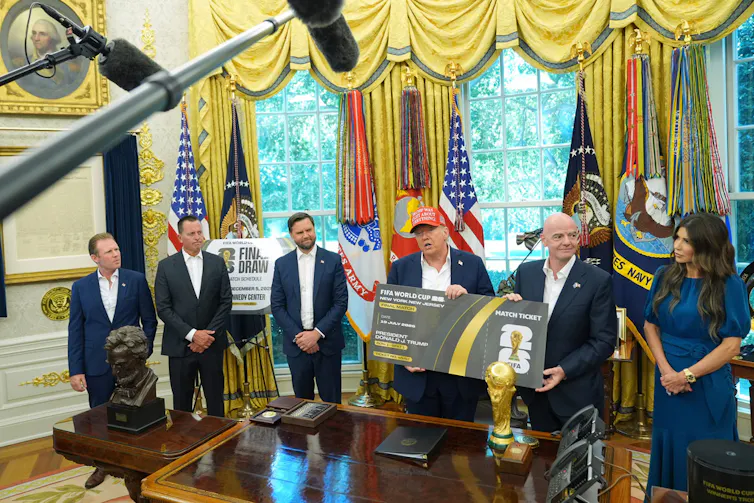
President Donald Trump speaks holding a large ticket representing a ticket for the World Cup final, alongside FIFA President Gianni Infantino on Aug. 22, 2025. AP Photo/Jacquelyn Martin

Following the money

Soccer fans, whether they are ticket buyers or media viewers, generate FIFA’s revenue. In turn, FIFA’s objectives are to use those funds to put on a great World Cup and to grow soccer and make it accessible. As revenues grow, however, it is reasonable to ask why – beyond fairness and ticket accessibility questions – FIFA believes that it needs reserves of over $4 billion – over half of its total costs in the 2019-22 cycle?

Indeed, the numbers suggest the organization has actually decreased some core funding priorities on a relative basis – significantly.

In the 2023-26 cycle, the budget for competitions rose from $2.45 billion to $5.62 billion, about a 130% increase, while the budget for development increased only 44%, and its share of budgeted revenues dropped from 44% to 36%.

FIFA could argue that maximum revenue is needed to cover costs of future events and fund soccer development, but that is not the whole story told by FIFA’s 2027-2030 budget.

Total additional costs are set at around $3 billion, with the main driver being competition and events. Crucially, for the 2019-2022 cycle, development was 44% of the costs; for 2023-2026, it dropped to 36% of the costs; and for the 2027-2030 cycle, it is budgeted to further decrease to 29% of costs. Undoubtedly, these numbers will change, but they currently do not signal that FIFA is going to use its additional ticketing revenue to support broader soccer-related or social change investments.

That is perhaps not surprising, as FIFA has faced governance challenges in the past, including issues of corruption, bribery and fraud, plus accounting practices that critics say lack transparency. Reforms have attempted to mitigate those problems, and FIFA has started programs like the FIFA Foundation, whose stated purpose is to use soccer to improve people’s lives.

Given FIFA’s background, surplus and reserves, however, the biggest question should be whether FIFA’s financial resources are being effectively used to achieve its objectives. FIFA has described its purpose with phrases like “develop the game, touch the world and build a better future.” But to me, its budgets suggest it is focused primarily on the first.

The Conversation

Richard Sheehan does not work for, consult, own shares in or receive funding from any company or organization that would benefit from this article, and has disclosed no relevant affiliations beyond their academic appointment.

  •  

In Iran war’s shadow, Israel’s renewed Lebanon campaign risks repeating failed lessons – and occupations – of the past

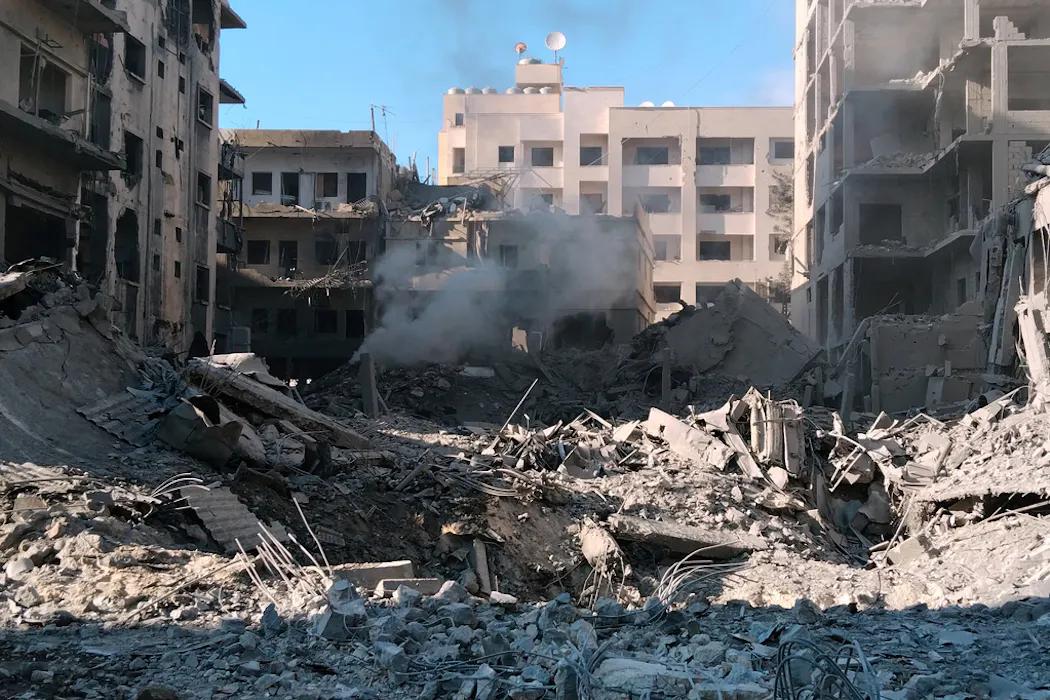
Buildings destroyed in Israeli airstrikes are seen in the southern port city of Tyre, Lebanon, on May 31, 2026. AP Photo

Going into the war in Iran, the Israeli government seemingly had two intertwined goals: to bring down the Islamic Republic and rid Israel of its Hezbollah problem.

The logic went that the Lebanese Shiite group – which has posed a persistent threat to Israel for 44 years – would finally succumb if stripped of its Iranian benefactor. After all, Israeli attempts to destroy Hezbollah through direct military action had not been effective, nor had internationally supported disarmament efforts.

But as the United States and Iran continue to negotiate over an agreement that might put an end to their war, the Israeli-Lebanese front remains as active as ever. Israel has increased strikes and incursions deeper into Lebanon, while Hezbollah is targeting the Israeli military deployed in southern Lebanon and the civilian population in northern Israel.

Worse, from the Israeli government’s perspective, is that Iran has found a way of turning its survival and newfound leverage over the Strait of Hormuz into protecting Hezbollah. Tehran is currently conditioning a potential deal with Washington on a complete halt of Israeli hostilities in Lebanon – a move clearly designed to safeguard the political and military standing of Hezbollah, its primary proxy.

Since full-scale war returned to Lebanon on March 2, 2026, it has had a massive humanitarian cost. As of June 1, over a million Lebanese have been displaced and more than 3,300 killed since the beginning of March. On the Israeli side, 24 soldiers and 4 civilians have been killed in the same time period.

Israel seeks to decouple its Lebanon front from the wider regional conflict, aiming to maintain its military campaign against the Shiite organization independently of broader U.S. negotiations with Iran. But whether it will able to do this is uncertain. The Trump administration has largely excluded Israel from the specifics of its Iranian dialogue while attempting to restrict Israeli operations in Lebanon to strikes in the country’s south and the Bekaa Valley and prohibiting attacks on state infrastructure. The ordering of attacks on Lebanon’s capital, Beirut, by Israeli Prime Minister Benjamin Netanyahu on June 1 lays bare the limits to U.S. pressure.

And ultimately, the resolution of this conflict rests upon how President Donald Trump chooses to navigate Iranian demands concerning the future of Lebanon.

As a historian of Israel and Lebanon, I have studied cycles of violence between these parties since 1982, and have noted recurring patterns in which Hezbollah has emerged emboldened, maintaining its dominance over Lebanese society as an Iranian proxy. Contrary to Israeli hopes, Iran’s patronage of Hezbollah has not been ended by the Iran war. And to confound issues, continued Israeli occupation of Lebanese land could grant Hezbollah the necessary justification to sustain its narrative of resistance at the cost of the broader Lebanese population.

A wounded but not dead Hezbollah

While significantly weakened as a result of more than two and a half years of war with Israel, Hezbollah continues to wield considerable power in Lebanon.

After a ceasefire in November 2024 – following the full-scale war in September-October of that year – ostensibly stopped fighting, a new Lebanese president was elected and a new government was established in February 2025.

A tank operates in a hilly environment.
An Israeli military tank drives along the Israeli-Lebanese border. Gil Cohen-Magen/Picture Alliance via Getty Images

That ended a three-year political deadlock generated by Hezbollah’s effective veto power over successive Lebanese governments since 2008. Even since the formation of a government in 2025, however, the Lebanese state has been unable to effectively make progress in disarming Hezbollah as stipulated in the November 2024, armistice agreement that ended that previous round of fighting.

Instead, Iran invested significant efforts to prop up its Lebanese proxy. Tehran even sent senior officers of its Revolutionary Guard soon after the November 2024 ceasefire to assume the command of the Shiite organization, which lost many of its leaders at the hands of Israeli assassinations and targeted strikes.

These efforts are paying off for Tehran now, as seen through Hezbollah’s ability to challenge Israel militarily.

With the beginning of this most recent war in March, the Lebanese prime minister banned Hezbollah’s operations, while the president condemned the group for dragging Lebanon into a conflict that most Lebanese rejected.

But, as in the past, the government has been unable to effectively rein in Hezbollah. A telling case came on March 24, 2026, when Lebanon’s Foreign Ministry declared the Iranian ambassador a persona non grata, ordering him to leave the country.

Iran and Hezbollah defied the order and the ambassador refused to leave the embassy in Beirut.

This example also suggests that the hopes for revitalized state capacities after the current Lebanese government came to power in February 2025 – the first government since 2008 not controlled by Hezbollah – may have been premature.

Gaza via Lebanon

Employing what some have called a “Gaza model” in Lebanon, Israel has effectively created a new security zone in south Lebanon by occupying Lebanese territory, razing to the ground whole villages that Hezbollah had used for military purposes and clearing out most of the population from the area.

But Israel has occupied south Lebanon in the past: first in March 1978, during the Litani operation, and then again from 1982 to 2000. The failure of these occupations should raise alarms in Israel. Neither resulted in lasting security improvements and instead left indelible, traumatic scars on Israel’s collective consciousness, creating the image of Lebanon as a quagmire into which Israel has been repeatedly drawn.

The government of Netanyahu is now leading the country into another potential quagmire in Lebanon.

The news about the Israel Defense Forces’ occupation of the Beaufort castle in south Lebanon on May 31 should bring grim memories for Israelis. That castle remains entrenched in the collective memory of Israel’s occupation of south Lebanon in 1982-2000 as a symbol of its failure. Netanyahu, however, packaged Israel’s occupation as a sign of strength, stating that “we have returned stronger than ever.” History suggests otherwise.

An old castle fortification stands atop a hill.
An Israeli flag flies over the medieval Beaufort castle on May 31, 2026. AFP/Getty Images

History repeats itself

Netanyahu is driven in large part by Israeli domestic affairs.

A majority of Israelis support the continuation of the war against Hezbollah. Moreover, with national elections scheduled for October 2026, Netanyahu needs to show some success in at least one of the multiple military fronts he has intentionally kept open since the Hamas attack on Oct. 7, 2023.

With Netanyahu seemingly failing to achieve his aims in Iran, Lebanon and Hezbollah provide him with an opportunity to keep a state of emergency in Israel, which he needs for his own political survival.

But failure in Iran makes achieving Netanyahu’s goal in Lebanon that much harder. The government in Tehran seems to have found significant leverage over the U.S. and Israel. And under these conditions, Tehran would not give up on Hezbollah, which remains its most important regional asset.

Diplomacy is the only way out of this imbroglio. And while it would not likely lead to the disarming of Hezbollah and to the Israel’s full withdrawal from south Lebanon, it remains the only constructive way forward.

At the behest of the Trump administration, Israeli and Lebanese ambassadors met to discuss a diplomatic understanding between two countries that have never had official relations. And on May 30, military representatives of the two countries met in Washington, D.C.

For the first time since 1983, the Lebanese government has agreed to negotiate directly with Israel over a long-term political agreement, including the possibility of finally demarcating their shared borders. Hezbollah, as expected, has vehemently opposed these negotiations.

What we are seeing currently unfolding in Lebanon is another testament to the failure of the Israeli-U.S. war against Iran. Yet a war that began with lofty promises of a new Middle East may end up with a worse version of the old Middle East – an emboldened Islamic Republic, a new Israeli occupation of south Lebanon and a Hezbollah, while weaker than before, still entrenched as an armed militia outside of Lebanese state control and working in concert with Iran.

The Conversation

Asher Kaufman does not work for, consult, own shares in or receive funding from any company or organization that would benefit from this article, and has disclosed no relevant affiliations beyond their academic appointment.
  •  

We analyzed paper money printed by Ben Franklin to uncover his anti‑counterfeiting techniques and materials innovations

Ben Franklin played a key role in America's founding, which included helping to design its paper currency. Kristina Davis

Benjamin Franklin understood something fundamental about money that still shapes modern economies: Money only works when people believe it is real.

In the early 18th century, the British colonies suffered from a chronic shortage of gold and silver coins, forcing local governments to rely on paper bills for trade and everyday commerce. But paper currency created a dangerous new problem: Unlike metallic coins, paper money could be easily copied, altered and faked.

Long before his experiments with electricity or his role in the American founding now 250 years ago, Franklin spent years working with paper, ink and printing. In the process, he developed a practical understanding of materials and manufacturing.

Nearly three centuries later, modern scientific analysis reveals how sophisticated some of his anti-counterfeiting strategies were. My colleagues and I in materials science recently analyzed hundreds of surviving colonial American bills, including notes printed by Franklin.

Using modern imaging and scientific methods, we examined fibers, pigments and microscopic structures hidden in the paper. The results suggested that Franklin approached currency as a practical materials problem.

Printing money that people could trust

Although paper money originated in China more than a thousand years ago, it did not appear in Europe until the 17th century. By the early 18th century, the American colonies lacked enough gold and silver coins to support a growing economy. To keep commerce moving, many colonies began issuing paper money instead. But paper currency also created anxiety because the colonial bills were relatively easy to fake.

A piece of paper reading 'three pence' and 'printed by B. Franklin and D. Hall'
A three-pence note of paper currency issued by the Province of Pennsylvania and printed by Benjamin Franklin and David Hall in 1764. Godot13/Wikimedia Commons

Forged notes circulated widely. Printers even put variations of the phrase “To Counterfeit Is Death” on colonial money and detailed harsh punishments for counterfeiters in their newspapers.

Franklin became involved in money printing in the early 1730s, soon after establishing himself as a printer in Philadelphia. During his career, Franklin printed millions of pounds worth of paper money for Pennsylvania and several other colonies. In 1749, he brought in the printer David Hall as a business partner. Hall carried on the practice with William Sellers after Franklin left the practice in the mid-1760s.

Franklin also created a network of printers in other colonies, supplying them with printing presses, paper and ink. This network printed paper notes for the Delaware, New Jersey, New York, Maryland and South Carolina colonies. Printing money required greater precision than printing newspapers or pamphlets. Franklin understood that a bill’s physical characteristics and the materials used to prepare it could shape whether people trusted it.

A printer who experimented with materials

Franklin approached printing as a craftsman, constantly experimenting with new printing techniques and materials.

Colonial papermakers produced paper sheets by pulping old linen and cotton rags in water, lifting the suspended fibers onto screens, and compressing the wet pulp by hand.

Under magnification, this old paper resembles a dense network of tangled fibers. Franklin explored ways to make his bills harder to copy by embedding additives into the paper. Some notes included indigo-colored fibers or threads mixed into the pulp.

Those innovations forced counterfeiters to reverse-engineer the paper, not just the printed image. Franklin also experimented with imitating designs from natural objects. For example, by pressing leaves into soft material, he captured complex vein patterns with high precision.

He later printed those patterns on colonial bills, producing designs that were difficult to copy because no two leaves share the same structure.

Franklin had written a famous pamphlet to advocate for paper money, though it did not record his exact techniques. Alongside his main account book, he kept a separate ledger – never found – to record dealings with the papermaker Anthony Newhouse in 1742 and 1743. In the mid to late 1740s, he purchased “money paper” from Newhouse.

Historians have speculated that Franklin was developing this new money paper with Newhouse and separated the accounts to keep its security features confidential.

Ben Franklin was an active figure in the printing world.

What modern analysis reveals

When my colleagues and I began investigating nearly 600 colonial bills, we wanted to understand the materials they contained. We employed imaging methods capable of examining structures thousands of times thinner than human hair. Those techniques allowed us to reveal the chemical makeup of the inks, fiber colorants and mineral particles used.

Some findings surprised us. Franklin’s black ink differed from many conventional printing inks of the period, which often used soot-based black pigment produced by burning vegetable oils or charring animal bone.

Instead, in many of Franklin’s bills, we found layered carbon structures similar to graphite, the naturally occurring form of carbon used in modern pencils. Unlike soot-based pigments, graphite consists of stacked layers of carbon atoms that give it distinctive physical and optical properties. These results suggested that Franklin experimented with ink composition more extensively than historians previously thought.

We also identified mica particles embedded in the paper. These particles reflect light, producing a faint shimmer. Whether added intentionally or introduced during papermaking, they created another visual feature that would have been difficult for counterfeiters to reproduce consistently.

Under advanced microscopes, the fibers revealed differences in manufacturing techniques, paper quality and material preparation. What appeared to be a simple colonial bill became a complex engineered object under the microscope.

Today, many banknotes contain similar particles, specialized threads and layered optical features designed to deter counterfeiters. Franklin’s materials were simpler than modern security technologies, but they relied on similar principles.

The material science of trust

Franklin never described himself as a materials scientist. Yet his work on colonial money reflected many of the ideas that guide secure printing today. He understood that an object’s physical properties could help build trust. The bill’s texture, fibers, pigments and printed details all helped convey authenticity.

That insight proved important far beyond the printing shop. Paper money provided a practical way to support trade, public projects and economic growth in the face of coin shortages. But paper currency could only serve those purposes if people trusted it. By making bills more difficult to counterfeit and easier to recognize as genuine, Franklin helped strengthen confidence in a financial system that supported a rapidly growing colonial economy.

Modern analysis now reveals details that earlier generations could not see: Franklin’s paper money was more than a financial instrument. It embodied a principal effort to engineer trust directly into everyday materials, an idea that still informs the design of modern money.

It is perhaps fitting that Franklin’s portrait appears on today’s US$100 bill. Long before becoming one of the faces of American money, he helped develop some of the ideas that made paper money trustworthy in the first place.

The Conversation

Khachatur Manukyan does not work for, consult, own shares in or receive funding from any company or organization that would benefit from this article, and has disclosed no relevant affiliations beyond their academic appointment.

  •  

Nearly half of maternal deaths in Pennsylvania occur more than 6 weeks after giving birth

But women continue to die from causes related to pregnancy and childbirth until one year after birth. Goodboy Picture Company/E+ Collection via Getty Images

For too many women, the journey to motherhood ends in death. Maternal mortality – the death of a woman during pregnancy or within 42 days of giving birth – is not a rare tragedy. Globally, the maternal mortality rate is unacceptably high – about 260,000 women died during and following pregnancy and childbirth in 2023. In the U.S., it is also an ongoing crisis.

The U.S. has the highest maternal mortality among high-income countries.

Globally, the most common indicator used to measure maternal deaths is the maternal mortality ratio. This is the number of maternal deaths per 100,000 live births. Estimates show that the U.S has a maternal mortality ratio of 17 – compared to 1 in Norway, 2 in Poland and Australia, 3 in Spain and Japan, and 4 in Germany, Sweden and the Netherlands. The U.S. number is more in line with Bahrain and Egypt, where resources are far more limited than in America.

The maternal mortality ratio for non-Hispanic Black women in the U.S. is even higher – 50.3 per 100,000 live births compared to 14.5 among white moms.

Pennsylvania offers a useful lens for examining this crisis at the state level. Recent data shows mental health conditions accounted for nearly half of pregnancy-associated deaths in Pennsylvania, with overdose and substance use disorders as the primary causes of death. Nearly 70% of maternal deaths in Pennsylvania occurred after childbirth, including 48% between six weeks and one year postpartum.

The Pennsylvania maternal mortality review committee, a state agency established to investigate deaths occurring during or within a year of pregnancy, determined that 98% of pregnancy-related deaths in the state were preventable. This highlights a need for expanded care for pregnant and postpartum women. Poor quality of care, care discontinuity and knowledge gaps are the most frequent factors in preventable maternal deaths. This number averages about 86% in other states.

A woman lies in a hospital bed, touching her stomach.
Pennsylvania’s maternal mortality review committee found that 98% of pregnancy-related deaths were preventable. globalmoments/iStock collection via Getty Images Plus

As a nurse scientist, my research has been focused on postpartum care for the past 14 years. Postpartum care is vital in lowering maternal mortality in the U.S., however, it isn’t always prioritized in public policy.

Why are mothers dying?

Mental health conditions account for about 28% of maternal mortality in America. Most deaths are caused by substance use disorders and depressive disorders.

These are followed by cardiovascular conditions, infections and hemorrhage.

One exception is that among non-Hispanic Black women, cardiovascular conditions are the most common cause of maternal mortality. These typically linger postpartum and sometimes show up later within the first year after giving birth. When a woman is discharged after birth, the burden is on her and her family to ascertain potential complications and seek timely care. Inadequate knowledge of warning signs of postpartum complications can lead to delayed care and management.

Benefits of longer postpartum care

Hospital stays after birth are growing shorter. This trend means healthcare providers have less time to educate new mothers about postpartum health complications and connect them with social services. Most postpartum education happens as new moms are being discharged a day or two after giving birth, a time when they may struggle to absorb new information.

A Black female patient getting a blood pressure cuff put on her arm.
Black postpartum mothers face a significantly higher risk of persistent high blood pressure after delivery. The Good Brigade/DigitalVision Collection via Getty Images

My colleague and I wanted to know how women felt about the health information they received as new mothers. We surveyed 80 Black women in St. Joseph County in Indiana about their postpartum education experiences. Most women were only somewhat satisfied.

About 46% of women did not recall receiving any education on postpartum warning signs.

The Association of Women’s Health, Obstetric and Neonatal Nurses recommends that all postpartum women should be able to recognize nine warning signs of postpartum complications, using the acronym POST-BIRTH. On average, participants in our survey could identify only two of the nine signs.

About 25% could not identify any of the signs:

  • Pain in the chest.
  • Obstructed breathing or shortness of breath.
  • Seizures.
  • Thoughts of hurting yourself or others.
  • Bleeding or blood clots.
  • Incision that is not healing.
  • Red or swollen leg.
  • Temperature of 100.4 F or higher, or 96.9 F or lower.
  • Headache that doesn’t get better.

The American College of Obstetricians and Gynecologists recommends that women receive an initial visit within three weeks of birth, in addition to the traditional six-week visit and ongoing follow-up as needed.

Changing the standard of postpartum care

At the Eck Institute for Global Health at the University of Notre Dame, I created an innovative postpartum care model called Focused Postpartum Care. This model provides more frequent follow-up appointments, standardized education for the post-birth year and peer support through group sessions for 12 months after giving birth.

This treatment protocol offers women head-to-toe assessments and measures of vital signs, and it provides group education at a two- and six-week appointment. Beyond six weeks, women continue to receive measures of vital signs and group education monthly until 12 months.

A white woman lies on her side in a hospital bed.
Inadequate knowledge of postpartum complications can lead to delayed care-seeking. Kemal Yildirim/E+ Collection via Getty Images

Blood pressure monitoring after six weeks postpartum is important, since hypertensive disorders can show up later within the post-birth year. Women are also screened for postpartum depression and social needs at multiple points throughout the year, as these needs can change over time.

In a randomized, controlled trial of this model in Ghana in 2021-23, women who received focused postpartum care showed greater knowledge of warning signs, healthy eating and family planning. They also showed significantly lower stress and depression scores at three months compared to those receiving standard care. The study sought to address shortcomings in postpartum care in sub-Saharan Africa, where health risks can continue well beyond birth and follow-up care is not always consistent.

This model of group postpartum care is being implemented in Indiana and is available upon request for use in any healthcare system.

The Conversation

Yenupini Joyce Adams receives funding from the Helen Kellogg Institute for International Studies and the Ford Program in Human Development Studies & Solidarity at the University of Notre Dame; Anthem Blue Cross and Blue Shield Foundation. She previously received funding from the Indiana Clinical and Translational Sciences Institute.

  •  

Soaring ticket prices could help FIFA pull in $15B this World Cup cycle — where does the money come from, where does it go?

FIFA's secondary ticket market can be seen on a smartphone screen. Maximilian Haupt / picture alliance via Getty Images

At soccer’s World Cup, the top scorer gets the “golden boot,” and the best goalkeeper is handed the “golden gloves.” This year’s tournament will also provide organizer FIFA with a golden opportunity to create billions in additional ticket revenues.

Ticket prices are so high that even President Donald Trump, a billionaire ally of FIFA President Gianni Infantino, said he wouldn’t pay.

The concern is that FIFA is pricing out many of the sport’s most devoted fans. In the 2022 Qatar-hosted World Cup, group-stage Category 1 tickets – the best seats – cost about $220, while Qatari residents could purchase tickets for $11 in some group-stage matches. Category 1 tickets to the final were about $1,600.

For the 2026 World Cup, dynamic pricing, which deliberately makes pricing opaque and subject to real-time changes, is being used for the first time. It means ticket prices may vary dramatically both across games and even for a given game over time.

The initial baseline for Category 1 tickets during World Cup 2026 was about $600 when they first went on sale in the fall of 2025 but now they generally sell for over $1,000 and sometimes much higher. The price for Category 1 tickets for the opening game in Mexico City is currently over $2,500, and even Category 3 tickets, the lowest available tier, are over $1,000. For the final, Category 1 tickets initially cost over $6,000 and had exceeded $32,000 by early May.

As an emeritus professor of finance and author of “Keeping Score: The Economics of Big Time Sports,” I’ve done some number crunching and predict that increased ticket receipts will help FIFA exceed $15 billion in revenue this world cup cycle – which would be a record-breaker for soccer’s governing body and significantly more than its 2022 stated goal of $11 billion.

FIFA’s ticket pricing approach may be a logical way to capture at least some of the revenue that normally goes to ticket scalpers, but it’s also unlikely to find a sympathetic audience among potential ticket buyers. Further, what remains unclear is FIFA’s plan on how to spend the extra billions of revenue, with its stated goal to support positive social change belied by a track record of corruption and lack of transparency.

How FIFA operates

It’s important to put ticket pricing in the context of FIFA’s broader finances and objectives.

FIFA is a nonprofit organization, registered as a charity in Switzerland, with a mandate not only to organize competitions like the World Cup but also to grow the game and expand soccer access globally.

It operates on a four-year budget cycle with most revenues generated by the World Cup in the last year of the cycle.

Historical comparisons help frame the issue. The 1994 World Cup in the United States, widely seen as a major success, generated $700 million in net revenue – or profits – versus a $550 million budget, driven largely by stronger-than-expected ticket sales and sponsorships. Large venues and high attendance also helped advance FIFA’s development goals, including the launch of Major League Soccer.

By 2022, FIFA’s finances had grown dramatically. Revenue for the cycle that included that year’s World Cup was budgeted at $6.44 billion but ended up reaching $7.57 billion — with most growth coming from broadcasting and marketing.

Budgeted ticket revenue appeared modest due to smaller venues in Qatar, but actual ticket revenue significantly exceeded expectations, most likely due to FIFA’s conservative revenue forecast. On the cost side, spending closely matched the budget, with $2.8 billion allocated to development programs in the 2019-2022 cycle. Despite this expense, reserves rose from $2.81 billion to $3.89 billion as a result of the 2022 tournament’s success.

Looking ahead to the 2026 World Cup cycle, FIFA budgeted that revenue would increase by $4.36 billion relative to the 2019-2022 cycle, to $11 billion, driven largely by ticketing — up $2.59 billion — and broadcasting, up $890 million. Costs were expected to rise by $4.57 billion, implying a projected surplus of about $100 million, the same small increase projected in the prior cycle. By 2024, a revised FIFA budget increased the forecasted revenue for the 2023-2026 cycle up to $13 billion.

FIFA’s leverage with ticket demand

FIFA’s track record suggests a pattern: conservative revenue projections, accurate cost control and consistent “surprises” in ticketing and licensing that generate higher than expected revenues and a dramatic increase in ending reserves.

My projections suggest that broadcasting and marketing this year are on track to equal their budgeted values, and historically FIFA’s actual costs closely track budget values. But ticketing remains the key revenue variable – and the central controversy. The expanded 2026 tournament means more teams, more matches, more fans and significantly higher ticket demand.

Even with larger stadiums than any World Cup since 1994, demand has vastly exceeded supply. There were over 500 million ticket requests for the random draw, but roughly 7.1 million available seats.

This imbalance gave FIFA tremendous pricing power. To try to mitigate criticism, FIFA introduced $60 “Supporter Entry Tickets” allocated through national associations. Yet these account for only a small share of tickets, fewer than 600 per match, and have done little to dampen the outrage over prices.

Most tickets have been sold in phases using dynamic pricing, with substantial increases across phases and most sales occurring in the later and more expensive phases. Venue seating charts also indicate most tickets are classified as the highest priced tier. Meanwhile, FIFA will receive ticket revenue from FIFA-controlled resale.

All three factors will likely push ticket revenue well above FIFA’s budget. Based on these dynamics, I project ticketing and hospitality revenue of a minimum of $7.44 billion – more than double FIFA’s budget, but consistent with stadium capacities, pricing across phases, seat allocation by category and ongoing resale activity.

Ticket and hospitality revenue per match in 2022 averaged $14.5 million. FIFA’s $3.1 billion budget for 2026 implies average ticket revenue per match would be about about $30 million. But given the larger stadiums and substantially higher ticket prices, that number appears to grossly understate actual ticket revenues. A final ticketing and hospitality value of close to $9 billion would not be a surprise. My predicted total revenue for FIFA is $14 billion to $19 billion.

People in business attire stand around a desk during a press conference.
President Donald Trump speaks holding a large ticket representing a ticket for the World Cup final, alongside FIFA President Gianni Infantino on Aug. 22, 2025. AP Photo/Jacquelyn Martin

Following the money

Soccer fans, whether they are ticket buyers or media viewers, generate FIFA’s revenue. In turn, FIFA’s objectives are to use those funds to put on a great World Cup and to grow soccer and make it accessible. As revenues grow, however, it is reasonable to ask why – beyond fairness and ticket accessibility questions – FIFA believes that it needs reserves of over $4 billion – over half of its total costs in the 2019-22 cycle?

Indeed, the numbers suggest the organization has actually decreased some core funding priorities on a relative basis – significantly.

In the 2023-26 cycle, the budget for competitions rose from $2.45 billion to $5.62 billion, about a 130% increase, while the budget for development increased only 44%, and its share of budgeted revenues dropped from 44% to 36%.

FIFA could argue that maximum revenue is needed to cover costs of future events and fund soccer development, but that is not the whole story told by FIFA’s 2027-2030 budget.

Total additional costs are set at around $3 billion, with the main driver being competition and events. Crucially, for the 2019-2022 cycle, development was 44% of the costs; for 2023-2026, it dropped to 36% of the costs; and for the 2027-2030 cycle, it is budgeted to further decrease to 29% of costs. Undoubtedly, these numbers will change, but they currently do not signal that FIFA is going to use its additional ticketing revenue to support broader soccer-related or social change investments.

That is perhaps not surprising, as FIFA has faced governance challenges in the past, including issues of corruption, bribery and fraud, plus accounting practices that critics say lack transparency. Reforms have attempted to mitigate those problems, and FIFA has started programs like the FIFA Foundation, whose stated purpose is to use soccer to improve people’s lives.

Given FIFA’s background, surplus and reserves, however, the biggest question should be whether FIFA’s financial resources are being effectively used to achieve its objectives. FIFA has described its purpose with phrases like “develop the game, touch the world and build a better future.” But to me, its budgets suggest it is focused primarily on the first.

The Conversation

Richard Sheehan does not work for, consult, own shares in or receive funding from any company or organization that would benefit from this article, and has disclosed no relevant affiliations beyond their academic appointment.

  •  

In Iran war’s shadow, Israel’s renewed Lebanon campaign risks repeating failed lessons – and occupations – of the past

Buildings destroyed in Israeli airstrikes are seen in the southern port city of Tyre, Lebanon, on May 31, 2026. AP Photo

Going into the war in Iran, the Israeli government seemingly had two intertwined goals: to bring down the Islamic Republic and rid Israel of its Hezbollah problem.

The logic went that the Lebanese Shiite group – which has posed a persistent threat to Israel for 44 years – would finally succumb if stripped of its Iranian benefactor. After all, Israeli attempts to destroy Hezbollah through direct military action had not been effective, nor had internationally supported disarmament efforts.

But as the United States and Iran continue to negotiate over an agreement that might put an end to their war, the Israeli-Lebanese front remains as active as ever. Israel has increased strikes and incursions deeper into Lebanon, while Hezbollah is targeting the Israeli military deployed in southern Lebanon and the civilian population in northern Israel.

Worse, from the Israeli government’s perspective, is that Iran has found a way of turning its survival and newfound leverage over the Strait of Hormuz into protecting Hezbollah. Tehran is currently conditioning a potential deal with Washington on a complete halt of Israeli hostilities in Lebanon – a move clearly designed to safeguard the political and military standing of Hezbollah, its primary proxy.

Since full-scale war returned to Lebanon on March 2, 2026, it has had a massive humanitarian cost. As of June 1, over a million Lebanese have been displaced and more than 3,300 killed since the beginning of March. On the Israeli side, 24 soldiers and 4 civilians have been killed in the same time period.

Israel seeks to decouple its Lebanon front from the wider regional conflict, aiming to maintain its military campaign against the Shiite organization independently of broader U.S. negotiations with Iran. But whether it will able to do this is uncertain. The Trump administration has largely excluded Israel from the specifics of its Iranian dialogue while attempting to restrict Israeli operations in Lebanon to strikes in the country’s south and the Bekaa Valley and prohibiting attacks on state infrastructure. The ordering of attacks on Lebanon’s capital, Beirut, by Israeli Prime Minister Benjamin Netanyahu on June 1 lays bare the limits to U.S. pressure.

And ultimately, the resolution of this conflict rests upon how President Donald Trump chooses to navigate Iranian demands concerning the future of Lebanon.

As a historian of Israel and Lebanon, I have studied cycles of violence between these parties since 1982, and have noted recurring patterns in which Hezbollah has emerged emboldened, maintaining its dominance over Lebanese society as an Iranian proxy. Contrary to Israeli hopes, Iran’s patronage of Hezbollah has not been ended by the Iran war. And to confound issues, continued Israeli occupation of Lebanese land could grant Hezbollah the necessary justification to sustain its narrative of resistance at the cost of the broader Lebanese population.

A wounded but not dead Hezbollah

While significantly weakened as a result of more than two and a half years of war with Israel, Hezbollah continues to wield considerable power in Lebanon.

After a ceasefire in November 2024 – following the full-scale war in September-October of that year – ostensibly stopped fighting, a new Lebanese president was elected and a new government was established in February 2025.

A tank operates in a hilly environment.
An Israeli military tank drives along the Israeli-Lebanese border. Gil Cohen-Magen/Picture Alliance via Getty Images

That ended a three-year political deadlock generated by Hezbollah’s effective veto power over successive Lebanese governments since 2008. Even since the formation of a government in 2025, however, the Lebanese state has been unable to effectively make progress in disarming Hezbollah as stipulated in the November 2024, armistice agreement that ended that previous round of fighting.

Instead, Iran invested significant efforts to prop up its Lebanese proxy. Tehran even sent senior officers of its Revolutionary Guard soon after the November 2024 ceasefire to assume the command of the Shiite organization, which lost many of its leaders at the hands of Israeli assassinations and targeted strikes.

These efforts are paying off for Tehran now, as seen through Hezbollah’s ability to challenge Israel militarily.

With the beginning of this most recent war in March, the Lebanese prime minister banned Hezbollah’s operations, while the president condemned the group for dragging Lebanon into a conflict that most Lebanese rejected.

But, as in the past, the government has been unable to effectively rein in Hezbollah. A telling case came on March 24, 2026, when Lebanon’s Foreign Ministry declared the Iranian ambassador a persona non grata, ordering him to leave the country.

Iran and Hezbollah defied the order and the ambassador refused to leave the embassy in Beirut.

This example also suggests that the hopes for revitalized state capacities after the current Lebanese government came to power in February 2025 – the first government since 2008 not controlled by Hezbollah – may have been premature.

Gaza via Lebanon

Employing what some have called a “Gaza model” in Lebanon, Israel has effectively created a new security zone in south Lebanon by occupying Lebanese territory, razing to the ground whole villages that Hezbollah had used for military purposes and clearing out most of the population from the area.

But Israel has occupied south Lebanon in the past: first in March 1978, during the Litani operation, and then again from 1982 to 2000. The failure of these occupations should raise alarms in Israel. Neither resulted in lasting security improvements and instead left indelible, traumatic scars on Israel’s collective consciousness, creating the image of Lebanon as a quagmire into which Israel has been repeatedly drawn.

The government of Netanyahu is now leading the country into another potential quagmire in Lebanon.

The news about the Israel Defense Forces’ occupation of the Beaufort castle in south Lebanon on May 31 should bring grim memories for Israelis. That castle remains entrenched in the collective memory of Israel’s occupation of south Lebanon in 1982-2000 as a symbol of its failure. Netanyahu, however, packaged Israel’s occupation as a sign of strength, stating that “we have returned stronger than ever.” History suggests otherwise.

An old castle fortification stands atop a hill.
An Israeli flag flies over the medieval Beaufort castle on May 31, 2026. AFP/Getty Images

History repeats itself

Netanyahu is driven in large part by Israeli domestic affairs.

A majority of Israelis support the continuation of the war against Hezbollah. Moreover, with national elections scheduled for October 2026, Netanyahu needs to show some success in at least one of the multiple military fronts he has intentionally kept open since the Hamas attack on Oct. 7, 2023.

With Netanyahu seemingly failing to achieve his aims in Iran, Lebanon and Hezbollah provide him with an opportunity to keep a state of emergency in Israel, which he needs for his own political survival.

But failure in Iran makes achieving Netanyahu’s goal in Lebanon that much harder. The government in Tehran seems to have found significant leverage over the U.S. and Israel. And under these conditions, Tehran would not give up on Hezbollah, which remains its most important regional asset.

Diplomacy is the only way out of this imbroglio. And while it would not likely lead to the disarming of Hezbollah and to the Israel’s full withdrawal from south Lebanon, it remains the only constructive way forward.

At the behest of the Trump administration, Israeli and Lebanese ambassadors met to discuss a diplomatic understanding between two countries that have never had official relations. And on May 30, military representatives of the two countries met in Washington, D.C.

For the first time since 1983, the Lebanese government has agreed to negotiate directly with Israel over a long-term political agreement, including the possibility of finally demarcating their shared borders. Hezbollah, as expected, has vehemently opposed these negotiations.

What we are seeing currently unfolding in Lebanon is another testament to the failure of the Israeli-U.S. war against Iran. Yet a war that began with lofty promises of a new Middle East may end up with a worse version of the old Middle East – an emboldened Islamic Republic, a new Israeli occupation of south Lebanon and a Hezbollah, while weaker than before, still entrenched as an armed militia outside of Lebanese state control and working in concert with Iran.

The Conversation

Asher Kaufman does not work for, consult, own shares in or receive funding from any company or organization that would benefit from this article, and has disclosed no relevant affiliations beyond their academic appointment.

  •  

Beast: Australia’s first MMA film, starring Russell Crowe, is cheesy yet oddly comforting

Stan

For a nation obsessed with professional sport, there is a surprising dearth of Aussie sports films. There have been, of course, a handful of memorable ones: The Club (1980), The Coolangatta Gold (1984) and, more recently, The Final Winter (2007).

But apart from the low-budget 2024 film Life After Fighting – understandable if you haven’t heard of it, it made less than A$6,000 at the box office – Beast is the first Australian film to be set in the world of mixed martial arts.

Patton James (Daniel MacPherson) is a retired fighter pulled back into the game due to tough circumstances. His young daughter Maddie (Sol Nc Carrico) needs to see an expensive specialist, his wife Luciana (Kelly Gale) is pregnant with another, and he barely makes a living working for a petty tyrant on a fishing boat.

When the opportunity to earn $150,000 fighting his former nemesis, world champion Xavier Grau (Bren Foster), arises, he finds it impossible to resist, despite the imprecations of his loving wife.

So Patton returns to his old trainer Sammy (Russell Crowe). And despite some bad blood between them, Sammy and his daughter Rose (Amy Shark, in her feature film debut) end up helping him get in shape for the fight.

After several trials and tribulations, the whole thing culminates in a bout in Thailand. “A fight all about redemption, no… revenge”, the commentator tells us. Guess the result?

Singer-songwriter Amy Shark plays Sammy’s (Crowe) daughter Rose, in her feature film debut. Stan

Bland delivery, bad accents

Beast has all the expected cliches, and to say the narrative is predictable is an understatement.

But for a feel good “against the odds” sports film, this isn’t necessarily a problem. There can be something pleasurable in watching cliché after cliché unfold, and genre cinema’s capacity to fulfil our expectations is one of the reasons we keep coming back to it.

But the problem is, Beast for the most part rings as hollow as the character’s names, which could only exist in a scriptwriter’s dreams – Patton James and Xavier Grau… come on.

Director Tyler Atkins found something charming and fresh in his undeniably sentimental earlier film, Bosch & Rockit (2022). Beast, however, feels stale. Much of this is technical, with many of the elements not really working (or not working well together).

Much of the films technical elements don’t really work together. Stan

Russell Crowe is a fine actor, and his revival as an angry, hefty middle-aged chap (as in the smashing 2020 film Unhinged) has been effective. But one can’t imagine this role would have stretched him much, and it feels like he’s just going through the motions.

Similarly, we’re consistently aware of the effort TV star MacPherson is putting into the lead role of Patton, and this makes for a valiant but not entirely convincing performance.

Kelly Gale acts like a model as Patton’s long-suffering wife, her undeniable presence offset by a strikingly monotone delivery.

The only standouts are screen veterans Matt Nable, excellent as usual in a tiny role as loan shark Barry Dunne, and Nathan Phillips, who has a small but memorable role as the skipper of the fishing boat, and Bren Foster, a martial artist-turned actor who commands every scene in which he appears.

Bren Foster commands every scene he appears in. Stan

The whole thing plays like Australian television rather than cinema. It’s like a 1940s melodrama with none of the style or mood – blandly lit with rudimentary cinematography, accompanied by a stock standard orchestral score, matching unconvincing American accents from some of the key actors (Luke Hemsworth’s accent as sleazy promoter Gabriel Stone perhaps explains why his career hasn’t been that of his brothers Chris or Liam).

At once unconvicing and strangely comforting

The screenplay is dull, co-written by Crowe, who also produced the film. It seems so concerned with coming across as an “Aussie film full of heart”, it ends up without any.

There are some unintentionally funny lines, such as what wise trainer Sammy says to Patton when he hears he’s taken the fight just for the money:

Time’s not a commodity like that. You’ve got moments and memories. If you don’t take the moments, you don’t get the memories.

That said, despite being soapy and not very convincing, Beast is quite watchable as a kind of sports telemovie – earnest, if a bit lame. Sure, it runs through the motions, but the motions are compelling enough to warrant a watch for fans of Aussie cheese.

There’s something eternally pleasurable about watching an against the odds sporting movie replete with training montages, even if it is Home and Away’s answer to Rocky IV.

Beast is showing on Stan from today.

The Conversation

Ari Mattes does not work for, consult, own shares in or receive funding from any company or organisation that would benefit from this article, and has disclosed no relevant affiliations beyond their academic appointment.

  •  
❌