Reading view

Australia now has access to Anthropic’s Claude Mythos. It may improve cyber safety – but not for everyone

Google DeepMind

Artificial intelligence (AI) giant Anthropic has expanded access to a highly advanced model deemed too dangerous for public release, including Australia in the select handful of users.

The large language model, known as Claude Mythos, is now being rolled out to an additional 150 organisations across 15 countries, including the Australian government and several local businesses, as part of Project Glasswing.

In an era where large-scale AI launches are happening on a day-by-day basis, this limited, gradual release may seem particularly surprising. But Mythos is not like most other AI systems. Instead it’s an automated tool for assessing software to find critical bugs and vulnerabilities.

This managed release is deliberate, as the discovery of vulnerabilities in computer systems is useful for those who want to defend them and those who want to hack them.

However, the real nature of the impact of AI systems on cybersecurity is significantly more complex.

Finding hundreds of severe vulnerabilities

Under initial testing, Mythos has been able to identify multiple new high-risk vulnerabilities. Left unfixed, such flaws allow attackers to easily steal data or induce system crashes.

While these reports are promising, the raw data needs context. Of the 23,000 vulnerabilities flagged by Mythos, only 6,200 were estimated as high-risk by Mythos. However AI isn’t perfect, as human experts could only validate two in every three of these vulnerabilities as high-risk. Even still, the nature and severity of identified vulnerabilities has led developers to say that with Mythos “defenders finally have a chance to win, decisively”.

And winning this battle is extremely valuable.

Over the last few years, Australians have repeatedly been the victims of costly cybersecurity incidents, including Optus, Medibank Private, the Melbourne International Film Festival, and Canvas.

This barrage of attacks likely explain why the Australian Signals Directorate welcomed Australia’s inclusion in Anthropic’s Project Glasswing. While this AI-driven security offers huge potential benefits, the government so far has been tight-lipped on the specifics of how Mythos will actually be used.

Dangerous in the wrong hands

While discovering vulnerabilities is useful, defenders need to be able to respond to them. This is problematic when tools like Mythos produce large numbers of false reports, which have the potential to overwhelm unprepared cybersecurity teams.

More concerningly, while access to Mythos is currently tightly controlled, it will not be long until similar tools are available to help support hackers.

And it’s not just the vulnerabilities that AI can discover that pose risks.

AI systems more broadly are incredibly vulnerable to being tricked or exploited, with highly damaging consequences.

Just this week, hackers used Meta’s AI powered chatbot to gain access to high-profile Instagram accounts, including Barack Obama’s. They did so by tricking AI chatbots into changing account details. And, even after Instagram announced it fixed the issue, within hours there were reports of further accounts being compromised.

A similar attack known as Echoleak last year revealed how tying Microsoft Copilot to email accounts could introduce significant risks. This was made possible by sending emails to accounts monitored by Copilot’s AI. These emails tricked the AI into leaking large amounts of private and confidential information, without the email ever needing to be opened by a human. No longer do we live in a world where hackers need to convince users to click a malicious link, if they can instead convince the AI that reads emails to act dangerously.

Both Echoleak and the Instagram hacks underscore the risks we face as more and more organisations tie their critical functions to AI systems that are difficult to audit, and easy to exploit – even by just being persuasive.

A new balance point

All of this suggests the current cybersecurity landscape might be shifting to a new balance point, where defenders and hackers race to develop and exploit powerful AI tools.

Tools like Mythos aren’t a silver bullet. While they provide defenders with an additional set of eyes on where to look, it still will require expertise to work out what is real, and what isn’t.

But the advent of the AI era has already fundamentally changed the risks associated with poor cybersecurity practices. Every day a user or service provider delays a software update on one of their devices is a day where a vulnerability can be exploited.

For cybersecurity teams, ensuring compliance is already a difficult enough process that will only get worse when the speed of vulnerability discovery increases.

While they are high value targets for hackers, large organisations will likely remain safe, as they will have the resources to access and deploy tools like Mythos. But smaller, less resourced companies will likely not have the capacity to access these tools – or to react to the upcoming tsunami of cybersecurity updates.

And if they fall behind on these updates, these smaller companies will likely find themselves at far more risk than they ever have been before.

The cybersecurity divide between those with and without resources will only grow. Bridging this gap is not just an IT challenge – it’s a public safety concern that will affect us all.

The Conversation

Andrew Cullen does not work for, consult, own shares in or receive funding from any company or organisation that would benefit from this article, and has disclosed no relevant affiliations beyond their academic appointment.

  •  

Extreme heat at the World Cup: are FIFA’s safeguards enough?

On a midsummer day in Miami, temperatures can exceed 32°C with high humidity. In a full stadium of 65,000 fans, it can be several degrees hotter, posing a potential health risk to players.

These are the conditions some teams will endure at the 2026 FIFA World Cup in June-July, the hottest months across much of North America.

FIFA has already acknowledged the risk, introducing cooling breaks in each half of all matches for the first time at a World Cup.

But is this enough to protect players in the heat?

It’s not just the high temperatures

When we talk about heat stress in sport, we are not just referring to air temperature.

What matters for the human body is a combination of heat, humidity, solar radiation and airflow – often summarised by the “wet-bulb globe temperature” index, originally developed in the 1950s to curtail heat illness during military training.

Soccer presents a particular challenge under high wet-bulb globe temperature conditions. Elite players routinely cover 10-13 kilometres per match, repeatedly sprinting, decelerating and changing direction.

This produces substantial internal metabolic heat, while opportunities for heat loss are limited by clothing, match structure, restricted access to shade, airflow or other cooling technologies.

If heat production exceeds heat loss, core temperature rises. This places more strain on the cardiovascular system, elevates perceived effort, impacts performance and increases the risk of exertional heat illness, which can include ailments such as muscle cramps and heat exhaustion. At the extreme end, exertional heat stroke, a life-threatening medical emergency can develop.

What the forecasts show for 2026

Analyses of historical weather data across the 16 World Cup host cities indicate heat stress will be common, particularly for afternoon kick-offs in cities such as Dallas, Houston, Miami, Kansas City and Monterrey.

While some venues such as Dallas, Houston and Atlanta have retractable roofs that can modify temperature and airflow, most matches will be played in open-air stadiums, exposing players to heat stress.

Later kick-offs may only offer limited relief, especially in humid environments where sweat evaporation is impaired.

Until recently, most evidence on heat strain in professional soccer came from experimental simulations. Unpublished field-based research from our laboratory at the University of Canberra, measuring core temperature during real professional matches, provides insight into what players experience during competition.

Our data show that during competitive match-play:

  • average peak core temperature often exceeds 39°C, rising progressively before half-time or full-time

  • players’ peak core temperature can exceed 40°C even in conditions that would not traditionally trigger extreme heat policies and in some cases even when cooling breaks are applied.

Importantly, these observations were documented in elite Australian A-League players who are fit and seasonally heat-acclimatised.

Taken together, this shows elite soccer players can reach and sometimes exceed a 40°C core temperature during matches at wet-bulb globe temperatures that are already considered “high risk” for exertional heat illness.


Read more: Curaçao and Cabo Verde are into the World Cup. What impact can these ‘minnow nations’ make?


Are cooling breaks enough?

Cooling breaks are a sensible and evidence-based safeguard and FIFA’s decision to mandate them in every match at the World Cup is a proactive step.

Cooling breaks – particularly when combined with cold fluid ingestion and ice towels – can lessen rises in core temperature, heart rate and perceived effort, especially in male players.

However, two important caveats remain.

First, cooling breaks do not prevent large rises in core temperature – they reduce the rate or magnitude of that rise. Even with breaks, players can still reach very high core temperatures.

Second, emerging evidence indicates cooling breaks affect women differently. Although women athletes generally reach lower absolute core temperatures than men during match-play, standard FIFA-style cooling breaks appear to provide smaller additional reductions in physiological strain.

Women get more benefits when in-play cooling breaks are combined with longer half-time breaks, which include cooling in air-conditioned spaces.

In short, universal cooling breaks may help but are unlikely to be sufficient on their own.

What are other sports doing?

Most heat policies in sport rely solely on environmental measures such as the wet-bulb globe temperature index. While useful, these metrics describe the weather, not the physiological strain experienced by players.

Several sports have begun to anchor heat policies to the predicted rise in core temperature, linking environmental conditions and sport specific characteristics – heat production and clothing – rather than relying on environmental conditions alone.

This approach focuses on the body’s ability to maintain thermal balance through sweating – something administrators may increasingly need to consider as matches are played in hotter and more humid conditions.

World Rugby uses a similar approach, but tailored to the sport’s demands and clothing worn, as does Sport Medicine Australia for a variety of recreational sports.

Timing matters, a lot

One of the most effective heat-mitigation strategies requires no ice, no towels and no new technology: avoid playing at the hottest time of day.

Afternoon kick-offs consistently produce the greatest thermal strain because they combine peak solar radiation with high air temperature. Evening matches reduce – but do not eliminate – risk, particularly in humid cities.

From a player safety perspective, match scheduling may be as important as in-game cooling strategies. Yet broadcast considerations have historically driven afternoon kick-offs at World Cups.

An ongoing problem

Heat stress is already being reported more frequently in domestic soccer leagues, continental tournaments and youth competitions.

Heat policies must keep pace with a warming climate.

Protecting player health will require earlier decisions, stronger mitigation strategies and a willingness to rethink when and how matches are played – not just at World Cups, but at all levels of the sport.

The Conversation

Julien Périard has previously received funding from Professional Footballers Australia (PFA), the International Federation of Professional Footballers (FIFPRO) and the Fédération Internationale de Football Association (FIFA).

Brad Clark has previously received funding from Professional Footballers Australia (PFA), the International Federation of Professional Footballers (FIFPRO) and the Fédération Internationale de Football Association (FIFA).

Harry Brown has previously received funding from Professional Footballers Australia (PFA), the International Federation of Professional Footballers (FIFPRO) and the Fédération Internationale de Football Association (FIFA).

  •  

GLP-1 drugs like Ozempic show promise for more than weight loss. But what’s science vs hype?

Pavel Danilyu/Pexels

You’ve probably heard of Ozempic or Wegovy. These are the injectable drugs that have become household names for weight loss and diabetes.

Now, researchers are investigating whether these medications known as GLP-1 agonists or GLP-1 drugs could treat everything from cancer and brain disease to depression, addiction and endometriosis.

Some findings are genuinely exciting. Others are being oversold. Here’s what the science actually says.

First, how do these drugs work?

GLP-1 (glucagon-like peptide-1) is a hormone your gut naturally releases after eating. It tells your pancreas to produce insulin and signals to your brain that you’re full. These drugs mimic that hormone.

But GLP-1 receptors aren’t just in the gut. They’re found in the heart, kidneys, liver and brain. That’s what makes scientists think these drugs might do far more than manage weight.


Read more: The rise of Ozempic: how surprise discoveries and lizard venom led to a new class of weight-loss drugs


Where the evidence is already solid

Beyond diabetes and obesity, GLP-1 drugs have now earned regulatory approval in several new areas.

A trial of more than 17,000 people found semaglutide (the active drug in Ozempic/Wegovy) cut the risk of serious heart attacks and strokes by 20%, even in people without diabetes.

In a trial of almost 1,200 patients, semaglutide outperformed a placebo in treating a type of advanced liver disease.

Tirzepatide (Mounjaro) has also been shown to significantly reduce the severity of sleep apnoea, mostly because weight loss puts less pressure on the airways.

GLP-1s and cancer: promising but no clinical trial evidence

Obesity is a risk factor for at least 13 cancers, so reducing weight using GLP-1 drugs can also be expected to limit cancer risk. This was shown in a study of 86,000 adults with obesity. It found GLP-1 users had a 17% lower cancer risk.

New data suggests GLP-1 users were also less likely to see cancer spread to other organs, but this work is yet to be verified by other researchers. The anti-inflammatory effects of these drugs, which appear to work independently of weight loss, may be playing a role.

However, there have not yet been any well-controlled clinical trials that establish the link between GLP-1 drugs and preventing cancer.

Endometriosis: early but promising signs

Endometriosis affects roughly one in ten women of reproductive age. This is where tissue similar to the womb lining grows outside the uterus.

Because GLP-1 receptors are also present in reproductive tissue, these medications have shown promise in improving symptoms, with a survey of 161 women supporting this.

But, similar to cancer, there are no randomised human trials.

Close up of a semaglutide injector pen
While these medications show promise for a number of conditions, the evidence base is still emerging. Haberdoedas/Unsplash

Addiction and smoking

GLP-1 receptors are concentrated in the brain’s reward pathways. These same circuits drive cravings for alcohol, nicotine and drugs.

An analysis of more than 1.3 million people found GLP-1 users had significantly lower rates of opioid overdose and alcohol intoxication.

A randomised trial found semaglutide reduced drinking in people with alcohol use disorder.

Early quit-smoking trials are encouraging, too.

The brain: the least clear picture for GLP-1 therapy

This is where the story gets genuinely complicated.

There are real biological reasons GLP-1 drugs could help with neurodegeneration and mental ill-health. They reduce brain inflammation, interact with dopamine (the brain’s motivation chemical) and support the gut-brain axis (the communication network that carries signals to and from the gut and brain).

However, current clinical evidence is conflicting.

For Alzheimer’s disease, researchers gave 204 participants with mild to moderate disease liraglutide (a GLP-1 that pre-dated Ozempic) and measured how much brain volume they lost. Those taking the drug showed significantly less shrinkage in key brain regions, including their temporal lobe and overall grey matter.

However, a large phase 3 trial of oral semaglutide found it wasn’t effective at slowing clinical disease progression.

Similarly, exenatide (another earlier GLP-1) showed no evidence for disease modification in a phase 3 Parkinson’s disease trial.

For mental health, current evidence is also mixed. Meta-analyses and large cohort studies show significant reductions in depression and anxiety scores among GLP-1 users.

But a separate observational study found people on these drugs had almost double the risk of major depression.

Another paper found that people with a genetic tendency toward low dopamine levels may face higher risk of depression and suicidal thoughts on these medications.

There are also case reports of serious psychiatric episodes appearing within weeks of starting treatment.

We don’t yet know who these drugs will help, and who they could seriously harm.


Read more: Taking a drug like Ozempic? What you need to know about risks of suicidal thoughts and contraception failure


What we need to be cautious about

Crucially, most of the new uses for these medications haven’t yet been tested in proper clinical trials. Large real-world studies are useful, but they can’t rule out crucial confounding factors. This means the effects may be due to external influences.

For example, most major GLP-1 trials have enrolled people with obesity or diabetes. People with mental health conditions, neurodegenerative diseases, or addiction were largely excluded. Yet, these are the very populations now being considered for treatment.

Long-term effects are also unknown. A study of more than 200,000 patients found a 2–2.5 times higher risk of drug-induced pancreatitis (dangerous inflammation of the pancreas).

Rapid weight loss also strips lean muscle, not just fat, affecting strength and metabolism, especially in older adults.

Studies have also indicated these medications carry a risk for thyroid cancer, prompting a warning on drug labels, but evidence is highly conflicting.

Time and further research will tell, but there are genuine safety concerns associated with the widespread use of these medications.

So, while the science here is genuinely exciting, we should continue to approach with informed caution.


Read more: Mounjaro is more effective for weight loss than Ozempic. So how does it work? And why does it cost so much?


The Conversation

Paul Joyce receives funding from The Hospital Research Foundation, Cancer Council SA, and the Australian Research Council. He is director of the Australian Controlled Release Society.

  •  

Babies with older siblings have a higher infection risk, but are less protected through vaccination

Getty Images

Parents know how easily coughs, colds and other infections can move through a household after a child picks up a bug at childcare or school.

This puts babies with older siblings at greater risk of serious infectious illness, especially while their immune systems are still developing during the critical first months of life. Maternal vaccination during pregnancy helps boost babies’ protection.

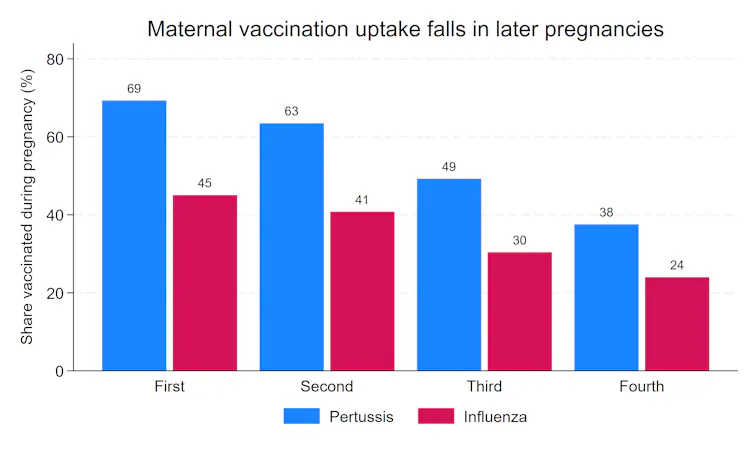
But my new research shows a worrying mismatch: vaccination uptake falls during later pregnancies, leaving babies who would benefit most from maternal immunisation less likely to receive that protection.

In Aotearoa New Zealand, vaccination against pertussis, also known as whooping cough, and influenza is publicly funded and recommended during every pregnancy.

These vaccines do not only protect the mother. The maternal antibodies are also transferred to the baby and help protect them.

Previous studies confirm that maternal immunisation substantially reduces babies’ risk of infection and hospitalisation from pertussis and influenza, but my research shows a birth-order pattern of reduced protection.

Immunisation falls with each pregnancy

Vaccination uptake during pregnancy remains far from universal.

Analysis of current Aotearoa Immunisation Register data for births in the year to June 2025 shows 61% of mothers received a pertussis vaccine and 40% received an influenza vaccine during pregnancy.

But these overall figures hide a clear birth-order pattern. Among first pregnancies, uptake was 69% for pertussis and 45% for influenza. In second pregnancies, this decreased to 63% and 41% respectively. By the fourth pregnancy, these figures had fallen to 38% and 24%.

Share of mothers receiving pertussis or influenza vaccination during pregnancy, by birth order. Data cover pregnancies resulting in births in New Zealand from July 2024 to June 2025. CC BY

These recent figures show the birth-order pattern for one year of births. In my research, I examined a longer period, covering births from 2015 to 2023, which allowed me to compare vaccine uptake for the same mother across different pregnancies.

Part of the overall pattern reflects differences between families. Mothers who have more children tend to have lower vaccination uptake overall.

But the pattern also appears within families. The same mother is less likely to be vaccinated in later pregnancies than in earlier ones.

This finding fits with a growing body of evidence showing parents’ health-related decisions can vary with a child’s birth order. Previous studies have found later-born children are breastfed at lower rates and are less likely to attend health checks and receive childhood immunisations. These differences can also begin before birth, with lower use of prenatal care in later pregnancies.

A double disadvantage for later-born babies

While later-born babies receive less protection through vaccination, they may also face a greater risk of infection.

The family environment plays a role in the spread of infectious diseases. Older children can bring infections home, exposing younger siblings. Studies in other countries have found later-born children have higher rates of hospitalisation for respiratory conditions and receive more prescriptions for contagious diseases early in life.

My study shows this pattern also holds in New Zealand for two diseases targeted by maternal immunisation: pertussis and influenza. Later-born babies were more likely to be hospitalised for these diseases than their earlier-born siblings.

This is concerning from a public health perspective. Babies with older siblings face a greater risk of infection, while their mothers are less likely to receive recommended vaccinations during pregnancy.

How health services can respond

There are several possible reasons maternal immunisation and other parental behaviours vary by birth order.

As families grow, parents have to divide their time, attention and other resources among more children. This may influence the care and support available during later pregnancies and early childhood.

Parents may also learn and adapt as they become more experienced, changing how they approach pregnancy and infant care.

These explanations also point to possible solutions. Evidence from New Zealand suggests gaps in awareness, time constraints and difficulty accessing services can contribute to missed maternal immunisation. These barriers may be exacerbated in later pregnancies, when parents are already caring for older children.

Policy and service efforts that provide clearer information and make vaccination easier to access could therefore be particularly effective if they include a focus on later pregnancies.

New Zealand has already been moving in this direction by expanding the settings where immunisation can be delivered, including pharmacies and community midwives. There is evidence that making maternal pertussis vaccination available through pharmacies increased uptake, particularly for Māori women.

If these changes make vaccination easier to access for busy families, they could help protect babies who currently face the double disadvantage of higher infection risk and lower maternal immunisation uptake.

The Conversation

This research was supported by the Health Research Council of New Zealand. These results are not official statistics. They have been created for research purposes from the Integrated Data Infrastructure which is managed by Stats NZ. For more information please visit https://www.stats.govt.nz/integrated-data/.

  •  

Conspiracy theories: do 300,000 Kiwis really believe Canada is building an army of mutant super-raccoons?

Enn Li Photography/Getty Images

Four percent of Americans – roughly 12 million people – believe that “lizard people” secretly control the Earth. At least, that was the finding of an infamous 2013 public opinion survey.

Do so many people really believe such outlandish claims? Or do results like these partly reflect people giving silly answers or deliberately skewing surveys for fun?

US psychiatrist Alexander Scott believes the latter plays a significant role.

Using the survey as an example, he coined the term “the Lizardman constant” to describe the idea that a certain amount of noise and trolling will always exist in surveys about unusual beliefs.

As Scott warned: “Any possible source of noise – jokesters, cognitive biases, or deliberate misbehaviour – can easily overwhelm the signal.”

As researchers who study uncommon beliefs such as conspiracy theories, we wanted to investigate how this kind of cheeky trolling can muddy the waters.

Trolls and true believers

Building on earlier Australian research, we surveyed New Zealanders to test how common dishonest or joking responses were in conspiracy theory surveys.

We did this in two ways. First, we directly asked people a yes/no question at the end of the survey:

“Did you respond insincerely at any earlier point in this survey? In other words, did you give any responses that were actually just joking, trolling, or otherwise not indicating what you really think?”

Second, we included in the survey a “conspiracy theory” so ridiculous we could assume most, if not all, people who said they believed it were taking the mickey.

We asked them if they believed:

The Canadian Armed Forces have been secretly developing an elite army of genetically engineered, super intelligent, giant raccoons to invade nearby countries.

In our representative online sample of 810 New Zealanders, 8.3% of respondents confessed to being insincere in the survey.

Another 7.2% said they thought the Canadian raccoon army theory was probably or definitely true. That proportion – similar to findings from Australia – would equate to more than 300,000 adult New Zealanders.

To complicate things slightly, there was some overlap between those admitting to insincere answers and those claiming to believe the raccoon conspiracy. Combined, 13.3% of respondents fell into one or both groups – roughly one in eight people not appearing to take the survey seriously.

Importantly, these respondents were also much more likely to endorse other conspiracy theories, inflating estimates of how widespread those beliefs really are.

For instance, 6.5% of the full sample endorsed the claim that governments around the world are covering up the fact that 5G mobile networks spread coronavirus.

But once we removed the insincere responders, that figure dropped by more than half to 2.7%.

Across 13 different conspiracy theories, the estimated proportion of believers fell substantially once those respondents were excluded.


Another interesting insight from our study was that people endorsing contradictory conspiracy theories were much more likely to show signs of responding insincerely.

Previous studies have found some people appear to believe conspiracy theories that directly contradict each other. In our survey, for example, some participants agreed both that COVID-19 is a myth and that governments are covering up the fact that 5G networks spread the virus.

But nearly three-quarters of those respondents also showed signs of joking or dishonest answers.

This suggests genuinely believing contradictory conspiracy theories may be less common than previously thought.

Not every conspiracy believer is joking

Our findings add further weight to the idea that surveys may overestimate how many people truly believe some conspiracy theories – thanks, in part, to trolls.

But does that mean all conspiracy theory research is bunk?

Fortunately not. Most research in this area is not focused on counting conspiracy believers, but on understanding why people hold these beliefs and what effects they can have.

We tested several well-established findings from earlier conspiracy theory research to see whether they still held up once insincere respondents were removed from the data.

For example, previous studies have found that people who endorse conspiracy theories are more likely to see the world as a dangerous and threatening place.

We found the same pattern. In fact, removing insincere respondents made little difference to the broader relationships identified in earlier research.

Nevertheless, we recommend that future surveys include ways to gauge whether respondents are answering sincerely and account for this in the analysis. At the very least, researchers should acknowledge that trolls and joking responses can distort their results.

While our research suggests some people are taking the mickey in surveys, it also shows a significant minority genuinely appear to believe some of these claims.

In some cases – such as believing authorities are covering up the fact that the Earth is flat – this may be relatively harmless. But other conspiracy beliefs can lead to real-world harm.

Good-quality research is essential for understanding how sincere believers end up down these rabbit holes, and how those beliefs influence real-world behaviour.

Research into why people embrace conspiracy theories – and the real-world consequences of those beliefs – remains important.

But when surveys suggest millions may believe in lizard overlords or genetically engineered raccoon armies, it is also worth remembering the “Lizardman constant”: some respondents may simply be having us on.


The authors acknowledge the contributions of Rob Ross, Mathew Ling and Stephen Hill to this article.


The Conversation

John Kerr is supported by a Royal Society Te Apārangi Mana Tūānuku Research Leader Fellowship.

This research was supported by the Marsden Fund Council from Government funding, managed by Royal Society Te Apārangi.

Mathew Marques does not work for, consult, own shares in or receive funding from any company or organisation that would benefit from this article, and has disclosed no relevant affiliations beyond their academic appointment.

  •  

A right mess: how mining, media and political interests are combining to influence public debate in Australia

Mining billionaire Gina Rinehart is bankrolling the acquisition of a 9.5% stake in Southern Cross Media by Bruce McWilliam, who worked for Murdoch’s News Corp for nine years and is also a former Seven Network executive.

This venture is costing Rinehart $26 million. It does not buy her a direct stake in Southern Cross, but if McWilliam cannot uphold his side of a security deed he has signed with her, she could take control of it.

Southern Cross is one of Australia’s biggest media organisations. It owns the Seven Network, 7news.com.au, the Triple M and Hit radio brands, a raft of regional radio stations, and West Australian Newspapers.

The Rinehart-McWilliam-Murdoch axis is a formidable force, part of a new combination of media, political and mining interests, reminiscent of that which formed the Liberal Party in the 1940s. The other key figures are News Corp chair Lachlan Murdoch, One Nation leader Pauline Hanson and Liberal Party director Tony Abbott.

This is the lens through which it is instructive to assess the media’s coverage of One Nation’s rise since the Farrer byelection on May 9.

To see the parallels with the 1940s, we need to join a few dots.

Rinehart is a benefactor to Hanson. She recently bought her a light aircraft worth $1 million.

She is also a benefactor to Lachlan Murdoch. Her company Hancock Prospecting is sponsoring Sky News, owned by Murdoch’s News Corporation, to the extent of a little over $1 million for a Sky event in Dubbo called the Bush Summit.

Lachlan Murdoch is chairman of News Corporation. In 2023, he appointed Tony Abbott to the board of the News subsidiary, Fox Corporation, a day after Rupert Murdoch announced his retirement. In May this year, Abbott was elected unopposed as federal president of the Liberal Party.

Lessons from the 1940s

The parallels with the 1940s can be seen in volume two of Sally Young’s magisterial two-volume history of the Australia media, Media Monsters, where she describes the machinations that led to the formation of the Liberal Party.

The right was in disarray. Robert Menzies’ comically ill-named United Australia Party had been trounced by Labor at the 1943 election. In the aftermath, Menzies was re-elected leader but made it a condition that he had the right to form a new party.

He was backed by an entity called Collins House. This was a collection of companies connected by networks of powerful business figures who dominated mining and manufacturing. An influential figure was Lachlan Murdoch’s grandfather, Keith Murdoch. As managing director of the all-powerful Herald and Weekly Times (HWT) newspaper group, he provided a vital connection between the Collins House group and the most senior level of politics.

The HWT and other major media proprietors of the day anointed Menzies and his proposal for the new Liberal Party, at a dinner of Collins House magnates in Melbourne in 1944.

The difference between the political circumstances of the 1940s and those of today is that today there are two right-wing political parties contending for supremacy: the Liberal Party and One Nation.

Rinehart seems to be having a million quid each way on which will prevail. By contrast, if the recent coverage of One Nation by The Australian is any guide, Lachlan Murdoch has already cast his vote decisively for the Liberal Party.

The media sober up

For a fortnight after One Nation’s historic win in Farrer, the media, including News Corp media, were intoxicated by the attendant excitement and controversy: the shredding of Liberal Party support; Hanson’s ambition to be prime minister; the possibility of a Liberal-One Nation coalition.

Then, led by The Australian, the media began to sober up. On May 23, its editor-at-large, Paul Kelly, wrote that the Nationals, Liberals and One Nation were locked in a bitter competition with “life or death” consequences.

From that point on, The Australian applied the blowtorch of journalistic scrutiny to One Nation, and The Age and Sydney Morning Herald swiftly followed.

With its customary disregard for journalistic ethics, The Australian made a point of reporting that One Nation’s South Australian parliamentary team was looking like a “rainbow coalition”, one of its MPs having come out as gay with a partner who was an Indonesian Muslim.

But then it got into some serious public-interest journalism. For two days it pursued the party over its handling of rape allegations against an adviser, Sean Black.

It accused Hanson of shirking her parliamentary duties by being absent from 88% of Senate estimates hearings over the past decade. It also drew attention to the fact One Nation had failed to lodge audited financial records for three years in Queensland, and disparaged its policy proposal for citizen-initiated referendums.

On June 3 it drew on all this to publish a thundering editorial. One Nation was drifting further out to the fringes. It would be divisive and disruptive. It had appeared to lurch into blind confusion. Hanson was “not fit in any sense” for the role of prime minister.

On June 6, it led page one with a full-frontal attack, carrying the self-revealing headline: “Hanson hit”. It said Hanson had been caught out misleading voters, raising further questions about her capacity to be prime minister.

The Age and SMH were by then taking up the theme.

Suddenly Hanson was reportedly not sure if she would pitch for the prime ministership. She had admitted having had to close down party branches that had been “infiltrated by extremists”. She had insisted she would not be influenced by Rinehart despite having adopted one of Rinehart’s key policies. In other words, she was all over the place.

On June 6, the papers’ political and international editor, Peter Hartcher, described her as a firebrand provocateur who specialises in grievances without solutions and turns to scapegoats instead – Asians, First Nations people, Muslims. He pointed out that Hanson had answered “no” when asked by another journalist whether she could think of any error that Donald Trump might have made since taking power.

The same day another Age/SMH commentator, Paul Sakkal, wrote about what he called the collection of right-wing forces barracking for Hanson: openly white supremacists, people who rallied alongside neo-Nazis, supporters of the so-called sovereign citizen Dezi Freeman, who had killed two policemen. “A serious governing party cannot retain these relationships.”

A right mess

The big question after all this is how the forces brought together through the new media-politics-mining combination will resolve the obvious tensions involved in creating an effective force on the right of Australian politics.

Murdoch, through The Australian, has clearly signalled his contempt for One Nation, and already has Abbott on his team through Fox Corporation.

Rinehart, with her substantial holdings via McWilliam in Southern Cross Media, could go either way: backing Hanson or the Liberals. And her record indicates she would use her power to influence editorial decision-making to support her choice.

In 2012 she became the largest shareholder in the Fairfax company, with 14.99%. However, she refused to sign the company’s charter of editorial independence, and as a result was refused a seat on the board. She sold out in 2015.

Her history in refusing to sign the Fairfax charter is a strong indicator she would want the option of using her position on any media board to influence editorial decisions.

The old Fairfax newspapers, The Age, the SMH and the Australian Financial Review, are now owned by the Nine Entertainment Company, and stand outside the new cabal. A crucial question is whether they might prove to be a countervailing force.

One Nation set off this earthquake in Australian politics, but how the media play into the aftershocks will be a significant factor in the shaping of the new landscape.

Correction: this article originally referred to Gina Rinehart as “billionaire heiress to the Lang Hancock mining empire”. This has been amended to “mining billionaire”.

The Conversation

Denis Muller does not work for, consult, own shares in or receive funding from any company or organisation that would benefit from this article, and has disclosed no relevant affiliations beyond their academic appointment.

  •  

One Nation’s banning of the ABC and abuse of journalists is shameful. It’s time other media took a stand

The day before the Farrer byelection on May 9 in which Pauline Hanson’s One Nation party delivered a seismic shock to the Australian political landscape, her party apparatchiks banned the ABC from attending its election-eve press conference.

Thirteen days later, another party apparatchik told a journalist from Guardian Australia to “shut up” during a press conference in Adelaide about the party’s policy on oil and gas. Hanson was later heard describing the journalist as a “nasty bitch”.

And a week before Farrer, at the byelection in the Victorian state seat of Nepean, the One Nation candidate, Darren Hercus, refused to speak to the ABC because, he said, the ABC was biased.

The response of the media industry and the profession of journalism to these antidemocratic outbursts has been supine: a shameful abrogation of their obligation to defend the freedom of the press.

In Farrer, the other journalists stood by and watched as the ABC reporters were ejected. In the ensuing two weeks, not a single word of condemnation has been uttered publicly by any industry or professional leader as one abusive episode followed another.

Yet across the Pacific we see exactly how this plays out in Trump’s America.

A far-right populist leader attains power and then turns on those elements of the media he does not like, branding them the enemy of the people, undermining public trust in their reporting, and shutting them out from the access they need to do their job.

Hanson is not there yet, but her party’s instincts are clear. The ABC and Guardian Australia have put her and her party under close scrutiny, and this is her party’s response. (Although in fairness it should be added that in terms of the Farrer incident, Hanson herself said the ABC should not have been ejected.)

However, the ABC has been in Hanson’s gunsights for years. As far back as 2017 she made a deal with Malcolm Turnbull’s government: you give me an inquiry into the ABC and I’ll support the changes you want to make to media ownership laws.

It was simply a stunt to divert resources within the ABC and generate negative headlines for the national broadcaster. It led to no change because there was no basis for change.

The proximate cause of her wrath this time was an ABC story revealing a One Nation candidate in the recent South Australian state election was wanted for questioning in the United Kingdom on allegations of sexual touching.

So less than 24 hours before the polls opened in Farrer, Hanson’s chief of staff, James Ashby, ejected two ABC journalists from the party’s press conference, saying contemptuously, “Bye, bye to the ABC”.

As The Age’s media writer later noted, it was straight out of Donald Trump’s playbook.

Yet we have not heard a word of condemnation from the ABC’s editor-in-chief, Hugh Marks, or the broadcaster’s chair, Kim Williams. Nor has there been editorial commentary or an opinion column in any of our major daily newspapers. What about the Media, Entertainment and Arts Alliance? Silence.

To its credit, the ABC TV program Media Watch did not pull its punches. Its presenter, Linton Besser, described One Nation’s attitude to the press, and in particular the ABC, as ugly. Alarm bells should be ringing, he said, because the slurs about “fake news” and “the enemy of the people” might very well be hurled at others too.

Tellingly, he reported the ABC had declined to comment on the Farrer incident.

Otherwise, the nearest any of Australia’s main media outlets came was an article in The Age and Sydney Morning Herald describing the events in Farrer and setting out the background. Useful as a reference, but it did nothing to defend the principle at stake: that in a democracy, the media must be free to cover matters of public interest, and their scope to do so must not be subject to the whims and vagaries of political leaders or parties.

Instead, the media has been consumed by One Nation’s historic victory and the prospect that it will make further gains.

Hanson is presented in an heroic light: the Nine papers quote the London Telegraph referring to Hanson as “Australia’s flame-haired answer to Farage”, a reference to the UK’s far right leader Nigel Farage, who also made historic gains in recent local government elections there.

Less heroically, she is also characterised by these newspapers as “mother duck”.

The Australian tells us “the shake-up is just starting”.

And The Age and SMH capture the mood of the electorate: “Voters tell Canberra: ‘Get stuffed’.”

None of this is to say her party’s result in Farrer, its winning of four seats in South Australia and its continuing high ride in the opinion polls is anything other than a story of immense significance. It deserves all the attention it is getting.

But to ignore her party’s anti-democratic behaviour shows wilful blindness to what is happening in the United States, and suggests a complacency that it can’t happen here.

Ironically, an American journalist, Sinclair Lewis, has a lesson in this for Australia’s media. In 1935 he wrote a novel called “It Can’t Happen Here”, predicting with terrifying accuracy what Trump is doing to the American republic.

On the face of it, the exclusion of the ABC from a party press conference may appear to be a small thing. Moreover, there is a healthy belief in newsrooms that the public are not interested in journalists writing about journalists.

But this is not a story about journalists. It is a story about the functioning of the Australian democracy. It is a story requiring the insight to see a large principle in a small thing, a quality we are entitled to expect in the leaders of the fourth estate.

The Conversation

Denis Muller does not work for, consult, own shares in or receive funding from any company or organisation that would benefit from this article, and has disclosed no relevant affiliations beyond their academic appointment.

  •  

Battleground Vienna: Austrian intelligence officer convicted of spying for Russia belongs to a long tradition

Egisto Ott is no James Bond. But the stories the 63-year-old Austrian told a Viennese jury recently would make good plotlines. Ott worked as an intelligence officer in Austria’s now-defunct Federal Office for the Protection of the Constitution and Counterterrorism. He was also moonlighting for the Russians.

Prosecutors say Ott, who was sentenced to four years in prison on May 20, handed over information to fellow Austrian Jan Marsalek, the fugitive former executive of the collapsed payments firm Wirecard. Marsalek ran a cell of Bulgarians who were convicted in London in 2025 of spying for Russia. They called themselves the “minions”.

In 2023, the London Metropolitan police in cooperation with MI5 secured chat messages between Marsalek and the minions, which led to Ott. It turned out Ott had provided sensitive data on dissidents, investigative journalists and a Russian intelligence defector. The trial also revealed that Ott had obtained the infamous “canoe-trip-mobiles”.

In 2017, high-ranking Austrian civil servants went on a canoe trip in a tributary of the Danube River. They managed to fall into the water and had their phones sent in for repairs. Their mobile data was copied by Ott and subsequently ended up in Moscow, along with Marsalek’s favourite Viennese chocolate cake, a Sachertorte. According to the chat messages, the minions had a stressful time finding the correct one (there are rival Sachertorte recipes).

What sounds like a comic opera has a sinister backstory. Since the 1950s, Austria has hosted several international organisations that are regularly targeted by intelligence services. These include Opec (the Organization of Petroleum Exporting Countries), the International Atomic Energy Agency and the United Nations Office on Drugs and Crime.

However, Austria’s reputation as a spying hub dates back even longer. The Austrian capital, Vienna, was known for espionage before and after the second world war. Arnold Deutsch, the recruiter of the Cambridge Five spy ring that passed information to the Soviet Union, hailed from Vienna. Its leading light, Kim Philby, was also talent-spotted by Soviet intelligence in the city in 1933.

But Vienna was never just a playground for Soviet intelligence. After the war, when the city was divided into four sectors for allied occupation, the UK’s foreign intelligence service, MI6, started its most creative cold war operations. Peter Lunn, head of MI6’s Vienna station, built listening stations in the city to tap Soviet phone lines.

He hid his listening tunnels underneath ordinary shops in the British zone. The first tunnel was built beneath a police station. Later, MI6 built another tunnel under a jewellery shop and then installed intelligence officers posing as a young, rich couple in a Viennese villa. While they were partying upstairs, their colleagues listened in to Russian military traffic downstairs.

The only surviving witness of a listening station today is Sir Rodric Braithwaite, whom I first interviewed in 2024. As a 19-year-old conscript, Braithwaite worked with British Army Field Security in the Aspang listening station, next to the Aspang Bahnhof (a train station on the outskirts of Vienna).

It wasn’t an uplifting experience. He sat there for long shifts with earphones on, handling old equipment and pressing recording buttons. But his memories of the tunnel are valuable because to this day MI6 has not released any photos, let alone recordings, that were made during these operations.

The Third Man

They have also not revealed the details of another highly creative intelligence operation. In 1948, a British team arrived in Vienna to film The Third Man, a thriller set in the city. They were eager to shoot scenes in the Soviet sector.

Four key people involved in the making of the film were working for British intelligence: novelist Graham Greene, director Carol Reed, “Austria advisor” Elizabeth Montagu and, most importantly, producer Sir Alexander Korda. Korda’s film production company had been providing covers for British intelligence officers in Europe since the 1930s.

Whether the filming of The Third Man was connected to Lunn’s tapping operations, or whether MI6 had to smuggle something out of the Soviet sector, is a matter of conjecture. But “odd people” appeared on the set.

Carol Reed in Amsterdam in January 1950.
The director of The Third Man, Carol Reed, in Amsterdam in January 1950. Jack de Nijs / Wikimedia Commons, CC BY

The film’s sound engineer, Jack Davies, remembered a British technician who turned up out of the blue. After filming, the technician vanished completely and Davies never came across him again – something rather unusual in the small world of British film technicians.

The script girl, Angela Allen, who I first interviewed for my book Das Haus am Gordon Place (Vienna ‘48) in 2024, also realised that something odd was going on. She noticed that Carol Reed was under enormous stress in Vienna and kept himself awake with Benzedrine. He stopped taking the drug once they were back in England, filming in London studios.

Allen, who is 97 now, wasn’t surprised to find out years later that Korda was working for the British intelligence services. She told me: “He had enormous charm. He could make his people do everything for him.”

Perhaps that is one reason why Ott and Marsalek failed. To succeed as a spy in Vienna, you need to be a great illusionist like Alexander Korda.

The Conversation

Karina Urbach’s book about spies in Vienna, Das Haus am Gordon Place (Vienna ’48), won the German crime award. Her interviews with Angela Allen and Sir Rodric Braithwaite can be watched here: https://vimeo.com/1086100608

  •  

Washing machines could support skin health for First Nations people – if we get the wash settings right

Doing a load of laundry involves lots of decisions – from which cycle to choose to what detergent to use.

These choices may seem like simple personal preferences. But in communities where skin and other infections are common, doing laundry is often part of medical advice.

Washing clothes and bedding is widely recommended to help control skin and other infections. However, we haven’t known which wash settings are needed to kill or remove pathogens found on fabrics.

How hot? For how long? And with what detergent?

Our new research aims to answer these questions.

Why washing matters

Washing clothes and bedding may be one way to support skin health.

Rural and remote First Nations communities experience a particularly high burden of skin infections. These infections are driven by the consequences of colonisation, socioeconomic marginalisation and housing inequity, which disproportionately affect First Nations people.

Skin infections can have serious consequences. For example, skin infections caused by the toxin-producing bacteria, Corynebacterium diphtheriae, are driving the current diphtheria outbreak that has already claimed one person’s life.

Strep A skin infections can lead to acute rheumatic fever and rheumatic heart disease, conditions that can cause inflammation throughout the body and permanent damage to the heart. This has a big impact on the lives of children and families. Severe cases may lead to serious disability or death.

Improving access to effective washing may be one way to support wellbeing and curb the spread of skin disease. But we need to get our wash settings right.


Read more: Deep-rooted inequalities are driving the latest diphtheria outbreak. But we can fix them


What we studied

In our new study, we conducted a systematic review that analysed all the available research about fabric contamination and the effect of washing practices on skin pathogens.

Our results show temperature is the most important factor in preventing the spread of skin infections. This was true across all the pathogens and parasites we reviewed.

We found it is most effective to launder clothes at a minimum temperature of 60°C for at least 15 minutes to effectively kill off any bugs or pathogens. This can be in a washing machine set to hot, or in a conventional dryer.

However, reaching these high temperatures is not always possible. Under current regulations, hot tap water can only reach a maximum of 50°C to prevent scalds. And only some washing machines have internal water heaters, so even a “hot” wash might not be hot enough. Heating water and running dryers is also energy intensive and expensive.

Detergents containing activated oxygen bleach can effectively kill some skin pathogens at lower temperatures. But we need more research to know whether detergents and disinfectants can make cold water washing more effective.

Washing in First Nations communities

However, it’s often not possible to wash laundry in a way that effectively kills pathogens. This is especially true in remote Aboriginal and Torres Strait Islander communities.

Many households struggle to purchase a reliable washing machine that is large enough to suit the needs of families. Washing machines can be twice as expensive in remote communities than urban areas, and the cost of electricity is exorbitant. Environmental factors such as dust, wet seasons and hard water – meaning water with higher concentrations of certain minerals – can damage machines and shorten their lifespan.

In some areas, as many as 70% of First Nations households go without a functional washing machine. Even fewer households have access to a dryer.

Community laundries may be one way to improve access to washing facilities. Our research shows that in the past decade, more than 50 communal laundry facilities have been set up in at least 38 rural and remote First Nations communities. These facilities give people free access to industrial washing machines, machine dryers, hot water and detergent.

Last November, the federal government committed A$11.4 million in funding for new or upgraded laundries.


Read more: How we partnered with local communities to halve skin sores among Aboriginal children in remote WA


Where to from here

Washing facilities are tied to the human rights to water, sanitation and dignity. They also have clear benefits for wellbeing.

But more work is needed to understand how effective washing could help reduce skin infection rates, particularly in remote First Nations communities.

One reason is funding for these laundry facilities is often tied to potential health benefits. The Remote Community Laundries Project, for example, aims to prevent serious conditions that can arise from skin infections. However, we don’t have enough evidence for looking at the health impacts of having more laundry facilities, or how we can maximise them.

Another reason is we don’t currently have guidance to support communities and laundry providers delivering these services. Our research highlights that the Australian Standard for Laundry Practice, for instance, has no specific recommendations about how community laundry facilities should be established or run.

Everyone has the right to wash and dry their clothes and bedding. But more work is needed to ensure washing facilities and practices meet the needs, preferences and priorities of First Nations communities.

The Conversation

Rosemary Wyber is supported by an NHMRC Fellowship and receives funding from The Kids Research Institute Australia and Yardhura Walani at Australin National University.

Rachel Burgess receives funding from The Kids Research Institute Australia.

Kate Summer does not work for, consult, own shares in or receive funding from any company or organisation that would benefit from this article, and has disclosed no relevant affiliations beyond their academic appointment.
  •  

Silicon Valley’s AI ‘tokenmaxxing’ obsession has a big problem – and philosophers saw it coming

Some time earlier this year, an employee at tech giant Meta built a system to track how much each staff member was using artificial intelligence (AI).

Named “Claudeonomics” after the Claude chatbot, the system created a leaderboard ranked by the number of tokens each user was exchanging with AI models, with leaders given titles such as “Token Legend”. (Tokens are tiny chunks of text, each around four characters long, that language models use for processing.)

Meta is not alone in its fascination with “tokenmaxxing”: AI labs OpenAI and Anthropic, e-commerce company Shopify, and tech investment firm Sequoia capital are all reportedly monitoring AI usage and rewarding heavy users, some of whom burn billions of tokens in a week.

Reducing a person’s performance to a single metric can be appealing for management in large corporations. But the choice of what to measure isn’t a neutral one – and if we’re not careful, it can start to rewrite our vision of what we actually value.

The score keeps the score

One of the more full-throated advocates of tokenmaxxing is Jensen Huang, chief executive of chipmaker Nvidia, who envisions a future in which tech employees negotiate high token budgets and consume tokens at rates commensurate with their salaries. Around 80% of those tokens are currently processed via Nvidia’s chips, so Huang’s enthusiasm makes sense.

But is token consumption a helpful metric for those of us who do not profit directly from AI processing volume?

In a recent book, The Score, philosopher C. Thi Nguyen analyses the rise of metrics throughout modern society and offers some helpful insights.

As Nguyen emphasises, what we measure shapes our goals. We develop metrics as tools of convenience; they standardise our measurement of values so we can compare large numbers of otherwise disparate things.

This standardisation comes at the expense of variation and distinctiveness, Nguyen argues. In business, it can make workers seem interchangeable.

Determining which employees in a large organisation are consuming the most tokens in a week is fairly straightforward. But it tells us nothing about the quality or impact of their work.

Bad metrics, bad results

In the past, questionable metrics have contributed to dramatically bad outcomes.

Prior to the 2008 global financial crisis, for example, many financial institutions had sophisticated systems of measures designed to incentivise selling as many loans as possible, as quickly as possible. Perhaps unsurprisingly, many of those loans turned out to be far riskier than anyone realised.

Nguyen emphasises that these types of metrics can tempt us into thinking they are unavoidable. But one of the central lessons of moral philosophy is that we ought to pause at moments like these and ask a couple of basic questions: what is a good life, and what values are actually worth chasing?

Huang and others usually don’t present tokenmaxxing as an answer to these question. But that’s how it functions. What is worth devoting your professional and creative energy to? Simple: grinding through tokens.

A new vision of the good life?

Silicon Valley has, of late, produced a striking number of manifestos and quasi-constitutions.

Consider Anthropic’s Claude’s Constitution, published in January 2026, which sets out the company’s aspirations for its model’s values and speech. Or look at venture capitalist Marc Andreessen’s Techno-Optimist Manifesto, which makes the case for ambitiously accelerating technological advancements in the service of promoting human flourishing.

Some of the most influential texts in the history of moral and political philosophy take this form. Thomas Jefferson wrote one – the US Declaration of Independence. Karl Marx and Friedrich Engels wrote another – The Communist Manifesto.

One way to view these Silicon Valley proclamations, and trends like tokenmaxxing, is as repackaging familiar commonplaces of corporate life – recasting mission statements and key performance indicators in a loftier register. But another is to see them as attempts to do something far more ambitious: sketch the outlines of a new and far-reaching vision of the good life.

On that view, the metrics used to measure progress against the vision matter. Tokenmaxxing, for example, is already creeping beyond the bounds of the tech industry – one report from the Wharton School at the University of Pennsylvania suggests many organisations are prioritising staff AI usage and spending as metrics.

Metrics can be useful – if we’re careful

Metrics do have their place in an ordered and complex society. There are many instances in which we might happily defer to the scores produced by simple metrics, trading nuance for convenience. Aggregate ratings on product or restaurant review sites, for example, can simplify our decision-making, even if they aren’t tailored to our specific preferences.

The problem is what Nguyen calls “value capture” – when we uncritically allow external metrics to determine our own goals and behaviour. Resisting this process involves questioning what is being measured and reframing it.

Instead of counting tokens, for example, we might use an equivalent metric such as energy consumption. Energymaxxing might sound more like conspicuous wastage, rather than improved performance.

Counting tokens is one measure of AI activity, which is itself intended as a measure of productivity, which in turn leaves aside the question of what is being produced. Not only is tokenmaxxing a dubious metric in itself, but it may also distort our vision of what matters.

The Conversation

Victoria Lorrimar receives funding from the John Templeton Foundation.

Tim Smartt does not work for, consult, own shares in or receive funding from any company or organisation that would benefit from this article, and has disclosed no relevant affiliations beyond their academic appointment.

  •  

Where did language come from? Nobody really knows, but the theories are fascinating

Sriharu Kapu/Unsplash

Humans are the only species known to use fully symbolic language: a system capable of expressing abstract ideas, imaginary worlds and endless combinations of meaning. But how did we get there?

The origins of language have fascinated philosophers, scientists and storytellers for thousands of years. Despite all our advances in linguistics, archaeology and cognitive science, we still don’t know exactly how language began.

That uncertainty hasn’t stopped people from trying to solve the mystery. In fact, some of the earliest theories of language’s origins are among the strangest and most entertaining ideas in the history of science.

Bow wow, ding-dong

In the 19th century, scholars proposed a flurry of curious theories to explain how speech first emerged. Many of these theories were given playful nicknames by the German philologist Max Müller, who intended them partly as satire. Yet the theories were genuine attempts to tackle one of humanity’s biggest questions.

German philologist Max Müller gave playful nicknames to competing theories of language’s origins. Public domain, via Wikimedia Commons

The most famous is probably the Bow-Wow Theory. This suggested language began through imitation of natural sounds. Early humans, according to this theory, copied the noises around them: animal cries, splashing water, thunderclaps and birdsong. Words such as “buzz”, “hiss”, “bang” and “splash” seem to support the idea because they sound like what they describe.

But there is a problem. Different languages hear the same sounds differently. English dogs go “woof” or “bow-wow”, but in Turkish they go “hev-hev”, while Indonesian dogs go “guk-guk”. Even animal noises, it turns out, are filtered through culture and language.

And onomatopoeic words (words that imitate sounds) make up only a tiny fraction of our vocabularies. Most words sound nothing like their meanings. For instance, there is nothing inherently tree-like about the word “tree”.

That brings us to the Ding-Dong Theory, which argued that sounds and meanings are naturally connected in some deeper, almost mystical way.

Some words do seem to fit their meanings uncannily well. “Mini”, “teeny” and “itsy-bitsy” feel small and delicate. “Lump”, “rump” and “plump” sound heavier and rounder.

Modern linguists call this sound symbolism. One famous experiment asked participants to match two nonsense words, “bouba” and “kiki”, to two shapes: one rounded and one jagged. Most people matched “bouba” with the soft shape and “kiki” with the sharp one.

The effect is real, but it is limited. Most language still appears to be arbitrary, which means there is no natural reason why a particular sound should mean a particular thing.

Pooh-pooh, la-la, ye-he-ho

Other theories focused less on imitation and more on emotion and social interaction.

The Pooh-Pooh Theory proposed that speech began with instinctive emotional cries such as “ouch”, “oh” or perhaps less publishable exclamations uttered after stubbing a toe. According to this idea, language evolved from spontaneous vocal reactions to pain, surprise, fear or joy.

Again, though, there are complications. Interjections vary widely across languages. English speakers say “ouch”. Greeks say “aou”. Czechs might exclaim “ach”. Emotional sounds are not nearly as universal as they seem.

Then there is the wonderfully named Yo-He-Ho Theory, which suggested language emerged from rhythmic chants used during collective labour, like sailors chanting “yo-heave-ho” while hauling ropes, or workers singing together to coordinate physical effort.

The theory may sound quaint, but modern researchers do think rhythm, cooperation and social bonding played important roles in human evolution. Language is, after all, deeply social.

Charles Darwin speculated that speech evolved from musical expression. Herbert Rose Barraud, Public domain, via Wikimedia Commons

Another proposal, the La-La Theory, linked language to music. Charles Darwin entertained the possibility that speech evolved from musical calls used in courtship and emotional expression. Before humans spoke, perhaps we sang?

Some modern theories echo this idea. One hypothesis suggests that, as early humans began walking upright, parents increasingly needed to soothe babies from a distance. Sing-song vocalisations, cooing and proto “baby talk” may have helped strengthen emotional bonds and eventually paved the way for speech.

Gestures, symbols and brains

Today, most scientists think no single theory fully explains language origins. Instead, language probably emerged gradually through a combination of gestures, vocalisations, facial expressions, social cooperation and increasing cognitive complexity.

Some researchers argue that language began with gestures before shifting to speech. Others believe language evolved as a tool for social bonding, allowing larger groups of humans to cooperate and share information. Still others see language as tied to the evolution of symbolic thought itself: our ability to imagine, plan, remember and communicate abstract ideas.

Biology is also a factor. Humans have developed unusually precise control over the tongue, lips and vocal tract. We have evolved specialised brain regions linked to language processing.

But anatomy alone cannot explain language. Parrots can mimic speech sounds. Many animals communicate. None, however, appear to possess grammar and symbolism on the human scale. And, frustratingly, early language leaves no evidence behind. Spoken words don’t fossilise.

That lack of evidence is one reason the topic became so controversial that, in 1866, the Société de Linguistique de Paris banned discussions about language origins altogether, dismissing the field as hopelessly speculative.

Saraswati, Hindu goddess of knowledge and speech – Raja Ravi Varma (1894) Public domain, via Wikimedia Commons

Of course, theories about language origins also appear in religion and mythology. In Greek mythology, the messenger god Hermes was associated with language and communication. In the Hindu tradition, the goddess of knowledge and speech Saraswati bestowed Sanskrit upon humanity. In the Judeo-Christian tradition, language was a gift from God, who enabled Adam to name the animals in the Garden of Eden.

These stories reflect something deeply human: our urge to explain where language came from, because language itself feels almost magical. Every theory of language origins captures a small piece of the puzzle. Imitation, emotion, rhythm, music, gesture, cooperation and symbolic thought probably all played some role.

But none can provide a complete answer. The truth is that language evolved so long ago, and likely so gradually, that we will never pinpoint a single moment when it began, unless someone invents a time machine.

The birth of language will probably remain one of humanity’s greatest unsolved mysteries. Still, the theories themselves tell us something important. Humans are always trying to explain what makes us human. And language may be the most human thing of all.

The Conversation

Karen Stollznow does not work for, consult, own shares in or receive funding from any company or organisation that would benefit from this article, and has disclosed no relevant affiliations beyond their academic appointment.

  •  

AI ‘digital twins’ are transforming heart care but will they work for women?

Digital “cardiac twins” offer advantages for advancing healthcare by providing precise, noninvasive monitoring and early detection of diseases, but distinguishing between biological differences in cardiovascular physiology remains a challenge. ART STOCK CREATIVE/ Shutterstock, CC BY

AI-powered digital twin technology could transform how doctors understand and treat heart disease. But if the medical data used to build these virtual models overlook biological differences between women and men, the promise of truly personalised medicine may remain incomplete.

Artificial intelligence is beginning to reshape how doctors study and treat heart disease. One of the most ambitious ideas is the “digital twin”: a computer model built from a patient’s medical data that allows researchers to simulate how a disease might develop and how treatments might work.

In cardiology, these models combine medical imaging, clinical records and biological data to create a virtual version of the heart. In the future, doctors could potentially test treatment strategies on this digital model before applying them to the patient.

But an important scientific question is emerging: What if the medical data used to build these models are missing important biological differences between women and men?

As digital health technologies move closer to clinical practice, ensuring these tools reflect the full diversity of human biology is becoming increasingly important.

In our research at Aix Marseille University on patient-specific computational models of inflammatory heart disease (MYOCAR3 funded by Civis Alliance), we are beginning to see how differences in immune responses between women and men could influence how these diseases develop and how they might appear in future digital models.

The promise of digital twins in heart medicine

Digital twins are attracting growing attention across Europe as a way to advance precision medicine.

Instead of treating patients based on average responses observed in large populations, researchers hope to build personalised models that capture the unique biological characteristics of each individual. Several European initiatives are exploring this approach.

The European Virtual Human Twin Initiative (VHT), supported by the European Commission, aims to accelerate the development of digital twin technologies for healthcare. Other projects, such as SimCardioTest, focus on building patient-specific cardiovascular models to improve diagnosis and treatment planning.

These efforts bring together engineers, clinicians and data scientists to better understand complex heart diseases. But the success of these models depends heavily on one crucial factor: the quality and representativeness of the data used to build them.

When medical data fails to represent everyone

Over the past decade, researchers have increasingly recognised that biomedical research has sometimes treated male biology as the default.

A widely cited analysis published in Nature reported that male animalshistorically outnumbered females by roughly five to one in many preclinical studies.

In cardiovascular medicine, this imbalance matters.

Heart disease remains the leading cause of death worldwide, responsible for nearly 18 million deaths each year, according to the World Health Organization.

Yet heart disease does not affect women and men in exactly the same way. Symptoms, disease mechanisms and responses to treatment can differ.

Inflammatory heart disease provides a striking example. Myocarditis, an inflammation of the heart muscle, can occur after viral infections and, in rare cases, after vaccination.

Global estimates suggest that myocarditis affects around 1.8 million people each year and occurs two to four times more frequently in men than in women, particularly among young adults.

Research published in journals such as Circulation suggests that these differences may be linked to variations in immune responses, hormonal influences and cardiac tissue biology.

For scientists developing digital heart models, this raises an important question: if datasets do not fully capture these biological differences, can digital twins accurately reproduce how the disease behaves in different patients?

From sex differences to gender-sensitive medicine

These concerns are part of a broader shift in biomedical research towards what is known as sex and gender-sensitive medicine.

This emerging field recognises that both biological sex and sociocultural gender factors influence health, disease progression and responses to treatment.

Researchers are increasingly working to integrate these dimensions into medical research, clinical practice and healthcare education.

For example, the University Hospital Zurich Heart Centerhas developed consultations dedicated to gender-sensitive cardiology. Researchers analyse international datasets, identify patterns across large patient cohorts and generate new clinical data to better understand how sex and gender influence cardiovascular disease.

At the same time, European scientific collaborations are working to strengthen how sex differences are considered in research.

The European Initiative COST Action EU-SABV is the first Europe-wide effort that focuses on improving how “sex as a biological variable” is integrated into biomedical research, helping ensure studies produce findings that are both rigorous and relevant for diverse patient populations.

Together, these efforts aim to generate better data sets, the essential foundation for reliable digital health technologies.

Building better digital medicine

Digital twins represent one of the most exciting frontiers in cardiovascular medicine. In the future, these models could allow doctors to simulate disease progression, test therapies virtually and tailor treatments to individual patients.

But the promise of digital medicine ultimately depends on the data that shape these models.

If those data fail to reflect biological differences between women and men, even the most advanced algorithms may miss part of the picture.

Ensuring that digital twins reflect the full diversity of human biology will, therefore, be essential. Only then can these technologies fulfil their promise of truly personalised medicine, not for an “average” patient, but for every patient.


This article was co-written with Morgane Evin (PhD – Aix-Marseille University) Hao Gao, (PhD – University of Glasgow) and Dr Franck Thuny (Hôpital Nord, APHM in Marseille).


A weekly e-mail in English featuring expertise from scholars and researchers. It provides an introduction to the diversity of research coming out of the continent and considers some of the key issues facing European countries. Get the newsletter!


The Conversation

L’auteur remercie l’Alliance européenne des universités civiques pour le financement de la bourse CIVIS 3i pour l’étude de recherche MYOCAR3.

  •  
❌