Reading view

National insecurity: what happens when countries start to lose their sense of identity?
Getty Images

You need only glance at the headlines these days to know that the current state of international relations is dangerous.

From Washington’s retreat from multilateral commitments to Moscow’s aggressive ethno-nationalism, the defining feature of world affairs is not simply cold strategic calculation but something closer to anxiety.

To explain this search for certainty in a world that no longer reflects the stories states have long told about themselves, political theorists have turned to the field of psychiatry. Specifically, to ideas of “self” and “being” that explain the idea of “ontological security”.

Ontology is a branch of philosophy that ponders the basic question of what it means to exist. In psychiatry, the term ontological security was coined by Scottish psychiatrist R.D. Laing, who characterised mentally stable people as having an identity and sense of autonomy that is never in question.

Those suffering from schizophrenia, however, typically felt:

more unreal than real; in a literal sense, more dead than alive; precariously differentiated from the rest of the world so that his identity and autonomy are always in question.

States, too, can suffer from this form of insecurity – not as a clinical condition but a structural one, emerging from the uncertainties of a fracturing international system.

As political scientist Jennifer Mitzen argues, states have similar needs to people: “to experience oneself as a whole, continuous person in time” to maintain a stable identity.

In his book Modernity and Self-Identity, sociologist Anthony Giddens argues that ontological security for states involves a “sense of continuity and order in events” – “security as being” rather than “security as survival”.

When stories don’t come true

The danger is that when a state’s sense of self collapses, identity stops being a background condition of foreign policy and becomes its driving purpose, with potentially catastrophic results.

Russia is perhaps the best example. The collapse of the Soviet Union in the 1990s shattered Russia’s sense of self – its role, purpose and place in the world.

What followed was a decades-long search for ontological security that hardened under President Vladimir Putin into the assertion of a distinct Russian identity fundamentally incompatible with – and threatened by – the West.

But this didn’t provide the ontological security it promised. Rather, it sowed the seeds for the invasion of Ukraine. For Putin, Ukraine’s embrace of Western identity was not merely a geopolitical inconvenience; it was a rebuke to that assertion of Russian identity.

In this sense, the invasion was an attempt to resolve by force what could not be resolved by narrative, namely the claim Ukraine is not a real nation.

The United States is a different but equally instructive case. The post-Cold War moment of supreme ideological confidence – the sense that liberal democracy had triumphed and American power could remake the world in its image – was gradually hollowed out.

The disastrous interventions in Afghanistan and Iraq shattered not just US prestige, but America’s story about being the “shining city on a hill”.

President Donald Trump’s “America First” focus – a notion that the US should recover a simpler, more certain sense of itself by retreating from the commitments of the liberal international order – is a textbook case of a nation seeking ontological security.

But it also has significant ramifications for those countries that have wedded themselves to the US for their own security.

Recovering a shared sense of self

Australia and New Zealand are such countries. Given their relatively small sizes (albeit to different degrees), they have always outsourced their survival to a security guarantor – that being the US for the past 75 years.

The arrangement worked well enough because there was sufficient alignment between them based on their mutual attachment to the world order underwritten by US liberal hegemony.

Yet this is crumbling before our eyes. Under Trump, the US has opted for naked power over liberal persuasion. Both Australia and New Zealand have felt the ire of Washington in recent months.

Add to this domestic pressures such as declining trust in government, cost-of-living crises and growing societal unrest about high immigration.

Beneath this lies the deeper disruption wrought by social media and artificial intelligence, technologies that erode the shared narratives on which collective identity depends.

There is no easy fix. But the antidote may lie in what Canadian Prime Minister Mark Carney has proposed: an alliance of “middle powers”.

If the ontological insecurity of great powers such as the US and Russia is driving the world toward paranoia and conflict, middle powers – unencumbered by imperial pretensions or hegemonic nostalgia – may be better placed to anchor the international order.

Together, New Zealand and Australia have the traditions, relationships and geographic position to play a meaningful role in anchoring a fraying international order.

But doing so requires something harder than diplomacy: recovering a shared sense of what they actually stand for – their own ontological security – at precisely the moment when it is most in doubt.

The Conversation

Nicholas Ross Smith does not work for, consult, own shares in or receive funding from any company or organisation that would benefit from this article, and has disclosed no relevant affiliations beyond their academic appointment.
  •  

Why the Iran war is breaking the US-European strategic alliance

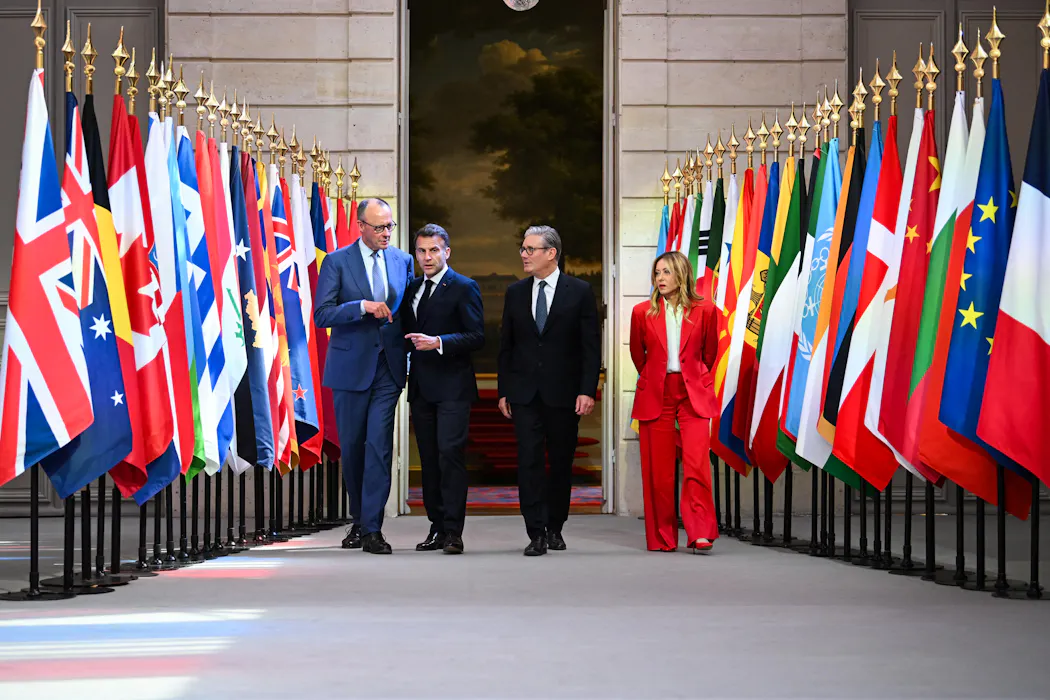
German Chancellor Friedrich Merz, French President Emmanuel Macron, British Prime Minister Keir Starmer and Italian Prime Minister Giorgia Meloni arrive for a press conference at the Elysee Palace in Paris on April 17, 2026. Jeanne Accorsini/Pool/AFP via Getty Images

Days after U.S. and Israeli strikes on Iran began on Feb. 28, 2026, Spanish Prime Minister Pedro Sánchez denied American forces the use of the Naval Station Rota and the Morón Air Base – installations that had hosted U.S. troops for more than 70 years.

“We are a sovereign country that does not wish to take part in illegal wars,” Sánchez said. U.S. President Donald Trump responded by threatening a full trade embargo against Spain.

Weeks later, Italian Prime Minister Giorgia Meloni – Trump’s closest European ally and the only EU head of government invited to his second inauguration – broke publicly with Washington.

“When we don’t agree, we must say it,” she said. “And this time, we do not agree.” Rome then refused to let U.S. bombers refuel at a base in southern Italy.

These are not minor diplomatic frictions. As a scholar of alliance politics and nuclear security, I see something much larger than a tactical disagreement. The Iran war’s most consequential casualty may not be in Tehran. It may be American credibility as an ally, and with it, the trans-Atlantic alliance itself.

The Iraq comparison misleads

The initial U.S. and Israeli strikes on Iran were launched with virtually no advance consultation with European allies. The Trump administration treated NATO partners not as participants in strategic decision-making but as logistical infrastructure to be commandeered or punished for refusing assistance.

European governments, even those most invested with the U.S., declined to join the campaign. The Trump administration has responded with the embargo threat against Spain and the withdrawal of 5,000 U.S. troops from Germany.

“The U.S.A. will REMEMBER!!!” Trump posted on Truth Social on March 31, 2026.

The reflex in Washington has been to read this as a rerun of 2003, when France and Germany opposed the Iraq War. In January 2003, Defense Secretary Donald Rumsfeld dismissed France and Germany as “old Europe” while courting the postcommunist “new Europe,” including Poland, the Czech Republic and Hungary.

On the surface, the parallel is tempting: a unilateral American war in the Middle East, European refusal to participate, trans-Atlantic recriminations.

Protestors carry three posters depicting lawmakers with crowns on their heads.
Protesters against the Iran war carry placards in Rome on March 28, 2026, depicting U.S. President Donald Trump, Italy’s Prime Minister Giorgia Meloni and Israeli Prime Minister Benjamin Netanyahu. Tiziana Fabi/AFP via Getty Images

But the comparison conceals more than it reveals. In 2003, the United States wanted Europe in its coalition. The George W. Bush administration sought United Nations authorization, courted allies and treated European refusal as a problem to be managed.

In 2026, the Trump administration explicitly does not want European input. It views allies as freeloaders and threatens them with economic coercion. It treats their hesitation as cause for retribution rather than negotiation.

The deeper difference is structural. In 2003, the trans-Atlantic alliance still rested on shared commitments to collective defense, open trade and an international, rules-based order.

Today, the Trump administration does not share the commitments that traditionally bound the United States to its European partners, whether on NATO, the Russia-Ukraine war, or the rules governing trade and migration.

The shared values that papered over the Iraq disagreement in 2003, and that allowed President Nicolas Sarkozy to reintegrate France into NATO’s command by 2009, are no longer there to do the work of repair.

The April 2026 collapse of Viktor Orbán’s 16-year rule in Hungary left Trump without a serious political ally among major European governments.

The real precedent is Suez

A more illuminating precedent lies further back. In 1956, Britain and France went to war with Egypt over the Suez Canal, in coordination with Israel, deliberately concealing their plans from the Eisenhower administration. Washington responded by threatening to crash the British pound, forcing London and Paris into humiliating retreat.

The crisis is conventionally remembered as the moment Britain accepted that it was no longer an independent great power.

But its more important legacy was strategic. Suez exposed the depth of Europe’s dependence on the United States. That humiliation drove Charles de Gaulle’s pursuit of an independent French nuclear deterrent. It also accelerated European integration and planted the recognition that genuine strategic autonomy would be a generational project.

The Iran war inverts the conditions of that lesson. In 1956, Europeans learned that they could not act independently of Washington. In 2026, they are learning that they cannot rely on Washington’s consent being available, and that the U.S. will act without them, against their stated interests and at their economic expense.

Two men in suits and ties talk while seated in front of a table.
Secretary of State John Foster Dulles, left, and President Dwight Eisenhower discuss the nationalization of the Suez Canal by the Egyptian government in August 1956 at the White House. Abbie Rowe/PhotoQuest via Getty Images

The pattern is the same: Dependence on the U.S. is unsustainable, and autonomous capacity is no longer optional. What has changed is that Europe is now willing to use the financial, economic and military tools it has long possessed in ways it would not have considered before.

The EU’s €90 billion joint-debt loan to Ukraine signals an autonomous European strategic stance. So do discussions of activating the bloc’s anti-coercion trade instrument against U.S. tariffs, France’s nuclear arsenal expansion and offers to “Europeanize” deterrence.

The strategic postures were debated for decades. The Iran war is making them operational.

This is not yet European strategic independence. Europe remains militarily reliant on U.S. air defense, satellite capacity and intelligence.

The closure of the Strait of Hormuz, for example, has forced an uncomfortable energy reckoning with American liquefied natural gas, Russian pipelines, Middle Eastern hydrocarbons and Chinese-dominated renewable supply chains. None of the available paths to energy security run through trusted partners.

France and Germany still disagree on nearly every detail of how integration should proceed. But the political condition for autonomy, a shared European belief that Washington can no longer be trusted to share strategic decision-making, has crystallized in a way that no previous crisis produced.

The post-1945 trans-Atlantic bargain traded U.S. security guarantees for European deference on global strategy. Iraq 2003 strained that bargain. Trump’s first term cracked it, and the Iran war has broken it.

What replaces it will not be a renewed partnership. It will be a parallel relationship between two powers with sometimes overlapping interests and, increasingly, separate strategic horizons.

In 1956, Europe learned how dependent it was on Washington. In 2026, it is learning that dependence is no longer sustainable.

Eleni Lomtatidze, a student in the International Relations Program at the University of Pennsylvania and at SciencesPo Paris, contributed to this story.

The Conversation

Farah N. Jan does not work for, consult, own shares in or receive funding from any company or organization that would benefit from this article, and has disclosed no relevant affiliations beyond their academic appointment.

  •  
❌