Reading view

Is soccer taking over America … or are Americans taking over football?
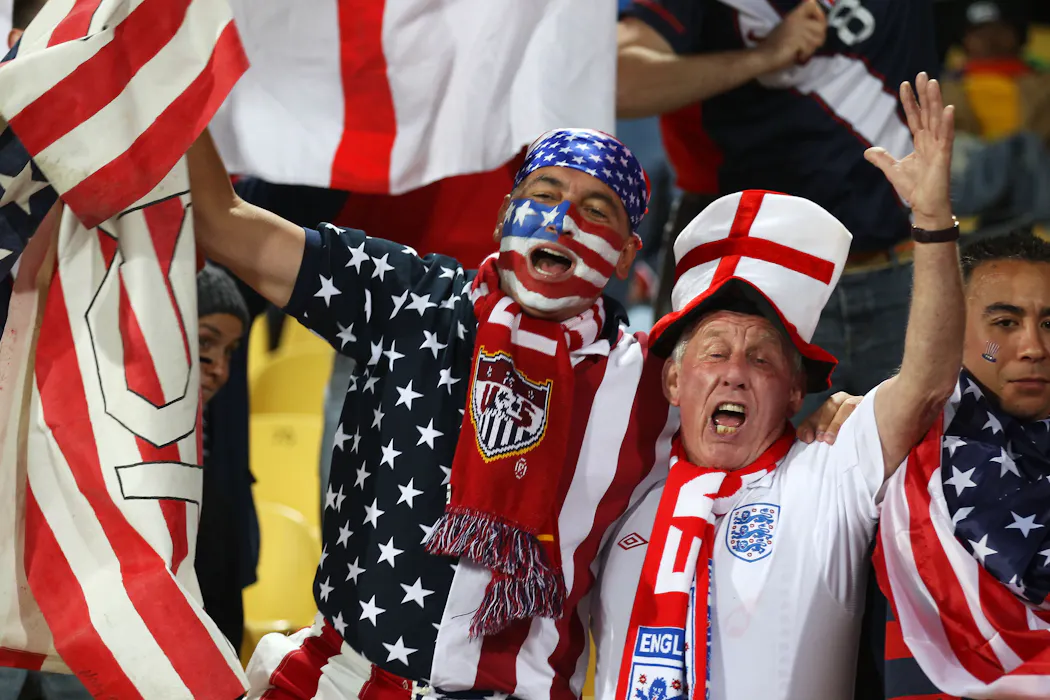
Not all soccer fans are happy with American interest in their clubs. Phil Cole/Getty Images

Soccer purists have long feared the “Americanization” of the game. But in one key respect, it is already happening: ownership.

Americans now own more than 40 European soccer clubs, including current English Premier League champion Arsenal, Italian Serie A champion Inter Milan and storied teams such as Manchester United and Liverpool. Americans are also investing heavily in the lower leagues, taking ownership of two dozen clubs outside the top division, including Birmingham City, whose ownership group includes former NFL star Tom Brady, and Norwich City, purchased by Milwaukee Bucks owner Mark Attanasio in 2022.

And while global fans may carp at superficial changes that hint at the growing influence of American culture – halftime shows, cheerleaders and the use of “soccer” over “football – the reality is, it is at the level of ownership where Americans have the biggest capacity to change the game. It is a trend my colleagues and I have been charting for several years.

The yanks are coming, the yanks are coming!

U.S. sports ownership norms and rules differ greatly from the traditional European model: U.S. owners tend to operate like "emperors” who can move franchises from city to city in pursuit of bigger profits; European owners are more inclined to act as “caretakers” and traditionally come from the local business community. They see their teams as passion projects that they’re willing to sink money into.

But the global rise of soccer has seen wealthy Americans increasingly take an interest in European teams. It began in earnest in 2005 when American businessman Malcolm Glazer bought Manchester United. The Glazer-leveraged buyout sparked protest from the club’s supporters trust at the time and has grown as the owners sucked out more than 1 billion pounds from the club to pay back debt interest, repayments, dividends and fees.

But such opposition, which has only accelerated since 2018 with the entrance of U.S. private equity groups, has done little to put off American owners.
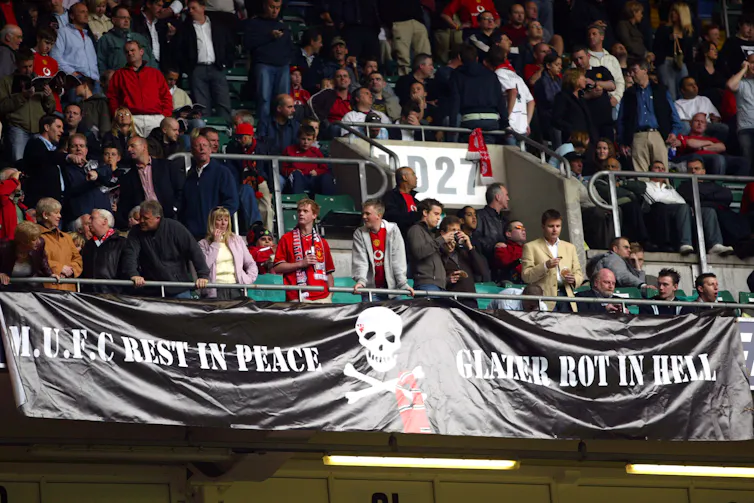
A large banner is seens saying 'MUFC Rest in Peace. Glazer rot in hell.
Malcolm Glazer isn’t everyone’s favorite person in Manchester. Mike Egerton/PA Images via Getty Images

Today, there are 11 American ownership groups in the English Premier League – and they are more accustomed to the U.S. way of doing things. Combined, they own six NFL teams, four NBA teams, two MLB franchises and four NHL clubs. Stan Kroenke, the owner of English champion Arsenal, also owns the Los Angeles Rams, the NBA’s Denver Nuggets and the NHL’s Colorado Avalanche.

Ownership of these franchises has made some very rich men ever more wealthy as the value of top teams grew. But traditional soccer fans are increasingly concerned about this shift toward a profit-driven style of ownership.

The ups and downs of the pyramid system

But there is a potential barrier to these American owners making megabucks: the structure of soccer itself. It represents a battle between U.S. “closed” leagues – that is, with fixed franchises – and a European pyramid structure in which teams can drop down divisions, wiping millions of dollars off their valuation in the process.

To understand why U.S. and English leagues have these different models, you need to look back to how professional sports leagues in the two territories were originally designed. Until the late 19th century, sports in England and the U.S. followed similar trajectories, with the baseball teams in America and soccer teams in England playing in organized leagues with predictable schedules.

Then, in 1876, baseball’s National League was founded with territorial exclusivity for teams and, by 1891, a constitution that enshrined eight permanent members. New franchises were not absorbed into the National League but instead formed the American League. Underperforming professional baseball teams could not be ejected or relegated to a minor league even if they lost every game. Meanwhile, franchises could relocate to new cities at will.

Other U.S. sports adopted baseball’s monopolistic system of fixed teams with all-powerful owners – a system that, by the 21st century, produced regular profits, the world’s highest-valued sports teams and absolute power for owners.

In contrast, England’s Football League, which began life in 1888, had a fluid membership – exchanging its weakest teams with the strongest teams from the rival Football Alliance to create a two-tier system. The English pyramid system took shape after another rival league was absorbed in 1894 as the third tier.

From the outset there was the possibility of teams moving up – or being promoted – based on their performance on the pitch. Conversely, teams could be demoted if they played badly.

This pyramid structure quickly became the norm for soccer around the world and enshrined in FIFA statutes.
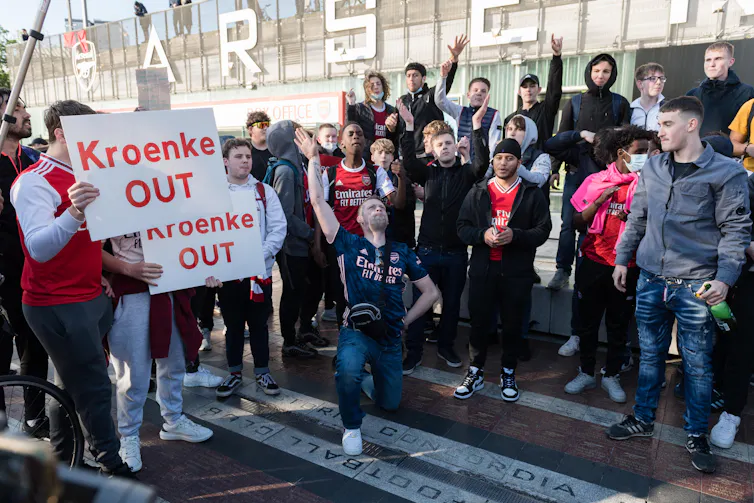
A group of people stand and kneel with a sign reading 'Kroenke out'
Arsenal fans gather to demand the resignation of club owner and American billionaire Stan Kroenke on May 6, 2021. Wiktor Szymanowicz/Future Publishing via Getty Images

A fans’ revolt

Promotions and regulations create drama, romance, season-long tension and fan passion that help make soccer the most popular sport in the world.

But it also terrifies many American owners.

Burnley and West Ham, English clubs with significant American investment, were recently relegated to the second tier of the English pyramid – a move that will likely devastate their budgets and valuations. American-owned Hellas Verona and Pisa in Italy and Girona and Mallorca in Spain were likewise demoted to the second divisions.

Spooked U.S. owners have begun to lobby for change – and the safeguarding of their lucrative sporting investments. And it was little surprise that American fingerprints were all over the April 2021 announcement of the “closed” European Super League. The elite competition would have guaranteed permanent participation for 12 to 15 teams, plus a handful of rotating annual participants, in a new, multibillion-dollar continental competition.

The breakaway league was to be financed with $4 billion from U.S. banking giant JPMorgan. Four of the teams – AC Milan, Arsenal, Liverpool and Manchester United – are American-owned.

The European Super League would have Americanized elite European football in one fell swoop, with fixed franchises, no threat of relegation and league control by the owners or presidents of the permanent teams.

But fans, coaches and former players from the six English Premier League teams involved revolted against an elite competition without relegation, calling it an “ultimate betrayal.” All six formally withdrew within 72 hours of the league’s announcement, joining Germany’s two biggest teams, Bayern Munich and Borussia Dortmund, which refused from the outset to join. France’s Paris Saint-Germain also refused an invitation.
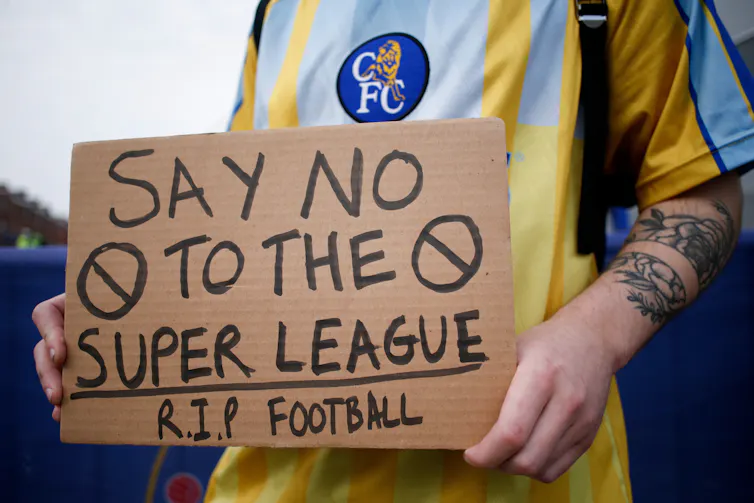
A person in a football jersey holds a sign reading 'Say No to the Super League. R.I.P. Football.'
Chelsea fans protest on April 20, 2021, against the establishment of the breakaway European Super League. David Cliff/Anadolu Agency via Getty Images

While the effort to create fixed franchises in Europe has, for now, been foiled, Americanization is still happening in smaller steps. Many of the changes are benign, such as cheerleaders and halftime entertainment. Other changes are more profound. American professional sports leagues often tweak rules to increase scoring, and FIFA is now experimenting with a new offside rule that would lead to more goals, reduce major upsets and benefit wealthier clubs.

Todd Boehly, co-owner of the Los Angeles Lakers and Los Angeles Dodgers, Strasbourg FC in France’s Ligue 1 and Chelsea in the U.K., is one of the American cheerleaders for this type of change.

He argues that the English Premier League should learn from American sports to increase revenue, including by introducing all-star games and postseason playoffs. Much of this is self-interest: Boehly’s Chelsea FC needs all the additional revenue it can find as the club announced record pre-tax losses of US$349 million for the 2024-25 season.

Welcome to … where now?

Some American franchise owners have given up on trying to change the European game and are looking elsewhere. U.S. capital is now being invested in a potential fixed-franchise league in Mexico. Mexico’s first division, Liga MX, whose television viewership in the United States exceeds that of the English Premier League and MLS combined, paused relegations for six seasons in 2020 due to the financial uncertainty brought on by COVID-19. Five of the 18 Liga MX clubs are now American-owned, and a return to relegations looks increasingly unlikely.

A group of people point and stand.
Ryan Reynolds and Rob McElhenney, co-owners of Wrexham FC, celebrate their team’s success on March 7, 2026. Robbie Jay Barratt/AMA via Getty Images

Hollywood actor Rob Mac (formerly McElhenney), who co-owns Wrexham FC in the U.K. with Ryan Reynolds, documented the romance of promotions in the TV documentary “Welcome to Wrexham.” But as a co-owner, with Eva Longoria, of Liga MX club Necaxa, Mac appears less enamored of the pyramid system in Mexico, pointing out “the potential value and devaluation of the clubs.”

Liga MX could soon become the first soccer league to fully transition from an established promotion and relegation system to a fixed-franchise model.

And that would be a significant step toward the global Americanization of the beautiful game.

The Conversation

Kirk Bowman does not work for, consult, own shares in or receive funding from any company or organization that would benefit from this article, and has disclosed no relevant affiliations beyond their academic appointment.
  •  

5 reasons Stephen Colbert is one of the most important satirists in American history

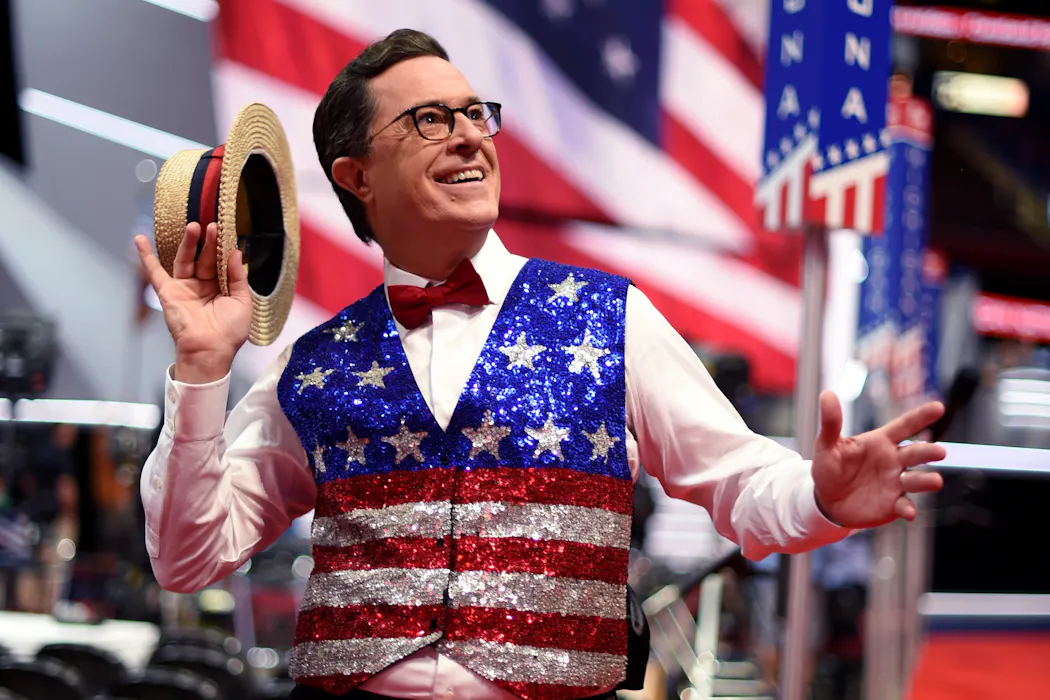
Stephen Colbert tapes a segment for 'The Late Show' at Quicken Loans Arena ahead of the 2016 Republican National Convention in Cleveland. Timothy A. Clary/AFP via Getty Images

Stephen Colbert’s final episode as host of “The Late Show” on May 21, 2026, won’t mark the end of his career.

But as a scholar of political satire, I think it offers a chance to reflect on the lasting impact of his comedy, which has spanned his work as a correspondent on “The Daily Show,” his conservative pundit persona on “The Colbert Report” and his reinvention on “The Late Show.”

The best satirists do more than entertain. They influence public discourse and leave lasting marks on political life. This group includes towering writers such as Benjamin Franklin and Mark Twain, alongside performers like Lenny Bruce and George Carlin.

In my view, Stephen Colbert has earned a spot in the top tier. Here are five reasons why.

1. He didn’t just satirize the news – he informed the public

Most satirists offer wry commentary about political events.

Colbert often did something more ambitious: He helped audiences understand them.

Critics have long dismissed political comedy as superficial entertainment, but Colbert’s satire frequently offered valuable information to the public.

In 2010, the U.S. Supreme Court’s Citizens United decision transformed campaign finance law, tilting political influence toward wealthy people and corporations. As host of the “Colbert Report,” the comedian responded by creating an ongoing series of “Colbert Super PAC” segments. Working with former Federal Election Commission Chair Trevor Potter, Colbert was able to translate the opaque mechanics of campaign finance law into accessible civic education.

The best satirists don’t just make people laugh. They help people understand power. And with that in mind, Colbert is among the best.

It’s hard to fully track the impact of this approach. But a 2007 Pew Research Center study did find that audiences for satirical news programs such as “The Daily Show” and “The Colbert Report” scored high on political knowledge measures, outperforming audiences who only consumed political news from traditional outlets.

That urge to use satire as a vehicle for civic education continued after Colbert became host of “The Late Show” in 2015.

With debates raging over the border wall proposed by the first Trump administration, Colbert brought experts on to the program to break down the engineering, financial and logistical realities of building one that spanned the entirety of the U.S.-Mexico border. Yes, the absurdity of the physics and finances elicited laughs. But Colbert also helped viewers understand why Trump’s promises were implausible.

2. He gave Americans a new political vocabulary

When the world is absurd, the satirist uses ironic wit to make sense of it.

Colbert excelled at distilling the spin and duplicity of politics into memorable soundbites.

On the first episode of “The Colbert Report” in 2005, he introduced the word “truthiness” to describe the tendency to prefer what “feels true” over what the evidence supports. It incisively gave a name to a deceptive political tactic, one that the Bush administration had repeatedly used, from “Mission Accomplished,” to “weapons of mass destruction” and “enhanced interrogation techniques.”

“Truthiness” took on a life of its own. Merriam-Webster named it Word of the Year in 2006.

Colbert continued this rhetorical work on “The Late Show.” For example, in February 2017, after Donald Trump escalated his attacks on the press by labeling major news outlets “the enemy of the American people,” the comedian shifted from parody to diagnosis. He foregrounded the phrase’s authoritarian history, insisting that the rhetoric signaled a meaningful escalation in attacks on First Amendment rights, rather than a passing controversy.

In other words: There was nothing to laugh about here.

Colbert used his platform to highlight the dangers of unrestricted, anonymous donations in politics.

3. He blurred the line between satire and direct action

Media scholars have increasingly noted how political comedians now function as hybrid figures who blur journalism, entertainment and civic engagement. According to communications scholar Joseph Faina, Colbert may be one of the clearest examples of that shift.

Colbert’s satirical presidential campaign in South Carolina in 2007 mocked the theater of American electoral politics. He actually attempted to enter the race through official channels, only to be blocked by the South Carolina Democratic Party. But even in his failure to appear on the ballot, he was able to show how party control and media spectacle, not just voter choice, structure the field of viable candidates.

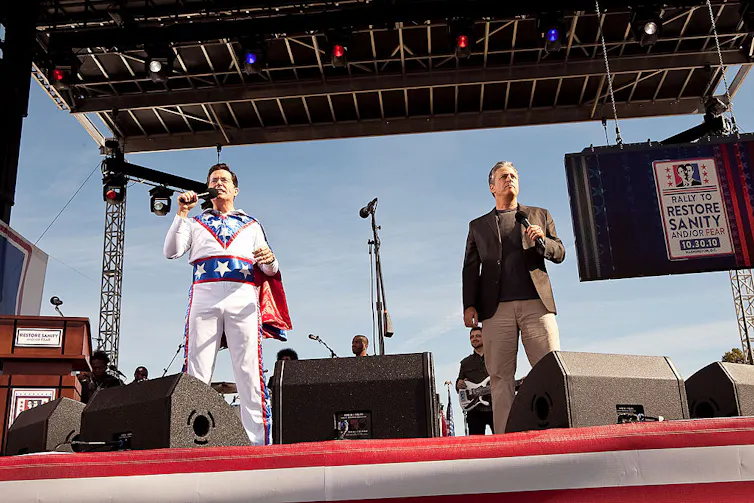
In 2010, he held a rally with Jon Stewart on the National Mall before a crowd of over 200,000 people. Assuming his conservative pundit persona, Colbert blended irony and sincerity, mocking the self-seriousness, sensationalism and outrage-driven news cycles of cable news through his competing calls for “sanity” and “fear.” But the event was also designed to motivate voter turnout in the midterm elections.

That interventionist impulse continued on “The Late Show.” During the 2020 election cycle, for example, Colbert encouraged voting through segments like “Better Know a Ballot.” A riff on his previous “Better Know a District” from “The Colbert Report,” the “Better Know a Ballot” series was designed to educate viewers about ballot access, voting procedures and the practical elements of democratic participation.

Two middle-aged men, one wearing a red, white and blue daredevil outfit with a cape, hold microphones on stage.
Stephen Colbert, left, and comedian Jon Stewart onstage at their ‘Rally to Restore Sanity and/or Fear’ on Oct. 30, 2010, in Washington, D.C. Paul Morigi/WireImage via Getty Images

4. He measurably influenced political behavior

Claims about comedians changing politics can easily become exaggerated. But Colbert’s influence has empirical support.

Research by political communication scholars Jody Baumgartner and Jonathan Morris found that exposure to political satire can increase viewers’ sense of what’s known as “political efficacy” – the belief that they can understand and engage with politics. Other studies suggest satirical news audiences are often more politically active than they’re assumed to be.

Colbert is repeatedly cited in these studies as one of the prime examples of a satirist who makes an impact.

Take, for instance, the so-called “Colbert bump,” where candidates who appear on his programs experience boosts in fundraising, visibility and media coverage. Political scientist James H. Fowler found that Democratic candidates who appeared on “The Colbert Report” experienced a 44% increase in campaign donations within 30 days of their appearance.

A similar effect could be seen on “The Late Show.”

After Colbert interviewed Texas state Rep. James Talarico, a U.S. Senate candidate, in February 2026, CBS canceled the segment, claiming – perhaps disingenuously – that the network could be punished for not adhering to the FCC’s “equal time” rule, which requires broadcast stations to offer comparable airtime to opposing candidates.

A taped version of the interview was nonetheless posted to YouTube, where it racked up over 9 million views, helping fuel Talarico’s US$27 million first-quarter fundraising haul, the largest amount ever raised by a U.S. Senate candidate in the first quarter of an election year.

5. He redefined American patriotism

To rank Colbert among America’s most important satirists requires one additional consideration: his role in redefining not only what America stands for, but what it means to be patriotic.

Many satirists lean toward cynicism, portraying politics as hopelessly corrupt and public life as fundamentally absurd. Not Colbert.

As linguist Geoffrey Nunberg argued in his 2006 book, “Talking Right: How Conservatives Turned Liberalism into a Tax-Raising, Latte-Drinking, Sushi-Eating, Volvo-Driving, New York Times-Reading, Body-Piercing, Hollywood-Loving, Left-Wing Freak Show,” conservatives had claimed a monopoly on patriotism as the 20th century drew to a close. At the same time, many of them promoted what’s known as “blind patriotism,” in which any criticism of the U.S. is cast as evidence of insufficient national loyalty.

Colbert’s satire directly challenged that framework.

To expose that performative patriotism, Colbert’s persona on “The Colbert Report” wrapped itself in exaggerated patriotic imagery: flags, bombast, overconfidence and chest-thumping nationalism.

But the joke was never America itself. The target was a performance of patriotism that treated dissent as disloyalty, emotional certainty as evidence and partisan identity as civic virtue.

As I argue in my 2011 book, “Colbert’s America,” Colbert’s satire consistently distinguished between nationalism and democratic patriotism. The former demands unquestioning loyalty. The latter demands accountability. For example, through segments like “Threat-Down” on “The Colbert Report,” he satirized the way nationalism often depends on exaggerating fictive dangers and denouncing symbolic, external enemies.

In that sense, Colbert belongs in a distinctly American satirical tradition that stretches back to Benjamin Franklin. The great American satirists have used humor not to reject the national project, but to expose the gap between its ideals and its realities. They reshape how citizens understand power and civic responsibility.

For nearly three decades, Stephen Colbert has done exactly that.

The Conversation

Sophia A. McClennen does not work for, consult, own shares in or receive funding from any company or organization that would benefit from this article, and has disclosed no relevant affiliations beyond their academic appointment.

  •  

‘Soccer’ is a fine term for the beautiful game – don’t let any ‘football’ snob or president tell you otherwise this World Cup

Scoring points over what you call the game isn't on. Matt Williams/The Conversation, CC BY

At the 2026 World Cup draw, FIFA Peace Prize recipient and U.S. President Donald Trump announced that the game should really be called “football.”

“There’s no question about it. We have to come up with another name for the NFL. It really doesn’t make any sense,” said Trump, an apparently new convert to the round-ball game.

He isn’t alone. The word “soccer” is, in some parts of the world, shunned by some fans.

Indeed, as a scholar of the sport who teaches a course called Soccer and Global Politics, I am bombarded with comments that the word “soccer” does not make any sense, and that people who use that term obviously know nothing about the beautiful game.

To me, this disparagement of the word “soccer” is not only petty and tiresome – it is also incorrect. It ignores the roots of the sport and the development of the language of the game.

Rather than making the word taboo, the football ecosystem should embrace it. To understand why, let’s go back to the beginning.

Associated to ‘assoc’ and then ‘soccer’

The game has been around in various forms for centuries, but it began to be codified in the mid-19th century.

“Association Football” was coined in 1863 to distinguish the game from rugby football, which, somewhat ironically, is played largely with the ball in hand.

British university students created their own slang at the time by abbreviating words and adding “-er” to them. Thus, “rugby” became “rugger” and “association football” was shortened to “assoc” and slanged to “soccer.”

And this term “soccer” was freely and proudly used in the British press and in public for nearly a century, until the 1980s.

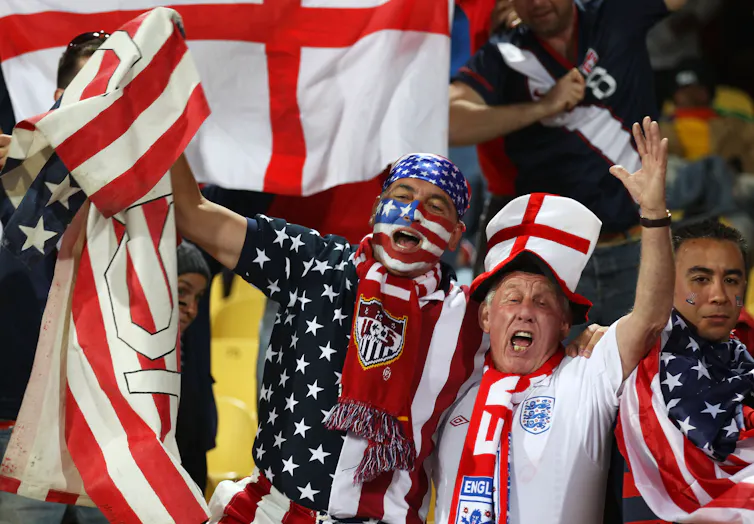
Soccer fans in English and USA garb celebrate together.
United by a common love of the game (whatever you call it). Phil Cole/Getty Images

In countries with other established codes of football – American football, Australian rules football and Gaelic football in Ireland – “soccer” became the dominant term. But British fans began abandoning the word in the 1980s, largely as a response to the embrace of the term in the States. And now, in the U.K. especially – but also among fans in the U.S. and Canada who present as “true” fans of the game – there are attempts to shame those who use the very term that the British invented and proudly used.

And that’s a pity. After all, using the word “soccer” has benefits. The British press continues to use “soccer” and “football” interchangeably to avoid repetitive writing. The shorter word is useful for tabloid editors when creating tight headlines. And using both words does not reveal that a person is ignorant but rather cosmopolitan.

The widespread use of “soccer” in Britain is still evident in the ongoing success of authoritative magazine World Soccer, founded in London in 1960; the TV show “Soccer AM,” which ran every Saturday from 1994 to 2023; the annual British charity match Soccer Aid; and Sky Sports’ “Soccer Saturday.” All document the enduring legacy of the term in Britain, despite the naysayers.

A shared vernacular

The beautiful game is also a universal one with a language shared by some 4 billion people.

Language evolves, and fans today equally understand “football,” “soccer,” “calcio,” “futebol” or “fútbol.”

Embracing all the variations of the beautiful game enriches the conversation. It illustrates the sport’s globalization and universal language, a shared vernacular that cuts across identities.

And besides, nobody wants the war that would ensue if American football fans were forced to find another name!

The Conversation

Kirk Bowman does not work for, consult, own shares in or receive funding from any company or organization that would benefit from this article, and has disclosed no relevant affiliations beyond their academic appointment.

  •  

Reduced health insurance payments for hospital births had a bigger impact on sterilization rates than correcting an injustice

Public outrage over the forced sterilization of poor, Black women had less impact on female sterilization rates in the U.S. than a policy changing how post-birth care is delivered. DisobeyArt/iStock via Getty Images Plus

For decades, female sterilization has been one of the most common forms of birth control in the U.S.: 11.5% of U.S. women, ages 15-49, use female sterilization as their primary contraceptive method – nearly identical to the pill.

But the history of sterilization is also deeply entangled with coercion in the form of racial targeting, invalid consent and state control.

As a health economist and a political scientist, we wanted to better understand what factors influence women’s choices around contraception and sterilization. Our recent study found that a policy change in the 1990s which reduced the length of hospital stays for women giving birth appears to have inadvertently had a more meaningful effect on female sterilization rates in the U.S. than a landmark civil rights intervention in the 1970s.

This leads us to believe that seemingly innocuous, practical policy changes may exert greater influence on women’s reproductive choices than even public outrage over an injustice.

In 1974, the case of Relf v. Weinberger revealed that between 100,000-150,000 girls and women, most of them poor and Black, were sterilized each year at federally funded public health clinics from 1970 to the time the case was heard.

Looking at inflection points

In our study, we revisited Relf v. Weinberger, a 1974 civil rights case that involved the sterilization of two Black girls – the Relf sisters – without valid consent. The girls’ mother was told they were receiving a birth control shot that would temporarily prevent pregnancy. Instead, doctors subjected them to an unwanted tubal ligation surgery, in which the fallopian tubes are sealed off to permanently prevent pregnancy.

The Relf sisters were not alone: In the the early 1970s, the sisters’ case helped bring to light broader patterns in federally funded sterilization that included invalid consent and pressure tied to public benefits. Though the U.S. District Court did not find that each of these sterilizations had been coerced per se, it did find strong evidence that minors and people legally unable to consent had been sterilized with federal funds, and that sterilization was often presented as a requirement for families to maintain welfare or other government benefits. The court ruled that federally funded medical procedures require informed, uncoerced consent.

Our study examined how the public outrage, litigation and consent reforms that followed reshaped U.S. sterilization trends in the 50 years after the court ruled in favor of the Relf girls.

We then compared those effects with another, less visible inflection point in the history of female reproductive health that began in 1992, often called the “drive-through delivery” era. At this time, insurance companies instituted fixed payments to hospitals for each birth. This meant that hospitals received the same payment whether women giving birth stayed one night or two nights afterward. The practical effect was that more women who had uncomplicated births were sent home after just one night in the hospital.

The 1996 Newborns’ and Mothers’ Health Protection Act was meant to end this era, but the shift towards shorter postpartum stays persisted in an effort to cut costs.

This shortened hospital stay after birth posed a problem for women who wanted to be sterilized: Tubal ligation is logistically easy to provide immediately postpartum, while a patient is already hospitalized after giving birth. But when insurers pushed shorter postpartum stays, providers had less time to schedule and perform the procedure, meaning fewer women ended up getting the surgery.

How we did the study

We compared U.S. sterilization trends with those in other countries that had similar trends. Those countries gave us a way to estimate what U.S. sterilization patterns might have looked like if the Relf ruling or changes to hospital payment policies had not occurred. We did not look at individual medical decisions in isolation, but instead tracked patterns in how often sterilization is used across the country.

We asked a simple but important question: What actually changed sterilization practices over time? Was it the highly visible public backlash invoked by the Relf ruling? Or was it a quieter administrative change in how childbirth care was organized and paid for?

We found that the Relf case and subsequent consent reforms, including a 30-day waiting period and minimum age of 21 for federally funded sterilizations, slowed growth in U.S. female sterilization but did not reverse the broader trend. Female sterilization was still becoming more common: The national rate rose from about 5% in 1970 to about 13% in 1975. After a brief pause following the ruling and the new consent rules, it continued climbing. BY 1990, nearly 1 in 4 married women aged 15-49, were sterilized.

Nor did we see a meaningful shift in the populations most at risk of state-targeted sterilization: younger Black women in the South.

By contrast, the administrative payment reforms of the 1990s were associated with the first national declines in sterilization since the 1960s.

Why it matters

Sterilization is not inherently good or bad. It is a highly effective and often desired form of permanent contraception.

That matters now more than ever. In the 2022 case of Dobbs v. Jackson Women’s Health, the U.S. Supreme Court ruled that states can set their own abortion laws, essentially limiting abortion access for many Americans. Since this ruling, our colleagues have found increases in permanent contraception, particularly among younger adults and in states with abortion bans.

In another study, we described limiting patient choices by not providing adequate birth control options as a problem of coercion built into the very structure of the healthcare system.

The issue is not always that patients are forced into, or denied, care altogether. Often, they are offered a narrowed set of options that may look like choice, but do not fit what best meets their needs. A person with diabetes, for example, may technically have access to insulin, but only to a formulation, device or at a pharmacy location that is hard to use safely or access in their daily life.

In reproductive care, we argue that restricting options in this way can be a form of coercion, even when it is less visible.

a postpartum mother speaks with a doctor in the hospital
Tubal ligation is logistically simplest after a woman gives birth, but shortened postpartum hospital stays have made it more difficult for patients who want the procedure to get it at that time. SDI Productions/E+ via Getty Images

A two-way problem

At the same time, many patients report being unable to obtain sterilization when they do want it because of Medicaid consent rules, hospital logistics, staffing limits, insurance timing or institutional restrictions.

So the problem goes two ways: Some people are pushed toward permanent contraception by a restrictive reproductive policy environment, while others are blocked from obtaining it when they want it.

That tension is precisely why sterilization is such an important issue. If rates rise or fall in response to payment incentives, discharge practices or insurance rules, it calls into question whether patient decisions are straightforward expressions of free choice. This is true for reproductive care broadly but has unique human rights implications when the method is permanent.

Our findings suggest that sterilization trends are highly responsive to policy shifts, and not only those driven by public outrage. This raises an uncomfortable question: To what extent do trends in sterilization rates truly reflect what people want, and to what extent do they reflect the choices patients were steered toward by the design of the healthcare system?

The Conversation

The authors do not work for, consult, own shares in or receive funding from any company or organization that would benefit from this article, and have disclosed no relevant affiliations beyond their academic appointment.

  •  

‘Soccer’ is a fine term for the beautiful game – don’t let any ‘football’ snob or president tell you otherwise this World Cup

Scoring points over what you call the game isn't on. Matt Williams/The Conversation, CC BY

At the 2026 World Cup draw, FIFA Peace Prize recipient and U.S. President Donald Trump announced that the game should really be called “football.”

“There’s no question about it. We have to come up with another name for the NFL. It really doesn’t make any sense,” said Trump, an apparently new convert to the round-ball game.

He isn’t alone. The word “soccer” is, in some parts of the world, shunned by some fans.

Indeed, as a scholar of the sport who teaches a course called Soccer and Global Politics, I am bombarded with comments that the word “soccer” does not make any sense, and that people who use that term obviously know nothing about the beautiful game.

To me, this disparagement of the word “soccer” is not only petty and tiresome – it is also incorrect. It ignores the roots of the sport and the development of the language of the game.

Rather than making the word taboo, the football ecosystem should embrace it. To understand why, let’s go back to the beginning.

Associated to ‘assoc’ and then ‘soccer’

The game has been around in various forms for centuries, but it began to be codified in the mid-19th century.

“Association Football” was coined in 1863 to distinguish the game from rugby football, which, somewhat ironically, is played largely with the ball in hand.

British university students created their own slang at the time by abbreviating words and adding “-er” to them. Thus, “rugby” became “rugger” and “association football” was shortened to “assoc” and slanged to “soccer.”

And this term “soccer” was freely and proudly used in the British press and in public for nearly a century, until the 1980s.

Soccer fans in English and USA garb celebrate together.
United by a common love of the game (whatever you call it). Phil Cole/Getty Images

In countries with other established codes of football – American football, Australian rules football and Gaelic football in Ireland – “soccer” became the dominant term. But British fans began abandoning the word in the 1980s, largely as a response to the embrace of the term in the States. And now, in the U.K. especially – but also among fans in the U.S. and Canada who present as “true” fans of the game – there are attempts to shame those who use the very term that the British invented and proudly used.

And that’s a pity. After all, using the word “soccer” has benefits. The British press continues to use “soccer” and “football” interchangeably to avoid repetitive writing. The shorter word is useful for tabloid editors when creating tight headlines. And using both words does not reveal that a person is ignorant but rather cosmopolitan.

The widespread use of “soccer” in Britain is still evident in the ongoing success of authoritative magazine World Soccer, founded in London in 1960; the TV show “Soccer AM,” which ran every Saturday from 1994 to 2023; the annual British charity match Soccer Aid; and Sky Sports’ “Soccer Saturday.” All document the enduring legacy of the term in Britain, despite the naysayers.

A shared vernacular

The beautiful game is also a universal one with a language shared by some 4 billion people.

Language evolves, and fans today equally understand “football,” “soccer,” “calcio,” “futebol” or “fútbol.”

Embracing all the variations of the beautiful game enriches the conversation. It illustrates the sport’s globalization and universal language, a shared vernacular that cuts across identities.

And besides, nobody wants the war that would ensue if American football fans were forced to find another name!

The Conversation

Kirk Bowman does not work for, consult, own shares in or receive funding from any company or organization that would benefit from this article, and has disclosed no relevant affiliations beyond their academic appointment.
  •  
❌