Metal credit cards have become a visible symbol of premium banking, often associated with exclusivity, higher spending limits, and luxury benefits. Their weight and finish set them apart instantly, but the real question for most users is a practical one. Do metal credit cards actually offer enough value to justify the upgrade, or are they more about appearance than usefulness? Banks such as IDFC FIRST Bank offer premium credit cards that focus on feature-driven value rather than novelty alone.
Understanding what metal credit cards truly offer helps consumers decide whether the upgrade makes financial sense.
What Is a Metal Credit Card?
A metal credit card is exactly what it sounds like. The card is made partially or fully from metal rather than plastic. This design choice is usually paired with premium positioning, higher eligibility criteria, and enhanced benefits.
However, the material itself does not change how the card functions. Payments, acceptance, and security remain the same as any other credit card. The difference lies in the benefits it offers and the user segment it targets.
Why Are Metal Credit Cards Appealing?
Metal credit cards appeal to users who value premium experiences and visible differentiation. The physical feel of the card creates a sense of exclusivity that plastic cards cannot replicate.
Beyond appearance, metal cards are often positioned as top-tier products with added privileges such as higher reward rates, travel benefits, and lifestyle perks. For some users, this alignment of status and features is appealing.
The real test is whether the benefits justify the annual fee.
Benefits That Usually Come with Metal Credit Cards
Metal credit cards typically include a range of premium features, though the exact mix varies by issuer. Before considering an upgrade, it helps to understand what these cards generally offer.
Enhanced Rewards: Higher reward rates on travel, dining, or premium spends.
Higher Credit Limits: Greater flexibility for large purchases and improved credit utilisation.
Priority Service: Dedicated customer support and faster issue resolution.
These benefits, not the metal itself, determine whether the card is worth holding.
Are Metal Credit Cards Worth the Annual Fee?
Most metal credit cards come with higher annual fees than standard cards. Some also have strict spend-based conditions to justify fee waivers.
Users must evaluate whether the benefits they actually use outweigh these costs. A card that looks impressive but remains underutilised offers poor value.
For many users, a premium plastic card with similar benefits may deliver better cost efficiency.
Who Truly Benefits from Metal Credit Cards?
Metal credit cards are best suited for individuals with consistent high spending, frequent travel, and regular need of premium services.
For such users, benefits like lounge access, reward acceleration, and travel insurance can offset the annual fee over time. The card becomes a tool rather than a statement.
For moderate spenders, the same benefits may remain unused, making the upgrade unnecessary.
Digital Experience Still Matters More
Regardless of material, the day-to-day experience of using a credit card is digital. Mobile apps, real-time alerts, spend tracking, and easy service requests matter far more than the card’s weight.
A metal credit card with poor digital support will always underperform compared to a well-designed card with strong digital features. Usability should never be sacrificed for aesthetics.
Applying With Clear Expectations
Before user apply online for credit card upgrade, users should carefully review eligibility criteria, fee structures, and benefit limits.
Applying purely for prestige often leads to disappointment when the benefits do not align with lifestyle or spending patterns. A thoughtful credit card decision should always be based on usage, not appearance. Comparing features across premium cards helps avoid overpaying for design alone.
Conclusion
Metal credit cards can be worth the upgrade for users who fully utilise their premium features and maintain high spending levels. However, the metal itself adds no functional value. What matters is whether the rewards, travel privileges, and service benefits justify the higher fees.
For many consumers, practical benefits outweigh visual appeal. Institutions like IDFC FIRST Bank continue to offer premium credit card options that focus on real usage value, allowing customers to choose substance over surface and make upgrades that genuinely fit their financial lifestyle.
As we mark Sunday’s UN World Press Freedom Day, ahead of HKFP’s 11th anniversary next month, our team of seven are soldiering on. We remain on the ground despite unprecedented political and financial pressure last year, including threats and harassment, scrutiny from multiple government departments, pressure on our corporate partners, and false complaints to the authorities.
But press freedom isn’t free – only 0.3 per cent of our regular readers make a recurring donation to our newsroom. In 2025, our newsroom entered a fourth year of deficit with a record HK$1.9 million loss. We made aggressive cutbacks whilst seeking to protect jobs, salaries and output, though a 20-month “random” tax inspection strained resources. On average, we spent HK$159,428 more per month than we had coming in during 2025, but we were able to reinvest our surplus.
On Press Freedom Day, can you help us bridge the gap and protect independent reporting in the city? We accept most payment methods, and all recurring donors receive eight benefits – including a free gift, exclusive content, Editor’s Blogs, and access to HKFP Monitor. Below are 25 reasons to support Hong Kong’s most financially transparent newsroom.
1. Fully independent – no billionaires, conglomerates or governments.
HKFP is not owned by any billionaire tycoon or conglomerate, controlled or funded by any government, nor answerable to any shareholders. We are 100 per cent independent in terms of our structure, finances and editorial output. HKFP has never been beholden to powerful elites or funders.
This means our reporting cannot be influenced by others, and that all decisions are made among the team in-house. Our independence is essential for maintaining the trust of our readers, and for holding those with power to account without interference.
2. Non-profit – answerable to Hongkongers, not shareholders.
Our work has no commercial motive. HKFP seeks to raise enough money to power our newsroom and fulfil our mission. Any funds left over at the end of the year are carried forward to be used in the future. If we experience a deficit, savings from previous years are used to fill the gap. Examine our income and spending here.
For-profit news outlets can suffer from bias, sensationalism and poor trust, as they prioritise stories which generate clicks and revenue, rather than providing a public service for readers. When an outlet becomes reliant on maximising profit, advertising and business interests can conflict with editorial and ethical considerations.
3. Proudly reader-funded – backed by 1,000 monthly supporters.
94 per cent of HKFP’s income comes directly from our readers, ensuring our press freedom and independence. The rest is from advertising, content sales, and licensing. HKFP does not rely on governments, umbrella companies or billionaire backers.
Instead, over 1,000 monthly donors donate an average of HK$200 to help sustain our newsroom – the best situation for our press freedom. Just 0.3 per cent of regular readers are HKFP Members – consider joining us!
4. Hong Kong’s most transparent news outlet.
HKFP is the most transparent news outlet in Hong Kong, if not Asia. We are externally audited every year, and anyone can examine our income and spending since 2015 – the year of our inception.
5. Governed by a comprehensive Ethics Code.
We publish our Policies, Ethics & Best Practices as part of HKFP’s commitment to credible, ethical, and independent journalism. These ever-evolving policies underpin all of our reporting practices.
They govern how we deal with certain topics, like elections; a host of issues like race, disability or hate speech; as well as how we use certain tools, like AI, or undercover reporting. They guide how we deal with accuracy, anonymity, complaints, sourcing and paid-for content, and include a staff code of conduct. The comprehensive code is backed by the Trust Project and Journalism Trust Initiative.
6. Efficiently run – we make every cent count.
HKFP is run as efficiently and prudently as possible, in order to maximise the impact of our donors’ generosity. We make savings by partnering with other media outlets, using free software/tools, and making full use of teamwork and automation.
We do not employ marketing staff, donation managers, or social media editors – every employee is primarily a journalist. In light of a years-long deficit, in 2024-25, HKFP slashed costs by switching insurers and merch store suppliers, downgrading software packages, adjusting staff transport allowances, finding sponsors for key costs, moving to a smaller office and halting most advertising. We make every cent matter, and we disclose our spending annually.
7. Home to multi-award-winning journalism.
HKFP has been nominated for, or won, multiple awards over the years – including from the Human Rights Press Awards, the Hong Kong Press Photographers Association, and the Society of Publishers in Asia.
In 2021, our newsroom was nominated for a Nobel Peace Prize. In 2024, we were nominated for an International Press Institute Free Media Pioneer award, as well as a Reporters Without Borders Press Freedom Prize.
8. No paywalls – accessible to everyone, everywhere.
Our daily reporting will always be paywall-free – we believe our journalism should be free and accessible to everyone. We ensure our news is available wherever your are: on Facebook, Bluesky, Twitter, LinkedIn, YouTube, Instagram, Threads, Flipboard, Apple News, MSN, Factiva, LexisNexis, ProQuest, Telegram (or add our bot: @hkfp_bot) and through our Android and Apple phone apps.
Owing to the lack of independence and ownership issues among fellow news outlets, and given the press freedom situation and dwindling number of newsrooms, HKFP is one of the few trusted sources of news left in the city.
12. Serving Hong Kong’s minorities, as a voice of the voiceless.
HKFP ensures a special focus on sexual, ethnic and religious minorities, and offers trusted coverage of the city’s domestic worker and migrant communities. As an English-language outlet, we also serve the minority who do not read Chinese.
We exist to offer a voice to the voiceless and to hold the powerful to account. In 2022, our original reporting on the city’s underrepresented communities won us backing from Google’s News Equity Fund.
The Trust Project seeks to improve media literacy and battle “fake news,” misinformation and online propaganda. We now join around 300 newsrooms across the world displaying the Trust Mark symbol, including the BBC, The Washington Post, Sky News, CTV and The Economist.
14. The city’s only Journalism Trust Initiative member.
In 2025, HKFP became Hong Kong’s only accredited member of the Journalism Trust Initiative following a months-long external audit. The project is an ISO standard and an international mechanism rewarding ethical journalistic practices.
The standard involved examining HKFP against 130 criteria, and was developed by a panel of 130 experts, including journalists, institutions, regulatory bodies, publishers, and new technology players.
15. 100% NewsGuard rating: Meeting all 9 credibility and transparency criteria.
HKFP meets all nine of the NewsGuard initiative’s credibility and transparency criteria. NewsGuard lists green or red credibility scores for over 6,000 news sites, with assessments carried out by humans, not algorithms.
Our 100 per cent rating reflects that we avoid false content, publish information responsibility, correct errors, label opinion and ads, avoid deceptive headlines, disclose ownership, financing and conflicts, and provide biographical information on writers.
16. Media watchdog Ad Fontes Media rates HKFP highly, above SCMP.
We have been rated by Ad Fontes Media experts as providing reliable, factual reporting from a politically neutral perspective. HKFP scored 43.20 in terms of reliability and news value, similar to NPR, The Wall Street Journal and Bloomberg, and slightly above Sky News, The Economist and the local South China Morning Post.
HKFP is among the most politically balanced news outlets in the world, according to the watchdog’s rating. With a score of 0.24 – meaning “middle” in terms of bias – HKFP is comparable to outlets such as Sky News.
17. Society of Publishers in Asia and Int’l Press Institute members.
We are proud members of the International Press Institute, a 73-year-old global organisation dedicated to protecting press freedom and improving journalistic practice. HKFP is also part of the Society of Publishers in Asia, founded in 1982 to champion press freedom and promote excellence.
18. A clear corrections policy – with all errors fixed and logged.
Our Corrections Policy ensures accuracy and accountability across HKFP’s work, with the date, time and details of any correction appearing clearly at the bottom of articles.
We also maintain a log of every correction made to ensure we are as transparent as possible.
19. HKFP sets standards in the workplace.
We are signed up to Oxfam’s Living Wage initiative to ensure fair pay for all staff, including interns.
Our newsroom offers a wage in line with international news outlets, including a health care plan, mental health support and other benefits. In 2020, we enacted a Freelance Charter to set out fair terms and conditions for external contributors.
20. Our journalism has been cited worldwide.
Our impact is not just measured through clicks – HKFP’s journalism has been cited in countless news reports, as well as by NGOs and governments. Our reporting has been referenced by everyone from The New York Times, to The Wall Street Journal, Bloomberg, the BBC, The Guardian, Reuters and others.
21. We ensure diversity – in our newsroom and in our coverage.
HKFP values inclusion and diversity – both in the newsroom and in our output – as part of our adherence to fair, balanced and accurate coverage. We amplify voices from underrepresented, underprivileged or marginalised groups, and our team seeks to balance opinions from different age groups, genders and ethnic backgrounds.
As part of our Diversity Statement, we have no tolerance for discrimination, prejudice or bullying and encourage job applications from candidates from minority backgrounds.
22. Boots on the ground and here to stay.
HKFP remains in Hong Kong as we can speak to Hongkongers, monitor the legislature, ask tough questions of officials, attend press events, and bear witness at court during key cases.
For now, it is better to have boots on the ground than attempt to report on the city from afar. Whilst the press freedom situation may be more predictable abroad, we can ensure better accuracy and nuance by staying put and navigating the situation.
23. Safeguarding press freedom.
In 2016, we helped to successfully lobby the government to recognise digital media and allow online journalists into press conferences. In 2021, we distributed a free, open-source fundraising platform for the industry. And in 2023, HKFP launched an anti-censorship version of our news app.
Over the years, we have also launched Ombudsman complaints to protect journalists’ access to press events, and co-signed several local and international statements to promote press freedom.
24. HKFP Members enjoy eight new benefits.
Donate monthly or yearly to unlock HKFP member benefits. Members receive an HKFP deer keyring or tote, exclusive Tim Hamlett columns, feature previews, “behind the scenes” insights, early access to our Annual Report, ad-free browsing, merch drops and discounts, and full access to our HKFP Monitor newsletter.
25. We accept most payment methods – it’s easier than ever to donate.
It couldn’t be easier to support us – HKFP accepts Mastercard, Visa, Amex, JCB, UnionPay, PayMe, Octopus, FPS bank transfers, Apple Pay, Google Pay and cheques.
Since Beijing imposed a national security law in Hong Kong in 2020, the city has seen the closure of independent media outlets, journalists jailed, newsrooms raided and government tax audits that appear to disproportionately target the media sector.
Journalists in Hong Kong. File photo: GovHK.
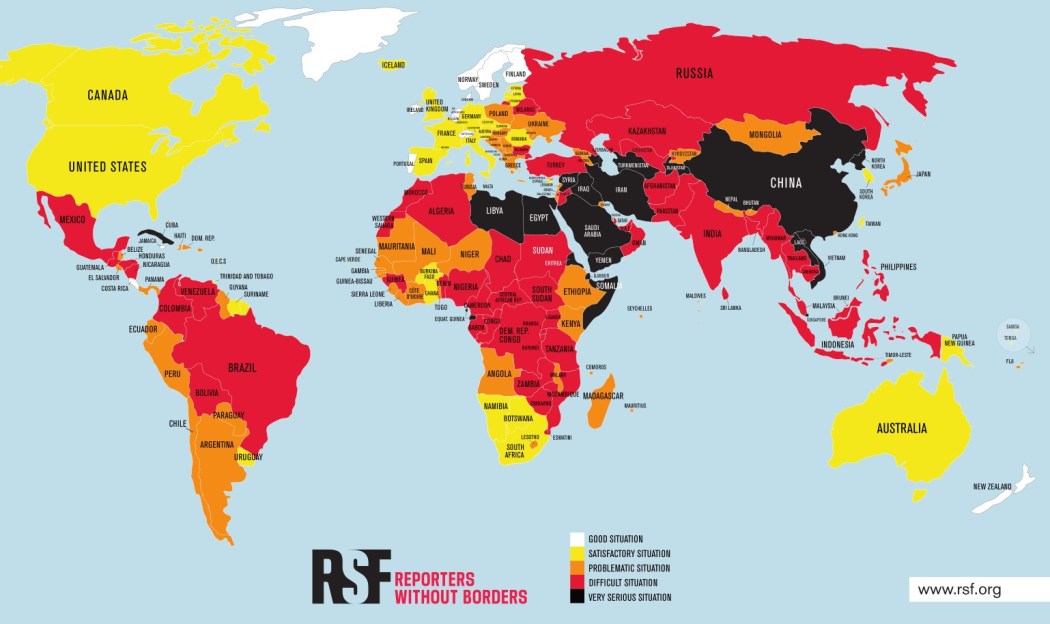
Hong Kong has plummeted in a global press freedom index. It now ranks 140th in the annual Reporters Without Borders Press Freedom Index, down from 73rd in 2019, whilst Chief Executive John Lee has said that press freedom remains intact. HKFP rounds up incidents that indicate how the city’s media landscape has changed.
April 2026
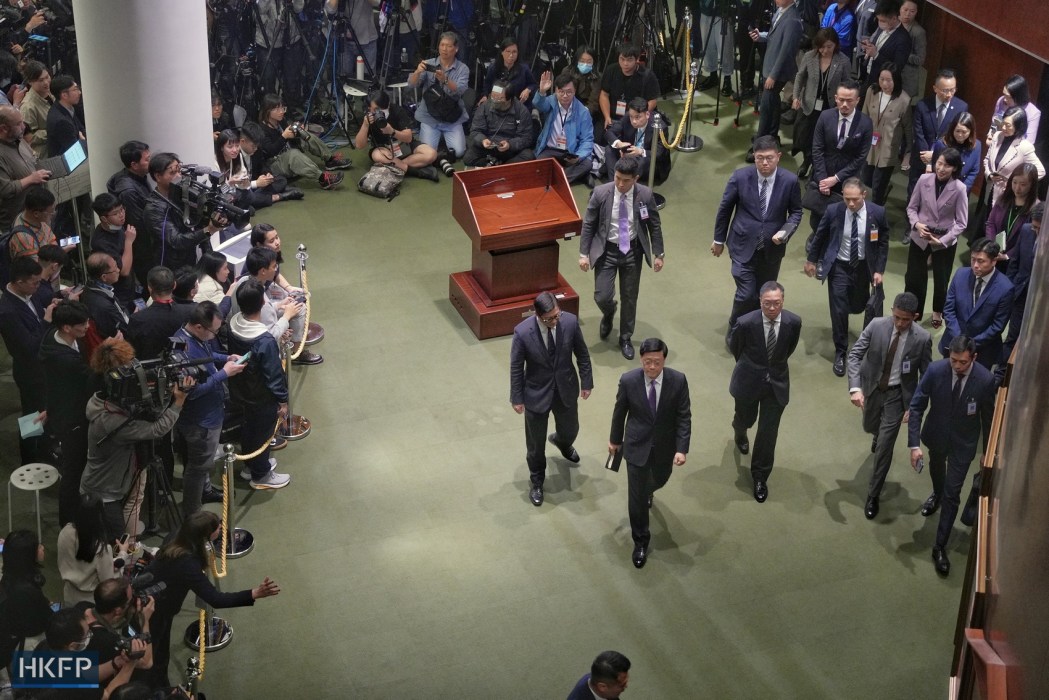
A Hong Kong press union warned that the stalking of journalists has a “chilling effect” on press freedom, after the Security Bureau slammed the group over “groundless speculations” that law enforcement may have tailed reporters from local news outlet InMedia.
Chief Secretary Warner Cheuk said journalists will not be permitted to tag along with survivors of the deadly Tai Po fire when they return to their flats to collect their belongings.
Reporters Without Borders (RSF) said that a French journalist was denied entry to Hong Kong in November, accusing the city’s authorities of “weaponising visas” against foreign media workers.
French journalist Antoine Vedeilhe. Photo: Reporters Without Borders.
Hong Kong remains at 140th place on Reporters Without Borders’ (RSF) global press freedom index of 180 countries and territories, with the NGO highlighting the 20-year sentence handed down to Apple Daily founder Jimmy Lai earlier this year.
March 2026
Hong Kong’s High Court dismissed the Hong Kong Journalists’ Association’s legal challenge against government restrictions on media access to the vehicle registry, years after the government lost in a landmark case concerning a journalist’s use of the registry to obtain records of vehicles involved in the 2019 Yuen Long mob attack
Yahoo Hong Kong announced it will begin winding down its news operation in line with its “strategic evaluation and long-term business planning.” An employee in Yahoo Hong Kong’s news content division confirmed to HKFP that the company would cease publishing original reports from April.
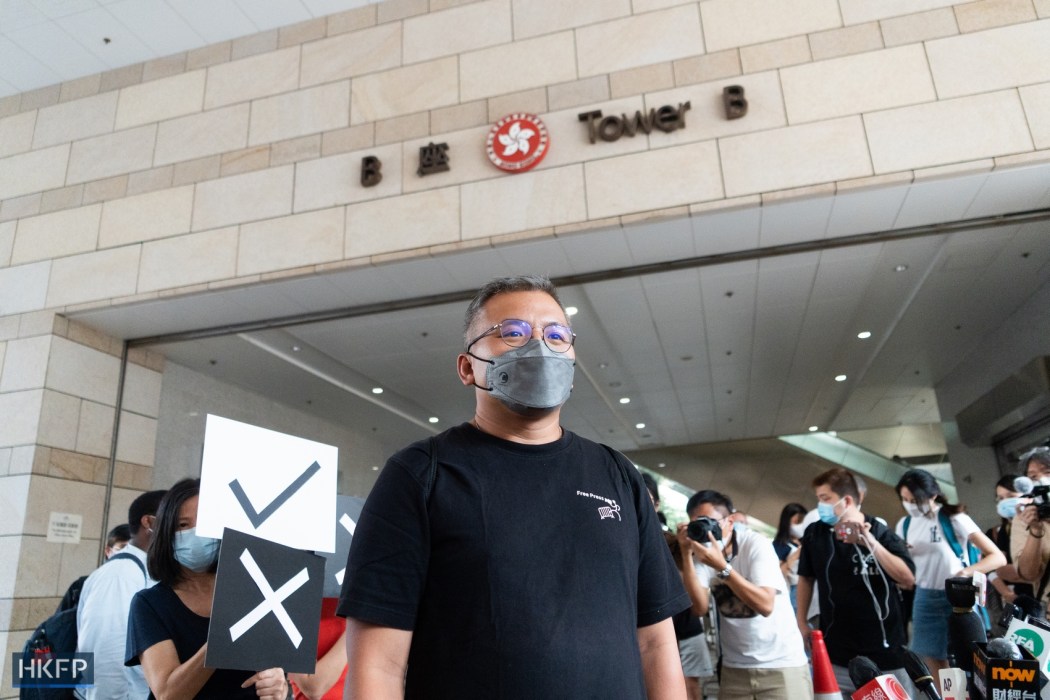
Hong Kong independent bookstore Book Punch owner Pong Yat-ming outside the Kowloon City Magistrates’ Courts on April 10, 2026. Photo: Hans Tse/HKFP.
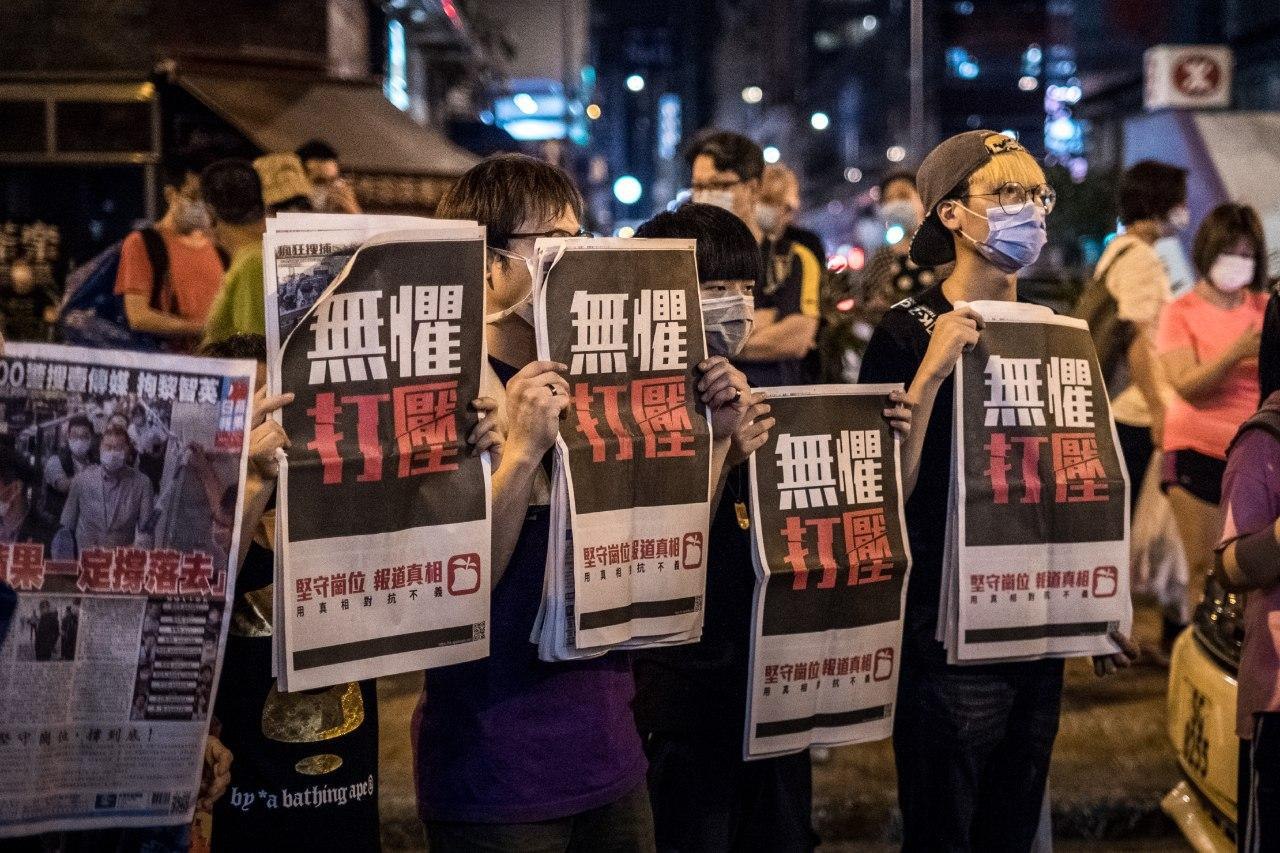
Three companies linked to the now-defunct Apple Daily newspaper became “prohibited organisations” after the Hong Kong government removed them from the corporate registry.
A former top editor of Apple Daily filed an appeal against his 10-year jail term in a high-profile national security case.
February 2026
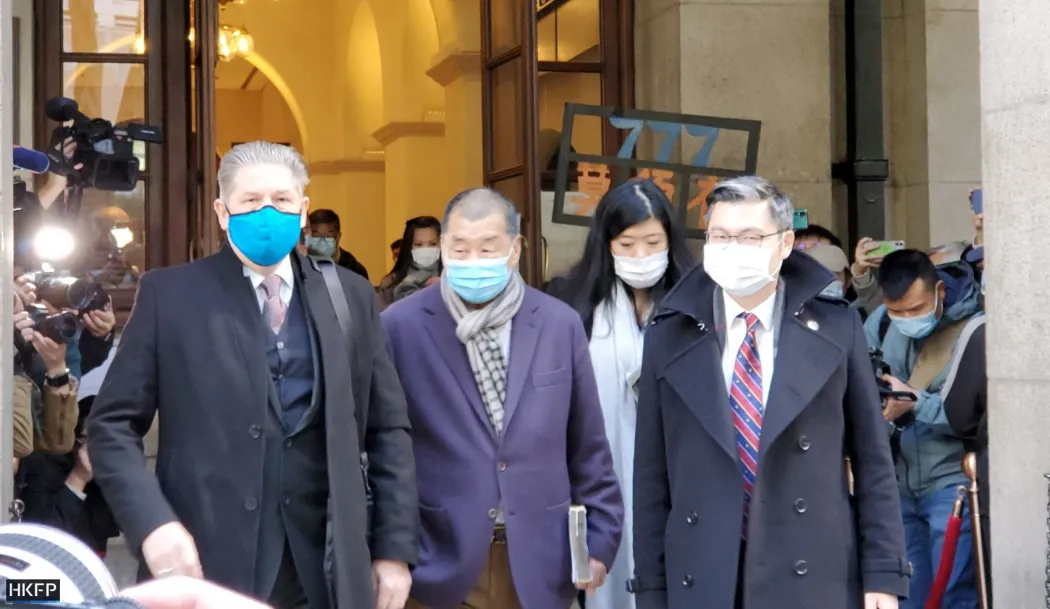
Pro-democracy media tycoon Jimmy Lai was sentenced to 20 years in jail following his conviction for conspiring to collude with foreign powers and conspiring to publish seditious materials. Six former Apple Daily staff who worked for Lai were jailed for 10 years for conspiring to collude with foreign powers.
The government-funded broadcaster stopped publishing all of its podcasts, with dozens of shows – in English and Chinese – grinding to a halt on Spotify and RTHK’s self-hosted Podcast One platform.
Hong Kong’s top judge criticised calls to release Jimmy Lai fter the pro-democracy media mogul’s conviction on foreign collusion and sedition charges, saying that such demands “strike at the very heart of the rule of law.”
Hong Kong authorities slammed the European Parliament’s calls for sanctions against Chief Executive John Lee and other officials following the conviction of pro-democracy media tycoon Jimmy Lai in his national security trial last month.
Running for chairperson of the Hong Kong Journalists Association is a “legally protected right,” journalist Selina Cheng said, as her wrongful dismissal lawsuit against her former employer continued.
Hong Kong police officers place a cordon outside the West Kowloon Law Courts Building on December 15, 2025, as the court hands down the verdict of Hong Kong pro-democracy media mogul Jimmy Lai. Photo: Kyle Lam/HKFP.
The Wall Street Journal pleaded not guilty to the allegedly unlawful firing of Hong Kong journalist Selina Cheng, who has accused the paper of sacking her for taking up leadership of the Hong Kong Journalists Association.
A total of 50 films had been required to be edited, and 13 titles had not been approved for screening on national security grounds since Hong Kong amended the Film Censorship Ordinance in 2021, according to authorities.
Hong Kong Journalists Association. Photo: HKFP.
September 2025
The Hong Kong government vowed to help local media overcome “operational pressures” and expand overseas, with Chief Executive John Lee saying in his Policy Address that he would not “interfere with” their work.
A group of former staff from Hong Kong independent media outlet Channel C launched a new online news platform – Channel We – with the financial support of a “white knight.”
Representatives of six independent publishers and bookstores hold a press conference on July 13, 2025. From Left: Leslie Ng of Bbluesky, Chan Wai-hung of Eleven Six Workshop, editor of Post Script Cultural Collaboration, editor of Word by Word Collective, Leanne Liu of Boundary, and Leticia Wong of Hunter. Photo: Kyle Lam/HKFP.
The Hong Kong Journalists Association voted in a new Executive Committee on Saturday, with freelance journalist Selina Cheng re-elected as chair unopposed.
The Department of Justice will not intervene in Hong Kong Journalists Association chairperson Selina Cheng’s lawsuit against her ex-employer, the Wall Street Journal, over her alleged unlawful termination after taking on the union’s leadership role.
Foreign Correspondents’ Club President Morgan Davis. Photo: Foreign Correspondents’ Club, Hong Kong, via Facebook.
May 2025
Hong Kong’s independent news sector, including companies, staff and family members, was facing simultaneous tax audits and backdated demands, the Hong Kong Journalists Association said, adding that the situation reflected a worsening press freedom environment.
Hong Kong tumbled five places, to 140th, in the annual Reporters Without Borders Press Freedom Index, entering the “red zone” – meaning a “very serious” situation – for the first time, alongside China.
Hong Kong’s security chief condemned a legal scholar for “undermining the rule of law” after the latter wrote an opinion piece criticising a court ruling that sent an ex-lawmaker to jail for “rioting” in the Yuen Long attack in 2019.
Former Meta executive Sarah Wynn-Williams accused the social media giant of developing a censorship tool to monitor viral content in Hong Kong and Taiwan when Facebook attempted to gain access to the Chinese market.
Secretary for Security Chris Tang and Fight Crime Committee member Roland Wong meeting the press on September 27, 2023. File photo: Kyle Lam/HKFP.
February 2025
Selina Cheng, chairperson of the Hong Kong Journalists Association, accused her ex-employer, The Wall Street Journal, of breaching the city’s laws protecting employees’ right to join union activities by firing her after she took on the union’s leadership role.
The Hong Kong Journalists Association postponed its annual fundraising dinner after the Regal Hongkong Hotel axed its venue booking, citing “water leakage causing unstable power supply.”
A student union at the Chinese University of Hong Kong cancelled the screening of a Burmese film set in Myanmar’s ongoing civil war, citing a last-minute government warning that hosting the event may break the law.
Veteran journalist Sum Wan-wah of the Chinese University of Hong Kong spoke in defence of student reporters who were accused by an official of making “sweeping generalisations” in a video documentary about district-level “care teams”.
Hong Kong pro-democracy media tycoon Jimmy Lai continued to give testimony as he denied he acted as a “middleman” to help Taiwan re-establish diplomatic ties with the US.
A ceremony for care teams. File photo: Kyle Lam/HKFP.
December 2024
Former Hong Kong journalists Chan Cheuk-sze and Kathy Wong won best documentary short at the 61st Golden Horse Awards in Taiwan for their debut film Colour Sampling Ideology.mov, a 59-minute visual analysis of colour symbolism in politics in Hong Kong and Taiwan.
More Hong Kong residents than ever perceived the city’s news outlets to be self-censoring and shying away from criticising local and Beijing authorities, the Hong Kong Public Opinion Research Institute found. In total, 65 per cent of the survey respondents perceived news outlets to have practiced self-censorship, up eight per cent from the previous year, and marking a record high.
An independent media outlet in Macau took down a report about various facilities being shut down before Chinese leader Xi Jinping’s three-day visit to the territory to mark the 25th anniversary of its handover to Beijing. The report was taken down “due to ‘unavoidable’ reasons,” according to All About Macau’s statement.
Hong Kong documentary filmmakers Chan Cheuk-sze (right) and Kathy Wong (left) leave the stage after winning the best documentary short film at the 61st Golden Horse Awards in Taipei, Taiwan, on November 23, 2024. Photo: Executive Committee of the Taipei Golden Horse Film Festival.
Hong Kong Journalists Association chairperson Selina Cheng sued The Wall Street Journal over her “unlawful dismissal,” after she was fired by the paper in July. Mediation with the US-based newspaper had been “ineffective,” she told reporters, after taking her case to the Labour Department, stating that she had been laid off unlawfully because of her participation in a union.
Hong Kong Journalists Association chairperson Selina Cheng and her lawyer Adam Clermont walk out of the Labour Relations Division (Hong Kong East) on November 12, 2024. Photo: Kyle Lam/HKFP.
The Court of Appeal overturned a warning by Hong Kong’s media watchdog that a satirical current affairs programme on RTHK had “insulted” the city’s police force. Judge Jeremy Poon ruled that satirical nature of the comments made in the programme meant that the requirement for accuracy, stipulated in the code of practice, was not applicable.
Associated Press photojournalist Louise Delmotte was denied entry to Hong Kong, months after an extension of her work visa was rejected by the city’s immigration authorities. Delmotte had won multiple photojournalism awards in the city, including for her exclusive shots of pro-democracy figure Jimmy Lai in a maximum security prison last August.
Former chief editor of shuttered Hong Kong media outlet Stand News Chung Pui-kuen was jailed for one year and nine months over publishing “seditious” materials. Stand News’ former acting chief editor Patrick Lam, who was initially handed 14 months in jail, walked free after the judge considered Lam’s poor health and the time he had spent in pre-trial detention. The judges ruled that the two editors had not been conducting genuine journalism, “but participating in the so-called resistance.”
Ex-Stand News acting chief editor Patrick Lam leaves District Court at 7.30 pm on September 26, after District Judge Kwok Wai-kin reduced his initial sentence for “conspiracy to publish and reproduce seditious publications,” on health grounds and allowed him to walk free. Photo: Kyle Lam/HKFP.
The chief editor of Ming Pao urged columnists to be “prudent” and “law-abiding” when writing for the newspaper, warning that otherwise, “crisis may come”. The memo read: “For Ming Pao to conduct itself and its mission in Hong Kong’s new era, as well as to exercise the role of the fourth estate, is a heavy responsibility and a long path that requires extra caution.”
The Hong Kong Journalists Association issued its annual press freedom index, which recorded a rating of 25 out of 100, the lowest since the survey was first conducted in 2013. Reporters said they were hesitant to criticise the government and that it had become harder for the media to function as a watchdog and to access information.
Ex-chief editor of independent Hong Kong media outlet Stand News Chung Pui-kuen and former acting editor-in-chief Patrick Lam were found guilty of sedition, marking the first such conviction of journalists in Hong Kong since the former British colony returned to Chinese rule in 1997. Judge Kwok Wai-kin ruled that Stand News was “a tool to smear and slander central and [Hong Kong] government” during the 2019 protests.
Former Stand News editor-in-chief Chung Pui-kuen leaves District Court in Wan Chai, Hong Kong, on August 29, 2024, after being found guilty of conspiring to publish “seditious” materials. Photo: Kyle Lam/HKFP.
The Court of Appeal rejected jailed media tycoon Jimmy Lai’s application to take his bid to hire a British lawyer to the city’s apex court. The 76-year-old wanted to challenge an appeal court’s ruling in April, when it sided with a decision from the Committee for Safeguarding National Security that barred him from hiring a British lawyer for his ongoing national security trial.
Selina Cheng, chair of the Hong Kong Journalists Association, speaks to reporters after being fired from The Wall Street Journal, allegedly over her role in the press union, on July 17, 2024. Photo: Kyle Lam/HKFP.
Hongkongers’ trust in the news “increased substantially,” rising to 55 per cent of those surveyed for an annual study of news consumption habits, the highest since the city was first examined in 2017, according to a report released by the Reuters Institute for the Study of Journalism.
Police carry cordon tape in Causeway Bay, Hong Kong, on June 4, 2024, the 35th anniversary of the 1989 Tiananmen crackdown. Photo: Kyle Lam/HKFP.
May 2024
Indian cartoonist Rachita Taneja and Hong Kong’s Wong Kei-kwan, better known as Zunzi, were awarded the biennial Kofi Annan Courage in Cartooning Award on May 3, World Press Freedom Day. Wong published satirical comic strips in Ming Pao for 24 years before the comic was suspended in May 2023.
The Wall Street Journal said it would shift its Asia headquarters from Hong Kong to Singapore. The US newspaper’s editor-in-chief, Emma Tucker, said in a letter to staff that the shift would also involve an unspecified number of layoffs.
The Immigration Department in Tseung Kwan O, Hong Kong, on June 11, 2024. Photo: Kyle Lam/HKFP.
March 2024
The Safeguarding National Security Ordinance took effect on March 23, after being passed into law by Hong Kong’s opposition-free legislature four days earlier. Known as Article 23, authorities said it was needed to plug loopholes left by Beijing’s security law, while United Nations High Commissioner for Human Rights Volker Turk warned that “such provisions readily lead to self-censorship and chilling of legitimate speech and conduct, in respect of matters of public interest on which open debate is vital.”
Andy Li, one of the 12 Hong Kong fugitives caught by China’s coastguard in August 2020 while trying to flee to Taiwan, took the stand in media mogul Jimmy Lai’s national security trial. Testifying against the Apple Daily founder, Li said that Lai’s “radical” stance was common knowledge and that he had financed a global advertising campaign.
The Chinese University of Hong Kong removed copies of the University Community Press from campus, saying the publication was “unauthorised” and could not be displayed without permission. The publication, formerly known as CUHK Student Press, was managed by the student union before the body was forced to shutter in 2021.
Radio Free Asia closed its Hong Kong office over staff safety concerns after Article 23 was enacted. The US-funded news outlet said that it no longer had full-time staff in Hong Kong and has closed its physical office, citing “concerns about the safety of RFA staff and reporters.”
Hong Kong authorities condemned the BBC’s reporting on Article 23, saying its report about the remission of sentences for security law convicts was “extremely misleading,” and condemned “fact-twisting” remarks by what it deemed anti-China organisations quoted in the report.
Hong Kong officials including Chief Executive John Lee and Secretary for Security Chris Tang leave the Legislative Council after the passage of Article 23 legislation on March 19, 2024. Photo: Kyle Lam/HKFP.
February 2024
Ex-Apple Daily publisher Chan Pui-man took the stand in media mogul Jimmy Lai’s national security trial, saying Lai told Apple Daily to play up the business sector’s concerns regarding the Beijing-imposed national security law in its coverage. She also said that Apple Daily had launched its English version to rally international support.
Ronson Chan, chair of the Hong Kong Journalists Association, said the “vague” legislative proposal for Article 23 had caused journalists working in the city to feel like they were in danger. Citing a survey conducted by the press union, he said more than 75 per cent of journalists believed Article 23 would only have a negative impact on press freedom.
Secretary for Justice Paul Lam attends a meeting on March 19, 2024 as the Legislative Council resumes the debate on a proposed domestic security law required under Article 23 of the Basic Law. Photo: Kyle Lam/HKFP.
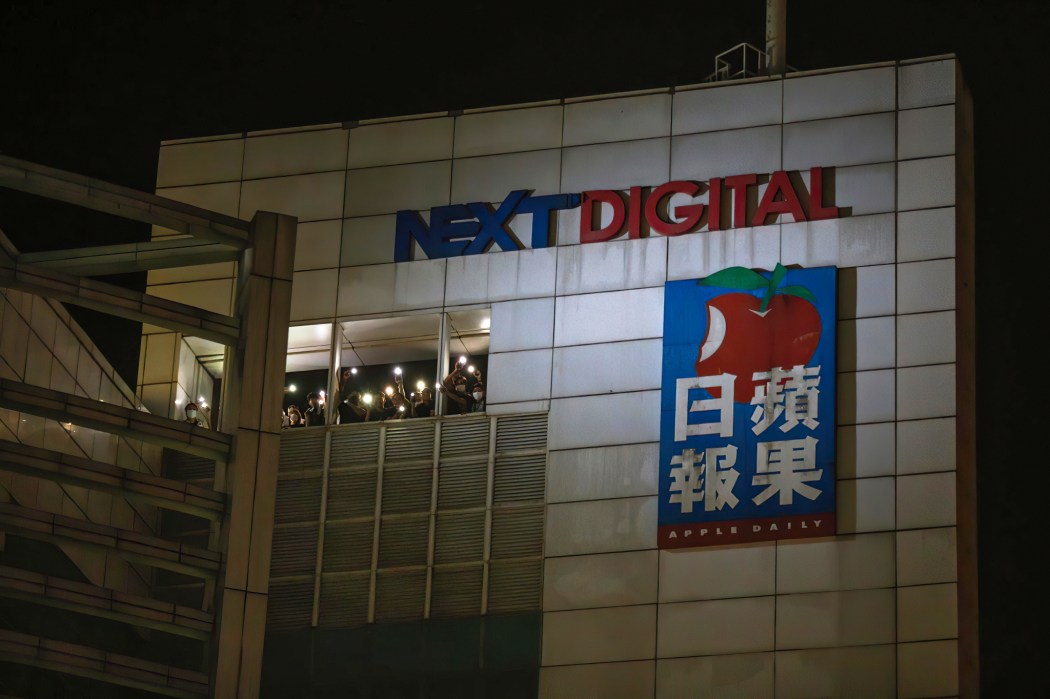
Apple Daily’s last edition is issued on June 24, 2021. File photo: Kelly Ho/HKFP.
December 2023
The HKJA raised concerns after Japanese media reported that South China Morning Post (SCMP) reporter Minnie Chan had gone missing after a work trip to China. Responding to an enquiry from HKFP, SCMP said Chan was on personal leave concerning a private matter and also threatened legal action.
The verdict in the trial against two former editors of now-defunct news outlet Stand News was postponed again pending a higher court’s ruling, expected in 2024.
A Hong Kong judge called for an investigation after prosecutors claimed that video footage linked to a rioting case during the 2019 Yuen Long mob attacks had been released by an online media outlet ahead of the trial.
Net satisfaction with press freedom in Hong Kong stood at negative 8 per cent, while 13 per cent of people believed the local news media had given full play to the freedom of speech, according to a PORI survey.
Sebastien Lai, the son of detained media mogul Jimmy Lai, spoke at a UN event on media freedom, as the government slammed the occasion as “political manipulation.”
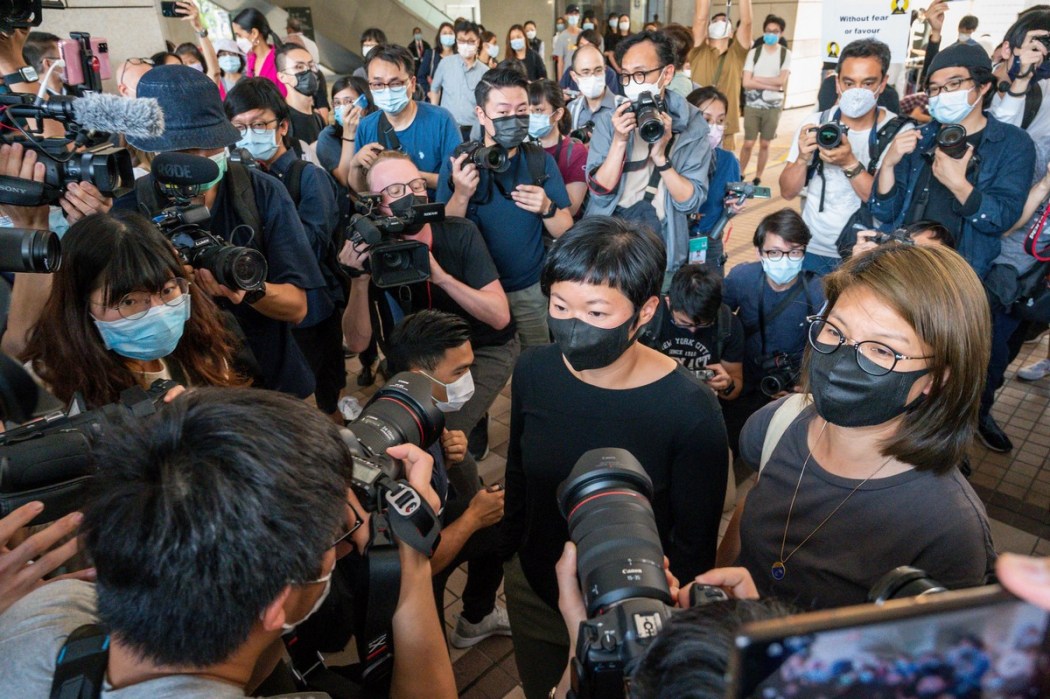
Ronson Chan, the head of the HKJA, was found guilty of obstructing a police officer while reporting last September and was sentenced to five days in prison before being granted bail pending appeal.
The national security trial of pro-democracy media mogul Jimmy Lai was delayed again to December to ensure that one of the handpicked judges will have finished presiding over another landmark national security case involving 47 democrats.
The West Kowloon Magistrates’ Courts received written closing statements in the trial against journalist Ronson Chan, who stands accused of obstructing a police officer.
A Hong Kong press group urged the city’s police to provide an explanation after its former chairperson was led away by officers while she was reporting on the 34th anniversary of the Tiananmen crackdown.
The Hong Kong government condemned US politicians’ calls for a joint effort with the UK to prioritise the release of pro-democracy media mogul Jimmy Lai by sanctioning Hong Kong officials, prosecutors, and judges involved in national security law detentions.
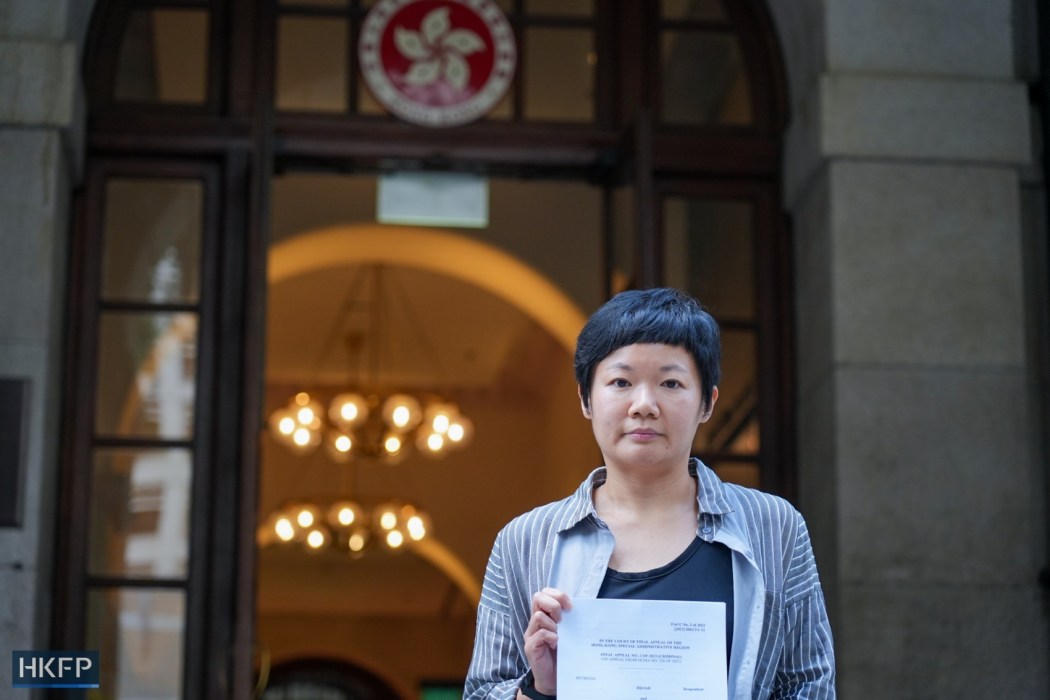
Journalist Bao Choy’s conviction for making false statements to access vehicle records was quashed after five judges ruled unanimously in favour of her appeal at the city’s top court. Her sentence was also set aside.
The Court of Appeal blocked media tycoon Jimmy Lai’s bid to challenge a national security search warrant of his phones, which he said contained protected journalistic materials, at the city’s top court.
Hong Kong journalist Bao Choy stands outside Hong Kong’s Court of Final Appeal after winning her appeal against her conviction for making false statements to obtain vehicle records, on June 5, 2023. Photo: Candice Chau/HKFP.
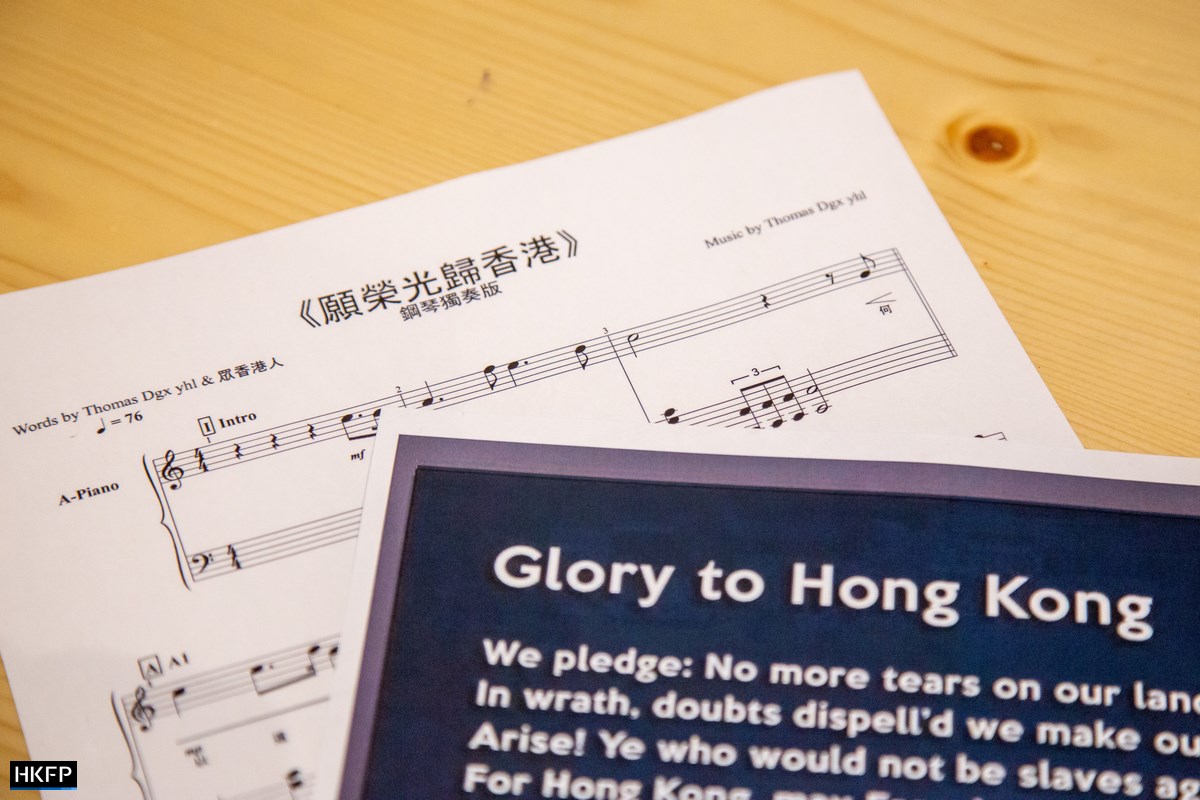
The Hong Kong Journalists’ Association said it was looking to intervene in a legal bid by the government to ban all forms of the protest song Glory to Hong Kong, in the hopes of gaining an exemption for media reporting. A statement said the press group wants to “protect the work of journalists.”
Citizens’ Radio, a pro-democracy pirate radio station, ceased operating on June 30 after its founder said the station’s bank account had been frozen.
A prominent Chinese financial journalist who compared the country’s economic problems to the Great Depression was banned from social media.
Blocking pro-democracy media tycoon Jimmy Lai’s overseas counsel from representing him in his national security trial is “persecution not prosecution,” his lawyer said in an application to halt the trial.
Hong Kong transport news site Transit Jam ceased operations, its owner announced, making it the latest outlet to disappear in the wake of the security law. The closure came days after its founder was targeted in the state-run press.
Hong Kong’s security minister hit back at the Hong Kong Journalists’ Association after it said the suspension of a long-standing political cartoon strip following repeated government complaints showed that the city “could not tolerate critical voices.”
The defence questioned whether an exchange between the head of Hong Kong’s largest journalists’ group, Ronson Chan, and a plainclothes police officer could have happened as described, as the trial against Chan began.
Hong Kong’s Court of First Instance rejected attempts by pro-democracy media tycoon Jimmy Lai to challenge a decision made by Hong Kong’s national security committee relating to the admission of an overseas lawyer for his trial.
Hong Kong Chief Executive John Lee refused to comment on reports received by the city’s largest press group that reporters had been followed by unknown men.
Hong Kong journalists who have emigrated faced a number of difficulties when trying to start their careers in media overseas, according to a report published by an overseas journalists’ body.
RTHK said it would “follow up” with Twitter, after the social media platform added a “state-affiliated media” label to the news outlet’s official account.
Hong Kong pro-democracy media tycoon Jimmy Lai filed a legal bid against the government’s decision to reject any further work visa applications from an overseas counsel he had hired for his national security case.
The Hong Kong government barred several government-registered media outlets from covering a National Security Education Day event, ignoring emails and evading questions by phone when challenged as to why.
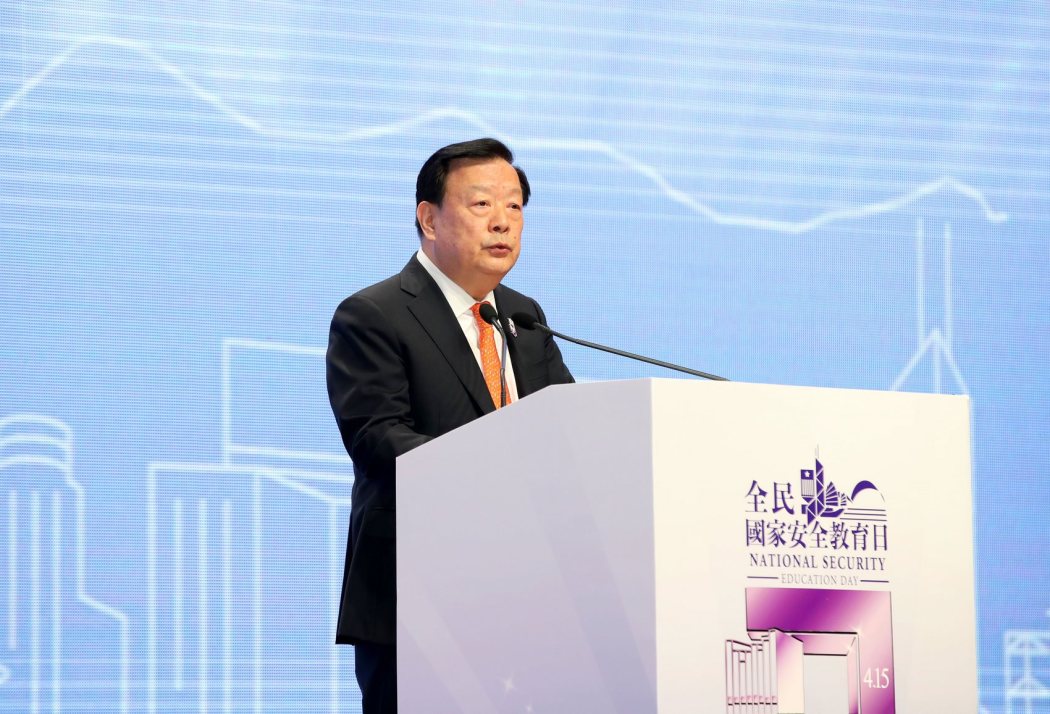
Director of the Hong Kong and Macau Affairs Office Xia Baolong attends the opening ceremony of the National Security Education Day on April 15, 2023. Photo: HKMAO.
The son and overseas lawyers of Jimmy Lai urged the United Nations to condemn the prosecution on “trumped-up” charges of the pro-democracy media tycoon, sparking criticism of them from the Hong Kong government.
Coconuts wound down its Hong Kong news site, citing commercial and journalistic challenges. The announcement came days after a new general manager took over the publishing group.
The trial against two former Stand News top editors charged under the colonial-era sedition law continued as the prosecution carried on the cross-examination of Chung Pui-kuen, ex-editor-in-chief.
The Hong Kong government submitted a proposal to introduce legislative amendments which would require local courts to obtain a certificate from the city’s leader before considering whether to allow foreign counsel to act in national security cases.
A committee on safeguarding national security in Hong Kong urged the city’s government to change the law as quickly as possible so it can ban a British lawyer from representing former pro-democracy media tycoon Jimmy Lai at his security trial.
The local legal team representing jailed Hong Kong media tycoon Jimmy Lai in his high-profile national security trial said it was not “professionally associated” with an international group of lawyers who reportedly met with a UK minister over Lai’s case.
Chung Pui-kuen, former chief editor of Stand News, at the District Court on January 26, 2023. Photo: Lea Mok/HKFP.
Hong Kong’s top court allowed journalist Bao Choy to appeal her conviction over accessing car licence information for an investigative documentary about a mob attack in Yuen Long in July 2019.
The government watchdog rejected a complaint filed by HKFP related to the authorities’ refusal to disclose their media invite list for Chief Executive John Lee’s inauguration last July 1.
The sedition trial against two ex-chief editors of defunct media outlet Stand News continued, as the court heard testimony from one of the defendants, former editor-in-chief Chung Pui-kuen.
December 2022
The national security trial of pro-democracy media tycoon Jimmy Lai was adjourned on its scheduled starting date until December 13 as Hong Kong waits for Beijing to “clarify” the law as to whether overseas lawyers are allowed to appear in such cases.
Defendants charged under the national security law could be sent to mainland China for trial if they cannot find a lawyer in Hong Kong, the city’s top delegate to Beijing’s advisory body said.
Journalist Bao Choy speaks with reporters outside High Court on Nov. 7, 2022. Photo: Lea Mok/HKFP.
The Hong Kong Journalists Association said it was “disappointed and worried” by the court’s decision to reject an appeal filed by journalist Bao Choy, convicted over accessing public data for a documentary about a mob attack in July 2019.
A Hong Kong citizen journalist who waved the British colonial-era flag while the Chinese national anthem was being played was jailed for three months for insulting the anthem, following the first conviction under a new law.
Hong Kong’s top court adjourned its decision on whether to allow the Department of Justice to appeal against an earlier ruling that let media tycoon Jimmy Lai hire a UK lawyer for his national security trial.
The International Federation of Journalists’ Hong Kong Freedom of Expression Report 2022. Photo: International Federation of Journalists, via screenshot.
Jimmy Lai, the founder of defunct Hong Kong pro-democracy tabloid Apple Daily, was convicted of fraud after being found to have violated the terms of the lease for the newspaper’s headquarters.
Two reporters quit the South China Morning Post last year after a senior editor axed their three-month investigation into human rights abuses in China’s Xinjiang region, according to an editor who resigned shortly after.
Ronson Chan, the chairperson of the Hong Kong Journalists Association, was granted bail after pleading not guilty to obstructing police officers and an alternative charge of obstructing another person lawfully engaged in a public duty.
Self-proclaimed non-pro-establishment party Path of Democracy appealed to the government to enact a fake news law as part of a broad list of suggestions for Chief Executive John Lee ahead of his policy address.
Hong Kong courts should not blur the line between criminal and civil cases, the District Court heard as the prosecution and defence presented their closing statements during the fraud trial against media tycoon Jimmy Lai.
Hong Kong’s High Court heard journalist Bao Choy’s appeal against her conviction over accessing public vehicle registration records when she researched and produced an investigative documentary about the Yuen Long mob attack in 2019.
Disclosing the media invite list for the July 1 leadership inauguration ‘would harm Hong Kong’s security,’ the government claimed.
Hong Kong democracy has taken a “quantum leap forward,” officials told a United Nations rights committee, during a grilling over the national security law, declining press freedom and other developments in the wake of the 2019 protests.
Hong Kong’s leader John Lee said journalists are “in the same boat” as him and that he hoped the news sector would join him in promoting the success of One Country, Two Systems to the world.
A United Nations rights monitor urged Hong Kong to repeal its national security law, citing the “overly broad interpretation” of its provisions and the subsequent violation of free expression in the city.
The Hong Kong Journalists Association held its annual general meeting, in which members approved changes to the group’s constitution to make dissolution easier.
Reporters Without Borders said Hong Kong authorities wielded a draconian new security law to silence critical news outlets and jail journalists in its latest report, as the city plummeted down an international press freedom chart.
The president of Hong Kong’s Foreign Correspondents’ Club said that the club still has a “role to play” following its decision to cancel this year’s Human Right Press Awards, citing legal risks.
The ex-acting chief editor of the now-defunct Stand News told a Hong Kong court that he intended to plead not guilty to sedition charges, as the case was adjourned until late June.
Hong Kong national security police demanded that Passion Times, an online news outlet which had ties with a defunct opposition group, remove “sensitive” content.
A Hong Kong citizen journalist was sentenced to one month in jail for behaving in a disorderly manner in a public place on National Security Education Day in 2021.
Hong Kong veteran journalist Allan Au was arrested by national security police for allegedly conspiring to publish seditious materials, and was released on bail after spending over 17 hours in police custody.
Pro-democracy cartoonist Ah To has announced his departure from Hong Kong, saying he would face “great mental stress” if he were to continue to produce political cartoons in the city.
A statement signed by 21 Western nations condemned a press freedom crackdown in Hong Kong and the arrests of journalists at the defunct independent media outlet Stand News.
Citizen News’ China news team. Photo: Citizen News screenshot, via YouTube
The Registry of Trade Unions launched a probe into the Hong Kong Journalists Association, asking it to provide answers on how certain events it held were relevant to its objectives.
Hong Kong public broadcaster RTHK “paused” the social media pages of a dozen programmes, including the axed political satire show Headliner and the popular Hong Kong Connection, which was still in production.
Hong Kong public broadcaster RTHK removed from its website a news report about Chinese tennis star Peng Shuai, who accused a former top Chinese official of sexual assault.
Chief Executive Carrie Lam vowed to “proactively plug loopholes” in the city’s internet regulation to ensure “fake news” circulating online does not “harm society.”
Two Hong Kong news organisations were barred from attending a reception organised by the local media sector in celebration of the upcoming Chinese National Day.
Hong Kong public broadcaster RTHK refused to say why it deleted a story from its website about proposals for a new law criminalising insults against public officers.
The head of the Hong Kong Journalists Association said that the security chief’s suggestion that the group could make public its members’ information may be in violation of the Privacy Ordinance.
Chairperson of the Hong Kong Journalists Association Ronson Chan. Photo: Screenshot.
It is announced that pro-democracy media tycoon Jimmy Lai is to stand trial on national security charges in Hong Kong’s High Court, where the maximum penalty is life imprisonment.
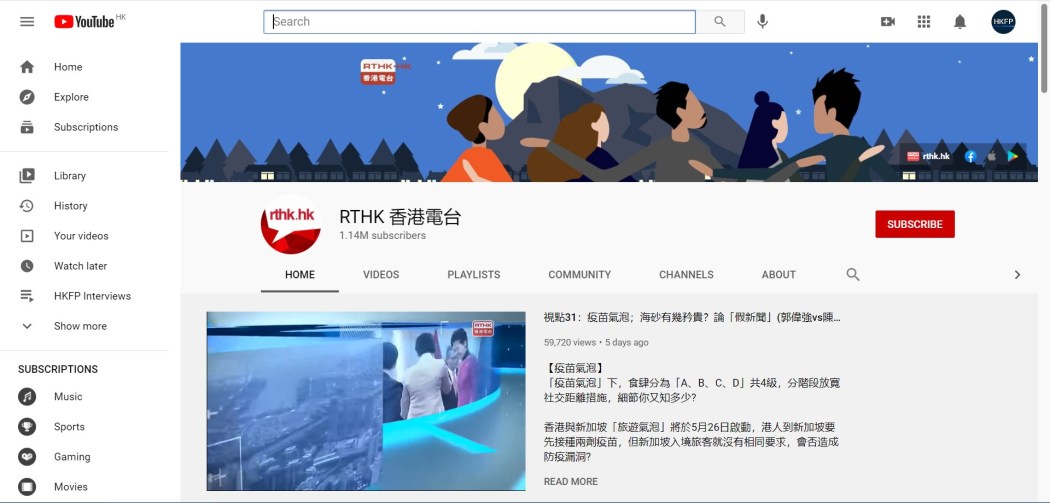
RTHK’s YouTube Channel. Photo: RTHK Screenshot via YouTube.
The Hong Kong Press Freedom Index hit a record low, with close to 99 per cent of respondents saying the Beijing-enacted national security law harmed the city’s free press.
Hong Kong journalist Bao Choy filed an appeal against a magistrate’s decision to convict her after she accessed public records to investigate police behaviour during the “7.21” mob attack at Yuen Long MTR station in 2019.
An executive producer who led Hong Kong’s longest-running TV documentary programme, Hong Kong Connection,resigned from RTHK.
Trading in shares of Next Digital, the parent company of Hong Kong’s largest pro-democracy newspaper Apple Daily, was suspended at the company’s request.
Hong Kong’s Security Secretary John Lee denied that the freezing of the assets of pro-democracy media tycoon Jimmy Lai represented a crackdown on press freedom.
WhatsApp chats which democrat Claudia Mo had sent to media organisations like the BBC and the New York Times outlining her fears for freedom of speech in the city were deemed by a High Court judge to be sufficient grounds to deny her bail.
April 2021
RTHK said that the Hong Kong government has the power to surcharge its employees for the cost of axed programmes.
The public perception of the independence and credibility of Hong Kong’s news media dropped to a record low, according to an opinion poll.
Chief Executive Carrie Lam said the Hong Kong government is the “biggest victim of fake news,” after pledging to submit a bill to tackle “doxxing” within the current legislative term.
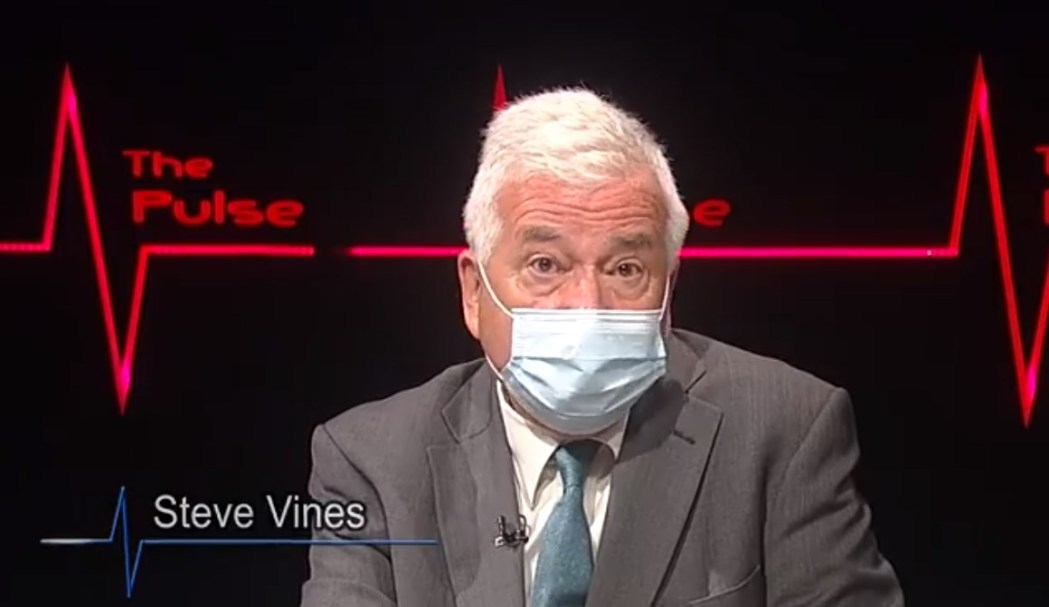
RTHK dropped veteran journalist Steve Vines as a regular current affairs commentator on its Morning Brew programme after more than ten years.
Hong Kong journalist Yvonne Tong, who famously challenged a WHO official, resigned from RTHK.
Reporters Without Borders East Asia warned that silence from the Hong Kong authorities over an attack on the Epoch Times is fostering a “climate of suspicion” against journalists and “encouraging” violent attacks on the media.
Police chief Chris Tang said that media outlets that endanger the security of Hong Kong by publishing “fake news” will be investigated.
State-owned newspaper Ta Kung Pao, in a full-page cover story, accused Apple Daily and other pro-democracy “yellow media” of “constantly creating fake news.”
Reporters without Borders warned that the national security law posed a “grave threat” to the city’s journalists as Hong Kong remained 80th out of 180 regions in the 2021 world press freedom index.
Journalist Bao Choy appears in court on April 22, 2021. Photo: Studio Incendo.
RTHK rejected a media award for a TV documentary about the police handling of the Yuen Long mob attack in 2019.
Hong Kong documentary producer Bao Choy was found guilty and fined HK$6,000 for knowingly making false statements to obtain vehicle ownership records for the RTHK programme on the Yuen Long mob attacks of 2019.
Police confirmed that a journalist from Ta Kung Pao was arrested in February for making false statements to obtain public vehicle records.
The Foreign Correspondents’ Club urged Hong Kong’s police chief to clarify his recent comments about “foreign forces” attempting to stir hatred and conflict in the city using disinformation.
Beijing accused the FCC of being an external force interfering with China’s internal affairs and undermining the city’s rule of law.
A top Beijing official said the principle of “patriots governing Hong Kong” extends to the judiciary, the education sector and the media, in addition to public officials.
A leading civil servant with no broadcasting experience took over as head of RTHK, where three senior employees quit in the space of two weeks.
RTHK made a last-minute decision to cancel a programme featuring a panel discussion of Beijing’s plans for a drastic election overhaul.
Press freedom in 2021. Photo: RSF.
The cinema screening of a documentary about a violent campus clash between student protesters and police in 2019 was cancelled at short notice after a pro-Beijing newspaper claimed the film may violate the national security law.
Hong Kong’s Ombudsman said that it would investigate the Immigration Department for refusing a work visa to Hong Kong Free Press for its incoming editor in 2020.
Bao Choy went on trial for allegedly violating the Road Traffic Ordinance in seeking to obtain vehicle licence plate information for a documentary.
Security officers at the West Kowloon Magistrates’ Courts barred at least two reporters from attending a trial hearing to protect the identity of a police officer who had provided a witness statement anonymously.
Hong Kong’s High Court refused to grant bail to media mogul Jimmy Lai again over national security law charges.
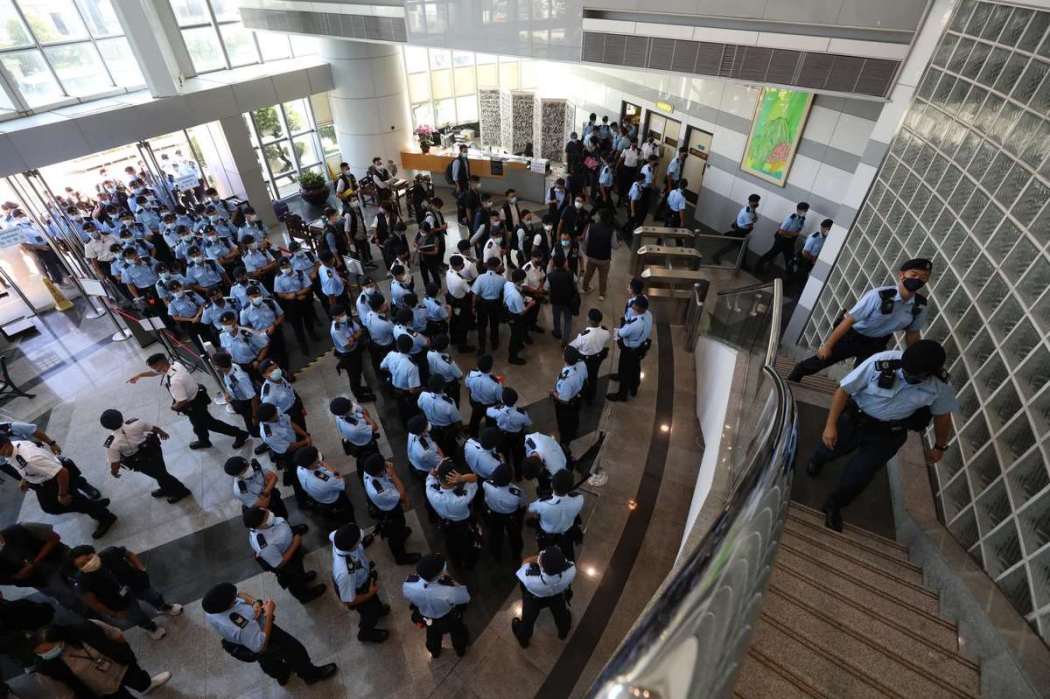
Police visited the newsrooms of Apple Daily, InMedia and StandNewswith search warrants demanding documents relating to the primary election for LegCo in July 2020.
Three people convicted of rioting and assaulting a mainland journalist at the airport during anti-government protests in 2019 were jailed for up to 5 1/2 years.
Bao Choy pleaded not guilty to making false statements after she obtained vehicle registration information for a film about the 2019 Yuen Long mob attacks.
The head of Hong Kong’s largest police union slammed public broadcaster RTHK for allegedly biased reporting of a weekend lockdown to combat Covid-19.
A silent protest staged by the RTHK union to support their colleague Nabela Qoser. Photo: Candice Chau/HKFP.
The staff union at RTHK staged a silent protest to support fellow journalist Nabela Qoser, after she was told to accept a new short-term contract or face dismissal.
The Communications Authority ruled that three episodes of RTHK’s satirical programme Headliner insulted and denigrated the police force, and “strongly advised” the station to follow broadcasting regulations more closely.
Freelance producer Bao Choy was arrested for searching car licence plate records while researching a TV documentary about the 2019 Yuen Long mob attacks.
Hong Kong Chief Secretary Matthew Cheung banned a planned journalists’ protest against the arrest of Choy, citing Covid-19 restrictions, despite earlier approval.
A district councillor was given a suspended prison sentence for publicly identifying the policeman who allegedly shot an Indonesian journalist in the eye.
The government reportedly told an independent film distributor to include an official warning in two documentaries about the anti-extradition bill protests.
US President Donald Trump said on Saturday that he was reviewing a new Iranian proposal to end the war.
“I’ll let you know about it later,” he said before boarding Air Force One, adding that “they’re going to give me the exact wording now”.
Two semi-official Iranian news outlets, Tasnim and Fars, believed to be close to Iran’s paramilitary Revolutionary Guard, said Iran has sent a 14-point proposal via Pakistan in response to a nine-point US proposal. Pakistan has hosted previous negotiations...
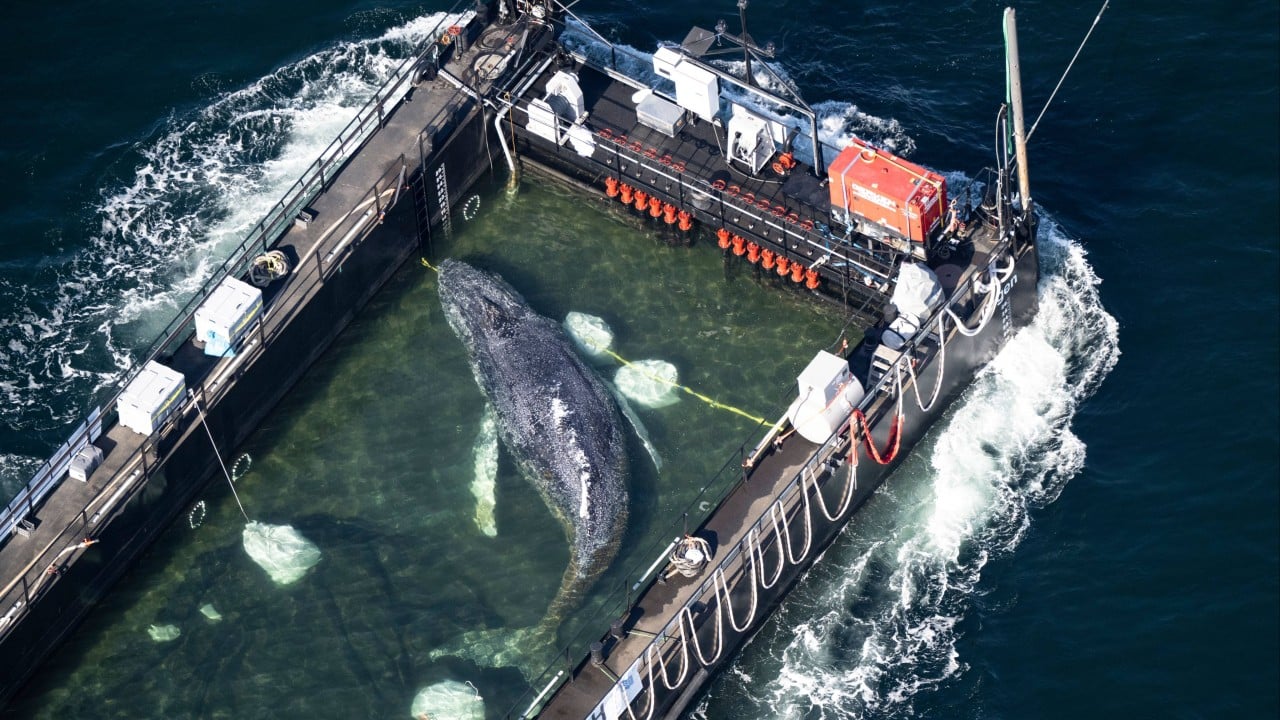
A rescue team on Saturday released from a barge in the North Sea a humpback whale that had been stranded in shallow waters near Germany since March, witnesses said.
Nicknamed “Timmy” by German media, the whale was spotted swimming near Germany’s Baltic Sea coast on March 3, far from its natural habitat in the Atlantic Ocean.
The mammal’s health deteriorated as it became repeatedly stranded in shallow waters near the coastal city of Wismar, and unsuccessful efforts to coax it towards deeper seas...

 Login
Login