Reading view

Beast: Australia’s first MMA film, starring Russell Crowe, is cheesy yet oddly comforting
Stan

For a nation obsessed with professional sport, there is a surprising dearth of Aussie sports films. There have been, of course, a handful of memorable ones: The Club (1980), The Coolangatta Gold (1984) and, more recently, The Final Winter (2007).

But apart from the low-budget 2024 film Life After Fighting – understandable if you haven’t heard of it, it made less than A$6,000 at the box office – Beast is the first Australian film to be set in the world of mixed martial arts.

Patton James (Daniel MacPherson) is a retired fighter pulled back into the game due to tough circumstances. His young daughter Maddie (Sol Nc Carrico) needs to see an expensive specialist, his wife Luciana (Kelly Gale) is pregnant with another, and he barely makes a living working for a petty tyrant on a fishing boat.

When the opportunity to earn $150,000 fighting his former nemesis, world champion Xavier Grau (Bren Foster), arises, he finds it impossible to resist, despite the imprecations of his loving wife.

So Patton returns to his old trainer Sammy (Russell Crowe). And despite some bad blood between them, Sammy and his daughter Rose (Amy Shark, in her feature film debut) end up helping him get in shape for the fight.

After several trials and tribulations, the whole thing culminates in a bout in Thailand. “A fight all about redemption, no… revenge”, the commentator tells us. Guess the result?

Singer-songwriter Amy Shark plays Sammy’s (Crowe) daughter Rose, in her feature film debut. Stan

Bland delivery, bad accents

Beast has all the expected cliches, and to say the narrative is predictable is an understatement.

But for a feel good “against the odds” sports film, this isn’t necessarily a problem. There can be something pleasurable in watching cliché after cliché unfold, and genre cinema’s capacity to fulfil our expectations is one of the reasons we keep coming back to it.

But the problem is, Beast for the most part rings as hollow as the character’s names, which could only exist in a scriptwriter’s dreams – Patton James and Xavier Grau… come on.

Director Tyler Atkins found something charming and fresh in his undeniably sentimental earlier film, Bosch & Rockit (2022). Beast, however, feels stale. Much of this is technical, with many of the elements not really working (or not working well together).

Much of the films technical elements don’t really work together. Stan

Russell Crowe is a fine actor, and his revival as an angry, hefty middle-aged chap (as in the smashing 2020 film Unhinged) has been effective. But one can’t imagine this role would have stretched him much, and it feels like he’s just going through the motions.

Similarly, we’re consistently aware of the effort TV star MacPherson is putting into the lead role of Patton, and this makes for a valiant but not entirely convincing performance.

Kelly Gale acts like a model as Patton’s long-suffering wife, her undeniable presence offset by a strikingly monotone delivery.

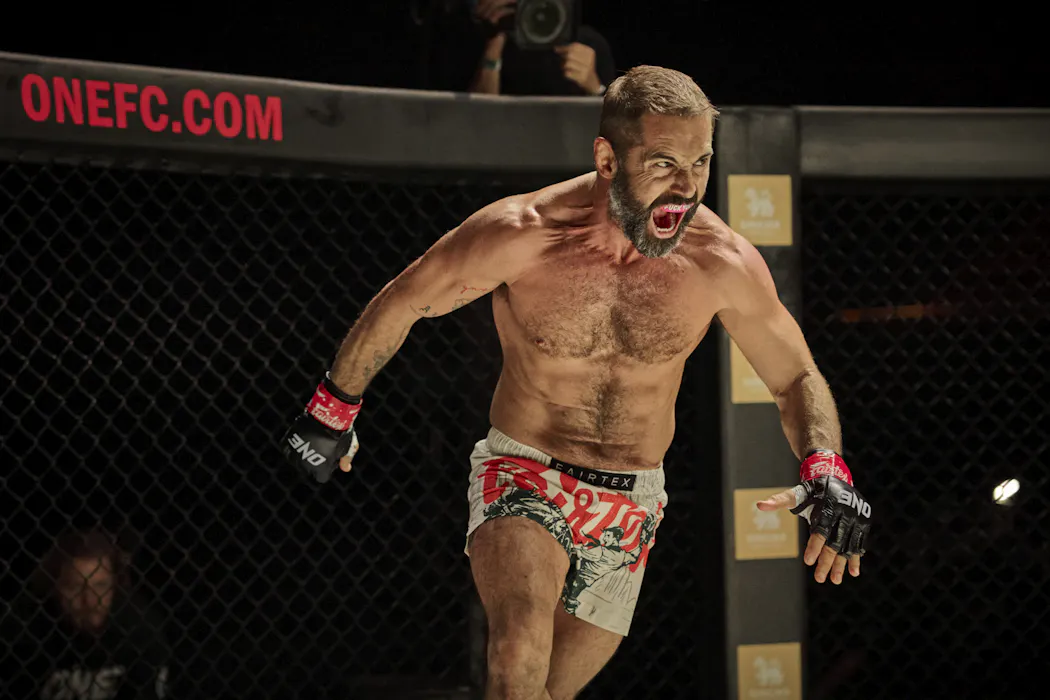
The only standouts are screen veterans Matt Nable, excellent as usual in a tiny role as loan shark Barry Dunne, and Nathan Phillips, who has a small but memorable role as the skipper of the fishing boat, and Bren Foster, a martial artist-turned actor who commands every scene in which he appears.

Bren Foster commands every scene he appears in. Stan

The whole thing plays like Australian television rather than cinema. It’s like a 1940s melodrama with none of the style or mood – blandly lit with rudimentary cinematography, accompanied by a stock standard orchestral score, matching unconvincing American accents from some of the key actors (Luke Hemsworth’s accent as sleazy promoter Gabriel Stone perhaps explains why his career hasn’t been that of his brothers Chris or Liam).

At once unconvicing and strangely comforting

The screenplay is dull, co-written by Crowe, who also produced the film. It seems so concerned with coming across as an “Aussie film full of heart”, it ends up without any.

There are some unintentionally funny lines, such as what wise trainer Sammy says to Patton when he hears he’s taken the fight just for the money:

Time’s not a commodity like that. You’ve got moments and memories. If you don’t take the moments, you don’t get the memories.

That said, despite being soapy and not very convincing, Beast is quite watchable as a kind of sports telemovie – earnest, if a bit lame. Sure, it runs through the motions, but the motions are compelling enough to warrant a watch for fans of Aussie cheese.

There’s something eternally pleasurable about watching an against the odds sporting movie replete with training montages, even if it is Home and Away’s answer to Rocky IV.

Beast is showing on Stan from today.

The Conversation

Ari Mattes does not work for, consult, own shares in or receive funding from any company or organisation that would benefit from this article, and has disclosed no relevant affiliations beyond their academic appointment.

  •  

Activism, complicated sexualities, and rural Oklahoma: what to stream this Pride Month

Pride Month takes place in June each year, prompting increased attention on the LGBTQIA+ community, key issues affecting us and our stories.

Some streaming services have previously curated prominent Pride Month categories, although these saw a downturn in 2025.

Queer “storyworlds” – television series that emphasise the social connections between LGBTQIA+ people – first emerged in the 1990s. These queer series were often products of experimentation in response to disruption, such as the proliferation of cable television.

In new research, we explore how queer storyworlds use the serial nature of television to present complex and nuanced portrayals of queer identities, experiences and community.

These storyworlds emphasise queer social connection, through friends and relationships. They move away from representations of the lone queer character in an otherwise straight world, who may occasionally have a love interest. And they use distinctly queer settings that include the spaces where community is formed, both in public – bars, cafes, nightclubs – and private homes.

Whether the 1990s or the 2020s, centrally queer stories on television remain revolutionary. They offer a glimpse into the ways we create liveable lives despite the dominance of heterocentric society. And for that, they remain a powerful and radical source of meaning making for our community.

We have found more than 70 queer storyworlds since the 1990s, created in the United States, the United Kingdom, Australia and Canada, but there are more queer storyworlds to explore. Here is just a small selection you should be streaming this June.

Queer as Folk

Prime Video

Russel T. Davies’ Queer as Folk (1999–2000) was the first fully queer storyworld in mainstream television. It centres the lives of gay men, and a few lesbians, in Manchester, and the scene on the infamous nightclub strip, Canal Street.

This bold, sexy series is also highly political. It critiques the UK’s oppressive Section 28 laws, which suppressed open discussion of homosexuality for those under 18 from 1988–2003 (2001 in Scotland).

The first episode features a 15-year-old Nathan Maloney (Charlie Hunnam) seeking and finding his first sexual experience on Canal Street, in a UK where it was also illegal for him to explore such desires with someone his own age in 1999.

The L Word

Stan (Australia), Prime Video (NZ and Australia)

Ilene Chaiken’s The L Word (2004–09) is the first all-lesbian (and bisexual woman) storyworld. It gained worldwide popularity early in its run, and is likely one of the most seen series on this list.

The L Word is sexy, dramatic and unafraid to tackle complex issues around relationships, infidelity, family and identity. As a central setting, the cafe/bar The Planet showcases a site of lesbian community-building.

In Our Blood

ABC iview and Stan

In recent years, period dramas have been a key feature of queer storyworlds. Australia’s own powerful contribution is In Our Blood (2023).

The miniseries focuses on queer community activist and government responses to the AIDS Epidemic in Australia. It highlights the diversity of Australia’s LGBTQIA+ community and the vital role of lesbians who led activism and care movements.

Importantly, In Our Blood has moments of levity, where the community comes together. Whether to celebrate progress towards their cause or to mourn loss, they are able to use spaces such as Oxford Street to find connection and joy.


Read more: The ABC’s In Our Blood shines a light on lesbian activism during the AIDS crisis – but there’s more to their story


Pose

Disney+

Another period drama, Pose (2018–21) celebrates the Black and Hispanic trans and queer voices at the centre of New York’s infamous ball culture in the 1980s and 1990s.

The series is groundbreaking for its casting of out trans and queer actors, the depth of storytelling, and the unflinching look at the impact of the AIDS epidemic on the community.

Pose boasts outstanding performances, and Dominique Jackson’s iconic reads – the act of throwing out witty, dismissive insults that originated on this scene – have become the subject of cultural listicle articles.

With 26 episodes over three seasons, Pose gives space to stories often overlooked in mainstream distribution.

Sort Of

ABC iview and Stan

Sort Of (2021–23) is a smart, funny series centring on non-binary Pakistani-Canadian Sabi (Bilal Baig), as they navigate between queer and non-queer spaces.

With three seasons and 24 episodes, Sort Of gives space to explore the complexity of trans and non-binary identity, including bisexual/pansexual attraction.

Sort Of also provides some hard hitting moments as Sabi finds a way to forge a liveable life.

Throughout the series, they learn how to understand and be understood by their family, how to be a good friend and how to make choices that are best for them.

But the series is about more than identity. It highlights the ways queer people build both literal and metaphorical community spaces, and how those remain vital today.

Eastsiders

Netflix

Starting on YouTube, Eastsiders (2012–19) is an independent web series that made the leap to streaming.

The first season of this dark comedy follows Cal (Kit Williamson) and Thom (Van Hansis) as they navigate a shift in what their relationship looks like after Thom is caught cheating.

As the seasons progress, the story expands to include a larger ensemble of LGBTQIA+ characters and community spaces.

The third and fourth season premiered on Netflix where all four seasons are now available.

Faking It

10Play

An astute teen comedy-drama that explores the “incoherence of identity”, Faking It (2014–16) follows Amy (Rita Volk) and Karma (Katie Stevens) who pretend to be queer to gain popularity at their progressive school.

As Amy begins to realise her sexuality might be more complicated, it prompts an important examination of the pressure to apply labels to our identity.

This series speaks to teen – and adult – audiences grappling with expectations to label themselves.

Smoggie Queens

Binge

Smoggie Queens (2024–) is all about the ways queer people find one another and build community wherever we are.

Set in the North Yorkshire port town of Middlesborough, this scrappy, queer chosen family ensemble shows off the beating heart of low-budget comedy as a place for sharp writing by new voices.

Smoggie is a term for people from Middlesborough, and this series gives us the queens of that community. It is packed full of acerbic wit, pop culture references and heartfelt moments.

Q-Force

Netflix

Q-Force (2021) blends the “chosen family” and “crack team of secret agents” tropes that stays on the funny side of stereotype.

The team features a type-A personality gay leader, a drag queen mistress of disguise, a trans hacker, a lesbian mechanic who is revealed to have a house full of rescue pitbulls, and a token straight guy (of course).

The series examines how we find community, sometimes despite our differences, as we are brought together under the LGBTQIA+ banner.

Iggy & Ace

SBS OnDemand

Part of the SBS Digital Originals initiative, Iggy and Ace (2021) follows its titular best friends (played by Sara West and Josh Virgona) as they navigate addiction within the queer community.

This short series examines the ways our community can find connection in bars and nightclubs, places intrinsically tied to alcohol, and the challenges this can bring.


Read more: Iggy & Ace: a zany Aussie comedy about two gay best friends — and alcohol abuse


Key highlights include the scenes set in Ace’s all-queer Alcoholics Anonymous group, led by Australian comedy legend Roz Hammond as Gwen. She brings heartfelt moments, and calls out Ace’s excuses, hitting at the heart of what makes queer community connection so powerful.

Special

Netflix

Created by Ryan O'Connell, Special (2019–21) is a semi-autobiographical comedy series about being a gay man with cerebral palsy in Los Angeles.

Special does more than putting an underrepresented story onscreen. It examines the life of a disabled gay man and his desire for friendships, relationships and sex.

The series gives us genuine, laugh-out-loud moments and shows how authentic writing can be irreverent and meaningful all at once.

Reservation Dogs

SBS OnDemand and Disney+

Reservation Dogs (2021–23) is a coming-of-age comedy about four Indigenous teenagers in a small town in the Muscogee Nation in rural Oklahoma. The series has been celebrated for its inclusive queer and trans Indigenous representation, both on screen and behind the scenes.

Over three seasons, the show reflects on community and culture, following Bear, Elora, Cheese and Willie Jack as they navigate the messiness, humour, and heartbreak of adolescence. One of the most refreshing aspects of Reservation Dogs is that it approaches LGBTQIA+ and Two-Spirit identities as a natural part of everyday life.

The Conversation

The authors do not work for, consult, own shares in or receive funding from any company or organisation that would benefit from this article, and have disclosed no relevant affiliations beyond their academic appointment.

  •  
❌