Reading view

Most Businesses Fail Because Founders Can’t Sell

Most Businesses Fail Because Founders Can’t Sell written by John Jantsch read more at Duct Tape Marketing

Catch the Full Episode

Episode Overview

In this episode of the Duct Tape Marketing Podcast, host John Jantsch sits down with serial entrepreneur Brian Will to unpack the real reasons most businesses fail and why it has little to do with product, market, or funding. Drawing from his experience building 10 companies worth over half a billion dollars, Brian explains how sales, not technical skill, is the true driver of business success.

The conversation explores practical sales psychology, common mistakes founders make, and actionable strategies to improve closing rates. Brian also shares his unconventional journey from high school dropout to successful entrepreneur and breaks down why mastering communication, negotiation, and human behavior is essential for any business owner.

Guest Bio

Brian Will is a serial entrepreneur who has built or co-built 10 companies across five industries, collectively valued at over $500 million at their peak. A high school dropout turned business leader, Brian specializes in sales systems, negotiation strategies, and business growth. He is the author of multiple books, including The Dropout Multi-Millionaire and The Psychology of Sales and Negotiations, where he shares proven frameworks for scaling businesses and improving sales performance.

Key Takeaways

1. Most Businesses Fail Because Founders Can’t Sell

  • Failure is rarely about product or market. It is about lack of sales ability.
  • Many founders are technicians who lack skills in selling and management.

2. The Biggest Sales Mistakes

  • Talking too much
  • Sounding like a stereotypical salesperson
  • Overloading prospects with technical details

3. Sales Is a Conversation, Not a Pitch

  • Asking the right questions is more powerful than presenting features.
  • Customers will tell you how to close them if you listen carefully.

4. Simplicity Wins

  • Communicate at a basic, clear level, around a fifth grade level.
  • The more complex your explanation, the less your customer retains.

5. “No” Is the Most Powerful Word in Sales

  • Every negotiation starts with “no.”
  • Setting expectations and anchoring price ranges improves outcomes.

6. Never Ask for a Budget

  • Customers will often mislead you.
  • Instead, provide a price range and let them choose within it.

7. Match Your Sales Style to the Buyer

  • Emotional buyers respond to feelings.
  • Analytical buyers want data.
  • Adjust your approach quickly based on cues.

8. Founders Must Build Around Their Weaknesses

  • If you are not a salesperson, hire or partner with one.
  • Success requires entrepreneur, technician, manager, and salesperson roles.

9. Listening Is a Competitive Advantage

  • Knowing when to stop talking dramatically improves close rates.

10. Growth Comes From Letting Go of Control

  • Brian’s biggest lesson is that success accelerated when he stopped trying to do everything himself and trusted more experienced partners.

Great Moments

00:02 – Why Businesses Really Fail
Brian explains that failure is usually due to lack of sales skills, not product or funding.

00:54 – Discovering a Natural Talent for Sales
Brian shares how he accidentally discovered his ability to sell insurance.

03:52 – The Three Core Sales Mistakes
Talking too much, sounding like a salesperson, and being overly technical.

05:35 – Talking Yourself Out of the Sale
A story illustrating how over explaining can lose deals.

07:04 – The Power of “No” in Negotiation
Why every negotiation starts with rejection.

09:57 – Why Technicians Fail as Business Owners
The Joe the plumber example highlights missing business skills.

12:29 – Ask Questions, Don’t Pitch
How questions reveal exactly how to close a deal.

14:47 – Practical Sales Example (Windows)
A real world walkthrough of effective sales questioning and pricing.

16:40 – Why You Should Never Ask for a Budget
Customers will mislead. Set ranges instead.

18:13 – The Lesson Brian Wishes He Learned Earlier
Success came when he stopped trying to do everything himself.

Memorable Quotes

“Most salespeople fail for exactly the same reasons. They talk too much and act like a salesperson.”

“If I can get you to have a conversation instead of selling, your closing rates will go through the roof.”

“Every single negotiation starts with no.”

“If your business fails, it won’t be because you’re bad at your craft. It will be because you can’t sell or manage.”

“The more you talk, the less they hear.”

Duct Tape Transcript

John Jantsch (00:02.122)

What are the reasons most businesses fail has nothing to do with their product, their market, or even funding and everything to do with the fact that the founder never learned how to Hello and welcome to another episode of the Duct Tape Marketing Podcast. This is John Jantsch. My guest today is Brian Will. He's a serial entrepreneur dropped out of high school, went on to build or co-build 10 companies across five different industries collectively worth over half a billion dollars at their peak.

He's the author of three books, including one we're going to talk about today. No, the psychology of sales and negotiations. So Brian, welcome to the show.

Brian (00:40.654)

John, I appreciate you having me today. It's gonna be fun.

John Jantsch (00:43.348)

So, start with the fact you dropped out of high school, built 10 companies. At what point did you realize that maybe this selling thing has a lot to do with my success?

Brian (00:54.648)

You know, it's funny, John, the first company I did was landscaping and I only did it because I basically had no education and no job skills and I thought anybody could dig a hole and mow grass. Right. So that's what I did. And I did that for 10 years and that company did well until it didn't. That's my one of my favorite things and ended up losing everything. Almost went bankrupt, lost the house, the cars, made a couple of critical errors in business that I carried with me for the rest of my life.

John Jantsch (01:05.683)

Yeah, right.

Brian (01:23.81)

But what was interesting when I got out of the landscaping business is a buddy of mine, he said, hey, you should come sell insurance with me. Now, mind you, I'm thinking, you remember the movie Groundhog Day with Bill Murray? And you remember Ned, needle nose Ned, and every day he tries to get Bill and one day Bill just knocks him out in the street. That was my internal picture of an insurance salesman. And I did not see myself walking around with a briefcase and a hat, know, chasing people down on the street.

John Jantsch (01:34.856)

yeah. One of my, one of my favorites. Yeah. Yeah.

John Jantsch (01:46.048)

Yeah.

Brian (01:51.022)

And I told my friend, no, I'm not selling insurance. Never. I'm a landscaper to start with. So he bugged me and bugged me and six months goes by and he kept showing me big checks. And finally I said, all right, how do I sell insurance? And he said, give me $500. I'll give you some leads. I'll take you on one appointment and then I'll turn you loose. That's the worst way to train a salesperson. I got to tell you.

John Jantsch (02:13.642)

you

Brian (02:15.061)

So that's what we We went on one appointment. We went into this house. We came out. He goes, I just made $500. And I was like, my gosh, that's incredible. So I took these 20 leads and a week later I showed up at the office and I had sold 12 insurance policies. And the guy that owned the agency, I walked in, I put him on the table and he goes, what's that? I said, those are the insurance policies I sold this week. And he goes, how many leads did you get? And I said, I had 20. I said, is that not good enough? He goes, my God.

That's like top 1 % in the country. What did you do to sell those? I remember saying, I don't know. I just sold them. I had no idea, John, I could sell. I tell my kids all the time, you probably have talents you don't know yet. And one of the talents I did not know at the time was apparently I could sell. And within six weeks, I was producing 50 % of the revenue in this agency.

John Jantsch (02:58.421)

Mm.

Brian (03:08.587)

Six months later, I broke off. started my own agency. A year and a half later, I sold it to a venture capital firm. It was my first sale. And we turned it into a company that went public. I didn't know I could sell. I just could, and I don't know why. But then I turned it into a system of selling and sales management and training and wrote the book. And, you know, that's what I do.

John Jantsch (03:30.474)

Well, a lot of people suggest sales can be taught, but it's not a skill necessarily. But you kind of backed into it as like, had that skill. I don't even know what I was doing. So how do you kind of reconcile that with the idea that you're now taking people who maybe say, I don't have that skill and you're teaching them.

Brian (03:44.813)

I

Brian (03:52.654)

You know, it's interesting. Most salespeople fail for exactly the same reasons every single time. Number one, they talk too much. Number two, they act like a salesperson. If I can just get you to learn how to have a conversation with somebody and not act and sound like a salesperson. You know, a salesperson's their voice.

John Jantsch (04:02.442)

Yeah.

Brian (04:15.854)

goes up like an octave and they talk really fast and they're excited. Like, hey, John, how are you, man? I'm glad you came in today. And you're like, dude, you're a salesperson. Stop doing that. Right. And then if I asked you about a product, you have to give me a 20 minute dissertation on everything there is to know about everything about this product. And I don't care because we know that psychologically people only remember 30 % of what they hear anyway. So the more you talk, the less they hear. And then the more you talk, the less they want to listen to you. And now they just want to leave.

So if I can get you to number one, have a conversation instead of sell and number two, learn when to shut up, your safe's closing rates will go through the roof right out of the gate.

John Jantsch (04:55.776)

My father was kind of an old time salesperson. was a manufacturer's rep and he'd go into these towns and go around the square to the stores that were there. I used to go with him every now and then. I remember he was like, really, we got this great new product. I'm going to show this person today. He walks in and he's like, hey, we got this great new product. The guy's like, that is nice. Can I get 10 cases? Got out his pad, sat it down, came to pen.

and left. was like, well, you didn't even tell me about it. He was like, I took the order. And it just lasted with me forever. A lot of people talk themselves out of orders.

Brian (05:35.663)

Oh yeah. And the third thing is they talk too technical, right? I remember I was doing a project out in Seattle a year or so ago and I always, if it's a small sales team, I like to go out with the salespeople and listen. And I out with their top salesperson and he went in to see this customer and they were selling windows and he's like, yeah, and these windows have...

The Belgian slash and the six inch nails and they do this and this and the customers nod their head. And I stopped, said, hey John, can I ask you something? What is a Belgian slash and a six inch nails? That sounds like a band. And he goes, I don't know, I said, and he said something different. And I looked at the customer and I said, did you hear six inch nails? And they go, yeah, that's what we heard too. And if I hadn't stopped John and asked the question, they would have the whole time never known what he said, right?

John Jantsch (06:12.946)

You

John Jantsch (06:27.21)

Yeah, yeah, yeah.

Brian (06:28.622)

So you can get too complicated and lose your client so easily. And I tell people, don't use tech talk. Talk at a fifth grade level. Stop due check-ins, know, pause for effect, just like I did right there. And, you know, there are a few things we can teach you to make you better. We may not be able to make you the best, but we can make you better.

John Jantsch (06:54.314)

So you start your, I think this is not your first book with this, the word no. Is there a story behind why you've kind of latched onto that?

Brian (07:04.874)

Yeah, because the most powerful word in the English language is no. Without a doubt. And that's on both sides of the sales process. can't tell. I've got so many stories about the word no. And the Genesis literally, believe it not, comes from Richard Branson. And he wrote a book. And one of the things in his book, he says, is if your first offer doesn't insult them, you've offered too much.

And no matter what, because if you're talking to somebody who's a negotiator, they're never going to offer you what you want. And if you're selling something, you're never going to sell it for, you know, never going to offer it for sale for what you actually want. So we already know right out of the gate, both sides are going to say no. Right. So we start with no. That's what we always start with. And every single negotiation starts with no. I'll give you a, I'll give you a funny example. I own some restaurants. I have a manager that works for me.

John Jantsch (07:36.629)

Mm-hmm.

John Jantsch (07:54.186)

Thanks.

Brian (07:59.791)

And I was sitting in there with a general contractor one day and the manager comes up and he said, Hey, the electrician's here and he wants to fix the outlet and the lamp and he wants $1,200. I said, offer him 600. And the manager looked at me and goes, what do you mean? I said, go back. He's already here. He's either going to take my 600. He's going to go home. He goes, but it's 1200. said, listen to me, just go offer 600 and come back. He comes back. goes.

He'll do it for nine. I said, take the deal. Right. And the manager was like, I don't understand what just happened. And the person at the table goes, do you do all your negotiations that way? I said, yes, I do. Whatever you tell me, it's no.

John Jantsch (08:40.96)

Well, that's an interesting point because the word negotiation is in the title, but I think a lot of people think selling is, have this offer, I give it to you, you pay me or you don't pay me. That negotiation is really not even a part of the deal. It's like, do you want it or not? So, and what you're suggesting is it should be a part of every conversation or at least every transaction.

Brian (08:56.419)

Yes.

Brian (09:04.536)

So you've been to the mall, right, John? To a store, to buy a suit or pants or... Those people are technically salespeople, but they're not selling you anything. That's retail, right? Salespeople are true salespeople that are going out and trying to sell a product or a service, and those things are negotiable, period.

John Jantsch (09:13.524)

No, no.

John Jantsch (09:24.234)

So what do you say to that? A lot of times, mean, a lot of my listeners are, you know, they don't have sales teams. mean, the founder is selling out there. And a lot of times they got into the business because they were good at doing something like landscaping, for example. Right. So how do you turn that person, especially the person is like, I hate selling. How do you turn that person? mean, obviously one of the pieces of leverage you have is the fact that, well, if you don't sell, you're going to be out of business. But how do you turn that person into

Brian (09:43.672)

Yes.

John Jantsch (09:54.519)

you know, somebody who could successfully sell.

Brian (09:57.423)

So my first book, John, is called The Dropout Multi-Millionaire. And I talk a lot about this in that book. And we like to say that every successful company has four personalities. And I don't care if it's Apple Computer all the way down to the guy who just started his own business. You have an entrepreneur who's a big thinker, who's also usually a salesperson, but not always. You have the entrepreneur, you have the technician, you have the manager, and you have the salesperson, right? Most businesses...

John Jantsch (10:01.311)

Mm-hmm.

Brian (10:26.572)

are started by technicians and they're not salespeople. And as I like to say, my books are famous for Joe the plumber, right? Joe's a plumber, he works for XYZ Plumbing for 20 years. He goes out every day, they're paying him 50 bucks an hour. One morning, Joe wakes up and says, why am I charging 150 an hour? I'm only getting 50. I'm gonna start my own business and we're gonna call it Joe's Plumbing. So Joe starts Joe's Plumbing.

If Joe's plumbing fails, it will not be because Joe is not a good plumber. It will be because Joe is not a good salesperson or a manager, one of the two. But Joe thinks that all there is to business is the technician part, not understanding that he doesn't understand how business works. He doesn't understand how insurance works and payroll works and sales work and, you know, managing people. None of that. He doesn't get that. And so that's why most businesses fail is because they're started by technicians.

If you are a technician, understand that you don't know how to do sales, bring somebody in who does.

John Jantsch (11:28.938)

Yeah. No, no, no question. I think a lot of people jump out of, out of work and, decide to start a business and don't realize just there's a lot of moving parts. So, if somebody came to you, they were a newbie in, like a class or coaching or something you were doing, what, would be the basic principles kind of map out the basic principles that you would teach or that have really worked for you over the years?

Brian (11:39.33)

Yes.

Brian (11:55.342)

You mean a new business owner?

John Jantsch (11:56.754)

Yeah, who wants to get better at selling? Yeah, yeah, yeah, yeah.

Brian (12:00.374)

better at selling. Okay. So the first thing we're going to do is we're going to, and I hate to say this, but I'm going to go out with you on a couple of sales calls to find out what you're doing right and what you're doing wrong. And then we're going to develop a system for you to learn how to sell. So there in my book, we lay all these things out, but it's sick. It literally gets into the things we've already talked about, which is you need to bring your presentation down to a few words, not a five minute dissertation.

John Jantsch (12:27.114)

Hmm.

Brian (12:29.934)

You need to quit selling and just ask questions. That's one of the most powerful sales tools there is. If I can find out what you want, why you want it, when you want it, who else you've looked at buying it from and why you didn't buy it from them, you will tell me exactly how to close you. But that's a series of questions. If we want to get into, you know, high level sales, then we'll start talking about

learning who the other person is. You know, some people give and receive information differently, as I like to say. John, if you're an emotional person and you like you live on your emotions and what's going to feel good and do good. And I try to give you a bunch of data. You're going to your eyes are going to roll back in your head. If you're a data person and I can tell that very quickly when I first start talking to you and I start giving you all the emotional reasons why you should do something and you keep going, no, just give me the numbers. Right.

how you receive information, how you give information is how you receive it. I need to pick up that small thing and my sales tactic has to match how you receive information. And then my close ratios will go up. Matching that with not talking too much, asking a ton of questions and letting the person close themselves. These are things we teach that I would try to teach somebody. And then it's learning when to shut up. Like that's the huge one. Just stop talking.

John Jantsch (13:58.314)

So the point you make about reading, you know, how somebody wants to be sold, how they process information, how they learn. Doesn't that take a long time to really get good at? I know one of the things that they teach all the time is just what you talked about. Go in and probe, right? Ask questions, ask questions, ask questions. I don't really like that when somebody comes in and I feel like I'm being interviewed because I'm like, I don't really know you that well yet. I don't trust you necessarily. I'm not going to give you, you know, all this information you're asking me for. how do you...

How do you deal with kind of, I mean, how do you teach people to do that reading, you know, how somebody needs to be, and again, I'm, you know, years of experience, you probably learned it because you've seen everything, but how does that newer person who is really maybe feeling a little uncomfortable with this, like this new approach that they've been taught?

Brian (14:47.982)

Well, these things are gonna all be product specific. So let me just, let me give you one, right? I have a company that does window and door replacement. Okay? So when I walk up to the door, I'm like, hey John, how are you doing? I understand that you're looking to replace some windows today. Is that right? Yeah. But which ones are you looking to replace? Well, I'm thinking the ones on the front of the house. Why do you wanna replace those? I mean, why not all of them? Why just these? And you're gonna say, well, because...

John Jantsch (14:52.382)

Yeah. Right.

Brian (15:16.526)

I either want a bigger window or this one's fogging up or I need a double pane window. So these questions aren't really interviewing you as much as why are you wanting to replace these windows. And when you say, this one's leaking and this one's leaking and I don't want a double pane here or I want a bigger window, I'm like, okay, great. So you're looking at a double pane window, you want to do this and this. Have you shopped with anybody else? And you'll say yes or no. Do you have any idea what windows like this cost? And you're going to say, well, not really.

John Jantsch (15:19.786)

It's all the sun all day. Yeah.

John Jantsch (15:30.453)

Mm-hmm.

Brian (15:46.061)

And then I do what we call, we set the Delta, right? And I'll say, well, just to let you know up in advance, Windows costs, and I know this because I did this with a window company, Windows costs between 300 and a thousand dollars a piece to replace. 300 is going to get you a base level, a thousand is going to get you the Mac daddy. What range are you going to be in? I'm going to set the range. And the reason I set the range is because I don't want you to come in and say, I thought they were a hundred bucks and I just spent a half a day with you.

John Jantsch (16:08.874)

Mm-hmm.

John Jantsch (16:14.922)

Yeah. All right.

Brian (16:16.27)

Right. I also want to try to I don't want to pitch you a thousand dollar window when you say my budget's 200 or if it's in my I never asked somebody a budget. I always give them a range. let them pick in the range. You want the cheapest at 300. You want me to talk about the thousand. Let's go in the middle. OK.

John Jantsch (16:23.882)

Mm-hmm. Yeah.

John Jantsch (16:31.508)

Yeah, you know, people ask the budget question. I'm always, you know, what are you looking to spend? That's my favorite question. And I'm like, as little as possible. mean, I'm just trying. It is.

Brian (16:40.174)

Yeah, that's a terrible people don't ever ever ever ask somebody what their budget is and they go why I'm saying because they'll lie to you. They want I don't go into the car lot and say I'm really looking to spend $52,560. Right? I'm gonna lie to you because I think you're to take advantage of me. Now, if that same person says Windows costs between 300 and $800 a piece.

John Jantsch (16:54.898)

Right?

Brian (17:05.646)

Now you know you're not getting it for 200 bucks. You're gonna give me at least, you want me to start at 300, 500, 800, where do you wanna go? Because I could spend all day talking about Windows, but let's talk about what's important to you. And by the way, if we're gonna get into super high level sales, John, if they pick the 500 and we get to the end and they're not willing to commit, this is what we call the drop back and punt. I'll say, well, let me ask you something. To be very fair, I just told you all about the $500 Windows, and those may be what you want.

Would you have any interest in hearing about the $300 window? Because if you say yes, you could never afford the 500 in the first place.

John Jantsch (17:42.504)

Ha

So do you find that these principles that you teach doesn't really matter? The industry, B2B, B2C, doesn't really matter?

Brian (17:52.855)

It is what, look, people are people. I don't care if you are the CEO of IBM, you still go home and fight with your wife and your kids are throwing up on you and you know, you're just a person.

John Jantsch (18:03.914)

So you also wrote the Dropout Multi-Millionaire. What lesson from that book do you wish you'd learned 10 years earlier?

Brian (18:13.55)

You know, I spent my first 10, 15 years in business trying to do everything myself, trying to be the smartest guy in the room. Particularly when you get under pressure, too many entrepreneurs fall back into the red personality zone where they get very autocratic and you will do it my way and blah, blah, And it wasn't until I met my business partner, Steve, who was way more successful than me.

And that even took a year before I broke down and I said, you know what? I'm going to listen to you. And when I did that, we went from zero to we sold our company for $80 million three years later. You know, at some point you have to understand that there are smarter people than you as smart as you think you are. There are people that know more about certain things that you need to listen to.

Finding somebody who's been there and done that, who's willing to come in and help you and tell you, and then your ability to take that advice and listen to it is the difference between your success today or your failure tomorrow, 100%. And I didn't know that when I was young.

John Jantsch (19:28.126)

I think that's a great place to end it today. Brian, I appreciate you taking a moment to stop by the Duct Tape Marketing Podcast. Is there anywhere you invite people to connect with you and find out more about your work?

Brian (19:37.484)

Yeah, BrianWillMedia.com. BrianWillMedia.com. My books, my training, everything's on there. You can find everything you want to know.

John Jantsch (19:43.816)

Awesome. Well, again, I appreciate you stopping by and hopefully we'll run into you one of these days out there on the road.

Brian (19:48.943)

Appreciate it, John. Thanks for having me.

Sign up to receive email updates

Enter your name and email address below and I'll send you periodic updates about the podcast.

powered by

  •  

The Reason Your Marketing Feels Broken (And Why More Tactics Won’t Fix It)

The Reason Your Marketing Feels Broken (And Why More Tactics Won’t Fix It) written by John Jantsch read more at Duct Tape Marketing

I’ve given this diagnosis so many times it has a name: Random Acts of Marketing.SEO aimed at one audience. Paid ads targeting another. The website describes the business differently than the founder does in a sales call. The content sounds like it came from a different company than the pitch deck. Everything is technically running. Nothing is working together.

This is the most common condition in small business marketing. And it’s almost never caused by lack of effort or thin budgets. It’s caused by the absence of a strategic foundation the tactics can actually build on.

What founders mistake for strategy

Most founders with a tactics problem think they have a strategy. They almost never do.

What they have is a list of tactics they’re running, opinions about each one, and a history of what did and didn’t work. That’s not a strategy. A strategy is a coherent answer to three questions:

Who exactly are we for? What do we do that the alternatives don’t? What’s the one sentence that ties those two things together?

Without those answers, the tactics underneath can’t compound. They just take turns failing.

Strategy First: the three pieces

The strategic foundation has three parts. All three have to exist. Any one of them alone isn’t enough.

The ideal client

A persona isn’t an ideal client. A demographic isn’t an ideal client. “Small business owners between 35 and 55 who value quality” is a description, not a strategy.

An ideal client is a specific type of customer, in a specific situation, whose problem you’re uniquely positioned to solve better than the real alternatives they’re actually considering.

Here’s what specificity looks like in practice: a home services company whose ideal client is “owners of 20-plus-year-old homes in zip codes where houses sell for over $800,000, who’ve lived there more than 3 years and are thinking about aging in place.” That’s a strategy. Every downstream decision, where they advertise, what their photos show, how they price, what they stop offering, can align to that specific person.

The riches are in the niches. That was true when I wrote the original Duct Tape Marketing. It’s more true now. In a market where AI makes it trivially easy to produce generic content for generic audiences, the only marketing that gets through is the marketing clearly made for someone specific.

Differentiation

Two mistakes come up constantly. Claiming differentiation that isn’t actually different (quality, service, experience: every business claims these). And describing differentiation against the wrong competitor.

Your customer is rarely choosing between you and the obvious direct competitor. They’re choosing between you and doing nothing, a different category of solution, or doing it themselves. Your differentiation has to land against that actual set of alternatives.

Differentiation is also a commitment. If you claim to be the firm that does the deepest strategic work before any execution, you can’t also take an emergency project on Monday and deliver by Friday. The claim requires you to turn down certain work. That’s the real test: does your differentiation require you to say no to something?

The core message

One sentence. In the customer’s language. Describes who you’re for and why they’re in the right place.

It has to pass 3 tests. Clear (a smart 12-year-old should understand who you serve and what you do). Different (it can’t be lifted and pasted onto a competitor’s site without anyone noticing). Credible (the customer believes it).

Clever is a tagline. The core message is clear. They can be the same thing. They usually aren’t.

The Marketing Hourglass

Strategy First also gives you the diagnostic lens you’ll use for everything that comes next: the Marketing Hourglass.

Most people were taught to think about the customer journey as a funnel. Leads in the top, customers out the bottom. It’s useful for a narrow slice of the work and dangerously incomplete for the whole picture.

Real growth for small businesses happens inside an hourglass, because the most valuable customer activity happens after the sale. The 7 stages: Know, Like, Trust, Try, Buy, Repeat, Refer. The hourglass widens again after Buy. That’s the part most small businesses ignore, and it’s where the highest-value growth actually lives.

The diagnostic is simple: find the stage where things are leaking and fix it before you build anything new on top.

One thing to do this week

Write your core message. One sentence. Customer’s language. Run it through the 3 tests: clear, different, credible.

If it can’t pass all three, that’s the strategy work. Everything else waits until it does.


This is step two of a seven-step system I’ve been refining for over 20 years. The full framework is in my new ebook, “7 Steps to Small Business Marketing Success.” Get it at dtm.world/7steps.

  •  

Why the Smartest Leader Usually Fails

Why the Smartest Leader Usually Fails written by John Jantsch read more at Duct Tape Marketing

Catch the full episode:

Overview

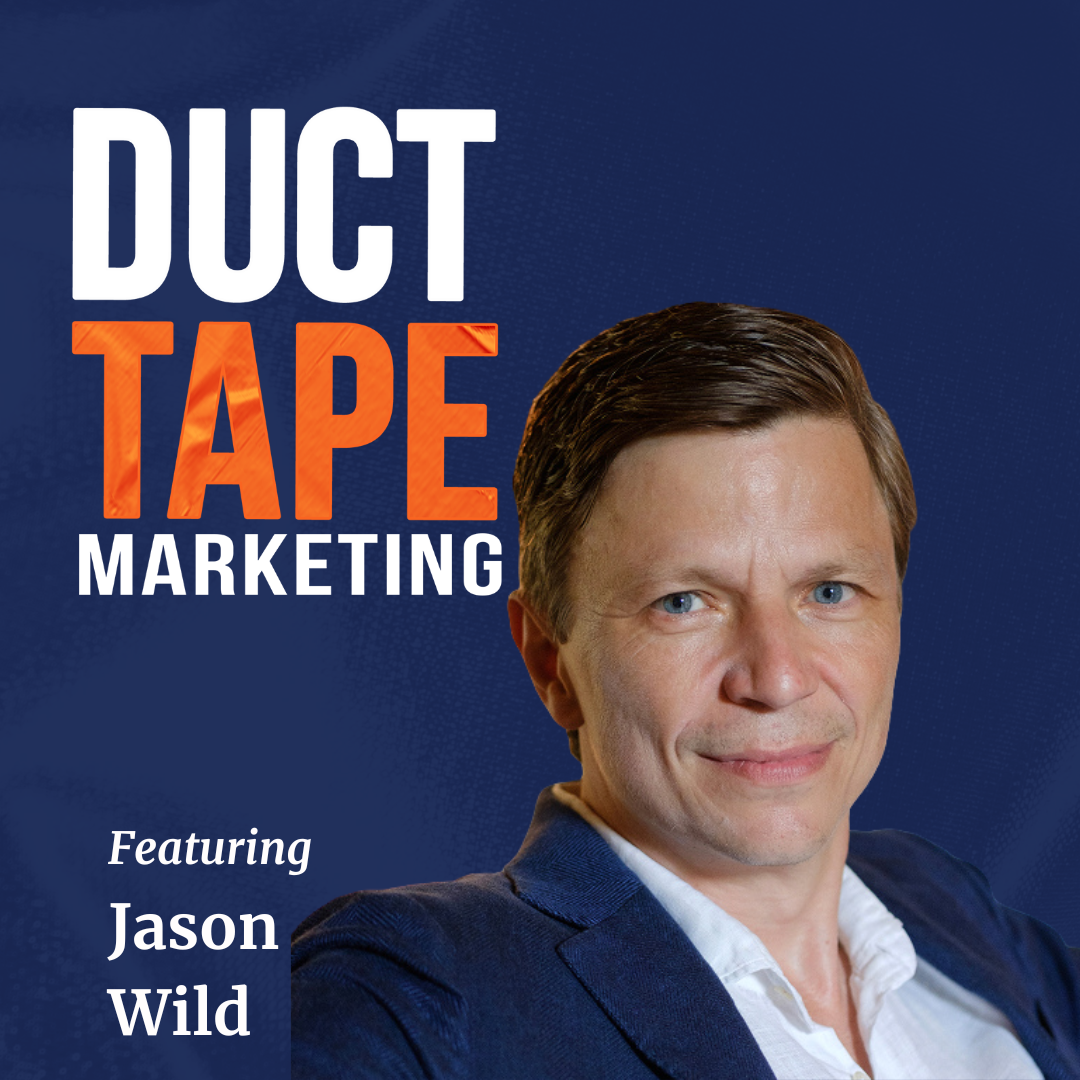
Most companies hit a ceiling not because of strategy or market conditions, but because the leader is still trying to be the smartest person in the room. In this episode, John Jantsch sits down with Jason Wild, executive advisor and co-author of Genius at Scale, published by HBR Press, to make the case that the lone genius model of leadership is not just outdated. It is actively holding companies back.

Jason spent more than 20 years in senior roles at Microsoft, IBM, and Salesforce, leading projects across 40 countries. He watched brilliant people pour their careers into innovation efforts that succeeded at rates of five to fifteen percent, not because the ideas were bad, but because the conditions around those ideas were never built to support them. Genius at Scale is his answer to that problem.

This episode covers the shift from pathfinding to wayfinding, the three leadership roles that drive repeatable innovation, why most good ideas die in integration rather than ideation, and what small business owners can do right now to build a team that does not need them to be the source of every good idea.

About Jason Wild

Jason Wild is an executive advisor, co-founder of Wild Innovation Consulting, and co-author of Genius at Scale: How Great Leaders Drive Innovation, published by HBR Press. He spent more than two decades in senior leadership roles at IBM, Microsoft, and Salesforce and has led projects in 40 countries. Earlier in his career he had television and film credits, including a co-starring role opposite Mr. T in a CBS movie. Learn more at geniusatscale.com.

Key Takeaways

  • Stop hiring for the A player. Build the A team. The distinction sounds small but it changes everything about how you lead, hire, and structure work.
  • Innovation is a social process. You cannot mandate it. You have to create the conditions where people feel safe enough and inspired enough to want to co-create the future with you.
  • Most innovation stalls at integration, not ideation. Good ideas are not the bottleneck. Getting them through the seams between people, systems, and teams is where everything falls apart.
  • Language shapes culture more than most leaders realize. The Pfizer VP who banned the word change and replaced it with evolve saw an immediate shift in how his skeptical team responded to new initiatives.
  • The most dangerous place to make decisions is your office. Getting out and experiencing what your customers actually experience is not a nice-to-have. It is a leadership practice.
  • Celebrating individual achievement sends the wrong signal. If you want collaboration to be the norm, recognize teams, not heroes.
  • Wayfinding is replacing pathfinding. In a world changing this fast, the job of a leader is not to set a fixed destination and remove barriers. It is to figure out where you are going while you are already moving.
  • Self-awareness is an underrated leadership skill. How you make people feel when you give feedback shapes whether they will ever bring you their best thinking again.
  • Small business owners are better positioned for this than they think. Smaller teams, less bureaucracy, and closer proximity to customers are advantages in building cultures of repeatable innovation.

Timestamps

[00:02] Opening hook: the reason your company hits a ceiling might have nothing to do with strategy.

[00:53] Jason’s first career in Hollywood and co-starring with Mr. T in a CBS movie of the week.

[01:44] The core premise: why the lone genius model of leadership fails and what replaces it.

[03:33] What Jason saw at IBM that shaped his thinking about why smart people accept such low innovation success rates.

[06:37] Why small business founders are wired to be the genius in the room and why that eventually becomes the ceiling.

[07:19] The ABC framework: architect, bridger, and catalyst unpacked.

[10:07] Why the architect role is really about culture and psychological safety.

[11:03] The bridger as the unsung hero of innovation and why Death Valley is where most good ideas go to die.

[13:04] The role outside consultants and third parties play in bridging across boundaries.

[14:03] What catalysts do differently and how movements start with people and ideas, not companies.

[16:35] The Pfizer story: how banning the word change helped get a vaccine out in 266 days instead of eight to ten years.

[18:25] What we typically celebrate about leadership that the research says is actually wrong.

[20:31] How writing the book as a collaborative team proved its own thesis.

Memorable Quotes

“Stop trying to hire the A player. Focus on building the A team. It sounds subtle but it is a fundamentally different way to lead.”

“Innovation is not about coming up with the best idea. The organizations that innovate time and time again focus on the conditions and the environment around the idea.”

“Most innovation stalls not at the ideation phase but the integration phase. That is where good ideas go off to die.”

“Self-awareness is one of the most undervalued skills in leadership. How you make people feel when you give them feedback determines whether they will ever bring you their real thinking.”

“If the billionaire founder can make time to stand in line at a bank branch, everyone else can practice empathy too.”


Learn more at geniusatscale.com.

Duct Tape Transcript

John Jantsch (00:02.083)

So what if the reason your company hits a ceiling has nothing to do with strategy, funding or market conditions and everything to do with who you think the genius in the room is supposed to be? Hello and welcome to another episode of the Duct Tape Marketing Podcast. This is John Jantsch and my guest today is Jason Wilde. He's an executive advisor and co-author of a book we're going to talk about today, Genius at Scale, How Great Leaders Drive Innovation. was published by HBR Press.

Jason spent more than 20 years in senior roles at Microsoft, IBM, and Salesforce and led projects in 40 countries and co-founded Wild Innovation Consulting. And this wasn't in your bio, I don't think, but I found you had some television credits, movie credits. So can we start there?

Jason Wild (00:53.47)

We can start wherever you want, John. It's great to on your show, yes. My first career was Hollywood. My mom was the classic stage actor, stage mom, trying to get me and my brother to be famous. So yes, believe it or not.

John Jantsch (01:09.562)

That's awesome. So you started with Mr. T in something? Is that one I found maybe? Was he? Yeah.

Jason Wild (01:16.238)

I did. did. It's, yeah, going back to the eighties, but at the peak of his his fame in the 18, I did co-starred a movie was the CBS movie of week called The Toughest Man in the World that you can find on Amazon or YouTube. I think actually a few years ago, I found a YouTube clip where whoever uploaded the clips said it was the worst fight scene in Hollywood history. And I agree.

John Jantsch (01:43.081)

Well, you have that permanent record for you. All right, so let's dive into the book. The core idea is that the idea of the genius at the top, the boss, is really now out of date and what's needed now is genius at scale. Can you make that concrete really for a business owner, say, running a team of 10, 20 people?

Jason Wild (02:08.046)

Yeah, absolutely. this is a book that when my co-author invited me to write the book almost 10 years ago, I kind of thought it would be the book writing version of the Gilligan's Island, right? It'd be maybe a two, three year tour. And here we are, believe it or not, almost 10 years later and thousands and thousands of hours and worth every minute. So basic premise was I was not interested. I'm a practitioner. You know, I've been leading projects in teams.

trying to do meaningful work around technology, digital transformation, cultures of innovation around the world with large companies as well as startups. honestly, at this point in my career, John, I was not interested in just writing a book to write a book. But I was really lucky to start my career at IBM when Lou Gerstner was still CEO there and got to interact with Lou a little bit and

And it was a really important moment, I think, for me at that part of my career, because IBM was very client focused, very customer centric. And that was ingrained deeply in my brain. I was surrounded literally by geniuses. I was there when IBM did Watson on Jeopardy. I got to know the guy who invented the relational database, eventually a small company called Oracle monetized and created a nice little business around.

John Jantsch (03:30.042)

You

Jason Wild (03:33.711)

You know, as I was working on these projects, long story short, I was seeing these incredibly talented people literally pour their life into these projects or whatever it is they were working on, but accepting very low success rates, 5%, 10%, 15%. And, you know, I bought into the same notion that innovation was all about coming up with the best idea, that it was about the lone genius.

John Jantsch (03:58.329)

you

Jason Wild (04:01.672)

I'm the person with the biggest title and power. But over time, I became really curious about what really did set out in a small company or a big company. You why did some ideas, you know, go far enough along to actually change the way that we live or work or change the system? And others didn't. And it kind of became a little bit of my career and life passion. And I saw so many of these people that I really looked up to just approaching it kind of the wrong way.

falling in love with the ideas, focusing on the world of innovation. And maybe they get lucky or there's some heroic result, but the real organizations or teams that were great at innovating time and time again, were the ones that really focused more on the conditions and the environment around them. And so, we started talking about Mr. T, it took me 40 years for my life to come full circle away.

But, know, genius at scale in some ways is meant to kind of put down this notion of, you know, senior leaders stop looking to hire that A-Team player and instead focus on building an A-Team. And I think it sounds very small and subtle, but it's a big part of the difference. And then when I looked at it, there are lots of books on innovation, of course, and lots of books on leadership, but there are no books about how do you actually lead innovation.

John Jantsch (05:25.433)

Yes.

Jason Wild (05:25.486)

which to me was really really fascinating because it's one of those words or topics that lots of people lean forward, they're interested, they're curious, but there was a lot more opinions than actual science around how do you actually create those conditions as a leader for people to be willing and able to want to innovate. In my co-author's last book that was published about 12 years ago, focused a lot on companies like Pixar and eBay.

right, super creative, know, digital native companies where innovating is not easy, but it's certainly easier than being, you know, a mom and pop small company, right, or a legacy company that, you know, was founded 80 years ago. So in Geniuses Scale, the book that we wrote, we, you know, we focused on companies in regulated environments, healthcare, banking, you know, as well as startups, startups in Africa and Japan to really shine a light on, you know,

Everyone's context is different, but really the role of leaders is to create the environment where innovation organically thrives as a result of the community versus constantly trying to chase the next shiny object.

John Jantsch (06:37.322)

So, a lot of my listeners are small business owners, mid-size business owners, founders. And I think the very nature of that is like, I created this thing, I'm the genius, it starts there. And so then I'm going to build a team and everybody looks to me to continue to say, what's next? And you really introduce the evolution, I guess, that that leader needs to go through and even some roles that they need to take on. You're ABC, you've got a good, like all consultants, you have a...

a good framework there for architect, bridger, and catalyst. Walk me through a little bit of what those roles are and maybe the challenges for lot of business owners to step into those roles.

Jason Wild (07:19.446)

Yeah, no, absolutely. I think, you know, for small businesses, you know, even large businesses these days, you know, doing business in the past was, don't think it was ever easy, but it was, it was, it was easier. And, you know, and literally the world is shifting two or three feet underneath our feet, you know, every single week. So there's so much to keep up with and

Yeah, you know, so legacy leadership was, you know, some would call kind of pathfinding to your point, whether you're, you know, the owner of a small business or a 4,200, 500 company, right? And that legacy kind of leadership is change management, setting the direction, right? Articulating the vision, hopefully very, very clearly, and then convincing as many people as quickly as possible to get in the car and follow you to that, to that destination. And maybe that was okay, right? When you had the luxury of time.

But the world is changing really quickly and you could argue that it's never going to be as slow as it is right now. It's only going to accelerate. So part of what the book is about is this what we're calling wayfinding. If classic leadership was pathfinding, setting that direction and trying to remove those inhibitors and barriers, which is even more important as a small business owner because your margin of error is even less than a large company.

It's very uncomfortable for many leaders, regardless of your pedigree and your background. But I do think that small business owners are going to be more ready and in a better position to be able to pursue this. And what we talk about is more wayfinding. And part of the uncomfort is, how do you lead when we're surrounded by fog? Because it's not just artificial intelligence that's changing the world. There's geopolitical aspects, there's supply chain.

There's other technologies, quantum, 5G, blockchain, all of these things are like feeding off of each other that makes predicting the future even more difficult than it was before. So this notion of wayfinding is figuring out what the destination is while you're on the path. And to your point, we identified common patterns and three very distinct roles that leaders play.

Jason Wild (09:39.119)

in cultures that have proven that they can innovate routinely in time and time again, and not just get lucky once or in the right place at the right time. So the ABCs, which yes, are convenient and memorable, but did kind of like surface naturally, you know, out of our research and work. So first and foremost, the foundation is the architect. And the architect's job is really about building community. And what I touched on a little bit earlier,

John Jantsch (09:52.218)

you

Jason Wild (10:07.118)

it recognizes that innovation is a social process. And especially in small companies, you can't mandate innovation. You have to invite people to want to co-create the future with you. And we define innovation very broadly, not just disruptive innovation, but anything that's new and useful, which I think makes it even more applicable to the world of small business. So architects do a good job of creating environments where people are both willing and able.

to want to contribute, there's a psychological safety. They don't feel like there's going to be a negative reaction when you challenge, right, or come up with a new idea. So that's why that's the foundation. And it is, it's a lot about culture. It is totally about culture. And I think in a way where the culture is continuously learning and experimenting too. And I think especially for small business owners,

John Jantsch (10:47.064)

That sounds like culture to me.

Yeah.

Jason Wild (11:03.5)

Right, your business is not too big or too small to at least have a couple of working hypotheses. And I think that's what great architects do is they have working hypotheses and they encourage and empower others to have working hypotheses of at least one or two big questions this calendar year that we want to get smarter about. And those questions will lead us to better questions. So architect is a foundation and I think we realize that

You know, that's important, but it's not enough. And then the next one is the Bridger B. Bridger is really about focusing on building partnerships and Bridgers, you know, tend to be more junior people in the organization. And I really feel having been a practitioner and out there like doing the work, the Bridger is the unsung hero of innovation where the architects maybe get, you know, the award and the Steven Spielberg and the Oscar.

And then we'll get to the catalyst, which is about igniting movements that literally change the world. The bridgers are usually behind the scenes doing really tough work and recognize that, recognizing that most innovation stalls, not at the ideation phase of coming up with the ideas, but the integration phase, human integration, system integration, integration with partners. So these bridges are, you know, focus on these boundaries or these seams.

where lots of good ideas go off to die. And one of my previous employers actually called this area Death Valley, as if it was a place that was a badge of honor if you survived it. So great architects and bridgers kind of flip the lens and create environments where it's not about surviving Death Valley, but it's about creating conditions.

John Jantsch (12:32.09)

Yeah.

John Jantsch (12:46.03)

Well, so what role then does like outside consultants and third parties play in that too? I've said, when you talk about partnerships, you're kind of focusing on internally, but bringing in great talent from the outside is probably a part of that bridge, isn't it?

Jason Wild (13:04.994)

Yeah, it is. It can be internal and external. can be sales and marketing, business and tech, right? A lot of it is people who speak different languages, have different objectives, feel that they're part of a different community. And, but you got to get them to kind of work together. They may not want to like hang out together at the end of the day and be best friends, but you know, the role of that leader and that bridger is getting the collective value out of them that individually never would have happened. So.

Absolutely, there's a lot of focus on partnering externally. And I think what Bridges, Bridges are good at many things, but one of things that really good at John is building trust in low trust environments, being proactive at mapping the ecosystem and places where, hey, if this goes well or not well, we think we're going to need some solutions or partners here and not waiting until it's a five alarm fire. And they give credit to others and go out of their way.

John Jantsch (13:45.338)

Mm-hmm.

Jason Wild (14:03.192)

to make others the hero and not about themselves. And then C is the catalyst, C is about really igniting movements, movements that become bigger than the individuals. And I think this is where it's not every day where people wake up and say, hey, John, I want to ignite a global movement, right? Because it just seems so far away.

And, but you look, I I worked at Salesforce for many years, which is one of the CRM platforms for small business. And, you know, what's interesting about a place like Salesforce is it's become kind of the de facto movement for CRM and cloud computing. So a lot of people associate the companies with those movements, but movements are really started by people and ideas. And so part of the reason of the book is to give hope.

to people that it may seem very difficult or impossible, but anybody can ignite a movement that changes how we work and live with the right focus and other best practices that obviously we would love for you and people to read the book and learn about.

John Jantsch (15:13.478)

Well, so the ABCs basically add up to what you're saying is we need to have collective genius in order to have innovation. how do, I mean, do people resist or maybe misunderstand that idea?

Jason Wild (15:29.656)

Yeah, think there's resistance everywhere. one of the things that I think in writing the book, we wanted to write a book that is educational and inspiring, but also a business book that doesn't put you to sleep and has an element of entertainment because we're so fortunate and privileged, John, to be able to have studied for years some of these leaders and be a fly on the wall.

And one of them was the leader of clinical supply chain at Pfizer, who was a relatively new executive. And it's the story behind what he and his team did to get the vaccine out there in 266 days, in usually what would take eight to 10 years. And one of the things that they did was a real focus on language. And it's a reminder that every detail matters if you want it to.

And Michael Koo, this Pfizer VP, he inherited the team that was skeptical of almost everything, just because of past failures and attempts and other leaders and the usual stuff inside of a big company. And one of the things that Michael decided in his first few months of joining Pfizer was he banned the word change. And it sounds very petty, but...

John Jantsch (16:52.346)

Hmm.

Jason Wild (16:56.386)

I think it represents a bit of the genius of him understanding the environment that he was parachuting into. And instead he said, let's talk about evolve. Cause when people would talk about change, immediately it would be a negative reaction, more change. We went through a change management program last year. I'm tired of change, but who doesn't want to evolve, right? Who doesn't want to keep up with the Joneses? And so there was something psychological there about

You know, everyone should want to get better, better, better at their craft. And if you don't, why are you here? And I think you again have less luxury in a small business. So language matters. And I think self-awareness is one of the most undervalued skills of leadership. How you make people feel when you give them feedback.

And these soft skills now with the arrival of AI, you you hear lots of people saying they're not soft skills anymore, right? Because, you know, getting the most out of people and tapping into as Pixar would say, everyone has their slice of genius is not the responsibility of the individual worker. It's of the leader to activate that and figure out what it is individually.

John Jantsch (17:58.614)

You

John Jantsch (18:11.918)

Yeah, I'm curious because you studied so many exceptional leaders, are there things that we typically celebrate that are wrong about leadership and leadership culture that your research found?

Jason Wild (18:25.294)

Oh yeah, know lots of things. One of the things that's a pet peeve of mine is celebrating like individual awards. And I mean, even like Thomas Edison said, it's like, nobody did anything alone. And whether it's intentional or not, just putting someone up on stage as an individual, it sends their own signals of, right, be an individual hero and be like this person, right? And you'll get to lift the trophy too.

and instead recognize teams. And that might mean that sometimes you're recognizing people who, you know, aren't pulling their own weight. But the real message you're trying to send to the organization is collaboration is not optional. And even better, get great at collaboration because that's how like meaningful value creation happens. I think the second thing is, that back to stop trying to be the smartest person in the room. And instead,

try to activate that collective intelligence of the entire team. And I think the third one, and I'm not as worried about this small business, but I'll say it anyway, is what do you think is the most dangerous place to make a decision,

John Jantsch (19:39.81)

in a meeting.

Jason Wild (19:41.635)

Yeah, in the office, right? In the comfort of your office. So I'm a big believer in getting out there and walking a mile in the shoes of your customers. Do it sometimes with purpose. Do it sometimes with a blank sheet of paper. I worked at Salesforce. Mark Benioff, the founder, co-founder of Salesforce, is a billionaire. know, famously ahead of a big meeting with one of the big American banks.

John Jantsch (19:52.792)

This is

Jason Wild (20:08.77)

He wanted to go to a local branch, wait in line, to see the experience. And Yad helped him prepare for the meeting, but it was more about sending a signal to the whole organization that if the billionaire founder can care about time to do it, then everyone else can practice and develop empathy. So those are a few things off the top of my head.

John Jantsch (20:31.406)

So this book, you had a co-writer, so this book in some ways was collective genius. Do you think that that collaboration itself made for a better book or at least a different experience than writing a solo book?

Jason Wild (20:45.442)

I think so, for sure. And we're still friends, thankfully. so yeah, it's a multi-generational team. I'm in the middle. know, two academics with me as a practitioner. And yeah, I think it was just a phenomenal experience that I think we all agree that there's no way we would have ended up where we got to if we tried to do this alone.

And I think the most important thing is that, you you write a book, but you never know how the world is going to respond. And, you know, I think some of the things like wayfinding is in the epilogue. And we wanted to write a book that was meant to be timeless, because I have some friends writing books about AI. You know, one was the former chief AI officer at NASA. And like tongue in cheek, I tell them like, good luck, hopefully it's still relevant by the time it's published. And

John Jantsch (21:40.806)

Yeah, no kidding.

Jason Wild (21:42.286)

So it's interesting that we didn't write a book about AI, but a lot of people serendipitously are saying that the ABCs represent a really interesting operating system, right? Because organizations, you need some structure and predictability, but again, you need to adapt and flex and morph your value proposition like great startups do. And so I don't think we would have landed there without this,

two exceptional co-authors that I've had the privilege of working

John Jantsch (22:15.578)

Well, and I think you also surfaced in this day and age, what are probably going to be the human skills that are going to remain the most valuable, I think, in the long run as well. Well, Jason, I appreciate you taking a few moments to stop by the Duct Tape Marketing Podcast. Is there a place you'd invite people to connect with you and certainly learn more about Genius at Scale?

Jason Wild (22:35.756)

Yes, thanks for asking. yeah, it was just published a couple of months ago. We've got a wonderful website in multiple languages, genius at scale.com, genius at scale all one.

John Jantsch (22:49.144)

Awesome. Well, again, I appreciate you stopping by and hopefully we'll run into you one of these days out there on the road.

Jason Wild (22:53.977)

Sounds great. Thank you so much, John.

Sign up to receive email updates

Enter your name and email address below and I'll send you periodic updates about the podcast.

powered by

  •  

7 Steps to Small Business Marketing Success – Episode 4

7 Steps to Small Business Marketing Success – Episode 4 written by John Jantsch read more at Duct Tape Marketing

Catch the Full Episode

john jantsch (1)Overview

Every founder I talk to is excited about AI content tools. Most of them should be a little nervous. The market is being flooded with content that reads fine and means nothing, and when you add to that pile, you do not rise above it. You disappear into it. In this solo episode of the Duct Tape Marketing Podcast, John Jantsch makes the case that more content is the fastest way to become less visible, and that the fix is not volume. It is content built to do a specific job.

The episode lays out a practical content strategy for small business owners who are tired of publishing for the sake of publishing. John walks through three principles: picking content pillars anchored on your ideal client’s problems, organizing everything under hub pages that signal authority to both buyers and AI, and repurposing authoritative founder content rather than mass-producing generic posts. He also names the ingredient most businesses skip entirely: a point of view.

This one is for small business owners, marketers, agencies, and consultants who want their content to compound over years instead of evaporating in a week. If you have ever written a blog post because the topic seemed interesting that week, this episode will change how you plan everything that comes next.

Guest Bio

John Jantsch is the founder of Duct Tape Marketing and the host of the Duct Tape Marketing Podcast. He is a marketing consultant, speaker, and author known for turning marketing strategy into a practical system small businesses can actually run. His books include Duct Tape Marketing, The Referral Engine, Duct Tape Selling, and The Ultimate Marketing Engine, the source of the 7 Steps framework featured in this series. Through Strategy First™ and the Marketing Operating System, John and his network of certified consultants help founders install strategy before tactics and build marketing that compounds over time. He works with business owners through fractional CMO engagements and shares field-tested, no-hype advice with the podcast audience each week.

Key Takeaways

  • More content is not the answer. AI has flooded the market with readable but forgettable material, and adding to it buries your brand instead of building it.
  • Content should do a job. If a piece cannot tie back to a clear pillar, you should not be producing it.
  • Pick three content pillars at most, anchored on your ideal client’s problems or buyer segments. Three gives you range without dilution.
  • Use the three-year test: if you would be bored with a topic in six months, it is a theme, not a pillar. Pillars are what you intend to own years from now.
  • Organize content under hub pages. One page per pillar where your proof, case studies, and expertise live together, so both search engines and buyers see real authority.
  • Hub pages serve your sales team too. They give you a credible place to send prospects who need the full picture on a topic.
  • Repurpose authoritative content. An hour of focused founder conversation can become 50 to 100 pieces of content in the founder’s real voice.
  • This is the best use of AI for content. Not to write the generic stuff, but to stretch the good stuff once you have captured it.
  • The missing ingredient is a point of view. AI returns the opinion of the collective mass. It cannot give you the thing only you believe.
  • A point of view does not have to be controversial. It just has to be different, and most founders already hold one they are simply not surfacing.

Great Moments

  • [00:01] John kicks off episode four of the seven-part solo series and frames the core idea: why more content is making you less visible.
  • [02:26] The first principle, picking pillars, and why your content needs to compound around your ideal client’s problems.
  • [04:49] The three-year test for separating a real pillar from a passing theme, plus how hub pages organize it all.
  • [07:12] The repurposing principle, including how an hour with a founder becomes 50 to 100 pieces of authoritative content.
  • [09:24] The missing ingredient most businesses skip: developing a genuine point of view in a sea of AI sameness.
  • [11:44] Your next steps and where to get the full Seven Steps ebook.

Memorable Quotes

  • “Adding to that pile doesn’t help you. It buries you.”
  • “If you’re bored with a topic in six months, it’s not a pillar. It’s a theme.”
  • “Every piece of content should point to one of those pillars. If you can’t tie it to one, you shouldn’t be doing it.”
  • “AI doesn’t develop points of view. It develops the point of view of the collective mass.”
  • “It doesn’t have to be controversial. It just has to be different.”

Resources

  • The Seven Steps to Small Business Marketing Success ebook (under five dollars): dtm.world/sevensteps
  • Talk to a Duct Tape Marketing advisor: ducttapemarketing.com/consultation
Duct Tape Transcript

John Jantsch (00:01.838)

Hello and welcome to another episode of the Duct Tape Marketing Podcast. This is John Jantsch, and again, another solo show. No guest today. I'm doing the seven steps to small business marketing success. So if you haven't caught the past, I think I'm on episode four here. If you haven't caught the past three, go check them out at Duct Tape Marketing. but this is a series of seven podcasts. This is number four. Why more content is making you less visible? How's that for a topic?

So here's the AI content trap. most founders I talk to are really excited about AI content tools and frankly they should be nervous. and that is because the market is being flooded with generic, readable but forgettable content like crazy. and I think adding that pile doesn't help you, it kind of buries you. So

He here's the problem, and this and this has been the problem all along. Content or I'm AI didn't necessarily change this, it just made it worse in a lot of ways. most content that small business owners have produced, somebody convinced them to write a blog post every week. but it it's just kind of the idea of the week. It has no spine, there's no thought behind it. maybe the topic seemed interesting that week, but two years down the road later, it actually serves zero purpose. So

The thing about AI is it makes it easier to publish a lot of content, but that doesn't really fix this problem. It just amplifies the problem that the content was not that valuable or useful anyway. and I think that customers, prospects are definitely going to, they already are, recognizing AI content and and ignoring it, tuning it out completely. and and in s to some degree, that's actually hurting.

the brand when they see that that's what you're producing, that's all you're producing. So there are three principles when it comes to really content. less is more content, or at least the right content, I guess is probably a better way. I'm not necessarily saying you don't need content. I'm saying you need content to do a job and a very specific job. and that requires a couple principles. number one is picking pillars. So you want your content to actually

John Jantsch (02:26.158)

compound. and you want it to be around some things that make total sense to you. If you if you're an architect and you do residential work, you do hospitality work and you do commercial work, you want to actually start thinking in terms of what would what would be pillars of kind those three types of work that you do, those three types of use cases, those three types of probably buyers.

what would be the pillars that would actually drive those folks or or at least let those folks to understand you better? and and start developing topics around a collection of pillars as opposed to as opposed to just, hey, I'll write about this this week because it seems interesting, or because I can get a lot of engagement in social media over it because it's a hot topic. I I think.

again, there may be a case for that if you've got lots and lots of extra time, but you really want your content to do a job. So you want to pick three pillars at most, that that are really going to be anchored on your ideal client, or at least I should say your ideal client's problems. and every single one, every single piece of content should point to one of those. If you can't make it, if you can't tie it or have an angle that ties it to one of those, you shouldn't be doing it.

This is a discipline, quite frankly, because especially a lot of organizations that just tell junior marketers to create content without giving them those pillars. That's one of the best things you can do. If you have people in your organization producing content or an agency producing content for you, you should develop strategically as the founder, as the owner, you should develop what those three pillars are. and and again, that's a discipline that maybe starts with the founder sometimes, because

Sometimes the founder wants to write about the cool topic or the thing that hit them that that that week. if you're bored with a topic, you can use this as a three-year test, I'll call this. If you're bored with a topic in six months, it's not a pillar. It's a theme. Pillars are really what you're still the authority on, or what you're driving to be the authority on two, three, four years from now. Now you won't always get that right.

John Jantsch (04:49.748)

but it's sure it certainly should make sense to say, yeah, long term, this is going to be important for my ideal client and the problems they're trying to solve. And I think I think three is the sweet spot because it allows you to have a lot of range. it allows you to be seen as an authority, but it's a it doesn't get diluted. I mean, it forces you to make decisions about your content. All right, so that's the starting point, having that frame, those three pillars. next is.

And I've I've talked, I've written about this for years, but I talked about it in the last episode as well. You then want to organize that content under hub pages. so every one of your pillars gets a page that you're going to then start building more and more content on. So as you as you pick a theme or you pick a topic that goes or a subtopic that goes under one of those pillars, you start organizing them as pages. hub pages

Have so many uses. First off, it's the way to organize your content so that the search engines, AI understands that this is a broad topic, that you have with lots of authority, that there's lots of information here, that your expertise, that you have actually put your client case studies and real proof into this entire topic, which has a ton of value just from being foundable. Foundable? Findable. There we go.

but it also don't forget, human beings want to consume this content as well. Think about your sales team if you have one. These hub pages, excuse me, these hub pages really allow your sales team to be able to say, if you are, you know, thinking about buying a business and you need to understand what the tax implications of buying that business are, here's the entire topic around that that we have written on. So it allows

folks to to actually allows you to share and and you know have really a useful tool or or home that you can send people to that that demonstrates that you're a real expert. And here's the real beauty of and this is really kind of third third principle, which is repurposing. Once you have these pillars, once you build these pages,

John Jantsch (07:12.182)

Or once you start to build these hub pages, quite frankly, you don't have to wait till they're done. Once you start producing content that is focused and and and has a purpose around these pillars, then you can actually start leveraging every piece of that. in fact, we we actually what we will often do is we will work with a founder and we will just sit with them for an hour, maybe a couple of times.

and just ask them questions, let them talk about their products, their services, the problems, actual customer case studies, really develop a point of view about and a voice about what they do. and we're actually to able to take that video transcript and turn it into 50 to 100 pieces of content, including social media posts, over a period of time. And and it's really the easiest way today to leverage.

authoritative expertise, human content in the voice of the founder or the voice of of the technical expert that's going to talk about something that your business does. And and frankly, AI can't do that. and that that's really the beauty of then using these AI tools is once we have that authoritative content, we can actually easily use the AI tools then to repurpose that content. And I think that that's really the

that's really one of the best uses, quite frankly, of AI when it comes to content. So the the the next thing I want to talk about is that's really the foundation structure, right? You've got the the pillar pages or the pillar topics, I'm sorry, the hub pages for each of those pillar topics.

and then the the mechanism to repurpose a lot of that content. That's what we have to do today to make sure that we're putting it in places like LinkedIn and Reddit and all the places that that are that that are gonna send authority signals, you know, back about our content and about our business to the AI tools. But the missing ingredient for most businesses is a point of view.

John Jantsch (09:24.566)

So we're thinking in terms of this content that is certainly AI driven in a lot of cases, it's very generic, it's very balanced, it's very readable, it's a collection of what everybody else wrote. And frankly, it's forgettable because there's nothing that makes somebody stand up and say, Yeah, that's different. Why isn't anybody else in our industry saying that? Everybody else is saying the same thing. Or why are we actually doing this the same way that we've always done it?

How can we develop a point of view in our writing that that actually demonstrates that that we have some unique thinking? AI doesn't develop points of view very often. It develop, well, it develops the point of view of the collective mass, right? And so if you can actually think in terms of of you know, think in think in terms of of those people that, and I'm not suggesting this, but think in terms of those people that write very polarizing stuff. I mean, I

You know, a lot of the stuff that's gone on in politics of late, you know, is really people recognizing that writing something very polarizing repels a lot of people, but it also attracts a certain people who re are very attracted to that point of view. And I'm not suggesting that. I'm just saying use that as an example. That if you can develop a point of view about a position, something the customer hasn't heard before, something that no one else in the industry is saying, it doesn't have to be that controversial.

It just has to be different. And I will say that that asking the right questions of AI can actually help you start to develop some of that point of view. you don't necessarily have to lock yourself in a room and think, how can I, you know, what what's different? Looking at the average, having a conversation with an AI tool about what everybody in your industry is typically doing. I mean, literally asking you questions like, you know, what is a

what is a generally accepted best practice in our industry that no one is actually pushing back on? things like that can actually then start surface some of the ideas or at least surface some of your thinking about actually putting a point of view into your writing. So here's your here here are your next steps. I want you today to think about three content pillars.

John Jantsch (11:44.13)

That would make total sense for your ideal client that would address either segments or problems that your ideal clients are actually having. and then think in terms of and again, you can use it, AI tools are great for research to get your thinking going. But you know, plug those thoughts, those themes in or those pillars in and start asking and about questions about what would be all the subtopics, what would be a way to write the ultimate guide to this

particular pillar topic and you'll start to get some ideas. Hopefully you'll dismiss some of them. Hopefully you'll add to them. Hopefully you'll think about this idea of a point of view that you can bring to each of those topics that others aren't saying. And and a lot of times that point of view exists. You just believe it and believe that your customers will appreciate it and understand it and know it when they see it. and you're not actually surfacing it. And that's a real key difference. So

this today's podcast was really built on this new ebook that I produced called The Seven Steps to Small Business Marketing Success. You can pick it up for less than five dollars at dtm.world slash seven steps. If any of this is resonating, go get the whole thing. If you actually want to talk to one of our advisors about how we do some of the things I'm talking about today and we could do for a business like yours, it's just duct tapemarketing.com/slash consultation. So

Thanks for tuning in and hopefully we'll run into you one of these days out there on the road.

Sign up to receive email updates

Enter your name and email address below and I'll send you periodic updates about the podcast.
powered by

  •  

Before You Touch Your Marketing, Do This First

Before You Touch Your Marketing, Do This First written by John Jantsch read more at Duct Tape Marketing

Most founders come to a marketing conversation with a tactic already in mind.

Better website. More leads. A LinkedIn strategy. Maybe an AI tool that’ll finally make content easy. The tactic changes. The assumption underneath it doesn’t: the marketing needs to change.

After 20 years doing this work with small businesses, here’s what I’ve actually seen. The marketing is rarely the first thing that needs to change. The founder’s clarity is.

Not because anything is wrong with the founder. Most of the founders who ask for marketing help are working hard and carrying a lot. The problem isn’t effort. It’s that they’ve lost the ability to see their own business clearly.

Why that happens

Five years in. Ten years in. You’ve absorbed a hundred opinions about what your business should be, and somewhere along the way you drifted from what it actually is.

You’re making decisions based on the business you remember, or the one you wish you had. Every new strategy you install inherits that confusion.

I watched a founder last year build out a full content strategy, hire a new agency, and rewrite their website. Same results they’d been getting for 3 years. The strategy was fine. The clarity underneath it wasn’t there.

The Founder Portrait: 4 questions most founders avoid

Before you touch strategy, before you change anything about your marketing, do this. One hour. A blank page. Four questions.

What’s actually working right now, and how do I know?

Not what you’re doing. What’s working. There’s a difference, and most founders can’t answer it with specifics.

“Working” has a real definition: it produces revenue, a measurable input to revenue, or it reduces what you’re spending to acquire revenue. Everything else is activity. If you can’t name what’s working and point to the evidence, that’s a starting point.

What am I doing out of habit, guilt, or optimism that I should stop?

Every business carries weight it doesn’t need. A service line that never quite worked. A customer segment that costs more than it pays. A channel somebody told you to be on 3 years ago.

The honest answer is almost always 3 to 5 specific things. Naming them is the hard part. Stopping them is what creates room for real growth.

Where is my business actually making money, and where am I pretending it does?

This one requires looking at revenue by segment, by service, by customer, with gross margin attached. Most founders have a story about their business that’s drifted from the numbers. The numbers don’t drift.

I’ve seen this pattern enough times that I look for it now. The founder thinks they run a 3-service-line firm. The numbers say they run a single-service-line firm with 2 expensive hobbies attached.

Who am I as a founder, and what do I want this business to give me?

This is the question most marketing work completely skips. Growth is one possible goal. Some founders want a business that supports a specific life. Some want an exit. And those are different businesses with entirely different marketing systems.

If you don’t know which one you’re building, no strategy can serve you. It’ll always optimize toward the wrong target.

What the Founder Portrait actually does

These 4 questions together produce what I call the Founder Portrait. It’s not a document you share or hand off. It’s the ground you stand on when you do the strategic work that comes next.

Without it, every downstream decision is made from an unstable position. The messaging, the ideal client definition, the channels, the campaigns: all of it inherits whatever you were confused about when you built it.

You can only build a system on what you actually know. The Founder Portrait is how you find out.

One thing to do this week

Sit down for one hour with a blank page and answer the 4 questions. No team. No advisors. No AI. Just you and the page.

Don’t try to turn the answers into a plan yet. The work this week is to see the business clearly. Everything else comes after that.


The Founder Portrait is the starting point. The rest of the system is what comes next. I’ve put the complete framework in a new ebook: “7 Steps to Small Business Marketing Success.” It covers everything from defining your ideal client to building a referral engine that actually runs. Grab it at dtm.world/7steps.

  •  

The Back Half of the Hourglass Is Where Your Best Growth Lives

The Back Half of the Hourglass Is Where Your Best Growth Lives written by John Jantsch read more at Duct Tape Marketing

The Marketing Hourglass has 7 stages: Know, Like, Trust, Try, Buy, Repeat, Refer.

Most small businesses have systems for the first five. They know how to get found, how to build some trust, how to close. Then the marketing ends.

Repeat and Refer, the back half, get left to chance. Good work, happy customers, and hope.

That’s expensive. And it leaves most of the growth on the table.

What a customer is actually worth

A customer who buys, comes back, and refers is worth between 3 and 10 times a customer who buys once. That ratio shows up in the data of almost every small business that tracks it.

And yet. Acquisition gets the meetings. Acquisition gets the budget. Customer experience gets the leftovers.

I worked with a landscape services business at about $4 million in revenue. Growing through Google ads, word of mouth, and one partnership. The owner knew he had loyal customers but had never systematized any of the customer work. Within 12 months of installing a Customer Engine, it accounted for roughly 45% of total new revenue, up from about 10%. Paid acquisition spend dropped by a third. Because the back half of the Hourglass was finally doing its job.

Four things the Customer Engine does

Onboarding

The first 90 days after a customer buys is where the relationship gets established. Most businesses treat it as operations: deliver the thing that was sold, move on.

A structured onboarding process does something different. It confirms the customer made the right decision. It surfaces anything that needs fixing before it becomes a problem. And it creates the natural moment to ask for a review, a referral, or both.

Most businesses skip the ask entirely. The onboarding sequence is what makes it feel natural instead of awkward.

Repeat engagement

What specifically brings your customers back? Most businesses rely on the customer remembering to return. The Customer Engine removes that dependency.

Maintenance plans, seasonal offers, anniversary touchpoints, check-ins anchored to natural moments in the customer’s life. The landscape business introduced seasonal maintenance plans and converted about 40% of project customers. Recurring revenue went from essentially zero to a meaningful line.

That happened because they asked.

The referral system

Same 3 parts as the Growth Engine: a specific ask, at the right moment, with an easy path for the referrer. All 3 matter. Most businesses have none of them.

The right moment is right after something good, while the experience is still fresh. The landscape business built this properly. Referred customers went from about 10% of new work to 25% within 6 months. That’s a system, not luck.

Reactivation

A one-time outreach to every customer from the prior 3 years who hasn’t purchased anything new. Simple, direct, personal note from the founder.

The landscape business converted about 8% of that list into some form of re-engagement within 90 days.

Reactivation is probably the highest ROI marketing move available to most small businesses. Almost nobody does it, mostly because it feels like admitting you lost touch. Reframe it: it’s a welcome reconnection, and customers respond to it that way.

What the Customer Engine actually powers

This is the part most founders miss. The Customer Engine doesn’t just produce direct revenue from existing customers. It feeds every other engine you have.

The Trust stage needs customer stories. The Customer Engine produces them. The Refer stage needs actual referring behavior. The Customer Engine systematizes it. The content engine needs real situations and wins. The Customer Engine surfaces them.

Under-investing in the Customer Engine under-powers everything else. Fixing it lifts the whole system, not just retention.

One thing to do this week

Write your referral system in one sentence.

If it turns into a paragraph of caveats, or “we don’t really have one,” that’s your answer. And it tells you exactly where to start.


The Customer Engine is step 6 of a seven-step system I’ve been refining for over 20 years. The full framework is in my new ebook, “7 Steps to Small Business Marketing Success.” Get it at dtm.world/7steps.

  •  

How to Know When Your Business Is Ready to Scale

How to Know When Your Business Is Ready to Scale written by John Jantsch read more at Duct Tape Marketing

Catch the Full Episode

DTM Podcast Mark RobergeOverview

Scaling too fast kills companies. So does scaling too slow. But most business owners never stop to ask whether they have actually earned the right to scale at all. In this episode of the Duct Tape Marketing Podcast, John Jantsch sits down with Mark Roberge, co-founder of Stage 2 Capital, founding CRO of HubSpot, and author of The Science of Scaling, to unpack one of the most misunderstood decisions in business growth.

Roberge, helped take HubSpot from zero to IPO, then spent years at Harvard Business School teaching founders why so many fast-growing companies implode. His framework asks a different question: instead of “how fast can we grow,” ask “have we proven we deserve to grow?” The answer requires evidence, not instinct, and not pressure from investors.

This episode is for small business owners, agency owners, and entrepreneurs who are thinking about adding headcount, launching new channels, or entering a new stage of growth. If you want to scale without destroying what you built, this conversation is your roadmap.

Guest Bio

Mark Roberge is the co-founder of Stage 2 Capital and the founding Chief Revenue Officer at HubSpot, where he grew the company from zero to IPO. He later joined Harvard Business School as a senior lecturer, teaching founders and operators how to scale with discipline. He is the author of The Sales Acceleration Formula and The Science of Scaling, and has spent the past decade as an investor, board member, and advisor helping companies navigate the gap between early traction and sustainable growth.

Key Takeaways

  • Product-market fit is not a revenue number. It is a retention metric. If customers are not staying and using your product, you do not have it yet, regardless of how many you have signed.
  • Go-to-market fit is the second gate before scaling. It is measured by unit economics, specifically whether you can acquire and serve customers profitably.
  • Scaling revenue too fast is a structural problem, not a motivation problem. Hiring 27 reps when you only have one requires 270 qualified interview screens, management infrastructure, and demand generation that most companies simply do not have.
  • Build a monthly hiring pace instead of a January 2nd headcount dump. Steady, intentional growth gives you time to build the systems that support each new hire.
  • The CRM funnel should not end at closed-won. Retention, engagement, and expansion are stages, not afterthoughts. The Marketing Hourglass is the right model.
  • Leading indicators of retention can be defined simply. Slack tracked whether 80% of customers sent 2,000 team messages per month. You do not need a data science team to build a version of this for your business.
  • A feature is not a moat. If a competitor can replicate your advantage in six months, it is not long-term defensibility. Founders need a vision for what makes them unbeatable over time.
  • The ability to up-level the executive team around you as the company grows is one of the strongest predictors of a successful exit. It is also one of the hardest skills to develop.
  • Sometimes the business outgrows the founder. The COO or president model is not failure. It is graduation. The reframe: someone else does the work you hate so you can focus on the work you love.
  • AI is accelerating faster than society can adapt. Mark is donating book proceeds to McLean Hospital for mental health research, because the people building this technology have a responsibility to help manage its consequences.

Great Moments (Timestamps)

[00:02] — The opening question that reframes every growth decision: are you betting on a business that is not prepared to win?

[04:04] — Mark defines what it actually means to earn the right to scale, and why most founders get this wrong from the start

[06:25] — The two-step framework: product-market fit and go-to-market fit explained clearly

[09:51] — Half scale too fast, half too slow. Mark explains the Groupon and WeWork examples as two failure modes

[11:40] — How to measure product-market fit without a data science team, using Slack and HubSpot as real examples

[13:29] — John and Mark align on why retention and advocacy belong inside the customer journey, not outside it

[16:31] — Why a feature is not a moat, and what long-term defensibility actually requires

[17:43] — The London School of Economics study on what predicts a strong startup exit (the answer will surprise most founders)

[20:33] — The mental health connection: Mark shares why he is donating proceeds to McLean Hospital and what the AI era demands of technologists

Memorable Quotes

“The decision on when to scale is usually when someone hands you a fat check, which doesn’t sound that strategic.” — Mark Roberge

“Do not let the dashboards and sales funnels in your CRM end at closed-won. That is literally step four of seven.” — Mark Roberge

“A feature is not long-term defensibility. If your competitor can build it in six months, you don’t have a moat.” — Mark Roberge

“We’re basically offering to pay for someone to do all the work you hate so you can do the work you love.” — Mark Roberge on helping founders let go

“We as technicians need to diversify our efforts away from just building and profiting toward helping society adapt to this new world.” — Mark Roberge

Duct Tape Transcript

John Jantsch (00:02.19)

So what if every time you hired too fast, launched a new channel or added a service line, you were making a bet that your business actually wasn't prepared to win. Hello and welcome to another episode of the Duck Tape Marketing Podcast. This is John Jance and my guest today is Mark Roberge. He's the co-founder of Stage Two Capital, founding chief revenue officer at HubSpot and the author of a book we're going to talk about today, The Science of Scaling.

Mark helped grow HubSpot from zero to IPO and then brought what he had learned into Harvard Business School where he taught founders how to grow without blowing up what they built. His framework gives business owners a way to use evidence rather than instinct or outside pressure to decide when they've truly earned the right to scale. So Mark, welcome to the show.

Mark Roberge (00:53.259)

Thanks, John. That's not my copy and I love it. Seriously, I love how you put it.

John Jantsch (00:59.105)

Awesome. good. Well, you know, we were talking before we got started, you and I met some 20 years ago when HubSpot was a nascent business. think maybe the first conference there were 500 people, something of that neighborhood.

Mark Roberge (01:04.916)

Yeah.

Mark Roberge (01:11.393)

Yeah, I was like in a Marriott in Cambridge. I have like, I remember specifically a couple of things about you. I think you were the most famous one of our early partners. I think I remember my last in-person chat with you was in some steakhouse in like South Boston or something. Cause I remember two people came up to you and asked for your autograph and you were like super humble about it. And I'm like, oh my gosh, this is crazy.

John Jantsch (01:21.271)

Ha ha ha!

John Jantsch (01:27.438)

You

John Jantsch (01:35.288)

Well, I'm glad I wasn't a jerk. That's for sure. Awesome. Well, let's get into your book a little bit. So I mentioned HubSpot, Harvard, now you back companies as a VC. Did something you learned or showed up across all three of those roles kind of make you say, I need to write this book?

Mark Roberge (01:37.365)

Hahaha

Mark Roberge (01:54.207)

Yeah. Yeah. It's like, it's kind of funny that we can unpack as much as you want, but in reflecting the last 20 years of my life professionally, I've given up on having a plan because I never intended to go into sales. I never applied for HubSpot. I never applied or intended to be a professor at Harvard. I never intended to start a venture capital firm.

And I never intended to write either the sales acceleration formula 12 years ago or the scientist's killing last year. These were all things that like people were like, would you be willing to do this? So they did, they do just like show up and the way that this one, as both books unfolded was a, like you, I am blessed with the opportunity to do a number of keynotes every year. and I, for the big ones like saster, I tended to try to do something fairly original for the year.

So I've, you every year I do something original. So I've given like 20 to 25 brand new speeches over the last decade. And this one was just like a pattern I saw after like eight years of being out of HubSpot as an independent board member, as a professor, as an advisor, as an investor, in why companies, the few that went IPO and billion dollar valuations versus the ones that went bankrupt was just this.

really non-strategic, non-rigorous perspective on when to scale and how fast. And half do it too early, too fast. Half of them wait too long and go too slow. It's more about going the optimal time. I started speaking about it and I'm like, it's ridiculous how many classes and rigorous frameworks we have on accounting for and accruing revenue, but not on scaling revenue. And it just went viral and kept speaking about it, kept writing about it. And then Stanford was like, hey, can you write this up?

And here we have it.

John Jantsch (03:47.128)

So the term, you kind of alluded to it, but I'll say it directly, earn the right to scale. It does a lot of work in your framework and your talk. So what does a business owner actually have to prove or do to prove that's true? Like, when do they know I have the right to scale?

Mark Roberge (04:04.286)

Yeah, it's kind of interesting how it unfolds right now. I I've done this with like tractor companies in Brazil and pharmaceutical companies in Japan, but mostly with software companies in Silicon Valley. And it's kind of funny how it's decided. Like the decision on when to scale is usually when someone hands you a fat check, which doesn't sound that strategic.

And so I try to unpack it as two steps that are sequential. One is product market fit and the other is go to market fit. And usually you're like product market fit, like duh, product market fit, duh. But like, what is product market fit? You know, I think a lot of people will say I'm ready to scale when I have product market fit, which I think is a great answer. But then when I ask them what product market fit is,

I get a lot of different answers, most of which are about a certain revenue number, a certain customer number, a certain number of inbound leads. And then I'm like, well, okay, cool. Let's say that you have 200 customers or like 500 inbound leads and everyone's buying, but like people stop using the product. Do you have product market fit? And they're like, okay, no, but

I'll just start, I'll just listen to them and build the product to appease their needs. And I'll be like, okay, well, how will you know when you've achieved it? And they'll be like, when they keep using the product and don't churn. And I'm like, exactly. So like that, that's like the first kind of like pivot mentally for folks is I encourage you to define product market fit, not as a revenue acquisition.

metric, but as a revenue and customer retention metric. And the book talks about how to extract that long-term lagging indicator back to something that you can evaluate in the first week of a customer being with you. Okay, so that's step one, product market fit. And then if you think about it, once you've achieved product market fit, all that means is that when you sign up 10 more customers, they're gonna see value that you promised and stick around.

John Jantsch (06:00.866)

Yes.

Mark Roberge (06:25.372)

It doesn't mean that you've proven that you can acquire and serve them profitably. And that's what go-to-market fit is. And it's measured by UNEconomics. So that's really the, probably the simplest way to describe the work is these two sequences of product market fit and go-to-market fit as measured by retention in the first one and positive UNEconomics in the second.

John Jantsch (06:29.506)

Mm-hmm.

John Jantsch (06:46.018)

Well, since we're defining terms, we probably better step back because I bet you if I asked 100 people, 10 people, 100 people sounds like too much work. If I asked 10 people what the word scale means, we'd probably get a bunch of definitions, more leads, more staff, more tools, but how do you define it?

Mark Roberge (06:59.21)

Sure. Sure.

Mark Roberge (07:07.528)

Yeah. So once you are ready to scale the way and that to your point, yeah, that can mean a lot of things. It could mean how do we scale our culture? How do we scale our engineering team? How do we scale our office space? Blah, blah. First off, I'm, I should be more clear that I'm talking about scaling the revenue. And to your point, scaling revenue, the inputs to that vary quite a bit by business by business. if you're a consumer business, you may just have to spend more on marketing. Something that you know a lot about Joan. if you're a B2B.

John Jantsch (07:15.094)

Mm-hmm.

John Jantsch (07:21.92)

Okay.

Mark Roberge (07:37.513)

sometimes you have to scale fancy outside salespeople if you're selling like rockets to governments. And sometimes you do it through PLG. And again, it's more of like a marketing exercise. So I really talk about scaling the revenue and the principles, apply, whether you're doing it through pure marketing or through, through sales head count. let's for simplicity, let's just talk about scaling through sales head count and the

Big pothole that people make there is even if they follow the guidance of like, let's achieve product market fit first and then go to market fit, and it could take a day, it could take a week, it could take a month, it could take a year, whatever, and now we're ready to scale, they raise money and then they have a target for the year and they hire like 27 reps the next week.

even though they only have one on the team today. And there's just no appreciation of the new capabilities that are needed to hire and onboard and manage 27 reps. Like just like, let's take one piece of it, which is let's kind of pontificate that the hiring quality might be correlated to the number of interview screens we do, qualified interview screens to the hire. If I do,

two interview screens and make a hire, I'm probably not gonna make as good of a hire as if I did 10 interview screens and make a hire. So if we're trying to do 10 and we're making 27 hires, that's 270 qualified interview screens. Where are we getting those candidates? Who's doing the interviews? Nevermind, where's the demand gen gonna come from? Who's gonna ramp them? What about the managers? It's just too driven from a Google Sheet or Excel, and so the simple pivot philosophically is,

Don't think about it as putting the annual plan together and hiring all those reps on January 2nd. Think about it as establishing a hiring pace every month or every quarter. 10 reps a month, boom, boom, boom. As opposed to like 37 at the beginning of the year.

John Jantsch (09:51.791)

So there's all kinds of horror stories of companies that blew up because they grew too fast. Would you say that they scaled too fast or they didn't scale fast enough?

Mark Roberge (09:57.47)

Yes.

Mark Roberge (10:04.928)

Both. have, like I said, it's about half and half. I mean, I would say like the classic examples out there, like an old school one is Groupon, which I think if you look at it from this lens, never really had product market fit. they just like, the promise was like, if you're a Chinese restaurant and give these coupons away, you'll get new customers, but it was really just the existing customers. And then maybe like WeWork never really had go-to-market fit. And that was pretty famously documented story.

John Jantsch (10:21.486)

There's Buzz. There's Buzz.

Mark Roberge (10:35.36)

The ones that didn't scale fast enough, we just don't know, right? Cause they're like, I can name some in our portfolio or people I've worked with over the years, but the reason why we don't know them is cause they just sat there and they were like, they had something, but the co-founders just like wanted to just go too slow and continue to do founder selling and wanted to run a profitable business when it needed to be a blitz scale business. And there's nothing wrong with running a profitable business. just, if you're trying to win in the AI customer support,

John Jantsch (10:38.702)

Yeah, yeah.

Mark Roberge (11:05.258)

category today, you can't be profitable right now. Like there's just certain blitz scale risk that you have in your category that needs to dictate how fast or slow you go.

John Jantsch (11:06.638)

Yeah.

John Jantsch (11:16.056)

So one of the key elements in science of scaling is evidence over instinct. So if I don't have a giant data team, and I know AI is actually solving some of this right now, but what does evidence actually look like at a startup or smaller business level?

Mark Roberge (11:29.768)

Mm-hmm. Yes.

Mark Roberge (11:40.117)

Yeah, I mean, you don't, you definitely don't need like a sophisticated data science team. You don't even need AI agents doing this stuff. Let me just give you like a really simple example. So we talked about product market fit is where I'm, I'm proposing to everyone that it's more about customer value and retention as opposed to customer acquisition. And obviously you need to acquire customers to eventually make them valuable. So it's an input to it.

John Jantsch (11:48.526)

Okay, all right.

Mark Roberge (12:08.34)

The retention is a lagging indicator. So we needed to find a leading indicator of retention. We can't wait a year to know if we have product market fit. I need to know like the week after I acquired the customer or the month after. And so what the book and the work I've been doing with companies for last decade is to help them define their leading indicator of retention. What is it that we can observe in the first month of a customer's experience with you, your product, your service, whatever.

that if we see that, they'll be with you forever. And if we don't, they'll probably churn. And so like, I frame it as P percent of customers do e-event every tee time. Okay, so that sounds like the programmers on the audience are like loving this right now. The history majors are like totally lost, right? So like, just to bring that to life, Slack, 80 % of customers send 2000 team messages every month. HubSpot, 80 % of customers use five or more features in the platform every month, right?

John Jantsch (12:53.55)

You

Mark Roberge (13:08.564)

These are things that can be measured in the first month to give us insight. If we're at 80%, we probably have product market fit. If we have 10%, we definitely don't. I don't need a data scientist to evaluate that. Okay, so these are not overly complicated, like PhD math type things.

John Jantsch (13:20.174)

So.

John Jantsch (13:29.922)

One of the things I've been preaching for 20 years is that when we talk about the customer journey, that retention and advocacy and all the things that come after somebody becomes a customer are part of the customer journey or should be part of the customer journey. And for so many people, it's let's get a customer. And I think what you're really certainly hammering home here is this idea that you're not going to scale without retention and without

Mark Roberge (13:44.234)

Yes!

John Jantsch (13:59.382)

know, referrals or whatever you call it. Yeah.

Mark Roberge (14:01.984)

Spot on. mean, when I hear people like you say this, the conviction continues to escalate, right? Because it's like, another way to say what John is saying here is, let's just talk really tactically. Do not let the dashboards and sales funnels in your CRM end at closed one. That is like literally step four of seven, right? Like let's just like really step back, like very, very like basic, like.

John Jantsch (14:20.468)

Yeah.

Mark Roberge (14:31.654)

know, opportunity stage one is, you know, business, like discovery call and like business and you know, metrics definition. Step two is product validation, demo, blah, blah. Step three is closed one. Step four is set up. Step five is regular engagement. Step six is retention. That's the funnel.

John Jantsch (14:52.558)

He

John Jantsch (14:59.438)

Yeah, yeah, yeah, yeah. I actually refer to it, have been referring to it as the hourglass, you know, with the idea being that, the funnel, right, but then it goes back out again. Yeah. Yeah.

Mark Roberge (15:06.26)

Totally. And expands. Exactly, because you expand more and like lot of people like winning by design with Jaco and like that's just a great way, the bow tie. A lot of people like it's a really good way to think about it because that usage, it represents that the usage and should grow.

John Jantsch (15:16.589)

Yeah.

John Jantsch (15:23.576)

So you were at Harvard and name a dozen schools, Stanford, that a lot of people go to those because they've got a big idea or they wanna have a big idea. They wanna turn out the next Google. I'm sure you encountered many founders or would be founders in those environments. What would you like if you were, I'm sure you did this in your class environment.

tell them they're gonna get wrong or how would you coach them of how you think they're thinking about it incorrectly?

Mark Roberge (15:58.009)

I mean, there's a lot to that. I think we covered a lot of them related to the work in terms of like, you know, being more precise around having the business fundamentals in place to be prepared to scale and how you go about scaling. I would say,

I guess I'll add two more to it that come up a lot, one that's related to revenue development to some degree and one that it really isn't. The one I'll mention is having a plan for a moat. And I would say like, when I ask people what their long-term defensibility will be, they often tell me about a feature.

John Jantsch (16:31.992)

Yes.

Mark Roberge (16:45.468)

And when I asked them if they are correct and they start crushing it and start winning, and then the competition realizes it, how long will it take them for them to build that feature? And they say six months. And I say, that's not long-term defensibility. So, so you really have to like, you don't have to prove it on day one. Cause oftentimes it might take something that you have to kind of take one of those design big start small approaches to it.

John Jantsch (17:02.58)

Hehehehe

Mark Roberge (17:14.464)

but you really need to have a vision around if you are right, there will be lots of copycats and the incumbents will try to take you out and you need to make sure that you win there. The other one, unless you want to talk about that, John, I have one more that I can throw out that's pretty popular. Yeah, yeah, the other one that's interesting, I think it was a study done at London School of Economics where they looked at like, I don't know, 5,000 seed funded businesses like 15 years ago and.

John Jantsch (17:22.637)

Yeah.

Yeah.

John Jantsch (17:31.17)

Yeah, yeah, go for it.

Mark Roberge (17:43.282)

and tried to evaluate the commonalities for those that like exited at, you know, very strong exit. The number one correlation was the founder's ability to up level the executive team around them as they went through the various phases of growth. And it's like, it's so pronounced in my journey with some of these folks. It's like, it's so hard to do too. Like it's so hard for like a founder to like stare someone in the eyes who've been there in the trenches with them from day one for three years.

and be able to communicate that they are over their head and that the business needs someone ready for the next stage. How you deliver that, how you recognize it, how you have the guts to say it, how you like move through that and still feel like a human and still feel like that person has been made whole. Like that's such a difficult skill to build, but that there's so much correlation with successful founders and CEOs and in

developing and executing that skill.

John Jantsch (18:43.372)

Well, and let's take it up one level. Many times the business outgrows the founder, right? So they may be having that conversation with themselves, right? Yeah.

Mark Roberge (18:48.714)

Sure. It's very rare that they're there. Totally. Yeah. And that lots of times the board has to manage that. think we, we went from an, like a culture or like a tactic around that. would say in the eighties and nineties when venture capital was much smaller and startups were, it just, was a much smaller portion of the economy. VCs were notorious for investing in these young technicians and then

fire in them. And I think in the early 2000s, venture took a different approach. They didn't want to get a reputation for firing CEOs. So they did what I call the Sheryl Sandberg, which is to like bring in the, the operator, but keep the CEO, which is good. think that's great. think a lot of times that CEO can sort of graduate up to being a

face to the organization, a driver of the culture, a person to be in key meetings with customers, to be on the road, but like don't have to be or nor qualified to be like the day-to-day operators, hence like today's COO president role. So, but yeah, sometimes founders, they're like not willing to let go. And I have to be like, I have to be like, do you even understand that you have graduated to an era and scale that every CEO

John Jantsch (20:00.782)

Yes, yes.

Mark Roberge (20:15.519)

founder dreams of, we're basically offering to pay for someone to do all the work that you hate and have you just do the work you love, which is product vision, talking to customers and talking to the market. So it's like, it takes a little reframing, you know.

John Jantsch (20:17.56)

Yeah, that's right.

John Jantsch (20:23.598)

You

John Jantsch (20:33.16)

Yeah, yeah, yeah, yeah. So you, I think your PR people mentioned this, they're donating the proceeds to the book to McLean Hospital for Mental Health Research. Is there an intentional connection of the subject of scaling to mental health?

Mark Roberge (20:42.014)

Yeah.

Mark Roberge (20:48.113)

my gosh. Huge. Well, not so much. It's very light. It's more of an intentional connection to the author. and it's just something as you've experienced, John, it like you get up, you get up in the morning and do these things three times more aggressively when you have a cause like this around you. And there's two personal reasons and thank you for providing a platform to talk about them. The first one is mental health has played an enormous piece in my own life.

John Jantsch (20:55.992)

Yeah.

Mark Roberge (21:18.259)

I have been a caregiver, a direct caregiver to many loved ones and I've been a patient. And I can stand here and say this because I've been blessed with certain resume wins that society values and I can be braver than most. And I'm sure by saying that some people may be hesitant to work with me. And I just think we need to fight that stigma more. Like we've come a long way in a generation, but

Even to this day, I think a lot of people will be interviewing a candidate and find out they survived cancer 10 years ago and it will elevate their perception of them versus if they found out that they overcame a serious mental illness, they may have some concern and both are just a disease. They're often genetic. So that's part of the personal driver. And the second one is I think in this moment in tech, there's a hundred times more capital talent.

John Jantsch (22:02.03)

Yes.

John Jantsch (22:07.308)

Yes.

Mark Roberge (22:17.009)

an effort going into building AI and next to nothing in helping society adapt to the world that about to become. And I think we as technicians need to change that. We can't delegate this to Washington or economists. They're just not close enough to it. And we just need to like really diversify our efforts away from just building and profiting toward

John Jantsch (22:25.347)

Yes.

Mark Roberge (22:44.265)

helping society adapt to this new world. like with every tech revolution, we ended up better as a society, but there are scars along the way. It happened with the internet. They're about to be really bad with AI if we don't do anything. So I think we all need to find a little thing to do. And right now that's my little thing to do.

John Jantsch (22:51.734)

Yes.

John Jantsch (22:59.914)

Awesome. Well, I appreciate you taking a few moments to stop by the Duct Tape Marketing Podcast. Any way you'd invite people to connect with you, find out more about your work as well as your latest book.

Mark Roberge (23:11.315)

Yeah, I'm all over. mean, LinkedIn is probably where I'm most at. I'm trying to hang out on TikTok more, John, just to like, because I need to like talk to these 22 year old founders as well, which is awesome. So I'm trying to find where they are. But I'm mostly on LinkedIn if folks want to go on there and collaborate.

John Jantsch (23:25.55)

Well again, I appreciate you stopping by and hopefully we'll run into you someday in a steakhouse in South Boston. I don't know how much that'll be worth to you, if you got a pen, I'll do it. All right. Thanks, Mark.

Mark Roberge (23:32.305)

I'd love it and maybe I'll ask for your autograph, John.

Mark Roberge (23:42.578)

All right, it's great to see you. Thank you.

Sign up to receive email updates

Enter your name and email address below and I'll send you periodic updates about the podcast.

powered by

  •  

What Most Businesses Get Wrong About Marketing

What Most Businesses Get Wrong About Marketing written by John Jantsch read more at Duct Tape Marketing

Catch the full episode:

Episode Overview

In this solo episode, John Jantsch revisits a core principle he has championed for years: strategy must come before tactics. Despite the explosion of marketing channels, tools, and now AI, most businesses are not lacking activity. They are lacking clarity.

John breaks down why inconsistent messaging, misaligned teams, and scattered priorities are symptoms of a missing strategic foundation. He shares insights from working with hundreds of businesses that achieved significant growth only after narrowing their focus, defining their ideal customer, and building a systemized marketing approach.

He also introduces a new evolution of his “Strategy First” methodology, a compressed, high-impact one-day strategic experience designed to align teams, clarify positioning, and create a practical 90-day roadmap for growth.

Guest Bio

John Jantsch is a marketing strategist, speaker, and bestselling author of multiple books including Duct Tape Marketing and The Referral Engine. He is the founder of the Duct Tape Marketing system, which has been licensed by over 400 agencies worldwide. Jantsch is widely recognized for
his practical, systems-based approach to small business marketing and his emphasis on strategy before tactics.

Key Takeaways

1. Activity Is Not the Problem, Clarity Is

Most businesses are overwhelmed with marketing options but lack a clear strategy.
More effort without direction leads to wasted time and inconsistent results.

2. Strategy Enables You to Do Less, Better

A strong strategic foundation helps eliminate unnecessary tactics and focus only on
what drives meaningful growth.

3. Ideal Customer Definition Is Critical

Growth accelerates when businesses clearly define who they serve and, just as importantly,
who they do not serve.

4. Lack of Strategy Leads to Misalignment

Teams, vendors, and departments often operate in silos, creating inefficiencies and
diluted messaging.

5. Differentiation Comes From Strategic Clarity

Without a clear strategy, businesses struggle to communicate what makes them unique
and why customers should choose them.

6. AI Has Increased Complexity, Not Reduced It

While AI promises efficiency, many businesses are working harder trying to manage
new tools without a guiding strategy.

7. Strategy Creates Internal Alignment and Reduces Stress

Clarity around direction and priorities brings relief to business owners and helps
teams operate more cohesively.

8. A Compressed Strategy Process Can Be More Effective

Condensing strategy into a focused, one-day experience eliminates delays, overthinking,
and miscommunication.

9. Shared Experience Drives Better Execution

Bringing the entire team into the strategy process ensures alignment, shared language,
and stronger buy-in.

10. A 90-Day Roadmap Turns Strategy Into Action

Effective strategy is not theoretical. It results in a clear, actionable plan for the
immediate future.

Great Moments (Timestamps)

  • 00:01 – Introduction to a Solo Strategy Discussion
  • 01:00 – The Core Problem: Too Much Activity, Not Enough Clarity
  • 02:20 – The Hidden Cost of Misalignment
  • 03:00 – Real Results From Strategy-First Businesses
  • 03:40 – The Myth of “Everyone Is My Customer”
  • 04:40 – The Traditional Strategy Process (30-45 Days)
  • 06:00 – Introducing Strategy First in One Day
  • 07:05 – The Power of Team Alignment in One Room
  • 08:00 – What the One-Day Strategy Experience Includes
  • 09:00 – Immediate Benefits: Clarity, Alignment, and Focus
  • 10:00 – Who This Is For (and Who It’s Not)
  • 10:45 – The Real Growth Problem: Lack of Shared Strategy
  • 11:00 – Call to Action: Explore Strategy First

Memorable Quotes

“Nobody’s short on marketing activity. The real challenge is they’re short on clarity.”

“If your growth feels messy, the problem usually isn’t effort. It’s the absence of a shared strategy.”


Duct Tape Transcript

John Jantsch (00:01.582)

Hello and welcome to another episode of the Duct Tape Marketing Podcast. This is John Jantsch and another solo show. I'm just going to ramble at you for a bit. Again, I'd love to hear your feedback. I get feedback from lot of folks that they enjoy these shows where I just kind of share some things that I have in mind. I'm just going to start off with no shocker here. I'm going to talk about strategy.

Talk about strategy before tactics. I'm going to talk about marketing as a system. These are things that if you've been listening for, I don't know, even a couple of weeks, but let alone a couple of years, you have heard me say repeatedly something I've written about in pretty much every one of my books. And it's a challenge or a problem that I haven't cracked yet. I haven't gotten the entire world, even the marketing world, to really come fully on board. But I will tell you this.

I've worked with hundreds now of business owners and I have seen the impact when they will step back and look at their business from a strategic point of view and certainly their marketing from a strategic point of view and really proceed to develop the tactics that they are going to develop around that strategy first. Nobody's short on marketing activity. I mean, there's more to do from a marketing standpoint. There seems to be.

more every day, that we can get into more channels, more platforms, more tactics that we can get into every day. So that's not really the challenge. The real challenge is that they're short on the clarity that actually might let them do less. Right. I mean, they're doing a lot of things. Maybe you're doing a lot of things that feel like marketing or under the heading of marketing. but those things don't always connect. so.

My experience is there's a great deal of inconsistent messaging, shifting priorities, right? It's like, well, let's try this this month. Teams, vendors, not allowed, not aligned, I'm sorry. I've come into a lot of organizations. have five, six people, there are five, six companies even doing stuff, but they're not actually even coordinating with each other, which I certainly find rather difficult to imagine. Money gets wasted, time gets wasted. You burn your people out.

John Jantsch (02:20.718)

Let's face it, the promise of AI is it was supposed to automate all this stuff. And I keep talking to people to say they're working harder because they're now trying to figure out all this new stuff. so growth gets really harder to do when we're really just, it's like we're running on the hamster wheel. I've said I've worked with hundreds of businesses over the years and I have many, many examples of case studies where we have doubled, tripled quad.

quadrupled. We'd work with them for years and we've double tripled, quadrupled their business. But it really started with a pretty significant change. We did strategy first. We helped them identify who was an ideal client, who is an ideal client for the business. And maybe more importantly, who's not. Because most businesses are content to say, hey, I do X service, X product, and anybody who has money is my ideal client. And not only is that

inaccurate, it's really costing a lot of growth because we are accepting or chasing the wrong clients. We're not actually being very narrow in our messaging to say, here's who we can help and here's the value we deliver to help those folks. So it really creates a lot of lost opportunity, even if you feel like, well, you we got a client out of it. It wasn't the right client or it was a not a profitable engagement. Certainly that happens all the time.

Probably the biggest thing that I find from no strategy is there's no real point of differentiation. There's no message that clearly communicates to somebody. Here's what we do and we do it better than anyone else. In fact, we've got proof that we do that thing better than anyone else that ever thought about. And when you get that, when you clarify that message, says, here's who we're for. And your ideal client reads that message and says,

Finally, you're talking about me, aren't you? As I said, this is something that we have done for many, many years. It's not new. I mean, it's continued to evolve, but it's continued to be something that we've licensed now to well over 400 agencies and consultancies who also get the power of this systemized approach that we've been able to create to develop strategy. But today I want to tell you about a new way that we are going to deliver it. And this may have some

John Jantsch (04:40.174)

some appeal. the past, ideally it took 30 to 45 days, quite frankly, to do this because we do a lot of in-depth research. We actually interview your clients as part of it and really then develop the messaging, develop the ICP, develop the customer journey, develop the priorities that are going to be really the next 90 days worth of work to kind of restructure the foundation and really get the business

pointed in the right direction. while businesses that understand the idea of investing in strategy sometimes would grumble about 30 to 45 days, it's like, why can't we do it now? But once they were through the process, there's no question the value that they received and they gush about the value they received. They gush about, it's not just, I mean, in 30 to 45 days of doing strategy first, all of sudden the phone's not ringing.

off the hook now with new business, but all of a the team has some clarity. Certainly the founder and the owner has some clarity about, here's why things haven't been working. Here's why we're spinning our wheels. Here's how we have to actually get very clear about who we serve and who we don't serve. that frankly, just having that has a tremendous amount of value.

frankly relieves a ton of stress for the business owner. But what we decided is, or asked ourself or challenged ourselves is, how can we do that faster? How could we actually deliver strategy first in a day? That is something that I'm introducing today. That is something we're going to lean in very heavily because I believe there are some distinct advantages to actually compressing

that time. have the ability, let's face it, we have the ability with a lot of the AI tools that we've mastered to actually do the research, to actually do the analysis in a way that allows us to do this in a much faster timeframe. But here's probably the biggest, I think, advantage to doing this. Quite often we would do this over a series of meetings that were required. Two weeks maybe would go between those meetings and quite often

John Jantsch (07:05.646)

It would really just be the founder. But imagine if we could come into your business, especially if you have a team, and we could bring everybody that you thought needed to be in that room, in that room for an entire focused day. Now we will certainly do a lot of work on the front end. We're not just going to show up and say, tell me about your business. We are going to do a lot of

work on the front end, the research that we can do on your industry and on your specific business and what we see out there that you've been doing in marketing already. But then we are going to spend a very focused day with you and your team creating what I would say is as much an experience as it is a strategic.

exercise or strategic engagement. This is not a workshop, this is not consulting. This is actually with your team building the components that we know will really kind of launch your business or launch your marketing in a much more effective way. So as I said, we do tons of prep ahead of time to get the context. And then we need all of your key decision makers or frankly, people that are doing stuff on behalf of your business in the name of marketing.

to be in the room, people that you wanna level up, people that you wanna actually experience as a group, what it's like or what it means to develop marketing strategy and to have the discussion around that. frankly, it's going to be as much a learning experience for them as it will be a deliverable for the business itself. So we're gonna identify where there's friction, we're gonna identify

the business objectives that you need to go, we're going to define that ideal customer and customer journey. We're going to tighten your positioning. We're going to actually create and sharpen messaging and really set the priorities for the next quarter or next two quarters as a big part of this. thing, some of the other advantages of have the output in this fashion in one focused day is that yes, you're going to get a clear strategic foundation. You're going to actually understand your business

John Jantsch (09:19.384)

probably better than you ever have. You're going to have a shared language. Some of the tools that we're going to give you and in part during this are going to be tools that you'll now be able to continue to work with with your team. And it won't just be, you went off to another thing and read a book and brought it back to the business. Everybody's going to be on the same page. And you're going to have a roadmap, a very practical roadmap in the short term for the next 90 days. And I think that this focus

The lack of delay, the lack of overthinking, mean, getting people aligned, I think it's going to have tremendous value. Now, this won't be for everybody. Ideally, is strategy in this fashion actually works better for a business in a one to $25 million range, for example. I mean, you've got traction, but you've also got growing complexity. And so it's time to professionalize your marketing in a way.

You know, the ad hoc marketing is just not going to really cut it anymore. Maybe you've already started to feel that. And you've got teams or people or even outside vendors that really need more alignment instead of more activity necessarily.

If your growth feels messy, the problem may not be effort. Usually isn't actually effort. In fact, you're probably working harder than ever. It's the absence of a shared strategy inside the business. And that's really what Strategy First was completely designed to solve. And Strategy First today, I believe solves that in a very unique kind of shared experience way. So.

If you want to learn more about this, if this kind of lights you up a little bit, we have a page. You can go read all about the very specifics. It's just dtm.world slash one day, all one word, one day. DTM is like duct tape marketing. So it's dtm.world slash one day. Love to come to your business, learn about how we can build this for you and really kind of have your marketing take off, not.

John Jantsch (11:29.986)

just this quarter, but really in a one day experience. So take care. Thanks for tuning in and hopefully we'll run into you one of these days out there on the road.

Sign up to receive email updates

Enter your name and email address below and I'll send you periodic updates about the podcast.

powered by

  •  

Turn Client Relationships Into Revenue Growth

Turn Client Relationships Into Revenue Growth written by John Jantsch read more at Duct Tape Marketing

Catch the full episode:

Taylor McMasterOverview

In this episode of the Duct Tape Marketing Podcast, John Jantsch sits down with Taylor McMaster, founder of Dot & Company, to unpack a commonly overlooked growth constraint in agencies: client account management. While most agencies obsess over lead generation and fulfillment, Taylor makes the case that long-term growth is driven by what happens after the sale.

The conversation explores how proactive communication, structured onboarding, and a culture of ownership can dramatically improve retention, increase client lifetime value, and unlock scalable growth. Taylor also shares insights on fractional account management, building acquisition-ready businesses, and how agencies can stay relevant in an AI-driven landscape.

Guest Bio

Taylor McMaster is the founder of Dot & Company, a specialized firm focused on helping digital marketing agencies improve client retention through better account management. Her company provides fractional account managers and builds systems for onboarding, communication, and client experience. Taylor also hosts the Happy Clients Podcast and has built Dot & Company into an acquisition-ready business, offering a unique perspective on specialization and scalable agency models.

Key Takeaways

1. Retention Is the Real Growth Lever

Most agencies focus heavily on acquiring clients but neglect the systems required to keep them. Strong account management directly impacts profitability and long-term growth.

2. Account Managers Are Growth Drivers, Not Just Support

The role goes beyond project coordination. Great account managers identify upsell opportunities, align services with evolving client goals, and actively contribute to revenue growth.

3. Proactive Communication Builds Trust

Silence creates doubt. Consistent, proactive communication ensures clients feel progress is being made and reinforces trust throughout the engagement.

4. Onboarding Sets the Tone for the Entire Relationship

A structured onboarding process is a key differentiator. How a client starts with you often determines retention, satisfaction, and perceived value.

5. Sales and Account Management Must Be Aligned

Misaligned expectations during the sales process create downstream issues. Involving account managers early ensures continuity and better client outcomes.

6. Delegation Requires Systems and Trust

Agency owners struggle to let go because processes live in their heads. Documented systems and gradual trust-building are essential for scaling beyond the founder.

7. Fractional Doesn’t Mean Disconnected

Fractional account managers can feel like full-time team members when integrated properly into culture, communication, and workflows.

8. Specialization Creates Competitive Advantage

Dot & Company’s success stems from focusing narrowly on account management, allowing them to build deep expertise and stand out in a crowded market.

9. Human Experience Is the Differentiator in the AI Era

As AI tools become more prevalent, clients will increasingly value human connection, strategic thinking, and consultative relationships.

10. Build a Business That Can Run Without You

A key factor in Dot & Company’s acquisition was Taylor removing herself from day-to-day operations, reducing risk and increasing business value.

Great Moments

00:01 – The Hidden Growth Constraint
John introduces the idea that account management—not lead generation—may be the real bottleneck in agency growth.

01:14 – The “Butt in the Seat” Mistake
Taylor explains why hiring an account manager without a strategy often fails.

02:44 – Account Managers as Revenue Drivers
Discussion on how account managers should actively identify upsell opportunities.

05:04 – The Power of Overcommunication
Taylor shares her philosophy on proactive communication and its impact on client perception.

07:18 – Why Onboarding Matters More Than You Think
John explains how structured onboarding drives long-term retention.

08:02 – Bringing Account Managers Into Sales
Avoiding the “handoff” problem by integrating delivery teams early.

10:27 – Letting Go as a Founder
How to build trust and transition client relationships away from the owner.

14:42 – AI vs Human Experience
Taylor explains why human connection will matter more—not less—in an AI-driven world.

16:22 – The Power of Specialization
Why Taylor chose a narrow focus and how it fueled growth.

21:06 – Building an Acquisition-Ready Business
Key factors that made Dot & Company attractive to buyers.

Memorable Quotes

“Account management really is part of the whole picture. It’s retaining your clients, keeping them around, and that directly affects your bottom line.”

“Every day that goes by without communication, clients think you’re doing nothing.”

“We don’t want clients to outgrow us—we want to grow with them.”

“People are going to crave the human experience more and more, but expect better results and efficiency.”

Duct Tape Transcript

John Jantsch (00:01.46)

What if the real growth constraint inside an agency is not lead generation or fulfillment, but the way client relationships are managed after the sale? Hello and welcome to another episode of the Duct Tape Marketing Podcast. My guest is Taylor McMaster, founder of Dot & Company, a business built around helping digital marketing agencies improve client retention through better client account management.

Rather than focusing on campaigns or delivery, Taylor specializes in the client facing side of agency growth, onboarding, communication, meetings, project flow, and account management systems. She also hosts the happy clients podcast and her experience building dot and company is a specialized acquisition ready business gives her a unique perspective on retention, specialization, and creating an agency model that can grow beyond the founder. So welcome Taylor. So, you know, as I read that,

Taylor (00:51.554)

Thanks for having me, John.

John Jantsch (00:54.784)

We are talking about agencies here, but quite frankly, account management, there's lot of types of businesses that have that function or should have that function. Is there something that you saw really convinced you that that was really a core growth issue and not what most people focus on getting more clients?

Taylor (01:14.616)

Yeah, I would say in the beginning of starting Dot and Company, it was mainly a pain point for the agency owners that I knew. They were all working so hard on building their marketing funnels and getting leads on their calendar and closing those leads, but they didn't have the time or energy to think about keeping those clients around. And they knew in their heart that they needed somebody to do this job.

but they almost approached it as more of a butt in the seat. They were like, I just need to hire an account manager and then my days will be free and I won't have to talk to clients ever again. But they didn't realize that account management really is part of the whole picture. It's retaining your clients, keeping them around and in turn, that really affects your bottom line. yeah.

John Jantsch (02:02.612)

Yeah. And you know, there's another element to that too. I think it's easy to focus on retention, but like we retain our clients forever. mean, my longest running client is 22 years. And so we've been through a lot together. But we keep our clients for years. But where we sometimes struggle is our model is pretty much retainer based. So it's like, what can you afford to pay me for the rest of your life?

Taylor (02:13.229)

Wow.

Taylor (02:16.526)

Mmm.

Taylor (02:29.87)

Yeah

John Jantsch (02:30.048)

But then we find out like three or four years later, we're like, well, we need to actually charge more. And so how can client management, account managers, you know, actually be put in sort of the role of selling?

Taylor (02:44.642)

Yeah, yeah. Upselling is a huge part of our role. And the way I always look at it is as an account manager, I am responsible for the whole client experience. And so that is not just onboarding a client and managing their project. It's making sure I'm doing the best that I can for that client, because at the end of the day, I'm responsible for that relationship and keeping them around. And keeping them around means giving them the best outcome.

and making sure that we're helping them hit their business goals. And oftentimes when we as agency owners are working with a client, those business needs evolve and there's always something that is changing or we need to layer on top of something. And my job as the account manager is to be looking for those things or finding these opportunities that I can continue to help my client evolve. And we want to be a part of that. We don't want this client to outgrow us. We want to grow with that client. So that's a huge part of our role and responsibility.

John Jantsch (03:41.44)

That's almost a culture point, isn't it? I mean, because I think a lot of people are like, well, that's not my job. My job is to make sure that this stuff goes out the door. so it really has to be that, that almost need, I mean, that not almost, that needs to be part of the job description, doesn't it?

Taylor (03:46.56)

Absolutely.

Taylor (03:56.717)

Yes, it does. And I think you see this all the time, John, I'm sure, is in our industry, I find people are so siloed in their roles and they put a box around themselves. like, well, that's not my job. I'm not doing that. But what I have always, how I've always worked is I'm just a person who wants to get my fingers into everything. And I want to help with sales and I want to help with operations and all this stuff. the way we've kind of packaged up our account manager,

expectations within the role is that you need to want to help the other teams and help the business grow or else that's why are you here, right?

John Jantsch (04:36.596)

You mentioned the word expectations and I was going to bring that up. feel like anytime we've lost a client over the years, it's really been a mismatch in expectations. Our clients, we've basically said, look, the next 90 days, we're going to be doing strategy or whatever it is. And the client's like two weeks in, they're like, how come the phone's not ringing? How do you actually work on managing communication, expectations, trust throughout the process?

Taylor (04:55.395)

Mm-hmm.

Taylor (05:04.502)

Yeah. You know, it's, I wish I had a SOP for this, but really it's, my methodology is over communication, proactive communication. And to me, proactive communication is not just, hey, we're doing strategy for the next 90 days and then hoping that the client understands that. It is every day over communicating and making sure that we are on the same page over and over and over and over again.

John Jantsch (05:14.058)

Right. Right.

Taylor (05:31.565)

because that client doesn't know anything generally about what in the world you're doing. And even though you have sold them on this story of the outcomes that you're going to get them, they don't understand how we go from here to actually hitting those goals for my business. So we need to consistently reset expectations every day, whether we feel like we need to or not. So my methodology has always been,

we need to be proactively communicating with our clients. the biggest thing I see, and I see this even when I'm working with other businesses, is every day that goes by that I'm not communicated with, I think they're doing absolutely nothing, right? Like we're human beings, that's just how we work. And so if you're not constantly proactively updating them, reiterating the next steps, reiterating the expectations, that client thinks,

John Jantsch (06:16.702)

Right. Yeah.

Taylor (06:29.08)

Well, I just wasted another 10 grand.

John Jantsch (06:31.328)

Yeah, absolutely. So I will tell you, we have a very formalized onboarding process. We have a very different process in that one of the first things, most of the people we work with are our owners, founders, and we dig into their business objectives before we ever start talking about marketing. And one of things we've discovered early on, I mean, to me, it just made sense. It was logical. But one of the things we discovered very early on is most people don't do that. And having a formalized, structured

onboarding process is even a unique experience for a lot of folks. And what I've discovered is that's one of the secrets to our long-term retention is how a client starts with you is certainly going to determine a ton about how long they stay with you, what the relationship looks like, whether you become an advisor or a vendor.

Taylor (07:18.99)

Yeah, and I think that starts in the sales process too. know, we sometimes, you know, we'll struggle when working with agencies when their sales team is not setting the right expectations and we're not getting the information that we need to kind of pull that over the line. So what I love to do as an account manager is working directly with the sales team so that I understand what this client needs and wants right from the beginning so that

John Jantsch (07:21.596)

It does, 100%.

Taylor (07:47.157)

When I then take them on under my wing and I'm managing this relationship, I know the backstory and I'm not trying to catch up or just take their word on it. I want to know everything. So getting an account manager involved in that sales process is super helpful.

John Jantsch (07:53.119)

Yes.

John Jantsch (08:02.57)

Well, I tell you one of the things we learned a lot of time too, because when I started my agency and I've written a couple of books that were very popular, some people would be attracted to us, but they were really attracted to me. And so naturally I would close them and go, by the way, have you met Taylor? And one of the things that we discovered early on is bringing those folks that are going to work with them in, like you said, in that sales process, they don't feel like they're handed off anymore. They were like,

Taylor (08:13.23)

Mm-hmm.

Taylor (08:30.324)

Mm-hmm. Yes.

John Jantsch (08:31.11)

mean I get the team, you know, as opposed to, now I get the B team. And boy, it made such a huge difference.

Taylor (08:35.65)

Yes.

So John, I'm curious, when your account managers came into the sales process, were they on every sales call or how did you structure that?

John Jantsch (08:46.976)

Fortunately, most of our leads are inbound just because we've been around so long and a lot of stuff's out there. So we close, especially for strategy, most of the time in one call. so consequently, try to get those folks involved. I mean, it may be a second call, like now we're going to have a call for discovery as when we'll bring that and we'll definitely make sure that everybody's going to be involved.

is there so that they see what they're getting. And then we will also, you know, our first step always starts with something we call strategy first. So it's a very scripted, structured process and deliverable. And we actually have everybody on the team deliver a part of that to the client. And so they get a kind of a full blown experience, you know, within the first 30 days of everybody they're going to work with.

Taylor (09:37.75)

Awesome. That's really cool.

John Jantsch (09:40.221)

So

On that same topic, we actually have a network of over a hundred agencies that we work with and train and have licensed our methodology. And one of the struggles they quite often have is as they start to grow, it's like, I want to add account manager. But then they really have trouble letting go. It's like, okay, I hired an account manager or maybe even a lead consultant.

let's call them that. And yet that they still micromanage every element. And it's really, really tough. I hate to answer for you, but I have a feeling I know what your answer is going to be. How do people get to the point where they can feel like, okay, the client's getting the experience I would give them?

Taylor (10:27.916)

Yeah, I mean, I think it's totally valid to feel that way as an entrepreneur, a business owner. get it. You know, we've all gone through that where we have to pass over relationships because it's the only way that we can grow and scale a business, right? It's to not be on every Slack message and every Zoom call. But I think the biggest thing is obviously hiring the right people. That's just a no brainer. You know, you have to have the right people, but trust comes over time.

John Jantsch (10:34.868)

Right.

Taylor (10:56.596)

And it's not something that you have to rush into. And it's not something that has a 30 day expiry. You have to be at a client calls within 30 days. You can build that trust over time. Maybe it's a six month runway and the account manager comes in and they shadow and then they take over a little bit and a little bit more until clients go to them first instead of you and clients realize that.

know, Betty's getting back to them way faster. And even though you're still there and still in the background or maybe still on the strategy, Betty can still be there and do a great job. And so once you start to build that trust, then you get to a point where you're like, I shouldn't be here. I should not be in the account manager seat because Betty's doing a way better job. And then you can then go focus on more important things. But until you get to that pivot point where you're...

John Jantsch (11:29.024)

Yeah.

Taylor (11:46.809)

you're feeling really good about that account manager, for a lot of agency owners, you don't have to run away yet. You don't have to close your eyes and hope for the best. It can be a gradual thing. And so I think when you're thinking about hiring for an account manager, stop thinking about it as just a butt in the seat and stop thinking about somebody just replacing you, because nobody's going to replace you, but somebody can come in and support you and support your clients to give them a really great experience.

John Jantsch (12:04.777)

Mm-hmm.

John Jantsch (12:09.13)

Yeah.

John Jantsch (12:15.616)

Well, and the other thing I would add to that certainly and why this is such a challenge for most of the agencies we work with is because they've actually never created a process. It's all here and it's all got and it's like, how can you get, expect somebody else to replicate that? You can't. And it's a ton of work to get from here to wherever you put it. But the payoff is huge. I don't do any sales calls. I don't do any client work.

Taylor (12:27.15)

Yeah.

Taylor (12:37.056)

Absolutely. Yep.

John Jantsch (12:44.956)

in our business. And I spend an inordinate amount of time innovating our processes is what I do. Part of these because I like it, but it is the most valuable work I can do. But it's tough to magically snap your fingers and get there. But that should be the goal, I think, for most of us.

Taylor (12:53.486)

Mmm.

Taylor (12:59.905)

Absolutely.

Taylor (13:08.044)

Yeah, and I think it depends on what your goals are, right? Whenever I'm chatting with agency owners, like, I need an account manager because I want to get out of the day at day to day, but really they don't. Like they actually don't want to, right? So, you know, a lot of the time it's understanding where you want your business to

John Jantsch (13:12.168)

Yeah, yes.

John Jantsch (13:20.126)

Yeah,

John Jantsch (13:27.252)

Yeah, a hundred percent. I mean, I think that's, that's probably the challenge too. Cause you know, the founders are really bad at, you know, once they get to a point where like, I really kind of like to get in there and mess with WordPress and, you know, cause I really enjoy doing it, but it, mean, it's the lowest payoff work you could possibly do. Right. But, but it's so fun, you know? And so that's, that's a real challenge a lot of times.

Taylor (13:47.278)

But it's so fun.

John Jantsch (13:56.576)

How do you create, especially in today's world? I was meeting with a group of agencies in our network today and they were complaining a little bit about the fact that their work clients were actually taking their work and running it through chat GPT and saying, you know, is this good? Is this valid? You know, where are the mistakes in this? And I think that we're increasingly going to face that, right? Because everybody's advertising, you know, replace your agency for free.

you know, with all these AI tools. So how do we actually rise above that and, and not only create like this high touch experience, but really become this trusted advisor and, really not be seen as that vendor.

Taylor (14:42.156)

Yeah, I mean, it's we're we're in it right now, right? We're we're in the blender trying to figure out how things are going to shake out. I think the biggest thing that I see, especially coming from the account management side of things, people are going to crave this human experience more and more and more, but they're going to expect efficiency. They're going to expect more for their money. They're going to expect better results.

John Jantsch (14:45.738)

Yeah.

Taylor (15:10.326)

So I think even though we see all this noise about AI replacing my agency, I think that's not going to happen. I think it's just changing our expectations when we work with clients. And so I think the value is still there. I think we just need to shift to more really consultative, making sure that clients feel heard, they feel understood, and that we're a partner versus just somebody running their ads. And I think the...

the expectations of our clients are going to continue to evolve in the sense where they're going to demand us to take it all off their plate. Like what business owner wants to stay on ChatGBT all day, trying to figure out marketing, even if it's through ChatGBT. They don't have the time or energy or expertise to do that. So it's just really making sure that they understand the value of what you're doing.

John Jantsch (15:54.112)

They don't at all. Yeah.

John Jantsch (16:05.024)

And trust me, we don't want a client that wants to be on chat GPT all day. So what led you to kind of choose, I mean, you're in the agency space, but in kind of a narrow lane in the agency space, what made you decide to go there instead of the broader kind of agency?

Taylor (16:08.499)

No, we do not. No, we do not.

Taylor (16:22.924)

Yeah, really kind of boring, but it was just what I loved. I loved account management and I didn't love what I thought running an agency previously because I started running my own small agency and then pivoted into just doing account management. I think as that started, I started to realize that there was this blue ocean. There was this huge need in our industry for great account managers and done differently because we are fractional account managers.

John Jantsch (16:43.178)

Hmm.

Taylor (16:52.674)

what everyone else is doing in the industry is hiring full-time people. And so we were just doing things differently. And so as the business started to grow, I realized there was this, yeah, this huge opportunity to specialize and to create something really awesome and to be known for that. Being a general agency, just couldn't, I couldn't get excited about it. So yeah, it just kind of took off. And once I saw some traction and we started to get the demand,

John Jantsch (16:55.988)

Mm-hmm.

John Jantsch (17:14.992)

A.S.

Taylor (17:22.786)

We just really went all in on the processes. Like you said, John, it was like where I spent all my time was like operationalizing everything from hiring to training to onboarding, offboarding, sales, everything was systematized and it paid off. Yeah.

John Jantsch (17:37.566)

Yeah. So, so talk to me a little bit about the fractional approach. We, we have gone both ways. mean, we, we actually provide fractional CMO services and we teach people how to do that. sometimes the disconnect is, you know, there, there's a lot of like, yeah, fractional, can save money. It'll be, you know, I don't need a full-time person, but you know, a lot of ways they still want a full-time person, right? They still want you in all their silly meetings, that, that, they have. So you do have to, obviously that's one of the

beauties of having a scope and a methodology. like, here's what I do. Here's what you get as opposed to what do need, right? But on the fractional account managers, do you find that there's a challenge in somebody being there fractionally or maybe doing a couple clients is really not going to be as motivated to be a team player, to want to do all the sort team building that really helps an agency. How do you kind of straddle that?

you know, that divide, especially since we're all distributed these days.

Taylor (18:37.836)

Yeah. Yeah. I would say the, when I started the business, was an, I was the account manager at DOT. So naturally I got to choose how I wanted it to look and feel. And for me, for me to be motivated working inside of these agencies, I needed to be a part of the team and a part of the culture. So early on I was going to the team events. I was flying in for the weekend. was doing the team calls and the cocktail hour and

John Jantsch (19:07.124)

Yes.

Taylor (19:07.502)

That really made me feel like a part of the team and it made me stick around for a really long time working in these agencies. And so as soon as we started to hire account managers and duplicate this model, we made sure that that was the expectation. We want these account managers to feel like a full-time team member. We want them in your Slack, in everything as if you hired them full-time. We want them to feel like that, not just for you, but for our account managers as well. want them to feel a part of the team.

we approached it very much so like, yes, we're fractional, but it feels full time because that's how I think it should be. Sure.

John Jantsch (19:45.504)

Okay, I'm going to throw you a softball. Are you a sports analogy person? Okay, but you get it, right? It's a bigger ball than a little ball. It's easier to hit, okay? So I can hire somebody for $20 an hour in the Philippines. Why don't I just do that?

Taylor (19:51.043)

I'm not, but I'll take it. Yeah.

Taylor (20:07.628)

Yeah, you definitely can. But the majority of the agencies we work with are looking for specialists. They're looking for people who they don't have to manage, they don't have to train, they don't have to worry if they know what they're doing. They want somebody ready to go. So essentially they need somebody to parachute in and save all their problems, fix the processes, keep their clients happy, and continue to grow and scale from there. So

John Jantsch (20:10.528)

You

Taylor (20:36.012)

We really approach ourselves as specialists. This is the last time you're ever gonna have to go and look for an account management solution because you're covered when you work with us.

John Jantsch (20:47.69)

So I'm curious, your business was acquired fairly recently. Looking back, is there a part of your company that you think made it more attractive? mean, revenue is always going to be a piece of it, but was there anything that you think made it more attractive to a buyer than the typical business?

Taylor (21:06.286)

A big piece was that I was removed from the day-to-day operations. Yeah, that was definitely attractive from a risk perspective too. You know, they didn't have to worry. Exactly, there you go. And then the second thing was specialized. So, you know, they were buying something that was very specific and had a very specific scope process, everything like

John Jantsch (21:09.908)

Yeah, sure. Yeah.

John Jantsch (21:17.79)

Like any dummy can run this business now, right?

John Jantsch (21:33.633)

And you're still involved in the business, though. Yeah, that was just part of the deal.

Taylor (21:37.078)

I am, I'm not involved. Yeah, I didn't have to stay on to be honest. It wasn't a requirement. I'm not involved in any of the operations. So you won't see me on a team call unless it's like high level. I'm more so a consultant strategist, you know, and I really wanna stay around and see.

John Jantsch (21:43.32)

okay.

John Jantsch (21:49.61)

Awesome. Okay. Yeah.

Yeah.

Taylor (22:02.388)

see the growth in DOT and also E2M, the company who bought us. I absolutely love them, what they're doing. So yeah, I'm excited to be a part of kind of this bigger picture now. Yeah.

John Jantsch (22:11.186)

Awesome. Well, I appreciate you taking a few moments to drop by the Duct Tape Marketing Podcast. Is there anywhere you'd invite people to connect with you, find out more about your work?

Taylor (22:18.848)

Yeah, I'm on LinkedIn all the time. So feel free to add me on LinkedIn and connect or check out our website dot and company dot co.

John Jantsch (22:27.88)

Awesome. again, I appreciate you taking a few moments and hopefully we'll run into you soon out there on the road.

Taylor (22:34.093)

We will. Thanks, John.

Sign up to receive email updates

Enter your name and email address below and I'll send you periodic updates about the podcast.

powered by

  •  

Why Some Entrepreneurs Keep Growing While Others Stall

Why Some Entrepreneurs Keep Growing While Others Stall written by John Jantsch read more at Duct Tape Marketing

Catch the Full Episode:

Overview

Most business owners are not failing because they lack ambition. They are failing because the daily practices that drive performance quietly erode under pressure, and nobody notices until the stall is already underway. In this episode of the Duct Tape Marketing Podcast, John Jantsch sits down with Jon Gordon, bestselling author of The Energy Bus and his latest release, The Power of Positive Habits, to talk about the micro-practices that separate leaders who keep growing from those who plateau.

Gordon has spent two decades working with organizations including the LA Dodgers, Miami Heat, Clemson football, Southwest Airlines, and Dell. His work is grounded in a simple premise: habits are not just personal development tools. They are leadership infrastructure. Without them, you cannot show up consistently for your team, your clients, or your business.

This episode is for entrepreneurs and small business owners who feel like they are already working as hard as they can and still losing ground. Gordon walks through specific, actionable habits around mindset, leadership, health, and relationships, and explains why simplicity and practicality are the only things that make habits stick long-term.

Guest Bio

Jon Gordon is a bestselling author of more than 30 books, including The Energy Bus, which has sold over 4 million copies worldwide. He is a sought-after keynote speaker and consultant whose clients include professional sports franchises, Fortune 500 companies, and leadership teams across industries. His work focuses on how positive habits, energy, and mindset drive individual and organizational performance. His latest book, The Power of Positive Habits, compiles 93 proven practices into a practical framework leaders can start using immediately.

Key Takeaways

  • Habits are not just personal development. They are leadership tools. If you are not showing up with the right energy and mindset, your team cannot perform at their best.
  • The thank you walk, taking a morning walk while practicing gratitude, floods the brain with positive emotions that build resilience over time. It is one of the highest-leverage single habits in the book.
  • Connect before you correct. Building genuine relationships with your team is not a soft skill. It is the prerequisite to feedback that actually lands and performance that actually improves.
  • Do not try to build 93 habits at once. Start with one. Master it. Then add a second. The compounding effect of three solid habits will outpace the chaos of chasing all of them simultaneously.
  • Good habits are the first thing to go during stressful times, but they are exactly what you need most when things get hard. Your habits are your foundation, not a reward for when things calm down.
  • Positive thinking is not about ignoring reality. It is about maintaining the belief and optimism necessary to navigate challenges and find a path forward. Pessimists do not build businesses.
  • Most plateaus are caused by a leadership gap or an unresolved wound that is quietly constraining growth. Identifying and working through it is how leaders move to the next level.
  • Mastering the morning, reading, thinking, and doing something positive before the day begins, creates a success anchor. You start the day already winning, which makes you more resilient when the punches come.
  • Principles inform, practices transform. Knowing what you should do is not enough. The habits you actually put into practice are the only thing that changes your life.
  • Jon Gordon was not naturally positive. His habits are the result of deliberate, consistent work over 20 years, not personality. That means these habits are available to anyone willing to practice them.

Great Moments (Timestamps)

[00:01] — The owners losing ground without knowing it, and why habits are the hidden culprit

[01:17] — Why Jon wrote this book for leaders specifically, and what makes it different from other habit books

[02:18] — The comparison to Atomic Habits: what ChatGPT said, and why it is worth hearing

[03:26] — The thank you walk explained, and the research behind why gratitude in the morning changes your brain chemistry

[04:43] — How these habits apply to small business owners and entrepreneurs, not just corporate teams

[06:42] — The one thing that makes habits stick long-term, and why complexity is the enemy

[09:07] — What happens when someone tries to do all 93 habits, and what Jon recommends instead

[12:23] — The honest answer to “can you be positive and still face hard realities?” Jon’s response is worth the whole episode

[14:22] — Why plateaus happen, what is really holding people back, and how to move through it

[17:16] — Jon’s personal story: how a failing marriage and a naturally negative mindset led him to build the habits he now teaches

Memorable Quotes

“Principles inform, practices transform. It’s going to be the practices that transform you.” — Jon Gordon

“Being positive doesn’t mean you ignore reality. It means you maintain optimism, belief, and faith in order to create a better reality.” — Jon Gordon

“If you grow your capacity for leadership, you will become greater than your problems.” — Jon Gordon

“Good habits go out the window during stressful times, and they actually need to be our foundation during those stressful times so we stay strong in the storm.” — Jon Gordon

“I’m not naturally positive. And so I have all these positive mindset tips in the book because thinking is a habit.” — Jon Gordon

  •  

Write Press Releases That Generate Real Media

Write Press Releases That Generate Real Media written by John Jantsch read more at Duct Tape Marketing

Catch the Full Episode:

Overview

Most small businesses have written off the press release as a relic. They should not have. In this episode, John Jantsch sits down with Mickie Kennedy, founder of eReleases, to make the case that earned media is more valuable now than it has been in decades — and that AI is changing how smart businesses write press releases, but not in the way most people think.

Kennedy draws on over 25 years of press release distribution to explain why 97% of press releases fail to generate a single article, and what the other 3% have in common. The conversation covers story arc, the contrarian angle, using surveys to manufacture news, and why putting the spotlight on a customer often works better than talking about your own product.

The AI component here is practical and specific. Kennedy walks through a paragraph-by-paragraph approach to using AI as a writing tool — not a strategy tool — and explains why letting AI decide what to write about is where most people go wrong. If you are a small business owner who has dismissed PR as too expensive or too complicated, this episode will change that.

About Mickie Kennedy

Mickie Kennedy is the founder of eReleases, a press release distribution service he launched in 1998 after watching small businesses get priced out of PR agencies charging $20,000 minimums. eReleases gives small businesses and entrepreneurs access to the same national newswire infrastructure used by major corporations, at roughly a quarter of the cost. He has worked with more than 32,000 clients and distributes around 10,000 press releases per year. He teaches PR strategy through a free masterclass at ereleases.com/plan.

Key Takeaways

  • Syndication links are not earned media. Getting your press release replicated on 200 subdomains means nothing if no journalist wrote an article about you. The only metric that matters is whether a human being covered your story.
  • AI is changing the value of earned media. Search engines and AI tools lean on credible industry publications as sources. One article in the right trade publication now carries more weight than it ever did.
  • 97% of press releases fail to generate coverage. The ones that do share common patterns: a story arc, stakes, a contrarian angle, or a data-backed finding from an original survey.
  • Do not let AI decide what to write about. Use AI to structure and write the press release once you have a strong strategic idea. The idea itself has to come from you.
  • Build press releases paragraph by paragraph with AI. Ask for structure first, then headline options, then opening paragraph variations. The whole process takes about 12 minutes and produces far better results than a single prompt.
  • Find an enemy or a blind spot. The carpet company that called out big box home improvement stores got picked up in every major flooring trade publication. Nobody had said it before. That is the opportunity.
  • Put the spotlight on a customer, not yourself. A story about a company that was losing money for three years and turned profitable using your software is more interesting than a feature list.
  • Surveys manufacture news in any industry. Partner with a smaller trade association, run a survey, find the most surprising result, and build the release around that finding.
  • The contrarian position is less crowded. Journalists outside of politics want balance. If everyone in your industry agrees on something, being the thoughtful voice of dissent gets you quoted every time the topic comes up.

Timestamps

[00:01] — Opening hook: the press release is not dead, but there is a catch when AI is involved.

[01:30] — How PR and press releases have changed since the web arrived, and why syndication feeds created a false sense of results.

[03:51] — Earned media vs. owned media, and why AI is pushing earned media back to the top of the priority stack.

[06:15] — The waste management client who got one article and landed $30 to $40 million in contracts from Australia.

[08:27] — How to find a newsworthy angle when you are not naturally in a newsworthy business.

[10:13] — The carpet company in New Jersey that called out Home Depot and Lowe’s and got picked up everywhere.

[12:05] — Why blasting a media database is killing your chances with journalists and what to do instead.

[14:47] — How to use AI to write press releases the right way: structure first, headlines second, paragraphs third.

[18:28] — Using AI for deep research and brainstorming contrarian ideas by industry.

[19:09] — Why the contrarian position is strategically underused and how it gets you recurring media mentions.

Memorable Quotes

“When a journalist writes an article about you, it’s an implied endorsement. Someone has transformed the press release into a written article.”

“You have to take what you want, and that’s the pill. Sometimes you’ve got to put it in cheese to get the journalist to swallow it.”

“AI is very good at writing the press release. The ideas behind it — it’s not very good at that. It’ll make a press release like you see out there, and you’re like, this is as good as that one. Well, that one probably didn’t get any pickups either.”

“The contrarian position is a much easier place because fewer people are competing for that spot.”


Learn more at ereleases.com. Mickie’s free PR strategy masterclass is at ereleases.com/plan.

Duct Tape Transcript

John Jantsch (00:01.71)

So what if the press release isn't a relic of the pre-internet era, but actually one of the most underused tools a small business has right now, especially when AI can help write them, but there's a catch. Hello and welcome to another episode of the Duct Tape Marketing Podcast. This is John Jantsch. My guest today is Mickie Kennedy. He's the founder of eReleases, a press release distribution service started back in 1998.

After watching small businesses get turned away from PR agencies, it charged a minimum of $20,000. He's since distributed over 150 press releases, more than 30,000 customers. And today we're going to talk about how to train AI to write press releases that journalists actually read and use. So Mickey, welcome to the show.

Mickie Kennedy (00:49.141)

Thanks for having me.

John Jantsch (00:50.872)

So I've been in this business over 30 years. And so certainly the press release and PR and media relations were a big component of marketing. Seems like when the web came along, they sort of lost a little bit of their use and usability. And I wonder how you've been in this game a long time as well. E-Release really came around.

kind of when the web was just starting. how have you seen the practice of PR in general and certainly the PR or the press release tool changed dramatically over the last couple of decades?

Mickie Kennedy (01:30.241)

So I think the biggest change I've seen is the proliferation of noise in the PR space. There is a lot of, I guess you'd call them syndication feeds where for $49 or $119 your press release gets replicated on a bunch of websites, but it's usually like a sub domain or a folder on the website. And if you go to the website and you do a search for your company, it won't show up.

John Jantsch (01:36.066)

Yeah, sure.

Mickie Kennedy (02:00.481)

So, you know, humans aren't actually seeing this and it's more of just a, I don't know, an ego lift. And it's gotten to the point that, you know, people don't recognize the opportunity of what a proper newswire is. In the US, it's largely a duopoly between Businesswire owned by Berkshire Hathaway and PR Newswire. And PR Newswire is the oldest and largest. And they also charge, they both charge

quite a bit being a duopoly, around $1,800 for a 600 WordPress release to go out nationally. That being said, all the releases that go out through e-releases go out nationally and it's probably about 25 % the cost of that. The caveat is you have to be a small business or entrepreneur. Basically the type of customer that PR Newswire sells team has no interest in pursuing. And that's sort of what I act as a co-op for small businesses and entrepreneurs. And we move about 30,

Let's see, right now we're moving about 10,000 press releases a year. Altogether, we've worked with over 30, I think right now around 32, 33,000 clients that we've helped. And so we're moving a lot of volume and as a result, we're really helping people. But you know, there are people who have used the other services, then they'll do a press release with us and they'll actually say, we had less impact with you. And I'm like, well, I see you got no earned media.

and you got no earned media with them. They're like, no, we got picked up by 200 links. And I'm like, where? And they're just the syndication links. And I'm like, nobody wrote an article about you. These are all the press release replicated on a bunch of syndication websites. And they, you know, it's just hard to, I find education has become the thing now where we try to get people to understand the opportunity.

John Jantsch (03:51.736)

Well, let's talk about that because in the old days, certainly the press release was a vehicle to get media coverage, even if you were just trying to get it in your town. Then when the web came along, it actually became as much or more of an SEO play than a PR play, right? Yeah, because unfortunately in the early days, those links buried 10 rows deep were getting picked up by the search engines.

Mickie Kennedy (04:07.861)

Yeah, people trying to game that.

John Jantsch (04:18.19)

Even though no people really saw them, they were getting indexed. And so they did actually have some value in that regard. But certainly the search engines now are onto the game and those days are certainly over. So talk a little bit about this idea of earned media versus owned media, because I think we're actually back in a window of time when earned media is probably going to become more important than it maybe ever was or certainly

Mickie Kennedy (04:21.909)

But right now.

John Jantsch (04:46.978)

more so than it's been in the last couple of decades.

Mickie Kennedy (04:49.685)

Right. I think with AI, people are looking for stuff and AI is leaning on credible sources. And believe me, when I tell you it's not this subdomain on a website that no one knows, it's, if you're in the waste management space and you've been picked up in Waste News, which is the industry standard publication, and they've written about you doing something exciting.

John Jantsch (05:03.459)

Right.

Mickie Kennedy (05:17.537)

the AI as well as the search engines are going to know that that's a very relevant publication. And as a result, you're going to stand out. you know, that let's just take that one as an example. I mentioned it because I had a client who did a press release about them where they build facilities for municipalities. And it's everything nuts and bolts from waste as well as recycling. And, you know, a city orders it.

And there's nothing else. They handle everything. They work with the contractors and they build out a complete facility. very, you know, there's nobody really doing that. And so, they sent that press release out. They got one article and waste news, magazine. It's like the perfect magazine, but it was just one article. They were contacted by, a city in Australia and, within six months they were under contract to build two facilities in Australia.

John Jantsch (06:06.136)

Mm-hmm.

Mickie Kennedy (06:15.297)

And it was I think over 30 or 40 million dollars from one article and so And you know, they'll continue to get leads and recognition for that and that's what happens with our media I tell you you know you appearing on a website that no one's looking at nothing is ever going to happen But when a journalist writes an article about you it's like an implied endorsement You know, it's someone has transformed the press release into a written article

John Jantsch (06:18.83)

Sure.

Mickie Kennedy (06:42.977)

You know, during the pandemic, we helped an initiative called the dining bond initiative to help restaurants that were closed during the pandemic. It was sort of like a volunteer effort. And if they you you nominated a favorite local restaurant, if they were able to contact them, you could give money that went directly to them back by dining bonds for like a gift certificate scenario. And it raised over $10 million in revenue, it got picked up in over 100 places. It got

You name it Wall Street Journal picked it up New York Times lots of food publications and I saw over 80 daily newspapers who picked it up and so it did extremely well and again that would never happen on these syndication sites, know, these were all individual articles that people wrote about and I think that you know what people are missing is You know, what's what's the magic sauce and its strategy, you know in this case it was a lot of unknown

John Jantsch (07:21.4)

Yeah.

John Jantsch (07:27.566)

100 %

Mickie Kennedy (07:40.279)

You know, we were sent home two weeks to flatten the curve and there was an uncertainty. And here was something that was potentially positive news, but it was also actionable. You know, we have, we are powerless, but we could give $50 to the favorite restaurant we go to for our anniversary every year and make sure we're helping them in some small way. And I think that that's

John Jantsch (07:59.896)

Well, that, I mean, I think that brings up a really good point because a lot of times when people think about promoting something, there is like, here's my new product, you know, press release. and you know, that's not very interesting, it's interesting to that person, but maybe nobody else. So how do you find those? mean, you know, the pandemic was kind of an interesting opportunity, but in, in, in the real world, every day of small business, how do you find that thing that, that, that nobody's covering or that

Mickie Kennedy (08:11.329)

No.

John Jantsch (08:27.33)

that's really unique inside your industry instead of just self-promotion.

Mickie Kennedy (08:31.798)

you have to, you know, sort of put your thinking cap on. You have to play the contrarian. You have to look at different angles. Do you have to think and talk to people? Like if we were at a trade show or conference, what are the things you'd want to ask people right now? Have you noticed that this is happening with your company or is it just mine? Those are the things that are ripe for bringing out because often these are industry blind spots that the industry is not reporting on yet.

but you've noticed this trend and now you're looking for verification from someone else. And if you can get that verification, they're like, yeah, I'm seeing that too. You can break that. And that puts you in control for getting that news out there. And I've had that work really well, especially for clients that traditionally aren't very newsworthy. There was a local carpet company in New Jersey and talking to them during a brainstorm, we asked who their biggest enemy was and they says the big box home improvement stores.

And not only are they our biggest enemy, they give consumers a really poor product and a poor experience. And this is why. And so we did a press release about that. And they got picked up in almost every floor trade publication. No one had discussed it ever before. And yet it was something that really excited everybody. And we continued to milk that cow for a few more weeks, talking about different ways of which this company

know, targets and markets against the big box of improvement stores and brings home the value of why having seasoned people install your carpet rather than Home Depot going down a list of saying, here's the list of people who have a certification for home improvement license in our state. And that's the only qualification that Home Depot and Lowe's uses. They,

John Jantsch (10:13.944)

That's a pretty good, like if people are looking for a hook, like find an enemy, right, in the industry, like find a bad guy to kind of rail against. That's a pretty proven practice, isn't it?

Mickie Kennedy (10:27.53)

And also, think putting the spotlight on a customer, you talk about a new product or service, you get greedy, and you want to put the spotlight on you. But often you're not the most interesting story. But if you had someone who beta tested your product or software, and they had an amazing outcome, sometimes putting the spotlight on them and saying, we have this new product or service, here's a company that used it three years in, they lost money every year, looks like they're going to be one of the casualties of these companies that

John Jantsch (10:31.276)

Yeah, yeah,

John Jantsch (10:39.534)

Right.

Mickie Kennedy (10:57.164)

fail in the first five years of business. And by using our software solution to write better invoices that are more profitable, they're now projected to have their first profit ever. And then you have a quote by them. And it's like that shows the stakes. And it makes it so much more intriguing and interesting for an audience. And a journalist is at the end of the day doesn't care about

John Jantsch (11:04.12)

Mm-hmm.

Mickie Kennedy (11:18.518)

whether this is going to make a strong article for you, but is it going to make an intriguing and interesting article that their audience is going to want to listen to or read? And that's the biggest metric. Sometimes I say, you have to take what you want, and that's the pill. And sometimes you've got to put it in cheese to get the journalist to swallow it. And what is that magic thing that you're going to do? And sometimes putting the spotlight on others, it's really just creating a compelling story arc. Because naturally,

John Jantsch (11:25.41)

Right. Right. Right.

Mickie Kennedy (11:47.863)

Journalists like to write in a story arc. It's something that we learn from children onward and having a product or service with a list of features doesn't yield much of a story. So what are the things that you can do to make the stakes higher and to put more of that story arc in there?

John Jantsch (12:05.102)

So another sort of casualty of PR practice was the fact that we could hit a button and send out 20 million. I get pitches every single day. like, who on the planet thought this was relevant to my audience? And so how do you kind of balance that? I mean, in a perfect world, I wrote this press release for you, journalist, in this publication in this city. I mean, how do you balance that?

with the fact that you're probably gonna need to send a few out to get a hit.

Mickie Kennedy (12:36.278)

Yeah. So I think that it's one of the cases where going over a newswire now is more important than ever. And it sucks that it's in a duopoly environment because it's expensive. But, you know, that being said, the newswire is very clean. And so if you go into your log in on PR newswire, you have an industry feed that you've signed up for, and you can actually tailor it to exclude, you know, press releases with certain keywords, make sure that you capture

John Jantsch (13:02.53)

Mm-hmm.

Mickie Kennedy (13:05.89)

and pin certain press releases that mentioned certain keywords that are really important to you. And so it's the opposite of their inbox. know, media databases have become prolific over the last 20 years. And, you know, if you're a golf club company who spent $10,000 for a yearly license, and you sent to 2400, you know, people who cover golf, and they all passed, you now start talking yourself into

Well, know, bankers and financial people like to play golf. So let's send it to financial analysts and reporters. And it's like, they'll never cover golf clubs. But you know, that's happening in every industry. People are talking themselves because it costs nothing to just hit a few keys and blast to everybody. And so I find that with everybody, but perhaps local media, email has become a really difficult way to reach journalists. And I think that the newswire

John Jantsch (13:46.35)

Yep, right.

Mickie Kennedy (14:00.382)

is a better way to reach them. You just have to make sure that, you know, when you're spending money to go over a newswire, even if it's a reduced price with us, that you're really playing with something that's strategic and you're not doing a press release that's like, hey, we hired Judy as the new HR associate or something like that. It's a meaningful press release. And so I tell people to really, you know, put a little bit of effort into the strategy behind the press release.

John Jantsch (14:19.416)

Right.

Mickie Kennedy (14:28.515)

you know, look for ways in which you can make a compelling story and help develop a story arc because almost anything that people do you can sort of play with it and elevate it and try to create nuances that brings out more of a story element.

John Jantsch (14:47.534)

So we mentioned AI and certainly, you know, if hitting the button to send has gotten easier, certainly writing the press release has gotten easier. In theory, you can do one prompt and tell it what your product is and what your company name is and voila, it'll put it in a press release format even for you. How do you actually write, how do you actually use the AI tools to write better press releases, ones that are going to get picked up? mean, what does that look like in practice?

Mickie Kennedy (15:15.267)

So I never let AI decide what to write on. I tell people the metric is about 97 % of press releases that even go through the newswire where people paid $1,700 plus to go out naturally. They do not generate earned media. So what I tell people to do is focus on the 3 % of press releases that do get picked up because there's patterns in there. The story arc is an important one.

John Jantsch (15:40.706)

Mm-hmm.

Mickie Kennedy (15:43.172)

you know, building in an industry survey or study, that's something anyone can do. Nobody owns an industry, you can do the legwork, get a survey in your industry, partner with a smaller independent trade association, not the big one, they'll often because it's a smaller independent one, they don't get a lot of love from the media. So they see it as a win win themselves. And I'd say more than two thirds of the time, they will cooperate with you to send that out to their members. And

you know, focus not on all the questions, but what was the most, uh, the biggest surprise or aha of that, uh, survey that you did and then focus on that, uh, as the press release. then ask AI, Hey, I've got this idea for a press release. Here's me. Here's my company. Do not write the press release. Give me the structure of what you feel would be the perfect press release on this subject. It'll probably write the press release anyways. And I go, okay.

I see you wrote the press release. Now give me just the structure. And then finally it gives you the structure and say, okay, give me eight headline options for this press release. And then if I find one that I really like, I'll get it. Otherwise we'll refine one. It's like number three comes closest, but I want to make sure that this is in there. And then I say, okay, now give me three opening paragraph options using this target headline. And it, this way takes longer. It might take.

John Jantsch (17:07.822)

Thanks

Mickie Kennedy (17:08.355)

I've the most has ever taken me to do a whole press release is 12 minutes. So you don't get it in 30 seconds. But if you take it top down, paragraph by paragraph, and then focus like, hey, I'm the second paragraph, I want to make sure I have a quote. And I want to say something very powerfully, you know, make sure active verbs are used, and that really stands out. And, you know, if you're comfortable,

John Jantsch (17:11.923)

Yeah.

Mickie Kennedy (17:33.88)

being a contrarian, you could even say you can make it a contrarian quote or something like that. like, let's say you did a survey of graphic designers and 80 % believe that they're gonna be replaced by AI in five years. could say, you could disagree with that and say, while this survey shows a lot of people are scared of the industry, I think this is a bit alarmist. And I do believe that those who don't know how to start incorporating AI into their graphic tools toolbox,

they're going to be at a huge disadvantage in the coming years. And you know, that you're not necessarily agreeing with what the survey said, but it makes you seem very thoughtful and rational. And, you know, those types of things. And then, you know, just going top down until you get what you will, you know, get it finished. AI is very good at writing the press release, but the ideas behind it, it's not very good at it'll, it'll make a press release, like you see out there. And you're like, this is as good as that one. Well, that one probably didn't.

John Jantsch (18:23.661)

Yeah.

John Jantsch (18:28.782)

Well, it's because it's read all the bad press releases, right? That's right. You know, one of the things I think people really under utilize is the deep research aspect of it. I mean, you can get to the point where you could go to just about any industry and ask it something like, what are generally accepted practices in this industry?

Mickie Kennedy (18:31.734)

Right. And it's like, yeah, you're right. It did as well as another bad press release that didn't get any media pickups. So,

John Jantsch (18:53.614)

that nobody is questioning. mean, questions like that can all of a sudden really spark some things that will be polarizing, controversial potentially. And that's really where the gems are, isn't it?

Mickie Kennedy (19:09.56)

Yeah, absolutely. mean, the research capability of AI is so good. And a lot of people also don't brainstorm with it. It's like, hey, what are some contrarian ideas that we could use for my industry and just brainstorm them. And maybe it gives you five or six, and you're sitting there saying, well, I would never feel comfortable saying that in my industry, but maybe number four.

is one that I could get behind and I wouldn't alienate my customer base. But being a contrarian is a really great way to stand out with the media because so many times everybody agrees in one direction. And as a result, stories get written that are one sided. And believe it or not, outside of politics, journalists like to be fair and balanced. So if you're the only one raising your hand and saying, hey, electric cars are bad for the environment, they're bad for right now,

you know, taking a lithium battery fire and getting it under control often involves 12 fire trucks and 50,000 gallons of water and and it burns to X amount of degree. Plus, we don't know what we're gonna do with these batteries at the end of the life. Maybe we could hit pause for a few years until we figure some things out before we embrace electric cars so strongly. And that way you stand the likelihood of every time they discuss this subject, you get plugged in as that rational contrarian viewpoint.

And that's a much easier place because less people are competing for that spot.

John Jantsch (20:40.75)

Well, Mickey, I appreciate you taking a few moments to stop by the Duck Tape Marketing Podcast. Where would you invite people to learn more about e-releases and connect with you?

Mickie Kennedy (20:49.902)

So our website's ereleases.com. I have a free masterclass where I teach people in less than an hour these strategic types of press releases that work, the 3 % of press releases that are actually working. And again, it's completely free and it's a great place for anybody to start. And that's at ereleases.com slash plan, P-L-A-N. And again, it's completely free and you can feel free to call or email my office or chat with us.

You know, we work with people all the time on their first real PR campaign and we're great at holding hands and sort of teaching people the way to do this. And I always tell people, this is something that anybody can do. You don't need to hire a PR firm. This is something that you can do yourself. It just takes a little bit of thought and effort, but it's a way in which I think a small business can sort of implement it and maybe do it quarterly or every other month, you know, find a cadence that works for you.

John Jantsch (21:45.516)

Well again, I appreciate you taking a few moments and maybe we'll run into you one of these days out there on the road.

Mickie Kennedy (21:50.735)

Sounds good. Thank you.

Sign up to receive email updates

Enter your name and email address below and I'll send you periodic updates about the podcast.

powered by

  •  

Your Team Reflects Your Leadership Values

Your Team Reflects Your Leadership Values written by John Jantsch read more at Duct Tape Marketing

Catch the Full Episode:

Episode Overview

In this episode of the Duct Tape Marketing Podcast, host John Jantsch sits down with executive coach and author Aiko Bethea to explore the deeper reasons why teams struggle with communication, trust, and accountability. Drawing from her book Anchored, Aligned, Accountable, Aiko introduces a powerful framework for self-leadership that goes beyond surface-level tactics and addresses the internal beliefs and patterns—what she calls “BS”—that derail effective leadership.

The conversation unpacks how leaders can move from reactive behaviors driven by external validation to intentional actions grounded in core values. Aiko shares practical insights on navigating difficult conversations, fostering psychological safety, and recognizing the “shadow side” of values that can unintentionally hinder growth.

This episode is a must-listen for leaders seeking to build stronger relationships, create healthier team dynamics, and lead with clarity and accountability.

Guest Bio

Aiko Bethea is the founder and CEO of Rare Coaching & Consulting, where she serves as an executive coach to Fortune 100 companies and nonprofit organizations. She is the author of Anchored, Aligned, Accountable: A Framework for Transcending BS and Transforming Our Lives and Work, with a foreword by Brené Brown.

Aiko is a former director at the Bill & Melinda Gates Foundation and a Dare to Lead™ Certified Facilitator. Her work focuses on helping leaders build self-awareness, navigate complexity, and create cultures rooted in trust and accountability.

Key Takeaways

1. Leadership Problems Are Often Values Problems

What appears as a communication breakdown is often rooted in misalignment with personal values. Leaders must identify and consistently act from their core values to build trust and clarity.

2. The “Anchored, Aligned, Accountable” Framework

  • Anchored: Know your core values
  • Aligned: Ensure your actions reflect those values
  • Accountable: Take responsibility for the impact of your actions

3. The Hidden “BS” That Derails Leaders

Limiting beliefs—such as scarcity, perfectionism, or the need for external validation—prevent leaders from operating authentically and confidently.

4. Values Have a Shadow Side

Even positive values like kindness can backfire. Avoiding difficult conversations in the name of kindness can lead to poor performance and misalignment.

5. Self-Awareness Is the Foundation of Leadership

Leaders must recognize how their behaviors impact others, especially when the outcomes don’t match their intentions.

6. Psychological Safety Starts with the Leader

Creating a safe environment requires modeling openness, inviting feedback, and responding constructively when challenged.

7. Accountability Goes Beyond Metrics

True accountability includes how results are achieved, not just whether targets are met. It’s about behaviors, relationships, and long-term impact.

Great Moments (Timestamps)

  • 00:01 – The real reason teams struggle with hard conversations
  • 01:46 – Why self-leadership is missing in organizations
  • 02:56 – Defining the “BS” that blocks effective leadership
  • 05:25 – The difference between having values and being anchored in them
  • 07:04 – The “shadow side” of positive values like kindness
  • 10:10 – Why self-awareness is essential for leadership success
  • 13:01 – Rethinking accountability beyond numbers
  • 15:17 – Navigating leadership as a woman of color
  • 17:38 – Practical ways to build psychological safety
  • 20:19 – Diagnosing when something feels “off” in relationships

Memorable Quotes

“What looks like a communication problem is often a values problem hiding underneath.”

“Your values have a shadow side—when overused, they can actually pull you out of alignment.”

“Accountability isn’t just about results—it’s about the impact of how you show up.”

Where to Connect with Aiko Bethea

Duct Tape Transcript

John Jantsch (00:01.848)

What if the reason your team can't have hard conversations with you, with each other, with clients isn't a communication problem, but a values problem hiding underneath one? Hello and welcome to another episode of the Duck Tape Marketing Podcast. This is John Jantsch. My guest today is Aiko Bethea. She's the founder and CEO of Rare Coaching and Consulting, an executive coach to Fortune 100 companies and nonprofits and the author.

of a book we're going to talk about today, Anchored, Aligned, Accountable, a framework for transcending bullshit and transforming our lives and work with a forward by Brene Brown. She's a former director of at the Bill and Melinda Gates Foundation and a Dare to Lead certified facilitator. So Iko, welcome to the show.

Aiko (00:50.733)

Hi, thanks for having me, John.

John Jantsch (00:52.352)

So, you know, these books, they've become really popular now that have curse words in the title. You know, that's kind of a new thing. And then you put these, you know, you don't want to have the full word. So you put the little aster, or the, what do we call that? An asterisk in there. So how are we supposed to pronounce that when it has the asterisk in it? I just went, blew through it and said the real word, but I always find that funny.

Aiko (00:56.995)

Ha ha ha!

Aiko (01:05.953)

Asterisk. huh. You're right.

Aiko (01:15.257)

Well, one, I think you said it perfectly. When I'm with audiences, oftentimes maybe I'll say BS instead, but you were perfect.

John Jantsch (01:17.006)

Hahaha

John Jantsch (01:21.678)

Yeah, yeah, yeah, yeah. So you have worked with major institutions, Fortune 500 companies mentioned earlier, the Gates Foundation. Now you're working with businesses of all sizes, really. What did you see inside those bigger organizations that made you want to build a framework for something, I don't know, some people might see as unglamorous, like self leadership?

Aiko (01:46.979)

Yeah, I would say that the same thing I saw within organizations when I was supporting them with their culture reflected what I saw in the leaders at all levels. So not just the C-suite that I work with, but also folks who might be entry level. And it was this, what could have been built for them is knowing who they are and who they want to be as a leader.

versus always looking for external validation, second guessing themselves based on whichever way the wind was blowing. Is my boss glad today? Are they in a bad mood? Who do I need to be? Did I get an argument with my partner today? What is the news saying? I remember that voice of my grandmother that was saying X, and Z, but supporting them and getting right back to their own grounding of who is it that they want to be and to have that intrinsic motivation.

versus going any way which the wind blows and feeling insecure or unsupported.

John Jantsch (02:46.158)

When you, we already mentioned the BS in the subtitle, was there a pattern that you were actually naming when you chose that for your framing?

Aiko (02:56.341)

Absolutely. We say the framework itself is very simplistic. The framework for self leadership at home or at work is being anchored into your values, aligned in terms of your actions, aligning with those values, and then being accountable for whatever that impact might be as well. And I would say that just with that alone, it helps people to come back to the forefront. And I had to think about what gets in the way of somebody actually practicing this framework.

And it's what I call the BS. So they could be the things in terms of we all have a community or family of origin, this belief that you need to always be producing to earn your worth, a belief of perfectionism or scarcity, which is like, hey, there's only enough of juice to go around, right? Or here comes John being hired, so I need to either sabotage him or keep one upping him versus thinking there's enough of space for everyone.

And once I go into scarcity, it completely goes, it's like the cousin of catastrophizing. Because once I realize, man, John's a new guy on the block, he's gonna, there's only space for one of us. And I think, wow, you're doing so well and you're outshining me. Next thing I do is I see that I'm gonna be fired. I'm not gonna be able to pay my bills. We're gonna be homeless. It happens like in a second. So the BS is really all of these things that...

we default to and may not always even recognize where they're coming from, but they stop us from being able to be anchored, aligned, and accountable.

John Jantsch (04:28.718)

I love that talking about that because so many people, it's it's cliche, but it's from childhood, right? A lot of the stuff that we carry around. I have nine siblings, so there were 10 children in my family. And so I should have a scarcity mentality, right? But my mom was always, her big thing was up, there's always room for one more. There's always room for one more.

Aiko (04:40.126)

woah.

Aiko (04:48.471)

I love that, yes.

John Jantsch (04:49.0)

And, and, and I think that that just really, you know, I feel like I do have that, like, Hey, I have no competitors. There's like the world's this big place, you know? And so, so it is funny that we do carry that into however we show up.

Aiko (05:02.095)

And that's a beautiful gift that your mom gave you. That's a great gift.

John Jantsch (05:03.662)

So there's a, mean, you're talking about being anchored in values. think a lot of business owners would say, well, yeah, I bring my values to it. My business is all about what I believe and what I value. So what's the difference between having those values and actually, in your words, being anchored in?

Aiko (05:25.155)

Yeah, so I could probably show you better than I could tell you. So I start off with asking people just top two values, because once you get to four, five, and six, it's just dilution. So John, what would you say one of your top values is? What is your top two?

John Jantsch (05:38.51)

top values? Well, I kind of shared one of them, I think that abundance, you know, is that the world's an abundant place is certainly one of them. And then I would like to say also kindness that, you know, that that that's something that's hard to in practice when you're especially as a business owner, when you're forced with like people punching you, or it feels like it. But I would say those those are pretty high.

Aiko (06:04.269)

Yeah, yes. So when you're in an abundance in that value, what are you doing? You kind of told us a little bit, but just say a couple of actions.

John Jantsch (06:15.086)

One, as I said, know, really certainly not viewing in the business context, not viewing people as competitors, but really viewing people as as collaborators, know, partners more often, regardless of how the world might label them.

Aiko (06:30.957)

Lovely and then kindness. What does that look like? What are you doing?

John Jantsch (06:34.774)

Well, probably starts with words, know, really choosing words carefully and not, you know, not letting like the fact that I'm stressed out about a deadline or something of impact, how I maybe show up in a meeting before that or something.

Aiko (06:49.495)

Yes, so have this degree of intentionality about what you say and maybe there are these behaviors that sounds like you maybe even pause before you say or do something. So one of your. You do I want to let you know.

John Jantsch (06:58.582)

I sound like a really good person, don't I?

Aiko (07:04.597)

And if we go back to your question that you asked, you said, why does it get in the way in terms of people being able to be anchored in their values? And because your values are so lovely, I'm going to take a different turn on this of what could get in the way of that is that our values also have a shadow side, like when we over index on them. And so it might be, John, that there's somebody who, let's just say your business, you have somebody who is, you know, perpetually coming in late, leaving early.

John Jantsch (07:09.272)

Yeah.

John Jantsch (07:20.642)

Hmm.

Aiko (07:34.64)

something and your value is kindness so you want to you know you want to be able to not like be yelling you're being very intentional about the words you use etc and this is not the case for you because I know that you're a mature leader period but what might get in the way of somebody really being in that anchored in that value of kindness might be the shadow side where I'm not gonna give Bob the feedback might land really

John Jantsch (08:01.966)

Mm-hmm.

Aiko (08:03.821)

in a hard place because my value is kindness. And so I don't want to hurt him. I also don't want him to feel like there's not enough space or room at the table for him. So I might not live into truly what that value of kindness is, which you'll go to the impact. Your impact isn't likely that you want Bob to keep underperforming. And if you keep thinking about you'd be like, the impact is I want Bob to be able to do his best.

And so we would have to look at the impact, and you're like, well, if I don't say anything, I'm actually not moving into my value. So that critical self-awareness and curiosity would take you to, wow, actually my value would tell me that I need to give him this feedback. And that's the kindest I could be. Because I want the impact to be that he is able to show up and do his best work. But that shadow side can sometimes deter us from truly being in that value. And instead, we're deflecting

John Jantsch (08:36.493)

Yeah.

Aiko (09:01.101)

or going over indexing in other ways. So that's the other side of it.

John Jantsch (09:06.552)

Well, that's really interesting. talk about that kind of flip side of it, because I will say that I've learned through trial and error that sometimes that kindness can show up in the negative and that I hate confrontation. And sometimes confrontation is necessary, but I avoid confrontation sometimes. that's an instance where it actually having maybe that self-awareness is

Really an important understanding, isn't

Aiko (09:37.968)

Absolutely and you're drilling and peeling back on that value. It's still the value of kindness, but you realize wow kindness means being able to have this impact. Helping Bob to be the best he can and helping you to be able to be honest and authentic versus just sparing somebody's feeling and actually I'm trying to avoid conflict. So that's how values we can live into them by being so clear about it and being clear of the impact.

John Jantsch (09:46.914)

Yeah, yeah.

Aiko (10:04.267)

Usually people don't get to that next point of the check and balance, is, but am I having the impact I want? Wait, I'm not in alignment.

John Jantsch (10:10.413)

Yeah. Yeah. Yeah. Yeah. So I already let the self-awareness term out of the bag. I swear every leadership book that's ever been written, I've had a lot of leadership authors on here. I mean, I can't think of one leadership book that didn't start with the need for self-awareness. If you're going to be a leader, you have to realize all the ways that you're sabotaging yourself or all the behaviors that aren't coming across like you think they are. So how...

I mean, when you work with somebody who is clearly not seeing what's obvious, you know, in a lot of cases, I mean, how do you get a business owner who believes they're in alignment to actually see where the gap is?

Aiko (10:53.551)

Yeah, usually, and there are my coaching practices, I really do go in knowing that and believing that my clients are completely resourceful. I don't need to tell them or direct them what to do. As a matter of fact, me telling them isn't going to help them. Otherwise, they just read an HBR article and do what it says, right? So the idea is that intrinsic innovation so that they are living into who they want to be. So first we'd start with what impact do they want to have?

And what does that impact look like? And if the impact is not correlating, we know there's this motivation now like, well, we've got to do something different. So they can notice what is actually happening in real time and name it. People don't give me feedback. When I ask for ideas, they don't give them to me.

When I actually try to have transparent conversations, people are quiet in the room. They always agree with me. And they're like, but I want people to bring some tension and to be able to give me certain feedback. OK, so you're not getting the behavior you want or the impact. What are you actually doing? How do you want it to be? How are you going to actually get that from people? What could be getting in the way? And then they might learn, wow, I found out in practically getting feedback or observing what I do is that

when you know Beth actually tries to raise her hand or say something I talk over her or I say my idea first and everyone kind of falls in. All I help them to pause to note what are they noticing how do they want it to be and now what do you need to do to get there and why is this even important to you and that's usually when it goes to not only desired impact but what are your values and who do you want to be right.

John Jantsch (12:38.69)

Yeah, and I do think sometimes people, they can identify is the symptoms, so to speak, and not necessarily the root cause, right?

Aiko (12:46.223)

Absolutely, and that's why that working backwards is so important because sometimes just like when you say people to ask people how do you want it to be? They may not even be able to tell you but they're able to say this is what I don't like and this is what I don't want and we can work from there.

John Jantsch (13:01.688)

So one of the true, I think, challenges, but also I think necessary skills for leaders that manage individuals is accountability. In other words, somebody knowing what's expected of them, but then you're holding them to that. But unfortunately, I see it turns a lot of times into like, did you meet your numbers? Like that's the old accountability measure. How do you get people to take it kind of beyond that or actually turn it into what it should be?

Aiko (13:31.0)

Yeah, we asked them, there's a lot of different techniques we use and oftentimes in the book I talk about this thing about looking forward, looking back, looking around, and I use the example of parenting. I think about how do I want it to be and so with my kids I think about what's the relationship I want to have with them 20 years from now, 30 years from now, and am I actually nurturing and exuding the behaviors that would lead to that.

John Jantsch (13:44.333)

Mm-hmm.

Aiko (13:56.836)

where I'm not having kids who are estranged from me, but they actually want me to be around them. And I've curved a lot of things I do in raising my voice to make sure that one, I'm a soft place to land. I'm a transparent, honest place to land. And I'm accountable for.

the ways that I am communicating with them or the impact I have with them. And I'm listening, et cetera. So with a business owner or something, I would want them to think about how do you want it to be X number of years from now? And it's not going to just be, oh, I want my numbers to be here, X, Y, and Z. They want to have some type of impact in their personal life, with their employees. What type of culture do you want? And all of those things go to the how and not just the what. Not just the numbers.

but also how do I want it to be in the organization? How do I even want to feel every morning when I know I'm going into X place? And that helps them to think about behaviors and not just this transactional component of the bottom line and the numbers.

John Jantsch (14:57.326)

You have likely had to navigate some rooms differently than me. You're an attorney, you're a senior leader, you are a woman, you're a woman of color. What did navigating in that way, the challenges that you uniquely faced, what did that bring you to today?

Aiko (15:17.251)

Well, a couple of things. One, and thank you for asking that question, John. It helps me to notice people in the room who might normally be treated as invisible or not seen because I've been on that receiving side going to argue a case as a first year attorney and people presuming that I'm the paralegal. And so I know what some of the assumptions can be and how we can jump to conclusions and it can be demoralizing for people.

John Jantsch (15:36.009)

Yeah.

Aiko (15:43.16)

And it also makes us lose a degree of connection. And that means when I go into a room, can often, I'm often thinking about who has the least amount of power in this room and how could I actually have an impact on people that I don't want to have. So I check my stories. I check, you know, what in the room is going to accommodate people. I realized that me just coming into the room and saying, Hey Beth, team, I want you all to be fully honest with me and transparent.

without me actually naming also that I understand what the risks could be and why that might be scary for you. But I want you to trust that because of X, Y, and Z, this is what I'll do instead. So I might tell somebody, I know that you may feel like you're the only person who X, but I need to hear your voice. And I tell them what that value proposition is and getting this different innovation or different rigor, how it serves all of us and that I will not be throwing you under the bus for X, and Z and recognizing that vulnerability.

John Jantsch (16:12.535)

Thanks

Aiko (16:42.353)

is different for everyone. That also means when you're on a team full of women. So one of the examples I give in the book is about a PTA meeting and there's only one male father who comes to the meeting and they're all women and there's like you know 60 women and they start with the PTA president actually saying well as always there are no dads here no men and it's the women leading the work and where does that leave him? He knows now his voice probably isn't gonna matter. I need to tiptoe.

John Jantsch (16:56.014)

You

Aiko (17:11.617)

and somebody else, another mother comes and apologizes and says, you know what, that shouldn't have been said. I want you to understand the context of why that was said, but it shouldn't have been. And you have as much to add here as everybody else. And I want to hear your voice. So that proactive closing the gap when you recognize who might have more to lose or a larger risk in the room and proactively addressing it.

John Jantsch (17:38.744)

So the term psychological safety seems to be one of those that is really in the boardrooms or in the leadership circles, certainly as part of culture. A lot of my listeners, five and six person organizations, how do they kind of practically teach that to their leaders? What is a version of that look like for them?

Aiko (18:02.755)

Yeah, think probably often modeling it. And when I talk about the terms of safe space, brave space, and psychologically safe space, I say that none of those actually own the idea of power and identity, et cetera. So I'm also a business owner.

I am aware that, wow, they feel like they're talking to the CEO. And this is somebody who who hires and fires. So this idea of one inviting not only critical thoughts or feedbacks that is critical of me in my decisions, but then when people give it to me, that's what's most important is how do I respond? So the idea of just the spirit of gratitude, recognizing, I know that may have felt risky for you to share that with me, but it was so important that I hear that because of X, Y, and Z.

So holding myself, one, as somebody who's going to invite it, and then holding myself accountable when someone says, hey, that didn't land, blah, blah, blah, blah, and saying, man, you know what? Even if I don't agree, I'll say, let me think about it, because I might be missing something. And I'm going to come back, and can we talk about it again?

So they know I've thought with it, I get a chance to sit with it and I can circle back and say, you know what, I got that wrong. And I'm so glad that you told me that. Or I might say, I'm really glad you told me that, but I don't know if I completely agree. So let's talk about this a little bit more. But I want them to feel heard, not to have punishment or judgment because they've said something that brings some tension or rigor. And to hold myself accountable first and foremost in the moment.

John Jantsch (19:40.366)

Yeah, I've actually heard many times that some of the healthiest teams are teams that actually can have healthy arguments or healthy conflict. It's not personal. It's just like, I know I have permission to say that's BS, right? So for a person listening to this, and we've been primarily focused on teams, but there's certainly client relationships that a lot of people have that this applies to. So for the person listening to this and they think, something's really off with that, can't really name it.

Where would you point that person first if they came to you and just with that sort of said something's off with my relationships. I can't really name it. What should I do first?

Aiko (20:19.575)

with my relationships with my clients.

John Jantsch (20:21.786)

clients with my team, maybe, you know, again, lot of it, I mean, parenting, you know, we've been talking about that. I mean, a lot of times it really all applies.

Aiko (20:31.001)

Yeah, so we dig in at that point and we ask, you know, what is it that you're noticing or you're feeling? And sometimes people say, I don't even know, I just feel like the vibe is off. And yeah, so I'll say, well, how do you want to feel? And then they can go back to whatever the moment is. I want to feel like, I don't know, lighter. I want to feel like they can talk to me and I can talk to them. Whatever it is, they can start envisioning that.

John Jantsch (20:40.642)

Right, right, right. That's what mean. I can't name it.

Mm-hmm.

Aiko (21:00.719)

And then I might say, well, what do you feel is getting in the way of that now? Now they're starting to diagnose what it could be. They may be like, I don't know. Well, actually, X, Y, and Z, there was this weird moment where blah, blah, blah. And then we start seeing behaviors and moments. And what were you doing? What was happening? If you wanted to get to X, this delta of I want to feel lighter, I want to feel, what does that mean you might need to do differently?

And sometimes it may not be in that scenario with that person. And we go all the way back and say, tell me about a relationship that you feel like you're in flow with and in sync and you love this relationship. And we go through where the components and characteristics of it. What do you all do? What do you not do? And then we can go back to this other one as a delta and say, OK, is any of that replicated here?

You know what, as a matter of fact, we don't. When I see John, it's high and by and there's nothing else. And then we realize, wow, having that interpersonal connection is important. Or John has never told me anything that was critical of me. It's like he always agrees. So now I realize I have to go and have a conversation and say, hey, I really want you to be able to tell me things that are difficult so I can be better. But those are ways you can diagnose it by contrast and compare.

John Jantsch (22:17.128)

Awesome. Well, I appreciate you taking a few moments to stop by the Duct Tape Marketing Podcast. Is there anywhere you would invite people to connect with you and find out more about your work as well as pick up a copy of Anchored, Aligned, and Accountable?

Aiko (22:29.837)

Yeah, there's a few places on Instagram they can find us on at rare rare underscore coach or on LinkedIn under my name. I go with the and also our website rare coaching net.

John Jantsch (22:43.286)

Well, again, I appreciate you stopping by and hopefully we'll run into you one of these days out there on the road.

Aiko (22:48.506)

Thank you for having me, John.

Sign up to receive email updates

Enter your name and email address below and I'll send you periodic updates about the podcast.

powered by

  •  
❌