Login
Login
Maggie O'Farrell flattens 19th century Ireland into a theme-pub cliché in her new novel
Maggie O’Farrell’s tenth novel Land is a sprawling family saga. It traverses the landmarks of 19th century Irish history, including the Great Famine – with its corollary, incarceration in the workhouse – and the mapping of Ireland via the Ordnance Survey.
The story is inspired by O’Farrell’s discovery that her great-great-grandfather worked on the survey. Carried out between 1824 and 1846, the survey sought to determine the boundaries of townships based on a uniform system, so the British colonisers could more accurately administer land-based tax.
As part of its mission of standardisation, it instituted spelling more palatable to English speakers. The maps it produced entrenched the Anglicisation of place names, which had been occurring since the 12th century.
Review: Land – Maggie O'Farrell (Hachette)
O’Farrell, who was born in Coleraine, Northern Ireland, in 1972, just months after Bloody Sunday, has drawn on her Irish heritage in two of her previous novels: Instructions for a Heatwave (2013) and This Must Be The Place (2016).
Homecoming is a central theme in both. In the former, the O’Riordan family decamps from London to a historic family cottage in Connemara to wrestle with a long-buried family secret. In the latter, a linguist’s return to Donegal to collect his grandfather’s ashes leads to him starting a new family in his ancestral homeland.
In Land, O’Farrell ramps up the theme of homecoming. Opening in 1865, the novel loops backwards and forwards in time to track the lives of Tomás, a surveyor, and his children Liam, Rose, Enda and Eugene.
An imagined Irishness
As its title suggests, Land is concerned with how the Irish make themselves at home in a landscape they have been culturally and legally disenfranchised from, through the colonial system of tenant farming. The novel is undergirded by a spirit of resistance to the survey as a colonial project. It privileges the perspective and experiences of the Irish underclass.
Tomás is compelled to work for the survey out of economic necessity. He is useful to his employers because he is a native Irish speaker who can extract knowledge from the locals about “where the boundaries lie, who owns which field, what this valley or that bluff is called and why, where might the ruins of this building be”.
He experiences a crisis of conscience when he comes across a well, or “tobar”, in a copse and glimpses something that puts him in contact with Gaelic mythology. He becomes determined to complete his own mapping project – one that more accurately reflects local knowledge, traditions and history.

In depicting these competing ways of knowing the landscape, O’Farrell returns to the motif of the palimpsest – an overwritten text – which she has employed to great effect in many of her previous novels.
The palimpsest is an established metaphor in Irish historiography and literature. It captures the successive waves of foreign invasion from the Vikings, Normans, Celts and British, as well as recurring moments of violent unrest, from the Catholic rebellion of 1798 to the Easter Rising of 1916 and the more recent Troubles.
It also encapsulates what Irish literature scholar Vicki Mahaffey terms “mythstory”: the persistent intertwining of myth and history. Irish literature often conveys this complexity by portraying a present haunted by a many-layered past.
Land embraces “mythstory”, but in an oversimplified way. Rather than presenting Irish history and culture as products of many interwoven influences, the novel promotes an imagined Irishness rooted in Gaelic place names and folklore.
O’Farrell invokes the Gaelic tradition of the seanchaí – a traditional Irish storyteller – to construct Gaelic culture in opposition to that of the British settlers. As the novel’s epigraph outlines, the seanchaí is a custodian of tradition and history: a “reciter of ancient lore”.
Tomás resembles a seanchaí in the way he becomes a repository for local knowledge and Gaelic place names in danger of being overwritten by the survey. The narrative, too, incorporates mythical elements in the manner of the seanchaí tradition, providing a sense of continuity from ancient times to the novel’s present. The well assumes a spiritual significance. It evokes life beyond ordinary human time, transporting those attuned to its uncanny powers to a kind of afterlife in a mythical realm.
Simplistic characterisations
The novel’s reassertion of Gaelic language and culture in opposition to the culture of the British colonisers relies on simplistic characterisations of both the Irish and the British.
In the throes of an apparent breakdown, Tomás becomes a mouthpiece for the book’s central theme, murmuring “myth is fact and fact is myth, and both are embodied in the land itself”.
The English, on the other hand, are always referred to as “redcoats”. They appear as caricatured villains, who casually deploy the stereotypical insult “paddy” and have an “odd hee-hawing way of talking, far back in the throat, hardly opening their lips”.
Members of the Ascendancy – the Anglo-Irish landowning class – are similarly one-dimensional. Their exploitative practices are made clear in the portrayal of the local Viscount’s sons as would-be rapists preying on the daughters of their impoverished tenants.
These issues are exacerbated by O’Farrell’s insistence on a version of Irishness untainted by Catholicism. Both Tomás and his son Liam reject the church. Tomás’ rejection is entangled with his status as an authority on pre-colonial names. But the narrative is also framed by his son’s path away from Catholicism: Liam abandons his vocation as a missionary in India and returns home, where he devotes himself to connecting with the landscape, including the well.
Catholic figures suffer from the same flattened characterisation as their Protestant counterparts. This is especially the case with the parish priest Father Joseph, who rushes to Tomás’ cottage to quash his talk of the well’s magical waters and perform his first exorcism, delighting in the opportunity to demonstrate his authority as the hand of God.
Blended beliefs
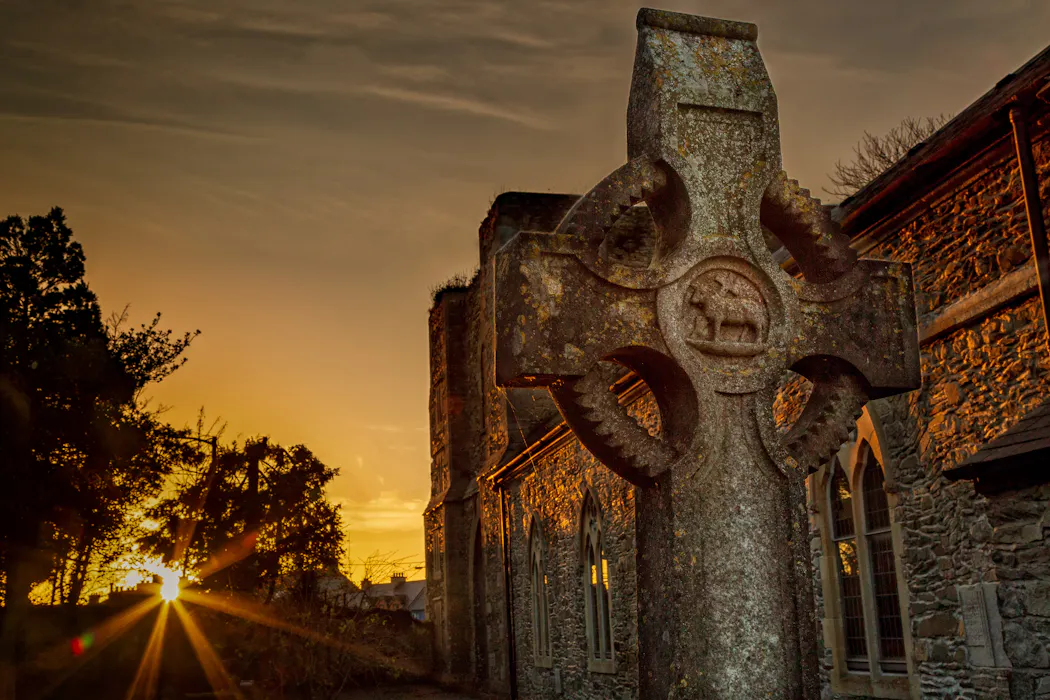
Gaelic and Christian cultures are not so easily disentangled. To convert the local population, early Christian settlers appropriated elements of folklore to produce blended, or syncretic, beliefs and iconography. The Celtic cross is one common example: it combines the traditional Christian cross with the pagan circle representing the sun or eternal life.
Wells also assumed Christian significance from the fifth century onwards. They were often renamed to honour Catholic saints. The idea that the well could be of spiritual significance to Tomás yet devoid of Catholic associations is questionable.
Even the seanchaí was, by the 17th century, dependent upon Catholic patronage. Declining Gaelic aristocratic families were no longer able to maintain the schools that perpetuated the tradition.
O’Farrell’s decision to disregard these entanglements feels like a jarring attempt to indict the Catholic Church for its contemporary failings. The novel’s promotion of an idealised Gaelic culture, uncorrupted by either Catholicism or Protestantism, also strikes a disingenuous note: the Gaelic language has become bound up with Catholicism. It is associated with nationalism in the Irish Republic and republican sectarianism in Northern Ireland.
As a result, though the novel’s unsympathetic portrayal of both Christian traditions seems to place it outside the sectarian divide, its reversion to pre-colonial culture yields nationalist associations. These associations are increased because the novel is largely set in an unnamed location in the west of Ireland, a region long associated with romanticised notions of Irish nationalism.
The ‘theme-pub’ version
Place names remain politicised in Ireland. Sectarian violence is still a simmering possibility.
Land depicts both Catholicism and Protestantism as separate from Irishness, which raises a question: who does have a right to belong? If rootedness is only achievable through a reversion to Gaelic culture, where does that leave contemporary migrant communities, let alone those from Catholic and Protestant families?
The question is also pertinent in light of rising anti-immigration violence in both the Republic and Northern Ireland.
Other writers of historical fiction have shown that exploring Ireland’s troubled history does not preclude an embrace of the other. Nor does it mean the past cannot be invoked in the service of a more hospitable present.
O’Farrell’s decision to engage with her Irish heritage is not one she has taken lightly. She was reluctant to do so early in her career. She was nervous about identifying as an Irish writer, given the country’s preponderance of literary greats.
But she also worried about replicating an “Irish theme pub” version of Irishness. In This Must Be The Place, her protagonist Daniel, born in America to Irish parents, voices a concern about how a desire to embrace Irish ancestry can produce a version of Irishness that is manufactured and stereotypical:
I am not one of those Irish-Americans coshed by a sense of Eiresatz nostalgia, filled with backwards-looking whimsy about a country that our great-grandparents were forced out of in order to survive. Within my family I am alone in this: My sisters all wore Claddagh rings, went to St Patrick’s Day parades and gave their children names with tricky clusters of ds and bs.
Sadly, O’Farrell has, in Land, succumbed to an “Eiresatz”, cliché-ridden portrait of Irishness. Any tourist brochure can rhapsodise about Ireland’s mythical landscape. It is the responsibility of the novelist, particularly one of O’Farrell’s skill, to articulate the complexities of the island’s continually evolving “mythstory”.

Amy Walters does not work for, consult, own shares in or receive funding from any company or organisation that would benefit from this article, and has disclosed no relevant affiliations beyond their academic appointment.