Reading view

Pope Leo warns of AI’s risks to humanity in his first encyclical

Pope Leo XIV has just declared artificial intelligence one of the defining moral challenges of our time, in his first encyclical: a formal letter intended to guide moral, social and theological thought. Titled Magnifica Humanitas (Magnificent Humanity), it argues technology must serve humanity, rather than concentrate power or weaken human dignity.

He presented it at the Vatican alongside AI developer Christopher Olah, cofounder of Anthropic, who acknowledged that companies like his need moral guidance to guard against “incentives and constraints that can sometimes conflict with doing the right thing”, the New York Times reported.

“Technology is not simply a tool,” read the roughly 42,300-word open letter. “When it becomes the standard by which everything is judged, it begins to dictate what matters and what can be discarded, reducing creation to an object of exploitation and human beings to mere cogs in a system driven toward ever greater efficiency.”

It warns that AI is never truly neutral, but “takes on the characteristics of those who devise, finance, regulate and use it”. And it calls for ethical oversight, social justice, protection of workers, responsible governance and peace.

Automated warfare

The encyclical criticises the use of AI in warfare, calling for imposing the “most rigorous ethical constraints” on weapons developed using AI.

As governments invest heavily in autonomous military technologies and AI-assisted defence systems, the “growing ease” of deploying them makes war more likely and “less subject to human control”, it warns. This “violates the principle that armed force should be used only as a last resort in cases of legitimate self-defense”.

The letter also criticises the growing concentration of technological power, and systems that reduce people to data or economic functions. It promotes what it calls a “civilisation of love”, centred on human dignity, solidarity, truth, compassion and the common good.

Pope Leo’s response to the the AI revolution deliberately references his predecessor Pope Leo XIII’s response to the problems of the Industrial Revolution, Rerum Novarum (“Of New Things”), in 1891. Though Magnifica Humanitas was released on May 25 2026, it is symbolically dated May 15, the date of Rerum Novarum.

Industrial Revolution to AI Revolution

An encyclical is not an ordinary papal statement. Traditionally addressed to bishops and the wider Catholic world, it is one of the Catholic church’s most authoritative teaching documents.

The pope no longer has the direct political power the papacy held in the 19th century. But papal teaching still carries moral weight across a global Catholic network of schools, universities, charities, hospitals and community organisations.

The Vatican cannot regulate AI. It cannot write safety standards, police data centres, or force companies to disclose how their systems work. But it can help shape the moral terms of the debate. For more than a century, Catholic social teaching has influenced public arguments about work, inequality, poverty, human dignity and the ethical limits of economic power.

Although popes issued encyclicals long before the modern era, Rerum Novarum made social encyclicals globally influential.

It confronted exploitative labour conditions, widening inequality, and conflict between workers and employers. Pope Leo XIII defended workers’ rights and argued that wealth carried social responsibilities. He criticised both unrestricted capitalism and revolutionary socialism.

The document influenced debates about labour rights and economic justice well beyond the church. In Australia in 1907, Justice H.B. Higgins drew on Rerum Novarum when establishing principles for a fair living wage.

Pope Leo XIV’s encyclical attempts to do for the AI age what Rerum Novarum did for the industrial age: provide a moral framework for a technological transformation reshaping work, power and human relationships.

Human dignity in the age of algorithms

Pope Leo XIV argues human rights are not granted by governments or corporations: they arise from the intrinsic dignity of every person. Technologies should serve humanity rather than reduce people to data, economic units or optimisation problems.

He builds on Pope Francis’ critique of “the tendency to let the logic of efficiency, control and profit alone shape personal, social and economic decisions”, in his 2015 encyclical. It, too, warned of the risks of technology.

Pope Leo XIV argues moral responsibility can’t be transferred to automated systems, regardless of how sophisticated they become. He also rejects transhumanist ideas that human limitations should be technologically overcome, arguing vulnerability, dependence and imperfection are essential to being human. Relationships, care, solidarity and compassion are not weaknesses. “Humanity flourishes not despite limitations, but often through them.”

Running throughout the encyclical is a contrast between a “culture of power” and a “civilization of love”. One treats technology primarily as a tool for domination and control. The other places human dignity, justice and care at the centre of social life.

Why this matters

The significance of Magnifica Humanitas lies in its ability to shape public conversation and moral imagination. Moral frameworks matter. They influence what societies fear, what they tolerate, what they defend – and what they refuse to sacrifice.

Governments are investing in AI capability while still developing frameworks for transparency, accountability and safe deployment. Businesses are adopting AI tools at speed. Schools and universities are rethinking assessment, authorship and learning. Workers are being asked to adapt to systems they did not design and often cannot challenge. And citizens are increasingly governed, assessed and targeted by automated systems they may never see.

Pope Leo XIV’s intervention reminds us the central question is not whether AI will be powerful: it already is. The question is whether that power will be made answerable to human dignity.

The future of AI will not just be decided in laboratories, boardrooms or parliaments. It will also be decided by the moral limits societies are willing to set. Pope Leo XIV’s encyclical is an attempt to draw those limits.

The Conversation

The authors do not work for, consult, own shares in or receive funding from any company or organisation that would benefit from this article, and have disclosed no relevant affiliations beyond their academic appointment.
  •  

This Renaissance queen helped build a nation. Her (male) critics called her dangerous

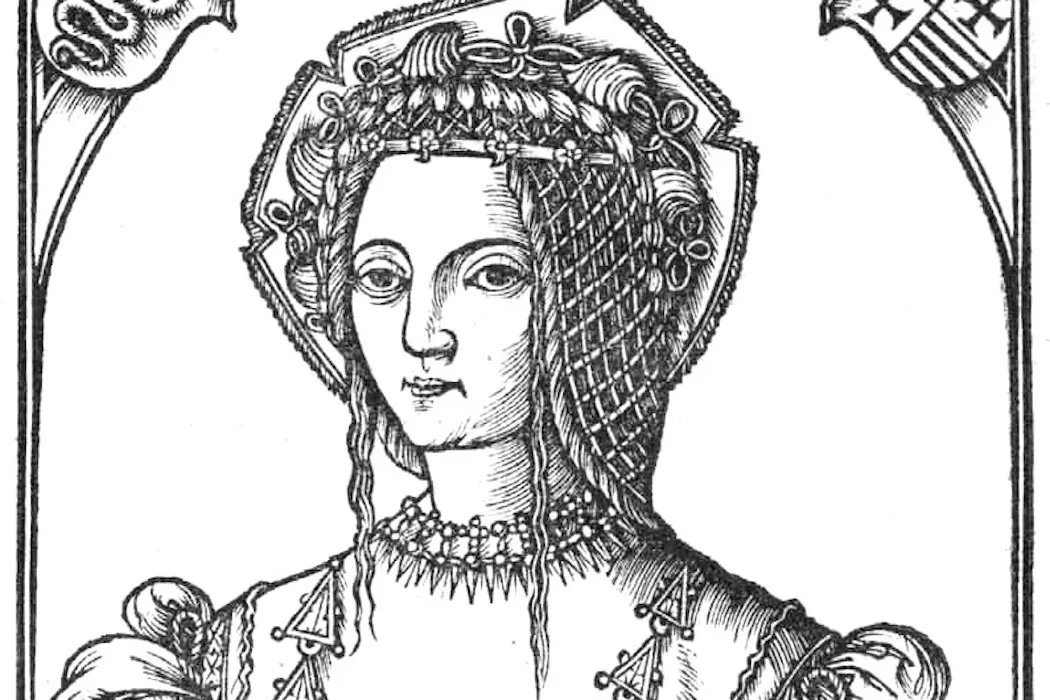
Bona Sforza, woodcut in the De vetustatibus Polonorum liber I. Cracoviae, 1521. Wikimedia Commons, CC BY

Bona Sforza was one of the most remarkable women of Renaissance Europe. Born into one of Italy’s leading ruling families and connected to figures such as Lucrezia Borgia through the tangled politics of Italian dynasties, she became queen consort of Poland and grand duchess of Lithuania.

More than a royal bride, she brought to Poland the administrative, financial and cultural ideas of Renaissance Italy. She understood how wealth, land and government could be used to strengthen a dynasty.

Although never a reigning monarch, Bona became one of the most politically influential women ever to sit on the Polish throne. Admirers praised her intelligence and determination. Critics condemned her as ambitious, overbearing and dangerously powerful. That tension lies at the heart of her story.

The debate over Bona’s legacy raises a question that still resonates today: why are women who wield power effectively so often judged differently from men who do the same?

Training for greatness

Bona Sforza, born in 1494, was the daughter of the Duke of Milan. She arrived in Poland in 1518 as a royal bride of Sigismund I. Contemporary observers praised her intelligence, learning and virtue, qualities they described as “rare among maidens”.

Bona grew up in Bari, Italy. Her mother, Duchess Isabella of Aragon, ruled the duchy of Bari in her own right. She exercised authority with confidence. Isabella ensured that Bona received a humanist education in languages, history, law, moral philosophy and public speaking, preparing her not simply to marry well, but to govern.

Bona’s tutors shaped her view of the world and of herself. They instilled in her the belief that she was “born to rule”, preparing her to see leadership not as a privilege, but as a responsibility.

Government required judgement, alliances and financial skill.

Bona learned to treat land as a working system of connected parts: fields, forests, tenants, mills, markets, workers and, of course, taxes.

Bona used this knowledge to strengthen the Jagiellon dynasty, the ruling family of Poland and Lithuania. She treated royal lands as productive assets, recovering estates that had been lost, leased or mortgaged by earlier rulers.

By 1555, alongside the lands assigned to her as queen, she controlled the revenues of 15 royal towns and 191 villages.

The result was greater dynastic wealth and greater independence and leverage in the royal house dealings with powerful nobles.

Land reforms

Bona’s reforms focused on making royal lands more productive and their revenues more reliable. She recovered lost Crown property, improved record-keeping, and insisted that surveys and legal decisions be documented and enforced.

She also promoted economic development through new settlements, markets, transport links and local infrastructure. These measures increased trade and created new income for the royal family.

Accused of poisoning rivals

Yet the more successful Bona became, the more criticism she attracted. Male nobles did not simply say they opposed higher taxes or the consolidation of the royal domain. They often framed her authority as unnatural.

One of the powerful courtiers, Krzysztof Szydłowiecki, put it bluntly in 1527: “nothing happens without her will”.

Her success provoked fierce opposition. During the Lwów rebellion of 1537, nobles accused Bona of greed, overreach and wielding too much influence. Some complained that earlier queens had no role in government, but under Bona, “everything happens differently” because she had “as much power as she wishes”.

Queens were expected to be wives, not political actors. Yet powerful men also accumulated land, built networks and influenced government and church appointments without attracting the same criticism.

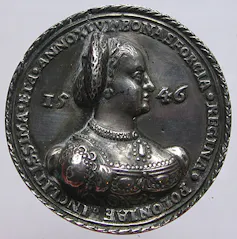
Medal of Bona Sforza by Giovanii Maria Mosca. Wikimedia

After her death in 1557, Bona’s reputation darkened. She was accused of poisoning rivals, practising witchcraft, manipulating politics and corrupting government. Some accusations grew from real political conflicts, but others reflected discomfort with a woman who exercised power so effectively.

Her recovery of royal lands threatened powerful nobles. Critics recast her competence as greed, her authority as overreach, and her political skill as dangerous ambition.

Women in leadership face familiar criticism

Like Bona, women leaders today are still often judged by standards that men rarely face.

A United Nations report on corporate leadership found that across 20 advanced economies, women held only 6% of chief executive officer roles, 7% of board chair roles, and 15% of chief financial officer roles.

Women’s access to capital is another parallel. A report from the Organisation for Economic Co-operation and Development (OECD) on women entrepreneurs found that, in 2024, women were about half as likely as men to report borrowing from a bank to start, run or expand a business. A US report on venture capital funding for tech companies shows progress, with female-founded companies raising a record amount. But the debate continues because access to investment remains uneven.

Modern attitudes to women also matter. A Stanford University institute describes the “likeability penalty”: women leaders who appear competent and assertive can be judged as less likeable, while men often receive praise for similar behaviour.

Five centuries later, the pattern remains familiar. Bona’s wealth, discipline and confidence strengthened the monarchy. They also made her a target. They made her easier to attack.

The question her life leaves us with is simple: when women manage power well, do societies recognise leadership, or do they still call it ambition?

The Conversation

Darius von Guttner Sporzynski receives funding from National Science Centre for the project "Queens consort of Poland in the 15th and 16th centuries as wives and mothers" (2021/43/B/HS3/01490).

  •  

Pope Leo warns of AI’s risks to humanity in his first encyclical

Pope Leo XIV has just declared artificial intelligence one of the defining moral challenges of our time, in his first encyclical: a formal letter intended to guide moral, social and theological thought. Titled Magnifica Humanitas (Magnificent Humanity), it argues technology must serve humanity, rather than concentrate power or weaken human dignity.

He presented it at the Vatican alongside AI developer Christopher Olah, cofounder of Anthropic, who acknowledged that companies like his need moral guidance to guard against “incentives and constraints that can sometimes conflict with doing the right thing”, the New York Times reported.

“Technology is not simply a tool,” read the roughly 42,300-word open letter. “When it becomes the standard by which everything is judged, it begins to dictate what matters and what can be discarded, reducing creation to an object of exploitation and human beings to mere cogs in a system driven toward ever greater efficiency.”

It warns that AI is never truly neutral, but “takes on the characteristics of those who devise, finance, regulate and use it”. And it calls for ethical oversight, social justice, protection of workers, responsible governance and peace.

Automated warfare

The encyclical criticises the use of AI in warfare, calling for imposing the “most rigorous ethical constraints” on weapons developed using AI.

As governments invest heavily in autonomous military technologies and AI-assisted defence systems, the “growing ease” of deploying them makes war more likely and “less subject to human control”, it warns. This “violates the principle that armed force should be used only as a last resort in cases of legitimate self-defense”.

The letter also criticises the growing concentration of technological power, and systems that reduce people to data or economic functions. It promotes what it calls a “civilisation of love”, centred on human dignity, solidarity, truth, compassion and the common good.

Pope Leo’s response to the the AI revolution deliberately references his predecessor Pope Leo XIII’s response to the problems of the Industrial Revolution, Rerum Novarum (“Of New Things”), in 1891. Though Magnifica Humanitas was released on May 25 2026, it is symbolically dated May 15, the date of Rerum Novarum.

Industrial Revolution to AI Revolution

An encyclical is not an ordinary papal statement. Traditionally addressed to bishops and the wider Catholic world, it is one of the Catholic church’s most authoritative teaching documents.

The pope no longer has the direct political power the papacy held in the 19th century. But papal teaching still carries moral weight across a global Catholic network of schools, universities, charities, hospitals and community organisations.

The Vatican cannot regulate AI. It cannot write safety standards, police data centres, or force companies to disclose how their systems work. But it can help shape the moral terms of the debate. For more than a century, Catholic social teaching has influenced public arguments about work, inequality, poverty, human dignity and the ethical limits of economic power.

Although popes issued encyclicals long before the modern era, Rerum Novarum made social encyclicals globally influential.

It confronted exploitative labour conditions, widening inequality, and conflict between workers and employers. Pope Leo XIII defended workers’ rights and argued that wealth carried social responsibilities. He criticised both unrestricted capitalism and revolutionary socialism.

The document influenced debates about labour rights and economic justice well beyond the church. In Australia in 1907, Justice H.B. Higgins drew on Rerum Novarum when establishing principles for a fair living wage.

Pope Leo XIV’s encyclical attempts to do for the AI age what Rerum Novarum did for the industrial age: provide a moral framework for a technological transformation reshaping work, power and human relationships.

Human dignity in the age of algorithms

Pope Leo XIV argues human rights are not granted by governments or corporations: they arise from the intrinsic dignity of every person. Technologies should serve humanity rather than reduce people to data, economic units or optimisation problems.

He builds on Pope Francis’ critique of “the tendency to let the logic of efficiency, control and profit alone shape personal, social and economic decisions”, in his 2015 encyclical. It, too, warned of the risks of technology.

Pope Leo XIV argues moral responsibility can’t be transferred to automated systems, regardless of how sophisticated they become. He also rejects transhumanist ideas that human limitations should be technologically overcome, arguing vulnerability, dependence and imperfection are essential to being human. Relationships, care, solidarity and compassion are not weaknesses. “Humanity flourishes not despite limitations, but often through them.”

Running throughout the encyclical is a contrast between a “culture of power” and a “civilization of love”. One treats technology primarily as a tool for domination and control. The other places human dignity, justice and care at the centre of social life.

Why this matters

The significance of Magnifica Humanitas lies in its ability to shape public conversation and moral imagination. Moral frameworks matter. They influence what societies fear, what they tolerate, what they defend – and what they refuse to sacrifice.

Governments are investing in AI capability while still developing frameworks for transparency, accountability and safe deployment. Businesses are adopting AI tools at speed. Schools and universities are rethinking assessment, authorship and learning. Workers are being asked to adapt to systems they did not design and often cannot challenge. And citizens are increasingly governed, assessed and targeted by automated systems they may never see.

Pope Leo XIV’s intervention reminds us the central question is not whether AI will be powerful: it already is. The question is whether that power will be made answerable to human dignity.

The future of AI will not just be decided in laboratories, boardrooms or parliaments. It will also be decided by the moral limits societies are willing to set. Pope Leo XIV’s encyclical is an attempt to draw those limits.

The Conversation

The authors do not work for, consult, own shares in or receive funding from any company or organisation that would benefit from this article, and have disclosed no relevant affiliations beyond their academic appointment.

  •  
❌