Reading view

What to know about sex trafficking as Pittsburgh hosts the NFL draft

Events that draw large crowds can create opportunities traffickers may try to exploit. AP Photo/Gene J. Puskar

With the NFL draft taking place in Pittsburgh and an estimated 500,000 to 700,000 people expected to attend the events downtown and on the North Shore, conversations about sex trafficking have resurfaced – as they often do when major events draw large crowds to a city.

But how much of what people believe about trafficking and big events is actually supported by evidence? Mary Burke, a psychology professor at Carlow University who studies this intersection, breaks down what the data shows.

Burke partners with local nonprofit groups that fight human trafficking, such as Eden’s Farm. The organization offered three community training sessions ahead of the NFL draft that focused on recognizing the signs of exploitation, understanding grooming tactics and strengthening prevention strategies.

With Pittsburgh hosting the NFL draft, what does research show about how large events can influence sex trafficking activity?

Researchers have not found conclusive evidence that large events such as the NFL draft, the World Cup or other similarly sized, temporary events cause an increase in sex trafficking. However, experts do believe the crime of sex trafficking is underestimated in general due to a number of factors. Because so much effort goes into concealing trafficking, the crime goes unreported and undetected more often than it’s discovered. The true scale of the problem is likely much larger than the data reflects.

Large events that draw crowds even on a smaller scale than the draft, such as motorcycle rallies and large business conferences, often create opportunities traffickers may try to exploit, according to a 2016 study by researchers at Carnegie Mellon University.

Also, we do see an increased demand for commercial sex with events that draw a large male audience. Some of this demand is met through consensual means and some through force, fraud and coercion, which is the definition of sex trafficking.

Closeup of a large, yellow countdown clock for the NFL Draft.
One common misconception about trafficking is that it usually looks like kidnapping. AP Photo/Gene J. Puskar

How are organizations like Eden’s Farm working on the ground to prevent trafficking during the draft?

Eden’s Farm as well as the Social Impact Institute and Carlow University have led training. The hope is that this will equip citizens and those on the ground – law enforcement, ride share drivers and hotel and restaurant employees, for example – to know how to identify and respond to potential trafficking situations.

Additionally, these groups teach the public how to recognize signs of exploitation, how grooming works and how to strengthen online safety. The training also help families, educators, service providers and community members prevent people they know from being trafficked.

What are common misconceptions people have about sex trafficking during events like this?

One of the most common misconceptions about sex trafficking is the idea that trafficking includes abduction or physical captivity. While kidnapping can occur, many trafficking situations are carried out through psychological coercion rather than physical force. Victims may be controlled through grooming, fraud, intimidation, fear of retaliation against loved ones, or deep emotional dependency on the trafficker.

This translates into a victim not appearing to be restrained physically, which can make identification of a person in distress more difficult.

A wide shot of a parking lot and stage with a stadium behind it.
Research shows an increased demand for commercial sex with events that bring a large male audience. AP Photo/Gene J. Puskar

What signs should the general public look for that might indicate trafficking is happening?

This is tricky, as some of the indicators would be revealed through conversation, rather than observation at a distance. With that said, people should be on the lookout for patterns of control – for example, someone who does not seem to be able to speak freely or move about freely, has money or identification that is controlled by another person, or appears fearful.

In our training, we explain how to become aware of signs that someone is being pressured into commercial sex through manipulation rather than overt violence or consent. No single sign is definitive on its own, but there are some common situational red flags the public can take notice of regarding potential victims: They are coming and going from a hotel room at unusual hours with multiple different people, they are dressed in a way that seems inconsistent with the weather or setting, or they don’t seem to know basic details about where they are or where they’re going.

What are some prevention strategies Pittsburgh could adopt?

For this event and going forward, trafficking prevention should include a city- and county-level plan that can be implemented in relevant agencies. Pennsylvania’s plan focuses on prevention through public awareness and training, especially by equipping transportation workers and the public to recognize and report trafficking.

Prevention plans could include recommendations for the service and hospitality industries that require staff training on recognizing trafficking indicators, such as signs of coercion or restricted movement, and how to report to law enforcement or 911 for a rapid response. There are also a variety of ways to report suspected sex trafficking activity through the National Human Trafficking Hotline. When businesses and service workers interact with people who may be trafficking victims, they should do so in a way that is sensitive, nonjudgmental and doesn’t put the person in danger.

For example, a hotel employee who suspects a guest may be a trafficking victim shouldn’t confront the trafficker directly or make a scene – instead, they should know how to quietly offer help or alert the right people without escalating the situation or making the victim feel ashamed or accused.

The Conversation

Mary Burke is also the Director of the Social Impact Institute.

Rachel Seamans volunteers with the Social Impact Institute and Eden’s Farm.
  •  

Justice Department’s effort to strip citizenship from naturalized Americans could face widespread judicial pushback

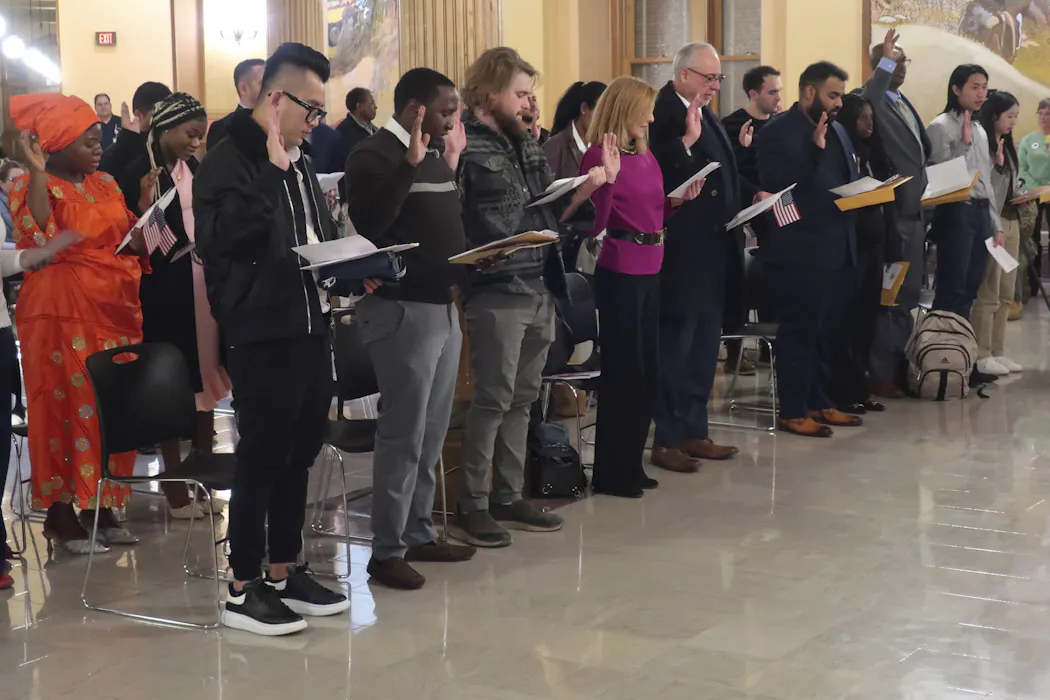
Dozens of immigrants from 18 nations take the oath to become U.S. citizens on Jan. 27, 2025, in Topeka, Kan. AP Photo/John Hanna

The Justice Department has identified 384 foreign-born Americans whose citizenship it wants to revoke as “the first wave” of such measures, according to recent reporting by The New York Times. These cases are being assigned to prosecutors in 39 U.S. attorney’s offices across the country.

The administration has ordered Department of Homeland Security staffers to refer upward of 200 denaturalization cases per month to the Justice Department as part of its crackdown on immigration, compared to an average of 11 cases per year between 1990 and 2017.

This shift comes as the Justice Department faces a severe staffing crisis, having lost nearly 1,000 assistant U.S. attorneys in resignations and firings. The strategy of distributing cases to regional offices appears designed both to increase capacity and to work around the expertise gap created by staff departures.

As we document in recent research, denaturalization risks becoming a tool of political control and intimidation. The lack of any statute of limitations in civil denaturalization gives prosecutors what the Supreme Court in 2017, in Maslenjak v. United States, warned against: “nearly limitless leverage” over naturalized citizens – creating permanent vulnerability for over 20 million naturalized Americans.

A brief history

Denaturalization is different from deportation, which removes noncitizens from the country. With civil denaturalization, the government files a lawsuit to strip people’s U.S. citizenship after they have become citizens, turning them back into noncitizens who can then be deported.

The government can only do this in specific situations. It must prove someone “illegally procured” citizenship by not meeting the requirements, or that they lied or hid important facts during the citizenship process.

The Trump administration’s “maximal” enforcement approach, outlined in a June 2025 Justice Department memo, means pursuing any case where evidence might support taking away citizenship, regardless of priority level or strength of evidence. As our earlier research documented, this has already led to cases like that of Baljinder Singh, whose citizenship was revoked based on a name discrepancy that could easily have resulted from a translator’s error rather than intentional fraud.

For most of American history, taking away citizenship has been rare. But it increased dramatically during the 1940s and 1950s during the Red Scare period characterized by intense suspicion of communism. The United States government targeted people it thought were communists or Nazi supporters. Between 1907 and 1967, over 22,000 Americans lost their citizenship this way.

Everything changed in 1967 when the Supreme Court decided Afroyim v. Rusk. The court said the government usually cannot take away citizenship without the person’s consent. It left open only cases involving fraud during the citizenship process.

After this decision, denaturalization became extremely rare. From 1968 to 2013, fewer than 150 people lost their citizenship, mostly war criminals who had hidden their past.

A man dressed in a suit and tie speaks and points his right index finger.
Sen. Joseph McCarthy appears at a March 1950 hearing on his charges of communist infiltration at the State Department. AP Photo/Herbert K. White

How the process works

In criminal lawsuits, defendants get free lawyers if they can’t afford one. They get jury trials. The government must prove guilt “beyond a reasonable doubt” – the highest standard of proof.

But in most denaturalization cases, the government files a civil suit, where none of these protections exist.

People facing denaturalization get no free lawyer, meaning poor defendants often face the government alone. There’s no jury trial – just a judge deciding whether someone deserves to remain American. The burden of proof is lower – “clear and convincing evidence” instead of “beyond a reasonable doubt.” Most important, there’s no time limit, so the government can go back decades to build cases.

As law professors who study citizenship, we believe this system violates basic constitutional rights.

The Supreme Court has called citizenship a fundamental right. Chief Justice Earl Warren in 1958 described it as the “right to have rights.”

In our reading of the law, taking away such a fundamental right through civil procedures that lack basic constitutional protection – no right to counsel for those who can’t afford it, no jury trial, and a lower burden of proof – seems to violate the due process of law required by the Constitution when the government seeks to deprive someone of their rights.

The bigger problem is what citizenship-stripping policy does to democracy.

When the government can strip citizenship from naturalized Americans for decades-old conduct through civil procedures with minimal due process protection – pursuing cases based on evidence that might not meet criminal standards – it undermines the security and permanence that citizenship is supposed to provide. This creates a system where naturalized citizens face ongoing vulnerability that can last their entire lives, potentially chilling their full participation in American democracy.

The Justice Department memo establishes 10 priority categories for denaturalization cases. They range from national security threats and war crimes to various forms of fraud, financial crimes and, most importantly, any other cases it deems “sufficiently important to pursue.” This “maximal enforcement” approach means pursuing not just clear cases of fraud, but also any case where evidence might support taking away citizenship, no matter how weak or old the evidence is.

This creates fear throughout immigrant communities.

About 20 million naturalized Americans now must worry that any mistake in their decades-old immigration paperwork could cost them their citizenship.

A 2-tier system

This policy effectively creates two different types of American citizens. Native-born Americans never have to worry about losing their citizenship, no matter what they do. But naturalized Americans face ongoing vulnerability that can last their entire lives.

This has already happened. A woman who became a naturalized citizen in 2007 helped her boss with paperwork that was later used in fraud. She cooperated with the FBI investigation, was characterized by prosecutors as only a “minimal participant,” completed her sentence, and still faced losing her citizenship decades later because she didn’t report the crime on her citizenship application – even though she hadn’t been charged at the time.

A woman accepts a small American flag handed to her from a man across a counter.
A woman receives a U.S. flag after passing her citizenship interview in Newark, N.J., on May 25, 2016. AP Photo/Julio Cortez

The Justice Department’s directive to “maximally pursue” cases across 10 broad categories – combined with the first Trump administration’s efforts to review over 700,000 naturalization files – represents an unprecedented expansion of denaturalization efforts.

The Trump administration’s strategy of distributing denaturalization cases across 39 U.S. attorney’s offices – many now staffed by less-experienced prosecutors handling unfamiliar constitutional terrain – may prove counterproductive.

These cases will come before dozens of federal judges, creating opportunities for multiple courts to rule against the policy. This pattern has already been seen with the administration’s detention policy: Federal courts have systematically rejected the administration’s attempt to drastically expand immigrant detention without hearings, with immigrants prevailing in 350 out of 362 cases decided by over 160 judges nationwide.

Denaturalization cases raise even more serious constitutional concerns and could face similar widespread judicial pushback.

The Supreme Court, in Afroyim v. Rusk, was focused on protecting existing citizens from losing their citizenship. The constitutional principle behind that decision – that citizenship is a fundamental right which can’t be arbitrarily taken away by whoever happens to be in power – applies equally to how the government handles denaturalization cases today.

The Trump administration’s directive, combined with court procedures that lack basic constitutional protections, risks creating a system that the Afroyim v. Rusk decision sought to prevent – one where, as the Supreme Court said, “A group of citizens temporarily in office can deprive another group of citizens of their citizenship.”

This is an updated version of an article originally published on July 10, 2025.

The Conversation

The authors do not work for, consult, own shares in or receive funding from any company or organization that would benefit from this article, and have disclosed no relevant affiliations beyond their academic appointment.

  •  

US refugee policy for white South Africans is part of a century-long effort to keep some English-speaking nations white

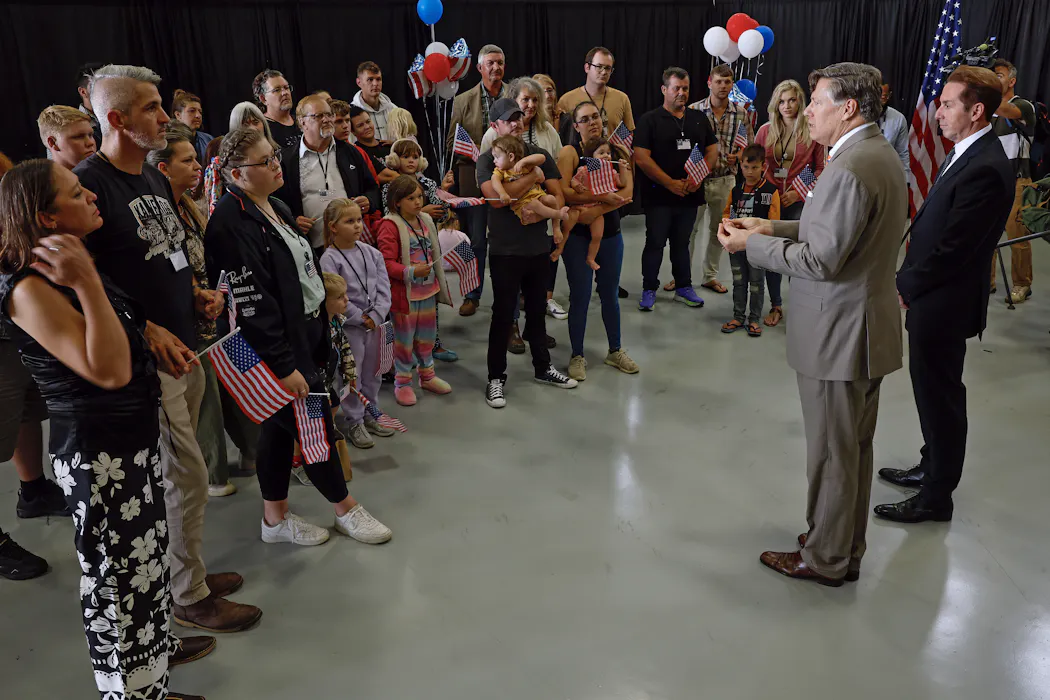
Newly arrived South Africans listen to U.S. Deputy Secretary of State Christopher Landau deliver welcome statements in a hangar near Washington Dulles International Airport on May 12, 2025. Chip Somodevilla/Getty Images

Whiteness appears to be an official immigration credential in the eyes of the United States government.

The Trump administration in late 2025 slashed the annual cap on refugee admissions to 7,500 for budget year 2026, down from the 125,000 cap set in 2024 by the Biden administration. That’s a historic low that will shut out thousands of global refugees from war and persecution, such as the victims of Taliban repression in Afghanistan or the Rohingya minority in Myanmar facing documented mass violence.

The new refugee cap, however, will mostly benefit white South Africans, known as Afrikaners. The State Department is building infrastructure to process 4,500 refugee applications per month from Afrikaners, a pace that would easily exceed the administration’s global cap.

The Trump administration’s justification are claims of racial persecution.

Elon Musk, born in South Africa, posted on X in March 2025 that “there is a major political party in South Africa that is actively promoting white genocide.” President Donald Trump agreed. “They’re being killed,” he said in May 2025. Casting blame on the news media, he said, “It’s a genocide that’s taking place that you people don’t want to write about.”

Tucker Carlson had spent years on Fox News pushing the claim that white South Africans were being murdered en masse. Trump had apparently been listening. The white genocide claim moved from fringe websites to cable television to the Oval Office.

As a historian who has spent years studying how racial supremacy gets weaponized as policy, I’d say these claims are worth examining carefully. The numbers don’t support the claims.

Over a year in 2023-2024, AfriForum, an Afrikaner civil rights organization, recorded 49 murders of Afrikaners. That’s .2% of the 27,621 murders across the country. As the Institute for Security Studies in Pretoria concluded, “The idea of a ‘white genocide’ taking place in South Africa is completely false.”

A white man stands next to a Black woman in a oval room.
Elon Musk listens as reporters ask President Donald Trump and South Africa President Cyril Ramaphosa questions in the Oval Office on May 21, 2025. Chip Somodevilla/Getty Images

A useful fiction

White genocide is a contemporary rallying cry for a project that predates it by over a century: keeping English-speaking nations white. The claim persists because it’s useful. Claims of white genocide, partly rooted in the fear that nonwhite populations are growing while white ones are shrinking, has been a far-right organizing concept for decades. But that fear was called “replacement theory” well before that.

Afrikaner lobby groups have successfully embedded their cause within a transnational far-right network, projecting South Africa as a warning for the U.S. and Europe. The Afrikaner myth is supposed to be a warning: white people are already being crushed in South Africa, and the same fate awaits whites everywhere unless something is done.

This has a specific history, one I’ve traced in my latest book, “White Supremacy: A Short History.”

Some English-speaking settler colonies explicitly identified themselves as “white men’s countries.” And in the early 20th century they coordinated immigration restrictions to keep them that way through a succession of acts passed in Australia, Canada, New Zealand and the United States between 1901 and 1924.

These were pieces of a linked ideological network, as I trace in the book, with ideas and personnel circulating between countries that understood themselves as outposts of the same white civilization.

Australia passed immigration acts from 1901 onward that largely barred people from East Asia, Eastern Europe and the Pacific Islands. Attorney General Alfred Deakin justified the restrictions to Parliament in 1901 in the name of “the purity of race.”

In that same September 1901 debate, another member of the Australian House warned that Black political power in the United States offered a cautionary lesson: “The black people there have increased to such an extent, and have gained such power, that the jurists and statesmen there pause and look with fear upon them.”

Canada’s Immigration Act of 1910 gave the government authority to exclude “any race deemed unsuitable to the climate and requirements of Canada,” implementing what historians call the “White Canada” policy. The aim was to limit immigration to “healthy, white, preferably British or American agriculturalists.” By the early 1920s, most nonwhite people were categorically excluded.

New Zealand’s Immigration Restriction Amendment Act of 1920 required entry permits for anyone “not of British or Irish parentage,” establishing what contemporaries called a “white New Zealand” policy.

The United States passed its own Immigration Act in 1924 to preserve what its proponents called an “unadulterated” and “Nordic breed,” restricting immigration from southern and eastern Europe and barring most Asians entirely.

A black and white photo depicts a man outdoors speaking to a crowd.
Woodrow Wilson, who as president resegregated the federal civil service, speaks to a crowd in September 1912. Library of Congress/Corbis/VCG via Getty Images

A shared fear

South Africa was part of this network. The career of one eugenicist, who promoted the theory that humans can be improved through selective breeding of populations, shows how it worked.

Harold Fantham, who lived from 1876 to 1937, was educated in London, taught zoology at Cambridge, then moved to South Africa in 1917. There, he took a leading role in promoting racial immigration restrictions, arguing in the South African Journal of Science in 1924 that the goal was “safeguarding our nation from racial deterioration.”

He praised the U.S.’s 1924 act for barring “idiots, feeble-minded, paupers,” and admired Germany’s compulsory sterilization laws. He became president of the South African Association for the Advancement of Science. Fantham bore his ideas across the English-speaking world, picking up American and German models along the way.

Behind all these restrictions was a shared fear: that growing numbers of nonwhite people would overwhelm white populations. Eugenicists imagined a race to make babies that whites were losing. They believed democracy itself was a liability, because more nonwhite immigrants could mean more nonwhite votes.

Woodrow Wilson, who resegregated the federal civil service after taking office in 1913, agreed. His intellectual framework was plain. As he wrote in The Atlantic in 1889, only “races purged of barbaric passions” could be entrusted with self-governance.

Whiteness as proof of citizenship

The Afrikaner program reactivates this logic. It treats whiteness as a refugee status and frames a former colonial ruling class as victims. It sits alongside a deportation campaign targeting people the president says are “poisoning the blood of our country.”

The countries that coordinated a century ago to build white nations are doing the same work again, with the same tools.

The majority of people suffering violence in South Africa are Black South Africans. They are not invited to the United States as refugees.

And while the Trump administration builds a race-based welcome for white South Africans, it’s also building a race-based enforcement apparatus.

In September 2025, in a 6-3 decision, the Supreme Court ruled in Noem v. Vasquez Perdomo that federal agents could use “apparent race or ethnicity” as a factor when stopping people to check their immigration status. Critics call the resulting detentions “Kavanaugh stops,” after Brett Kavanaugh, the justice who wrote the concurrence.

As justice Sonia Sotomayor put it in dissent, “We should not have to live in a country where the Government can seize anyone who looks Latino, speaks Spanish, and appears to work a low wage job.”

Whiteness is functioning as a credential on the streets of American cities. And white skin qualifies Afrikaners for expedited entry. Darker skin qualifies you for a stop.

The Conversation

John Broich does not work for, consult, own shares in or receive funding from any company or organization that would benefit from this article, and has disclosed no relevant affiliations beyond their academic appointment.

  •  

75 years after she led a student strike that helped end school segregation, Barbara Rose Johns now stands in the US Capitol where Robert E. Lee once did

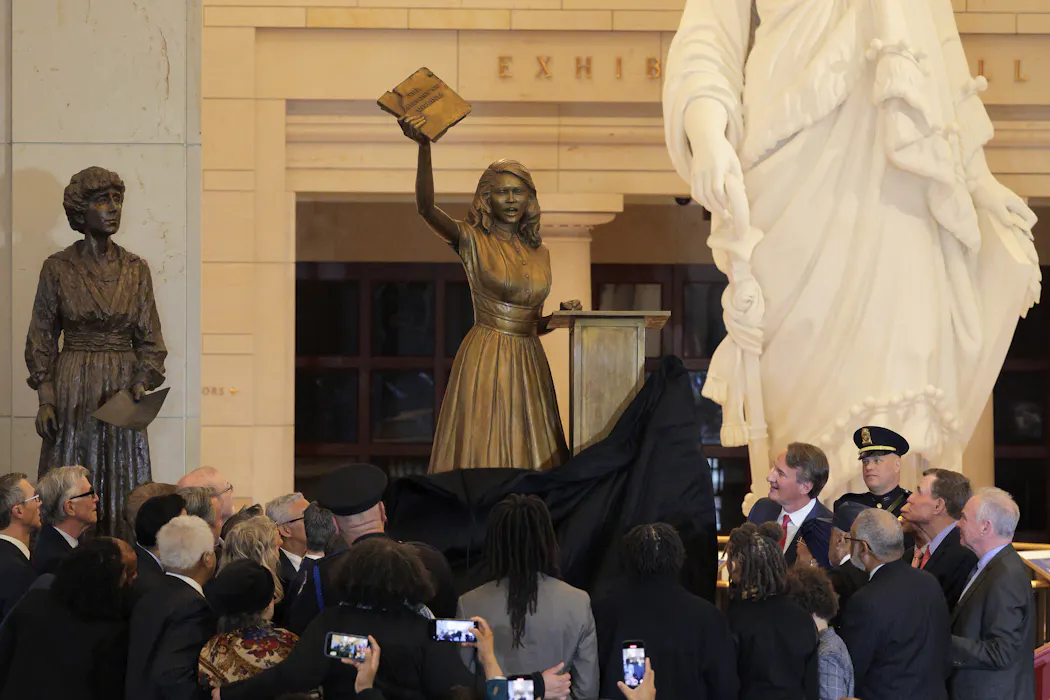
A statue of civil rights activist Barbara Rose Johns is unveiled in Emancipation Hall at the U.S. Capitol on Dec. 16, 2025, in Washington. Chip Somodevilla/Getty Images

The 250th anniversary of the Declaration of Independence isn’t the only important anniversary in 2026. This year also marks the 75th anniversary of an extraordinary case of student activism that helped lead to the Supreme Court’s decision outlawing segregated schools.

In April 1951, 16-year-old Barbara Rose Johns organized a student strike to protest the shabby conditions and inadequate education at her segregated Black high school in Prince Edward County, Virginia.

Prince Edward County is located about 65 miles southwest of Richmond and around 30 miles east of Appomattox, or 48 kilometers, in a part of Virginia known as Southside. African Americans constituted almost half the population, but they were largely prevented from voting before passage of the Voting Rights Act in 1965 and could not eat in local restaurants before passage of the Civil Rights Act of 1964. The public schools were segregated, and for decades there was no Black high school at all.

In 1939, following years of pressure by Black residents, the white authorities opened a high school for African Americans. That segregated institution was named for Robert Roosa Moton, who had been raised in Prince Edward County and served as an administrator at Hampton Institute in Virginia before being appointed as the second head of Tuskegee Institute following the death of Booker T. Washington.

The new building became severely overcrowded almost immediately. Although it was designed for a maximum enrollment of 180, attendance reached 219 the year after it opened and 377 in 1947.

The following year, the school board put up three temporary outbuildings to accommodate the overflow. Many Black residents scorned these buildings as “tar paper shacks” because of their covering and dilapidated condition. They had inefficient wood stoves that provided limited heating, and their thin walls often leaked when rain fell.

The shabbiness of these interim structures became a source of continuing tension, as negotiations between the Black community and white authorities for a more permanent facility dragged on inconclusively into early 1951.

Johns makes her move

As an 11th grader at Moton High School, Johns began talking with some of her fellow students about taking action to protest the shacks and improve their education.

On April 23, 1951, someone lured Moton’s principal, Boyd Jones, out of the building on the pretext that two students were in trouble elsewhere in town. After Jones left, Johns summoned the student body to the auditorium, where she exhorted her peers to walk out to protest the deplorable condition of their school.

Johns also sent a letter to Oliver W. Hill and Spottswood W. Robinson III, two Richmond civil rights lawyers who worked closely with the NAACP, asking for their legal assistance.

The strike went on for two weeks. During that time, Hill and Robinson met twice with hundreds of students and parents. The meetings grew out of the lawyers’ initial skepticism about litigating over school conditions in rural Prince Edward County, where they feared that plaintiffs would be subject to severe physical and economic retaliation.

Those meetings persuaded Hill and Robinson that the Black community broadly supported an effort to obtain desegregation rather than mere improvements in the separate Black schools. The lawyers therefore filed their lawsuit in the United States District Court for the Eastern District of Virginia on behalf of scores of Black students and parents, alleging that segregated schools violated the 14th Amendment.

Victory – and messy history

Johns’ initiative had both short- and long-term consequences.

In the immediate aftermath of the strike, the all-white school board fired Jones, whom they regarded as having put the students up to their activism despite his – and the students’ – insistence that the whole affair was a student initiative.

The lawsuit – and other similar suits filed in South Carolina, Delaware and Kansas – failed in the lower court. The plaintiffs appealed to the Supreme Court, which reversed those judgments and ruled in the consolidated case called Brown v. Board of Education that segregated public schools were unconstitutional.

A yellowed page from a legal decision with the name 'SUPREME COURT OF THE UNITED STATES' at the top.
The first page of the printed copy of the Supreme Court’s desegregation decision in Brown v. Board of Education, May 17, 1954. Smithsonian National Museum of American History

Meanwhile, in the wake of the student strike at Moton, Johns’ family feared that she would be in physical danger if she remained in Prince Edward County for her senior year. They sent her to live with her uncle Vernon Johns, a minister and outspoken civil rights advocate, in Montgomery, Alabama.

Johns graduated from Drexel University and worked for many years as a public school librarian in Philadelphia before her death in 1991.

The post-Brown history of Prince Edward County is very complicated. White authorities closed the public schools for five years to avoid desegregation. For a long time afterward, virtually all the white children went to a private academy that opened when the public schools closed.

But that messy history cannot detract from the courage and impact of Barbara Johns.

In December 2025, her statue replaced that of Robert E. Lee as one of the two Virginians displayed in the U.S. Capitol. Johns is there – along with George Washington.

The Conversation

Jonathan Entin does not work for, consult, own shares in or receive funding from any company or organization that would benefit from this article, and has disclosed no relevant affiliations beyond their academic appointment.

  •  
❌