Reading view

Iran dragged out the 1979 hostage crisis to humiliate the US. It may try to do the same to Trump now

The weekend exchange of strikes between Iran and Israel has put US President Donald Trump under even more domestic and international pressure to end the unpopular war he launched with Israeli Prime Minister Benjamin Netanyahu more than three months ago.

The Israeli leader favours the continuation of the war until Iran is reduced to a feeble state. This would enable him to win the Israeli general elections later this year and further his goal of expanding Israel’s borders and regional domination in pursuit of a so-called “Greater Israel”.

Netanyahu is against any US–Iran deal that doesn’t meet his objectives. Israel’s invasion of southern Lebanon to repel the Iran-backed Hezbollah group is part of his strategy, which has been boldly countered by Iran.

Tehran, meanwhile, has shown a steely resilience to ensure the war is settled in its favour as a formidable regional actor.

As a result of all this, Trump faces the difficult task of reaching an acceptable deal with Iran and restraining an unruly Netanyahu.

Why the standoff has gone on so long

At this point in the war, what would constitute a “victory” for Trump?

He wants an outcome that can vindicate his decision for starting the war, which has proved to be very costly, generating a worldwide energy crisis and a great deal of economic pain. The war could cause Trump political problems in the midterm elections later this year, too.

He also wants an agreement on Iran’s nuclear program that he could claim is better than the 2015 deal Tehran struck with the Obama administration and its international partners, called the Joint Comprehensive Plan of Action. Trump withdrew the US from the deal in 2018.

But Iran’s Islamic government has so far not been willing to bend to Trump’s demands.

Relying on a mix of ideological devotion to Shia Islam, a strong sense of historical nationalism, and an effective military capability, the regime has not only survived, but made strategic gains.

It has destroyed or damaged many US bases in the Persian Gulf, hit Israel hard with missile and drone strikes, and above all gained control of the Strait of Hormuz. The strait – a critical oil and fertiliser chokepoint – has now become Iran’s most potent lever of resistance and punishment.

The conflict has also given renewed life to the Islamic government and its instruments of power. Many citizens who were opposed to the regime have rallied around the flag in the face of the external threats and for the love of their country.

Further, the war has propelled the government’s Islamic Revolutionary Guard Corps, which is designated by the US and many of its allies as a terrorist organisation, to new heights. It has been able to prove its worth as the key actor defending Iran and its Islamic system.

Meanwhile, Tehran is not as isolated as the Trump administration believes, either. It has the support of both Russia and China. And Iran’s geographical location has worked to its advantage, enabling it to access markets by road through its neighbours and via the Caspian Sea to the north.

The US and Israel still have the advantage when it comes to military power and they can inflict heavy damage on Iran. But Tehran’s strategic gains have placed it in a stronger bargaining position in the peacemaking process.

No matter the level of US military and economic pressure, Tehran is unlikely to succumb to US and Israeli demands to dismantle its nuclear program or relinquish control over the Strait of Hormuz.

The regime was designed to be resilient. It has built a system based on defiance, resistance and pragmatic decision making when faced with serious threats from both inside and outside Iran.

As such, it has the patience and endurance to outlast Trump – and for that matter, Netanyahu.

Echoes of 1979

The regime also has a history of outlasting the United States.

For instance, there are some parallels that can be drawn between the way the founder of the Islamic Republic, Ayatollah Ruhollah Khomeini, dealt with the hostage crisis of 1979–81 – when a militant group of his supporters ransacked the US embassy and took 66 Americans hostage – and the manner in which his successors are now managing negotiations with the US.

Khomeini let that episode drag on for 444 days to both consolidate his power and humiliate the US for having backed the pro-Western monarchy of his predecessor, Mohammad Reza Shah Pahlavi.

His approach played a key role in then-President Jimmy Carter’s defeat to Ronald Reagan in the 1980 US presidential election. The regime released the remaining 52 hostages just minutes after Reagan was inaugurated in January 1981.

The current standoff with Iran is only 100 days old, and it appears the regime is now prepared to use a similar strategy to punish Trump and Netanyahu for attacking Iran.

Iran’s leaders are seemingly determined to turn the tables on their adversaries and humiliate them. Whether they succeed will depend on what Trump does next – and what he’s willing to compromise on to bring Iran to the table for a lasting, mutually acceptable agreement.

The Conversation

Amin Saikal does not work for, consult, own shares in or receive funding from any company or organisation that would benefit from this article, and has disclosed no relevant affiliations beyond their academic appointment.

  •  

Museums have always been entangled with European imperialism. Will the world’s first ‘AI art’ museum be any different?

Dataland will open at the Frank Gehry designed The Grand LA. RDNE Stock project/Pexels

The “world first museum of AI arts” is scheduled to open next month in a 35,000 square feet purpose-built facility in downtown Los Angeles.

Dataland is the brainchild of Refik Anadol and Efsun Erkiliç, artists known for using artificial intelligence and vast datasets to create large-scale immersive art projects.

The “living museum” will present a continuously evolving immersive, audiovisual experience based on millions of images, sounds and scents from nature. As an indication of what it will be like, Dataland’s website presents phantasmagorical images of ecological wonder and awe.

Anadol says he wants Dataland to

develop a new paradigm of what a museum can be, by fusing human imagination with machine intelligence and the most advanced technologies available.

But behind its futuristic facade and the fleeting cultural landscapes hosted inside, the museum has much deeper historical roots.

The birth of the museum

A clear connection exists between the aspirations and dreams of Dataland’s founders and the 19th century fascination with emerging technologies. Large-scale exhibitions promised new forms of public spectacle and commercialised entertainment.

The Crystal Palace exhibition was held in London in 1851. Its purpose-built glass and iron building was considered a technological marvel.

Sepia photograph – a great hall with interesting machines.
The Great Exhibition at Crystal Palace, featuring the hall of works of industry of all nations. Attributed to Ferrier & F. von Martens, C.M., 1851/Rijksmuseum

Visited by over six million people, it was designed to promote Britain as an industrial power.

It showcased more than 100,000 objects from around the globe. These included locomotives, hydraulic presses, agricultural products and musical instruments. Its most famous item was the world’s largest-known diamond, acquired from India two years earlier for Queen Victoria.

The “midway” at the 1893 Chicago World’s Fair was famous for its exhilarating amusements and living exhibits.

Premier attractions were the world’s first Ferris wheel and the world’s first commercial movie theatre. It also featured human display villages, or “human zoos”, that reinforced racist colonial hierarchies.

Colour illustration.
The world’s first Ferris wheel – designed by George Ferris – at the Chicago World Fair. Field Museum

This era kicked off the modern public museum movement in Europe and the United States. Early museums were rooted in Enlightenment ideals of industrial and technological progress, civic education and national identity.

Museums including the South Kensington Museum (1857) and the Smithsonian’s Graphic Arts Department (1897) extended visitor fascination with new technologies such as cinema and railway travel, and sold mass-produced souvenirs of exotic and intriguing cultures.

Just as we today express conflicted views about AI-generated art, 19th-century audiences needed to learn how to respond to new cultural forms. Entertainment was key.

They quickly learnt viewing motion pictures was a social and public activity, improved if they suspended disbelief and expressed individual reactions.

The most well-known (albeit exaggerated) account describes an 1895 screening of a Lumière Brothers film. As the moving image of a train seemingly hurtled toward the audience, viewers are said to have screamed and ducked under seats.

Global exploitation

There is a darker side to the 19th-century precursors of Dataland.

The project’s dataset is a large nature model (LNM) – an open-source model trained on half a billion images sourced “ethically” from partner institutions including the Smithsonian in Washington, DC, and London’s Natural History Museum.

These images are complemented by data gathered by Anadol’s team from 16 rainforests “from Chile to Indonesia to Australia”.

Dataland’s website does not provide provenance information about partner institution’s source collections. But we know they would likely include 19th century specimens.

Natural history collecting was a lucrative industry in the 19th century. The increasing ease with which people and commodities were able to travel the world expanded supply chains and the global industry of specimen transfer.

Black and white photo: sharks suspended over display cases.
London’s Natural History Museum, photographed in 1881. Courtauld, CC BY-NC-SA

Museum collecting was deeply entangled with the violent, systemic processes of European imperialism, colonial expansion and scientific exploitation.

Dataland promotes its “permission-based” approach to using data from institutions. It cites contemporary collaboration with the Yawanawá people of the Amazon as “radically responsible”.

It also insists it manages the environmental impact of the museum’s consumption of natural resources.

But Dataland does not appear to apply its own ethical standards for producing collections from rainforests to the vast historical resources it sources from its partner museums.

It is silent on the obligations it may have to contemporary descendants of communities from which specimens and knowledge were extracted. It provides no guardrails about appropriate cultural protocols or safeguards for anyone wanting to access or learn more about any of its collections.

This approach is out of step with the United Nations Declaration on the Rights of Indigenous Peoples. The declaration enshrines the rights of Indigenous peoples to self-determination over their data. This includes traditional knowledge and ownership over natural resources.

Many of the kinds of institutions Dataland has partnered with are now seeking to repair the loss of Indigenous knowledge, cultural heritage and authority caused by colonial collecting.

The Natural Sciences Collections Association UK explains this reparative work is

proactive in telling hidden truths however difficult, about how we got our collections – [we must] acknowledge we have them, but at what cost?

The lack of transparency and self-awareness regarding the large nature model’s use of historical collection materials is a significant oversight. It echoes criticism that AI art does not adequately seek human consent or offer credit or compensation for contemporary art.

Dataland is a museum of the future. But it cannot outrun the historical and very human legacies of the form it has chosen to align itself with – the museum.

The Conversation

Kylie Message does not work for, consult, own shares in or receive funding from any company or organisation that would benefit from this article, and has disclosed no relevant affiliations beyond their academic appointment.

  •  

Maggie O'Farrell flattens 19th century Ireland into a theme-pub cliché in her new novel

Celtic cross at sunset, St David's Church, Naas, Republic of Ireland. Rectorstdavids, via Wikimedia Commons, CC BY-SA

Maggie O’Farrell’s tenth novel Land is a sprawling family saga. It traverses the landmarks of 19th century Irish history, including the Great Famine – with its corollary, incarceration in the workhouse – and the mapping of Ireland via the Ordnance Survey.

The story is inspired by O’Farrell’s discovery that her great-great-grandfather worked on the survey. Carried out between 1824 and 1846, the survey sought to determine the boundaries of townships based on a uniform system, so the British colonisers could more accurately administer land-based tax.

As part of its mission of standardisation, it instituted spelling more palatable to English speakers. The maps it produced entrenched the Anglicisation of place names, which had been occurring since the 12th century.


Review: Land – Maggie O'Farrell (Hachette)


O’Farrell, who was born in Coleraine, Northern Ireland, in 1972, just months after Bloody Sunday, has drawn on her Irish heritage in two of her previous novels: Instructions for a Heatwave (2013) and This Must Be The Place (2016).

Homecoming is a central theme in both. In the former, the O’Riordan family decamps from London to a historic family cottage in Connemara to wrestle with a long-buried family secret. In the latter, a linguist’s return to Donegal to collect his grandfather’s ashes leads to him starting a new family in his ancestral homeland.

In Land, O’Farrell ramps up the theme of homecoming. Opening in 1865, the novel loops backwards and forwards in time to track the lives of Tomás, a surveyor, and his children Liam, Rose, Enda and Eugene.

An imagined Irishness

As its title suggests, Land is concerned with how the Irish make themselves at home in a landscape they have been culturally and legally disenfranchised from, through the colonial system of tenant farming. The novel is undergirded by a spirit of resistance to the survey as a colonial project. It privileges the perspective and experiences of the Irish underclass.

Tomás is compelled to work for the survey out of economic necessity. He is useful to his employers because he is a native Irish speaker who can extract knowledge from the locals about “where the boundaries lie, who owns which field, what this valley or that bluff is called and why, where might the ruins of this building be”.

He experiences a crisis of conscience when he comes across a well, or “tobar”, in a copse and glimpses something that puts him in contact with Gaelic mythology. He becomes determined to complete his own mapping project – one that more accurately reflects local knowledge, traditions and history.

In her latest novel, Maggie O'Farrell invokes Ireland’s mythical past. Hachette Australia

In depicting these competing ways of knowing the landscape, O’Farrell returns to the motif of the palimpsest – an overwritten text – which she has employed to great effect in many of her previous novels.

The palimpsest is an established metaphor in Irish historiography and literature. It captures the successive waves of foreign invasion from the Vikings, Normans, Celts and British, as well as recurring moments of violent unrest, from the Catholic rebellion of 1798 to the Easter Rising of 1916 and the more recent Troubles.

It also encapsulates what Irish literature scholar Vicki Mahaffey terms “mythstory”: the persistent intertwining of myth and history. Irish literature often conveys this complexity by portraying a present haunted by a many-layered past.

Land embraces “mythstory”, but in an oversimplified way. Rather than presenting Irish history and culture as products of many interwoven influences, the novel promotes an imagined Irishness rooted in Gaelic place names and folklore.

O’Farrell invokes the Gaelic tradition of the seanchaí – a traditional Irish storyteller – to construct Gaelic culture in opposition to that of the British settlers. As the novel’s epigraph outlines, the seanchaí is a custodian of tradition and history: a “reciter of ancient lore”.

Tomás resembles a seanchaí in the way he becomes a repository for local knowledge and Gaelic place names in danger of being overwritten by the survey. The narrative, too, incorporates mythical elements in the manner of the seanchaí tradition, providing a sense of continuity from ancient times to the novel’s present. The well assumes a spiritual significance. It evokes life beyond ordinary human time, transporting those attuned to its uncanny powers to a kind of afterlife in a mythical realm.

Simplistic characterisations

The novel’s reassertion of Gaelic language and culture in opposition to the culture of the British colonisers relies on simplistic characterisations of both the Irish and the British.

In the throes of an apparent breakdown, Tomás becomes a mouthpiece for the book’s central theme, murmuring “myth is fact and fact is myth, and both are embodied in the land itself”.

The English, on the other hand, are always referred to as “redcoats”. They appear as caricatured villains, who casually deploy the stereotypical insult “paddy” and have an “odd hee-hawing way of talking, far back in the throat, hardly opening their lips”.

Members of the Ascendancy – the Anglo-Irish landowning class – are similarly one-dimensional. Their exploitative practices are made clear in the portrayal of the local Viscount’s sons as would-be rapists preying on the daughters of their impoverished tenants.

These issues are exacerbated by O’Farrell’s insistence on a version of Irishness untainted by Catholicism. Both Tomás and his son Liam reject the church. Tomás’ rejection is entangled with his status as an authority on pre-colonial names. But the narrative is also framed by his son’s path away from Catholicism: Liam abandons his vocation as a missionary in India and returns home, where he devotes himself to connecting with the landscape, including the well.

Catholic figures suffer from the same flattened characterisation as their Protestant counterparts. This is especially the case with the parish priest Father Joseph, who rushes to Tomás’ cottage to quash his talk of the well’s magical waters and perform his first exorcism, delighting in the opportunity to demonstrate his authority as the hand of God.

Blended beliefs

Gaelic and Christian cultures are not so easily disentangled. To convert the local population, early Christian settlers appropriated elements of folklore to produce blended, or syncretic, beliefs and iconography. The Celtic cross is one common example: it combines the traditional Christian cross with the pagan circle representing the sun or eternal life.

Wells also assumed Christian significance from the fifth century onwards. They were often renamed to honour Catholic saints. The idea that the well could be of spiritual significance to Tomás yet devoid of Catholic associations is questionable.

Even the seanchaí was, by the 17th century, dependent upon Catholic patronage. Declining Gaelic aristocratic families were no longer able to maintain the schools that perpetuated the tradition.

O’Farrell’s decision to disregard these entanglements feels like a jarring attempt to indict the Catholic Church for its contemporary failings. The novel’s promotion of an idealised Gaelic culture, uncorrupted by either Catholicism or Protestantism, also strikes a disingenuous note: the Gaelic language has become bound up with Catholicism. It is associated with nationalism in the Irish Republic and republican sectarianism in Northern Ireland.

As a result, though the novel’s unsympathetic portrayal of both Christian traditions seems to place it outside the sectarian divide, its reversion to pre-colonial culture yields nationalist associations. These associations are increased because the novel is largely set in an unnamed location in the west of Ireland, a region long associated with romanticised notions of Irish nationalism.

The ‘theme-pub’ version

Place names remain politicised in Ireland. Sectarian violence is still a simmering possibility.

Land depicts both Catholicism and Protestantism as separate from Irishness, which raises a question: who does have a right to belong? If rootedness is only achievable through a reversion to Gaelic culture, where does that leave contemporary migrant communities, let alone those from Catholic and Protestant families?

The question is also pertinent in light of rising anti-immigration violence in both the Republic and Northern Ireland.

Other writers of historical fiction have shown that exploring Ireland’s troubled history does not preclude an embrace of the other. Nor does it mean the past cannot be invoked in the service of a more hospitable present.

O’Farrell’s decision to engage with her Irish heritage is not one she has taken lightly. She was reluctant to do so early in her career. She was nervous about identifying as an Irish writer, given the country’s preponderance of literary greats.

But she also worried about replicating an “Irish theme pub” version of Irishness. In This Must Be The Place, her protagonist Daniel, born in America to Irish parents, voices a concern about how a desire to embrace Irish ancestry can produce a version of Irishness that is manufactured and stereotypical:

I am not one of those Irish-Americans coshed by a sense of Eiresatz nostalgia, filled with backwards-looking whimsy about a country that our great-grandparents were forced out of in order to survive. Within my family I am alone in this: My sisters all wore Claddagh rings, went to St Patrick’s Day parades and gave their children names with tricky clusters of ds and bs.

Sadly, O’Farrell has, in Land, succumbed to an “Eiresatz”, cliché-ridden portrait of Irishness. Any tourist brochure can rhapsodise about Ireland’s mythical landscape. It is the responsibility of the novelist, particularly one of O’Farrell’s skill, to articulate the complexities of the island’s continually evolving “mythstory”.

The Conversation

Amy Walters does not work for, consult, own shares in or receive funding from any company or organisation that would benefit from this article, and has disclosed no relevant affiliations beyond their academic appointment.

  •  

Birth rates are declining in most of the world, including Australia. Here’s why that really matters

Birth rates have been declining worldwide since the peak of the post-second world war baby boom. Birth rates have now reached below replacement in most of the world, including Australia. Put simply, populations on average aren’t replacing themselves.

Everyone from Elon Musk to Italian Prime Minister Giorgia Meloni, to the pope have opinions on declining total fertility (or birth) rates – the average number of births per woman.

Overpopulation has dominated popular discourse since the 1960s. While fears of overpopulation remain, especially tied to immigration, concerns have shifted to depopulation and the related economic and national security issues.

Overpopulation fears to depopulation woes

In his 1968 book The Population Bomb, Paul Ehrlich warned the 1970s would bring “people, people, people, people” and an overpopulation “cancer” resulting in famine and war. Human extinction was imminent, we were warned.

Overpopulation-associated human extinction has not come to be.

The global total fertility rate has more than halved since 1950. Average birth rates for OECD countries now sit at 1.46 births per woman, well below the 2.1 required for generational replacement.

World population decline is projected by the mid-2080s. China is now in its fourth year of population decline. South Korea has been declining since 2019 with its near-global record low birth rates. Germany has seen deaths outnumber births since 1972. Japan, Greece, Italy, Cuba and Thailand are also among those in the depopulation club.

Without immigration, the United Kingdom would also see population decline, with deaths outnumbering births. Australia is about a generation away from the same fate. Immigration controls have seen depopulation in Canada.

Birth rates a solution to the ageing ‘problem’

Enormous advancements since the 1950s, mostly in health and medical technologies like immunisation, mean humans are living longer. We’re also having fewer children, and as a result populations are ageing.

An ageing population is a mark of success and human ingenuity, but economic systems tend to view ageing societies as problematic.

Workers and working-aged people are essential to maintain a healthy economy. Individual income taxpayers are the top source of federal government revenue in Australia. Too few people of working age replacing those retiring can seriously undermine economic wellbeing, forcing governments to do more service provision with less financial resources.

Below-replacement fertility and its implications for government bottom lines have resulted in Australian politicians calling on Australians to have more babies. “Have one for mum, one for dad, and one for the country”, treasurer Peter Costello famously said in 2004.

In 2020, former prime minister Tony Abbott suggested the wrong kind of women were having children, calling on “middle class” women to have more. Talking the budget, treasurer Jim Chalmers in 2024 said it would be “better if birth rates were higher”.

Human catastrophe of low birth rates

People are increasingly saying the choice to have children is constrained by external factors. Worldwide, around one-in-five surveyed by the United Nations said fears about the future would or has resulted in them having fewer children than they wanted.

Housing affordability, economic stability, gender inequality and climate change present insurmountable barriers for having a much-wanted family.

The lack of choice to have children in below-replacement regions, I’d argue is indeed a human catastrophe. How is it that we’ve allowed society to become so hostile that children are out of the question for so many who want them?

The intergenerational bargain is well and truly corrupted.

We are confronted with the tough question of who will care for us with the children gone.

Can a human catastrophe be avoided?

The burden of having a family falls on working-aged people, especially women.

A baby bonus or one-off payment is unlikely to change people’s minds and increase the total fertility rate; such payments merely change timing. Instead, increasing total fertility rates requires a comprehensive suite of measures from a policy perspective.

Tackling the big four big domains of housing, the economy, gender and climate encompass issues such as

  • secure, affordable and appropriate housing
  • employment and income security
  • accessible childcare
  • social and workplace gender equality
  • climate change action.

People of childbearing age aren’t being hedonistic when making family and fertility decisions. They’re not thinking about themselves, they’re actually thinking about the future world and weighing what that might look like for prospective children.

Loss of hope among people of childbearing age, including fears of being left behind, contribute to overall concerns about an insecure future.

Not only is the human catastrophe of low births rates reflecting more widespread concerns, such as insecurity, it could also be undermining social cohesion.

Rather than an exploding bomb of overpopulation, the world faces an economic and social implosion due to lacking substantive supports necessary to help raise much-wanted children.

Surely it’s beyond time we ask people what they actually need – and give it to them.

The Conversation

Liz Allen receives funding from the Australian Research Council for a Discovery Project on the history of grandparenting in Australia (DP250100728).

  •  

Are Australia’s carbon farming schemes just hot air? Hardly – forests are regrowing almost everywhere

Trees take carbon dioxide from the air and turn it into wood, storing it for decades. This is why Australian authorities have made forest regeneration eligible for carbon credits.

The largest carbon farming scheme is known as human-induced regeneration. Here, land owners and managers support forests to return on once-forested land. Every tonne of carbon dioxide soaked up by regrowing trees is worth one Australian carbon credit, about A$37.50.

The scheme has around 42 million hectares of land on its books. But only a third of this area is eligible for carbon credits, as the land has to be assessed as likely to regenerate into forest under changed management.

In recent years, some projects have come under fire. Researchers have suggested there’s not enough regeneration or that regeneration would have happened anyway. But independent assessment of these claims suggest these concerns are overblown.

As someone responsible for formally reviewing almost 100 of these projects since 2023, I have visited many sites and verified the data. Overall, I found these projects were being managed well – and forests are regrowing.

How does carbon farming work?

Under the rules, the area can’t have been forested for at least a decade before the project starts. It must have a high likelihood of becoming forested and richer in carbon through regeneration.

If left alone, trees will naturally regrow unless something stops them. Grazing by livestock, feral animals and sometimes native animals is the biggest barrier.

Many regeneration projects are in semi-arid areas with limited water. If water is made freely available for livestock, it can lead to surging numbers of kangaroos, wallabies and other native animals that eat regenerating saplings. This is why one method of limiting grazing is removing artificial watering points.

Fencing is another method. Australian and international researchers have found trees and vegetation on degraded land usually regenerate better when behind fences, though not always.

Does it work?

Australian authorities define a forest as an area dominated by trees over two metres tall, with existing or potential taller trees covering 20% or more of the area.

Participants have to prove forests of local tree species exist in the surrounding area, show the land can support forest and that there are sources of seeds. They also have to show evidence the area could be considered forest 20 years or so after the project begins.

Before carbon farmers can earn credits, the evidence they supply is audited and reviewed by teams of independent experts.

As one of these experts, I have reviewed a great deal of evidence and been on site when data was collected by independent ecologists to confirm how accurate tree cover estimates are. They’re not perfect. But they are very good.

If regeneration is too slow or fails, the area can be removed from the scheme. To date, about 6% of the land considered likely to regenerate has been taken off the scheme. Put another way, that means forests are actually regrowing on 94% of the land considered likely to regenerate.

How human-induced regeneration projects are assessed and audited.

Is criticism warranted?

Prominent critics have questioned the link between stopping grazing and regenerating forest. If this critique was accurate, it would mean there was no permanent boost to forests by ending grazing.

They argue instead in favour of only giving carbon credits to projects where trees are actively planted on previously cleared land.

The problem is, planting is relatively expensive and can be limited in scope. Planting also requires great care in tree species selection and genetics.

By contrast, removing pressure and allowing forests to naturally regenerate avoids these issues. Natural regeneration can also work in areas where planting and tree management would be expensive.

The critics used national-scale maps of woody vegetation to argue tree cover on some projects was falling short.

But as other experts have pointed out, these criticisms don’t stack up. The maps and models they rely on underestimate tree cover, compared to local and precise data gathered by aircraft with high-resolution scanning lasers.

When regeneration areas are independently assessed using similar gold standard methods, almost all show clear signs of regenerating forest.

Where does this leave us?

Worldwide, there are very real and well documented problems with carbon credit schemes intended to protect or restore forests.

This is why it’s important to scrutinise Australia’s human-induced regeneration scheme and others like it. But not all criticisms are valid.

The good news is, gold standard data gathered by participants cross-checked with regular on the ground audits and reviews show the scheme is largely working.

Regeneration can be slow, even after livestock have been removed. Some heavily degraded areas may not regenerate at all. But overall, it is leading to more forests and more carbon stored.

Under Australia’s carbon credit rules, all methods of producing credits expire after ten years. As a result, the human-induced regeneration scheme closed to new participants in 2023. Policymakers are working on new nature-based solutions to store carbon and boost wildlife on privately managed land.

But for the foreseeable future, forests will quietly regrow on huge tracts of land – and their successes and failures will be tracked and measured to make sure Australia has more trees than it would have otherwise.

The Conversation

Cris Brack subcontracts to ANU Enterprise to deliver regular independent reviews of the Human Induced Regeneration program. He has no current research grants but previously received income to help develop Australia’s National Carbon Accounting System (NCAS) and advise industry and government about sustainable natural resource management.

  •  

From cloning romance authors to YouTube piracy, AI is transforming audiobooks

Miguelangel Perez/Unsplash

News on AI and audiobooks is coming thick and fast. Australia-based audiobook producer Bolinda recently announced it will create a “bespoke” AI clone of romance bestseller Barbara Cartland’s voice, in partnership with her estate. (She died in 2000.)

Two days later, Spotify announced a tool (created by synthetic voice company ElevenLabs) that will allow self-published authors to create audiobooks voiced by AI on its platform, and publish them anywhere.

Meanwhile, a recent New York Times exposé revealed AI-enabled audiobook piracy on a massive scale on YouTube, with versions appearing of everything from literary fiction to Harry Potter, business bestsellers to John Grisham. A pirated version of his latest legal thriller, The Widow, accompanied by an “AI slop” video, has over 80,000 views. Listeners called the voice “boring” and “awful”.

“If you look up any best seller, you find a free audiobook on YouTube,” said the chief executive of the United States Authors Guild. A 2025 survey found that 35% of audiobook consumers had listened to a YouTube audiobook – and that AI-narrated audiobooks now account for 23% of new releases.

Around 17% of Australian audiobook listeners have (knowingly) listened to an AI audiobook, according to my own recent survey of over 500 Australian audiobook listeners. This rate is higher among listeners with vision impairments and other disabilities, who have long used AI for accessibility reasons – and should be centred in these discussions.

How have AI voices in audiobook listening evolved? And where is it heading?

The evolution of AI voices

The large language models behind ChatGPT and Claude map the relationship between words across billions of pieces of text. Similar models map sound patterns across recorded speech to produce contemporary “AI voices”.

AI voices were originally used for accessibility. The first automated text-to-speech system was created in 1968 by a Japanese research laboratory. The first screen reader technology was developed by IBM in the early 1980s. In 1986, it introduced its first screen reader for general use on personal computers.

This text-to-speech technology was originally for vision-impaired readers, who were the first to embrace it.

But as AI voices became more convincing, concern about their impact on human-narrated audiobooks grew. In 2009, the US Authors Guild blocked implementation of the Kindle 2’s text-to-speech function, claiming it infringed their audiobook rights.

Many high profile authors argued against the decision and its impact on accessibility. “The day that artificial intelligence gives us perfect Kindle readings, we’ll have bigger fish to fry than audiobook rights,” science fiction and tech author Cory Doctorow wrote in the Guardian. He called the idea that computer narration might ever seriously rival human narration “nonsensical”.

Voice clones and pirates

Swedish Storytel, the largest streaming platform in Nordic markets, reported in 2024 that nine out of ten listeners “could not tell which narration was human” when it tested the AI-generated voices in its Voice Switcher program.

Like Spotify, Storytel uses ElevenLabs AI technology. With Voice Switcher, listeners can choose between the original human narrator, three different AI-generated voices, or an AI version of popular Swedish actor and narrator Stefan Sauk, who has licensed his voice to Storytel.

Only a handful of Barbara Cartland’s 723 novels were available as audiobooks before her estate signed an exclusive agreement with Bolinda, the leading producer of Australian audiobooks. Bolinda started by distributing accessibility materials, such as large print and talking books, in 1986, and moved to audiobooks in 1995.

Cartland’s voice clone will be used to frame the beginning and end of her audiobooks, while human narrators will continue to narrate the books themselves. Even for this limited use, Cartland fans have described the announcement as “creepy”, “haunting”, “gross” and “disappointing” on social media.

Voice clones are being put to worrying uses. Along with other “deepfakes”, this led to the UN publishing a “wake-up call” to organised fraud in March. Audiobook publishing is not immune to these deepfakes, or artificially generated imitations of real people.

Recordings of Stephen Fry reading the Harry Potter series were used to generate an illegal clone of his voice in 2023. And this year, author Shaun Rein discovered deepfakes of himself on YouTube, reading chapters of his book. “The voice clone was probably created from the author’s publicly available interviews,” wrote publishing commentator Jane Friedman.

Piracy is a problem for digital content in general – including audiobooks. YouTube addresses piracy by automatically scanning uploads to see if they match with material in their massive database of copyright content. Pirates alter or add bracketing material to try to circumvent it. Publishers told the New York Times that the program, built for music, is “less effective” with audiobooks, where “even slight changes – like shifts in speed, pitch or voice, or added background noise or music – can prevent a match”.

Audible, Spotify and Project Gutenberg

Audible, owned by Amazon, began implementing AI-voiced audiobooks in late 2023. A year later, it added a service that lets select narrators create and monetise replicas of their own voices.

The other major global player in audiobooks, Spotify, first offered AI-narrated audiobooks in 2023, the year it launched its audiobook business.

Last year, it began accepting audiobooks narrated using ElevenLabs’ AI voice technology, which lets self-publishers create an audiobook with a voice from a catalogue, or create their own voice clone. The catalogue includes trademarked clones of actors like Michael Caine. And now, self-publishers can create AI-voiced audiobooks on Spotify itself.

Commercial and pirate audiobooks sit alongside projects like public domain repository Project Gutenberg’s free catalogue of 5,000 AI-narrated audiobooks of out-of-copyright books, created by Microsoft and MIT. It was named one of the best inventions of 2023 by TIME magazine.

The future of audiobooks

Voice actors are concerned about the erosion of skilled jobs and the use of cloning technologies to infringe on their vocal rights. Unions and advocacy groups are actively campaigning for tighter regulatory controls. And authors and publishers want action on YouTube piracy.

These issues are intensified by the important ethical and environmental questions raised by AI use. Legislators, technology companies and major commercial players have a responsibility to ensure AI narration technologies are made and used transparently and ethically.

But there is no one way to read a book. Only a fraction of books published will ever be available as human-narrated audiobooks, due to the significant time and expense of making them. And for many readers – those with vision impairments or some forms of neurodivergence, for instance – audiobooks are an essential resource.

Human performance offers a gold standard listening experience: expressive, immersive and authentic. But AI narration has a growing role in the audiobook’s future.

The Conversation

Millicent Weber received funding for this research from Australian Research Council Discovery Early Career Research Award DE240100466, 'Audiobooks and Digital Book Culture'.

  •  

Too hot, too humid: why the sustained heatwave in India and Pakistan is so dangerous

India and Pakistan are no strangers to heat. This time of year is the worst, as heat peaks before the monsoon brings cooler conditions from June.

But this year’s heat is something else. Intense, sustained heat began in mid-April. Daily maximum temperatures have topped 46°C in many locations, with some areas running around 5–8°C above seasonal norms.

The unrelenting heat has driven record demand for electricity in India as people turn on air conditioners – and worsened drought conditions affecting more than a million square kilometres across both countries.

When extreme heat combines with humidity, it can be lethal. Human bodies cannot cool themselves easily in these conditions. The heatwave has claimed at least 37 lives in India and 10 in Pakistan. These figures are likely to be a major underestimate, as heat-related deaths are systemically undercounted in India.

Why is it so hot?

It’s usually a hot wait for the monsoon. But several factors can line up to make a bad season much worse.

One reason it’s been so bad this year is due to persistent high-pressure weather systems. When these systems sit in place, they make heatwaves more likely by suppressing cloud formation and reducing the chance of cooling rain. This year, strong high-pressure systems have lingered over parts of India and Pakistan, trapping hot air near the surface and allowing temperatures to build over many days.

With less rain, there’s more heat at ground level and soils dry out. Drier soils make things worse, because less heat is used up evaporating moisture in the soil and more goes into heating the land. High pressure systems can often hang around for many days, allowing extreme heat to build up.

It’s often worst in cities, as concrete and asphalt absorb heat during the day and release it slowly overnight. This means cities stay hotter overnight, boosting health risks for people without access to cooling.

Behind these immediate reasons is the big one: climate change. As the world gets steadily hotter, heatwaves get worse and worse. Estimates from World Weather Attribution suggest the first big heatwave from 15–29 April 2026 was made about three times more likely and about 1°C hotter due to climate change.

At current global levels of global warming (~1.4°C), this means the subcontinent faces similar events about once every five years. At present, we’re tracking towards 2.6°C of warming by 2100. At that level of heat, heatwaves like this would hit every 2-3 years and be 2.2°C hotter.

Humidity makes heat much more lethal

The number on a thermometer is only part of the danger.

Many parts of India and Pakistan are intensely humid. When sustained extreme heat arrives, humidity acts to intensify the threat to health. Humidity levels are worsening in parts of the region.

That’s because it’s harder to cool down naturally in humid conditions. Human bodies use sweating as the main method of cooling. When these beads of warm water evaporate off the skin, heat is carried away.

Humid air makes sweating a much less effective method of cooling. When the air already holds a lot of moisture, it takes longer for sweat to evaporate. The body can keep getting hotter even as it sweats.

This is why scientists are increasingly concerned about lethal humidity – when heat and humidity combine to rapidly sicken or kill.

Dying like this is deeply unpleasant. It begins with the core body temperature rising. People sweat more to try to shed the heat, but sweating doesn’t work well. If there’s no reprieve, the body temperature can keeps rising past 40°C and heatstroke can set in, damaging the brain and other vital organs. This can be fatal without rapid cooling and urgent care.

To gauge the combined danger of heat and humidity, scientists use measures such as the wet-bulb temperature. This reflects how much cooling is possible through sweating.

It used to be thought the limit for human survival was a wet-bulb temperature of 35°C. But new research shows heat and humidity can be lethal across a range of temperature and humidity combinations. For example, for older people who are outdoors, 35°C and 90% humidity is as deadly as 45°C and 30% humidity. These levels have already been reached during heatwaves in Southern Asia in recent years. For instance, even healthy 18-35 year olds are at risk of dying with humidity of 40% and temperatures of 45°C.

It’s likely some areas of the subcontinent have hit those limits at times during this intense period of heat. But we can’t say for sure, as most weather bulletins give air temperatures rather than wet-bulb temperature.

A threat faced unequally

The risks of heat and humidity are not faced equally. Wealthier people can turn on the air conditioner and avoid going outdoors.

But poorer people in informal settlements can’t escape the heat. Neither can construction workers, farmers, delivery riders and others doing physically demanding work outdoors.

There’s another risk too. The body needs cooler temperatures overnight to recover from intense heat. When the heat continues overnight, there’s no relief.

While cities are hotter than the surrounding areas, rural communities still face threats from heat and humidity. That’s because more work tends to be outdoors, healthcare is often far away and cooling is limited.

When could relief come?

When the monsoon arrives, it usually brings cooler conditions. Cloud cover and widespread rainfall help lower daytime temperatures, though humidity often stays high. The monsoon usually arrives in early June in southern India and covers the whole country by mid-July. In Pakistan, the monsoon typically arrives later, usually beginning in early July. The monsoon often lasts till September.

Relief can’t come too soon for the region.

Unfortunately, it won’t be the last threat. But as climate change ramps up, extreme heat and humidity will hit these nations more often – and more severely.

The Conversation

Oluwafemi E. Adeyeri receives funding from the Australian Research Council.

Sarah Perkins-Kirkpatrick receives funding from the Australian Research Council and is President of the Australian Meteorological and Oceanographic Society.

  •  

The government is reforming child support. Here’s what’s changing – and what’s been missed

Many parts of the federal government’s budget have been hotly debated in recent weeks.

But budgets are dense documents. There are always important measures that receive very little attention. One of these is planned changes to Australia’s child support system. The government has allocated $182 million over the next four years to make the system “safer and more effective”.

Almost one million children nationally are registered to receive child support every year. The amendments would change the way many parents experience the system and provide for their families.

What are the proposed changes?

The proposed changes would encourage child support to be collected directly from wages more often. About half of child support payment arrangements are made privately, which can be hard to enforce.

The government is also planning to release an online tool to help parents select the most suitable collection method.

The proposed laws would also be more flexible, allowing either parent to switch from private to government collection to recover child support debts.

There’s also funding to crack down on people who repeatedly don’t lodge tax returns to reduce the amount of child support they owe.

A primary aim of these reforms is to address unfair outcomes linked to Family Tax Benefit Part A, a government payment that helps mainly lower-income families (including many single parents) with the cost of raising children.

When child support is unpaid, delayed, or underpaid, payees (mostly mothers) can lose access to higher government payments or face unexpected debts because government payments are linked to expected child support. Single mothers with young children almost always carry the greatest financial burden of non-payment because they are less likely to be employed than other mothers.

Tackling financial abuse

Under the changes, late or unpaid child support is increasingly being framed as financial abuse. According to a government media release:

some parents deliberately choose to weaponise the scheme, including by deliberately minimising or under-reporting income to minimise their child support obligations or by underpaying, not paying or threatening to stop paying their child support.

The government’s budget statement draws on the Commonwealth Ombudsman’s 2025 report The Weaponisation of Child Support. The ombudsman’s media release refers to “widespread manipulation and weaponisation” of child support.

The ombudsman’s report relies heavily on complaints and evidence based on samples recruited through advocacy networks. Given the lack of representative data, claims that the weaponisation of child support is widespread remain difficult to substantiate.

That’s not to say that economic abuse isn’t a serious problem. It certainly is, and it demands urgent action. Women should never be abused or controlled through child support payments.

However, abuse is just one of many problems plaguing the child support system, and one of many reasons why men fail to meet their financial obligations. Framing it all as deliberate abuse risks oversimplifying a complex problem.

Why don’t people pay up?

“Can’t pay” is different from “won’t pay”. It’s not always easy to tell which is going on.

For some separated fathers, rising housing and living costs can make it harder to meet child support obligations consistently.

Of course, these broader financial pressures affect many Australian families, especially single-mother families and children.

Although reliable Australian evidence on the reasons for non-compliance is currently lacking, evidence from the United States shows key reasons for non-payment stem from payers having difficulty finding work or insufficient income despite employment.

These are not reasons for people to avoid paying what they owe, but they do explain that there isn’t always ill intent.

What else needs attention?

There are more fundamental structural challenges facing the child support system that are missed with a narrow focus on financial abuse.

The formula for how child support is calculated is complex, and difficult for many parents to understand. Parental disputes often arise over reported income and parenting arrangements where one extra night of care can significantly change payments.

Child support debt nationally continues to rise. It was $1.6 billion in 2021 but has now reached $2 billion.

Rising debt does not automatically mean rising non-compliance. Old debts can linger for years, and can arise for many reasons besides deliberate non-payment. The Australian National Audit Office is investigating Services Australia’s use of its powers to recover child support debt. Stronger enforcement might follow.

Evidence also shows separated parents often see the child support system as difficult to navigate, administratively heavy and unfair.

While tackling non-compliance and family violence is important, attention is also needed on updating the actual costs of raising children, ensuring the formula remains fair and income support payments are adequate, recognising that many young adults need financial support beyond age 18 and the need for better data to monitor the system.

The current framing of the child support reforms risks alienating fathers, which won’t help compliance. What will help is confronting the identified structural problems facing the child support system and acknowledging the broader economic challenges facing families.

Until these fundamental issues are addressed, and emotionally charged terms such as “weaponisation” don’t dominate the debate, the child support system’s ability to support children and earn public trust remains limited.

The Conversation

Bruce M Smyth receives funding from La Trobe University, and the University of Canberra as an external Chair of its Human Research Ethics Committee. He has received funding from the Australian Government Department of Social Services, and was a member of the Expert Panel on Child Support (2024-2025). The views expressed here are the author's own.

  •  

How much water and power will AI data centres use in Australia? Ironically, we don’t have the data to know

Daniele Levis Pelusi/Unsplash, CC BY-NC-SA

Australia’s data centre rush now rivals the mining boom. OpenAI chief executive Sam Altman last week said Australia could become a “data centre capital of the world”.

This would come at an environmental cost. Water use is a common concern. One report estimates AI centres could use billions of litres of water a year.

But what do the numbers say? Based on the value derived per megalitre, data centres look less threatening and more likely to be a highly economically productive use of water.

The bigger problems are energy and location. As a new report suggests, electricity demand from data centres could outstrip clean power from renewables and lead to new gas plants.

Before committing fully, we need granular detail on how much water and energy these centres use.

What value do we get from water?

In the 2023–24 financial year, Australian industries consumed about 17.6 million megalitres of water – about 30 times the water in Sydney Harbour.

Of this, agriculture, forestry and fishing consumed about two-thirds of the total – nearly 11.8 million ML. This water was used to produce goods valued at A$54.6 billion – roughly $4,600 for every megalitre consumed.

Compare this to “other industries”, the category covering data centres. A megalitre of water in this sector was valued at $2.3 million – 500 times more value than if used on a farm.

How much water do data centres use?

We can only make a rough estimate on water use due to a lack of clear data.

Research shows data centres need about 25ML of water per megawatt of capacity. Australia has about 300 data centres with about 1.3 gigawatts of operating capacity. Using these figures, Australia’s current data centres would use 15,000–35,000ML a year. That would be a fraction of 1% of the water used nationwide – close to a rounding error.

There are three caveats.

First, credible estimates of water use vary widely.

Second, most estimates – including this article – only count water used directly for cooling. Data centres can be remarkably frugal with this water and getting more efficient.

But data centres indirectly use substantially more in the water used to produce the electricity powering them. Coal, gas and hydro plants all need water.

Third, proposed new data centres are much, much larger than existing ones. Some are seeking between 5ML and 40ML a day.

Sydney is set for huge growth in AI data centres.

If all 41 in the pipeline or under assessment are built, they would directly use 15–20% of Sydney’s water supply within a decade.

Sydney would bear the strain on water supplies in return for an upfront economic benefit from construction and some ongoing jobs. But the economy wide $116 billion boost to GDP from AI adoption by all industries over the next ten years would be spread nationally.

It would make sense to locate data centres where water is more abundant and cheaper.

Energy is a bigger concern than water

At present, data centres use just over 2% of the electricity on the National Electricity Market.

This would almost triple to 6% within four years, according to Australian Energy Market Operator forecasts. The Clean Energy Finance Corporation estimates the figure could be 11% within a decade.

Energy use isn’t inherently bad. What matters is whether increasing demand will be met by renewables – or gas.

aerial view of wind turbines and a data centre warehouse set among green fields.
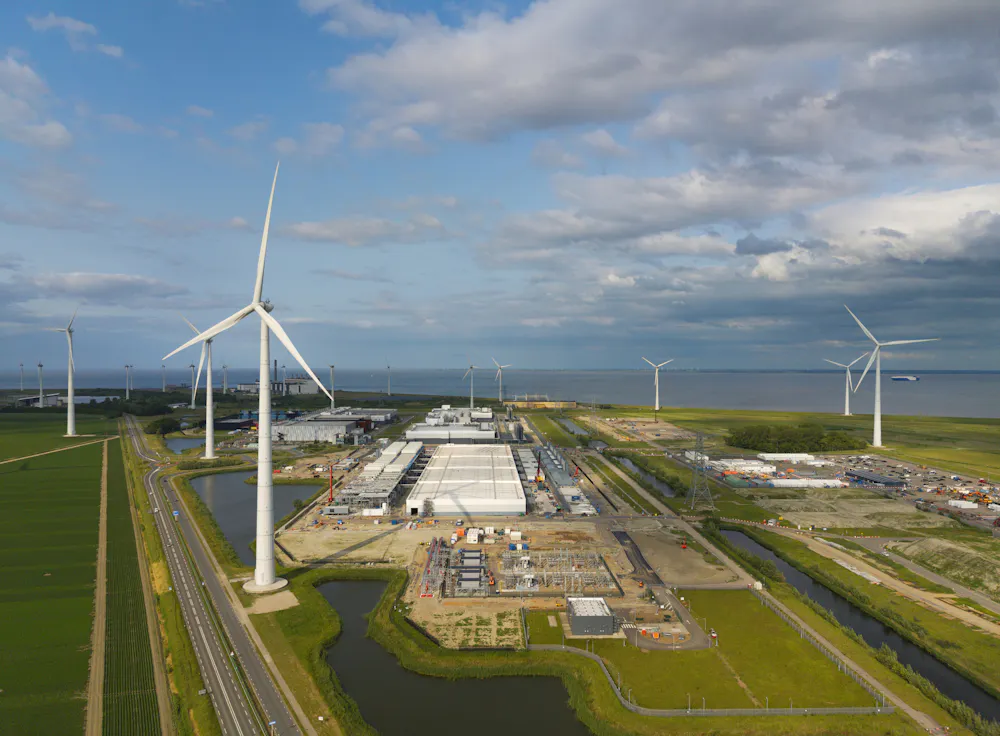
Data centres are hungry for energy. The question is how that demand will be met. Westend61/Getty

We need better data – on data centres

We can’t manage what we don’t measure. Data centres are a textbook example of a data gap impeding good policy.

The Australian Bureau of Statistics rolls data centres into a broader category.

This means we can’t access detailed statistics on how much water or energy data centres use. Nor how much they add to the national accounts.

The federal government has introduced new expectations on water use and efficiency for data centre operators. That’s something. But it’s not the same as a national picture that fits with existing official statistics. Only one data centre meets the new national water-efficiency rating.

Surprisingly, Australia’s National AI Plan has little focus on water and energy. State and federal water ministers have named data centres as an emerging threat to water security. A Senate inquiry is in progress.

We need to track water use better

Australia’s water accounts measure how much water every industry uses. But they don’t track how much water is lost to evaporation or value all water used. Water supply and sewerage are bundled together in even the most detailed view of the national accounts, meaning neither can be seen clearly.

So while data centres appear to be a high-value use of water, we can’t confirm it.

There are signs of change. Australia uses the international System of Environmental-Economic Accounting to track water use. This is being rewritten now, in part to address these issues. The national accounts have also begun treating damage to nature as a cost of production. Both shifts matter, no longer treating the environment as free lunch.

To finish the job, authorities will have to properly value all the water used by industries and disentangle data centre data from other industries. This would turn a noisy debate into a measurable one.

Time to keep tabs on AI

Based on the data we do have, we can say Australia’s data centre boom is neither the water villain some fear nor the cost-free miracle its promoters describe.

Instead, it looks like a high-value industry arriving at record speed which is relatively light on water use and fairly heavy on energy.

With better data in hand, the numbers – not the headlines – should decide where the next megalitre and the next megawatt should go.

The Conversation

Michael Vardon is a member of the Australian government's Technical Advisory Panel for Environmental-Economic Accounting and is on a United Nations team working on environmental-economic accounting.

  •  

What would it take for Pauline Hanson to become prime minister?

There has been a lot of speculation lately, not least from Pauline Hanson, about the possibility of the One Nation leader riding her surging polling figures into the Lodge at the next election.

So what are the rules around who can be prime minister? What would need to happen first? Is it likely Hanson will ever hold the position, or is this just hype?

What are the rules?

While the prime minister has historically come from the House of Representatives and not the Senate, where Hanson is, this is not actually stipulated in the Constitution.

This means many of our rules are mostly conventions inherited from the Westminster traditions of the United Kingdom, rather than legal requirements.

By these conventions, the prime minister has historically been the leader of the party or parties that can maintain the confidence of the House of Representatives. To be eligible, section 64 of the Constitution requires only that all government ministers have a seat either in the Senate or House within three months of being appointed to the role.

So, given Hanson holds a seat in the Senate, she’s eligible to be a government minister and will remain so unless she loses her seat and can’t get it back.

By convention, prime ministers have traditionally been drawn from the House of Representatives. This convention is so strong that when Senator John Gorton was voted by the Liberals to become their leader in 1968, he resigned and moved to the lower house almost immediately.

Having the prime minister in the lower house means they are directly accountable to the people of an individual electorate, can face more scrutiny during question time, and helps to show they’re better in control of their own ministers and backbenchers. It also means they share in the three-year electoral cycle with the majority of MPs, rather than six-year terms of senators.


Read more: The new leader of the Greens sits in the Senate. Why is that so unusual in Australian politics?


What would need to happen?

First, One Nation would need to get a large enough share of seats in the lower house to ensure Hanson could survive a vote of no confidence. This would need to be either a majority (76 of the 150 seats up for grabs) or a large enough share to persuade other parties to join a coalition or at least guarantee her confidence.

An example of this in practice occurred after the 2010 election, when Prime Minister Julia Gillard needed to negotiate with independents and Greens to form government.

It is likely Hanson would want to move from the Senate (where she’s very safe) to a lower house seat, either by resigning and running herself in 2028 or persuading another member to vacate the seat. In the latter scenario, she would still need to win a byelection in that seat. If her party or coalition could obtain the right numbers, either by election or defection from other parties, she could then make a case to the governor-general for appointment to the top job.

What is likely to happen?

The reason we are asking these questions is because One Nation for the first time in its history has been polling better than the Liberal-National Coalition federally (and with a higher primary than Labor in two recent polls).

This comes as the conservative parties, after several leadership changes and election defeats, are at one of their lowest ebbs. It is also reflective of an environment in which none of the major parties is attracting as enthusiastic support as in the past. Similarly, Albanese and Labor are at a point in the electoral cycle where incumbents are generally in decline.

History may prove me wrong, but I think Hanson’s ambitions are unlikely to be achieved for three reasons.

First, although the Liberal and National parties are struggling at the moment, they may bounce back in the coming years. Polling outside of an election period is also different from when an election is looming – and the next federal election is not due until 2028.

Low satisfaction with Albanese in 2024 didn’t translate to a win for his opponent Peter Dutton in 2025. The polls reversed just before the election when people were paying more attention, and Albanese was elected with a large majority.

Voters closer to an election may put more scrutiny on One Nation’s policies around economic management, or their positions on vaccines, abortion and gun control. With migration falling, the importance of their core issue area may have lessened as well, although much will depend on how people are feeling about the state of the economy, and how much they connect migration with other pressing issues such as housing.


Read more: What does One Nation actually believe in?


Second, despite some recent polling suggesting as many as 18 Labor seats were potentially under threat from One Nation, the main contest – at least for now – will be between One Nation and the Coalition for rural and regional seats.

Unless Hanson’s appeal can spread much further than it has in the past into the seats where most people live in cities with a more multicultural electorate, it’s unlikely One Nation would win more seats than Labor. The centrist independents who are doing well in these areas where Labor struggles would be unlikely to team up with her.

Finally, Hanson has historically been both the party’s greatest strength, and its greatest weakness. Her initial win in Oxley in 1996 was as a disendorsed Liberal candidate. By 1998 she was voted out again. When she was out of politics (and contemplating a move to the UK), the party struggled, despite an initial surge of enthusiasm at the 1998 Queensland state election (winning 11 seats from around 22% of the primary vote). By the next election, none of those elected were still with the party.

She has famously fallen out with other MPs in the past, including former Labor leader Mark Latham, who led the party in New South Wales, and the longstanding member for Mirani in Queensland, Stephen Andrews. One Nation has reportedly been aiming to create a more stable and traditional party branch structure recently. However, the party has often been run from the top down while lacking the organisational discipline of other parties.

Until the Farrer byelection last month, they had never won a federal lower house seat under their own label. It remains to be seen whether recent success in South Australia and the inclusion of high-profile but divisive figures such as Barnaby Joyce and Cory Bernardi will make the party more or less stable in the long term.

The Conversation

Pandanus Petter is employed with funding received from The Australian Research Council.

  •  

After an opaque summit, China and the US want to work together again. That might not be good news for the world

Back in 2005, US economist Fred Bergsten coined the term “Group of 2” or “G2”, proposing a stronger partnership between what are now the world’s two largest economies – the United States and China.

In the aftermath of the global financial crisis a few years later, economic cooperation between these two countries briefly seemed to attest to the success of efforts at integrating China into a liberal rules-based order.

To be sure, the ostensible G2 was not meant to replace the larger, formalised G20 group of major economies, so much as strengthen it. Underpinning the broader G20’s response to the global financial crisis, the US enacted an initial US$787 billion fiscal stimulus, while China provided its own US$586 billion stimulus. This helped avert a much larger global economic catastrophe.

This week’s summit between US President Donald Trump and Chinese President Xi Jinping heralds a different sort of G2. On Friday, Trump claimed the countries had struck some “fantastic trade deals”. But anyone hoping for details of such deals – on tariffs, rare earths or Iran – was left disappointed on Friday afternoon.

Whatever may have transpired, US–China cooperation no longer automatically implies positive spillover effects for the rest of the world. Instead, in 2026, the G2 appears, at best, to be a private bargain between two great powers, imposing hidden costs on those outside, looking in.

The Trump administration has ushered in a noticeable shift in how the US views its economic interests: no longer premised on shared liberal values, but on spheres of influence among great powers. The key question, therefore, is not whether the US and China can cooperate. It is what kind of order their cooperation will produce.


Read more: Trump-Xi summit: 3 ways the US and China can compete without going to war


West and East

An older economic contrast is useful here.

In the wake of the second world war, the Western bloc (led across the US, the United Kingdom, and Western European states) was united by a shared commitment to a Keynesian global order (under the Bretton Woods system) that sought freer trade in goods while preserving national economic autonomy.

In contrast, the Eastern bloc (led by the Soviet Union) organised trade through what was called the Council for Mutual Economic Assistance (Comecon), trading many goods between countries through planned barter arrangements, instead of for cash.

The irony for the present day is that the Trump–Xi agenda looks more like the old Eastern bloc’s approach.

In this light, the clearest sign that a G2 may be working outside the G20 or larger rules-based order is not that Washington and Beijing are talking. It is the range of issues that may be managed, tying together such concerns as tariff relief, airplane orders, rare-earths access, chip restrictions, Taiwan and Iran.

In each of these cases, it’s reasonable the two countries would want to coordinate their policies. But together, they point to a new global order where two superpowers increasingly call the shots in their own interests.

Chips and rare earths

Rare earths and advanced chips are the clearest example. Beijing wants access to the advanced semiconductors necessary to dominate the artificial intelligence race.

Washington wants rare earths and critical minerals whose importance has become more acute as the conflict with Iran has strained US stocks of missiles, drones, air-defence systems and other high-end military technologies.

If these are traded against one another, the summit is not about economic liberalisation. It is about whether strategic technologies remain national-security constraints or become bargaining chips in a bilateral deal.

An entourage of executives

The business delegations that have accompanied Trump on this trip point in the same direction.

The presence of executives such as Nvidia’s Jensen Huang, Apple’s Tim Cook, Tesla and SpaceX’s Elon Musk (not to mention others from Qualcomm, Citigroup and Boeing) gave the summit the appearance of a commercial negotiation.

Reported agreements on aircraft orders, agricultural purchases, investment forums and corporate access may all be presented as signs of economic normalisation.

But the question is not only whether US firms gain market access. It is whether commercial wins help stabilise a great-power bargain whose geopolitical costs are borne elsewhere.

Any deal the countries eventually reach on tariffs will likely have the biggest market impacts. But the deal itself could matter less than the optics, allowing Trump to claim a business victory.

This might calm markets in the short term, but it highlights the potential for a retreat from rules-based multilateral liberalisation in the longer term.

A warning on Taiwan, near silence on Iran

The question of Taiwan loomed large over this week’s summit. On Thursday, Xi gave an unusually direct warning to Trump, saying if the issue was not handled properly, the two countries could see “clashes and even conflicts”.

In a larger sense, the danger is not necessarily a formal US concession on Taiwan. It is that Taiwan and other regional actors bear the external costs of a private bargain.

If Taiwan becomes one variable in a wider negotiation, the costs of US–China cooperation may fall on those not in the room.

Iran and oil broaden the same logic. If Trump has pressed Xi to use China’s influence over Tehran, he is not simply asking for diplomatic help. He is treating Beijing as a co-hegemon in a great-power bargain based on order for some – the US and China – and exclusion for others.

This kind of G2 can undermine the global public good. It will also test whether middle powers like Australia, Canada and European countries can keep their seat at the table where decisions are made or, as Canadian Prime Minister Mark Carney put it, risk being “on the menu”.

The Conversation

Wesley Widmaier receives funding from the Australian Research Council.

  •  

Washing machines could support skin health for First Nations people – if we get the wash settings right

Doing a load of laundry involves lots of decisions – from which cycle to choose to what detergent to use.

These choices may seem like simple personal preferences. But in communities where skin and other infections are common, doing laundry is often part of medical advice.

Washing clothes and bedding is widely recommended to help control skin and other infections. However, we haven’t known which wash settings are needed to kill or remove pathogens found on fabrics.

How hot? For how long? And with what detergent?

Our new research aims to answer these questions.

Why washing matters

Washing clothes and bedding may be one way to support skin health.

Rural and remote First Nations communities experience a particularly high burden of skin infections. These infections are driven by the consequences of colonisation, socioeconomic marginalisation and housing inequity, which disproportionately affect First Nations people.

Skin infections can have serious consequences. For example, skin infections caused by the toxin-producing bacteria, Corynebacterium diphtheriae, are driving the current diphtheria outbreak that has already claimed one person’s life.

Strep A skin infections can lead to acute rheumatic fever and rheumatic heart disease, conditions that can cause inflammation throughout the body and permanent damage to the heart. This has a big impact on the lives of children and families. Severe cases may lead to serious disability or death.

Improving access to effective washing may be one way to support wellbeing and curb the spread of skin disease. But we need to get our wash settings right.


Read more: Deep-rooted inequalities are driving the latest diphtheria outbreak. But we can fix them


What we studied

In our new study, we conducted a systematic review that analysed all the available research about fabric contamination and the effect of washing practices on skin pathogens.

Our results show temperature is the most important factor in preventing the spread of skin infections. This was true across all the pathogens and parasites we reviewed.

We found it is most effective to launder clothes at a minimum temperature of 60°C for at least 15 minutes to effectively kill off any bugs or pathogens. This can be in a washing machine set to hot, or in a conventional dryer.

However, reaching these high temperatures is not always possible. Under current regulations, hot tap water can only reach a maximum of 50°C to prevent scalds. And only some washing machines have internal water heaters, so even a “hot” wash might not be hot enough. Heating water and running dryers is also energy intensive and expensive.

Detergents containing activated oxygen bleach can effectively kill some skin pathogens at lower temperatures. But we need more research to know whether detergents and disinfectants can make cold water washing more effective.

Washing in First Nations communities

However, it’s often not possible to wash laundry in a way that effectively kills pathogens. This is especially true in remote Aboriginal and Torres Strait Islander communities.

Many households struggle to purchase a reliable washing machine that is large enough to suit the needs of families. Washing machines can be twice as expensive in remote communities than urban areas, and the cost of electricity is exorbitant. Environmental factors such as dust, wet seasons and hard water – meaning water with higher concentrations of certain minerals – can damage machines and shorten their lifespan.

In some areas, as many as 70% of First Nations households go without a functional washing machine. Even fewer households have access to a dryer.

Community laundries may be one way to improve access to washing facilities. Our research shows that in the past decade, more than 50 communal laundry facilities have been set up in at least 38 rural and remote First Nations communities. These facilities give people free access to industrial washing machines, machine dryers, hot water and detergent.

Last November, the federal government committed A$11.4 million in funding for new or upgraded laundries.


Read more: How we partnered with local communities to halve skin sores among Aboriginal children in remote WA


Where to from here

Washing facilities are tied to the human rights to water, sanitation and dignity. They also have clear benefits for wellbeing.

But more work is needed to understand how effective washing could help reduce skin infection rates, particularly in remote First Nations communities.

One reason is funding for these laundry facilities is often tied to potential health benefits. The Remote Community Laundries Project, for example, aims to prevent serious conditions that can arise from skin infections. However, we don’t have enough evidence for looking at the health impacts of having more laundry facilities, or how we can maximise them.

Another reason is we don’t currently have guidance to support communities and laundry providers delivering these services. Our research highlights that the Australian Standard for Laundry Practice, for instance, has no specific recommendations about how community laundry facilities should be established or run.

Everyone has the right to wash and dry their clothes and bedding. But more work is needed to ensure washing facilities and practices meet the needs, preferences and priorities of First Nations communities.

The Conversation

Rosemary Wyber is supported by an NHMRC Fellowship and receives funding from The Kids Research Institute Australia and Yardhura Walani at Australin National University.

Rachel Burgess receives funding from The Kids Research Institute Australia.

Kate Summer does not work for, consult, own shares in or receive funding from any company or organisation that would benefit from this article, and has disclosed no relevant affiliations beyond their academic appointment.

  •  
❌