Reading view

Why was an Egyptian mummy stuffed with a fragment of Homer’s Iliad?

Achilles Lamenting the Death of Patroclus by Gavin Hamilton (1760-1763). National Galleries of Scotland Collection

Archaeologists have found something unexpected inside a 1,600-year-old Roman-era Egyptian mummy: a fragment of Homer’s Iliad. It wasn’t placed beside the body, but inside the mummy’s abdomen. But the real surprise isn’t just where the fragment was found. It’s how it got there. To understand, we must go back – to the Iliad itself, and to what it became in the Roman world.

In The Iliad, a poem shaped in the 8th century BC and attributed to Homer, the Trojan war does not end in triumph or renewal. It ends in devastation. The poem closes at the edge of collapse, with Troy reduced to a landscape of heroic ruin. And yet, this is not where the story ends.

According to later Roman tradition, one Trojan escaped. Aeneas – son of Anchises and the goddess Aphrodite – fled the burning city carrying his father on his shoulders and the household gods in his hands. He moved west, across the Mediterranean, towards Italy, where he became the ancestor of Rome.

This continuation did not come from the Iliad itself. It was shaped centuries later, most famously in Virgil’s Aeneid. But it changed the meaning of the Trojan war entirely. The past, in other words, was actively reorganised – through stories that could be reworked, extended and connected across time and space.

Painting by Pompeo Batoni (1753), depicting Aeneas fleeing the burning city of Troy with his father Anchises and the household gods, as the fall of Troy is recast as the beginning of a journey toward the foundation of Rome.
Painting by Pompeo Batoni (1753), depicting Aeneas fleeing the burning city of Troy with his father Anchises and the household gods, as the fall of Troy is recast as the beginning of a journey toward the foundation of Rome. Galleria Sabauda

Turning defeat into origin

For Roman audiences, the Trojan war was more than a distant Greek legend. It became a way of thinking about origins, identity and power.

Claiming descent from Troy was more than a matter of tracing a lineage. It required constant cultural work – through storytelling, education and shared knowledge. The Iliad provided the raw material: characters, events and genealogies that could be reshaped and redeployed across generations.

Across the Roman Empire, educated elites learned Homer as part of their schooling. They quoted him in speeches, analysed him in classrooms and used him to signal cultural authority. To know the Iliad was to speak a language that others across the empire understood.

A senator in Rome, a teacher in Asia Minor or a student in Egypt could all draw on the same stories. The poem created a shared frame of reference – one that allowed very different people to situate themselves within a common past.
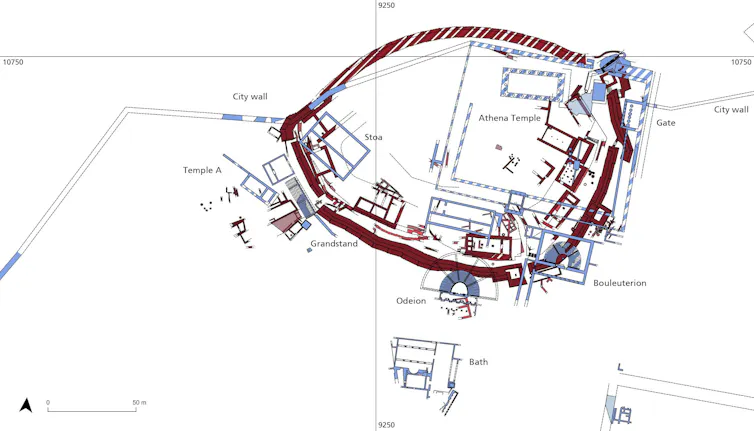
Plan of the late bronze age citadel of Troy
Plan of the late bronze age citadel of Troy (c. 1300–1109BC) shown in red, with Roman-period structures in blue, integrated into the ancient fortification in such a way that the surviving walls functioned as a theatrical backdrop of ‘authentic antiquity’, transforming archaeological depth into a deliberately scenographic experience. University of Tübingen, CC BY-SA

In the Roman imperial period, the site of ancient Troy – located in modern-day Turkey – became a destination. Emperors invested in its development, tying it directly to Rome’s claimed Trojan origins. Under Emperor Augustus, Troy was folded into the political language of empire. And under Emperor Hadrian, it became part of a wider culture of travel, memory and heritage.

A visitor to Troy in the 2nd century AD would have arrived at a curated landscape. There were baths, places to stay and spaces for performance. A small theatre – the Odeion – was built directly into the ancient citadel, so that the remains of the bronze age city, understood as the setting of the legendary battles around Troy, formed a dramatic backdrop.

Visitors could walk through what was presented as the setting of Homeric epic, experiencing the Trojan war as something anchored in the ground beneath their feet.

From Troy to Egypt

Across the Roman Empire, the Iliad circulated as a living text: copied, taught and read. Egypt, one of Rome’s most important provinces, was no exception. Yet here, Homer circulated within a cultural landscape that differed in important ways from the Greek literary world in which the poem had first taken shape.

For Roman observers, Egypt often appeared as a place where antiquity was materially preserved as well as remembered – through temples, monuments and practices that emphasised continuity with the past. At the same time, it was a deeply hybrid society, where Egyptian, Greek and Roman traditions interacted in complex ways.

Homer was among the most widely copied authors in Roman Egypt – read and taught as a marker of education and cultural belonging and deeply embedded in everyday literary culture.

A small covered Roman theatre
The Odeion of Troy, a small covered theatre inserted into the fabric of the ancient citadel and constructed in the early 2nd century AD, exemplifies the Roman reconfiguration of the site’s urban and cultural landscape. University of Tübingen, CC BY-SA

The Homeric version of the Trojan War was particularly prominent among the Greek-speaking elite, especially in urban centres such as Oxyrhynchus, where the mummy was found. Other versions of the story – which placed greater emphasis on Paris and Helen’s stay in Egypt, as reported by Herodotus based on accounts from Egyptian priests – were probably more widespread among the broader Egyptian population.

The initial media coverage of the discovery of the fragment inside the Egyptian mummy suggested the text was deliberately chosen to accompany the deceased. As a personally meaningful object, perhaps reflecting their education or cultural identity.

The most telling explanation, however, may be the most straightforward. Discarded or damaged papyri could be reused as inexpensive material. The fragment may therefore have functioned as stuffing – bundled together and inserted into the body cavity without particular regard for its literary content.

The very fact that a scrap of the Iliad could end up as disposable filling, however, speaks to how deeply Homer had penetrated everyday life in Roman Egypt.

A text in motion

To make sense of the past in the Roman world meant moving between story and monument, between genealogy and deep time. Each perspective made the others more intelligible.

The Iliad helped create a world in which different pasts could be connected, compared and reshaped. By linking stories, places and traditions across the Mediterranean, the Roman world turned the past into a flexible resource – one that could generate identity, authority and belonging in shifting contexts.

This is why the Iliad mattered: it circulated across many different settings. It shaped elite education, but it was also part of everyday reading culture. At Troy, it helped transform the city into a place of cultural memory. The text itself also had a long material afterlife, surviving not only as an authoritative story, but through manuscripts and writing materials that were copied, passed on – or even reused for entirely different purposes.

Its most enduring insight is therefore this: the past is not something simply preserved, but something continuously made and remade – through the stories, practices and materials that carry it across time.

This article features references to books that have been included for editorial reasons, and may contain links to bookshop.org. If you click on one of the links and go on to buy something, The Conversation UK may earn a commission.

The Conversation

The authors do not work for, consult, own shares in or receive funding from any company or organisation that would benefit from this article, and have disclosed no relevant affiliations beyond their academic appointment.

  •  

Chief Purpose Officers: A leadership solution or another management fad?

Chief Purpose Officers: Do firms really need them? For decades, the shareholder primacy model dominated corporate strategy, often displacing explicit discussions of broader organizational purpose. Today, in a world shaped by AI, economic uncertainty, and constant organizational change, many stakeholders want companies to stand for something more than short-term results. As a result, the term “purpose”, defined as the reason a firm exists in society, has become a powerful business buzzword, especially following the Business Roundtable’s 2019 statement on corporate purpose. However, the more companies talk about purpose, the fewer employees seem to believe them.

Research suggests corporate purpose may be “too good to be true”. Employees increasingly experience purpose rhetoric as vague, superficial, and disconnected from everyday work realities. Companies make ambitious promises about values and responsibility to connect with society, yet the day-to-day remains dominated by growth targets, efficiency pressures, and quarterly results.

Employees notice the gap between what organisations say and what they actually do.

The emergence of CPOs and the importance of being ‘purpose-driven’

This growing complexity has fostered a new executive role that has quietly emerged: the Chief Purpose Officer, or CPO.

Ubisoft, Virgin Atlantic, Cisco, Sephora, and KPMG, to name a few, have introduced purpose-focused leadership roles in recent years.

Their task is simple in theory but difficult in practice: making sure a company’s stated purpose influences real decisions. Rather than competing with financial goals, CPOs help clarify how purpose and performance can be aligned, especially when leaders face difficult trade-offs about growth, stakeholders, and long-term responsibility.

Our recent study of 44 Chief Purpose Officers across industries such as gaming, travel, and beauty found that these executives work at the intersection of strategy, culture, and ethics to transform their organisations into more purpose-driven entities.

They help by connecting lofty purpose statements to the reality of organisational life.

In practice, this means asking difficult questions during leadership meetings:

  • Does a business decision align with the company’s long-term direction and with its purpose?
  • When does growth undermine the organisation’s purpose?
  • How does the company create value for society? And where its activities cause harm, what changes are needed to transform the business?

Some CPOs redesign hiring and reward systems so employees are evaluated partly on their contributions to strengthening the organisation’s purpose. Others develop “purpose metrics” that executives discuss alongside financial performance.

Some examples are surprisingly concrete. One executive told us their company had ended relationships with clients whose practices conflicted with its values. Another described leadership meetings where executives openly discussed their emotional reactions to climate-related events. Some make purpose visible in simple, tangible ways. One CPO, for example, created a “light bulb wall”: each time an employee acts in a way that brings the organisation’s purpose to life, a new bulb is switched on. Over time, the wall becomes a visible reminder that purpose is enacted through everyday decisions and small, repeated actions.

At first glance, CPOs’ practices may appear unusual. In reality, they reflect a deeper transformation in management itself, trying to integrate moral and emotional considerations into strategic decision-making.

CPOs set out to reshape how organisations think about their societal role. They foster emotional engagement around shared values. They build relationships across stakeholders and departments. And they embed purpose into tangible structures such as incentives, metrics, and governance systems. In short, they attempt to transform abstract ideals into operational reality.

Can CPOs really make a difference?

The big question is whether companies need a dedicated executive for this work. While the role may overlap with functions such as HR, CPOs add value by linking purpose to long-term strategy and governance. As purpose is not static, CPOs support purpose evolution. They ensure that decisions reflect the organization’s responsibilities toward employees, customers, and communities, turning purpose into a practical guide for business.

Critics argue that Chief Purpose Officers risk becoming symbolic figures with little real influence. If one executive champions purpose while finance and operations teams control the actual decisions, nothing changes.

As a result, in some organisations, the role can become a form of corporate theatre: a visible commitment to values without meaningful structural reform. And lastly, purpose is also difficult to measure. Unlike sales or profits, its impact is harder to quantify. That makes it easy for sceptics to dismiss the role as another management fad.

Our research suggests that CPOs only make a difference under certain conditions.

  1. The organisation must genuinely use purpose as a decision-making filter and link purpose with strategy.

  2. The CPO must have both legitimacy and authority. They must report directly to the CEO and participate in strategic meetings.

  3. Leadership must visibly model purpose, especially when it conflicts with short-term profit. If the CEO abandons purpose when it becomes inconvenient, the entire effort collapses into theatre.

When these conditions are present, organisations can change in tangible ways. Hiring practices evolve. Supplier relationships shift. Incentive systems are redesigned. Purpose begins to shape everyday decisions and becomes strategically relevant.

So, do firms need Chief Purpose Officers? Increasingly, yes.

In a business world marked by technological disruption, social pressure, and growing distrust of corporate rhetoric, firms face pressure from all directions at once. They must remain profitable, innovate quickly, attract talent, respond to social expectations, and adapt to technological change. Purpose does not replace these goals. It helps connect them.

This is where Chief Purpose Officers can make a difference.

Their role is about helping organisations clarify what they stand for when facing difficult trade-offs and competing priorities.

CPOs cannot solve these tensions alone. But they can help organisations turn purpose from a marketing message into a tangible, organisational reality that can be experienced in the workplace.

Why Europe needs CPOs

Society is raising the bar for responsible business. The European Union’s Corporate and Sustainability Reporting Directive and Green Deal now require large firms to align finance and operations with stated sustainability commitments and report on their impact. Yet compliance alone does not create purpose.

A company may report strong environmental performance while still lacking a clear reason for existing beyond shareholder returns. A Chief Purpose Officer is one emerging and fragile answer that helps close this gap by ensuring that a company’s purpose genuinely shapes financial and operational decisions, driving the transformation of European businesses toward more responsible and sustainable models.

Ones to watch

List of top executive appointments dedicated to upholding best practices:

  • Richard Boele, Chief Purpose Officer, KPMG Australia
  • Alexandra Michat, Chief Purpose Officer, Exo Travel
  • Simon Cheetham, Chief Purpose Officer, Andrew Property & Purpose
  • Priya Srinivasan, Chief People and Purpose Officer, Coty
  • Laura Dunne, Chief Purpose and Proposition Officer, Lincolnshire Co-op
  • Caroline Jeanteur, Chief Purpose Officer, Ubisoft.

Paradoxically, several CPOs in our study suggested that their ultimate success would be to make the position less necessary over time by embedding purpose into the organisations systems, routines, and decision-making processes.

Yet the very emergence of the Chief Purpose Officer points to a broader shift in modern capitalism: companies are increasingly expected to demonstrate how their purpose shapes how they create value, govern themselves, and respond to society’s demands.


The full research on how to implement purpose in organisations is available in “Dynamic Strategifying: How do Chief Purpose Officers make purpose strategic and strategy purposeful?”, published in Long Range Planning (2025), and “Too good to be true? The ambivalent consequences and managerial challenges of purpose implementation,” in European Management Review (2026).


A weekly e-mail in English featuring expertise from scholars and researchers. It provides an introduction to the diversity of research coming out of the continent and considers some of the key issues facing European countries. Get the newsletter!


The Conversation

Les auteurs ne travaillent pas, ne conseillent pas, ne possèdent pas de parts, ne reçoivent pas de fonds d'une organisation qui pourrait tirer profit de cet article, et n'ont déclaré aucune autre affiliation que leur organisme de recherche.

  •  

We tested the new World Cup ball – this is what you need to know about how it will fly, dip and swerve

Small variations in the ball can influence how it behaves once it leaves the foot. Robbie Jay Barratt/AMA/Getty Images

Every four years, the men’s World Cup delivers some certainties. The pitch dimensions are tightly regulated, offside is signaled with a flag, and referees end the match with a blast of a whistle. But one key piece of equipment is changed on purpose: the ball.

Adidas, which has supplied World Cup soccer balls since 1970, introduces a new match ball for every tournament, and with that comes fresh aerodynamic calculations for players. How will it fly through the air, weave and dip?

For the past 20 years, my engineering colleagues in Japan and England and I have put the new balls through their paces, investigating soccer ball aerodynamics. Our work begins by putting balls in wind tunnels to measure drag, side and lift forces. We use the measurements from these tests in trajectory simulations that tell us how the ball will behave in a real-game setting.

Putting the 2026 World Cup ball through the wind tunnel test.

That may all sound a little academic, and we do produce an academic paper on our findings. But what our data indicates could mean the difference between a goal or a miss for strikers, a save or a blunder for goalkeepers, and jubilation or heartache for fans.

At the World Cup, the ball is the most important piece of equipment in the biggest tournament of the world’s most popular sport.

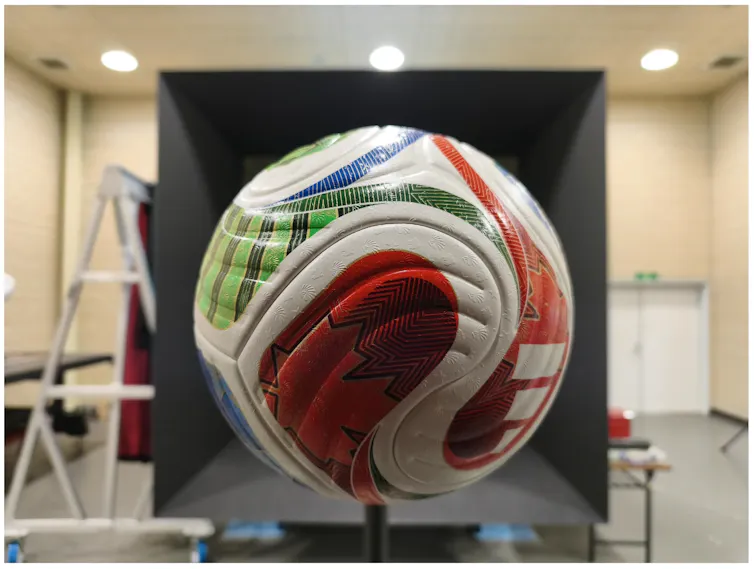
This year’s ball, the Trionda, is especially interesting. When FIFA and Adidas unveiled it in fall 2025, the first thing many people noticed was the color and the paneling.

An orange ball and a black and white ball are under a trophy.
Earlier World Cup balls used many panels; modern balls use far fewer. Manfred Rehm/picture alliance via Getty Images

The ball’s red, blue and green graphics correspond to the three host countries, with maple leaf, star and eagle motifs representing Canada, the United States and Mexico. And for the first time in men’s World Cup history, matches will be played with a four-panel ball.

But with so few panels, has Adidas made the ball too smooth? That is the trap engineers fell into with the Jabulani ball used at the 2010 World Cup in South Africa that became notorious for sudden dips and swerves, which made goalkeepers’ lives far trickier.

You do not want the World Cup ball to feel like the start of a science experiment once it is in the air. And if it behaves strangely, players and goalkeepers notice immediately.

The evolution of soccer balls

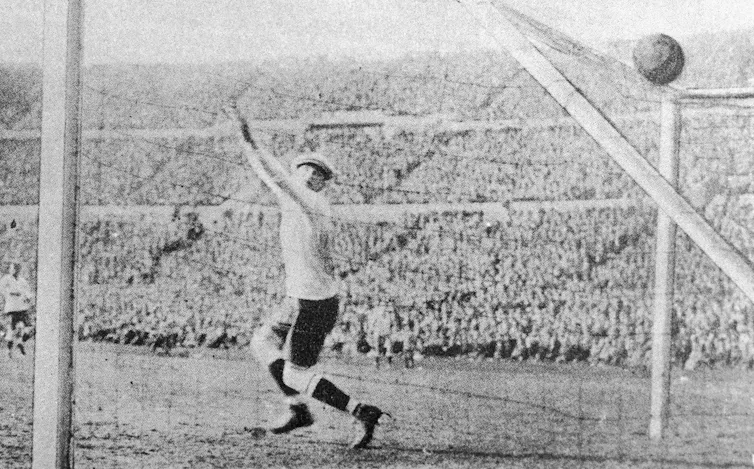
World Cup balls have come a long way over the decades. If you go back to 1930, the ball looked very different. The first World Cup final used two different leather balls: Argentina’s Tiento in the first half and Uruguay’s T-Model in the second. Both were hand-sewn, multipaneled balls, inflated through a bladder opening that had to be tied off and tucked back beneath the laces. In damp conditions, the leather absorbed water, making the ball heavier and less predictable in play.

A ball nestles in the top of a goal.
Uruguayan keeper Enrique Ballestrero fails to save a shot from Argentina’s Carlos Peucelle in the final of the first World Cup. Keystone/Getty Images

By 1994 – when the United States last hosted the men’s tournament – the official ball, Adidas’ Questra, had evolved into a foam-based design. The modern World Cup ball is no longer just stitched leather. It is an engineered aerodynamic surface.

Trionda pushes that evolution further. It has only four panels, the fewest in men’s World Cup history, which have been thermally bonded – melded together using heat and adhesive.

Fewer panels might suggest less total seam length and therefore a smoother ball. And smoothness matters because the thin boundary layer of air clinging to the ball determines where the flow separates, how large a wake forms, and how much drag the ball experiences.

The Trionda has intentionally deep seams, three pronounced grooves on each panel and fine surface texturing.

But will these textures and grooves do the trick? To find that out, my colleagues and I measured the ball’s seam geometry and overall aerodynamic behavior. We compared it with Trionda’s four predecessors: 2022’s Al Rihla, 2018’s Telstar 18, the Brazuca used in 2014 and the Jabulani in 2010.

What the measurements show

In our wind tunnel tests at the University of Tsukuba, we measured something called the drag coefficient, which is a way of describing how much air resistance a ball experiences as it moves.

Using this data, we gained insights into how the airflow changes around the ball after it is kicked. The tests helped identify the drag crisis, the speed range in which changes in the boundary layer and flow separation produce a sharp change in drag, which can alter the ball’s acceleration, trajectory and range.

A ball is seen suspended.
The Trionda soccer ball prepares for the wind tunnel. Goff/Hong/Liu/Asai

We found that the Trionda is effectively rougher than those predecessors.

Trionda reaches its drag crisis at a lower speed, at about 27 mph (43 kph). That is below the roughly 31-40 mph (50-65 kph) range for Al Rihla, Telstar 18 and Brazuca, and far below Jabulani’s roughly 49-60 mph (79-97 kph) range, depending on orientation.

Why does all that matter? Because a ball can feel ordinary off the boot and still behave differently in flight. When the drag crisis occurs in the middle of game-relevant speeds, small changes in launch speed, orientation or spin can shift the ball from one aerodynamic regime to another.

That was Jabulani’s problem. Once kicked with little spin, it had a tendency to slow down too much as it passed through its critical-speed range.

Trionda does not look like that kind of ball. It has a more steady and consistent drag coefficient in the range of speeds associated with corner kicks and free kicks.

But there is a trade-off. Our measurements also showed that once Trionda enters the higher-speed, turbulent-flow regime, its drag coefficients are somewhat larger than those of Brazuca, Telstar 18 and Al Rihla.

In plain language, that suggests a hard-hit long ball may lose a little range.

In our simulations, the difference is not huge. But it is large enough that players may notice long kicks coming up a few meters short.

It is also important to note that we tested a nonspinning ball. As such, our results do not provide a prediction of every pass, clearance or free kick fans will see this summer. Balls in flight often spin due to off-center kicks. That, along with altitude, humidity, temperature and air pressure all influence how a ball flies through the air once kicked.

A ball mounted on a rod.
Close-up of the Trionda ball during wind tunnel testing. Goff/Hong/Liu/Asai

The big test yet to come

Fewer panels and more texturing aren’t the only differences with the new ball.

Trionda also carries technology that has little to do with its flight and a great deal to do with officiating. Like Al Rihla, Trionda includes “connected-ball technology” that lets computers know when the ball is kicked, helping with offside decisions.

But the architecture has changed. In 2022, the measurement unit was suspended at the center of the ball. With Trionda, it sits in a specially created layer inside one panel, with counterbalancing weights in the other three panels. The chip sends data to the video assistant referee, or VAR, system and the tournament’s semi-automated offside system.

That tweak will help referees, but will the new ball in general help or hinder players?

The evidence from our tests suggests that the ball won’t be behaving in a way that leads to baffling and erratic flight.

But the more intriguing possibilities are subtler and outside the scope of our tests. Will the grooves on Trionda help players generate more backspin on the ball, generating more lift and possibly offsetting Trionda’s somewhat larger high-speed drag coefficient?

That is why I keep studying World Cup balls both in the lab and through their behavior in play. Every four years, a new design offers a fresh way to watch physics enter the game, not in theory, but in the movement of an object in which every player on the soccer field must place their trust.

The Conversation

John Eric Goff currently works as a visitor in the Department of Physics at the University of Puget Sound in Tacoma, Washington. Following the conclusion on 30 June of that one-year appointment, he will start on 1 July as Professor of Engineering Practice in the Weldon School of Biomedical Engineering and the School of Mechanical Engineering at Purdue University.

  •  

Europe’s dilemma – to use China’s turbines to meet its renewable targets or not

Europe’s wind turbines have become part of a wider struggle over energy security, industrial power and the west’s dependence on China.

European wind power capacity has surged dramatically in recent years. Wind energy now supplies 17% of EU electricity up from 13% in 2019. Offshore wind has expanded particularly rapidly, with installed capacity growing strongly over the past decade.

But Brussels wants renewables to provide at least 42.5% of the EU’s total energy mix by 2030. Wind is “pivotal” to this strategy, according to the European Commission’s wind power action plan. The challenge for Europe is to meet its 2030 target, it needs to build 33 gigawatts (GW) of new wind turbines annually.

So far, data from 2022, 2023 and 2024 indicates that Europe has averaged only around 16-19 GW of new installations per year. This leaves a significant gap between Europe’s target and its implementation.

Across the Atlantic, the picture is just as uncertain. The US Inflation Reduction Act introduced during Joe Biden’s presidency promised a surge in renewable energy investment, including wind. But growing political opposition to turbines, especially from Donald Trump and his political allies, has cast doubt over how far that momentum can go.

Cheap turbines and fast delivery

Europe’s installation shortfall and the US’s retreat from wind energy create a strategic opening for China. Chinese manufacturers dominate the global wind industry, with six of the top ten turbine makers and producing over 70% of the world’s new wind turbines in 2024. Companies like Goldwind, Envision and Mingyang offer turbines that are 30-40% cheaper than western equivalents and promise faster delivery.

This puts the west in a bind: accept Chinese help to meet climate targets quickly and cheaply, or reject it and risk falling further behind.

Europe could certainly rely on Chinese wind power to close its gap in renewable energy. The same could be said about the US, although its desire to push forward with wind power is not clear. US wind deployment fell to 5.2 GW in 2024, the lowest level in a decade, and turbine orders dropped 50% in the first half of 2025.

However, allowing Chinese firms greater market access creates a real policy dilemma. While purchases of Chinese turbines would speed up Europe’s energy transition and is cost effective, the EU sees China as an economic rival and security risk that potentially undermines the union’s industrial and strategic autonomy.

The US appetite for Chinese wind tech is much lower than Europe’s. Aside from permit delays, grid connection bottlenecks and rising costs, Trump’s return to office in 2025 is an important factor in the US’s renewable slowdown. The US president has publicly labelled wind power “a joke”, and has frozen federal permits for offshore and onshore wind projects, in addition to eliminating renewable energy tax credits.

But that’s not all. Washington views China’s dominance in wind turbine technology as a security threat requiring protectionist barriers, and has effectively blocked Chinese wind technology through various measures. This includes national security probes into wind turbine imports, 50% tariffs on wind turbines and parts, and tax credit restrictions that bar companies using Chinese-manufactured components from accessing federal clean energy incentives.

Western tariffs haven’t slowed China’s wind industry but have redirected it. Chinese wind turbine exports surged 50% in 2025. By the end of 2025, cumulative exports had exceeded 28 GW, a thirteenfold increase from 2015. Chinese manufacturers are now selling wind turbines to more than 60 countries, and have established production or research operations in more than 20.

The UK’s largest wind farm is off the east coast.

Targeting new markets

The pattern is clear: China is targeting developing markets where western competition is weak and renewable energy demand is surging. The biggest purchasers of turbines from China in 2024 were Saudi Arabia, Uzbekistan, Brazil, Egypt and Kazakhstan. All are participants in China’s economic development plan, the Belt and Road Initiative.

But China’s wind momentum shows no signs of slowing. Pakistan, Indonesia, Vietnam, Saudi Arabia and Malaysia are expected to add 120 GW of wind and solar capacity over the next decade, requiring US$73 billion (£53.5 billion) in investment. Chinese firms already captured over 60% of renewable energy capacity in these markets since 2024, and is set to expand further.

While China’s wind turbine sales to the US and Europe may be uncertain, Beijing has secured a different prize. Since 2013, Chinese companies have installed 156 GW of power capacity across Belt and Road Initiative countries, 70% in Asia and 15% in Africa.

The west may be protecting its own energy independence, but may also be handing the control of Africa and Latin America’s energy future and security to China, if things don’t change.

The Conversation

Chee Meng Tan does not work for, consult, own shares in or receive funding from any company or organisation that would benefit from this article, and has disclosed no relevant affiliations beyond their academic appointment.

  •  

What’s wrong with how US and Uganda plan to stop Ebola spreading

The Democratic Republic of Congo is scaling up health operations to contain the Ebola epidemic. Michel Lunanga/Getty Images

As public health workers in the Democratic Republic of Congo work to rein in a growing outbreak of a rare Ebola virus, other countries are establishing protocols for keeping their own populations safe.

As of May 27, 2026, Congo has reported more than 1,000 suspected and confirmed cases, and more than 250 deaths, according to the U.S. Centers for Disease Control and Prevention. Neighboring Uganda has also reported seven cases and one death. Several Americans who were in the region have been exposed.

Measures such as screening incoming travelers and isolating those who have been exposed, announced by the U.S., Canada and other countries, are scientifically proven ways to effectively address outbreaks.

But recent decisions by two countries stand out because they are not supported by epidemiological evidence – and because they reflect a surprisingly similar way of thinking about outbreak control: On May 27, Uganda closed its border with Congo. Only a narrow set of exceptions apply, mostly for emergency aid workers, and those who cross the border will be subject to health screening and supervised isolation. The following day, the United States announced plans to send exposed Americans from affected countries to a quarantine facility in Kenya, a country with no Ebola cases – though as of May 29, a Kenyan court has blocked the move.

Uganda closed its border with Congo to prevent the spread of Ebola, but public health history suggests this is not a great idea.

These are very different policies, but both rely on a common assumption: that creating geographic distance from a threat provides protection. However, surveillance, isolation and response capacity are often more important. And both the Ugandan and U.S. moves have drawn criticism from public health and medical experts who argue that managing outbreaks depends more on detection and monitoring than distance alone.

And both decisions emerge from a long-running debate in public health: whether controlling where people are located is more effective than investing in the systems that identify, monitor and treat disease.

As an epidemiologist studying infectious disease outbreaks, I think a look at the history of border restrictions and closures during epidemics helps explain why scientific consensus usually recommends against them.

Land borders are challenging to ‘close’

The instinct to seal borders during outbreaks goes back centuries. Venice’s 14th-century “quarantino” was one of the earliest organized attempts by a state to regulate movement in the name of collective health. It worked because the unit of control was a ship: a discrete location that could be anchored offshore for a period of time.

A land border is a fundamentally different problem. As trade networks crossed continents, epidemic control encountered something maritime quarantine never had to solve. You cannot easily anchor people at a land border.

By the 19th century, repeated cholera outbreaks had made the problem international. European powers responded with waves of uncoordinated border closures and trade restrictions that caused enormous economic damage without reliably stopping transmission.

A four-panel etching from 1833 showing people trying to disembark from a boat and go ashore.
Sealing a border is easier when people arrive by sea than by land. Wikimedia Commons

In 1874, governments from around the world met in Vienna for the Fourth International Sanitary Conference to address a problem that sounds remarkably modern: how to control infectious diseases crossing borders without crippling trade and travel. Delegates explicitly rejected border closures and land quarantine as “unworkable and consequently useless.”

The modern descendant of those 19th-century conferences is a set of global laws called the International Health Regulations. Their core purpose is straightforward: Make it safe for countries to report outbreaks honestly, without fear that doing so will trigger economic punishment or travel bans.

Incentive problem at the heart of global health

The entire modern global health surveillance system rests on a single premise: Countries need to report outbreaks quickly, without fear of automatic economic punishment for doing so. If declaring an outbreak triggers immediate border closures and travel bans, governments have a powerful incentive to delay reporting.

This concern is not hypothetical. During the first SARS outbreak in 2003, China’s delays in official reporting, driven in part by concern about economic fallout, contributed directly to the global spread of the disease. This prompted the World Health Organization to publicly accuse a member state of placing the world at risk. The International Health Regulations were most recently revised in 2005 in direct response to that failure.

When the WHO declared the current Ebola outbreak a public health emergency of international concern on May 17, it explicitly warned against border closures and travel restrictions, saying that these moves “have no basis in science.” That’s because such actions push movement to informal border crossings that are not monitored and “can also compromise local economies and negatively affect response operations from a security and logistics perspective.”

For example, a mother trying to get a sick child to a clinic just across the border may not stop because the formal crossing is shut. The Uganda-Congo border is several hundred miles long and crossed by numerous footpaths beyond formal border posts, which many people use daily to visit family or to trade.

The public health system loses the ability to test, isolate or trace those interactions. This matters especially for Ebola, which transmits only after symptoms begin – meaning a person who can actually spread the virus is already identifiable through symptom screening, making case detection and isolation far more effective than geographic restriction.

U.S. plans to establish quarantine facilities in Kenya for Americans exposed to Ebola have drawn strong pushback.

The U.S. decision to send exposed Americans to a quarantine facility in Kenya reflects a related instinct – to keep the virus off native soil. But exposure has already occurred, so the public health question is no longer how to prevent entry but how to monitor potentially exposed people safely and effectively. The plan is particularly controversial because it would transfer potentially exposed individuals to a country with no Ebola cases of its own, despite the U.S. already possessing specialized facilities designed for exactly this purpose.

The Infectious Diseases Society of America criticized the plan, noting that the United States has already invested heavily in specialized Ebola treatment centers specifically designed to care for patients with highly dangerous infectious diseases. It warned that building and staffing a new unit in Kenya during an active outbreak raises questions about resources, timing and quality of care.

Border restrictions do not work alone

Some countries did use border closures effectively during COVID-19 – New Zealand, Australia and Taiwan sharply restricted international travel while pairing those measures with intensive testing, quarantine and contact tracing. But specific circumstances made those cases work: restrictions before the virus began spreading widely in the community, island geography that naturally limited informal crossings, and aggressive internal measures running in parallel.

Remove any of those elements and the effectiveness drops sharply. In these examples, the act of closing the border did not work alone. It bought time for setting up the infrastructure for testing and contact tracing.

These circumstances don’t apply to Uganda’s border closing. Researchers estimate the virus had been transmitting for approximately six weeks, and Uganda already has seven confirmed cases. A closure here is not a moat.

Governments face real pressure to act visibly during outbreaks, and border restrictions are easier to communicate to a worried public than investments in surveillance infrastructure. Those incentives are understandable.

But history suggests that outbreaks are controlled less by where people are located than by whether governments can identify cases quickly, trace contacts, isolate infections and maintain public trust. In other words, borders alone do not stop outbreaks. The real work happens inside them.

The Conversation

Katrine L. Wallace does not work for, consult, own shares in or receive funding from any company or organization that would benefit from this article, and has disclosed no relevant affiliations beyond their academic appointment.

  •  

Dark patterns on the web are designed to manipulate you – why aren’t they all illegal?

Website designs that try to change your behavior cross a line when they outright deceive. Fizkes/iStock via Getty Images

You open a free app to do one simple thing. Before you even start, a full-screen message asks whether you want to try the paid version. The “Start free trial” button is large, bright and hard to miss. The option to keep using the free version is smaller, buried at the bottom. The same prompt appears again tomorrow. And the day after that.

A lot of people look at screens like that and think, “Surely this has to be illegal.” We even have a name for them, “dark patterns.” They feel pushy. They waste time. They seem designed to wear you down. But in most cases, they are perfectly lawful.

“Dark pattern” is not a legal term with a clear boundary. It is a broad label for digital designs that nudge, pressure, confuse or trap users. As a legal scholar who studies consumer protection and digital design, I think the most important thing for readers to understand is that the label “dark pattern” covers a broad spectrum.

Some of that spectrum is just annoying. Some of it is aggressive salesmanship. And some of it crosses the line into deception or coercion. Federal and state consumer protection laws are mostly aimed at that last category. They do not ban every design choice people dislike, only those that trick or coerce.

Annoying isn’t illegal

smartphone screenshot of images of a well-dressed young man
The ‘X’ in the upper right corner of this ad, for users to click to dismiss the ad, appears after the ad has been displayed for a moment. The ad also has an ‘X’ in the upper left corner, which is part of the image in the ad. Some users might click the ‘X’ on the left to dismiss the ad but instead be sent to the ad’s website. Possibly annoying but not illegal. Screen capture by Gregory Dickinson

That reality may sound unsatisfying, but it is not unusual. Offline life is full of things that are irritating but not unlawful. Think of the cashier who asks whether you want to sign up for the store credit card, then points out the discount you are turning down, then asks again. Most people know exactly what is happening. They roll their eyes, say no and try to shop somewhere else next time.

The same is true online. A repeated pop-up can be obnoxious. A guilt-inducing button can be tacky. But consumers recognize ordinary annoyance for what it is. In many cases, the market answer is simple: Close the app, ignore the pitch or take your business elsewhere.

Similarly, law does not ban persuasive sales pitches just because they are effective. A car salesperson who keeps steering you toward the upgraded model is trying to influence your choice. So is the airline clerk who offers travel insurance. So is the restaurant server who asks whether you want dessert. Salesmanship is nothing new. Digital design often borrows from familiar techniques.

That helps explain why lawmakers cannot simply outlaw “manipulation.” And so many interfaces are built to persuade, openly and lawfully.

What crosses the line

What the federal FTC Act and analogous state consumer-deception statutes usually care about is not whether a design is annoying. They focus on whether the design is likely to mislead a reasonable consumer. That is the core idea in modern consumer protection law.

So a design is likelier to be unlawful when it hides key facts, makes an optional choice look mandatory or tricks people about the effect of the button they are pressing. A fake countdown timer, a disguised ad, a misleading one-click purchase button or a cancellation path that looks finished when it is not are all different from ordinary hard selling. Those designs do not just pressure users; they can deceive them.

That is also why the app maker’s intent is not always the key question. In many consumer protection cases, a company does not get a free pass just because no one said, “Let’s trick people.” The legal question is often about effect: What would a reasonable user likely understand from this screen?

Research on dark patterns reinforces that concern. Even relatively mild designs can push people into choices they would not otherwise make. And regulators have increasingly focused on subscription flows, hidden fees and cancellation obstacles for exactly that reason.

image of a website form with a pop-up box in front of it
The instructions for this web form and the pop-up box that appears when users click ‘Continue’ indicate that the form has required fields. The form uses the word ‘mandatory,’ which could lead some users to believe that the form itself is required in order to continue when it is instead optional. Possibly annoying but not illegal. Screen capture by Gregory Dickinson

Why it feels like dark patterns are everywhere

One reason people might think there are no laws against dark patterns is that they see them so often. But that frequency reflects that the term covers a wide range of conduct, from lawful nagging to outright deception.

It also reflects enforcement limits. Regulators cannot chase every irritating screen on every app and website. They have to prioritize the worst cases. That leaves a lot of borderline conduct in the wild, which makes the whole problem feel bigger and murkier to ordinary users.

So when people ask why there is not a law against dark patterns, the best answer is that there already is, but the law does not prohibit every annoying or high-pressure design. It targets lies, misleading cues and coercive obstacles.

That line can be fuzzy. But the fuzziness is not a mistake. It is what you get when the law tries to separate persuasion from deception in a world full of both.

The Conversation

Gregory M. Dickinson does not work for, consult, own shares in or receive funding from any company or organization that would benefit from this article, and has disclosed no relevant affiliations beyond their academic appointment.

  •  

As America approaches its 250th anniversary, The Federalist remains an indispensable guide to understanding the constitutional system and the nation’s enduring independence

Without the series of essays known as The Federalist, the U.S. Constitution might never have been ratified. wingedwolf, iStock/Getty Images Plus

More people are talking about the Declaration of Independence now than they likely have for decades, largely because of the festivities, exhibits, historical commemorations and other public events associated with the upcoming 250th anniversary of American independence.

But even as they discuss the historical meaning, purpose and ideas of the declaration, they should remember that independence was only the first step in becoming a nation.

Despite laying out the purposes of the new nation, the declaration did not say what kind of government the new United States should have. That discussion was left for later debates, leading first to the Articles of Confederation and then, ultimately, to the Constitution.

Yet, fully understanding the Constitution requires referring to the another crucial founding-era document: The Federalist, known to many as The Federalist Papers. Without it, the Constitution may not have been ratified, and it has helped guide American government and law for the past 2½ centuries.

A political cartoon from 1788 showing columns, each labeled after a state, being placed upright by a hand extending from a cloud, labeled 'United they stand - divided fall.'
An early Federalist political cartoon from the Massachusetts Centinel, Jan. 16, 1788, in which the standing pillars are states that have ratified the Constitution. Library of Congress

Drive for ratification

Under the Articles of Confederation, adopted by the Continental Congress in late 1777, the national government was exceptionally weak, unable to levy taxes or tariffs or enforce treaty obligations. Moreover, the states often abused their authority, both over their own citizens and with regard to each other. For example, states would often impose tariffs on each other’s goods, even if those goods were moving only from Virginia to Maryland and vice versa, thereby inhibiting the development of a national market and hamstringing internal trade.

The Constitution sought to correct these problems by creating a much stronger national government able to protect itself from national security threats, both foreign and domestic, and secure liberty at the same time.

Those supporting ratification adopted the name Federalists on the idea that they supported strengthening the national government, which was often described as a federal union. Their opponents, who sought to defeat the Constitution’s ratification, were then dubbed the Anti-Federalists, much to the latter’s consternation.

While there were a variety of Federalist authors writing to support the Constitution during the ratification debates in 1787-88, the essays of The Federalist were specifically co-authored by Alexander Hamilton, James Madison and John Jay under the collective pseudonym “Publius.”

The practical political purpose of the essays was to convince New York to ratify the Constitution. Nine states had to ratify to put the Constitution into effect, yet it was recognized that without key states such as New York, Virginia, Massachusetts and Pennsylvania, the Constitution – and more broadly the union – could not survive.

Thus, even though 10 states ratified before New York, enabling the Constitution to go into effect, New York’s ratification remained essential.

Each of The Federalist’s 85 essays – 51 by Hamilton, 29 by Madison and five by Jay – were addressed “To the People of the State of New York.” Nearly all were published in New York newspapers as op-eds, with some republished in other states. They were meant to be read and thought about by an interested and educated public, as the authors understood the importance of public opinion not simply to the ratification process but to any democratic system.

Ratifying the Constitution was the immediate goal of The Federalist. But in making their arguments, the authors went further, addressing fundamental questions of politics by laying out the political theory that underlies that Constitution.

In short, The Federalist sits at the intersection where theory meets practice.

Advancing political science

In “Federalist 1,” Hamilton breaks down major issues to be considered in deciding whether to adopt the Constitution: the utility of the union; the defects of the Articles of Confederation; the need for energetic government; how the Constitution is analogous to the New York constitution; how the Constitution will preserve liberty and prosperity; and how the Constitution creates a republican government. Such a republican government is defined by Madison in “Federalist 39” as a government with powers derived from the people and administered by representatives for a period of time.

Reflecting the political debate, however, the authors had to be flexible with their writing plans as they responded to the arguments made by their Anti-Federalist opponents.

Yet, even in that dynamic environment, there are two consistent themes that contribute to The Federalist’s timelessness.

The first theme revolves around what Hamilton in “Federalist 9” calls “the science of politics.” Hamilton and Madison frequently address the ideas of past political philosophers and the traditional assumptions of what republics were supposed to look like.

This is most evident in “Federalist 10” where Madison overturns the long-held belief, articulated most clearly by the French philosopher Montesquieu and embraced by the Anti-Federalists, that republics needed to be small to preserve liberty.

Madison shows that, on the contrary, it was a large republic that could best deal with the problem of factions and preserve liberty by preventing any faction from gaining a majority, thereby providing “a republican remedy for the diseases most incident to republican government.”

Similarly, in “Federalist 70,” Hamilton explains that a single strong executive is not inherently monarchical and antithetical to republican government, but rather is essential to a republic’s proper operation. “Energy in the Executive is a leading character in the definition of good government,” he wrote.

The Federalist advanced political science itself, changing the conception of what a republic was and could be.

An almost 250-year-old portion from a newspaper column, entitled 'The FEDERALIST. No I.'
A section from Federalist No. 1, published in New York on Oct. 27, 1787, by the Independent Journal, also known as The General Advertiser. Library of Congress

Accounting for self-interest

A second theme is the recognition of how human motivations interact with institutions.

Past philosophers, such as Aristotle, emphasized the necessity of virtue in both the people and their rulers, and Montesquieu argued that virtue was the defining principle of republics.

But Hamilton and Madison, focusing more on historical experience than theory, emphasized the need for institutions to account for the self-interested behavior of officeholders.

This emphasis is evident at the very beginning when Hamilton asserts in “Federalist 1” that a clean debate on the merits of any public proposal “is a thing more ardently to be wished than seriously to be expected,” and that some people will be driven by personal interests.

In “Federalist 51,” Madison provides the clearest articulation of this view with his famous statement, “Ambition must be made to counteract ambition. The interest of the man must be connected with the constitutional rights of the place.”

In their view, it is not enough to rely on the virtue of officeholders. But we can arrange our institutions in such a way that our low, base, self-interested human nature may be channeled to ultimately serve a higher public good.

This is not, however, to say that The Federalist is a cynical work.

Enlightened statesmen not always at the helm

In “Federalist 55” Madison points out that “there are other qualities in human nature which justify a certain portion of esteem and confidence.”

That optimistic statement is followed by his observation, “Republican government presupposes the existence of these qualities in a higher degree than any other form.”

Republics rely on the people having some measure of public virtue to work. The key insight Madison brings out is that such higher qualities alone cannot be relied upon.

The institutions created by the Constitution are set up to be functional, but they are also built to account for the kind of human beings who will inhabit them. As Madison succinctly put it in “Federalist 10”: “Enlightened statesmen will not always be at the helm.”

Thomas Jefferson called The Federalist “the best commentary on the principles of government which ever was written.” It remains the most systematic and important exploration of our constitutional system.

As Americans celebrate the 250th anniversary of American independence, it is worth reflecting on the institutions that have facilitated the endurance of that independence. You can find no better guide to that reflection than The Federalist.

The Conversation

Jordan Cash does not work for, consult, own shares in or receive funding from any company or organization that would benefit from this article, and has disclosed no relevant affiliations beyond their academic appointment.

  •  

PFAS in ski wax: Despite bans, these forever chemicals linger in wax rooms, study shows – so does their health risk

Despite bans, PFAS from old wax dust can still be found in wax rooms. Philipp von Ditfurth/picture alliance via Getty Images

For more than 30 years, manufacturers of ski and snowboard waxes used PFAS – per- and polyfluoroalkyl substances – to make skis and snowboards glide faster over snow. These synthetic chemicals were highly effective and common in competitive racing just about everywhere.

Then studies began finding PFAS in human bodies, and research suggested the chemicals could harm human health.

In response, racing groups such as the International Ski and Snowboard Federation, as well as venues like the Craftsbury Outdoor Center in Vermont and municipalities like Park City, Utah, banned these fluorinated – or “fluoro” – waxes. Bans, coupled with evolving regulations on PFAS, generally mean fluoro waxes have largely been phased out of production.

But the PFAS problem isn’t gone.

New research I conducted with colleagues tells a cautionary tale of how difficult it is to remove these “forever chemicals” from the environment and what happens after they are banned, particularly when people like the benefits PFAS chemicals bring to products.

The problem with PFAS

There’s a good chance you’ve encountered PFAS in many parts of your life.

This large group of as many as 15,000 individual compounds are used extensively in consumer products, medical devices, emergency response equipment and industrial processes. They help rain gear repel water and some food wrappers repel grease. They’re used in firefighting foam and for heat resistance.

From the late 1980s through the early 2020s, PFAS were also added to many – but not all – types of ski wax.

Curls of wax are visible at the end of a ski as a wax technician prepares skis for use.
Applying and removing wax from skis leaves behind wax particles, some of them the size of dust. RJ Sangosti/The Denver Post via Getty Images

In general, waxes are used to make skis perform better in specific snow conditions, such as fresh, warm or wet snow. There are hundreds of different wax products.

Adding PFAS reduces the surface tension as skis slide over the snow, resulting in less friction and smoother glide. PFAS were particularly common in waxes designed to perform well in warm, wet or dirty snow conditions, and they were used widely in competitive ski racing and recreational settings alike.

Then, in the 2010s, researchers began finding a buildup of PFAS in the environment near ski venues and in the bodies of people who wax skis professionally.

When skis are waxed, tiny particles and chemicals – including PFAS – can become airborne. Scientific research has suggested associations between PFAS and numerous adverse human health effects, including increased risks of thyroid, liver and cardiometabolic diseases, along with certain cancers.

In the early 2020s, my colleagues and I began asking questions about whether these environmental health risks were limited to professionals. Our early research indicated that a broad range of skiers might be exposed to PFAS in ski wax, beyond just professional wax technicians.

What goes on inside a wax room.

Among skiers in a follow-up pilot study, individuals who waxed more skis tended to have higher levels of PFAS in their blood and also had higher total cholesterol and low density, or “bad,” cholesterol. Both are risk factors for cardiovascular disease, and they have been shown to be positively associated with PFAS exposure in other groups of people.

By the early 2020s, initiatives to restrict PFAS globally and in Europe, where most waxes are manufactured, had reduced the fluoro supply. Industry organizations, venues and municipalities began restricting the use of fluoros. And, ultimately, the International Ski and Snowboard Federation and International Biathlon Union banned fluorinated waxes in all sanctioned competitions beginning in the 2023-24 season.

The lingering dust of forever chemicals

Banning fluoros has helped reduced exposures, but it hasn’t solved the problem.

PFAS are extremely durable, meaning that they do not degrade easily in the environment or in people’s bodies. As a result, PFAS that enter the environment – both indoors and outdoors – from ski waxing will remain in those areas for a long time.

Three wax bars in different colors.
Three ‘low-fluor’ ski waxes designed for different temperatures and snow conditions. Being low-fluor doesn’t mean PFAS-free. Tiia Monto, CC BY-SA

My new research found that while PFAS concentrations in dust from waxing work areas declined substantially following the implementation of fluoro bans, PFAS were not fully eliminated.

Specifically, the study found that concentrations of PFAS in dust in wax rooms dropped significantly after the fluoro bans were implemented and waxing areas were cleaned. But PFAS were still detectable. Research shows that even tiny amounts of PFAS can pose risks to human health. The latest research suggests people working in wax rooms and in the vicinity still face ongoing PFAS exposure risks.

Some skiers still have fluoros in their wax collection and may be inclined to use them from time to time.

What will replace fluoros?

Given what we know today, one might ask, “Were PFAS in wax really worth it?”

While that question begets a wide range of beliefs and opinions, two themes emerge in my conversations with skiers: First, fluoro waxes were beloved among skiers because of how well they improved the glide of skis, particularly in wet or sticky snow. Second, gaps in people’s knowledge of past and present environmental health risks from ski waxing present challenges for weighing costs and benefits.

Wax manufacturers are actively searching for chemistries that can replicate the feel of skiing on fluoros.

What will be in these waxes – and whether they will be less harmful to human health and the environment – are open questions. Wax formulations are typically proprietary and shielded from disclosure by intellectual property and confidential business information laws.

What skiers can do to stay safe

There are steps you can take as a skier or snowboarder to reduce lingering PFAS exposure.

  1. Stop using fluoro waxes.

  2. Wax your skis in a well-ventilated space or outside.

  3. Use personal protective equipment, such as an N95 mask or a respirator with organic cartridges, when waxing.

  4. Don’t eat or drink in the spaces where you wax or tune your skis or snowboard to avoid wax dust getting into your food.

  5. Wash your hands and change your clothes after leaving your waxing space.

  6. Clean your wax area with a vacuum equipped with a HEPA filter and a wet cloth to avoid the accumulation of wax-related dust.

The Conversation

Kathryn Crawford does not work for, consult, own shares in or receive funding from any company or organization that would benefit from this article, and has disclosed no relevant affiliations beyond their academic appointment.

  •  

What is the Sex Discrimination Act and how does it protect people?

The Sex Discrimination Act is currently in the news following the outcome of a high-profile court case reaffirming transgender rights in Australia.

The controversy concerns the meaning of “sex” in the act and its interaction with gender identity discrimination. The Coalition wants to amend the act to include a definition of biological sex, arguing “the law does not properly protect single sex spaces for women and girls”.

But what’s missing from the conversation is how the Sex Discrimination Act works and what it was designed to achieve.

What is the Sex Discrimination Act?

The Sex Discrimination Act is a federal law. It originally became law in 1984 and protected people from sex, pregnancy and marital status discrimination.

Currently, the act protects people from discrimination based on a wider range of attributes, called “protected attributes”. These include their sex, sexual orientation, gender identity, intersex status, marital or relationship status, pregnancy or potential pregnancy status, breastfeeding or family responsibilities.

Discrimination is prohibited in employment, the provision of goods, services and facilities, education, accommodation, land, clubs, and federal programs and laws. A purpose of the act is to eliminate “so far as possible” discrimination based on the protected attributes.

Unlawful discrimination is either “direct” or “indirect”. Direct discrimination occurs when a person with an attribute is treated less favourably than a person without that attribute in the same situation. Classic examples of direct sex discrimination are where a woman is paid less than a man while completing the same work.

Indirect discrimination addresses more subtle forms of inequality. For example, a rule may seem to treat everyone equally, but, in practice, it disadvantages one group that shares an attribute.

Let’s say a firm requires all partners to work a 60-hour week. People with family responsibilities could be less able to comply with this rule.

Rules that cause disadvantage based on an attribute can be legal if they are reasonable, but direct discrimination cannot be defended on the basis it is reasonable.


Read more: Politics with Michelle Grattan: Margaret Thornton on the landmark Tickle v Giggle transgender case


What are the exceptions?

There are limits to protection against discrimination under the Sex Discrimination Act.

The act contains many exceptions allowing conduct that would otherwise be discriminatory. For example, there are general exceptions for services where they can only be provided to members of one sex.

Exceptions also apply to staff and students in religious educational institutions.

There are exceptions for participation in sports where strength, stamina or physique is relevant.

It is also not discrimination to provide affirmative action or equal opportunity measures. But these exceptions, called “special measures”, cannot discriminate on the basis of other protected attributes.

Very few court tests

Despite the act being in force for more than 40 years, it has received little attention from higher courts.

The recent decision of Giggle For Girls v Tickle was the first case of gender identity discrimination heard by the Federal Court. The full bench found a transgender woman had been directly discriminated against on the basis of gender by being refused access to a women-only social media app.

The High Court of Australia has considered only three sex discrimination claims in its history. None of these was made under the Sex Discrimination Act. Two of those were decided in the 1980s, and one was considered in 2006. That means the High Court has not heard a sex discrimination claim in 20 years.

It has never considered the act and its prohibitions on discrimination. This means there is little higher court authority on how its provisions operate.


Read more: A historic court victory has upheld transgender rights in Australia. A legal academic explains why


The 2013 changes

Until 2013, federal law did not protect people from discrimination because of gender identity, sexual orientation or intersex status. While there were protections in state and territory acts for these attributes, they varied greatly. This led to inconsistent protection from discrimination across Australia.

In 2013, the federal Sex Discrimination Act was amended to include the attributes of gender identity, sexual orientation, intersex status and relationship status.

This made it unlawful to discriminate, directly or indirectly, against people based on their sexual orientation, gender identity, intersex status or relationship status. This protection from discrimination applies in all areas of life captured by the act.

The amendments created definitions of these newly protected attributes. The definition of gender identity was designed to achieve “maximum protection” for gender-diverse people.

It was also designed to recognise that “gender” and “sex” are distinct concepts. The definition indicates both are changeable.

Further, the definition of “intersex status” was designed to recognise that sex is not binary.

The definitions of “man” and “woman” were also removed and are instead understood by their “normal meaning”. This means the words aren’t narrowly interpreted to exclude transgender people. Women and men (of all ages) would also continue to be protected from discrimination based on their sex.

In 2013, the amendments made to the Sex Discrimination Act were not particularly controversial. As then-Attorney-General Mark Dreyfus noted in respect of a Senate Committee Report on human rights and discrimination legislation:

all parties agree on one issue – the pressing need for protection from discrimination for the lesbian, gay, bisexual, transgender and intersex community at the federal level.

It was recognised that there was substantial evidence of discrimination due to sexual orientation, gender identity and intersex status. This discrimination was harmful and created barriers in how people could live their lives.

While controversies have sprung up since, the 2013 changes to the Sex Discrimination Act remain a milestone. For many Australians, the changes marked the first time that federal law protected their right to live free from discrimination.

The Conversation

Alice Taylor does not work for, consult, own shares in or receive funding from any company or organisation that would benefit from this article, and has disclosed no relevant affiliations beyond their academic appointment.

  •  

Federal investigation into Smith College probes whether transgender students can attend women’s schools – challenging the evolving mission of women’s education

The Smith College campus in Northampton, Mass., in October 2025. Jonathan Wiggs/The Boston Globe via Getty Images

Within the past decade, most women’s colleges in the United States – including Smith College, a liberal arts college in Northampton, Massachusetts – have expanded their admissions policies, allowing transgender students to also attend. Many of these policies allow transgender women to apply, while policies for transgender men and nonbinary students vary more widely.

The Trump administration announced on May 4, 2026, that it is investigating Smith College for violating Title IX, a law that prohibits discrimination based on someone’s sex.

“An all-women’s college loses all meaning if it is admitting biological males,” Assistant Secretary for Civil Rights Kimberly Richey said in a statement issued by the Education Department.

As a scholar of higher education who studies the experiences of LGBTQ+ students, I think it is important to recognize that women’s colleges offer a unique experience to students, including transgender and queer students. They create environments where students who are marginalized by their genders see themselves as leaders.

Women’s colleges have also long been welcoming places for lesbian and queer relationships, offering community and support as attitudes about gender and sexuality have changed.

A woman with dark hair and a long jacket smiles and holds a trophy, walking next to a man in front of a woman's bathroom sing.
Lia Thomas, a competitive swimmer at the University of Pennsylvania, walks with her coach after winning an event in March 2022. Mike Comer/NCAA Photos via Getty Images

A prior focus on trans athletes

Up until now, the Trump administration’s policy agenda on transgender rights and education has primarily focused on whether universities should let transgender students participate in college sports.

The Trump administration froze US$175 million in federal funding to the University of Pennsylvania in 2025 because it objected to how the school allowed transgender students to participate on women’s sports teams. One trans woman athlete named Lia Thomas, in particular, gained recognition for her strong performance on the women’s swim team at Penn.

The administration released the frozen funding after Penn agreed in July 2025 to block trans athletes like Thomas from participating in women’s sports.

Some of the sports-related lawsuits the administration filed in 2025 – like those targeting Penn and the University of Maine for allowing trans women to participate in women’s sports – have been settled out of court.

Other Title IX investigations into San José State University and the University of Nevada-Reno, for example, are still ongoing.

Understanding role of women’s colleges

Women’s colleges were created in the mid-to-late 1800s, when women were largely not allowed to enroll in most colleges. Women’s colleges became places where these students would be taken seriously as women and leaders.

As more colleges went coeducational, women’s colleges had to explain their purpose and evolving missions over time.

After World War II, for example, people said that American women who were working jobs outside the home should stop. Women’s colleges again explained their mission to the public, stating they could prepare women for the workforce and home. So, while women’s colleges were created to respond to the gendered exclusion of women, their missions have shifted as societal understandings of gender have evolved, too.

Transgender students didn’t suddenly appear at women’s colleges or other higher education institutions. But in the early 2000s, more students began to openly identify as transgender, and colleges increasingly had to decide how to adjust their policies.

Some older alumni of women’s colleges have expressed concern about admitting trans students, including whether allowing them affects a women’s college’s reputation, traditions or identity. These debates can matter a lot because most women’s colleges in the U.S. are private liberal arts colleges that depend on tuition payments and donations.

But some alumni have supported more expansive admissions policies consistent with the broader mission of women’s education.

While women’s schools have presented their own challenges for some queer and transgender students, they have long remained significant to the LGBTQ+ community.

A group of young women sit close together and look at one woman who is drawing an air foil on a chakboard.
The women of Smith College’s flying club learn about airplane maintenance, flying instruction and flight logging management in September 1945. George Woodruff/Bettmann Archive/Getty Images

What should women’s colleges be?

The number of women’s colleges has declined sharply over the past few decades.

In 1960 there were about 230 such colleges. In 2023 there were 30 women’s colleges in the United States. As more colleges became coeducational, women had more options, and many women’s colleges either closed, merged or began admitting men.

This decline in women’s colleges helps explain why debates over admitting trans students to women’s colleges are so charged. Each decision becomes part of a broader question about what women’s colleges are and should be.

The conversation around transgender and nonbinary students attending women’s colleges became more public in the 2010s. In 2013 Smith College denied admission to a trans woman because the student indicated that she was male on her federal financial aid forms.

This resulted in a big debate between Smith alumni and students about what the school’s admission policy should be. Leading up to this point, several women’s colleges – including Barnard, Smith, Mills and Wellesley – treated trans student applicants on a case-by-case basis, or in an informal way.

In 2014, Mount Holyoke, a women’s college in western Massachusetts, created one of the most expansive early policies on this issue. It allowed applications from transgender women and from some applicants who identified as transgender more broadly, while continuing to exclude cisgender men.

Smith also announced a new policy in 2015 that allowed anyone who identified as female to apply and be admitted.

Today, most but not all women’s colleges have their own policies regarding the admission of trans students. These policies vary: Some admit transgender women and some nonbinary applicants, while others are more restrictive. Many do not admit applicants who identify as men, including transgender men.

Mixed experiences for trans students

Some research finds that students overall at women’s colleges report higher levels of support – including from faculty – than students at coeducational colleges. Some transgender students arrive expecting these colleges to offer a safe and accepting atmosphere.

But some transgender students have negative experiences at women’s colleges and can feel like they are being watched too closely, ignored or both. These problems aren’t just because of interactions with other people. They can also occur when trans students encounter student records, bathrooms, housing and campus rules that assume everyone is either a man or a woman, or identifies with the sex they were assigned at birth.

Transgender students often report that college can feel less welcoming to them. Research on trans college students shows that academic, cocurricular, peer and institutional contexts shape how welcoming or alienating campus feels.

My research with other colleagues also examines how trans and queer students thrive in college, whether at co-ed or women’s colleges. Many form close-knit communities and are vital members of their campuses. The difficulties trans students face are not inherent to being trans. I believe they are produced by policies and systems that marginalize them because they are trans.

Barring transgender people from attending women’s colleges would block a higher education pathway for transgender and queer students.

Women’s colleges were created in response to gender inequality. I believe this history should push them to keep making college more open and supportive for students excluded because of gender.

The Conversation

Alex C. Lange receives funding from the Spencer Foundation.

  •  

Flavored vapes led to a major shake-up at the FDA – 3 health policy analysts explain the science behind the controversial products

There are currently 45 approved vaping products in the U.S. Most are tobacco- or menthol-flavored; only two are fruit-flavored. Roman Mykhalchuk/iStock via Getty Images Plus

The resignation of Marty Makary, commissioner of the U.S. Food and Drug Administration, on May 12, 2026, brought to the forefront a heated controversy over fruit-flavored nicotine vapes.

Rumors had been circulating for weeks that President Donald Trump was planning to fire Makary, in large part due to Makary’s disagreement with Trump over the FDA’s recent approval of two fruit-flavored vapes. Makary reportedly disagreed in private with the FDA’s decision, which came soon after Trump pushed the FDA to move more quickly in approving fruit-flavored vapes.

Before that FDA approval, the agency had only approved menthol- and tobacco-flavored nicotine vapes. The clash between Trump and Makary over whether to allow fruit-flavored vapes is a high-profile example of the continued debate surrounding these products.

Beyond Washington, the public health community is also divided. Researchers are working to understand how flavored vapes affect public health, but the evidence is complicated.

We are a team of public health researchers who study scientific evidence, health policy and regulation as it relates to tobacco and nicotine products. Our team at the Center for the Assessment of Tobacco Regulations at the University of Michigan and University of Massachusetts Amherst is studying questions about flavors in these products.

The authorization of two fruit-flavored vapes marks a pivotal moment in U.S. e-cigarette regulation.

Closeup headshot of former Food and Drug Administration Commissioner Marty Makary.
Former Food and Drug Administration Commissioner Marty Makary is said to have clashed with President Donald Trump over the FDA’s controversial approval of two flavored vapes. Brendan Smialowski/AFP via Getty Images

FDA’s role in regulating tobacco and nicotine

The Family Smoking Prevention and Tobacco Control Act, which was signed into law in 2009, gave the FDA the authority to regulate the manufacture, distribution and marketing of tobacco products. This includes nicotine alternatives such as e-cigarettes, vapes and oral nicotine pouches.

Tobacco and nicotine products, such as major cigarette brands, that were on the market before 2007 did not require FDA authorization, but new products, like vapes, do. To be authorized, new tobacco and nicotine products must meet the standard of being “appropriate for the protection of public health”. In other words, their benefits to the population as a whole must be judged to outweigh their risks.

The Center for Tobacco Products at the FDA is responsible for making these decisions and implementing regulations. Academic research centers, like ours, support the center in understanding how its policies might affect public health.

Vaping has a lower relative risk than smoking

Vaping nicotine is not risk-free, but research is clear that it is much less harmful than smoking. Vapes and e-cigarettes don’t contain tobacco leaf like cigarettes do, nor do they have the same toxic chemicals that are found in cigarettes. Smoking involves burning organic material, which releases cancer-causing pollutants; vaping does not.

Vapes can contain potentially harmful chemicals, but these are usually in much lower amounts than those found in cigarettes. Nicotine is an addictive chemical, but it does not on its own cause cancer. The FDA’s regulation and oversight of vapes is important for public safety. As of May 2026, the FDA has approved 45 vaping products that can be lawfully sold in the U.S.

On the other hand, the U.S. is flooded with illegal vapes, including colorful devices manufactured in China. It can be difficult to know what is in illegal vapes.

Because vaping is not risk-free but has a lower relative risk than smoking, it presents an increased risk for people who do not otherwise use tobacco or smoke, but a decreased risk for people who smoke.

Large vape cartridge sitting atop three cigarettes
There’s no question that vapes are less harmful than cigarettes. But that doesn’t mean vapes aren’t harmful. Witthaya Prasongsin/Moment via Getty Images

Flavored vapes attract new users, especially youth

Flavored vapes can include menthol and mint, fruit and sweet flavors and concept flavors with names like “jazz,” “solar,” “fusion” and “unicorn puke.” Other flavored vapes are often packaged in bright and appealing colors, even if they do not include explicit flavor description words.

The recent FDA decision to approve two fruit- and sweet-flavored nicotine vapes, which have the color-coded names of “Sapphire” and “Gold,” is a potentially significant expansion of the FDA’s approach to authorizing e-cigarettes.

Research shows that flavored vapes attract new users, including young people who do not have a history of smoking tobacco. It also shows that experimenting with flavors increases the appeal of vapes among adolescents. Young people often think fruit-flavored vapes are less harmful than tobacco-flavored vapes.

Flavored vapes might help people quit smoking

Flavored vapes can attract youth, but they can also appeal to people who smoke. For people who smoke, switching to nicotine vapes can diminish their exposure to cancer-causing chemicals and potentially lower their likelihood of tobacco-related disease.

Researchers regularly assess the scientific evidence on whether e-cigarettes can help people stop smoking. Regularly updated evidence across more than a hundred studies continues to show that nicotine vapes can help people who use cigarettes to quit smoking.

However, researchers don’t yet know whether or how adding flavors to vapes might affect smoking and vaping. While fruity and sweet flavors can be appealing to people who smoke, tobacco and menthol flavors are sometimes more popular among older people who have a history of smoking tobacco.

As the recent clash between Trump and Makary shows, the debate over flavored vapes continues. Whatever the outcome, it remains important that decisions made about vapes are based on scientific evidence, and that the reasons behind policy decisions are communicated effectively to the public.

The Conversation

Claire L. Ma is a Postdoctoral Research Fellow at the Center for the Assessment of Tobacco Regulations, where she leads research dissemination efforts for the Policy Analysis and Dissemination Core. Her research is funded by the FDA and NIH through a Federal grant to the University of Michigan School of Public Health. Dr. Ma does not receive any funding from the tobacco or vaping industries.

Holly Jarman is the Co-Lead of the Policy and Dissemination Core for the Center for the Assessment of Tobacco Regulations (CAsToR) at the University of Michigan and receives funding from the NIH and FDA for that work. Jarman does not receive any funding from the tobacco or vaping industries.

Jamie Hartmann-Boyce receives funding from the NIH, FDA, Truth Initiative, Cancer Research UK and the Massachusetts Department of Health for research related to tobacco control. She does not receive any funding from tobacco or vaping industries.

  •  

Cricket and soccer are Australian sporting giants. How can they be struggling financially?

Cricket and soccer are two of, if not the biggest national sporting codes in Australia.

Yet the governing bodies of both have recently been in the news for their financial difficulties.

How can it be these two dominant codes are struggling?

Major sports, major problems

Football Australia (FA) recently announced it will cut around 20% of its workforce, following a loss of more than $15 million. This has raised concerns about organisational performance.

But the financial detail suggests something more structural.

In 2025, FA generated record revenue of approximately $139 million, yet reported a net loss of $15.3 million – about 11% of total income.

This follows a deficit of $8.5 million the previous year.

Revenue has been rising but financial stability remains elusive, a pattern also evident in Cricket Australia (CA).

CA reported around $455 million in revenue and an operating surplus of $109.6 million in 2024–25. However, after distributing roughly $120 million to state associations, it recorded a net deficit of about $11 million.

This highlights how large revenues in sport do not necessarily deliver financial strength.

In many governing body models, revenue functions less as retained capital and more as a redistribution mechanism to support leagues, grassroots systems, pathways and national teams.

Revenue growth without financial stability

At first glance, both organisations appear financially strong.

FA has expanded commercial partnerships and participation while CA has benefited from increased attendance and broadcast income associated with major international series.

However, much of this revenue is cyclical, particularly in cricket where income fluctuates with international scheduling, while soccer revenues remain exposed to changes in participation patterns and media markets.

This suggests FA’s high fixed costs relative to variable costs are limiting profitability.

Much of FA’s cost base is now structurally embedded: national team investment, women’s soccer expansion, technical infrastructure and participation systems. These create recurring expenditure that is difficult to reduce quickly without damaging sporting or political objectives.

On the expenditure side, both organisations face relatively inflexible cost structures. FA’s employee and team-related expenses increased to more than $63 million in 2025, up from about $50 million the previous year.

Wages alone rose by roughly $11 million over the same period.

CA faces comparable pressures. Total expenses rose to nearly $346 million, with player payments exceeding $133 million – representing the largest category of expenditure.

While CA generated a substantial operating surplus, much of that cash flow is redistributed via state funding arrangements, player payments and system-wide commitments.

In practice, CA functions more like a financing institution for the broader national cricket economy.

What the financial data actually show

FA’s revenue increased from $124 million in 2024 to $139 million in 2025, yet its losses expanded from $8.5 million to $15.3 million during the same period.

This divergence reinforces earlier evidence that expenditure growth, particularly in labour-intensive areas, is outpacing revenue, reflecting cost pressures within the system.

These costs appear structurally embedded, which means they can’t be easily reduced in the short term.

FA has also been affected by the A-League’s own turbulent finances.

While FA is the governing body for soccer in Australia, the A-League is independent. FA does not directly cover the league’s losses but does support the A-League by allowing it to retain money it might otherwise have owed.

This is because a financially stable A-League is critical to the health of the entire soccer system, including player development, national team performance and the sport’s commercial viability in Australia.

CA’s position reflects a different structural constraint. While the organisation generated an operating surplus of $109.6 million, distributions of around $120 million to state associations effectively absorbed that surplus, resulting in a net deficit.

This financial uncertainty led CA to recently investigate raising money by selling some or all of its Big Bash League teams to private equity. However, the move was quashed by the states.


Read more: Cricket Australia’s Big Bash cash grab is rejected – but there are better options on the table


Governance constraints and contested reform

Australian sports’ governing bodies are increasingly caught between globalised cost structures and comparatively limited domestic market scale. Many remain dependent on cyclical broadcast markets and concentrated domestic audiences.

These structural pressures are made worse because FA still has financial obligations tied to the A-League. But anticipated A-League revenues have not been fully realised, transferring financial strain onto the FA.

CA provides a comparable example, where proposals to restructure commercial arrangements, such as the proposed Big Bash equity sales, have been constrained by stakeholder resistance.

Together, these cases illustrate how federated governance structures constrain financial adaptability, creating structurally embedded pressures in which cyclical revenues and rising cost bases generate financial strain even during periods of growth.

The Conversation

The authors do not work for, consult, own shares in or receive funding from any company or organisation that would benefit from this article, and have disclosed no relevant affiliations beyond their academic appointment.

  •  
❌