Login
Login
One State Recycles 38% of Its Carpet. The Other 49 Recycle 9%.
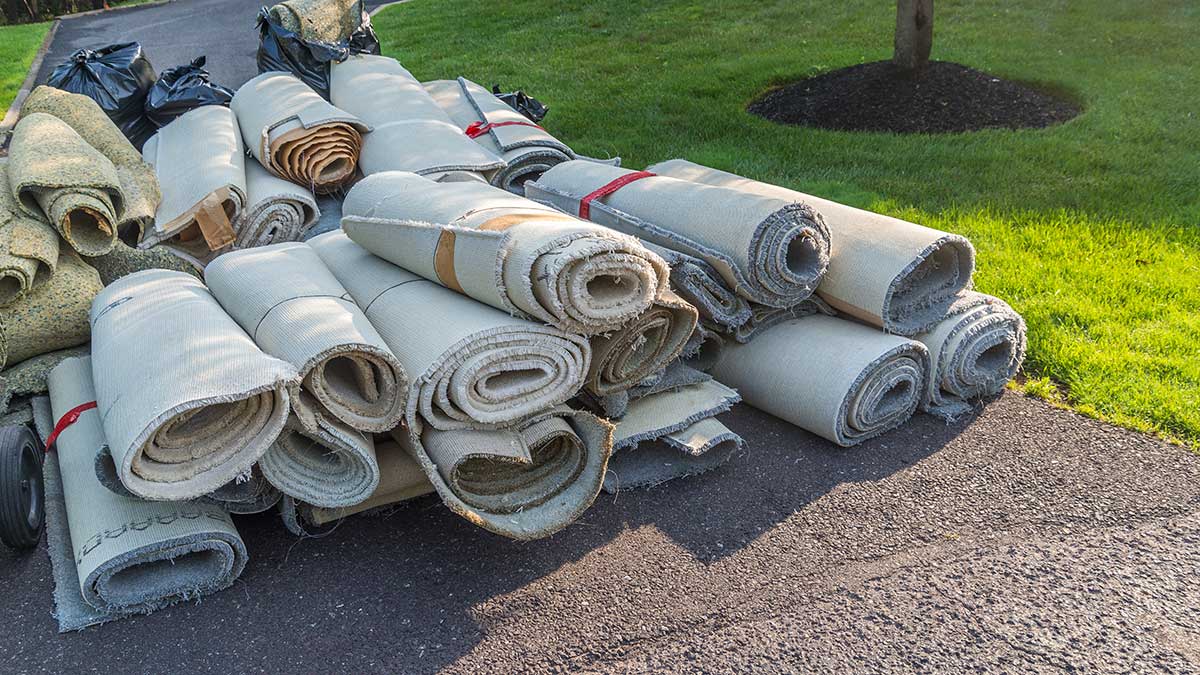
A 2,000-square-foot house holds about 700 pounds of carpet. The average residential carpet lasts 5 to 15 years, depending on fiber and traffic. When it is removed, more than 90 percent of it goes straight to landfill, a bundle of fiber, backing, latex, calcium carbonate, and whatever stain-resistance chemistry was sprayed on top that will be buried in a single dense, slow-decomposing mass.
The U.S. generates roughly 3.4 million tons of post-consumer carpet a year. The last national report from the Environmental Protection Agency put the national recycling rate at 9.2 percent, essentially flat for a decade and a half, despite a 2002 industry-government agreement that promised steady gains. One state, California, has made significant progress, hitting 38.5 percent in 2024 under a producer-funded program. New York becomes the second state to require an extended producer responsibility (EPR) program for carpet, when its law launches in July 2026.
The remaining 48 states still treat carpet as ordinary household trash.
What’s in the roll
Modern wall-to-wall carpet is a layered composite designed for foot traffic, not disassembly. The face fiber is typically nylon 6, nylon 6,6, polyester (PET), or polypropylene. Beneath that sits a primary backing of woven polypropylene, a layer of styrene-butadiene latex glue, and a secondary backing weighted with calcium carbonate filler. A separate pad — usually rebond polyurethane foam — goes between the carpet and the subfloor. Your floors are covered in plastic that sheds billions of microfibers.
It’s the composite nature of carpet that is the problem. Each material has its own downstream value, but once they are glued, tufted, and coated together, separating them is mechanical and chemical work that the disposal price of carpet does not cover. A 2022 analysis in the Journal of Cleaner Production put it starkly: the annual mass of nylon embedded in U.S. waste carpet exceeds U.S. virgin nylon production. The country buries more of the polymer every year than it makes.
The Dalton concentration
More than 80 percent of the tufted carpet manufactured in America is produced within a 100-mile radius of Dalton, Georgia, the city that calls itself the carpet capital of the world. Shaw Industries, Mohawk Industries, Engineered Floors, and J&J Industries are all headquartered there. The concentration is an engineering and supply-chain success and an environmental liability in the same place.
For decades, Dalton-area mills used per- and polyfluoroalkyl substances, or PFAS, the “forever chemicals” used as stain and water repellents. Wastewater carrying those chemicals was discharged into the Conasauga River and the local land application system, and downstream water utilities in Rome, Georgia, and elsewhere have since sued the manufacturers over drinking-water contamination.
U.S. carpet manufacturers stopped using PFAS in domestic production in 2019, according to the Green Science Policy Institute. Interface began phasing out PFAS in 2011 and completed the process in 2014; Shaw, Mohawk, Tarkett, and Engineered Floors have since followed suit.
The legacy carpet still on American floors and in American landfills — anything installed before roughly 2020 — was largely manufactured with PFAS. In 2024, the EPA designated PFOA and PFOS as hazardous substances, which changes the liability arithmetic for any future cleanup at carpet manufacturing sites or carpet-receiving landfills.
The household line item
Over a 50-year homeownership arc, a single family will buy and discard carpet four to six times. Almost none of it will be recycled.
The cost of unrecycled carpet is uneven. New residential carpet runs $2 to $9 per square foot installed, according to HomeAdvisor, with the typical replacement project costing $780 to $2,813. Carpet removal and disposal adds $0.50 to $1.50 per square foot, a cost that most homeowners pay without seeing because it is bundled into the installer’s invoice. For a 1,500-square-foot home, that is $750 to $2,250 in disposal cost alone, almost all of which pays the tipping fee at the dump. Landfilling carpet is expensive.
The replacement cycle is short by durable-goods standards. Most residential carpet is designed to last 5 to 15 years, according to the Carpet and Rug Institute. PET-based carpet — increasingly common in the budget tier — sits at the lower end and is often replaced after 5 to 10 years.
What California built
California’s Carpet Stewardship Program, authorized in 2010 and run by the Carpet America Recovery Effort (CARE) under CalRecycle oversight, is the only U.S. carpet EPR program with a multi-year track record. A producer-funded assessment of about 35 cents per square yard of carpet sold — far less than the disposal costs in other states — funds collection, transportation, and recycling subsidies that close the gap between the cost of recycling and the lower cost of landfilling.
The state’s 2024 results are the strongest the program has posted. CARE reported a 38.5 percent recycling rate, exceeding CalRecycle’s 34 percent goal for the year. The state collected 82.7 million pounds of carpet, of which 90.5 percent was recycled. Reuse also plays a part, as carpet diverted to a second use rather than ground up grew 249 percent from 2021.
New York’s law, signed in December 2024, is in some respects more aggressive. It is the first U.S. carpet EPR program to include artificial turf, requires that all carpet sold in the state contain at least 10 percent post-consumer recycled content, and bans the sale of PFAS-containing carpet, effective December 31, 2026. Producer plans are due to NYSDEC by December 31, 2025; the producer-funded collection program launches July 1, 2026.
That leaves 48 states with no carpet-specific recovery infrastructure beyond what CARE finances voluntarily and what individual municipal bulky-waste programs choose to set up.
The recycling reality
Even in California, the math is harder than the headline rate suggests. The bulk of recycled carpet today is downcycled, mechanically shredded and pelletized into engineered resins for automotive parts, construction products, and carpet backing, rather than run through a closed-loop fiber-to-fiber recycling process that would substitute for virgin nylon production. Carpet-to-carpet recycling exists at meaningful scale only for nylon 6, which can be depolymerized and repolymerized into new fiber, and only at a small number of facilities globally. Aquafil’s Slovenia and Phoenix plants supply most of the ECONYL closed-loop nylon used in commercial carpet today.
Nylon 6,6, historically dominant in U.S. residential carpet, lacks an equivalent commercial chemical-recycling pathway. PET face-fiber carpet, the fastest-growing residential carpeting, is largely incompatible with existing nylon recovery streams and most municipal PET recycling because its latex backing and calcium carbonate filler contaminate the polymer.
The real cost of unrecycled carpeting
Carpet imposes costs that show up in places other than the homeowner’s invoice:
Landfill volume. At roughly 3.1 million tons of post-consumer carpet landfilled annually, it is one of the larger durable-goods waste streams in the country. Carpet is dense and slow to break down. Most carpet installed today contains synthetic fibers with a century-plus lifespan, so the volume sent to landfills is essentially permanent.
PFAS legacy. Legacy carpet in landfills is a documented source of PFAS leachate. The Interstate Technology and Regulatory Council’s 2024 PFAS fact sheet identifies carpet, textiles, and fluoropolymer-containing consumer products as primary PFAS sources in municipal solid waste streams, with measurable migration into leachate that flows downstream to wastewater treatment plants not designed to remove PFAS.
Methane is not the main story here, but the latex is. Unlike food waste or paper, carpet itself does not generate significant methane in landfill. The climate cost sits earlier in the chain, in the virgin petrochemical production of nylon and polypropylene and the calcium carbonate mining for filler, and at the end, in the slow leaching of additives.
Virgin material extraction. Every ton of carpet not recycled is, in effect, a ton of virgin polymer and filler that requires drilling for oil, refining, and polymerization to replace it. Nylon recovery from end-of-life carpet alone could supplant U.S. virgin nylon demand if collection and chemical recycling capacity existed at scale.
What You Can Do
At home
Buy carpet that can be recycled where you live. Ask the retailer specifically whether the carpet you are considering is recoverable through any program in your state. In California, CARE’s online tool lists certified collection points; outside California, the honest answer is usually that there is no local pathway. Buying with eventual recovery in mind matters most for nylon 6 face fiber, which has the clearest closed-loop pathway.
Choose carpet with verified PFAS-free certification. All major U.S. manufacturers have phased PFAS out of new production, but verify the specific product, particularly for stain-treated lines. Look for OEKO-TEX, Cradle to Cradle, or NSF/ANSI 140 certification, which require disclosure of PFAS content. Avoid imported carpet without an equivalent disclosure.
Extend the carpet you already have. More than 60 percent of premature carpet replacement is driven by poor maintenance or installation rather than fiber failure. Professional cleaning every 12 to 18 months, prompt spot treatment, and replacing the pad rather than the carpet when the pad fails first all measurably extend useful life.
At end of life, ask the installer where the old carpet goes. Most installers default to the nearest landfill because it is the cheapest disposal option. If you live in California, the disposal fee already funds CARE’s recovery system — ask explicitly whether the installer is using a CARE-certified collector. Outside California, ask whether the installer can route to any regional carpet recycler (CARE maintains a national directory), and use the Earth911 recycling search tool to check local options. Be prepared for the answer to be no.
In your community
Ask your state legislator about carpet EPR. Ten states have considered carpet stewardship legislation. Only California and New York have enacted programs. The Product Stewardship Institute tracks model legislation that other states can adopt rather than draft from scratch.
Push municipal bulky-waste programs to separate carpet. Most municipal solid-waste contracts treat carpet as bulky waste to be landfilled with everything else. A separate carpet drop-off, even at one transfer station, is a precondition for any future recovery pathway.
For renters and tenants, ask about flooring material at lease signing. Property managers replace carpet in rental units roughly every 5-7 years, generating the largest aggregate carpet waste stream in many cities. Tenant advocacy for flooring choice and for cleaning rather than replacing where possible reduces per-unit waste meaningfully.
The post One State Recycles 38% of Its Carpet. The Other 49 Recycle 9%. appeared first on Earth911.