Reading view

7 Steps to Small Business Marketing Success – Episode 3

7 Steps to Small Business Marketing Success – Episode 3 written by John Jantsch read more at Duct Tape Marketing

Catch the Full Episode

john jantschOverview

For 20 years, small business marketing came down to one question: can Google find you? That still matters. It is no longer the whole answer. Buyers now ask ChatGPT, Perplexity, and Claude very specific questions, get a short list of names back, and trust what they read. If your business is not on that list, you are invisible at the exact moment someone is ready to buy.

In this solo episode of the Duct Tape Marketing Podcast (Step 3 of the Seven Steps of Small Business Marketing Success), John Jantsch walks through the new reality of AI search visibility and why it is a current problem, not a future one. He breaks it into three things every business has to get right: findable, credible, and retrievable. That means building real topic authority instead of stuffing keywords, turning your website into a selling tool instead of a brochure, using hub pages to own a topic, and treating your third-party presence as infrastructure rather than housekeeping.

This one is for small business owners, marketers, and consultants who suspect their website is stuck in 2019 and want a strategic, non-technical way to get found first. John also shares a simple test you can run in 60 seconds to see exactly where you stand against your competitors.

Guest Bio

John Jantsch is the founder of Duct Tape Marketing and the host of the Duct Tape Marketing Podcast. He is a marketing consultant, speaker, and author known for turning marketing strategy into a practical system small businesses can actually run. His books include Duct Tape Marketing, The Referral Engine, Duct Tape Selling, and The Ultimate Marketing Engine, the source of the Seven Steps framework featured in this series. Through Strategy First™ and the Marketing Operating System, John and his network of certified consultants help founders install strategy before tactics and build marketing that compounds over time. He works with business owners through fractional CMO engagements and shares field-tested, no-hype advice with the podcast audience each week.

Key Takeaways

  • Run the test: open an AI tool and ask the three questions your best customers ask before they hire someone like you. See if you show up, your competitors show up, or nobody does.
  • AI search is a current reality, not a future one. Many businesses are still optimized for 2019, when ranking in Google Maps or search was the whole game.
  • Three things matter now: be findable, be credible, be retrievable.
  • Findable means topic authority you can prove with case studies, reviews, and real results, not a page built around three or four keywords.
  • Credible means a homepage that makes the right buyer feel understood in seconds. Most founders have not read their own homepage in years.
  • Retrievable means AI can actually read and describe you, which depends on real content, structured data, reviews, citations, and mentions across the web.
  • Your website should be a selling tool, not a brochure. A brochure describes. A selling tool converts.
  • Lead with a core message above the fold: who you serve and how you solve their problem better than anyone, not a description of your industry.
  • Hub pages are your topic authority unit. Build one deep, organized guide on a core topic, linked to subtopic posts, and both AI and search engines reward it.
  • Treat directories, reviews, and third-party mentions as infrastructure you build over time, not one-time housekeeping.

Great Moments

  • [00:43] The 60-second test: ask an AI tool the three questions your customers ask, then describe what you find.
  • [01:16] Why this is a current problem and a real opportunity for founders who act now.
  • [03:39] The framework: findable, credible, and retrievable, and why it is strategic rather than technical.
  • [05:42] Credible: does your site confirm the visitor is in the right place?
  • [06:04] When did you last actually read your homepage?
  • [08:25] Mining your reviews for the real problems you solve and the fears buyers carry.
  • [10:45] Your core message above the fold and naming your ideal client.
  • [12:34] Hub pages explained, using the kitchen remodel example.
  • [14:48] Organizing reviews around topics as real proof only you can offer.
  • [17:05] Run the test, screenshot your baseline, and where to go next.

Memorable Quotes

  • “We are not reacting to the new realities of AI or Google. We are reacting to how people choose to buy today.”
  • “A brochure describes. A selling tool converts.”
  • “When is the last time you actually read your homepage?”
  • “This is strategic. It is not technical. A lot of SEO folks love technical because technical is hard to confuse people with.”
  • “A lot of people look at directories as housekeeping. Today it is more like infrastructure.”
Duct Tape Transcript

John Jantsch (00:03.01)

Hello and welcome to another episode of the Duct Tape Marketing Podcast. This is John Jantsch and no guest today. Again, some of you that have been following along may recall I am doing the seven steps to small business marketing success. This is actually episode number three, step number three. So you can check out in the show notes the past sessions as well if you're just trying to catch up. But today I want to talk about this re new reality. our businesses have

possibly become invisible to AI search. In fact, I want you to do this test.

John Jantsch (00:43.394)

Go to Chat CPT Perplexity Claude, take your pick, right? Type in three questions that your best customers look for or ask when they are looking for a business like yours. Not anything about your particular business, but the the problems they're trying to solve, the the issues that they have. something that they would ask before hiring somebody you. Now, we you can stop the episode right now and do that. I'll wait. but.

John Jantsch (01:16.44)

Describe what mu what you find. think about what you find. Is it nothing? Is it you? are you dominating? That would be awesome, of course. that's a new reality. and this isn't a future problem. This isn't coming. this is a current one. Now, a lot of local businesses are still showing up in in Google and Google Maps, and that's still important, but it's it's fading a bit, right? people, I don't know if it's right or not, but people go today and when they see those like.

Best remodeling contractor in SoSo City, and AI tells them three companies, they believe it. because they've ty typically typed in who do kitchens in older home homes who blah, blah, blah, blah. So it's a very specific type of search now. And the results that come up there are the ones that are winning. so are you coming up there or are your competitors coming up there? I mean, this is this is how research is being done today. and and I think

A lot of small businesses are still optimized for, I don't know, 2019. when all you needed to do, boy, if you showed up on that Google Maps or you showed up in in Google search, then that, you know, that was really all it took. I think this is an opportunity. I mean, I think the founders who act now still absolutely have the the opportunity. It's kind of like when we first went online, we first started blogging, all those kinds of things.

The opportunity now is to actually be first in AI search. So what's changed? for 20 years, as I said, you know, Google, can Google find you? I mean, in a lot of ways, we got lazy because that was the only question you really had to answer. it it still applies. It's just not the whole answer anymore. so what we have to do or or we have to think in terms of is not just

search results, keyword phrases, all the things that were thrown around by SEO folks so much. We have to be findable, we have to be credible, and we have to be retrievable. Those are three things I really want to talk about. And and it's not I I'm not here to talk about how to hack SEO or how to hack, you know, GEO or whatever new term they're gonna come up w with, you know, for for these various engines. It's really just more a matter of how

John Jantsch (03:39.276)

We have to get our story out the same way we always have. It's just sometimes you have to adapt to the new realities of of the buyer. I mean, and I think that's something that doesn't get said enough, is that we're not reacting to the new realities of AI or of Google. We're reacting to how people choose to buy today. And that's really if you keep that in mind, and you keep in mind what they have available to them, that's what we need to really respond to and not just.

Some new platform or some new tool or some new trend or some new hype. All right. So findable. there really is traditional search, social search, and now AI mediated. I don't know what we would call it, search. Those are the three kinds of search that we have to to respond to today. And again, most people have really just thought about one of those. So topic authority.

Think about that. It used to be keywords, right? We we wanted to have a page that that we optimized for you know three or four keywords that people would search and that the search engines would would actually be keyed on. and today it's really more about topic authority, a deep, rich topic authority.

That you can actually prove that you were an expert in, not that you can write about, but that you can actually prove you have the results, you have the case studies, you have the reviews, you have all the things that would human, real human beings would be saying about your business.

This is strategic. It's not technical. And I think a lot of times that's what we've done. We've kind of defaulted to the technical aspects. And frankly, a lot of SEO folks love that because technical is hard. Technical is easy to confuse. strategic is not so much, frankly. And I think that that's the the the part, while it's a mindset shift, I think that's the part that's the real opportunity for folks. So credible.

John Jantsch (05:42.23)

Is the second part. So findable, topic authority, credible. Does your site confirm that they're in the right place? And a lot of times again, I I could talk to I'm blue in the face about websites and and the brochure aspect of them as opposed to the practical aspect of them, but

John Jantsch (06:04.588)

Here's a here's a question I love to ask people. When's the last time you read actually read your homepage? that's what I find is quite often the case. We we'll start working for somebody and we'll have lots of suggestions about ways to improve their homepage. And they actually are like, I didn't even realize we said that, or we don't even offer that service anymore. so you most founders haven't done it in years. And I and I think that quite often we run across sites that reflect the reality of a business three years ago.

I I actually ran into somebody said they haven't updated, they haven't changed one thing on their website since 2019. We are in 2026 today. you know, that that I don't even want to start with how much has changed since 2019. but but clearly that site is not going to perform. and and the thing is, a lot of people get very focused on design. Design's really not going to solve the problem. Yes, the site has to look like somebody.

thinks it's going to look, or that they're used to how to navigate, you know, how it looks. But it's really more about deep proof of real work and and a connection so that when the buyer or potential buyer shows up, says, you get me, or I I feel heard, or you understand the problems that I'm trying to solve. All right. So then the last one is retrievable. So we've got findable, credible,

And retrievable. So this is probably kind of a new one for many people. AI builds its answers from whatever is publicly available on a website, like your website content, structured data, third-party presence, reviews, citations, right? And so all of those things have to be there if if your content is

Very thin, if it is missing structured data, if it's if there's weak external presence, meaning that that people aren't linking back to it, people aren't talking about it. AI can can either find you or really can't describe you with accuracy. And that's why we really want to start talking about, you know, real FAQs. Go read every one of those reviews that you have gotten. plug them into an AI tool and ask that to to analyze and summarize the reviews that you've gotten.

John Jantsch (08:25.382)

many times you that that will be the the absolute gold mine of the problems that you really solve. And then the flip side of that, the fears that a client or your your clients at least were really worried about in in in engaging a company like yours or or your competitors. And I think that that's where we have to start thinking about real content.

That addresses those things because that's what people are searching. They're going out there and saying, I want to find a contractor that won't destroy my home, that won't let my dog out. I mean, they're asking very specific things like that. And that's what AI is trying to surface. And all it does is goes out there and and reads a whole bunch of stuff. and and in fact, we're seeing that businesses that that write that real stuff, the voice of customer, really putting their reviews

Out there as like, here's the problems we solve. Maybe didn't even have a great search presence before because search was dominated by companies that knew how to hack the algorithm. But AI doesn't care about the what Google used to care about. it really cares about retrieving the data to very specific searches that people are making today. So, all right, here are three things that you need to build.

Your website has to be a selling tool, not a brochure. Hub pages, something I've talked about for many years. And the beauty is they become more important than ever. So I'm going to review review that. And then the last one is third party presence. And that's a part that many business owners, I won't say they neglect, but it's just the hard part in a lot of cases. It's the part that you don't control, that you don't own. And so you have to be very intentional about making it happen.

All right. So the website, a brochure describes a selling tool converts. That's the difference, right? And so there are really four things that I think have to be there. They are a priority. there is an order to them. your core message above the fold. Here's who we serve, here's how we solve their problem better than anyone ever thought about. Not here's what we do. your ideal client needs to be named. It's like we serve and we are the best.

John Jantsch (10:45.848)

Better than anyone at serving XYZ. Very specific. Identify segments, whatever it is, identify them so that when somebody arrives there, they're like, Okay, you you work with people like me.

Heart stop on what's next, right? Not a menu, not contact us. One frictionless action for the person who's ready. Schedule a consultation. Download this free assessment. get a quote. don't have a dozen ways that people can think about contacting you. Have very active, not passive, very active. Here is why you should contact us. Here's what you'll get when you schedule. Here is the the

you know, tool that you can use to download to solve your problem. Have a very specific call to action.

Probably what I see more than anything is that first one. The core message is is either buried, generic, or missing entirely. I can't tell you how many sites I still run across that above the fold, first thing somebody reads is a description of what your profession is, what your industry is. We are accountants in XYZ City. and that was a old SEO holdover. but what somebody wants to know is who you serve.

How you solve their problem, how you how you solve their problem like nobody else ever dreamed of doing. That's what they need to understand first. All right, hub pages. So this is, I mentioned already, topic authority. This is your topic authority unit, is a hub page. And so the idea is if you think about a book, you've got a large body of work that is organized around chapters. And that's really what a hub page is. So if you have a topic,

John Jantsch (12:34.478)

Home remodeling kitchens, for example. that's a topic that somebody who wants to remodel a kitchen is going out there and looking for information about. So if you had the page that says everything you need to know about remodeling, but again, that's gonna be broken up into getting ready to remodel. Should you remodel?

Design considerations, appliances, pre-construction, construction, after finishes. I mean, a whole category of subtopics. And so the idea behind a hub page is somebody arrives at that page, maybe they just want to know about wallpaper today. but they are remodeling a kitchen. So they find that page, and then there's a subtopic on you know wall finishes. And so they jump over to that, but then they jump back to the hub page.

So, if when they want to talk about appliances or kitchen countertops, for example. And so this is like the entire guide, the ultimate guide to remodeling your kitchen, has all these subtopics that are essentially blog posts that you link out to. So this, but this page becomes the collection or the structure of all of that topic. And so what that certainly tells the AIs, sells the search engines has for years.

That this is an authoritative page on this topic that then has may it might have 10, 20, 30,000 words ultimately collected in a number of blog posts that are on subtopics. So it's it's probably more about it's not the it's not the content. Well, the content's important, but a huge part of it is the structure of the content. this is like a jumping off point for anybody who wants to know about that topic. And the AI tools as well as the search engines absolutely love that.

And the beauty from a practical small business owner standpoint is that's something you can structure, plan, take a year to build. It's like writing a book, as I said. it just has all of the topics organized on this one page. and you could start having case studies, you can start having look through all of your reviews, and somebody said about how clean you are, somebody said.

John Jantsch (14:48.154)

about your pricing. somebody said about your design. So you you all of a sudden can start organizing your reviews even around some of these topics. And that's that's what the AI tools want to see. That's what they they want to see, topic authority, topic expertise with real proof, not just 700 words that AI spun up, real proof that only you, you're the only ones who can actually talk about what that client got as a result. and so hub pages are

to me, really your secret weapon to dominate. We've done it for we've done them for many, many clients. And they rank have always ranked in SEO and they are always ranking now in AI searches because of the nature the the the real focus nature on a core topic. third party so AI doesn't just use your website.

I mean, really the search engines never did too. That's why p you hear people talk about backlinks and reviews and and getting other people in social media to talk about your products and services. That's always been important. So things like your Google Business profile, industry directories, reviews, mentions, citations across the web, those are all things that you do actually have a way to actively participate in. You don't control them necessarily, people write what they

want to write or going to write, say in reviews and mentions. But you do have the ability to optimize, to, to make sure that your information is correct in those directories. That you are your you you if you do searches in AI, you'll see there are certain directories and certain websites like Reddit and things that that some of the of of the AI tools actually rely on pretty heavily. And and those will change, evolve. They all, you know, they constantly are.

But you get a sense of some places maybe that you're not mentioned. Say how's, you know, again, going back to where I'm remodeling contractor, is a source that a lot of the AI tools depend on. It's an authoritative source. are you playing there? that that just gives you some some ideas on some third-party places. in a lot of ways, think about it as I think we've always thought about it as housekeeping.

John Jantsch (17:05.848)

To to be in those directories, to make sure that they were correct, that you didn't have the wrong phone number. A lot of people look at that as housekeeping. And I think today, in today's environment, it's it's more infrastructure. you know, it's something that you actually have to build, it's behind the scenes, it you know, it's not gonna pay off today. Long term thing that you need to to build as part of the infrastructure of your business. So if you didn't run that test, pause now and run that test.

Screenshot the baseline. Are your your competitors showing up at when you do a search that your customers were are likely asking? are you showing up? it just kind of gives you the picture of, you know, if you've ignored this, it gives you the picture of what you have to do. so that's really it today. I I will tell you that if if some of the things I talked about today, again, go get the free ebook. it's dtm.

world slash seven steps. I misspoke. We I think we're charging $4.99 for it tremendous amount of value. It's more of a workbook than an ebook. it'll give you lots of things to think about, lots of things to work on as well. So it's DTM.world seven steps. And if you just want to skip all of that and find out how working with us and and having us install strategy first in your business and then build a marketing operating system.

with you that you own that that can address the each of these seven steps, that is just duct tapemarketing.com slash consultation. So thanks for tuning in. next episode, episode step number five of seven is coming up. So thanks for tuning in. Hopefully we'll run into you one of these days out there on the road.

Sign up to receive email updates

Enter your name and email address below and I'll send you periodic updates about the podcast.

powered by

  •  

When Referrals Stop, Do This Before Touching a Single Marketing Tactic

When Referrals Stop, Do This Before Touching a Single Marketing Tactic written by Shawna Salinger read more at Duct Tape Marketing

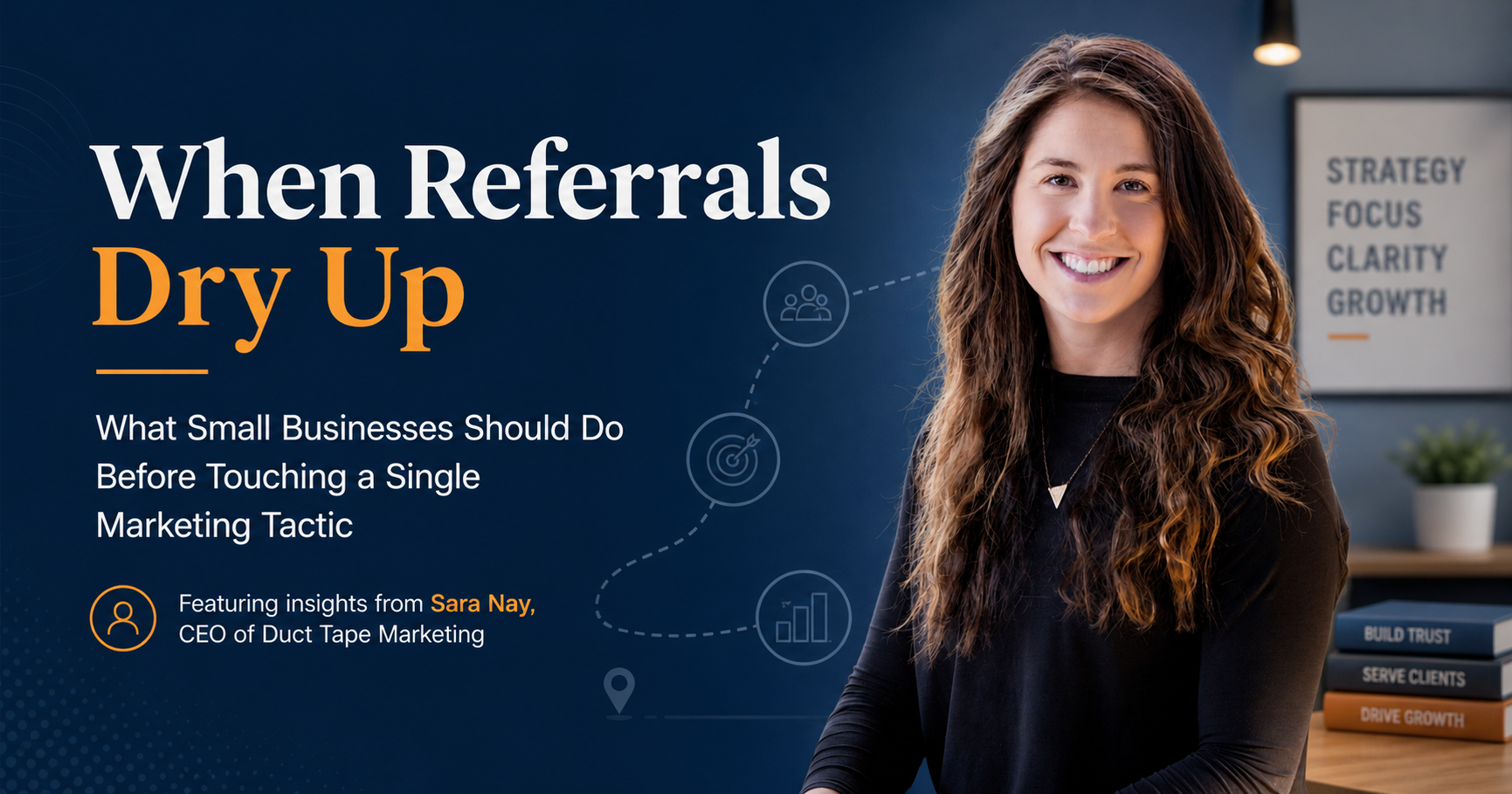
When Referrals Dry Up: What Small Businesses Should Do Before Touching a Single Marketing Tactic

Featuring insights from Sara Nay, CEO of Duct Tape Marketing

It starts with a sick feeling.

You built your business on referrals. Good work led to good word of mouth and for years, that was enough. Then you look up and realise it has been months since a new one came in. When referrals dry up for a small business, there is often nothing else in place. No ads. No content strategy. No real pipeline. Just the hope the phone will ring.

Sara Nay, CEO of Duct Tape Marketing, knows this scenario well. She sees it constantly across the small businesses she works with. And she has a direct message for anyone in that position: the answer is not to start running ads next week.

The answer is to build a strategy first.

Sara Nay’s segment begins at 13:04. Full episode on Paul Green’s MSP Marketing Edge.

Why referrals dry up and what most small businesses do wrong next

Growing through referrals is actually a good sign. It means clients like you, trust your work, and talk about you. Sara is the first to say so.

“It’s great that you’ve been able to grow based on referrals,” she says. “That shows that you provide a good service and clients are happy. That’s checkbox one.”

But referrals are not a marketing strategy. They are a single, uncontrollable channel. When they slow down, businesses with nothing else in place have nothing to fall back on.

The instinct when referrals dry up is to grab the nearest tactic. Run some paid ads. Start posting on LinkedIn. Hire someone to do SEO. Sara says that instinct is understandable but almost always wrong.

“Instead of just going okay, we’re now going to do paid ads,” she explains, “it’s taking a step back and saying: who are our clients? Where do they hang out online? How do they make buying decisions? What keeps them up at night?”

Channel selection follows strategy. It does not precede it.

The two things you need before you pick any channel

Sara is clear about what has to come before any channel decision. Two things.

First, a real picture of your ideal client. Not just their job title. Where do they spend time online? How do they make buying decisions? What keeps them up at night? What problems are they trying to solve?

Second, messaging that gives people a reason to care, not just a list of what you sell.

“You really need to understand those two things first before you can decide what channel or how you’re going to approach the channel moving forward,” Sara says.

This is the foundation of what Duct Tape Marketing calls Strategy First. It is a structured 30-day process that produces a complete marketing strategy before any tactics start. Duct Tape Marketing has built their client work on it for over 30 years, and Sara argues it is more important now than ever. The current positioning at DTM says it plainly: strategy before technology.

Technology, AI tools, platforms, none of them become valuable until a clear strategic direction is in place. The tools should follow the strategy, not the other way around.

Map the customer journey before you map the tactics

Once you know who you are serving and what to say to them, the next step is understanding how people move through a relationship with your business.

Duct Tape Marketing uses the Marketing Hourglass. It is a customer journey model John Jantsch first laid out in his book Duct Tape Marketing, and Sara still uses it with every client. The seven stages are Know, Like, Trust, Try, Buy, Repeat, and Refer.

Think of it as a complete loop rather than a one-way funnel. The goal is not just to get someone in at the top. It is to move them through every stage and bring them back again.

Sara explains why this matters in practice: “You can sit down and analyze what are we doing in each of these stages. Where are gaps? Where are opportunities to improve? And if you can really nail moving someone through each of those stages as they interact with your business, they’re going to become repeat customers and then they’re also going to just naturally refer you.”

A well-mapped customer journey does not just improve retention. It restarts referral flow naturally. When referrals dry up for a small business, this audit is often where the answer lives.

Tactics without tracking are just busy work

Sara sees a pattern constantly. A new client walks in running five or six marketing activities. When she asks what is working, they have no idea. They never set a goal before they started.

“It’s not enough just to create your list of tactics at the end of strategy,” she says. “You need to say, if we’re going to do these things for the next 90 days, what’s the definition of success and how are we going to track that? Because that information is going to help guide if you should keep doing things or if you should shift.”

Set a goal for each tactic before you start, then track it over 90 days. Hitting the goal, keep it. Not hitting it, stop or adjust. That is a system. Running activity without measurement is just spending time.

How to stand out when everything feels like noise

The marketing environment right now is loud. AI-generated cold outreach fills inboxes and LinkedIn messages. New platforms launch weekly. Every vendor promises a lead generation system.

Sara says she barely checks her LinkedIn messages anymore because so much of what arrives is automated pitch after pitch.

“It is harder to get people’s attention and it is harder to stand out,” she says. “But if you approach marketing with a more authentic human feel to it and not just trying to scale with AI, there is opportunity for people to see your authentic selves.”

Her take on AI is precise. Use it, but put a human on both ends. Lead with your own insight, stories, and direction. Let AI help shape and scale that into content. Then edit and refine the output yourself.

“Human on the front end, AI in the middle, human on the back end. That’s where it can be powerful,” she says. “It helps elevate you and your skill set and not replace your creativity.”

Low-budget marketing that actually works

If you have a few hundred dollars a month and no marketing infrastructure, Sara has a clear point of view on where to start.

  • Content repurposing. Record short videos on specific topics your audience needs to know about. Use those videos as the source material for social clips, email newsletters, and blog posts. AI makes the repurposing faster, but the original thinking has to come from you.
  • Direct personal outreach. Build a list of people in your ideal target market and reach out to them as a human. Call them. Send a personal message. When every inbox is full of automated pitches, a real call or personal message stands out immediately.
  • Podcast guesting. Getting onto someone else’s podcast costs nothing but your time. It puts you in front of their audience and builds authority in a format people actually trust.

None of these require a big budget. They require clarity about who you are talking to and the discipline to show up consistently. That clarity, as Sara would say, comes from strategy first.

Frequently asked questions

What should I do first when referrals dry up?

Do not start with a channel. Start with your ideal client profile. Define who they are, where they spend time, how they make decisions, and what message will resonate with them. Only then does channel selection make sense. Sara Nay of Duct Tape Marketing also recommends auditing your customer journey using the Marketing Hourglass to find where existing client relationships are breaking down.

Should I run paid ads when referrals stop?

Not until you have a strategy foundation in place. Paid ads without a clear ideal client profile and resonant messaging will waste budget. Build those first, then decide whether paid ads are the right channel for where your clients actually spend time.

How do I get referrals to come back naturally?

Map your customer journey using the Marketing Hourglass. Look at what you are doing at the Know, Like, Trust, Try, Buy, Repeat, and Refer stages. Gaps in the Repeat and Refer stages often explain why referrals have dried up. Fixing those gaps creates the conditions for referrals to restart without actively asking for them.

What is the Marketing Hourglass?

The Marketing Hourglass is a customer journey model created by John Jantsch of Duct Tape Marketing. It maps seven stages: Know, Like, Trust, Try, Buy, Repeat, and Refer. Unlike a traditional funnel, it continues past the first sale into retention and referral. Duct Tape Marketing uses it as an audit tool to identify gaps and set marketing priorities.

How should small businesses use AI in their marketing?

Sara Nay’s framework: human on the front end, AI in the middle, human on the back end. Bring your own insight, stories, and direction. Let AI help shape and scale that into content. Then edit and refine the output. The goal is to use AI to elevate your thinking, not replace it.

Ready to build your marketing strategy before your next tactic?

Duct Tape Marketing works with small businesses to create a complete marketing strategy through a structured 30-day engagement called Strategy First. You leave with a full plan you can run with internally or have us execute as your fractional CMO.

Visit ducttapemarketing.com/strategy-first or connect with Sara Nay on LinkedIn.


  •  

Marketing Strategy for Businesses That Have Outgrown More Tactics

Marketing Strategy for Businesses That Have Outgrown More Tactics written by John Jantsch read more at Duct Tape Marketing


Marketing Strategy for Small Business: Why Clarity Beats More Tactics Every Time

Most small businesses aren’t short on marketing activity. They’re short on the clarity that would let them do less of it. After working with hundreds of small businesses on their marketing strategy over 30 years, I’ve seen the same pattern: scattered tactics, inconsistent messaging, and a team that’s busy but not aligned. The problem isn’t effort. It’s the absence of a strategy.

You Don’t Have a Marketing Problem. You Have a Clarity Problem.

Most business owners I know are working harder than ever. More channels. More platforms. New AI tools to figure out every other week. The promise of AI, by the way, was that it was supposed to make all this easier. Ask most owners how that’s going, and they’ll tell you they’re working harder just keeping up.

That’s not a tools problem. That’s a strategy problem.

When you don’t have a clear strategy, every new platform looks like an opportunity and every new tactic looks like the fix. You say yes to everything because you don’t have a filter for knowing what to say no to. Teams get busy. Vendors get busy. Nobody is coordinating. And the messaging starts to drift in five different directions at once.

I’ve seen this at every level. Businesses with five people doing marketing. Businesses with five outside vendors all working on the same brand. All moving. None of it quite connecting.

The fix isn’t a better tactic. It’s the clarity to know what you’re actually trying to do, who you’re doing it for, and why someone should choose you.

What a Small Business Marketing Strategy Actually Looks Like

Here’s where a lot of people get tripped up. They hear “marketing strategy for small business” and assume it means more planning, more documents, more time before anything happens. That’s not what I’m talking about.

Clarity starts with a single honest question: do you know exactly who your ideal client is, and do you know why they’d choose you over every other option they have?

I worked with a business owner a couple of years ago. Solid seven-year-old business, good local reputation, decent revenue. But the marketing never quite landed. He’d tried ads. Tried SEO. Had a consultant in for a while. Still felt like running in place.

When we sat down, the problem was obvious. He had tactics. What he didn’t have was a clear picture of who he was actually for. His messaging was written to appeal to everyone, which meant it resonated with nobody.

We got specific about his ideal client: who gets the most out of this, values the work, pays well, comes back, and sends referrals? Who is specifically not that person? Once he could answer those questions clearly, everything else simplified fast. The messaging changed. The channels narrowed. The conversations started to feel different.

That’s what strategy does. It’s not about doing more. It’s about knowing what matters, and having the confidence to ignore the rest. You can see this play out in our client case studies.

The Part That Doesn’t Get Talked About Enough: Team Alignment

Even when a business owner has clarity, the team often doesn’t. And that’s where a lot of good strategy dies.

I walk into businesses regularly where the founder has a clear sense of direction but the team is working from their own assumptions. The vendors are doing the same. Nobody is comparing notes. The result is inconsistent messaging, wasted effort, and a growing frustration that marketing “just isn’t working.”

That’s not a brand problem. That’s an alignment problem.

And alignment doesn’t come from circulating a PDF after the fact. It comes from building the strategy together.

When the whole team is in the room for the process of defining the ideal client, sharpening the message, and setting priorities, they own it. They understand why decisions were made. They can defend those decisions to a vendor or a prospect. That shared language is worth more than the document itself.

How to Build That Foundation Faster Than You Think

In the past, the kind of strategy work I’m describing took 30 to 45 days. And it was worth it. Clients came out the other side with more clarity than they’d had in years. Relief was usually the word that came up most.

But I kept asking myself whether we could deliver the same depth faster.

Turns out, we can. With the AI research tools we’ve gotten good at, we can do the front-end analysis of your industry, your existing marketing, and the competitive landscape before we ever show up. Which means the day itself is all signal, no setup.

We call it Strategy First in a Day. One focused day with your key team in the room. We build the ideal client profile, sharpen the positioning, tighten the messaging, and set the priorities for the next 90 days. Same outputs as the full engagement. One day instead of 45.

It works especially well for businesses in the one to 25 million dollar range: ones that have proven they can get clients but feel the growing complexity that comes with real traction. The ad hoc approach got you here. It won’t get you to the next level.

Questions I Get Asked About This

Is this only for businesses that are struggling with marketing?

Not at all. Some of the businesses that benefit most are growing well but feel the friction. Revenue is up, but the messaging is inconsistent. The team keeps restarting conversations that should already have answers. Strategy First in a Day works best when there’s real traction and you’re ready to make the marketing match where the business actually is.

What does my team walk away with at the end of the day?

A complete strategic foundation: your ideal client profile, your core message, your positioning relative to the competition, and a 90-day priority roadmap. Some businesses hand that to their internal team and run with it. Others move into ongoing fractional marketing leadership. Either way, the work is done in the room, not assigned as homework.

How is this different from a workshop or a consulting engagement?

Workshops give you frameworks. Consulting engagements give you recommendations. Strategy First in a Day gives you the actual deliverables, built with your team, that day. The distinction matters. When everyone in the room builds the strategy together, they understand it, they own it, and they can actually use it. That’s different from being handed someone else’s conclusions.

The Bottom Line

Growth that feels messy usually isn’t a marketing execution problem. It’s a clarity problem. And clarity isn’t something you stumble into by adding more tactics.

It starts with knowing who you’re for, why they’d choose you, and what matters most right now. Everything else follows from that.

If you want to see what building that foundation looks like in a single focused day with your whole team, head to dtm.world/oneday. That’s where we’ve laid out exactly how Strategy First in a Day works, who it’s built for, and what you walk away with.

  •  

7 Steps to Small Business Marketing Success – Episode 4

7 Steps to Small Business Marketing Success – Episode 4 written by John Jantsch read more at Duct Tape Marketing

Catch the Full Episode

john jantsch (1)Overview

Every founder I talk to is excited about AI content tools. Most of them should be a little nervous. The market is being flooded with content that reads fine and means nothing, and when you add to that pile, you do not rise above it. You disappear into it. In this solo episode of the Duct Tape Marketing Podcast, John Jantsch makes the case that more content is the fastest way to become less visible, and that the fix is not volume. It is content built to do a specific job.

The episode lays out a practical content strategy for small business owners who are tired of publishing for the sake of publishing. John walks through three principles: picking content pillars anchored on your ideal client’s problems, organizing everything under hub pages that signal authority to both buyers and AI, and repurposing authoritative founder content rather than mass-producing generic posts. He also names the ingredient most businesses skip entirely: a point of view.

This one is for small business owners, marketers, agencies, and consultants who want their content to compound over years instead of evaporating in a week. If you have ever written a blog post because the topic seemed interesting that week, this episode will change how you plan everything that comes next.

Guest Bio

John Jantsch is the founder of Duct Tape Marketing and the host of the Duct Tape Marketing Podcast. He is a marketing consultant, speaker, and author known for turning marketing strategy into a practical system small businesses can actually run. His books include Duct Tape Marketing, The Referral Engine, Duct Tape Selling, and The Ultimate Marketing Engine, the source of the 7 Steps framework featured in this series. Through Strategy First™ and the Marketing Operating System, John and his network of certified consultants help founders install strategy before tactics and build marketing that compounds over time. He works with business owners through fractional CMO engagements and shares field-tested, no-hype advice with the podcast audience each week.

Key Takeaways

  • More content is not the answer. AI has flooded the market with readable but forgettable material, and adding to it buries your brand instead of building it.
  • Content should do a job. If a piece cannot tie back to a clear pillar, you should not be producing it.
  • Pick three content pillars at most, anchored on your ideal client’s problems or buyer segments. Three gives you range without dilution.
  • Use the three-year test: if you would be bored with a topic in six months, it is a theme, not a pillar. Pillars are what you intend to own years from now.
  • Organize content under hub pages. One page per pillar where your proof, case studies, and expertise live together, so both search engines and buyers see real authority.
  • Hub pages serve your sales team too. They give you a credible place to send prospects who need the full picture on a topic.
  • Repurpose authoritative content. An hour of focused founder conversation can become 50 to 100 pieces of content in the founder’s real voice.
  • This is the best use of AI for content. Not to write the generic stuff, but to stretch the good stuff once you have captured it.
  • The missing ingredient is a point of view. AI returns the opinion of the collective mass. It cannot give you the thing only you believe.
  • A point of view does not have to be controversial. It just has to be different, and most founders already hold one they are simply not surfacing.

Great Moments

  • [00:01] John kicks off episode four of the seven-part solo series and frames the core idea: why more content is making you less visible.
  • [02:26] The first principle, picking pillars, and why your content needs to compound around your ideal client’s problems.
  • [04:49] The three-year test for separating a real pillar from a passing theme, plus how hub pages organize it all.
  • [07:12] The repurposing principle, including how an hour with a founder becomes 50 to 100 pieces of authoritative content.
  • [09:24] The missing ingredient most businesses skip: developing a genuine point of view in a sea of AI sameness.
  • [11:44] Your next steps and where to get the full Seven Steps ebook.

Memorable Quotes

  • “Adding to that pile doesn’t help you. It buries you.”
  • “If you’re bored with a topic in six months, it’s not a pillar. It’s a theme.”
  • “Every piece of content should point to one of those pillars. If you can’t tie it to one, you shouldn’t be doing it.”
  • “AI doesn’t develop points of view. It develops the point of view of the collective mass.”
  • “It doesn’t have to be controversial. It just has to be different.”

Resources

  • The Seven Steps to Small Business Marketing Success ebook (under five dollars): dtm.world/sevensteps
  • Talk to a Duct Tape Marketing advisor: ducttapemarketing.com/consultation
Duct Tape Transcript

John Jantsch (00:01.838)

Hello and welcome to another episode of the Duct Tape Marketing Podcast. This is John Jantsch, and again, another solo show. No guest today. I'm doing the seven steps to small business marketing success. So if you haven't caught the past, I think I'm on episode four here. If you haven't caught the past three, go check them out at Duct Tape Marketing. but this is a series of seven podcasts. This is number four. Why more content is making you less visible? How's that for a topic?

So here's the AI content trap. most founders I talk to are really excited about AI content tools and frankly they should be nervous. and that is because the market is being flooded with generic, readable but forgettable content like crazy. and I think adding that pile doesn't help you, it kind of buries you. So

He here's the problem, and this and this has been the problem all along. Content or I'm AI didn't necessarily change this, it just made it worse in a lot of ways. most content that small business owners have produced, somebody convinced them to write a blog post every week. but it it's just kind of the idea of the week. It has no spine, there's no thought behind it. maybe the topic seemed interesting that week, but two years down the road later, it actually serves zero purpose. So

The thing about AI is it makes it easier to publish a lot of content, but that doesn't really fix this problem. It just amplifies the problem that the content was not that valuable or useful anyway. and I think that customers, prospects are definitely going to, they already are, recognizing AI content and and ignoring it, tuning it out completely. and and in s to some degree, that's actually hurting.

the brand when they see that that's what you're producing, that's all you're producing. So there are three principles when it comes to really content. less is more content, or at least the right content, I guess is probably a better way. I'm not necessarily saying you don't need content. I'm saying you need content to do a job and a very specific job. and that requires a couple principles. number one is picking pillars. So you want your content to actually

John Jantsch (02:26.158)

compound. and you want it to be around some things that make total sense to you. If you if you're an architect and you do residential work, you do hospitality work and you do commercial work, you want to actually start thinking in terms of what would what would be pillars of kind those three types of work that you do, those three types of use cases, those three types of probably buyers.

what would be the pillars that would actually drive those folks or or at least let those folks to understand you better? and and start developing topics around a collection of pillars as opposed to as opposed to just, hey, I'll write about this this week because it seems interesting, or because I can get a lot of engagement in social media over it because it's a hot topic. I I think.

again, there may be a case for that if you've got lots and lots of extra time, but you really want your content to do a job. So you want to pick three pillars at most, that that are really going to be anchored on your ideal client, or at least I should say your ideal client's problems. and every single one, every single piece of content should point to one of those. If you can't make it, if you can't tie it or have an angle that ties it to one of those, you shouldn't be doing it.

This is a discipline, quite frankly, because especially a lot of organizations that just tell junior marketers to create content without giving them those pillars. That's one of the best things you can do. If you have people in your organization producing content or an agency producing content for you, you should develop strategically as the founder, as the owner, you should develop what those three pillars are. and and again, that's a discipline that maybe starts with the founder sometimes, because

Sometimes the founder wants to write about the cool topic or the thing that hit them that that that week. if you're bored with a topic, you can use this as a three-year test, I'll call this. If you're bored with a topic in six months, it's not a pillar. It's a theme. Pillars are really what you're still the authority on, or what you're driving to be the authority on two, three, four years from now. Now you won't always get that right.

John Jantsch (04:49.748)

but it's sure it certainly should make sense to say, yeah, long term, this is going to be important for my ideal client and the problems they're trying to solve. And I think I think three is the sweet spot because it allows you to have a lot of range. it allows you to be seen as an authority, but it's a it doesn't get diluted. I mean, it forces you to make decisions about your content. All right, so that's the starting point, having that frame, those three pillars. next is.

And I've I've talked, I've written about this for years, but I talked about it in the last episode as well. You then want to organize that content under hub pages. so every one of your pillars gets a page that you're going to then start building more and more content on. So as you as you pick a theme or you pick a topic that goes or a subtopic that goes under one of those pillars, you start organizing them as pages. hub pages

Have so many uses. First off, it's the way to organize your content so that the search engines, AI understands that this is a broad topic, that you have with lots of authority, that there's lots of information here, that your expertise, that you have actually put your client case studies and real proof into this entire topic, which has a ton of value just from being foundable. Foundable? Findable. There we go.

but it also don't forget, human beings want to consume this content as well. Think about your sales team if you have one. These hub pages, excuse me, these hub pages really allow your sales team to be able to say, if you are, you know, thinking about buying a business and you need to understand what the tax implications of buying that business are, here's the entire topic around that that we have written on. So it allows

folks to to actually allows you to share and and you know have really a useful tool or or home that you can send people to that that demonstrates that you're a real expert. And here's the real beauty of and this is really kind of third third principle, which is repurposing. Once you have these pillars, once you build these pages,

John Jantsch (07:12.182)

Or once you start to build these hub pages, quite frankly, you don't have to wait till they're done. Once you start producing content that is focused and and and has a purpose around these pillars, then you can actually start leveraging every piece of that. in fact, we we actually what we will often do is we will work with a founder and we will just sit with them for an hour, maybe a couple of times.

and just ask them questions, let them talk about their products, their services, the problems, actual customer case studies, really develop a point of view about and a voice about what they do. and we're actually to able to take that video transcript and turn it into 50 to 100 pieces of content, including social media posts, over a period of time. And and it's really the easiest way today to leverage.

authoritative expertise, human content in the voice of the founder or the voice of of the technical expert that's going to talk about something that your business does. And and frankly, AI can't do that. and that that's really the beauty of then using these AI tools is once we have that authoritative content, we can actually easily use the AI tools then to repurpose that content. And I think that that's really the

that's really one of the best uses, quite frankly, of AI when it comes to content. So the the the next thing I want to talk about is that's really the foundation structure, right? You've got the the pillar pages or the pillar topics, I'm sorry, the hub pages for each of those pillar topics.

and then the the mechanism to repurpose a lot of that content. That's what we have to do today to make sure that we're putting it in places like LinkedIn and Reddit and all the places that that are that that are gonna send authority signals, you know, back about our content and about our business to the AI tools. But the missing ingredient for most businesses is a point of view.

John Jantsch (09:24.566)

So we're thinking in terms of this content that is certainly AI driven in a lot of cases, it's very generic, it's very balanced, it's very readable, it's a collection of what everybody else wrote. And frankly, it's forgettable because there's nothing that makes somebody stand up and say, Yeah, that's different. Why isn't anybody else in our industry saying that? Everybody else is saying the same thing. Or why are we actually doing this the same way that we've always done it?

How can we develop a point of view in our writing that that actually demonstrates that that we have some unique thinking? AI doesn't develop points of view very often. It develop, well, it develops the point of view of the collective mass, right? And so if you can actually think in terms of of you know, think in think in terms of of those people that, and I'm not suggesting this, but think in terms of those people that write very polarizing stuff. I mean, I

You know, a lot of the stuff that's gone on in politics of late, you know, is really people recognizing that writing something very polarizing repels a lot of people, but it also attracts a certain people who re are very attracted to that point of view. And I'm not suggesting that. I'm just saying use that as an example. That if you can develop a point of view about a position, something the customer hasn't heard before, something that no one else in the industry is saying, it doesn't have to be that controversial.

It just has to be different. And I will say that that asking the right questions of AI can actually help you start to develop some of that point of view. you don't necessarily have to lock yourself in a room and think, how can I, you know, what what's different? Looking at the average, having a conversation with an AI tool about what everybody in your industry is typically doing. I mean, literally asking you questions like, you know, what is a

what is a generally accepted best practice in our industry that no one is actually pushing back on? things like that can actually then start surface some of the ideas or at least surface some of your thinking about actually putting a point of view into your writing. So here's your here here are your next steps. I want you today to think about three content pillars.

John Jantsch (11:44.13)

That would make total sense for your ideal client that would address either segments or problems that your ideal clients are actually having. and then think in terms of and again, you can use it, AI tools are great for research to get your thinking going. But you know, plug those thoughts, those themes in or those pillars in and start asking and about questions about what would be all the subtopics, what would be a way to write the ultimate guide to this

particular pillar topic and you'll start to get some ideas. Hopefully you'll dismiss some of them. Hopefully you'll add to them. Hopefully you'll think about this idea of a point of view that you can bring to each of those topics that others aren't saying. And and a lot of times that point of view exists. You just believe it and believe that your customers will appreciate it and understand it and know it when they see it. and you're not actually surfacing it. And that's a real key difference. So

this today's podcast was really built on this new ebook that I produced called The Seven Steps to Small Business Marketing Success. You can pick it up for less than five dollars at dtm.world slash seven steps. If any of this is resonating, go get the whole thing. If you actually want to talk to one of our advisors about how we do some of the things I'm talking about today and we could do for a business like yours, it's just duct tapemarketing.com/slash consultation. So

Thanks for tuning in and hopefully we'll run into you one of these days out there on the road.

Sign up to receive email updates

Enter your name and email address below and I'll send you periodic updates about the podcast.
powered by

  •  
❌