Login
Login
Penang to spend RM2.9b on water infrastructure as consumption set to surge
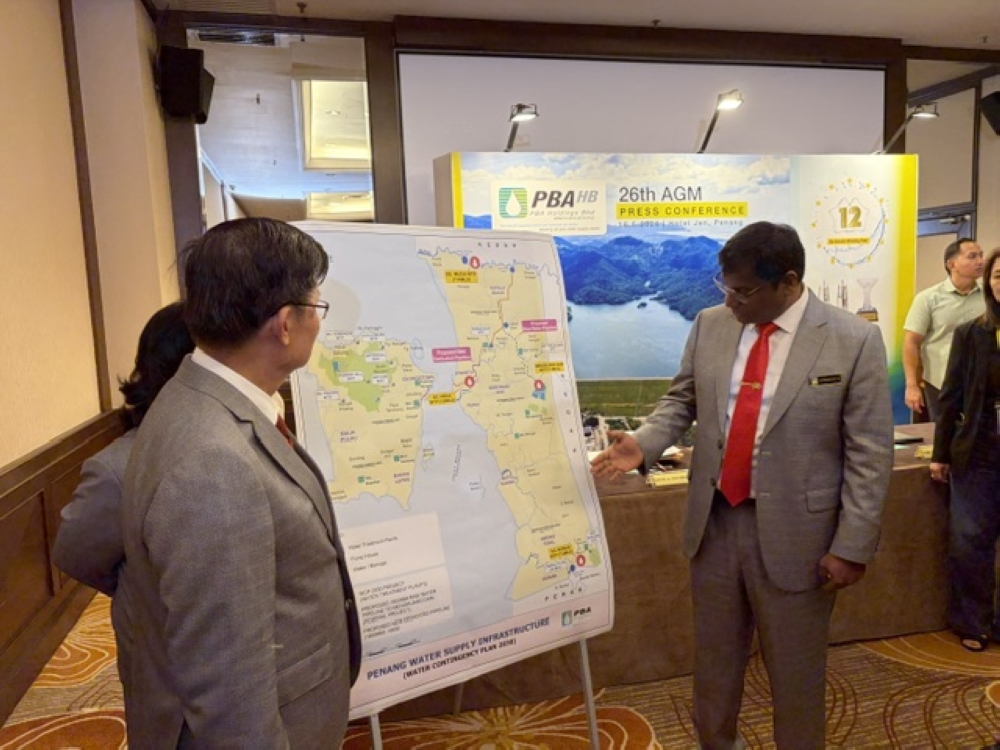
GEORGE TOWN, June 16 — A total of RM2.9 billion will be invested in 12 water supply projects across Penang over the next five years as the state prepares for a projected 34.3 per cent increase in water demand driven by industrial expansion, new townships and major infrastructure developments.
Perbadanan Bekalan Air Pulau Pinang Sdn Bhd (PBAPP) chief executive officer Datuk K. Pathmanathan said the projects, undertaken jointly by PBAPP and the federal government, are aimed at ensuring water supply remains sufficient to support Penang’s economic growth through 2032.
“Penang’s socioeconomic growth trajectory towards 2032 cannot be compromised, held back or delayed by insufficient water supply,” he said at a press conference today after attending the PBA Holdings Bhd annual general meeting.
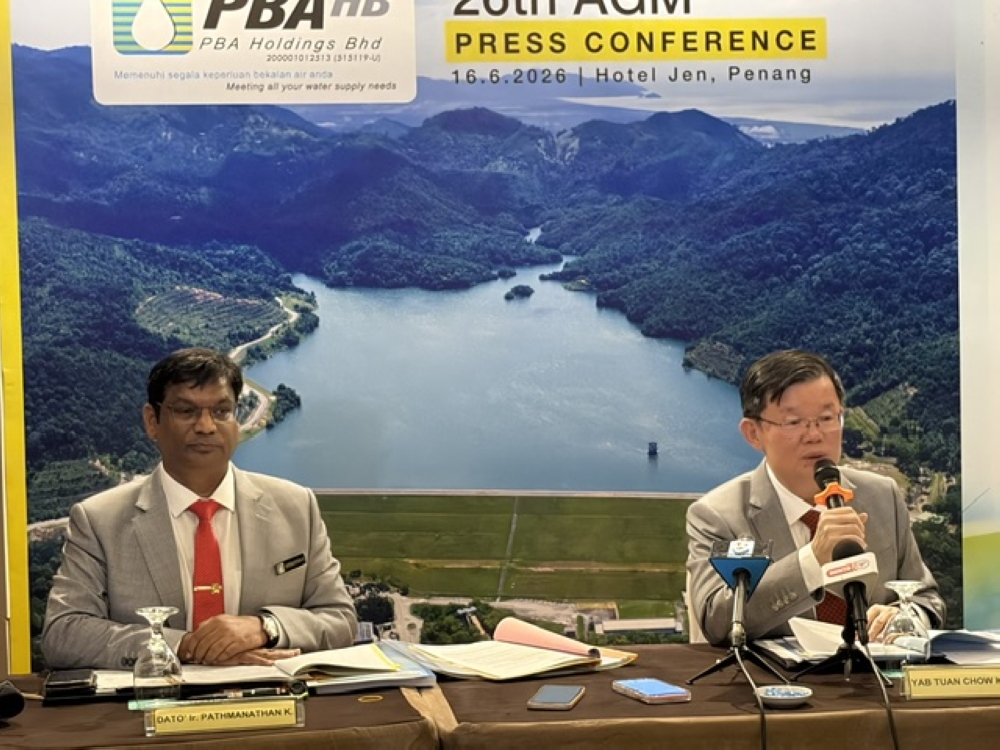
Water consumption in Penang was recorded at 865 million litres per day (MLD) in 2025 and is projected to rise to about 1,162 MLD by 2032, he said.
He said the expected hike in water consumption is due to factory expansion and new investments by multinational companies including Intel, Osram, Siliconware Precision Industries and Western Digital, as well as large-scale property developments on both the island and mainland.
Of the RM2.9 billion investment, he said RM2.098 billion will be spent on six projects under PBAPP’s Water Contingency Plan 2030 (WCP 2030), while five federal government projects are valued at RM838 million.
“An additional 80 MLD water treatment plant at Sungai Kerian will be developed under a build-operate-transfer model,” he said.
Among the major projects planned are new water treatment plants at Mengkuang, Sungai Kerian, Sungai Perai and Sungai Muda, which together are expected to increase Penang’s water treatment capacity by 478 MLD by 2031.
“PBAPP will also lay two major pipelines to increase the amount of treated water that can be delivered from the Sungai Dua Water Treatment Plant to Penang Island from 400 MLD currently to 600 MLD by 2030,” he said.
The federal government’s projects include a new Sungai Muda barrage, expansion works at Mengkuang Dam, raw water resource projects linked to Sungai Kerian, water intake works in Teluk Bahang and a comprehensive study on Penang’s future raw water resources.
Pathmanathan said the bulk of the profits recorded by PBA Holdings Bhd (PBAHB) are reinvested into water infrastructure rather than distributed to shareholders.
He said PBAHB invested RM72.67 million, or about 50 per cent of its 2024 profit after tax of RM144.17 million, into water projects in 2025.
“For 2026, the company has allocated RM99.55 million, equivalent to about 87 per cent of its 2025 profit after tax of RM114.55 million, for capital expenditure on water projects,” he said.
He said the total dividends payable to shareholders for the 2025 financial year amount to RM16.55 million, representing 14.45 per cent of profit after tax.
“The people who live in Penang and businesses that operate here are the primary beneficiaries of PBAPP and PBAHB’s annual profits,” Pathmanathan said.
He noted that PBAHB’s largest shareholder is the Penang State Secretary’s Office, which holds a 55 per cent stake, meaning dividend payments received by the state-linked entity are ultimately channelled back into public projects.
To support future infrastructure needs, PBAPP has also launched a RM5 billion sukuk programme, which Pathmanathan said would complement existing funding sources and help finance Water Contingency Plan 2030 projects.
He said annual profits alone would be insufficient to fund all the infrastructure needed to ensure Penang’s taps do not run dry as the state continues to attract investments and expand its population base.