❌

Reading view

MOM: Wage growth slowed down for workers in Singapore last year compared with 2024; expected to stay moderate in 2026

SINGAPORE: Singapore workers received pay rises for a second straight year in 2025, although wage growth slowed compared with 2024.

The good news is that workers were still better off in real terms. With inflation easing, salaries stretched further, giving employees a stronger boost in purchasing power than the year before.

According to the Ministry of Manpower (MOM) on May 28, nominal wages for full-time resident employees who stayed with the same employer for at least a year rose by 4.9 per cent in 2025, down fro`m 5.6 per cent in 2024. After adjusting for inflation, real wages increased by 4.0 per cent, up from 3.2 per cent the previous year.
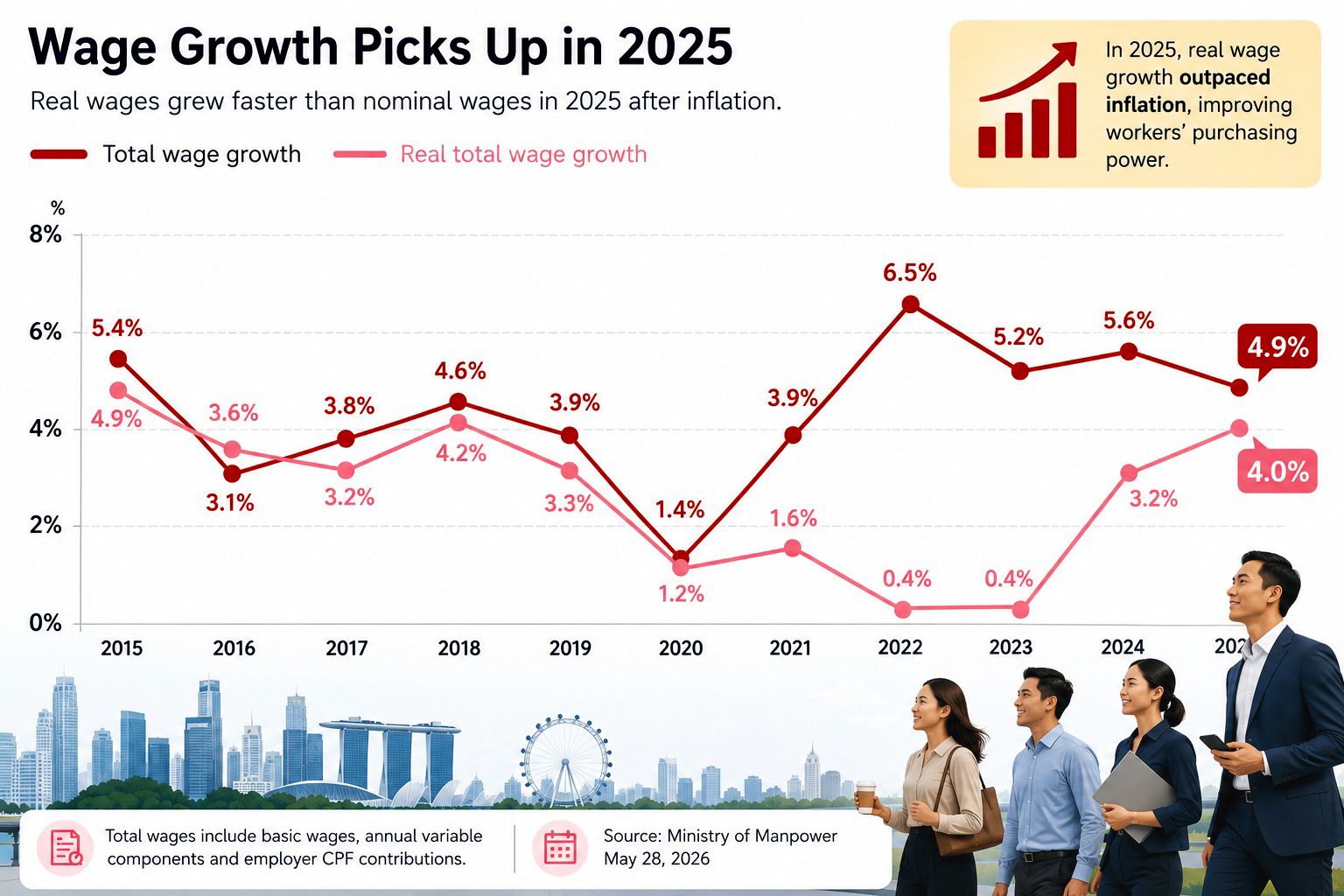
MOM: Wage Growth 2025
Nick Karean/The Independent Singapore News
MOM: Wage Growth 2025

The figures suggest that while pay packets didn’t grow as fast based on data, workers still benefited from a lower cost-of-living environment than in 2024.

More companies remained profitable

MOM’s report showed that business conditions stayed fairly healthy through 2025. More than eight in 10 establishments, or 83.1 per cent, reported making a profit, up from 80.8 per cent in 2024. At the same time, the share of companies reporting losses fell to 16.9 per cent from 19.2 per cent a year earlier.

The data paints a picture of a business sector that stayed resilient despite ongoing global economic uncertainty. Smaller firms were still more likely to report losses than larger companies, mirroring the tougher operating conditions faced by businesses with fewer resources.

Employers became more careful with salary increases for employees

While most employers continued raising salaries for workers, there were signs of greater caution. About 72.4 per cent of establishments increased wages in 2025, down from 78.3 per cent in 2024. Meanwhile, nearly a quarter of firms left wages unchanged, up from 18.5 per cent the year before.

Among companies that granted pay increases, the average wage rise was 5.8 per cent. Employee retention remained the main reason employers chose to increase salaries. In a tight labour market, retaining experienced staff remains a priority for many businesses.

Only 3.1 per cent of companies reduced wages; those that did generally faced weaker business performance than in the previous year. The trend shows that workers still expect wage growth, but businesses are also preparing for economic uncertainty and rising costs.

Wage gains spread across sectors and job levels

One notable finding from the report was that wage growth was broad-based. Rank-and-file employees saw wages grow by 4.8 per cent, junior managers by 5.1 per cent and senior managers by 4.9 per cent. The differences between these groups narrowed, suggesting gains were shared more evenly across the workforce.

Every sector recorded positive wage growth. Administrative and Support Services posted the strongest increase at 7.5 per cent. The sector includes cleaning, security and landscape services, where lower-wage workers continue to benefit from the Progressive Wage Model and Local Qualifying Salary requirements.

Financial Services and Insurance Services also recorded healthy wage growth as demand remained strong for professionals and managers.
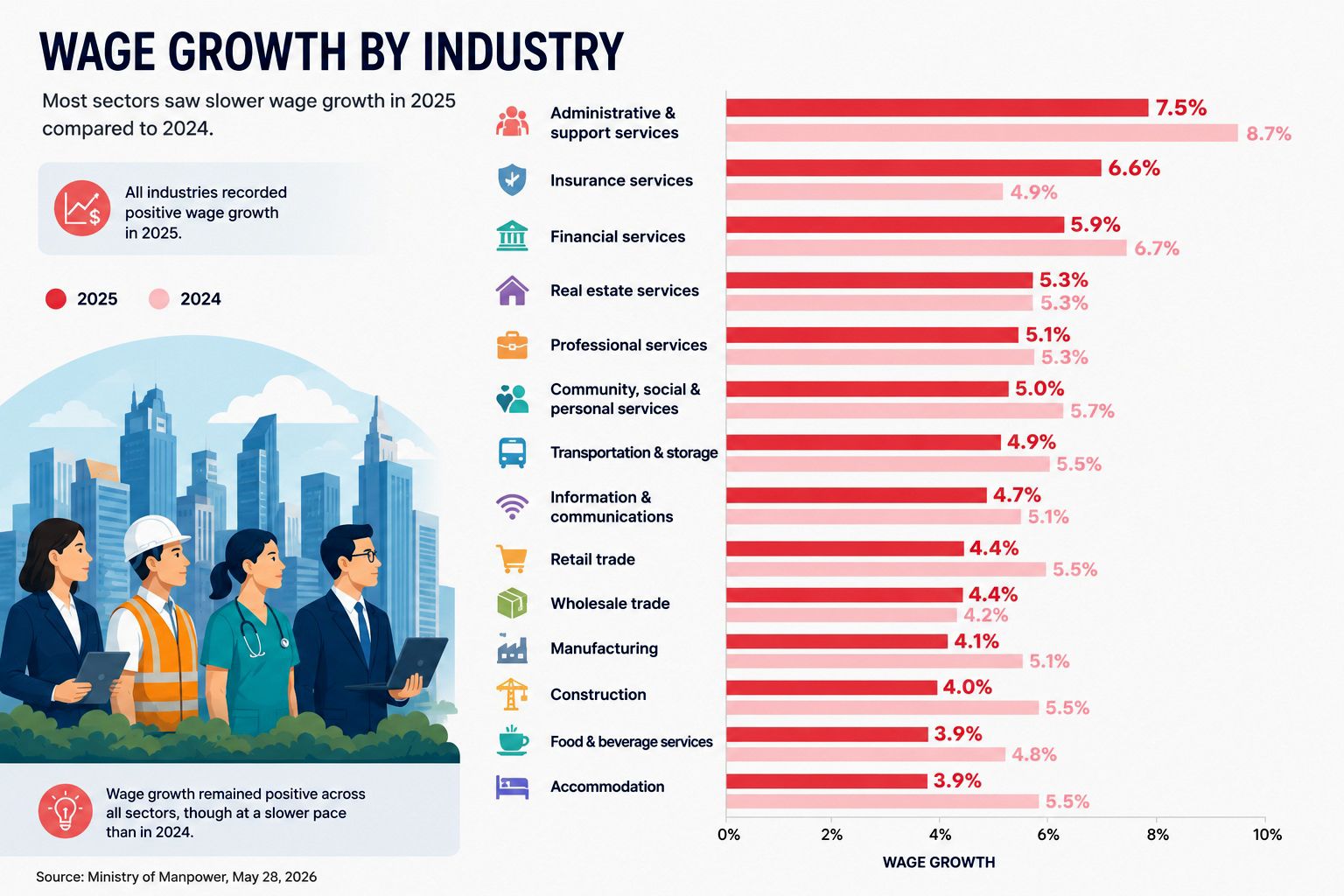
MOM: Wage Growth by Industry 2025
Nick Karean/The Independent Singapore News
MOM: Wage Growth by Industry 2025

The accommodation and construction sectors still saw pay increases, but at a slower pace than the previous year, as hiring demand stabilised following the post-pandemic rebound.

Workers can expect real wage growth to stay positive in 2026

MOM expects real wage growth to remain positive in 2026. However, businesses are likely to stay cautious when deciding on salary increases due to inflation risks and geopolitical tensions.

As such, workers may continue seeing pay rises, but probably not at the pace many experienced during the stronger post-pandemic recovery years.

The report indicates that wage growth is still tied to productivity. Sustainable salary increases depend on businesses becoming more productive, workers upgrading their skills and companies maintaining healthy financial performance.

What matters more now than how much salaries increase is how much purchasing power is left for Singaporeans after their everyday expenses are paid.


Read related: Singapore job hiring drops across most sectors despite AI-driven manufacturing demand; employment outlook weakens in the coming months

This article (MOM: Wage growth slowed down for workers in Singapore last year compared with 2024; expected to stay moderate in 2026) first appeared on The Independent Singapore News.

  •  

SG Ministry of Manpower wage report 2025: Which industries are workers’ salaries rising the fastest in Singapore

SINGAPORE: New data from Singapore’s Ministry of Manpower (MOM) shows that workers in Administrative & Support Services enjoyed the strongest wage growth in 2025, outpacing employees in finance, insurance and several other traditionally higher-paying industries.

The figures come from MOM’s Report on Wage Practices 2025, released on May 28, and offer a closer look at how salaries moved across different sectors over the past two years.

Earlier this year, MOM reported that Singapore’s median monthly salary rose to S$5,775 in 2025, a 5% increase from 2024. The latest breakdown shows that the gains were far from uniform.

Support services came out on top

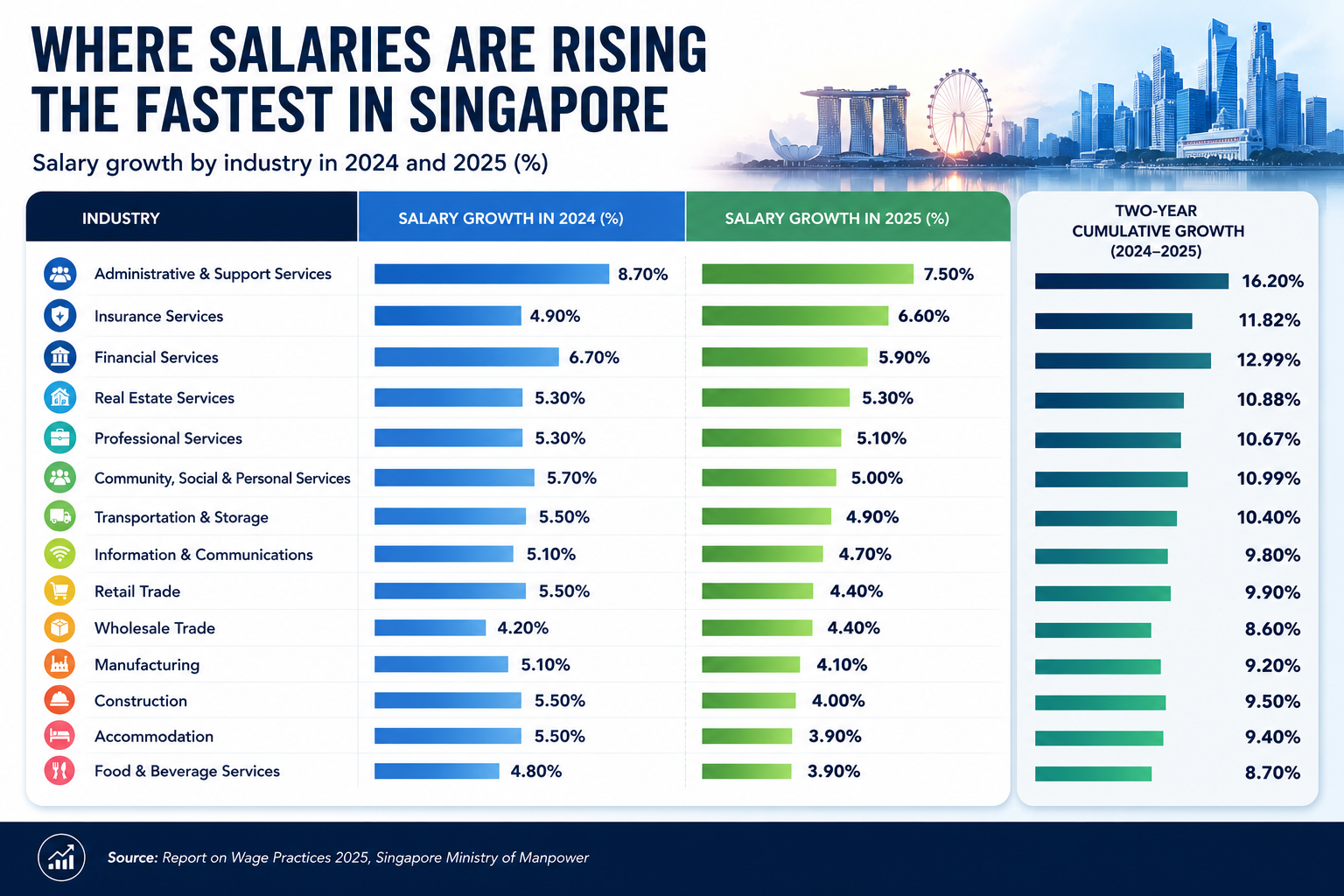
According to the MOM data, workers in Administrative & Support Services received average wage increases of 7.5% in 2025, making the sector the strongest performer among all major industries.

At the other end of the table were Accommodation and Food & Beverage (F&B) Services, which recorded the slowest salary growth.

Finance and insurance jobs are associated with higher pay packages, yet their wage growth over the past two years hasn’t kept pace with that in support services.

Report on Wage Practices 2025 by the Singapore Ministry of Manpower
Nick Karean/The Independent Singapore News
MOM: Report on Wage Practices 2025

The findings show that salary growth and salary size aren’t always the same. A sector can offer high pay while still recording slower annual increases than industries playing catch-up.

Two years of gains add up

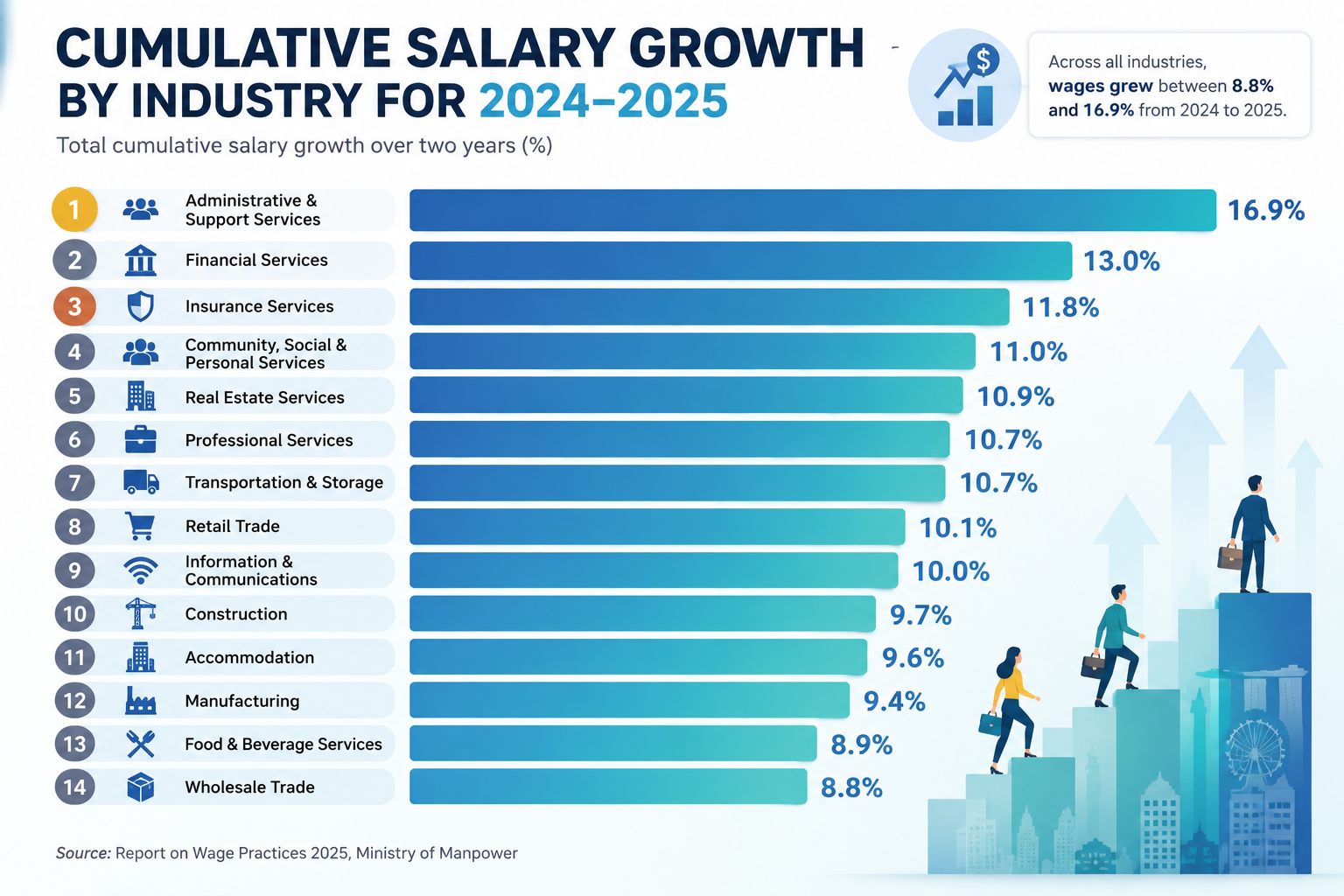
Looking at cumulative wage growth from 2024 and 2025 paints an even clearer picture. Workers in Administrative & Support Services saw wages rise by nearly 17% over the two-year period. In practical terms, that amounts to roughly two extra months of 2023 salary spread across the period.

Workers in sectors near the bottom of the rankings still experienced gains, though at a slower pace. Their cumulative wage growth ranged between about 8% and 9%, equivalent to roughly one additional month of 2023 income.

One notable change involved Wholesale Trade. While it slipped to the bottom of the cumulative rankings, the sector may be positioned for a stronger recovery.

Report on Wage Practices 2025 by the Singapore Ministry of Manpower
Nick Karean/The Independent Singapore News
MOM: Report on Wage Practices 2025

According to the data, rising demand linked to electronics manufacturing and artificial intelligence (AI) has boosted trading activity and improved sentiment within the industry.

The wage outlook for 2026 remains mixed

Singapore’s economy expanded by 6% in the first quarter of the year, showing strength across multiple sectors. Yet businesses are also facing uncertainty stemming from geopolitical tensions and disruptions affecting trade and energy markets, which may make employers more cautious when deciding on salary increases.

Workers in electronics manufacturing and wholesale trade could be among the better-positioned groups if current industry trends continue. Strong demand tied to AI-related supply chains has helped drive activity, and profitable companies may have more room to reward staff.

For many other sectors, however, wage growth could depend on how global economic conditions develop over the coming months.

Number averages only tell part of the story

The latest MOM figures show why headline salary numbers never tell the whole story. A rising national median wage is encouraging, but workers experience the economy differently depending on where they work.

For employees, the report offers a useful benchmark. For employers, it serves as a snapshot of where competition for talent is heating up.

As always, salary growth is strongest when businesses perform well, and workers continue to build valuable skills. Economic conditions matter, but so does staying adaptable in a changing job market.


Read related: MOM: Wage growth slowed down for workers in Singapore last year compared with 2024; expected to stay moderate in 2026

This article (SG Ministry of Manpower wage report 2025: Which industries are workers’ salaries rising the fastest in Singapore) first appeared on The Independent Singapore News.
  •  

Seven parties charged over sinkhole that swallowed a car in Tanjong Katong

SINGAPORE: Nearly a year after a dramatic sinkhole opened up along Tanjong Katong Road South, swallowing a car along with its driver in its wake, investigations by the Building and Construction Authority (BCA), the Ministry of Manpower (MOM), and the Land Transport Authority (LTA) have concluded, with enforcement actions now being taken against those involved.

What happened on July 26, 2025

The incident took place beside a worksite where a shaft was being constructed to connect three new sewer pipelines. The works involved soil strengthening using Jet Grout Piles, as well as the casting of reinforced concrete caisson rings.

At around 5:50 p.m., part of the shaft under construction reportedly failed, causing soil to flow into the shaft. At around the same time, a sinkhole formed on the road above, and a car, with its driver still inside, fell into it. Workers at the worksite managed to rescue the driver, who was taken to hospital conscious.

Seven parties charged, two given conditional warnings

Following the joint investigation, charges have been brought against seven parties tied to the project. These include the builder, Ohin Construction Co Pte Ltd, along with its managing director, project director, and project manager. Two Qualified Persons and a resident engineer have also been charged.

The alleged lapses span several areas. Investigators found that unauthorised building works and road resurfacing had been carried out, with the works not complying with approved plans and lacking adequate risk assessments or safe work procedures. There were also reportedly licensing and supervisory failures, with specialist building works carried out without the required licence.

On the monitoring front, mandatory tests stipulated under the approved plans were allegedly not conducted, and the worksite did not have an operational video surveillance system at the time of the incident. Investigators also found that authorities were not notified of a road depression that had occurred before the sinkhole formed, and that there had been false declarations regarding the appointment of a site supervisor.

Separately, conditional warnings have been issued to PUB and Surbana Jurong Consultants Pte Ltd for offences under the Building Control Act.

Work on the project has been halted since the incident and remains so. Before it can resume, new project parties appointed by PUB will need to submit fresh structural plans, which will undergo comprehensive safety assessments and require approval from the BCA’s Commissioner of Building Control.

What this means for other construction sites in Singapore

In the aftermath of the incident, BCA reviewed more than 60 similar ongoing projects across the island and found no safety issues, reporting that adequate safeguards were in place across all of them. An advisory was also issued to the industry, reminding project parties to exercise due diligence on similar works.

MOM, for its part, has stepped up inspections at construction worksites since the incident, taking enforcement action where safety lapses were found. This included those related to excavation works, as well as issuing advisories to contractors and professionals on worker safety.

The authorities have reiterated that all parties carrying out road works must obtain the necessary permits from LTA and fully comply with regulatory requirements before starting any works. They added that breaches of safety or compliance duties that put the public at risk will be taken seriously.

For commuters and residents near construction sites, particularly those involving excavation or underground works, the case serves as a reminder of just how much relies on proper supervision, testing, and timely reporting behind the scenes, especially on projects that run beneath roads still in daily use.Β 

This article (Seven parties charged over sinkhole that swallowed a car in Tanjong Katong) first appeared on The Independent Singapore News.

  •  

Pay rises in Singapore expected to cool amid inflation and geopolitical risks

SINGAPORE: Singapore’s wage growth is expected to ease in 2026 as businesses take a more cautious stance amid growing geopolitical uncertainties and persistent inflationary pressures.

According to a report released by the Ministry of Manpower (MOM) on Thursday, Singapore’s focus remains on ensuring that wage increases are supported by productivity improvements while safeguarding jobs. The report showed that nominal wages for resident employees rose by 4.9 per cent in 2025, down from the 5.6 per cent increase recorded in 2024.

The moderation in wage growth comes as employers navigate a more challenging economic environment. Businesses are increasingly concerned about rising operating costs, particularly labour expenses, as global uncertainties continue to cloud the outlook.

A survey conducted by an industry group last month found that more than half of the companies polled were worried about labour costs amid an unpredictable global economy. At the same time, Singapore’s labour market has shown signs of softening, with the unemployment rate edging up to 2.1 per cent in the first quarter of the year, compared with 2 per cent in the previous quarter.

The latest data reflects broader concerns over the impact of geopolitical tensions and inflationary risks on business sentiment and hiring decisions.

Prime Minister Lawrence Wong has previously pledged support for workers facing increasingly rapid and unprecedented economic changes. The global environment has become more volatile due to factors such as ongoing conflict in the Middle East and the rapid advancement of artificial intelligence technologies, both of which are reshaping industries and labour markets.

These disruptions are already affecting employment worldwide. Technology giant Meta Platforms and German biotechnology company BioNTech have been among firms that have announced job cuts, highlighting the pressures faced by businesses as they adjust to changing economic conditions.

Singapore’s central bank has also warned of a softer labour market ahead. In April, the Monetary Authority of Singapore (MAS) said labour demand is likely to remain subdued this year as companies adopt a more cautious approach.

The MAS noted that if economic growth weakens for a prolonged period, employers may scale back hiring plans, while layoffs could increase. Such developments could further weigh on wage growth as businesses seek to manage costs and preserve employment in an uncertain environment.

Despite the slower pace of wage increases, Singapore’s labour policies continue to emphasise balancing wage growth with productivity improvements, with the aim of ensuring sustainable income gains for workers while maintaining the competitiveness of businesses.

This article (Pay rises in Singapore expected to cool amid inflation and geopolitical risks) first appeared on The Independent Singapore News.
  •  
❌