The Legislative Council (LegCo) has confirmed that the Designated Demonstration Area at the complex, along with the surrounding LegCo Square, is being used as a car park.
LegCo Square and the Designated Demonstration Area at the front of the Legislative Council complex on April 22, 2026. Photo: Kyle Lam/HKFP.
In a response to HKFP earlier last month, the LegCo Secretariat said that the revamp was part of the renovations which took place after the number of lawmakers was expanded from 70 to 90 for the 2022 legislative term.
LegCo Square and the Designated Demonstration Area at the front of the Legislative Council complex on April 22, 2026. Photo: Kyle Lam/HKFP.
The Secretariat said: “Since the completion of the expansion project of the Legislative Council (“LegCo”) Complex, all 90 LegCo Members and their staff as well as staff of the LegCo Secretariat have moved into the Complex and have been working under one roof.”
It added, “To meet operational needs, the LegCo Square and the whole area (including the Designated Demonstration Area) outside the main entrances to the Complex have been used as a parking area for Members and visitors to the Complex. The Legislative Council Commission will keep the use of this area under review from time to time.”
LegCo Square and the Designated Demonstration Area at the front of the Legislative Council complex on April 22, 2026. Photo: Kyle Lam/HKFP.
It did not respond when asked when the car park work was completed, but according to a LegCo fact sheet, major expansion works were completed at the complex last year.
Status of protest area ‘clear,’ says LegCo
The Designated Demonstration Area was intended as the only authorised location for petitions and protests at the legislature. However, it was closed during the 2019 pro-democracy protests and unrest.
After the turmoil and the Covid-19 pandemic restrictions that followed, then-legislative president Andrew Leung hinted that the protest area could reopen in early 2025 at the latest. He dismissed concerns that the extended closure was for political reasons, stating that it “can only reopen when we get rid of the glass and can ensure it is safe,” according to the Standard in 2023.
LegCo Square and the Designated Demonstration Area at the front of the Legislative Council complex on April 22, 2026. Photo: Kyle Lam/HKFP.
Leung may have been referring to the brief occupation of the building on July 1, 2019, by pro-democracy protesters, who broke windows to access the complex and vandalised it.
The storming of LegCo on July 1, 2019. File Photo: May James/HKFP.
Last August, Leung said the reopening was still under consideration, adding that the “scale of current petition activities had become smaller, and it is necessary to consider whether such a large space is still required,” according to NowTV.
HKFP asked the LegCo Secretariat multiple times last month whether the Designated Demonstration Area was still available for those who wished to submit a petition or stage a protest.
They did not directly confirm whether it remained open, but they referred HKFP to their earlier response, adding that it was already “clear,” and did not “amount to a refusal to confirm if the Designated Demonstration Area is still operational.”
LegCo Square and the Designated Demonstration Area at the front of the Legislative Council complex on April 22, 2026. Photo: Kyle Lam/HKFP.
A Legislative Council handbook for lawmakers, dated this February, suggests that the protest area is still available for applications, despite the new car park.
LegCo Square and the Designated Demonstration Area at the front of the Legislative Council complex on April 22, 2026. Photo: Kyle Lam/HKFP.
The application form for using the area is still online, as are the guidelines – both from 2018.
They state: “Members of the public are allowed to stage petitions or demonstrations at the LegCo Square, subject to the terms set out in the ‘Guidelines for staging petitions or demonstrations by individuals and groups at designated demonstration areas in premises managed by The Legislative Council Commission’.”
‘Doors always open’
According to its website, the purpose-built Legislative Council complex at Tamar in Admiralty was opened in September 2011 and included architectural features to showcase transparency.
LegCo Square and the Designated Demonstration Area at the front of the Legislative Council complex on Wednesday, April 22, 2026. Photo: Kyle Lam/HKFP.
The website states: “The Tamar Project has been designed with the main theme of ‘Doors Always Open’, ‘Land Always Green’, ‘Sky Will Be Blue’ and ‘People Will Be Connected’.”
No major mass protests have been held in Hong Kong since the onset of the 2020 national security law.
Four men have pleaded guilty to rioting during the siege of the Hong Kong Polytechnic University (PolyU) campus amid the anti-extradition protest and unrest seven years ago.
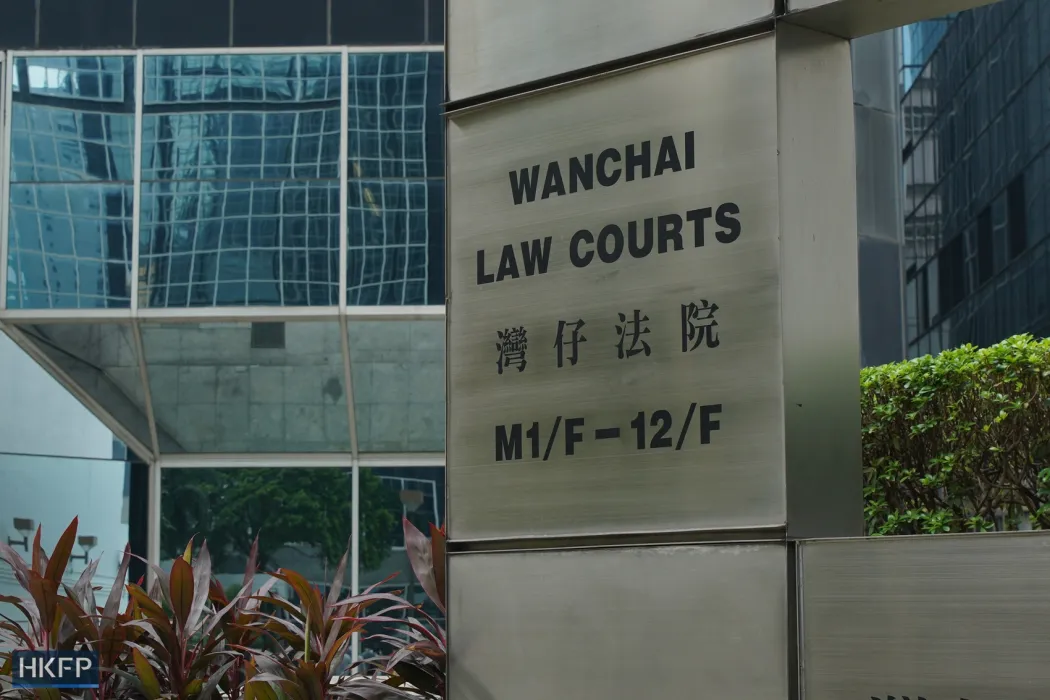
District Court in Wan Chai. File photo: Hans Tse/HKFP.
Cheung Chung-yiu, 24; Cheung Chin-ming, 29; Chan Chun-hei, 22; and Chan Yuen-ming, 33, appeared at the District Court on Monday morning to enter their pleas.
The four defendants were not prosecuted when they were first arrested in 2019 and 2020. However, they were re-arrested in June 2024 and charged with rioting at PolyU between November 14, 2019 and November 20, 2019.
The events at the Hung Hom campus were one of the most violent episodes during the protests and unrest in 2019, with protesters setting fires with petrol bombs as they faced off against police.
A fifth defendant, Lai Chun-kit, was not present. He has not attended hearings since October 2024, and an arrest warrant has been issued for him, The Witness reported.
Protesters outside the Hong Kong Polytechnic University in Hong Kong on November 17, 2019. Photo: Studio Incendo.
According to the prosecution, CCTV footage captured the defendants’ behaviour during the riot. Cheung Chung-yiu was seen moving barriers to block a footbridge, while Cheung Chin-ming and Chan Chun-hei were filmed taking containers from a laboratory.
Chan Yuen-ming was seen walking around the university campus and taking a large flask and two bottles with him.
Mitigation
The four defendants had initially planned to plead not guilty and go forward with a trial, the court heard, but later changed their minds.
During mitigation, Cheung Chung-yiu’s lawyer said that the defendant had gone abroad to study before he was re-arrested in 2024, while Cheung Chin-ming’s lawyer told the court that his client had supported victims of the Wang Fuk Court fire in its aftermath.
A bridge leading to the Hong Kong Polytechnic University set on fire on Nov. 17, 2019. Photo: Viola Kam/United Social Press.
A legal representative for Chan Chun-hei said the defendant was only 16 at the time of the incident. He worked in the construction sector and became a father at 21, his lawyer said, adding that he regretted what he had done when he was younger.
Chan Yuen-ming’s lawyer said his client was tricked into working at a scam farm in Thailand, returning to Hong Kong in 2022 after his family paid a ransom. He suffers from post-traumatic stress disorder, the lawyer said.
The lawyer added that Chan Yuen-ming was sentenced to 18 years and five months in prison for a drug trafficking offence, and that he stands to face a long time in prison.
The four defendants will be sentenced on June 8. Rioting is punishable by up to 10 years’ imprisonment, although jail terms handed down at the District Court are capped at seven years.
Two Hong Kong men accused of conspiring to incite people to riot during the 2019 protests and unrest have had their case moved to a higher court, where they face a maximum sentence of seven years’ imprisonment.
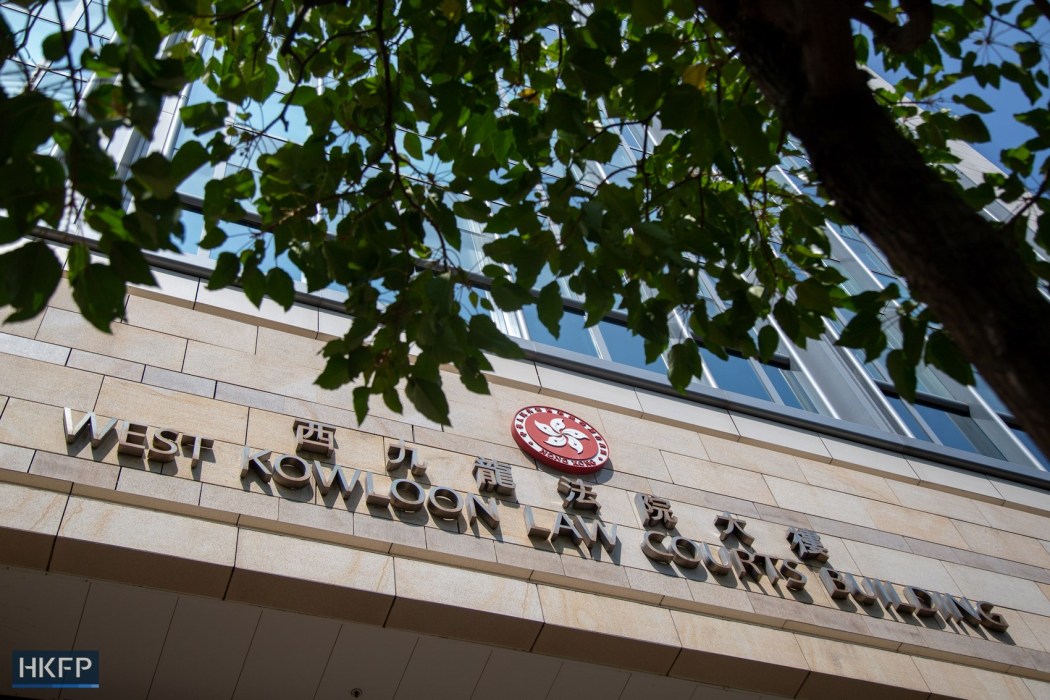
West Kowloon Magistrates’ Courts. File photo: Kelly Ho/HKFP.
Ng Tsz-lok, who is unemployed, and photographer Chan Wai-leong appeared at the West Kowloon Magistrates’ Courts on Thursday.
The two men have been remanded since they were charged in October over their alleged role in the anti-extradition protests six years ago. Prosecutors have accused them of manufacturing and providing weapons to protesters.
The pair have been charged with conspiring to incite others to take part in a riot, with the date of the offence being October 22 to 23, 2019.
Ng was among a group of defendants acquitted by a High Court jury in September of alleged involvement in three bomb plots in places including a hospital and a car park between November 2019 and March 2020.
Ng Tsz-lok leaves the High Court after being acquitted on September 4, 2025. Photo: Kyle Lam/HKFP.
With the completion of handover procedures, Magistrate Victor So announced on Thursday the transfer of the case to the District Court.
The maximum penalty at the District Court is seven years’ imprisonment. At the magistrates’ court, the maximum penalty is two years, or three years when a defendant is convicted of more than one offence.
The case will be heard at the District Court on June 2 for the pair to confirm whether they will plead guilty or not guilty, So said.
Ng also faced an additional charge of “incitement to take part in a riot” on November 14, 2019. The prosecution said on Thursday it had changed the charge to “conspiracy to incite others to take part in a riot” and added an additional day – November 15, 2019 – to the offence.
District Court in Wan Chai. File photo: Almond Li/HKFP.
The details of the amended charge specified that the target of Ng’s incitement was an unknown individual and somebody by the name of Lee Tsz-ying – transliterated from Cantonese, as read out in court by the prosecution.
The prosecution also added a new charge for Ng, accusing him of inciting others to riot on different dates, between October 19 and November 8, 2019.
The barrister-turned-activist sought to challenge the legitimacy of the national security allegations against herself, former colleague Lee Cheuk-yan, and the organisation they led, which held Hong Kong’s candlelight vigils commemorating China’s 1989 crackdown on pro-democracy demonstrators in Beijing’s Tiananmen Square.
From 1990 to 2019, the Hong Kong Alliance in Support of Patriotic Democratic Movements of China organised the commemorative event every year on June 4 at Victoria Park, demanding accountability for the bloody crackdown and the democratisation of China, both taboos in the country.
Beijing imposed a national security law in Hong Kong in 2020, following the 2019 protests and unrest. In 2021, police arrested the Alliance’s leadership, including Chow, Lee, and Albert Ho. The Alliance voted to disband that year, ending its decades-long vigils and advocacy.
Chow, Lee, and the Alliance are standing trial for “inciting subversion” under the national security law, an offence that carries a maximum penalty of 10 years behind bars. Ho pleaded guilty when the trial opened in January.
HKFP looked at the events surrounding the establishment of the Alliance, the Tiananmen vigils it organised, and the ongoing trial of its leaders.
Chow Hang-tung, barrister and a leader of the Hong Kong Alliance in Support of Patriotic Democratic Movements of China, on March 21, 2021. Photo: Peter Parks/AFP.
Hong Kong prosecutors have argued that the case against the Alliance is not political and does not concern its activism, the vigils, or the 1989 crackdown. They allege that, however, the group had been calling for the overthrow of China’s ruling Communist Party (CCP) through its “end one-party rule” slogan – a key tenet of the Alliance since its founding.
For Chow, who represents herself in the trial, the prosecution has upended Hong Kong’s value of being a free-wheeling city that tolerates the kind of political dissent not permitted in mainland China.
The trial has in effect “cornered” the court, forcing it to choose its side between the rule of law and an authoritarian regime, she argued.
Alliance and 1989 Tiananmen crackdown
Massive pro-democracy demonstrations broke out in China in the spring of 1989, triggered by the death of Hu Yaobang, a former CCP leader seen as a reformist. Students and protesters gathered in Beijing’s Tiananmen Square for weeks, demanding political reforms and democracy, as the rest of the country rallied to support those in the capital city.
In May that year, the Alliance was founded in Hong Kong, and huge demonstrations were staged in support of protesters in mainland China.
Around 1.5 million people joined a mass rally on May 28, a day after celebrities like Anita Mui, Teresa Teng, Eric Tsang, and Jackie Chan took part in the Alliance’s benefit concert in support of the students’ movement.
Around 1.5 million people take part in a mass rally in Hong Kong in support of students protesting at Tiananmen Square in Beijing. Photo: 1989年的傳真 , via Facebook.
Lee personally went to Beijing to deliver donations raised during the concert. However, he was detained and made to sign a letter of remorse, around the time the tanks rolled in to crush the burgeoning movement.
The protests in Beijing ended in a bloody crackdown as Chinese troops dispersed protesters on June 3 and 4. Estimates of death tolls during the crackdown range from hundreds to thousands.
In the years that followed, the Alliance organised candlelight vigils at Victoria Park every June 4 to commemorate the dead and to keep the spirit of the 1989 pro-democracy movement alive.
The Alliance’s five tenets – release pro-democracy activists, vindicate the 1989 democracy movement, hold those responsible for the crackdown accountable, end one-party rule, and build a democratic China – were an integral part of the candlelight vigils.
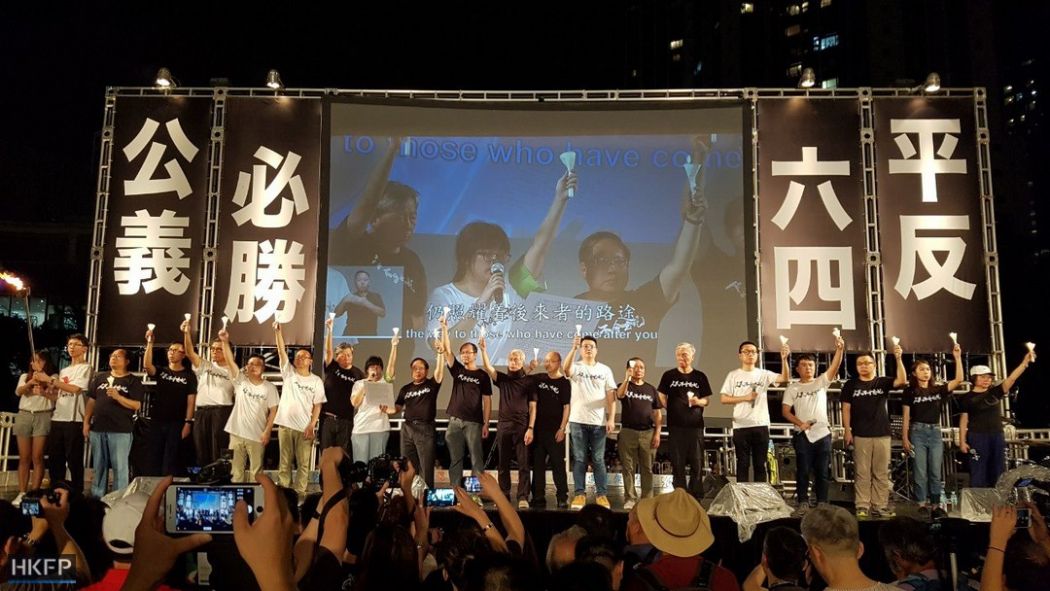
Tens of thousands of people attended the commemorations every year. They lit candles, sang songs, observed a moment of silence, and chanted the Alliance’s five slogans, led by the group’s leaders.
Alliance leaders (from left) Lee Cheuk-yan, Chow Hang-tung, and Albert Ho appear on the giant screen at Hong Kong’s annual Tiananmen crackdown vigil on June 4, 2019. File photo: Todd R. Darling/HKFP.
In 2020, authorities banned the vigil for the first time, citing Covid-19 restrictions. They prohibited the gathering again the following year, also citing the pandemic. The Alliance was disbanded in September 2021, following the arrests of its leaders.
No official vigils have been held since 2019, but there is a heavy police presence at Victoria Park and nearby streets on June 4.
For four consecutive years, Victoria Park has been occupied by a pro-China food festival in early June, including the anniversary day of the bloody crackdown.
‘Weird’ prosecution
In her closing argument last month, Chow said the prosecution was “weird,” as the defendants had not disputed the alleged acts and instead, they embraced what they did.
“Ending one-party rule means putting an end to the status quo, in which those in power are not bound by the law,” she told the court in Cantonese. “What is really in dispute is what the law suppresses and what it protects.”
According to the prosecution, the Alliance’s calls to “end one-party rule” had exceeded the legitimate boundary of freedom of expression as the defendants intended to stoke hatred against Beijing. “Freedom is not absolute,” lead prosecutor Ned Lai told the court in Cantonese.
The last official Tiananmen crackdown candlelight vigil on June 4, 2019. File photo: Todd R. Darling/HKFP.
Chow said the prosecution’s argument had undermined the values long championed in Hong Kong, such as freedom of expression and the rule of law.
“Speaking out the truth has become stoking hatred. Seeking justice has become taking advantage of suffering,” she said. “Asking for accountability has become breaching the constitution. Demanding democracy has become inciting subversion.”
She maintained that the court must protect human rights when reaching a verdict in the case.
“What the court has been asked to ban, to punish in this case are, in fact, what society and the law should encourage… They are the core values of Hong Kong, the norms and ideals accumulated through generations,” she said.
“I hope the court will make a correct decision to safeguard the dignity and bottom line of the law, at a time when values are being reshaped,” she added.
Prosecutors have argued that there are no “lawful means” to end CCP rule after a 2018 constitutional amendment stipulated that the party’s leadership is the “defining feature” of China’s socialist system.
A pro-Beijing food carnival at Victoria Park on June 4, 2025, the anniversary of the Tiananmen crackdown. File photo: Kyle Lam/HKFP.
During his closing submission last month, Lee’s lawyer, Erik Shum, argued that prosecutors had presented a “tautological theory.”
“We ask: How exactly did the Alliance incite others to overthrow the CCP? And my submission is that the prosecution has always reverted to the claim that ending CCP rule is illegal,” Shum said in Cantonese.
Shum urged the court to draw a boundary for what is considered an acceptable political expression and what is not.
“The court must not pay lip service to human rights protections,” he said.
The three-judge panel – Alex Lee, Johnny Chang, and Anna Lai – has adjourned the proceedings, saying they hope to deliver a verdict in “mid or late July.”
In a letter from prison this week, Chow, who has been behind bars since September 2021, said she would go on a 37-hour hunger strike in commemoration of the 37th anniversary of the 1989 crackdown.
A Hong Kong court has ordered the forfeiture of more than HK$670,000 in “terrorist property” from three persons involved in a thwarted bomb plot during the 2019 protests.
The High Court. File photo: Kyle Lam/HKFP.
In a written judgment on Thursday, High Court Judge Judianna Barnes ruled that Wong Chun-keung and Ng Chi-hung were “terrorists” and Lau Pui-ying was a “terrorist associate” under the United Nations (Anti-Terrorism Measures) Ordinance.
Barnes said a total sum of HK$674,860 in the defendants’ accounts and in cash, which was liable to be seized under the ordinance, was “intended to be used to finance or otherwise assist the commission of ‘terrorist acts.’”
In November 2024, Ng was sentenced to almost 24 years in jail for masterminding the foiled bomb plot, which aimed to kill police officers at a demonstration on December 8, 2019, amid the large-scale protests and unrest that year.
Wong, who led a radical group known as “Dragon Slayers,” was sentenced to 13 and a half years in prison. Both defendants pleaded guilty, with Wong testifying for the prosecution in exchange for leniency in sentencing.
Lau was among seven defendants who stood trial by jury. In August 2024, the nine-member jury found her and five others not guilty. Only one defendant was convicted by the jury and was sentenced to 10 years and 10 months behind bars.
Despite her acquittal, authorities submitted “numerous Telegram messages” that showed Lau “actively administered, together with [Wong], crowd-funding exercise in securing funds” for Dragon Slayers and the bomb plot, according to the judgment on Thursday.
A rally is held in Hong Kong Island on December 8, 2019, to mark International Human Rights Day. File photo: May James/HKFP.
Between November 6 and December 9, 2019, Lau’s three accounts received net deposits of more than HK$1 million while she was earning a salary of less than HK$3,000, the government submitted.
Barnes said the evidence “overwhelmingly supported” the government’s application to forfeit the sum.
Roughly HK$536,000 was kept in Lau’s three accounts, according to the judgment, while the remainder, around HK$138,000, consisted of deposits in Wong and Ng’s bank accounts, as well as cash.
Wong and Ng did not oppose the application while Lau was absent throughout the proceedings, including court notices and a hearing regarding the government’s application.
The anti-terrorism ordinance, enacted in 2002, was invoked for the first time to prosecute the group.
The defendants were accused of planning a bomb attack during a rally marking International Human Rights Day, plotting to place two bombs along the rally’s marching route to kill police officers.
A Hong Kong court has convicted a former law student of rioting during the 2019 protests and unrest after the government successfully appealed against her acquittal, leading to a retrial.
The protest in Wan Chai on August 31, 2019. File photo: May James/HKFP.
Alice Tong, 26, was found guilty of rioting on Tuesday, nearly seven years after she was arrested in Wan Chai on August 31, 2019, according to local media. District Judge Edmond Lee remanded Tong in custody pending sentencing on July 15.
Lee initially acquitted Tong of rioting and possession of an offensive weapon in a public place in August 2021, saying at that time prosecutors had failed to prove she committed violence or abetted the riot.
Authorities appealed against her acquittal, and the Court of Appeal overturned Lee’s decision in June 2024.
The three appellate judges said at that time that the circumstantial evidence of Tong’s participation in the riot was “overwhelming,” according to media outlet The Witness.
The Court of Appeal judges ordered the case to be reconsidered by the trial judge. In July last year, they rejected Tong’s application to take her case to the Court of Final Appeal.
Judge Lee said on Tuesday that the circumstantial evidence was “overwhelming” in showing that Tong was part of the riot and had encouraged others through her presence.
District Court in Wan Chai. File photo: Hans Tse/HKFP.
At the time of her arrest, Tong was dressed in black, carrying a gas mask and a black scarf, and holding an umbrella and a walking stick, Lee said.
Officers also seized a helmet, goggles, gloves, and a laser pen from her backpack, Lee said.
The defendant’s clothing and the equipment she carried were “extremely unusual and suspicious,” Lee said, pointing out that her outfit on that day was clearly similar to that of other protesters.
Lee also said that, in the minutes before the defendant was stopped by police, many black-clad protesters were retreating along the same route on Wan Chai Road towards the east.
The judge dismissed the defence’s argument that Tong was merely caught in the riot and was not leaving the scene alongside other protesters.
Tong was seen weeping after the judge delivered his verdict, while her supporters yelled, “We all love you,” as she was led away by guards, The Witness reported.

 Login
Login